

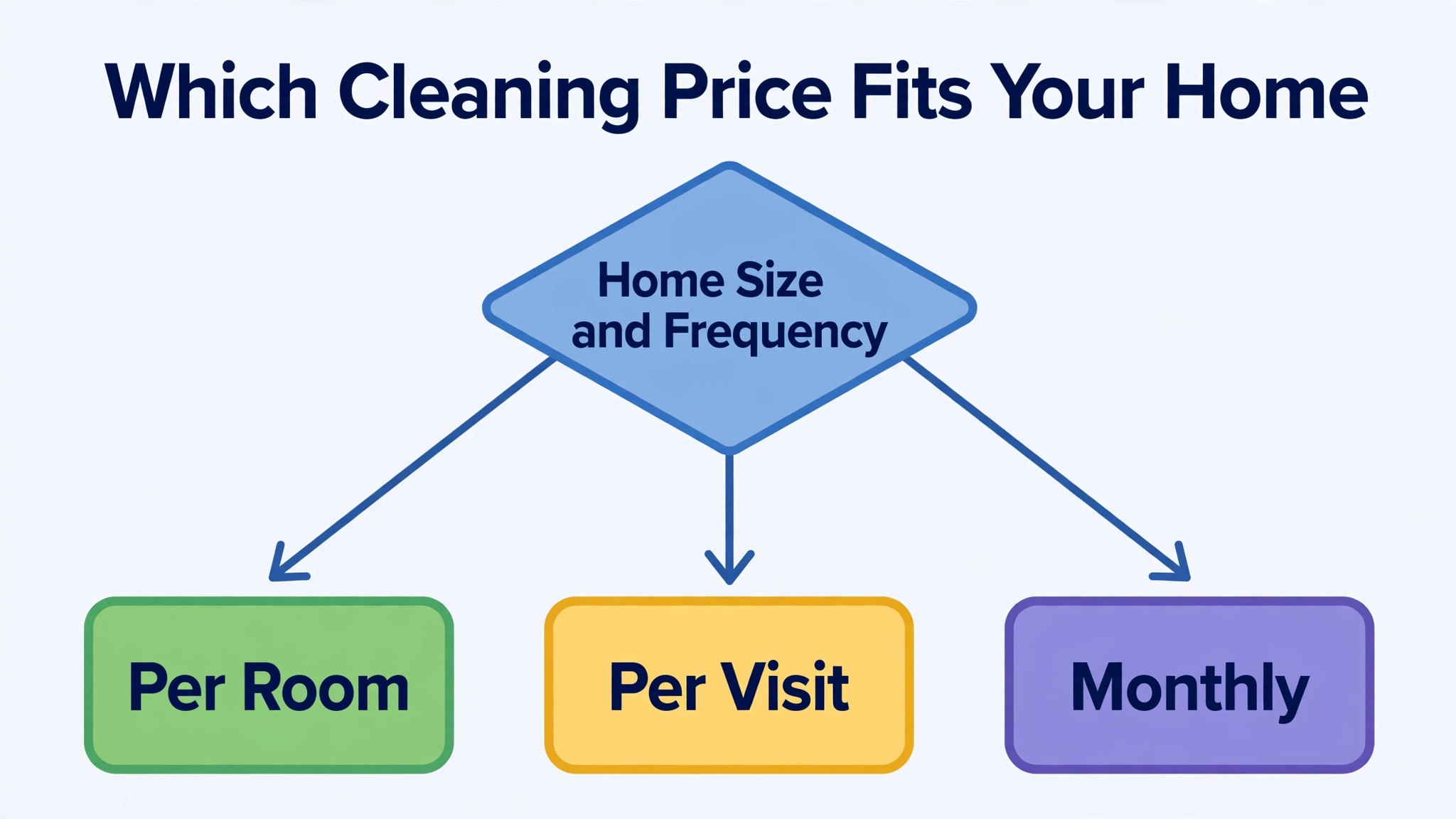
A small apartment with one bathroom suits a simple per-visit price. A large family home with pets, three bathrooms, and a kitchen that works hard every day suits a monthly plan with a set scope and a fixed visit rhythm. A home that only needs two rooms cleaned, or a landlord who needs a single turnover clean, suits per-room pricing. That is the short answer to choosing among home cleaning service pricing packages, and the rest of this guide turns it into numbers you can check before you book.
Most pricing confusion comes from comparing quotes that do not measure the same thing. One company quotes a flat visit price, another quotes by the room, and a third quotes a monthly total, and the cheapest number on the page is not always the cheapest month. A per-room quote can look low until every bathroom, hallway, and living area is added back in. A monthly quote can look high until you divide it by the visits it actually includes.
The price ranges in this guide come from published 2026 pricing guides and vendor price pages checked at draft time, including Angi, FieldCamp, ProHousekeepers, Sparkly Maid in Chicago, and Bravo Maids in San Diego. They are national and city ranges, not a quote for your address, so treat them as a planning band, then get two or three itemised quotes for your own home before you commit.
How Home Cleaning Service Pricing Packages Are Built
Every cleaning price, whatever the label on it, is built from the same four inputs. The first is time on site, meaning how many cleaners work for how many hours. The second is scope, meaning which rooms are cleaned and which tasks are done in each one. The third is frequency, meaning how often the team returns, because a home cleaned every week stays closer to clean and takes less time per visit than the same home cleaned once a month. The fourth is condition and extras, meaning pets, heavy shedding, built-up grime, inside appliances, windows, and laundry.
Hourly rates give a useful cross-check on all three models. Published 2026 guides put professional cleaners at roughly 35 to 75 dollars per cleaner per hour, with independent cleaners lower, at roughly 25 to 50 dollars per hour. A two-person crew doubles the hourly figure but finishes in about half the time, so the visit total stays similar. If a quote implies far less than 25 dollars per cleaner per hour for an insured company, ask what is missing, because insurance, supplies, travel, and supervision all have to be paid from somewhere.
Square footage works the same way as a cross-check. FieldCamp reports per-square-foot rates of roughly 0.10 to 0.30 dollars for standard work, with larger homes tending toward the lower end of the rate because setup and travel are spread over more rooms. Per-square-foot pricing is best used for deep cleans, move-out cleans, and post-construction work, where condition varies more and time is harder to predict from room count alone. For routine maintenance, per-visit or per-room pricing is usually clearer, because the rooms and tasks are known in advance.
Frequency discounts are the third input worth understanding before you compare models. ProHousekeepers publishes a recurring discount ladder of 20 percent for weekly visits, 15 percent for visits every two weeks, 10 percent for visits every three weeks, and 5 percent for visits every four weeks, each measured against its one-time price. Angi reports a similar pattern, with weekly cleaning at 75 to 200 dollars per visit and biweekly cleaning at 100 to 250 dollars per visit nationally. The weekly visit costs less each time, but the monthly total is higher, because there are more visits.
A package, in practice, is a promise about scope plus a promise about rhythm. The scope promise lists every room and task, and says plainly what is not included. The rhythm promise says how often the team comes, what happens on a missed visit, and how a customer pauses or cancels. A package that only lists a price, without those two promises, is not a package at all.
Per-Room Pricing and When It Wins
Per-room pricing charges for each room cleaned, sometimes with a base fee for the first rooms and a smaller fee for each extra room. FieldCamp reports per-room rates of roughly 25 to 100 dollars per room for standard cleaning, a wide band that reflects how different a small bedroom is from a large kitchen or a bathroom with heavy limescale. Some companies simplify the band into a base price plus 10 to 20 dollars per extra room for a standard clean.
Among home cleaning service pricing packages, per-room pricing wins in three situations. The first is a partial clean, where only the kitchen and bathrooms need professional help and the bedrooms are handled by the household. The second is a home with rooms of very different sizes or uses, such as a home office that only needs dusting beside a kitchen that needs a full scrub. The third is a rental or turnover clean, where the landlord or host can price exactly the rooms that must be ready.
Per-room pricing loses when the room count hides the real work. A hallway, a landing, a laundry room, and an entryway are rooms in a pricing sense, even when a customer does not count them as rooms in conversation. A home described as three bedrooms can easily become six or seven priced spaces once bathrooms, kitchen, living areas, and hallways are counted. The fix is simple, and it should happen before any booking. Ask for the priced room list in writing, count the spaces yourself, and check whether bathrooms carry a higher room rate than bedrooms. Angi reports that each additional bathroom adds roughly 10 to 40 dollars to a standard clean.
A worked per-room example makes the point concrete. Take a two-bedroom home with a kitchen, a living room, and two bathrooms, priced at a base of 100 dollars for the first three rooms plus 20 dollars per extra room. Six priced spaces means three extra rooms, so the visit total is 160 dollars before add-ons. If the second bathroom is priced as a premium room at 40 dollars instead of 20 dollars, the total becomes 180 dollars. Only the itemised version lets a customer see why the quote moved, so when a per-room quote arrives as a single number with no room list, ask for the list, because the list is the quote.

Per-Visit Pricing and When It Wins
Per-visit pricing, also called flat-rate pricing, charges one price for a defined clean of a defined home, regardless of whether the visit takes two hours or three. Published 2026 guides put a standard visit for a two to three bedroom home at roughly 120 to 280 dollars, with one-bedroom homes at roughly 75 to 110 dollars for a regular clean and four-bedroom homes at roughly 150 to 210 dollars. Deep cleans sit higher, at roughly 200 to 500 dollars for a typical home, and Angi reports a national average deep clean price of about 260 dollars.
Among home cleaning service pricing packages, per-visit pricing wins when the home, the scope, and the condition are stable. A household that wants the same clean every two weeks, with the same rooms and the same tasks, gets a predictable number it can budget for, and the company gets a predictable job it can schedule tightly. It also wins for one-time cleans, because a customer who needs a single deep clean before guests arrive does not want to negotiate room rates for a job that will only happen once.
The risk in per-visit pricing is scope drift. A flat price only holds while the scope holds, and scope drifts in small ways that add up. A kitchen that gains a second fridge, or a living room that gains a large rug that needs extra vacuuming, can push the visit past the time the flat price assumed. Good companies write the task list into the booking, and flag a scope change at the door rather than silently absorbing it for three visits and then raising the price without warning. As a customer, the useful question is not only what the visit costs, but what would make it cost more, and how much notice you get before it does.
Frequency changes the per-visit price, and this is where per-visit and monthly pricing meet. A company that charges 200 dollars for a one-time standard clean of a three-bedroom home might charge 170 dollars for the same clean every two weeks, applying the 15 percent recurring discount reported by ProHousekeepers, and 160 dollars for the same clean every week, applying the 20 percent discount. The visit price falls as frequency rises, because the home stays cleaner between visits and each visit takes less time. The monthly total, however, moves in the opposite direction, because weekly service means roughly four visits a month against two for biweekly service.

Monthly Pricing and When It Wins
Monthly pricing bundles a set number of visits into one monthly total, usually with a discount against the one-time visit price. Angi reports monthly totals of roughly 300 to 800 dollars for weekly service and roughly 200 to 500 dollars for biweekly service. A weekly plan at 150 dollars per visit is 600 dollars for four visits. A biweekly plan at 175 dollars per visit is 350 dollars for two visits. The monthly headline for the weekly plan is higher, but the cost per visit is lower, and the home is cleaned twice as often.
Among home cleaning service pricing packages, monthly pricing wins for busy households that want cleaning to happen without rebooking every time. It also wins for homes with pets, children, or high foot traffic, where a fortnightly gap lets dust, hair, and kitchen grease build to a level that makes each visit longer and harder. In those homes, the weekly plan can cost less per hour of cleaning achieved, even though the monthly total is higher, because each visit stays short and the home never reaches the state that needs a deep clean to reset it.
Monthly plans usually come in tiers, and the tier names matter less than the task lists behind them. A typical three-tier structure is a light maintenance tier, a standard tier, and a deep or premium tier, with the tiers differing on tasks such as inside appliances, baseboards, ceiling fans, light fixtures, and interior windows. A light tier that excludes bathrooms, or a standard tier that excludes the kitchen floor, is not a bargain at any price, so compare task lists line by line, not tier names.
The questions that protect a monthly customer are practical. Ask how many visits the monthly total includes, and whether a month with five weeks includes a fifth visit or a fifth charge. Ask what happens to a missed visit, whether it is rescheduled, credited, or lost. Ask how much notice is needed to pause, skip a week, or cancel, and whether a discounted monthly rate is lost if a visit is skipped. A plan with clear answers to those questions is safer than a cheaper plan that answers none of them, because the expensive surprise in monthly cleaning is rarely the headline price.
Monthly pricing also deserves a candid check on value. Take the monthly total, divide it by the number of visits, and compare that per-visit figure against the per-visit quotes for the same home and scope. If the monthly plan implies a per-visit price far above the one-time price for the same scope, the plan is not a discount at all.

The Pricing Comparison Table
The table below compares home cleaning service pricing packages across the three models for the same three-bedroom, two-bathroom home, using the published 2026 ranges cited in this guide.
| Pricing model | Typical visit price | Typical monthly total | Best for | Main risk |
|---|---|---|---|---|
| Per room | 25 to 100 dollars per room, or a base price plus 10 to 20 dollars per extra room | Depends on room count, roughly 150 to 250 dollars for a six-room clean | Partial cleans, rental turnovers, homes with uneven rooms | Hallways and extra bathrooms quietly increase the total |
| Per visit, flat rate | 130 to 200 dollars for a three-bedroom standard clean, 150 to 300 dollars for a deep clean | One visit only, or the visit price times visits booked | Stable homes, one-time cleans, households that control the calendar | Scope drift raises the price without a clear trigger |
| Monthly, weekly | 120 to 185 dollars per visit after a 20 percent recurring discount | 480 to 740 dollars for four visits | Busy homes, pets, high traffic, households that want a fixed slot | Paying for visits that are missed or not needed |
| Monthly, biweekly | 140 to 220 dollars per visit after a 15 percent recurring discount | 280 to 440 dollars for two visits | Most households, the common middle ground | Gaps that let grime build between visits |
| Monthly, every four weeks | 145 to 210 dollars per visit after a 5 percent recurring discount | 145 to 210 dollars for one visit | Tidy homes that need a periodic reset | A single visit that tries to do a month of work |
Read the table as a decision aid, not a price list. A household that values a fixed slot and a home that never gets dirty will read the weekly row differently from a household that travels half the month and only needs a reset when it returns. Both readings are correct, because the right model depends on how the home is lived in, not only on how it is measured. The table also shows why a monthly headline can mislead. The weekly monthly total is the highest number in the table, and the weekly visit price is the lowest recurring price, and both facts are true at the same time.
Home size shifts every row. Angi reports regular cleaning at roughly 75 to 110 dollars for a one-bedroom home, 100 to 150 dollars for a two-bedroom home, 130 to 200 dollars for a three-bedroom home, and 150 to 210 dollars for a four-bedroom home. Deep cleaning for the same sizes runs roughly 90 to 130 dollars, 120 to 200 dollars, 150 to 300 dollars, and 200 to 420 dollars.

Add-Ons That Change the Total
In home cleaning service pricing packages, add-ons are where a fair quote becomes an expensive month, and they deserve their own budget line rather than a vague allowance. Published vendor lists give a consistent picture of what common add-ons cost. Inside fridge cleaning is reported at roughly 25 to 35 dollars by Sparkly Maid in Chicago, and at 45 dollars with food inside or 25 dollars empty by Bravo Maids in San Diego. Inside oven cleaning is reported at roughly 30 to 45 dollars by Sparkly Maid, and at 45 dollars by Bravo Maids. Interior windows are reported at roughly 40 to 75 dollars depending on size and quantity.
Wall washing is reported at roughly 60 to 150 dollars depending on the number of rooms. Pet hair removal for heavy shedding is reported at roughly 30 to 60 dollars. Laundry folding is reported at roughly 25 dollars per load.
Add-ons fall into three groups, and each group deserves a different decision. The first group is periodic deep tasks, such as inside oven, inside fridge, baseboards, and interior windows, which a home needs a few times a year rather than every visit. The sensible pattern is to schedule them quarterly, or to rotate one deep task into each monthly visit, so the home is covered across the year without a large single bill. The second group is household-specific tasks, such as pet hair removal, laundry, and balcony cleaning, which depend on how the home is lived in and should be priced only when they are actually needed.
The third group is one-time tasks, such as move-out cleaning and post-construction cleaning, which carry their own prices and should never be folded silently into a recurring visit price.
Move-out cleaning deserves a separate note, because it is often quoted beside standard cleaning and the two are not comparable. Angi lists move-out cleaning at up to 500 dollars, and published guides put it at roughly 200 to 700 dollars depending on size and condition, because it covers empty cabinets, drawers, appliances, and a landlord-ready finish across the whole home. For a rental turnover, ask for the move-out task list in writing, and check it against the landlord or host checklist before the team arrives, not after.
The add-on rule that saves the most money is simple. List every add-on you think you need, price each one from the ranges above, and then delete every add-on that is not tied to a real problem in your home. A home without a pet does not need pet hair removal. A home with a self-cleaning oven that is wiped weekly does not need an inside oven clean every visit. Add-ons should follow the home, not the brochure.

The Package Builder
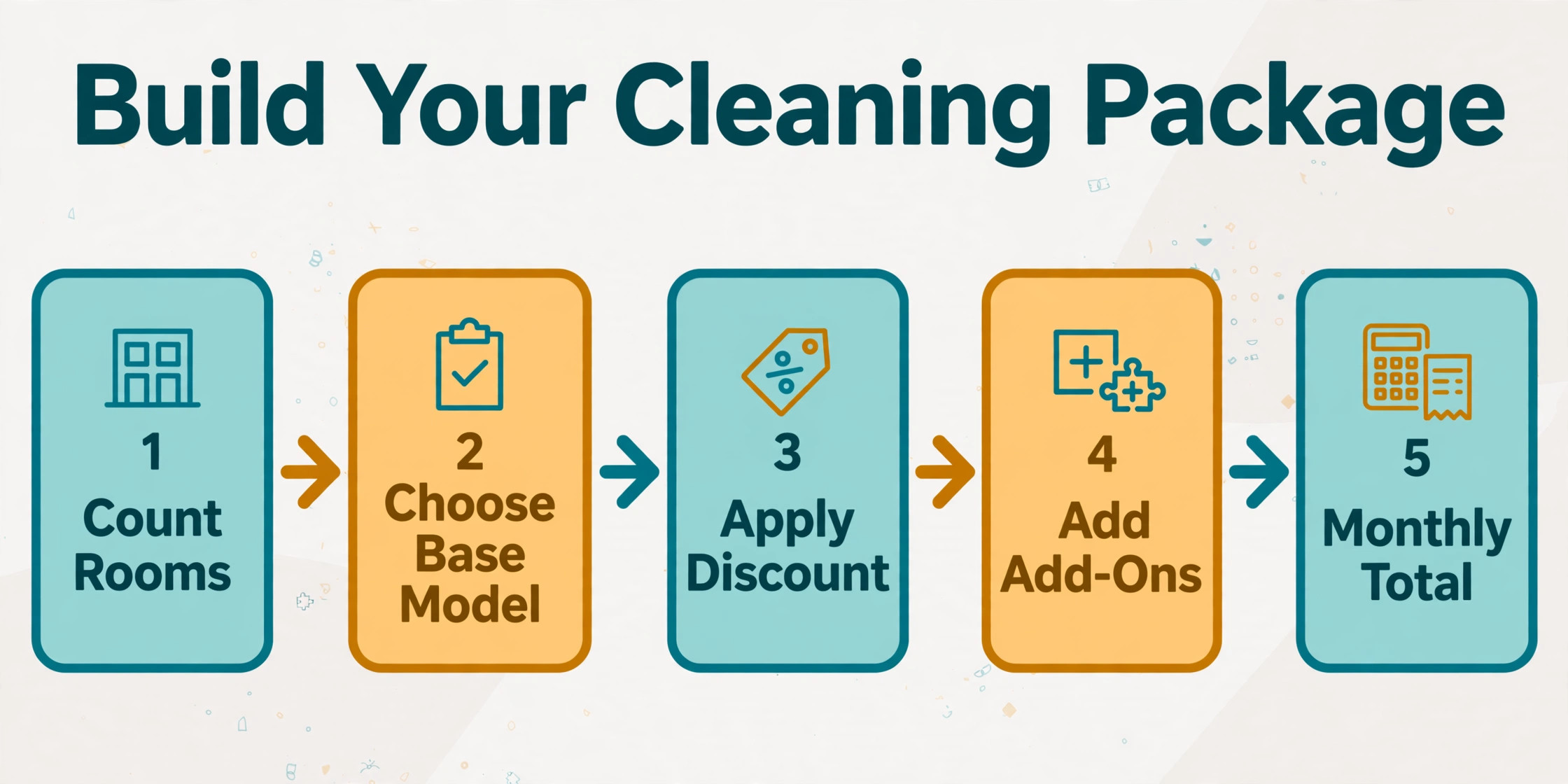
The package builder below shows how home cleaning service pricing packages are built for a specific home. Work through the steps in order, and write down the figure at each step, because the final number is only trustworthy when each step is visible.
- Count the priced spaces. List every room, bathroom, hallway, and living area the team will clean, and confirm the count with the company. The example home has six priced spaces, namely three bedrooms, two bathrooms, a kitchen, and a living room.
- Choose the base model. For this home, per-visit pricing is the base, because the scope is stable. The published band for a three-bedroom standard clean is 130 to 200 dollars, so the planning figure starts at 165 dollars, the middle of the band.
- Apply the frequency discount. A biweekly plan carries a 15 percent recurring discount in the ProHousekeepers ladder, which brings a 165 dollar midpoint to about 140 dollars. Use the one-time quote you actually receive, and apply the discount the company actually offers.
- Add the recurring add-ons only. Pet hair removal at 30 to 60 dollars is a real need in this home, so add 45 dollars, the midpoint, to each visit. Inside fridge and inside oven are periodic, not recurring, so leave them out of the visit price and budget them quarterly instead.
- Calculate the monthly total. Two biweekly visits at 185 dollars each, meaning a 140 dollar base plus 45 dollars for pet hair, come to 370 dollars per month. Check that figure against the Angi biweekly monthly band of 200 to 500 dollars.
- Budget the periodic deep tasks separately. Inside fridge at 30 dollars and inside oven at 40 dollars, each four times a year, add 280 dollars per year, or about 23 dollars per month when spread evenly. Interior windows at 60 dollars twice a year add 120 dollars per year, or 10 dollars per month spread evenly.
- Add the true monthly cost. The visit total of 370 dollars per month plus about 33 dollars per month of spread periodic costs gives a true monthly cost of about 403 dollars. That figure, not the 370 dollar visit total, is the number to compare against a monthly plan headline.
- Test the monthly plan against the build. If a company offers a monthly biweekly plan at 380 dollars that includes pet hair removal but excludes inside appliances and windows, the plan is cheaper than the build by 23 dollars a month. If the same plan costs 430 dollars and includes one periodic deep task per quarter, it may be better value despite the higher headline.
The builder also works for the other two models. For per-room pricing, replace step two with the room rate the company quotes, multiply by the priced space count from step one, and then apply steps four to eight unchanged. For a monthly plan, start from the monthly headline, divide by visits to get the implied visit price, and then check that implied price against the per-visit band for the same home.
A second worked example shows why the builder matters for small homes. A one-bedroom apartment with one bathroom, priced per visit at 95 dollars for a standard clean, with a weekly plan discount of 20 percent, costs 76 dollars per visit and 304 dollars for four weekly visits. A biweekly plan at a 15 percent discount costs about 81 dollars per visit and 162 dollars for two visits. The weekly plan costs 142 dollars more per month, and buys two extra visits.
What to Check Before You Sign
A good package is easy to check, because the company is willing to put the details in writing. Ask for the room list, the task list for each room, the visit price, the frequency discount, the add-on price list, the missed visit rule, the pause and cancel notice, and the price rise notice, all before the first visit. If any of those items is only described verbally, ask for it in the booking confirmation.
Insurance and supplies are two items that customers forget to check, and both affect price honestly. An insured company with trained staff and its own supplies and equipment costs more than an uninsured solo cleaner, and the published hourly bands reflect that gap. If a quote is far below the band, ask whether the cleaner is insured, who supplies the products and equipment, and what happens if something is damaged. A low price that leaves the customer carrying the risk is not a low price at all.
Payment terms deserve the same attention. Some companies charge per visit, some charge monthly in advance, and some charge a deposit for a first deep clean. Monthly advance billing is normal for a monthly plan, but it should come with a clear credit rule for missed visits, and a customer should never pay a full month in advance for a plan whose task list is still unwritten. A deposit for a deep clean is also normal, but it should be a fraction of the visit price, not the whole visit price, and it should be refundable with reasonable notice.
Finally, check the exit. A plan that is easy to join and hard to leave is a plan that does not trust its own service. A fair monthly plan lets a customer pause with a week or two of notice, cancel with a month of notice or less, and keep the discounted visit price for visits already completed. A plan that charges a penalty for cancelling, or that claws back past discounts on exit, should be priced as a contract, not as a convenience, and compared against per-visit pricing without any discount at all.
Readers weighing a cleaning service as a business, rather than as a customer, will find the costing logic in this guide useful in reverse, because the same room counts, visit times, and frequency discounts that set a customer price also set a business margin. The guide to how to start a cleaning business with AI covers the setup side, while the guide to best AI pricing tools covers tools that help a small business test prices. For wider running costs, see best accounting software for small business, best CRM software for small business, and automate small business with AI.
Frequently Asked Questions
How much does a standard home cleaning visit cost?
A standard visit for a two to three bedroom home typically costs roughly 120 to 280 dollars nationally, according to published 2026 guides, with one-bedroom homes at roughly 75 to 110 dollars and four-bedroom homes at roughly 150 to 210 dollars. The exact figure depends on room count, bathroom count, condition, pets, and local labour costs.
Is per-room or per-visit pricing cheaper?
Neither model is always cheaper, because the cheaper model depends on the home. Per-room pricing is usually cheaper for a partial clean, where only some rooms need professional help, and for rental turnovers priced room by room. Per-visit pricing is usually cheaper for a full-home standard clean, because the flat price spreads setup and travel over the whole home.
How much does a monthly cleaning plan cost?
Angi reports monthly totals of roughly 300 to 800 dollars for weekly service and roughly 200 to 500 dollars for biweekly service, depending on home size and market. A weekly plan at 150 dollars per visit is 600 dollars for four visits, while a biweekly plan at 175 dollars per visit is 350 dollars for two visits.
What does a deep clean cost compared with a standard clean?
A deep clean typically costs roughly 200 to 500 dollars for a typical home, against roughly 120 to 280 dollars for a standard clean, and Angi reports a national average deep clean price of about 260 dollars. The premium reflects baseboards, ceiling fans, light fixtures, inside appliances, and built-up grime that routine visits skip.
Which add-ons are worth paying for?
The add-ons worth paying for are the ones tied to a real problem in your home. Inside fridge cleaning at roughly 25 to 45 dollars and inside oven cleaning at roughly 30 to 45 dollars are worth paying for a few times a year, not every visit. Pet hair removal at roughly 30 to 60 dollars is worth paying for when shedding is heavy, and laundry folding at roughly 25 dollars per load is worth paying for only when the household actually needs it. Delete every add-on that does not match a real need, and schedule periodic deep tasks quarterly instead of buying the full bundle every time.
Can I change or cancel a monthly cleaning plan?
Most fair monthly plans let you pause with a week or two of notice and cancel with a month of notice or less, with a clear rule for missed visits, whether they are rescheduled, credited, or lost. Check the pause rule, the cancel notice, the missed visit rule, and whether past discounts are clawed back on exit, before you sign. A plan that is easy to join but hard to leave should be compared against per-visit pricing without any discount, since the discount is only real if you can leave without paying it back.
Build Around the Home, Not the Price List
The right choice among home cleaning service pricing packages is the one that fits how the home is lived in, how often it needs attention, and which tasks actually matter to the people who live there.
A package that survives that test is worth signing, because its price is honest, its scope is written down, and its exit is fair. A package that fails it is worth renegotiating, because the failure usually points to a room that was miscounted, a task that was assumed, or a visit that was charged but not delivered.