
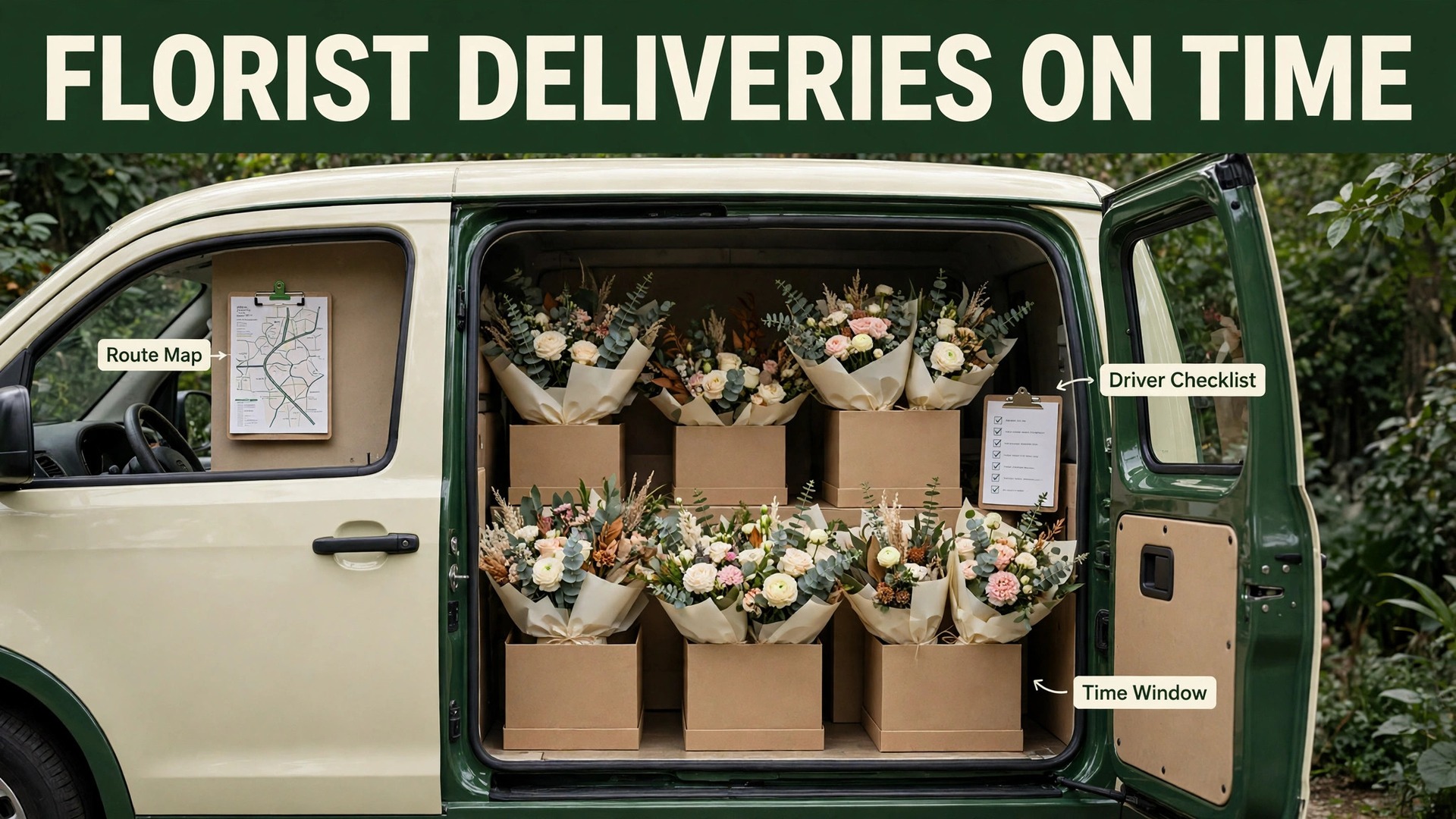
A paper route list and a routing tool can both get flowers out of the shop, but they fail in different ways. The paper list depends on one person remembering every shortcut, every awkward apartment block, and every customer who is only home between school drop-off and lunch. When that person is sick or the van is late, the whole day unravels. When you use AI for florist delivery scheduling, the knowledge moves into a system that can re-sequence stops in minutes, hold a promised time window, and show every driver exactly where to go next.
This guide is written for a small florist shop with one to three vans or cars, a mix of pre-orders and walk-in orders, and delivery days that spike around weekends, weddings, and holidays. It covers time windows, route building, driver assignment, and same-day orders, with tool prices checked at draft time. Prices change, so confirm at checkout before you commit.
Why Manual Route Lists Break at Flower Scale
Manual lists work until about fifteen stops a day. Below that level, a good driver can hold the map in their head, and the shop can absorb one late delivery with a phone call and an apology. Above that level, the maths turns against memory. Every new stop changes the best order for every other stop, and sorting by postcode or habit leaves gaps that look small on paper and cost real money on the road. Extra miles burn fuel, extra minutes push later windows into risk, and a driver who backtracks across town twice arrives tired at the stop that matters most, a wedding venue or a funeral home with a fixed ceremony time.
Flowers add constraints that a parcel route does not have. Bouquets wilt in a hot van, arrangements are bulky and fragile, and some recipients need a signature, a door code, or a wait for building access. A route that ignores those details looks efficient on a map and fails at the door. The fix is not to work harder at sorting. It is to give the sorting job to software that can weigh distance, time windows, vehicle capacity, and driver hours at once, while the shop keeps the decisions that need judgment.
Time your current routine for one full week. Record when the route list is finished, how many stops move after it is printed, how many customers call to ask where their flowers are, and how many arrive outside the promised window. Most shops find the same pattern. The list takes longer than expected, changes keep coming after it is final, and the calls cluster in the last two hours, when no slack is left. That pattern is the case for changing the system, not for blaming the driver.

How to Use AI for Florist Delivery Scheduling in a Real Shop Week
The phrase sounds grander than the daily reality, and that is good news. In practice, you use AI for florist delivery scheduling by feeding the tool clean order data, letting it propose a route order, and then reviewing that proposal with shop knowledge before you send it to drivers. The tool does the heavy sorting. The florist still decides which orders are untouchable, which driver suits a delicate wedding delivery, and when a route is simply too full.
Start with one delivery day, not a whole new system. Pick a normal Saturday, export that day’s orders into the tool, and compare the tool’s route with the route your best driver would have chosen. Check three things. Total miles and driving time, whether every time window is respected, and whether the load makes sense, with heavy or tall arrangements placed so they are not crushed. If the tool beats the manual route on two of those three and ties on the third, it earns a second week. If it does not, the problem is usually the input data, such as missing postcodes or windows written as free text.
Set a simple rule for the trial. The tool proposes, a named person reviews, and no route goes to a driver unreviewed for the first month. That review takes ten to fifteen minutes once the data is clean, and it prevents the most common early failure, which is drivers losing trust after one bad route. A driver who trusts the route follows it and reports problems early. A driver who does not will quietly reorder stops from memory, and then the shop cannot tell whether a late delivery was a routing failure or a human override.
Time Window Booking That Customers Actually Keep
A time window is a promise, and florists break that promise most often at booking, not on the road. Shops offer windows too wide to be useful, such as any time on Saturday, or too narrow to be kept, such as a fifteen minute slot across town during a wedding rush. The wide window makes the customer wait all day. The narrow window makes the shop look unreliable when traffic or a long handover eats the margin.
Offer three or four windows per delivery day, sized to the geography you serve. A workable pattern for a city shop is morning, midday, afternoon, and early evening, each two to three hours long, with premium tight windows for venues. Let customers pick a window at checkout or on the phone, and record it as a start time and an end time, not as a note that says morning-ish. When you use AI for florist delivery scheduling, the tool needs numbers to work with, and a note cannot be optimised.
Protect the windows that cannot move. A funeral service, a wedding ceremony, and a hospital ward with strict visiting hours should be marked as fixed stops before routing starts. Most tools let you pin a stop or set a hard window, so the optimiser builds around it instead of treating it as flexible. Do the same when the van cannot leave before a certain time after a big prep morning. That is a constraint, not a detail to sort out on the road.
Tell customers what happens inside the window. A short message at booking should say the driver will arrive inside the chosen window, the customer will get a message when the driver is on the way, and the shop will call if the window is at risk. That sets an expectation the shop can meet, and it gives the customer a reason to answer the phone when the driver calls from outside a gated building. Shops that skip this step get more failed first attempts, and a failed attempt on flowers is worse than on parcels, because the bouquet sits in a warm van while the driver finishes the route.
Price windows honestly. Same-day delivery, tight venue windows, and long-distance drops cost more in driver time and risk, and hiding that cost in a flat fee means local customers subsidise distant ones. Standard windows carry the standard fee, tight or same-day windows carry a higher fee, and out-of-area drops carry a distance fee or run only on certain days. Customers accept tiered fees explained at booking. They resent a surprise fee added after they have paid for the bouquet.
Building Routes That Respect Flowers, Traffic and Driver Hours
Good route building starts before any software runs, with clean addresses, correct vehicle capacity, and a realistic picture of how long each stop takes. A florist stop is not a two minute parcel drop. It includes parking, carrying a sometimes large arrangement, waiting for access, handing over the flowers, and getting a signature or photo where needed. Budget five to ten minutes per residential stop and ten to twenty minutes per venue, hospital, or office stop, and adjust those numbers from your own timed data after two weeks. When you use AI for florist delivery scheduling, a route built on two minute stops will look beautifully short and collapse by midday.
Group stops by area first, then let the tool sequence inside each group. This keeps each driver in one part of town and cuts the risk of a long cross-town leg with perishable stock in the back. If you serve two towns, do not let one driver cover both unless volume forces it. Two short dense routes beat one long thin route on fuel, fatigue, and recovery when a stop runs long. Use the zone feature even when the tool claims it can optimise across the whole map.
Load the van in reverse stop order where the vehicle allows it. The first delivery should be the easiest to reach without moving other arrangements, and fragile or tall pieces should be secured so they do not slide when the driver brakes. A load list that matches the route order, with one line per stop naming arrangement size and handling notes, prevents most damage.
Build slack into the route on purpose. A route with no slack cannot absorb a road closure, a customer who takes ten minutes to answer the door, or a venue that asks the driver to wait. Aim for ten to fifteen percent slack on a normal day, meaning a route planned to finish before the last window closes, not exactly when it closes. On peak days, plan shorter routes with more drivers or runs, and accept that the cost per delivery rises.
Review the route before dispatch with four checks. Every fixed window is respected, no driver exceeds a safe working span, no vehicle is loaded beyond capacity, and every stop has a phone number and an access note where needed. If any check fails, fix it before the driver leaves, not on the road.

Driver Assignment Without Playing Favourites
Drivers notice unfairness faster than customers notice late flowers. If the same driver always gets the easy dense route while another always gets the long rural run, morale falls. Rotate the hard routes, balance stops and miles across drivers over a week rather than a single day, and keep a simple record so the rotation is visible.
Match drivers to stops by skill and vehicle, not just by availability. A new driver should not carry a wedding venue delivery alone on their first week, however good the route looks. A driver with a small car should not be given the funeral sprays that need a van. A driver who knows a hospital layout or a particular estate well is the right choice for those stops, and that local knowledge is worth more than a few saved miles. When you use AI for florist delivery scheduling, set driver skills, vehicle types, and start locations properly, because those fields turn a generic route into a florist route.
Plan the last stop near the driver’s home base or near the shop, and make the return leg explicit. Drivers who know when their day ends plan their energy across the route. Drivers who do not will rush the last stops, which are often the ones with the most emotional weight.
Handle driver feedback as data, not as complaint. When a driver says a route order was wrong, ask for the specific stop pair that should have swapped and why. Was it a one-way street, a school run, a market day closure, or a building where parking is impossible at certain hours? Those details become constraints in the tool. A tool that learns from driver notes gets better every month.

The Daily Scheduling Workflow
This workflow is the overview-proof core of the system, and it shows what happens when you use AI for florist delivery scheduling day after day. It is the sequence a shop can follow every delivery day, specific enough that a summary cannot replace it. Print it, keep it by the dispatch desk, and refine the times to fit your opening hours.
- Close the order book for the next delivery day at a fixed cutoff time, and list every order that still lacks a full address, a phone number, or a time window.
- Chase the missing details before routing starts, by phone or message, and move any order that cannot be confirmed into a callback list rather than letting it into a route as a guess.
- Mark fixed stops first, meaning funerals, weddings, hospitals, and any customer who paid for a tight window, and pin those stops in the routing tool.
- Assign zones and vehicles, matching large arrangements to vans and dense residential runs to the driver who knows that area best.
- Run the optimisation, then review the proposal against the four dispatch checks covering windows, driver hours, vehicle capacity, and access notes.
- Adjust by hand where shop knowledge beats the algorithm, such as swapping two stops around a school road closure or moving a fragile arrangement to a driver with a larger vehicle.
- Send routes to drivers with a load list in route order, and send customers a message naming their window and explaining that they will get a second message when the driver is on the way.
- Track the day live from the shop, watching for late windows and failed first attempts, and reassign only the stops that are genuinely at risk rather than reshuffling the whole route.
- Close the day by recording proof of delivery for every stop, logging failed attempts with a reason, and noting any stop pair that drivers flagged for next time.
- Review the week every Monday, looking at on-time rate, miles per stop, failed first attempts, and driver hours, and change one thing for the following week based on what the numbers show.
The cutoff time is where most shops lose control. Without a cutoff, orders keep arriving while routes are being built, and every late order forces a rebuild. With a cutoff, same-day delivery applies only to orders placed before a stated time, and later orders move to the next day or to a premium tier. Customers accept a cutoff shown at checkout and repeated in the confirmation.

Handling Same-Day Orders Without Wrecking the Route
Same-day orders are the highest margin and the highest risk work a florist takes. They arrive after routes are set and tempt the shop to squeeze one more stop into a full route. Take them safely by reserving capacity instead of hoping for it. Hold one or two flexible slots per driver on normal days, and a full flexible run on peak days, staffed by a standby driver on call.
Judge every same-day request against three questions before you accept it. Can the flowers be made in time without delaying pre-orders already in production. Is there a realistic window that fits an existing route or a reserved slot, without pushing a fixed stop late. Is the address inside the area already covered today, or does it need a new leg that would break the route. If the answer to any question is no, offer the next available window honestly rather than promising today and failing. A customer who hears a clear next-day offer with a good reason will often accept it.
Insert same-day stops with care, not by appending them to the end of a route. Appending is the easiest move and often the worst, because it sends a driver back across town after they have already passed nearby. When you use AI for florist delivery scheduling, re-optimise the remaining stops and check the effect on every later window before you confirm the new order. If re-optimising pushes a fixed stop outside its window, the same-day order goes to the standby driver or to the next day. That discipline keeps same-day work profitable instead of letting it damage the reputation built by pre-order routes.
Communicate more, not less, on same-day orders. The customer should get confirmation, a window, and a message when the driver is on the way, and the shop should call promptly if anything slips. Same-day customers are often buying for an occasion happening that day, so silence feels worse than a delay. A short honest update preserves trust in a way that a silent late arrival never does.

Tools and Costs Compared
Four tools cover most small florist needs, and they charge in different ways, so compare them on your own volume rather than on headline price alone. The tool you pick when you use AI for florist delivery scheduling matters less than matching its billing model to your volume. Routific charges by orders, which suits a shop whose driver count changes with the season. OptimoRoute charges by driver, which suits a shop with steady drivers and rising order volume. Florist-specific software adds order and website features that a pure routing tool does not, and a spreadsheet plus a maps app remains a valid starting point for a very small shop, provided the shop accepts the manual sorting cost.
| Tool | Best for | Starting price checked at draft time | Watch out for |
|---|---|---|---|
| Routific | Small shops that want strong route optimisation without per-driver billing | Free up to 100 orders a month, then 150 dollars a month for up to 1000 orders | SMS notifications are an add-on, so budget separately for text updates |
| OptimoRoute | Shops with steady drivers and multi-day planning needs | Lite at 35 dollars 10 cents per driver a month on annual billing, or 39 dollars monthly, Pro at 44 dollars 10 cents per driver a month on annual billing, or 49 dollars monthly | Lite caps concurrent orders at 700 and leaves out proof of delivery and analytics, so most florists need Pro |
| Floranext | Florists that want orders, website, point of sale, and delivery routing in one system | Starting price listed at 59 dollars 99 cents a month | Breadth can mean a longer setup than a pure routing tool, so allow training time |
| Hana Florist POS | Small and multi-location shops that want delivery scheduling inside a florist point of sale | Starting price listed at 19 dollars 99 cents a month | Check its routing depth matches your peak day before relying on it alone for a holiday run |
Do the maths on your own numbers before choosing. A shop doing 400 orders a month with two drivers pays 150 dollars a month on Routific above the free level, while the same shop on OptimoRoute Pro monthly pays 98 dollars for two drivers. A shop doing 900 orders with five drivers pays the same 150 dollars on Routific, but 245 dollars on OptimoRoute Pro monthly. The cheaper tool flips as volume and driver count change, so re-run this comparison every six months.
Trial properly before you pay for a year. Run the same real delivery week through two tools, compare miles, on-time rate, and driver feedback, and include data cleaning and training time in the cost. A tool that saves an hour of routing a day but takes three weeks to learn may still be worth it, but only if the shop counts the learning time honestly. Only take an annual deal after a paid month has proved the tool on a peak-style day, not just a quiet Tuesday.
Keep a manual fallback even after you adopt a tool. If the internet fails, the tool goes down, or a driver phone dies, the shop still needs to deliver. A printed route list, a paper copy of addresses and phone numbers for fixed stops, and a charged spare phone turn an outage from a disaster into an inconvenience. Test the fallback once a quarter on a quiet day.
The Route Checklist
Use this checklist at dispatch, every delivery day, before any driver leaves the shop, as the last human check when you use AI for florist delivery scheduling. It is short on purpose. A twenty minute checklist will be skipped. A five minute one will be used.
- Every order has a full address, a phone number, and a start and end time for its window.
- Fixed stops are pinned, and every driver knows which of their stops cannot move.
- Vehicle loads match the route order, with fragile and tall arrangements secured and reachable in the right sequence.
- Every driver has a charged phone, the route on their app, and the shop number saved for problems.
- Customers with a morning window have received their window message, and same-day customers have received confirmation.
- Proof of delivery is set up for every stop, whether photo, signature, or both, and drivers know what to do when nobody answers.
- A standby plan exists for the first failed attempt, including whether to leave with a neighbour, return to the shop, or attempt a second drop later in the route.
- The shop has a named person watching the live routes, with authority to reassign a stop without waiting for the owner.
The failed-attempt plan deserves a line of its own because florists handle it badly when they improvise. Decide in advance what a driver does when nobody answers. For most residential deliveries, a photo, a message, and a safe place agreed at booking is enough. For high-value or venue deliveries, the driver should call the shop before leaving flowers anywhere unplanned. In hot weather, do not leave flowers in direct sun while finishing a long route.

What to Measure, and the Mistakes That Cost Deliveries
Measure four numbers weekly and you will see problems before customers do. On-time rate should sit above ninety-five percent on normal days. Miles per stop shows whether routes are tightening or drifting. Failed first attempts show whether booking data or communication needs work. Driver hours per route show whether a route is fair and sustainable. If on-time rate falls but miles per stop also falls, the problem is usually windows that are too tight or service times that are too short, not bad driving.
The most common mistake is adding stops to a full route because the customer sounded urgent. Urgency is real, but a full route has no room, and the extra stop steals time from every later customer. The second mistake is keeping two systems at once, with some orders in the tool and some on paper. A half-adopted tool produces routes that look optimised and are missing stops. Commit to one system of record for delivery day, even during the trial.
The third mistake is ignoring service time. Shops set service time to two minutes because that is what a parcel takes, then wonder why drivers run late. Time your own stops for two weeks, split residential and venue stops, and set the tool to your real numbers. The fourth mistake is never reviewing the week. A route that worked in spring may fail in summer when a holiday changes traffic or a new estate adds awkward stops.
For related reading on the wider business, see best AI tools for florists, best scheduling apps, automate small business with AI, best AI tools for restaurants, and best CRM software for small business.
Frequently Asked Questions
How many deliveries can one florist driver handle in a day?
A realistic range for a city driver with residential and venue stops is fifteen to twenty-five stops in an eight hour shift, depending on distance, parking, and service time. Dense neighbourhood routes sit at the higher end, rural routes and routes with many venue handovers at the lower end. The right test is your own timed data, not a vendor claim. Run a week with real service times recorded, then set a cap per driver that leaves ten to fifteen percent slack.
Do I need routing software if I only deliver twenty orders a day?
You can manage twenty orders a day on a careful manual list, but the tool still pays for itself if late deliveries, driver overtime, or customer calls about arrival times are already a weekly problem. Start with a free tier, such as Routific free up to 100 orders a month, and compare a tool-built week against your manual week on miles, on-time rate, and planning time. If the tool does not beat the manual week clearly, keep the manual system and revisit it when volume grows.
What time windows work best for flower delivery?
Two to three hour windows work best for most residential deliveries, with tighter windows reserved for venues, funerals, and weddings where the time is fixed by an event. Offer three or four windows per day rather than an open all-day promise, record each window as a start and end time, and tell customers they will get a message when the driver is on the way. Avoid fifteen minute promises across town unless you have a standby driver and real slack.
How should I handle a customer who is not home?
Follow the plan agreed at booking. For most orders, that means a photo, a message, and leaving the flowers in the safe place named at booking, out of direct sun where possible. For high-value or venue orders, the driver should call the shop before leaving flowers anywhere unplanned. Record every failed first attempt with a reason, and offer a second drop later in the route or collection from the shop.
Is per-order or per-driver pricing better for a florist?
Per-order pricing suits a shop whose driver count changes with the season, because the bill follows order volume rather than headcount. Per-driver pricing suits a shop with steady drivers and rising volume, because the bill stays flat as orders grow. Work it out on your own numbers. A shop doing 400 orders with two drivers and a shop doing 900 orders with five drivers can reach opposite answers from the same price lists, so re-run the comparison when either number changes.
Can a small florist use the same tool on Valentine’s Day and Mother’s Day?
Yes, but only with shorter routes, more drivers or runs, and a stricter order cutoff. Peak days break normal routes because volume doubles or triples while the working day stays the same length. Plan peak routes at about two thirds of normal stop counts, bring in standby drivers, close same-day booking earlier, and protect fixed venue and funeral stops first. A tool that handles a normal Saturday well will still fail on a peak day if fed peak volume on normal route settings.
The Route That Pays for Itself
A good delivery system does not feel like technology. It feels like a calm shop, drivers who leave on time, customers who get a message before the flowers arrive, and a Monday review that finds one small improvement instead of a list of apologies. That calm compounds. On-time deliveries earn repeat orders, repeat orders make routes denser, and denser routes cost less per drop.
Start with one delivery day, one clean order list, and one tool trial. Fix the windows, pin the fixed stops, balance the drivers, and protect a little slack. Keep the paper fallback, measure the week honestly, and change one thing at a time. A shop that delivers reliably becomes the shop customers trust with the orders that matter most.