

A newsletter that earns money needs two things from its platform, a fair price for the list it has today, and a price that does not punish it for growing tomorrow, and that test is the heart of beehiiv pricing for small business. Beehiiv promises both, with a free plan that covers 2,500 subscribers, paid plans that start at 49 dollars a month, and a zero percent take rate on paid subscriptions, which means the platform keeps none of your subscription revenue. That promise is the reason small publishers choose it over Substack, and the reason this guide exists is that the promise has a price curve underneath it that every buyer should understand before signing up.
Beehiiv pricing for small business changed on 1 October 2026, when the company renamed its plans. Launch became Free, Scale became Lite, and Max became Pro, and the prices moved with the names. Articles written before that date quote the old names and the old prices, and a buyer who reads one of them will be confused by the current pricing page. This guide uses the current names and the prices checked against the vendor pricing page and independent comparisons in October 2026, and it explains the old names wherever they still appear, so you can translate any review you read.
The core idea is simple, and it is worth stating before the numbers. Beehiiv charges a flat software fee that rises with subscriber count, and it takes nothing from the money your subscribers pay you, apart from Stripe processing. Substack charges no software fee and takes 10 percent of your subscription revenue. A small newsletter with few paying readers pays less on Substack. A newsletter with many paying readers pays less on Beehiiv. The crossover point is the number that decides this purchase, and this guide works it out.
Beehiiv Pricing for Small Business at a Glance
The short answer on beehiiv pricing for small business is that a newsletter under 2,500 subscribers pays nothing, a newsletter that wants to earn money pays from 49 dollars a month on Lite, and a newsletter that wants branding removed and more publications pays from 95 dollars a month on Pro. Every paid price rises with subscriber count, so the price at 1,000 subscribers is not the price at 10,000, and the table below shows the starting price at each tier, with the subscriber count that price covers.
| Plan | Price, monthly billing | Price, annual billing | Subscribers |
|---|---|---|---|
| Free, formerly Launch | 0 dollars | 0 dollars | Up to 2,500 |
| Lite, formerly Scale | From 49 dollars a month | From 43 dollars a month | Up to 1,000 at entry |
| Pro, formerly Max | From 109 dollars a month | From 95 dollars a month | Up to 1,000 at entry |
| Enterprise | Custom quote | Custom quote | Above 250,000 |
The annual billing figures above are the monthly equivalent when you pay for a year, and they come from the pricing page as checked in October 2026, with Lite at 49 dollars monthly or 43 dollars annual at the 1,000 subscriber tier, and Pro at 109 dollars monthly or 95 dollars annual at the same tier.
A newer check of the same page puts Pro at 95 dollars a month on annual billing at 1,000 subscribers, which matches the figure above, and Lite at 49 dollars a month, which matches too. The two sources agree on the shape, and they disagree only on the exact monthly figure for Pro, which is why you should check the pricing page for your own list size before you pay.
The subscriber slider is the feature that matters most on the pricing page, because every paid plan reprices as your list grows. Lite at 2,500 subscribers costs about 69 dollars a month on annual billing, at 5,000 subscribers about 95 dollars, and at 10,000 subscribers about 119 dollars, while Pro at the same sizes costs about 129, 159 and 199 dollars a month. Lite caps at 100,000 subscribers, where it reaches about 399 dollars a month, and Pro extends to 250,000 subscribers, where it reaches about 869 dollars a month. A newsletter that grows fast should budget for the next tier, not the current one, because the price follows the list.

What Each Plan Actually Includes
Free, formerly Launch, is one of the most generous free plans in the newsletter business, and it is a real product rather than a trial. It covers up to 2,500 subscribers with unlimited email sends, a website, a podcast, custom domains, a link in bio page, campaign analytics, the recommendation network, an AI website builder and API access, all for nothing. What it does not include is monetization, and that omission is deliberate. No Ad Network, no paid subscriptions, no Boosts, no paid recommendations and no community features, which means a newsletter that wants to earn money must leave Free behind.
Lite, formerly Scale, is the plan where Beehiiv starts earning its own money, and it is the plan most small publishers should buy, which makes it the centre of beehiiv pricing for small business. It starts at 49 dollars a month on monthly billing, or about 43 dollars on annual billing at the 1,000 subscriber tier, and it unlocks every monetization feature.
Those features are the Ad Network, paid recommendations, paid subscriptions at a zero percent take rate, digital products, email automations, surveys, webhooks, A/B testing and three team seats. It also includes a 14 day free trial on the paid tier, which lets a publisher test monetization before committing. Lite is the plan where a newsletter becomes a business, and the 49 dollar price is the cost of that change.
Pro, formerly Max, is the plan for a publisher who wants the brand to disappear and the operation to scale. It starts at 109 dollars a month on monthly billing, or about 95 dollars on annual billing at the 1,000 subscriber tier, and it adds everything in Lite plus removal of Beehiiv branding, up to 10 publications, unlimited team seats, a sponsorship storefront, audio newsletters, appointments, RSS to send and priority support. The branding removal is the feature most buyers name first, because a newsletter that carries another company logo looks less professional to readers and sponsors, and Pro is the only plan that removes it.
Enterprise is a custom quote for lists above 250,000 subscribers, with dedicated support, custom contracts and volume pricing, and no small business should budget for it unless the list genuinely demands it. A newsletter with 100,000 subscribers fits on Lite or Pro, and the step beyond Pro is a conversation with sales, not a button on the pricing page. Keep your budget on Lite or Pro until subscriber count, not ambition, forces the move.
The Zero Percent Take Rate, Worked Honestly
The zero percent take rate is the headline feature of Beehiiv, and it deserves a careful explanation, because it is both real and easy to misunderstand. Beehiiv takes nothing from paid subscription revenue, so a reader who pays 10 dollars a month for your newsletter sends 10 dollars to you, minus Stripe processing of about 2 dollars and 90 cents plus 30 cents per transaction, which is roughly 3 dollars and 20 cents on a 10 dollar payment. Substack takes 10 percent of the same payment, so the same reader sends 9 dollars to you, minus Stripe processing, which is roughly 1 dollar less per reader per month.
The table below works out the monthly math for three newsletter sizes, with 100 paying readers at 10 dollars a month, 500 paying readers, and 1,000 paying readers, comparing Beehiiv Lite at the relevant subscriber tier against Substack 10 percent, before Stripe fees, which apply to both platforms.
| Paying readers | Monthly revenue | Beehiiv Lite cost | Substack 10 percent cost |
|---|---|---|---|
| 100 readers | 1,000 dollars | 49 dollars | 100 dollars |
| 500 readers | 5,000 dollars | 69 dollars | 500 dollars |
| 1,000 readers | 10,000 dollars | 119 dollars | 1,000 dollars |
The crossover is clear from the table. At 100 paying readers, Beehiiv Lite at 49 dollars costs half of Substack 10 percent at 100 dollars, and the saving grows with every reader after that. At 500 paying readers, Beehiiv costs 69 dollars against Substack 500 dollars, a saving of 431 dollars a month. At 1,000 paying readers, the saving is 881 dollars a month. A newsletter with a small paid audience saves money on Beehiiv from the first month, and a newsletter with a large paid audience saves a fortune. The only newsletter that pays less on Substack is one with almost no paying readers, where the zero software fee beats a 49 dollar subscription.
Stripe processing deserves a line in this math too, because it applies on both platforms and it is easy to forget. Stripe charges about 2 dollars and 90 cents per hundred plus 30 cents per transaction in the US, so a 10 dollar subscription costs about 59 cents in processing, and that fee is the same whether the platform is Beehiiv or Substack. A publisher who budgets subscription revenue should subtract Stripe first, then the platform fee, and the platform fee is zero on Beehiiv and 10 percent on Substack. That order of subtraction is the honest way to compare the two.
How the Price Grows with Your List
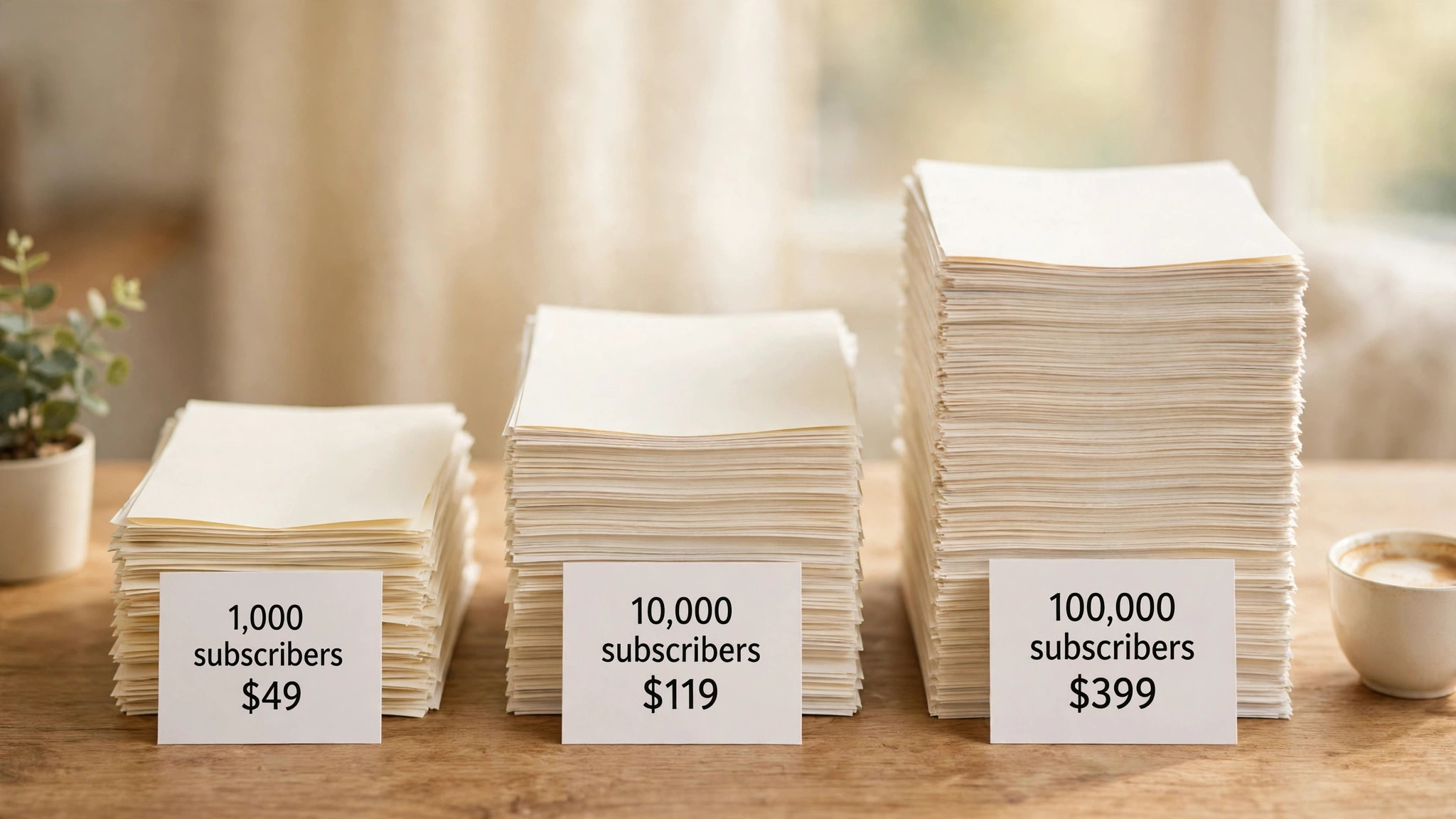
Beehiiv prices by subscriber count, in defined bands, and the price rises in steps as the list grows, which means a publisher should know the next step before they celebrate the current one. Lite starts at 49 dollars a month for up to 1,000 subscribers, rises to about 69 dollars at 2,500, about 95 dollars at 5,000, about 119 dollars at 10,000, and about 399 dollars at 100,000, which is the Lite cap. Pro starts at 109 dollars monthly for up to 1,000 subscribers, rises to about 129 dollars at 2,500, about 199 dollars at 10,000, and about 869 dollars at 250,000, which is the Pro cap.
The growth curve is gentler than it looks, because the price per subscriber falls as the list grows, even while the total bill rises. Lite at 1,000 subscribers costs about 5 cents per subscriber a month, and at 10,000 subscribers it costs about 1 cent per subscriber a month, which is a tenth of the per-subscriber cost. A newsletter that doubles its list does not double its Beehiiv bill, and a newsletter that grows tenfold pays about two and a half times more, not ten times more. That curve is the reason Beehiiv suits a growing publisher, because the platform gets cheaper per reader as the audience grows.
The practical habit is to check the subscriber slider on the pricing page every quarter, and to budget for the next band before the list reaches it. A newsletter at 2,400 subscribers is one good issue away from the 2,500 band, and the price will rise without any announcement, because the billing system follows the subscriber count automatically. A publisher who watches the slider never gets a surprising invoice, and a publisher who ignores it will discover the new price on the next billing date. Set a calendar reminder for the first of each quarter, and check the slider then.
Beehiiv Against Substack, Ghost and ConvertKit
Beehiiv is not the only newsletter platform, and the comparison with its rivals shows where the flat fee model wins and where it loses. Substack charges no software fee and takes 10 percent of subscription revenue, which suits a writer with a small paid audience and no budget for software.
Ghost charges a flat monthly fee starting at about 9 dollars a month for its Starter plan, with no take rate, and it requires self-hosting or a managed plan for larger lists, which suits a technical publisher who wants full control. ConvertKit, now Kit, charges by subscriber count with a free tier to 10,000 subscribers and paid plans from 25 dollars a month, which suits a creator who sells courses and digital products alongside a newsletter.
The table below compares the four at a common small publisher size, with 5,000 subscribers and 500 paying readers at 10 dollars a month, before Stripe fees, which apply to all four platforms.
| Tool | Software cost | Take rate | Monthly platform cost |
|---|---|---|---|
| Beehiiv Lite | About 95 dollars | 0 percent | 95 dollars |
| Substack | 0 dollars | 10 percent | 500 dollars |
| Ghost | From 9 dollars | 0 percent | From 9 dollars |
| ConvertKit | From 25 dollars | 0 percent | From 25 dollars |
Ghost and ConvertKit look cheaper in that table, and for a publisher who needs only email, they are. Beehiiv earns its higher price through the Ad Network, Boosts, paid recommendations and the growth tooling that Ghost and ConvertKit do not offer in the same form, and a publisher who uses those features will earn more than the price difference. A publisher who does not use them should buy the cheaper tool, because an unused feature is worth nothing at any price. The deciding factor is not the software fee, it is the revenue the platform helps you earn beyond subscriptions.
The Ad Network deserves a special mention, because it is the feature that sets Beehiiv apart for small publishers. Beehiiv pays publishers over 1 million dollars a month combined through its Ad Network, and a newsletter with an engaged audience can earn meaningful revenue from ads in its emails, on top of subscription revenue. That income does not exist on Substack in the same form, and it can exceed the software fee for a newsletter with a few thousand engaged readers. A publisher who plans to monetize through ads should trial Lite for a month and measure ad revenue against the subscription cost, because the net cost may be zero or negative.
When Beehiiv Is Worth It, and When It Is Not
Beehiiv is worth it when the newsletter is a business, not a hobby, and the publisher wants to earn money from subscriptions, ads and recommendations without giving away a share of revenue, and that is the clearest test of beehiiv pricing for small business.
A writer with 500 paying readers saves 431 dollars a month against Substack, a writer with 1,000 paying readers saves 881 dollars a month, and a writer who earns from the Ad Network on top of that may find the platform pays for itself several times over. The flat fee model rewards a publisher who grows, because the price per reader falls as the list grows, and the zero percent take rate means every new paying reader is pure revenue minus Stripe.
Beehiiv is not worth it when the newsletter is a hobby with no paying readers and no plans to monetize, because the free plan covers 2,500 subscribers, and a hobbyist who never leaves Free pays nothing and loses nothing. It is also not worth it when the publisher needs only email and nothing else, because Ghost at 9 dollars a month or ConvertKit free tier will send the same emails for less, and the growth tooling that justifies Beehiiv price will sit unused. A publisher who writes for fun should stay on Free, and a publisher who writes for money should buy Lite, and the line between them is the first paying reader, not the subscriber count.
The middle case is a publisher with a growing free list and no paid readers yet, and that publisher should stay on Free until the list passes 2,500 or the first monetization feature becomes necessary. Free covers unlimited sends to 2,500 subscribers, which is a large audience for a new newsletter, and the moment to pay is the moment the newsletter starts earning, not the moment it starts growing. Paying 49 dollars a month for a newsletter that earns nothing is a cost, not an investment, and the free plan exists precisely so a new publisher does not have to pay it.
A Simple Decision Checklist
Use this checklist before you enter card details, and keep the answers with your budget notes for the year.
1. Count your subscribers today, and check the price at your size on the slider. 2. Count your paying readers, and work out the Substack 10 percent comparison. 3. Decide whether you need monetization now, or whether Free covers you. 4. Check whether you need branding removed, which starts on Pro. 5. Start on monthly billing, and switch to annual only after three steady months. 6. Set a quarterly reminder to recheck subscriber count against your tier. 7. Trial Lite for 14 days, and measure ad and subscription revenue against the cost.
A publisher who can answer all seven points in one sitting is ready to buy. A publisher who cannot answer the first two points should spend a week counting subscribers and paying readers before spending anything, because those two numbers decide the plan, and the plan decides a bill that grows with the list. The cheapest plan is the one that fits your actual audience and revenue, not the one with the lowest headline price.

How to Move Your Newsletter to Beehiiv
Moving a newsletter to Beehiiv takes a weekend, not a month, and the move is worth planning carefully, because a migration done badly loses subscribers, breaks paid billing and confuses readers who expected the next issue on time. The beehiiv pricing for small business decision usually comes first, because the plan you buy decides which features the migration can use, and a publisher who moves on Free and then discovers monetization needs Lite will have to move billing twice. Pick the plan first, then move the list, then move the money.
Start with the subscriber list, and export it from your current platform as a CSV file, with email addresses, names, subscription dates and any tags or segments you use. Clean the list before you import it, because a list with duplicates, dead addresses and unsubscribed readers will hurt deliverability on the new platform, and Beehiiv will judge your sending reputation from the first campaign. Remove anyone who has not opened an email in a year, merge duplicates, and confirm that every address on the list gave permission to receive your newsletter, because a clean list is the foundation of the move.
Next, import the list into Beehiiv and rebuild your segments, tags and automations by hand, because those structures do not transfer automatically from another platform. Recreate the welcome email that new subscribers receive, rebuild the automation that sends a free sample to new readers, and set up the publication settings, including your custom domain, your sender name and your website. Test the whole setup with a small group of friendly readers before you send to the full list, and ask them to check the design, the links and the unsubscribe flow, because a broken link in the first Beehiiv issue will be remembered longer than a perfect tenth issue.
Then move paid subscriptions, which is the step that needs the most care. Beehiiv charges a zero percent take rate, but your paying readers are currently billed through Substack or another platform, and they need to be moved without being charged twice or losing access. Beehiiv provides migration support for paid lists, and the usual path is to import the subscriber list, connect Stripe, and let Beehiiv guide paying readers through a transfer that preserves their billing date. Do not cancel the old platform until the transfer is complete and the first Beehiiv payment has arrived, because a gap in billing is a gap in revenue, and a reader who is charged twice will not renew.
Finally, tell your readers about the move in the issue before it happens, and explain what changes and what does not. The content stays the same, the sender name stays the same, and the only change is the platform underneath, which most readers will never notice. A short note in the newsletter, with the new website link and a reassurance that no action is needed, prevents the confusion that makes readers unsubscribe during a migration. The move is complete when the next issue goes out from Beehiiv, the open rate matches the old platform, and the first payment arrives without a complaint.
Related Guides
Keep exploring with these guides on Stratilyze:
- Square Pricing for Small Business
- Sprout Social Pricing for Small Business
- Notion Pricing for Small Business
Frequently Asked Questions
What happened to Beehiiv Launch, Scale and Max?
Beehiiv renamed its plans on 1 October 2026. Launch became Free, Scale became Lite, and Max became Pro, with prices moving at the same time. Free stays at zero dollars for up to 2,500 subscribers, Lite starts at 49 dollars a month, and Pro starts at 95 dollars a month on annual billing at the 1,000 subscriber tier. Existing customers keep their old price until their next renewal on or after 1 November 2026 for monthly plans, or the end of their annual term for yearly plans. Any article written before October 2026 that quotes Launch, Scale or Max is describing the same plans under retired names.
Is Beehiiv really free up to 2,500 subscribers?
Yes, the Free plan covers up to 2,500 subscribers with unlimited email sends, a website, a podcast, custom domains and API access, all for nothing, and it never expires. What it does not include is monetization, so a newsletter that wants paid subscriptions, the Ad Network or Boosts must move to Lite at 49 dollars a month. Free is a genuine starting plan for a growing newsletter, not a trial, and a publisher with a free list under 2,500 subscribers should stay on it until monetization becomes necessary.
How much does Beehiiv cost at 10,000 subscribers?
At 10,000 subscribers, Lite costs about 119 dollars a month on annual billing, and Pro costs about 199 dollars a month, with monthly billing higher on both plans. At 5,000 subscribers the figures are about 95 dollars for Lite and about 159 dollars for Pro, and at 2,500 subscribers they are about 69 dollars and 129 dollars. The price rises in defined bands with subscriber count, so check the slider on the pricing page for your exact list size, because the bands change and promotions can move the numbers.
Does Beehiiv take a cut of paid subscriptions?
No, Beehiiv takes zero percent of paid subscription revenue from Lite onwards, which means you keep 100 percent of what subscribers pay, minus Stripe processing of about 2 dollars and 90 cents per hundred plus 30 cents per transaction. Substack takes 10 percent of the same revenue, so a newsletter with 500 paying readers at 10 dollars a month keeps 431 dollars more a month on Beehiiv Lite than on Substack. The software fee is the only platform cost on Beehiiv, and it is flat, not a share of revenue.
Can I use the Ad Network on the free plan?
No, the Ad Network is a Lite feature, and it requires a paid plan, because it is part of the monetization set that Free deliberately excludes. Lite at 49 dollars a month unlocks the Ad Network, paid recommendations, paid subscriptions, Boosts and digital products, and a newsletter with an engaged audience can earn enough from ads to cover the subscription cost. Trial Lite for 14 days, measure ad revenue against the 49 dollar cost, and keep the plan only if the revenue justifies it.
Is Beehiiv better than Substack for a small newsletter?
It depends on paying readers. A newsletter with few or no paying readers pays less on Substack, because Substack charges no software fee and takes 10 percent of nothing. A newsletter with 100 or more paying readers pays less on Beehiiv, because the flat 49 dollar Lite fee is cheaper than 10 percent of growing revenue, and the saving grows with every reader. A newsletter that wants ads, recommendations and growth tooling should pick Beehiiv. A newsletter that wants the simplest possible setup with no monthly bill should pick Substack.
A Final Word Before You Choose
Beehiiv is the cheapest serious newsletter platform for a publisher with paying readers, and it is a fair price for a publisher who uses its growth tools properly. The free plan is genuinely generous, Lite at 49 dollars a month is the plan where a newsletter becomes a business, and Pro at 95 dollars a month is the plan where the brand becomes fully yours. The bill stays honest as long as you watch the subscriber slider, count paying readers before you compare against Substack, and recheck your tier every quarter.
Start free if your list is under 2,500 and you are not monetizing yet, move to Lite when the first paying reader arrives, and move to Pro when branding removal and more publications matter to your business. That ladder is the whole strategy behind beehiiv pricing for small business, and it costs nothing to follow until the newsletter starts earning. Check the vendor pricing page before you pay, because the numbers move with your list size, but the logic in this guide does not.