

A therapist finishes a full day of sessions and faces two more hours of notes, and that evening paperwork is the problem the best ai meeting note takers for therapists are built to remove. The note has to be accurate enough for an insurer, clear enough for the next session and written fast enough that the clinician can go home on time. A tool that only transcribes the session does half the job, because the draft still needs shaping into a clinical record.
The workflow runs in four steps. The session is captured with the client’s consent, the tool drafts a structured note in a format such as SOAP, DAP or BIRP, the therapist reads and edits every line before signing, and the finished note moves into the record system. When any step is weak, the time saved in drafting is lost in fixing, and a note the therapist does not trust will not be used.
Mentalyc takes the lead here on therapy fit alone, with session formats, treatment plans and a signed agreement for protected health information on every account. Upheal follows for practices that want notes and a record system in one place, and the other six cover free starts, ambient scribing, agency-scale work and measurement-based care. All eight tools were live when this guide was checked in November 2026, and the prices come from vendor pricing pages or from reports the text marks as reported, so confirm the figure on the vendor site before buying.
What Makes a Therapy Note Different
A therapy note is not a meeting summary. It carries a clinical formulation, a record of interventions, a plan for the next session and, in many cases, the evidence an insurer needs to pay the claim. A general note taker will produce a neat transcript with action items, and that output is useless to a therapist who needs a progress note in a recognised format. The best ai meeting note takers for therapists draft in SOAP, DAP, BIRP or GIRP by default, because the format is part of the work rather than decoration on top of it.
Continuity matters as much as format. A note that forgets last week’s goals forces the therapist to re-read the file before every session, and a tool that carries the thread forward saves that time. The tools in this guide were judged on whether the draft connects to the treatment plan and to earlier sessions, because a note that stands alone is only a transcript with better manners.
Privacy Rules That Decide the Shortlist
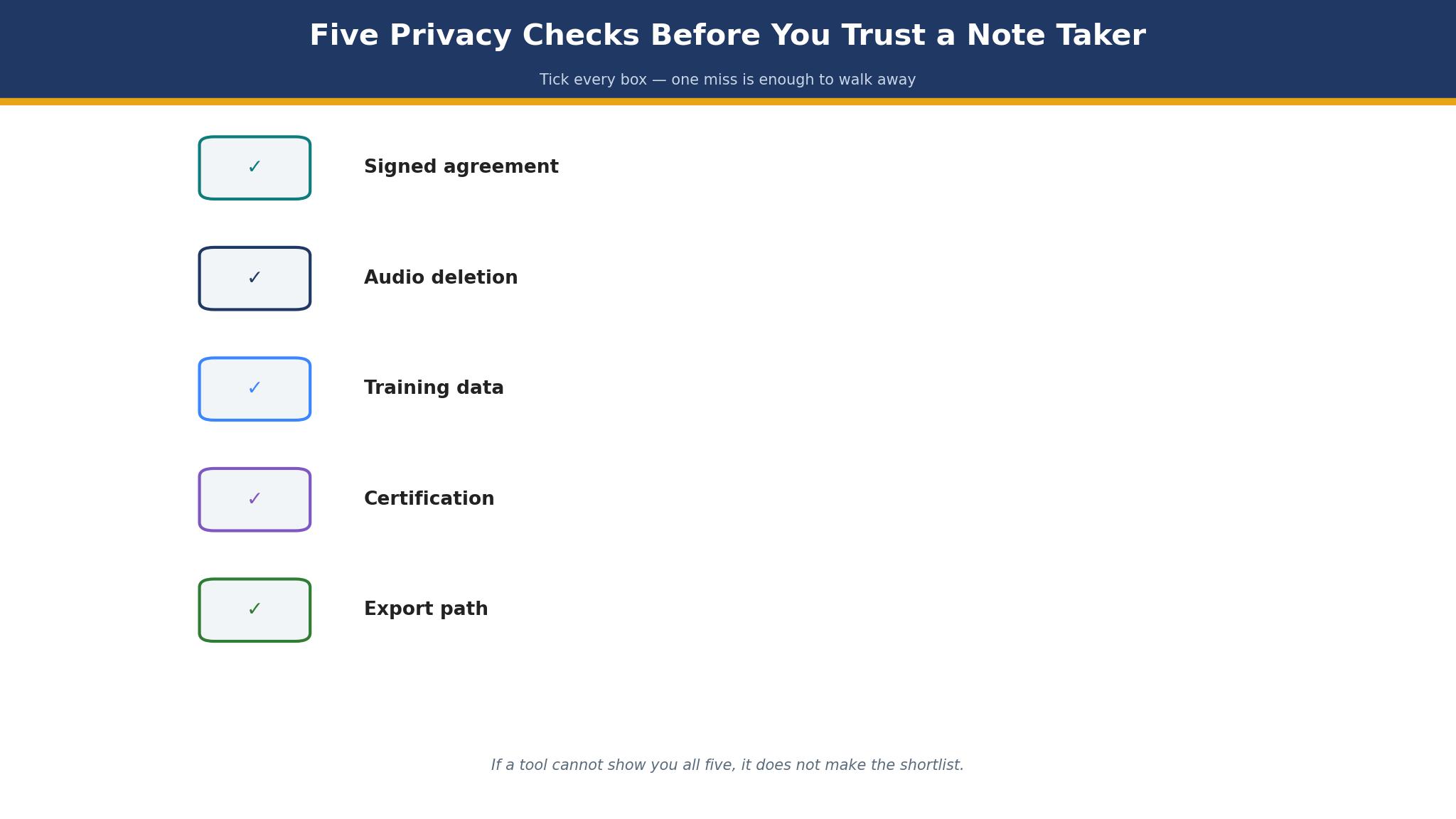
No therapy tool is usable without a signed Business Associate Agreement, known as a BAA, and that single document eliminates most general note takers at once. Any vendor that processes session audio handles protected health information, and the law requires a signed BAA before a single real session is recorded. Every tool in this guide offers a BAA, though some offer it only on paid plans, so a therapist should confirm the agreement is signed before the first client session.
Audio handling is the second test. Some tools delete the recording once the note is ready, while others keep de-identified audio to improve their models, and the difference matters for a practice that promises clients their words stay private. A therapist should ask three questions of any vendor, whether audio is stored, whether client data trains the model, and whether the vendor holds SOC 2 Type II certification. The detail sections below call out the answers where they are published, and a tool that will not answer plainly should not be trusted with a session.
The 8 Tools at a Glance
| Tool | Main job | Best for | Starting price |
|---|---|---|---|
| Mentalyc | Therapy progress notes and plans | Most therapists | From 14.99 dollars a month |
| Upheal | Notes plus a record system | Practices wanting one platform | Free, paid from 59 dollars a month |
| Heidi Health | Free ambient clinical notes | Free start with no time limit | Free, Pro from 99 dollars a month |
| Freed | Ambient medical scribe | Clinicians who want speed | From 39 dollars a month |
| Eleos Health | Documentation for agencies | Behavioural health organisations | Pricing on the vendor site |
| Blueprint | Measurement-based care notes | Outcome tracking | From 0.99 dollars a session |
| Berries | Simple HIPAA notes | Solo practices on a budget | Free to start |
| Scribeberry | Therapy notes and summaries | Small practices | Pricing on the vendor site |
Best Pick by Job
| Job type | First pick | Second tool | Why this pair works |
|---|---|---|---|
| Solo therapist | Mentalyc | Berries | Mentalyc covers notes and plans and Berries covers a free start |
| Practice with telehealth | Upheal | Heidi Health | Upheal joins notes and records and Heidi adds a free scribe |
| Agency or group | Eleos Health | Blueprint | Eleos handles supervision at scale and Blueprint adds outcome measures |
| Free start | Heidi Health | Berries | Heidi transcribes without a time limit and Berries adds therapy formats |
| Outcome tracking | Blueprint | Mentalyc | Blueprint measures progress session by session and Mentalyc adds the plan |
The right note taker depends on the size of the practice, so two practices can buy the same product and reach opposite verdicts. A solo therapist needs a note in minutes, while an agency needs supervision, audit trails and consistent formats across dozens of clinicians. A product that handles the secondary need competently still lets the practice down when it fumbles the notes that fill the week. Choose the first tool for the size of the practice that signs the cheques, and keep the second ready for the sessions the first cannot document.
The same thinking applies to the bill. A solo therapist seeing twenty clients a week can run Mentalyc for under 20 dollars a month, since the per-note cost stays small at that volume. A practice with ten clinicians needs a per-seat price that holds at scale, and a free tier that caps sessions will force an upgrade fast. The tools in this guide are judged on the bill at real caseload size, not on the entry price.
How to Judge the best ai meeting note takers for therapists
Start with a note quality test, because that is where a scribe either earns its fee or wastes it. Record three real sessions with consent, let the tool draft the notes, and read every line against what was actually said. A good draft captures the intervention and the plan, not just the topics discussed, and it should need ten minutes of editing rather than a full rewrite. Check whether the draft invents anything, since a hallucinated detail in a clinical record is worse than a missing one.
Next, test the privacy paperwork before the trial starts. Ask the vendor for a signed BAA, read the audio retention policy, and confirm whether client data trains the model. The best ai meeting note takers for therapists answer those questions in writing, because a practice cannot promise confidentiality it has not verified. If the vendor hesitates or points to a vague policy page, the trial should stop there.
Then check the export path into the record system. Draft a note, edit it, and move it into the practice’s existing records without retyping. A tool that exports cleanly into SimplePractice or TherapyNotes saves hours a week, while one that traps notes behind copy and paste will quietly add work back. Look for a Chrome extension or a direct integration, since a therapist should not need a second screen to finish a note.
The 8 Tools in Detail
Therapy-specific formats and signed privacy agreements set the order below, so the tool built for mental health first leads the list.
1. Mentalyc
Mentalyc earns the top spot by speaking therapy’s language from the first screen. It turns each session into an insurance-ready note in SOAP, DAP, BIRP, GIRP or narrative form, and it builds treatment plans and progress summaries from the same sessions, so the record stays connected week to week. Plans start from 14.99 dollars a month billed yearly, or 19.99 dollars billed monthly, with a 14-day trial, and a BAA is included on every account. Audio is deleted once the note is ready, and the vendor states that client data is never used for training.
The drawback is the format range on the cheapest plan and the single-language limit. The entry plan covers individual adult sessions, while couples, family and child work sit on higher tiers from 59.99 dollars a month, and group sessions cost more again. The tool works in English only, which rules it out for bilingual practices, and the template set, while strong for common modalities, is thinner for specialist approaches that need custom structure.
Mentalyc suits a solo therapist and a small practice that wants notes and plans from one tool. It fits a clinician with a steady caseload of adult clients, a practice that bills insurance and needs audit-ready notes, and anyone who wants the privacy paperwork settled without negotiation. The treatment plan link is the feature that matters, because a note that feeds the plan saves a second round of writing every week.
Run three real sessions through the trial with consent and read each draft line by line against the recording. If the notes need ten minutes of editing and the plan updates itself, Mentalyc will carry the caseload.
2. Upheal
Upheal is the pick for a practice that wants notes, telehealth and a record system in one place. The free tier covers up to ten sessions a month, and the paid AI notes plan starts from 59 dollars a month, with a fuller record system billed per session at 1 dollar. Notes arrive in SOAP, DAP, BIRP, GIRP and custom formats, and the platform adds session analytics, so a therapist can see patterns across a caseload rather than reading one note at a time.
The drawback is the price step and the data policy. The free tier is genuinely useful for a part-time clinician, but a full caseload needs the paid plan, and the record system adds a per-session charge on top. De-identified data may be used to improve the AI unless the practice opts out, which means a therapist who promises clients their words stay private must change a setting before the first session.
Upheal suits a practice that wants to replace two systems with one. It fits a therapist who runs telehealth sessions and wants the note drafted from the same call, a small group practice that needs a shared record system, and anyone who values analytics across the caseload. The combined record system is the feature that matters, because a note that already lives in the chart needs no export step at all.
Book a supervised pilot week with ten sessions on the free tier and check how many notes reach the chart without retyping. If the notes land cleanly and the analytics surface something useful, Upheal fits the practice.
3. Heidi Health
Heidi Health is the strongest free start in this guide, because its free tier offers unlimited transcription with no time limit, which no therapy-specific rival matches. The tool works across medical specialities, drafts notes in SOAP and custom formats, and supports several languages, so a bilingual practice can use it for sessions in more than one tongue. A BAA is available on the free tier, and the vendor holds SOC 2 Type II certification, which makes the free plan usable for real clinical work rather than only for testing.
The drawback is the therapy depth and the paid price. Heidi is a general clinical scribe rather than a therapy-native tool, so its templates are broader and less tuned to psychotherapy formats than Mentalyc or Upheal, and treatment planning is limited. The Pro plan is reported from 99 dollars a month, while another source notes that no US dollar price was published in November 2026, so the paid figure should be confirmed on the vendor site before budgeting.
Heidi suits a therapist who wants a free scribe that stays free. It fits a clinician in a mixed medical setting, a psychiatry practice that also sees therapy clients, and a practice outside the United States that needs strong privacy alignment. The unlimited free transcription is the feature that matters, because a scribe that never runs out of minutes removes the meter from the session.
Run a full week of sessions on the free tier and compare the drafts with the notes the practice used to write by hand. If the drafts are close enough to edit in minutes, Heidi can stay in the workflow at no cost.
4. Freed
Freed is the fastest ambient scribe in this guide, built to listen, transcribe and draft a note in under two minutes. The clinician starts the capture, talks through the session as normal, and receives a structured draft that needs only a quick review before signing. Plans start from 39 dollars a month on the Starter tier, with Core at 79 dollars and Premier at 119 dollars a month, and a free trial covers the first week. A BAA is included, and the vendor stores no recordings.
The drawback is the therapy fit and the price ladder. Freed is a general medical scribe, so its templates are general rather than therapy-specific, and a therapist who needs BIRP or DAP by default will find the formats less tuned than Mentalyc. The Starter tier covers 40 notes a month, so a full caseload needs Core, and the vendor does not hold SOC 2 certification, which some institutional practices require.
Freed suits a clinician who values speed above all else. It fits a therapist with back-to-back sessions and no gap for notes, a medical practice where the same scribe covers several specialities, and anyone who wants the note ready before the next client walks in. The two-minute draft is the feature that matters, because a note that arrives fast is a note that gets finished the same day.
Try the trial across a full day of sessions and time how long each note takes from capture to signature. If the day ends with notes done rather than notes pending, Freed has earned its place.
5. Eleos Health
Eleos Health is the pick for behavioural health organisations that run many clinicians across many sites. The platform drafts notes in behavioural health formats, adds clinical insights and supervision tools, and connects directly into organisational record systems, so a supervisor can review documentation quality across a whole team. The vendor holds SOC 2 and HITRUST certification, which suits agencies that answer to institutional compliance requirements. Pricing is set by sales, with no public list price.
The drawback is the size and the cost. Eleos is built for organisations rather than for a solo therapist, so a small practice will find the sales process and the implementation heavier than a self-serve tool, and the price reflects an enterprise buyer. De-identified audio may be kept to improve accuracy, which a practice with strict privacy promises should confirm in writing before signing.
Eleos suits a community agency, a multi-site behavioural health organisation and any team where supervision is part of the job. It fits an agency that needs consistent note quality across fifty clinicians, a certified community clinic with Medicaid oversight, and a leadership team that wants documentation data rather than anecdotes. The supervision view is the feature that matters, because a note that a supervisor can review is a note the agency can stand behind.
Arrange a demo with the agency’s real record system and ask the vendor to draft notes from a sample session. If the supervision dashboard shows what leadership needs, Eleos fits the organisation.
6. Blueprint
Blueprint is the pick for a practice that measures outcomes, because it pairs note drafting with measurement-based care. The platform collects client-reported measures between sessions, scores them, and feeds the results into the note, so a therapist can see whether a client is improving rather than guessing from memory. Pricing runs from 0.99 dollars a session, or 69 dollars a seat a month for unlimited notes alongside an existing record system, with its own record system at 1.49 dollars a session.
The drawback is the fit for practices that do not measure outcomes. A therapist who does not use client-reported measures will pay for a system whose best feature sits unused, and the note formats, while solid, are less broad than Mentalyc. The per-session price is cheap for a light caseload but adds up for a clinician seeing thirty clients a week, so the seat price is the honest comparison.
Blueprint suits a practice that tracks outcomes as part of care. It fits a clinic that reports outcomes to a payer, a therapist who wants data for supervision, and a group that measures progress across its caseload. The outcome measures are the feature that matters, because a note that shows change over time is more useful than a note that only records what happened.
Run the measures with five clients for a month and read the notes that result. If the trend lines change a treatment decision, Blueprint is doing work no other tool in this guide does.
7. Berries
Berries is the simple, independent option for a solo practice that wants HIPAA-compliant notes without a big bill. The tool drafts clinical notes for mental health professionals, keeps the interface light, and offers a free tier with a BAA included, which is rare at this price. The vendor holds no SOC 2 certification, but the privacy basics are covered, and the tool does the core job of turning a session into a note without a long setup.
The drawback is the depth and the scale. Berries is a small independent tool, so its template range, integrations and analytics are thinner than the larger platforms, and a practice that needs treatment plans, supervision or outcome measures will outgrow it. The free tier suits a light caseload, and a full practice will need a paid plan whose price sits on the vendor site.
Berries suits a solo therapist starting out. It fits a new practice with a small caseload, a clinician who wants a simple note taker without a sales call, and anyone who needs a BAA on a free plan. The free tier with a BAA is the feature that matters, because a new practice should not have to pay to stay compliant.
Draft a week of notes on the free tier and check whether the formats match the practice’s billing needs. If the notes pass review without rework, Berries can carry the practice until it grows.
8. Scribeberry
Scribeberry is the quiet workhorse of this guide, a therapy-focused scribe that drafts notes and summaries without the noise of a large platform. It covers the common therapy formats, offers a BAA, and keeps the workflow short, which suits a small practice that wants the note done and the evening free. Ask the vendor for a quote, and a free tier lets a therapist test the drafts first.
The drawback is the visibility and the integrations. Scribeberry is less widely reviewed than Mentalyc or Freed, so a buyer has fewer independent reports to lean on, and its record system integrations are thinner than Upheal or Eleos. The vendor holds SOC 2 Type II certification, which helps, but a practice that needs a direct link into a specific record system should test the export path before committing.
Scribeberry suits a small practice that wants a focused tool. It fits a therapist who dislikes bloated platforms, a practice that needs notes and summaries without a record system, and anyone who values a short workflow over a long feature list. The short workflow is the feature that matters, because a note taker that adds steps has missed the point.
Test the export path into the practice’s record system with three real sessions before paying. If the notes arrive cleanly and the drafts read true, Scribeberry fits the practice.
Errors That Put a Practice at Risk
The most expensive mistake is recording a session without clear client consent. A tool that captures audio needs the client’s agreement in writing, and a practice that skips that step risks a complaint and a compliance problem that no time saved can justify. Tell the client what is recorded, what happens to the audio and who can read the note, and keep that consent in the file. The best ai meeting note takers for therapists make consent part of the workflow, because a note that starts with a clear agreement is a note the practice can defend.
A second mistake is signing a draft without reading it. AI drafts are good and they are not perfect, and a note that invents a detail the client never said becomes part of the clinical record. Read every line, fix what is wrong, and sign only what is true. A therapist who signs blind is not saving time, and the first time an insurer or a supervisor questions a line, the saving disappears.

A Calm Way to Run the Pilot Week
Start with one clinician and one week, because a pilot that is too big hides the problems. Pick five sessions, get consent in writing, and run the same tool across all five so the comparison is honest. Measure three things, the minutes spent editing each draft, the number of invented details found, and whether the note reached the record system without retyping. The best ai meeting note takers for therapists prove themselves on those three measures, and the winner is usually the right tool, even when it is not the cheapest.
Then bring the second clinician in. A tool that works for one therapist and fails for another has a workflow problem rather than a quality problem, and the pilot should surface that before the whole practice moves. Ask both clinicians what they would change, and listen for the complaint that repeats, because the repeated complaint is the one that will kill adoption in month two.
Frequently Asked Questions
Is it legal to record a therapy session with an AI note taker?
Yes, when the client gives clear consent and the vendor signs a BAA, because the recording is part of the clinical record rather than a secret capture. Consent should be written, and the client should know what happens to the audio and who can read the note. Check the recording law in the practice’s state too, since some states require all parties to consent.
Does an AI note taker replace the therapist’s judgment?
No, the tool drafts and the therapist decides, because only the clinician can judge whether a draft captures the session accurately. A good scribe saves the typing and leaves the clinical thinking to the therapist. Any tool that encourages signing without reading should be treated as a risk rather than a convenience.
Which note taker is best for a solo therapist?
Mentalyc is the best starting point for a solo therapist among the best ai meeting note takers for therapists, because it covers therapy formats, treatment plans and a BAA from 14.99 dollars a month billed yearly. Berries is the better pick when the budget is zero, since its free tier includes a BAA. A solo clinician should test both before committing.
How much does an AI therapy scribe cost per month?
A therapy scribe costs between free and 99 dollars a month for a solo clinician, with the median around 40 to 60 dollars on a paid plan. Heidi Health offers unlimited free transcription, Mentalyc starts at 14.99 dollars a month billed yearly, and Freed starts at 39 dollars a month. Agency tools such as Eleos are priced by sales and cost far more.
Can these tools work with SimplePractice or TherapyNotes?
Most of them can, through export, a browser extension or copy and paste, though the smoothness varies. Upheal and Eleos connect most directly into record systems, while Mentalyc, Freed and Heidi rely on export or a browser extension. Test the export path with three real notes before paying, since a note that cannot reach the chart adds work back.
What happens to the session audio after the note is ready?
It depends on the vendor, and the answer should be in writing before the first session. Mentalyc and Freed delete audio once the note is ready, Heidi states its retention policy in its documentation, and Upheal and Eleos may keep de-identified audio unless the practice opts out. A practice that promises clients privacy should confirm the policy and the opt-out in the signed agreement.
The Verdict on AI Meeting Note Takers for Therapists
Mentalyc takes the top spot because it is the tool a therapist is least likely to regret, and it stands out among the best ai meeting note takers for therapists on that measure. The therapy formats are right, the treatment plan link saves a second round of writing, and the privacy paperwork is settled on every account, including the cheapest one. The price is fair for what it does, and the entry plan covers a real caseload.
Upheal is the pick for a practice that wants notes and records in one place, Heidi Health is the pick for a free start that stays free, and Eleos is the pick for an agency. The best ai meeting note takers for therapists are the ones that save the evening without risking the record, and the winner is the one whose drafts a clinician can trust after reading them once.
Choose by privacy first, by note quality second and by price third. Run a supervised pilot week with real sessions, measure the editing time and the errors found, and set a review date. A practice that picks this way will spend less time typing notes and more time with the clients who need the hour.