

Nearly half of pharmaceutical companies now use some form of AI, and the global AI in pharma market is projected to grow from 1.94 billion dollars in 2025 to 16.49 billion dollars by 2034. That growth is not abstract for working pharmacists. It shows up as a dosing model that catches a vancomycin error, a voice agent that answers the refill line at 9pm, and a review tool that finishes the paperwork before the patient sits down. The best ai tools for pharmacists are the ones that give that time back without adding a second job in software admin.
This guide compares 15 tools across the jobs pharmacists actually do in 2026. Dosing and clinical decision support, medication reviews and deprescribing, prior authorisation, phone and refill automation, prescription entry, safety checking, benefits, and the core dispensing systems everything else plugs into. Prices come from third-party comparisons of vendor pages in 2026, so check the vendor pricing page before committing, because many of these tools quote custom prices and change terms often.
The tools split into two groups, and the split matters more than any ranking. Enterprise tools such as DoseMeRx, InsightRX and Sully.ai serve hospitals and health systems at thousands of dollars a month. Independent pharmacy tools such as Brilo.ai, Kiroku and Pharmie AI start in the hundreds and solve one daily pain well. Pick the group first, then the tool, and you will avoid the most common mistake in this category, which is trialling a hospital platform for a community pharmacy.
Why Pharmacy AI Pays Off in 2026
A pharmacist day is full of work that is important but not clinical. Phone calls about refills, faxes about authorisations, data entry from paper prescriptions, and benefit checks that end with a patient walking away from the counter. Each of those jobs is small on its own. Together they take the hours that should go to counselling, reviews and clinical checks. AI tools earn their keep by taking whole jobs off that list, not by adding a dashboard staff must check.
The second reason is safety. Dosing models, interaction checks and entry automation catch errors that tired humans miss at the end of a long shift. A tool that flags one serious interaction a month has paid for itself many times over, and a dosing model that keeps a patient in therapeutic range avoids a hospital admission. Safety is the argument that convinces a pharmacy owner faster than any efficiency claim, because the cost of one error dwarfs the monthly subscription.
The third reason is that patients now expect the pharmacy to work like everything else in their life. They expect to request a refill by phone at any hour, to know the price before they arrive, and to get a reminder before they run out. Pharmacies that offer that experience keep patients. Pharmacies that still run on phone queues and paper lose them to the chain down the road. The best ai tools for pharmacists close that gap without hiring more staff.
The 15 Tools at a Glance
| Tool | Main job | Best for | Watch out for |
|---|---|---|---|
| DoseMeRx | Precision dosing | Hospital pharmacists | About 3,500 dollars a month |
| InsightRX | Precision dosing | Health systems | Custom pricing |
| Kiroku | MTM reviews | Review pharmacists | From about 400 dollars a month |
| Tabula Rasa | Deprescribing | Long-term care | Custom pricing |
| DrFirst | Prior authorisation | Busy pharmacies | From about 1,200 dollars a month |
| Sully.ai | Clinical automation | Health systems | Custom pricing |
| Pharmie AI | Phone automation | Independents | Custom pricing |
| Asepha | Prescription entry | Paper-heavy pharmacies | Custom pricing |
| NoHarm | Safety checking | Hospitals | Free for public beds |
| Brilo.ai | Refill voice AI | Any size pharmacy | From 149 dollars a month |
| Pharmesol | Refill voice AI | PioneerRx users | Custom pricing |
| BestRx | Pharmacy management | Independents | Quoted pricing |
| PioneerRx | Pharmacy management | Independents | Quoted pricing |
| RxBenefits | Benefits checking | High-abandonment stores | From about 600 dollars a month |
| PharmacyOS | Workflow automation | Growing pharmacies | From about 800 dollars a month |
No single table can pick your tool, because the right choice depends on where you practise. A hospital pharmacist should read the dosing and safety entries first and ignore the refill voice tools. An independent owner should do the opposite. The table is a map, not a ranking, and the detail below is where the real differences show. Check the vendor pricing page for every figure here, since most of these vendors quote custom prices and third-party figures move.

Best Pick by Job
| Job type | First pick | Second tool | Why this pair works |
|---|---|---|---|
| Hospital dosing | DoseMeRx | InsightRX | Evidence-backed dosing plus deep hospital reach |
| Medication reviews | Kiroku | Tabula Rasa | Fast review paperwork plus deprescribing depth |
| Refill phones | Brilo.ai | Pharmie AI | Low entry price plus pharmacy-native depth |
| Independent pharmacy core | PioneerRx | BestRx | Proven dispensing plus bundled reminders |
| Patient safety net | NoHarm | Sully.ai | Cheap safety check plus full automation |
A hospital pharmacist choosing the best ai tools for pharmacists should start with DoseMeRx for dosing and add NoHarm as a safety layer, since the two solve different problems and neither replaces the other. An independent owner should start with Brilo.ai for the phone and Kiroku for reviews, because those two remove the largest blocks of non-clinical work in a community pharmacy. A long-term care pharmacist should start with Tabula Rasa, since deprescribing is the job no other tool here does properly.
How to Judge the Best AI Tools for Pharmacists
Start with the job, not the demo. Write down the three tasks that eat the most staff hours in your pharmacy this month, with real numbers. How many refill calls a day. How many prior authorisations a week. How many medication reviews a month, and how long the paperwork takes. A tool that does not move one of those three numbers is a distraction, however impressive its demo looks.
Next, check compliance before price. Any tool that touches patient data needs a business associate agreement, HIPAA-compliant handling, encryption and audit trails. No agreement means no deployment, whatever the price. Ask for the agreement in writing during the trial, not after you have signed, and confirm which of your systems it integrates with. A voice agent that cannot read your dispensing system is a message taker, not an automation tool.
Then trial on real volume with real patients. A week of real refill calls tells you more than a month of vendor demos, because patients behave differently from test scripts. Older patients may resist a voice agent. Prescribers may ignore a prior authorisation portal. Measure completion rates, error rates and staff hours saved, then decide on the numbers. The best ai tools for pharmacists prove themselves in one trial week or they do not prove themselves at all.
The 15 Tools in Detail
1. DoseMeRx
DoseMeRx is a Bayesian dosing platform that calculates personalised drug doses from patient factors such as kidney function, weight, age and genetics, covering more than 500 medicines.. It suits hospital and clinical pharmacists who dose high-risk drugs such as vancomycin and aminoglycosides, where a standard dose can miss the target by a wide margin. Third-party comparisons report pricing from about 3,500 dollars a month for a single pharmacy, so check the vendor page before budgeting. Its dosing models are backed by peer-reviewed studies, which matters when a hospital committee asks for evidence before adoption.
The trade off is the price puts it out of reach for most independent pharmacies, and set-up needs clinical informatics support. For a hospital pharmacy, it is the strongest dosing pick in this guide. For a community pharmacy, it is simply too much tool.
2. InsightRX
InsightRX does one job well. a model-informed precision dosing platform used in more than 1,000 hospitals, which builds patient-specific dosing models and is adding agent-driven decision support on top. It fits health-system pharmacists who want dosing guidance inside the electronic health record workflow rather than in a separate app. Pricing is custom and quoted by the vendor, so a hospital needs a sales conversation before it can budget. Its hospital footprint means most large systems will already find colleagues using it, which shortens the internal case for adoption.
Watch out for custom pricing and an enterprise sales cycle, which rules it out for small pharmacies. If you work in a health system, ask for a demo early. If you run an independent pharmacy, skip it and look at the lighter tools below.
3. Kiroku
Start with what Kiroku actually does. a cloud platform that automates the data gathering and documentation behind medication therapy management and medication safety reviews. It suits pharmacists who run medication reviews and MTM sessions and lose hours to chart pulls and paperwork before the patient conversation even starts. Third-party comparisons report pricing from about 400 dollars a month for independent pharmacies, rising to about 1,200 dollars a month for large chains. A 7-day trial is reported, which is enough to run a real week of reviews through it.
Where it falls short: it covers reviews and documentation, not dispensing or inventory, so it is one piece of a wider stack. For MTM-heavy practices it pays for itself in recovered hours. Pair it with a dispensing system rather than expecting it to replace one.
4. Tabula Rasa HealthCare
Tabula Rasa HealthCare earns its place here because deprescribing is its core job, not an afterthought. an enterprise platform that combines deprescribing guidance, medication therapy management workflows and real-time clinical decision support. It fits pharmacists in long-term care and health plans who manage older patients on ten or more medicines and need a structured deprescribing path. Pricing is custom and quoted by request, which puts it firmly in the enterprise bracket.
The honest limit is complex set-up and enterprise pricing that small pharmacies cannot justify. A strong pick for long-term care and plan-based pharmacy. Community pharmacies should look at lighter review tools instead.
5. DrFirst
For teams that need fewer prior authorisation phone calls and faxes, DrFirst is the shortlist entry to test first. an e-prescribing and prior authorisation platform that connects prescribers, pharmacies and payers so authorisation work happens inside the prescription workflow. It suits pharmacies drowning in prior authorisation calls, where staff chase faxes and phone queues for drugs that should have been approved at the point of prescribing. Third-party comparisons report pricing from about 1,200 dollars a month, with an on-site demo rather than a self-serve trial. Because it sits at the prescriber end as well as the pharmacy end, it can cut the back-and-forth that eats staff time.
It is not perfect. the monthly cost and demo-led sales process make it a considered purchase, not a quick trial Worth a demo if prior authorisations cost your team hours every day. If authorisations are rare, the price is hard to defend.
6. Sully.ai
Sully.ai sits in a different lane from most tools here. a clinical workflow automation platform whose agents handle medication verification, drug interaction checks and prescription management, integrated with major record systems such as Epic, AthenaHealth and Cerner. It fits hospitals and health systems that want AI agents working inside the record system rather than in a side tool staff must open separately. Pricing is custom and quoted by the vendor, and deployments are enterprise scale, with the company reporting use across more than 100,000 providers. Its specialist medical language model is reported to outperform general models on clinical accuracy in medication contexts.
Before you buy, check enterprise pricing and implementation, with no published self-serve tier. A serious option for health systems. Independent pharmacies will find nothing to buy here at their scale.
7. Pharmie AI
Pharmie AI is a voice AI platform built for independent pharmacies that answers patient calls, handles refill requests and routes controlled-substance calls to staff.. It suits independent pharmacies where the phone never stops and staff cannot pick up every refill call while serving the queue at the counter. Pricing is custom and quoted by the vendor, so you need a call to get a number. The vendor reports up to about a 70 percent reduction in calls handled manually in some deployments.
The trade off is custom pricing means you cannot compare it on a price list, and voice quality must be tested with your own patients. Test it with real patient calls during a trial week. If patients accept the voice agent, the time saved is large.
8. Asepha
Asepha does one job well. an AI platform that automates prescription data entry, including handwritten prescriptions, and checks the entered data for errors before it reaches the dispensing queue. It suits pharmacies still keying in paper and faxed prescriptions by hand, where entry errors are the most common safety risk. Pricing is custom and quoted by the vendor. In head-to-head preference testing the vendor reports its output was preferred over human responses in 71 percent of cases.
Watch out for it covers entry and checking only, so it must sit alongside a dispensing system. A focused tool with a clear return where paper prescriptions are common. Fully electronic pharmacies gain less from it.
9. NoHarm
Start with what NoHarm actually does. a medication safety platform that scans prescriptions for errors and unsafe combinations, with free access reported for public hospital beds. It fits hospital pharmacists who want an independent safety check on every prescription, catching issues that busy prescribers and dispensing checks miss. The vendor reports free access for public beds, with other pricing by arrangement. Its reported 95 percent accuracy in identifying medication issues gives safety committees a number they can cite.
Where it falls short: it is a safety layer, not a workflow system, so it adds a check without removing other work. Low risk to trial where it is free. Measure how many real issues it catches in your first month before deciding.
10. Brilo.ai
Brilo.ai earns its place here because it is priced for independents and goes live fast. a voice AI agent for pharmacy refill requests that verifies patient identity, checks prescription status and sends outbound refill reminders, with a business associate agreement for HIPAA compliance. It suits pharmacies of any size that want refill calls handled around the clock without hiring night staff. Pricing starts at 149 dollars a month, with a free tier reported, and the vendor says a pharmacy can be live in about 7 minutes.
The honest limit is voice agents need careful testing with older patients, who may prefer a human voice. The cheapest credible refill voice agent here. Trial it with a small patient group and watch completion rates before a full rollout.
11. Pharmesol
For teams that need refill calls answered inside your own dispensing system, Pharmesol is the shortlist entry to test first. a pharmacy voice platform built by pharmacists that answers refill calls, verifies identity against the pharmacy management system and handles outbound reminders. It suits community and independent pharmacies running PioneerRx, FrameworksLTC, CPR+ or Liberty, since it integrates natively with those systems. Pricing is custom and quoted by the vendor. Native integration means it can check real prescription status during the call instead of taking a message.
It is not perfect. custom pricing and a narrower integration list than API-first rivals If your dispensing system is on its native list, it is the most natural refill voice pick. If not, compare Brilo first.
12. BestRx
BestRx sits in a different lane from most tools here. a pharmacy management system covering electronic prescription processing, automated refill reminders and inventory management for community pharmacies. It suits independent pharmacies that want one system for dispensing, refills and stock rather than three separate tools. Pricing is quoted by the vendor, with a free trial reported. Its refill reminders and inventory tools cover the two daily jobs that most often pull staff away from patients.
Before you buy, check it is a management system first and an AI tool second, so its AI features are narrower than the specialist tools here. A solid core system for independents. Add a specialist AI tool on top for dosing, reviews or voice rather than expecting BestRx to do it all.
13. PioneerRx
PioneerRx is one of the most widely used pharmacy management systems in the United States, covering dispensing, workflow, inventory and patient communication for independent pharmacies.. It suits independent pharmacies that want a proven dispensing core with deep workflow customisation and a large user community. Pricing is quoted by the vendor. Its scale means most pharmacy AI tools, including Pharmesol, build integrations for it first.
The trade off is it is not itself an AI product, so the AI gains come from the tools you connect to it. Choose it as the foundation, then add AI where it helps most. A strong core with weak add-ons still beats a weak core.
14. RxBenefits
RxBenefits does one job well. a real-time insurance eligibility and benefits checking tool that tells the pharmacy what a prescription will cost the patient before dispensing. It suits pharmacies where patients abandon prescriptions at the counter after a surprise copay, and staff spend hours on benefit checks. Third-party comparisons report pricing from about 600 dollars a month, with a 14-day trial. Real-time benefit data lets staff offer a cheaper alternative or a coupon before the patient walks away.
Watch out for it solves benefits only, so it is an add-on cost on top of a dispensing system. Worth it where abandonment is a real problem. Track your abandonment rate before and after the trial to prove the return.
15. PharmacyOS
Start with what PharmacyOS actually does. an end-to-end pharmacy workflow automation platform covering dispensing workflow, patient outreach and day-to-day operations. It suits pharmacies that want their whole workflow automated in one place, from intake to patient messaging, without stitching tools together. Third-party comparisons report pricing from about 800 dollars a month, with a 30-day trial. A 30-day trial is long enough to run a full monthly cycle through it, which most trials are not.
Where it falls short: at 800 dollars a month it is a serious line item, and breadth can mean less depth in any single job. Trial it for the full 30 days on real volume. If it does not cut staff hours measurably, the specialist tools may serve you better.
The Real Monthly Cost, Worked Honestly
The sticker price is only part of the bill for most tools here. Enterprise platforms add implementation, training and a three to six month rollout, and third-party estimates put first-year totals for tools such as Ironclad-style enterprise systems far above the subscription alone. Pharmacy tools follow the same pattern. A hospital dosing platform needs informatics time, validation work and committee approval before it touches a patient.
For an independent pharmacy the maths is simpler and more honest. Add the subscription, the per-call or per-review cost if any, and the staff hours the tool saves at your real hourly cost. Brilo.ai at 149 dollars a month that saves ten staff hours a week is cheap. A 400 dollar review tool that saves five hours a week is cheap. A 600 dollar benefits tool that prevents ten abandoned prescriptions a month is cheap. Work the numbers with your own volume, because a tool that is cheap for a busy store can be dear for a quiet one.
The rule that holds across both groups is to budget for the trial as well as the subscription. Staff training, workflow changes and patient communication all cost time in the first month. A tool that looks dear on paper but goes live in a week, like Brilo.ai, can cost less in the first quarter than a cheaper tool that needs a month of set-up. The best ai tools for pharmacists are the ones whose total first-quarter cost, not just the monthly price, fits your budget.
Mistakes Pharmacists Make When Adopting AI
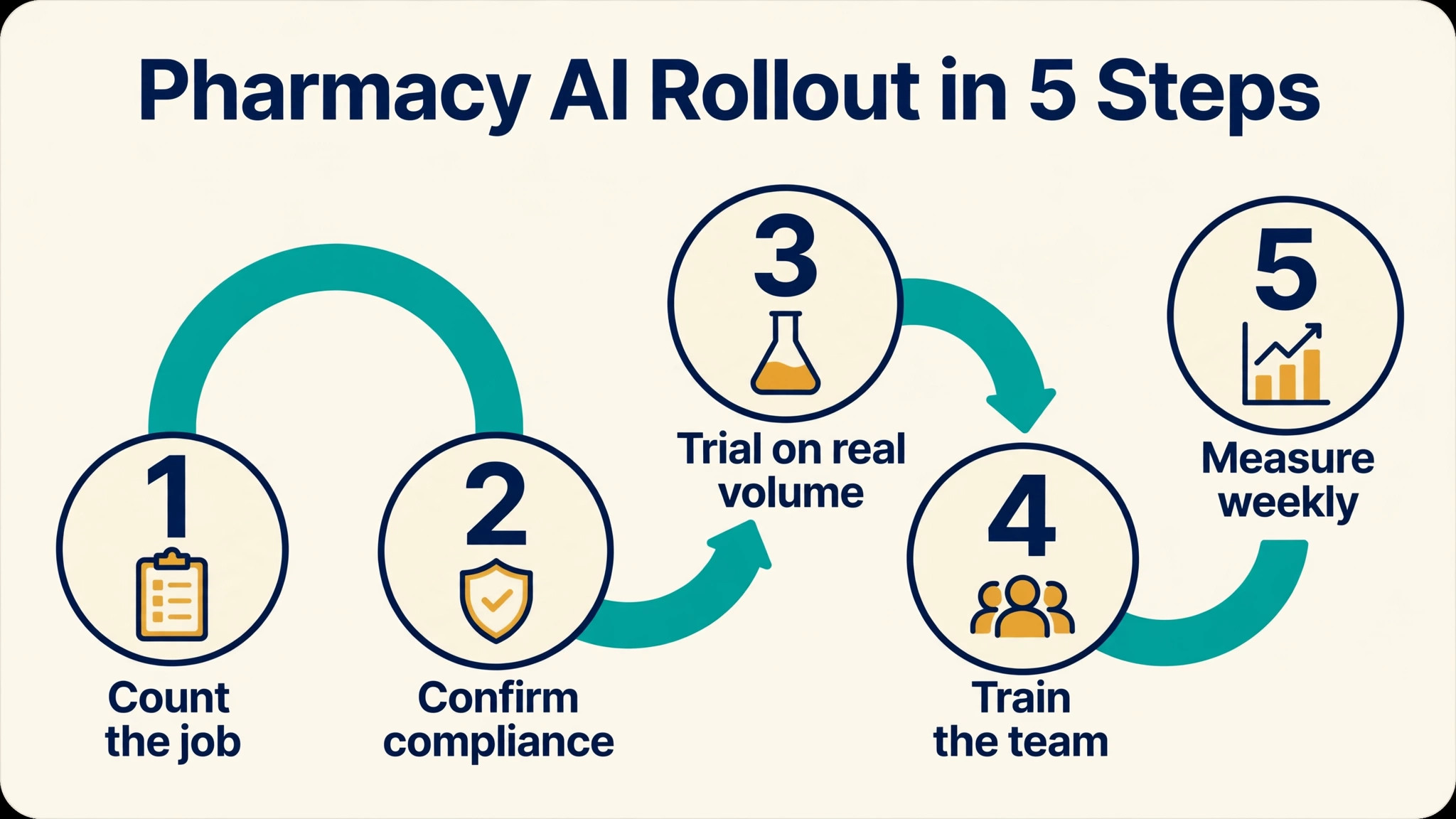
The first mistake is buying a tool for a job nobody measured. A pharmacy buys a review platform before counting how many reviews it actually does, or buys a voice agent before counting daily calls. Without a baseline, nobody can tell whether the tool helped, and the subscription quietly renews for a year. Count the job first, then buy the tool that moves it.
The second mistake is skipping the compliance check. A tool that handles patient data without a business associate agreement is a legal risk, not a productivity win. Confirm the agreement, the data handling and the audit trail before the trial starts, and involve your compliance lead early. A tool rejected late wastes more time than a tool rejected early.
The third mistake is rolling a voice agent out to every patient at once. Older patients and patients with complex prescriptions need a human path, and a bad first experience with a voice agent can cost a loyal patient. Start with a small group, keep a human fallback obvious, and expand only when completion rates prove patients accept it. The best ai tools for pharmacists earn patient trust gradually, and a rushed rollout loses it fast.
Rollout Checklist
Use this checklist when you bring a new AI tool into your pharmacy, and keep a copy where the whole team can see it.
1. Count the job first, with real daily or weekly numbers for calls, reviews or authorisations. 2. Confirm the business associate agreement, HIPAA handling and audit trails in writing. 3. Check integration with your dispensing or record system before signing anything. 4. Trial on real volume for at least one full week with real patients. 5. Train every staff member on the new workflow, including the human fallback. 6. Tell patients what is changing and how to reach a human. 7. Measure staff hours saved, completion rates and error rates weekly for the first month. 8. Review the subscription against those numbers before the first renewal.
Related Guides
Keep exploring with these guides on Stratilyze:
- 15 Best AI Tools for Pharmacies in 2026
- Best Pharmacy Management Software for Independent Pharmacies (10 Tools)
- Use AI for Pharmacy Refill Reminders
Frequently Asked Questions
What is the best AI tool for pharmacists in 2026?
There is no single winner, because hospital and community pharmacies need different tools. DoseMeRx leads for hospital precision dosing, Kiroku leads for medication review automation, and Brilo.ai leads for independent pharmacy refill calls at 149 dollars a month. Start from the job that costs your team the most hours and pick the tool that moves that number.
Do AI pharmacy tools need a business associate agreement?
Yes, any tool that touches patient health information needs a business associate agreement and HIPAA-compliant handling before deployment. Confirm the agreement, encryption and audit trails in writing during the trial. No agreement means no deployment, whatever the price or the features.
How much do AI tools for pharmacists cost?
Independent pharmacy tools start around 149 dollars a month for refill voice AI and about 400 dollars a month for review automation. Enterprise dosing and clinical platforms run into thousands a month or custom quotes. Most tools here quote custom prices, so check the vendor pricing page and trial before budgeting.
Can AI handle pharmacy phone calls safely?
Voice AI can handle routine refill requests, identity checks and reminders, and vendors report large cuts in manual call volume. Controlled-substance calls and complex clinical questions should still route to staff. Trial with a small patient group first and keep a clear human fallback.
Will AI replace pharmacists?
No. The tools in this guide remove paperwork, phone queues and data entry so pharmacists can spend more time on counselling, reviews and clinical judgement. Dosing models and safety checks support decisions, they do not make them. The pharmacist remains responsible for every clinical call.
Which AI tool should an independent pharmacy try first?
Start with the phone or the reviews, since those are the two largest blocks of non-clinical work in most independents. Brilo.ai at 149 dollars a month handles refill calls, and Kiroku from about 400 dollars a month automates review paperwork. Trial one, measure the hours saved, then add the second.
A Final Word Before You Choose
There is no universal winner among these 15 tools, because a hospital pharmacist and an independent owner face different days. A hospital team should start with DoseMeRx for dosing and NoHarm for safety. An independent pharmacy should start with Brilo.ai for the phone and Kiroku for reviews. A long-term care pharmacist should start with Tabula Rasa for deprescribing. Whichever you choose, count the job first, confirm compliance in writing, trial on real volume, and judge the tool on staff hours saved and errors caught. The best ai tools for pharmacists are the ones that give clinical time back, and the only way to know is to measure it.