

The best AI voice agents for customer support have crossed a real threshold in 2026: callers can interrupt them, speak over them, and mumble an order number, and still get their issue resolved. But the marketing hasn’t crossed the same threshold of honesty. Vendor pages promise 80–90% “containment” while production deployments on messy, real-world call mixes land far lower — and the pricing models (per-minute, per-resolution, six-figure enterprise contracts) are designed to be hard to compare.
So we tested six platforms the way a buyer should: the same script of support calls — order status, account help, appointment changes, a billing complaint, and one deliberately frustrated caller — and chased down what each one actually costs in October 2026. This guide gives you the pricing models straight, realistic deflection expectations, and the failure modes nobody puts in the brochure.
Bottom line: Enterprise with millions of calls and want it done for you? PolyAI or Sierra — bring a six-figure budget. Launching this quarter? Synthflow (no-code) or Bland AI (simplest pricing). Engineers on staff? Vapi gives the most control per dollar. Already on Intercom? Fin‘s voice add-on at $1.99 per resolved outcome is the lowest-friction path.
Quick Answer
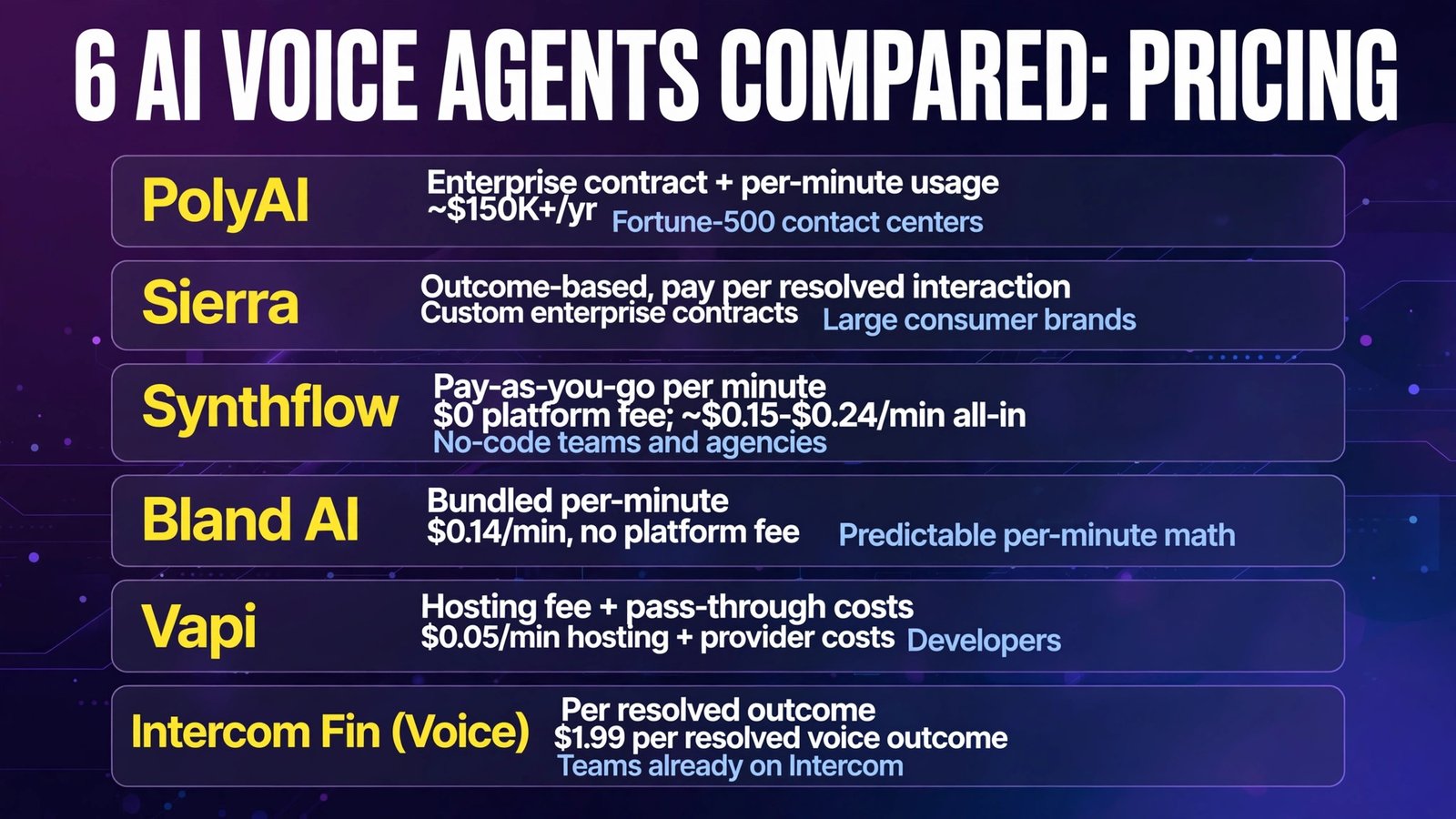
| Platform | Pricing model (Oct 2026) | Entry point | Best for |
|---|---|---|---|
| PolyAI | Custom enterprise contract + per-minute usage | Not published; third-party estimates ~$150K+/yr | Fortune-500 contact centers wanting a managed deployment |
| Sierra | Outcome-based (pay per resolved interaction) | Not published; custom enterprise contracts | Large consumer brands that want vendor incentives tied to resolutions |
| Synthflow | Pay-as-you-go per minute | $0 platform fee; ~$0.15–$0.24/min all-in typical | No-code teams and agencies deploying fast |
| Bland AI | Bundled per-minute | $0.14/min, no platform fee | Predictable per-minute math; high-volume calling |
| Vapi | Hosting fee + pass-through components | $0.05/min hosting + provider costs | Developers who want to choose their own model/voice stack |
| Intercom Fin (Voice) | Per resolved outcome | $1.99 per resolved voice outcome + seat plan | Teams already on Intercom who want voice added to their AI agent |
How We Tested (and What “Deflection” Really Means)
Each platform faced the same five call types, including the two that break demos: a caller who interrupts mid-sentence, and a billing dispute where the correct behavior is escalate, don’t improvise. We judged naturalness, task completion, escalation behavior, and cost per resolved call.
One definition before the numbers: vendors quote containment (the call ended without a human) as if it equals resolution (the customer’s problem was actually solved). A caller who gives up and hangs up is “contained.” Throughout this guide, resolution/deflection means the issue was verifiably solved — our expectations are calibrated to that stricter standard.
1. PolyAI — The Managed Enterprise Standard
What it is: PolyAI is a voice-first, fully managed service: PolyAI’s own team designs, builds, integrates, and continuously tunes your voice assistant. It runs some of the largest deployments in banking, insurance, hospitality, and telecom, with proprietary speech and reasoning models tuned for phone audio — accents, noise, interruptions — and 45+ languages.
2026 pricing (not published — described, not quoted): PolyAI sells custom enterprise contracts only; there is no price list, free tier, or self-serve signup. Independent analyses consistently place typical contracts at roughly $150,000+ per year plus per-minute usage, with implementation handled inside the engagement. If a reseller quotes you a PolyAI “plan price,” it isn’t one — get the number from PolyAI directly.
Our evaluation: We assessed PolyAI via its live demo line and published deployment data (no self-serve trial exists). Voice quality is the best we heard: natural pacing, clean barge-in handling, and multi-turn stability — on the billing call it correctly refused to improvise a refund policy and escalated with context. PolyAI reports 50–70% containment on mature banking deployments; treat higher figures (80%+) as best-case, single-use-case numbers.
Pros:
- Best-in-class voice realism and interruption handling
- Fully managed: their team builds and tunes it — minimal internal lift
- Proven at genuine enterprise scale with SLAs and 24/7 support
Cons:
- Six-figure annual floor excludes mid-market buyers entirely
- 6–12 week implementation; changes route through their team
Verdict: If call volume is in the millions and voice is your support channel, PolyAI is the safest pair of hands in the category — at enterprise prices, on enterprise timelines.
2. Sierra — Outcome-Based Pricing for Big Consumer Brands
What it is: Sierra (founded by former Salesforce co-CEO Bret Taylor and ex-Google executive Clay Bavor) builds AI agents for large consumer brands across chat, voice, email, and SMS. Its differentiator is commercial as much as technical: outcome-based pricing — you pay when the agent successfully resolves an interaction, not per minute or per seat.
2026 pricing (not published — described, not quoted): Sierra publishes no rates, tiers, or minimums. Its confirmed model is pay-per-successful-outcome, sold through custom enterprise contracts. Third-party analyst estimates — unverified by Sierra — put annual commitments starting around ~$150,000, with year-one totals (including implementation) often estimated at $200,000–$350,000+. Budget from a written quote, not blog estimates — ours included.
Our evaluation: Demo-and-briefing evaluation (there is no other way in). The agent approach is genuinely strong: Sierra agents take actions in back-end systems (processing returns, changing orders, applying credits within guardrails) rather than just answering questions, and the supervision tooling for reviewing agent behavior is the most enterprise-grade we saw. Voice handling was natural, and it escalated our billing dispute correctly with a summary attached.
Pros:
- Outcome-based pricing aligns the vendor’s revenue with your resolutions
- Deep back-end action-taking, with strong guardrail/supervision tooling
- Enterprise compliance posture (SOC 2, HIPAA, PCI) for regulated buyers
Cons:
- No published pricing, no self-serve, long enterprise sales and rollout cycles
- “Successful outcome” definitions are contractual — negotiate them carefully
Verdict: The pick for large brands whose board wants AI spend tied to resolved outcomes. Everyone else will find the door price too high.
3. Synthflow — The No-Code Fast Lane
What it is: Synthflow is a no-code voice agent platform: a visual flow builder, knowledge bases, and its own telephony (or bring-your-own Twilio), aimed at businesses and agencies that want agents live without engineering. It supports 50+ languages and carries SOC 2, HIPAA, GDPR, and ISO 27001 certifications.
2026 pricing (verified): Pay-as-you-go with a $0 platform fee — build for free, pay only for calls. The meter is component-based: voice engine $0.09/minute, LLM ~$0.02–$0.05/minute by model, Synthflow-managed telephony ~$0.02/minute (bring-your-own is $0). Synthflow states most setups land at $0.15–$0.24 per minute all-in, and failed calls aren’t charged. Enterprise (from ~10,000 minutes/month) is custom.
Our test: Fastest no-code build we tried: order-status agent on a test number in under an hour, no code anywhere. Voice quality was strong and latency stayed conversational. The flow builder handles branching support logic well; very complex multi-system actions are where you’ll feel the no-code ceiling.
Pros:
- Zero platform fee to start; pay only for successful call seconds
- Genuinely no-code — support ops can own it, not engineering
- Compliance certifications (SOC 2, HIPAA, GDPR, ISO 27001) at a self-serve tier
- White-label/agency features on higher tiers
Cons:
- Component pricing means per-minute cost drifts with model and add-on choices
- Complex logic is hard to debug in a purely visual builder
Verdict: The best starting point for most mid-size teams: live in days, real compliance credentials, and honest pay-as-you-go economics.
4. Bland AI — One Rate, No Surprises
What it is: Bland AI is a developer-friendly voice platform built around a single bundled per-minute rate: the language model, transcription, and voices are included in the minute price rather than itemized. It’s known for high-volume calling, scripted “pathways” for structured conversations, and telephony from Bland or your own carrier.
2026 pricing (verified): Start: $0/month platform fee + $0.14/minute (10 concurrent calls, 100 calls/day). Build: $299/month + $0.12/minute (50 concurrent). Scale: $499/month + $0.11/minute (100 concurrent). Human-transfer minutes bill separately at $0.05/$0.04/$0.03 per minute by tier on Bland numbers (free with your own Twilio). Enterprise is custom and adds warm transfers, guardrails, SSO, and BAA.
Our test: The bill was the easiest to predict of any platform here — one rate, no stack of provider invoices. Voice quality is good rather than PolyAI-tier, and the product is clearly built for teams comfortable with an API: the dashboard is functional, but this is not the no-code hand-holding Synthflow offers.
Pros:
- Truly bundled rate: LLM + STT + TTS in the per-minute price — forecasting is trivial
- Free Start tier with no card required; live in an afternoon
- Scales to serious volume with clear concurrency tiers
- Bring-your-own-telephony keeps transfer minutes free
Cons:
- Warm transfers, guardrails, and BAA sit behind Enterprise — check your tier before comparing prices
- Less polish for non-technical buyers; plan on developer involvement
Verdict: Choose Bland when predictable unit economics and volume are the priority, and you have (or can borrow) a developer for setup.
5. Vapi — The Developer’s Building Blocks
What it is: Vapi is an API-first voice platform: it provides the real-time hosting/orchestration layer, and you bring your own transcription, LLM, and voice — each billed at provider cost with no markup. It’s the most configurable option here and the least “productized.”
2026 pricing (verified): $0.05/minute hosting fee, plus pass-through component costs at provider cost. Vapi’s calculator puts a typical 1,000-minute setup at roughly $0.08–$0.13 per minute all-in depending on your model/voice stack. A $10 free credit covers initial testing; the optional Core package is $29/month (10 concurrent calls; the default allows 4). HIPAA is a paid add-on priced in the four figures per month — confirm the current figure in your quote. Enterprise is custom.
Our test: Our engineer tester loved it: model swaps took minutes, latency was excellent, and the automated call-testing tools caught a hallucination path before “production.” Our non-technical tester never got past setup — both experiences are the product working as intended. Budget-wise, Vapi is cheap at pilot scale, but the hosting fee becomes a serious line item at very high volume: run the 12-month math first.
Pros:
- Maximum control: choose every component, swap models freely, no markup on providers
- Excellent latency and solid developer tooling (testing, A/B, observability)
- Cheapest credible way to run a serious pilot ($10 credit, pay-as-you-go)
Cons:
- Requires developers — not a support-ops purchase
- HIPAA add-on is expensive relative to headline pricing
Verdict: The builder’s choice — Vapi for custom voice work; Synthflow or Fin if you want a support tool.
6. Intercom Fin (Voice) — The Add-On That Isn’t Really an Add-On
What it is: Fin is Intercom’s AI agent — the centerpiece of the platform since Intercom rebranded around it. Fin handles support across chat, email, and voice: Fin Voice answers phone calls using the same help-center knowledge and procedures as its text agent, escalating to your human team inside the same inbox.
2026 pricing (verified): Fin bills per outcome, not per minute: $0.99 per resolved support outcome on text channels and $1.99 per resolved voice outcome, at most one charge per conversation, with a 50-outcome monthly minimum (~$49.50). You also need Intercom seats for your human team (Essential from $29/seat/month billed annually). Crucially, you’re not charged when the customer asks for a human or Fin can’t answer — handoffs are free.
Our test: If your knowledge base already lives in Intercom, nothing here is close on time-to-live: Fin Voice inherited our help-center content with essentially no new build, and resolution quality matched its chat performance. Voice naturalness is a notch below the best dedicated platforms.
Pros:
- Per-outcome pricing: you pay for resolutions, not talk time or failed attempts
- Zero new knowledge build if you’re already on Intercom — voice inherits chat’s brain
- Handoffs are non-billable — the model punishes bad escalation less
Cons:
- Requires the Intercom platform; seats add up for large human teams
- Voice polish a step behind dedicated voice platforms
Verdict: Already on Intercom? This is your voice agent — turn it on. Not on Intercom? Compare total cost against Synthflow before switching helpdesks for it.
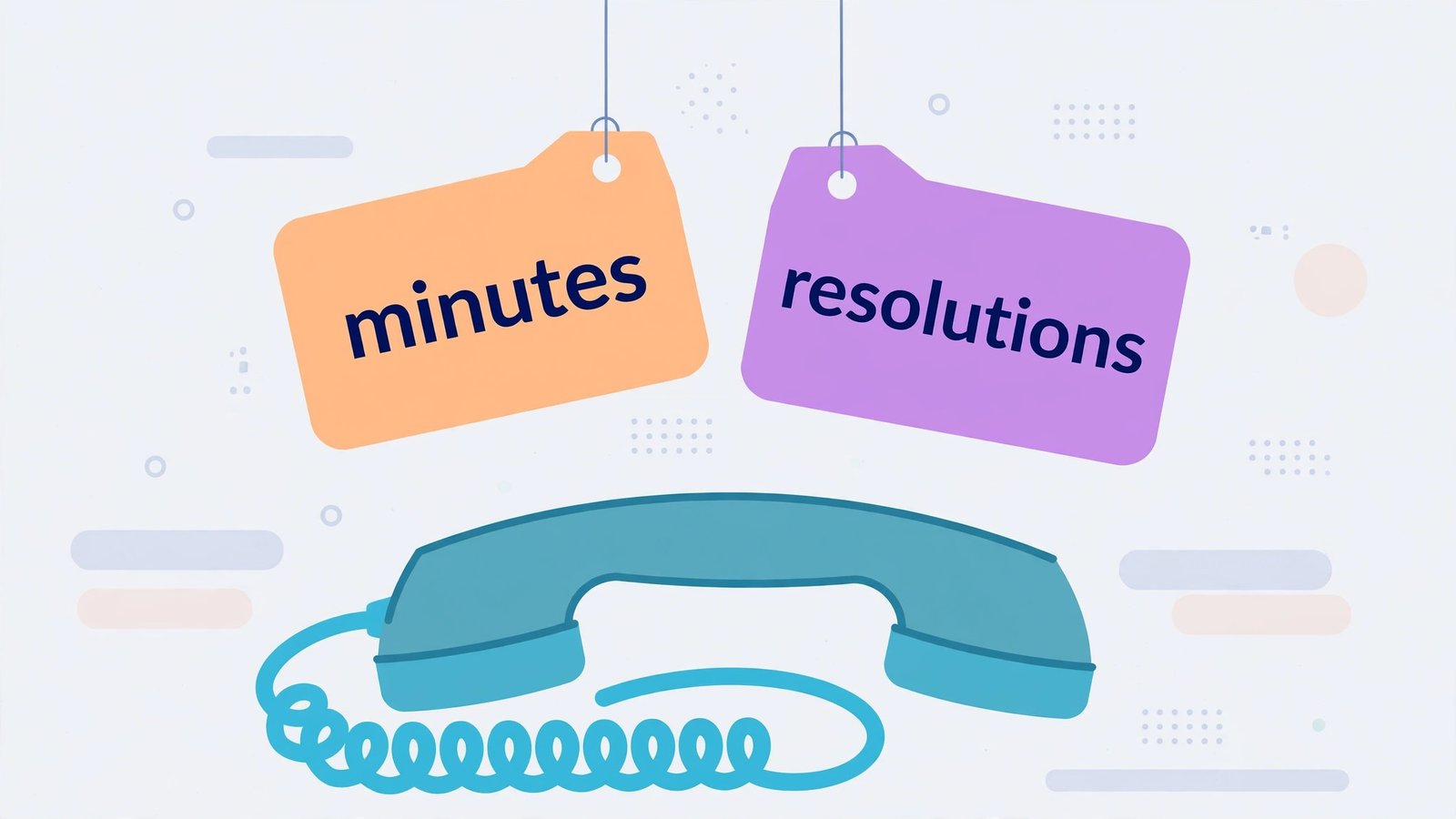
Per-Minute vs. Per-Resolution: Which Pricing Model Wins?
The two models price the same call very differently — worked example for a 3-minute average resolved call:
| Model | Example platform | Cost per resolved 3-min call |
|---|---|---|
| Bundled per-minute | Bland AI (Start) | 3 × $0.14 = $0.42 |
| Component per-minute | Synthflow (typical all-in) | 3 × ~$0.18 = ~$0.54 |
| Hosting + components | Vapi (typical stack) | 3 × ~$0.10 = ~$0.30 |
| Per-resolution (voice) | Intercom Fin Voice | $1.99 flat |
| Outcome-based enterprise | Sierra / PolyAI | Negotiated; typically part of six-figure contracts |
Per-minute looks cheaper until you add what it hides: you pay for unresolved minutes too, plus human time for every escalation. Per-resolution looks expensive until you notice failed attempts and handoffs cost nothing. The honest comparison is total monthly cost ÷ verified resolutions — compute it from a pilot, never a rate card.
Realistic Deflection Expectations (Read This Before Your Board Meeting)
Vendor marketing cites containment figures of 60–90%. Those numbers come from narrow deployments — one use case (order status), one language, primed callers. For a general support line in year one, plan on:
| Call type | Realistic AI resolution rate |
|---|---|
| Status/lookup (orders, appointments, balances) | 70–90% |
| Simple account actions (resets, changes, bookings) | 50–75% |
| Policy/how-to questions | 40–65% |
| Billing questions (non-dispute) | 30–50% |
| Complaints, disputes, anything emotional | 0–15% — and should stay low by design |
| Blended general support line, year one | ~30–50% |
Two consequences. First, budget ROI on 30–50% blended deflection and treat anything above as upside — teams that finance the project on 80% cut the human team too far and torch CSAT. Second, your call mix matters more than your platform. Measure deflection per call type, or the number is meaningless.

The Risks of Premature Deployment
- Hallucinated policies. The agent invents a refund window or warranty term, and “your AI promised me…” becomes a real dispute category. Mitigation: ground answers in a curated knowledge base and hard-code money/policy guardrails.
- Escalation loops. The caller says “agent” five times while the bot keeps pitching self-service — the fastest way to turn a neutral customer into a detractor. Mitigation: honor the first clear request for a human, always.
- Compliance exposure. Recording-consent laws vary by state/country, and AI-voice disclosure rules are tightening (in the US, the FCC treats AI voices under TCPA rules for outbound calls, which need prior express consent). Get legal review before outbound.
- Premature headcount cuts. Leadership books the savings, cuts the team, then a spike hits an under-trained agent and an under-staffed floor at once. Sequence it the other way: prove deflection for two quarters, then adjust staffing.

Human-Handoff Checklist
A voice agent is only as good as its exits. Before go-live, confirm every item:
- Caller can reach a human by asking once, in any phrasing (“agent,” “person,” “representative,” zero-key)
- Transfer carries context: transcript, caller identity, issue summary — the human never re-asks
- Warm transfer for complaints and high-value accounts
- After-hours path defined: callback promise, voicemail-to-ticket, or next-day commitment — stated explicitly
- Failed-authentication path: caller who can’t verify identity gets a human or a secure callback, not a dead end
- Callback number captured before transfer, so a dropped call isn’t a lost customer
- Escalations not counted as agent failures in reporting (or teams will game the agent to avoid them)
- Every escalation reason logged and reviewed weekly — it’s your training backlog

Full Comparison Table
| PolyAI | Sierra | Synthflow | Bland AI | Vapi | Intercom Fin | |
|---|---|---|---|---|---|---|
| Pricing model | Enterprise contract + usage | Outcome-based | Per-minute (components) | Per-minute (bundled) | Hosting + pass-through | Per-resolution |
| No-code setup | Managed for you | Managed with vendor | Yes | No (developer-leaning) | No (API-first) | Yes (inside Intercom) |
| Voice quality | Best-in-class | High | High | Good | Depends on your stack | Good |
| Channels | Voice-first | Voice, chat, email, SMS | Voice-first | Voice | Voice | Voice, chat, email in one agent |
| Time to live | 6–12 weeks | Months | Days | Days | Days–weeks | Days (if on Intercom) |
| Compliance highlights | SOC 2, HIPAA, GDPR | SOC 2, HIPAA, PCI | SOC 2, HIPAA, GDPR, ISO 27001 | BAA on Enterprise | HIPAA paid add-on | Intercom platform |
How to Choose
- Start with your call mix, not the vendor list. Tag 500 recent calls by type. If 60%+ are status/lookup/simple actions, any platform here will pay for itself; if your line is complaints and edge cases, fix the human workflow first.
- Pick your buying motion. Managed enterprise (PolyAI, Sierra) if voice is strategic and budget is six figures. Self-serve (Synthflow, Bland, Vapi, Fin) for everyone else — decide no-code vs. developer-first by who will own it.
- Model cost per verified resolution. Run a 2–4 week pilot on after-hours or overflow calls, count verified resolutions, and divide total cost by that number. That’s your comparison metric.
- Audit the handoff before the voice. Mystery-call test focused only on escalation: ask for a human three ways, simulate a dropped transfer, call after hours. Vendors demo the happy path; your customers live in the exits.
- Contract for the definition of “resolved.” On outcome-based pricing, the definition is the price — negotiate what counts (customer-confirmed vs. silence), caps, and audit rights before signing.
Frequently Asked Questions
How much does an AI voice agent cost per call?
On per-minute platforms, a typical 3-minute resolved support call costs roughly $0.30–$0.70 all-in (Vapi-style stacks at the low end, component-priced setups at the high end). Intercom Fin charges a flat $1.99 per resolved voice outcome regardless of length, with handoffs free. Enterprise platforms (PolyAI, Sierra) bundle costs into six-figure annual contracts. Compare on cost per verified resolution, including minutes spent on calls the agent didn’t resolve.
What deflection rate should I realistically expect?
For a general support line in year one: 30–50% blended, counting only genuinely resolved issues. Lookup/status calls resolve at 70–90%; complaints and disputes should resolve near 0% by design — those belong with humans. Vendor claims of 80%+ usually describe containment (no human touched the call, including hang-ups) on a narrow use case.
Per-minute or per-resolution pricing — which is better?
Per-minute is cheaper per call and more predictable at low volume, but you pay for failed calls too. Per-resolution (Fin, Sierra) costs more per success but makes failures free. Simple-lookup-heavy mix → per-minute. Messy, escalation-heavy mix → per-resolution protects you from paying for the mess.
Can AI voice agents handle angry customers?
They can detect them — sentiment and raised-voice signals are standard — and the correct behavior is a fast, graceful handoff with full context. In our testing, the best performers (PolyAI, Sierra) escalated our frustrated-caller scenario earliest, with a summary that let the human start warm.
Do I have to tell callers they’re speaking to an AI?
Requirements are tightening and vary by jurisdiction. In the US, the FCC’s 2024 ruling treats AI-generated voices as artificial voices under the TCPA — outbound AI calls need prior express consent (written for marketing), and several states add recording-consent and disclosure rules. Inbound is less restricted, but disclosure is best practice everywhere and mandatory in some places. Get legal sign-off for your call types before launch.
Conclusion
The best AI voice agents for customer support in 2026 fall into three honest groups: managed enterprise (PolyAI for voice excellence, Sierra for outcome-based commercials — both six-figure, both strong), self-serve platforms (Synthflow for no-code speed, Bland AI for the most predictable per-minute bill, Vapi for developers), and the platform add-on (Intercom Fin Voice, unbeatable if your support already lives in Intercom). The platform matters less than deployment discipline: scope it to the calls AI resolves well, build exits you’d be proud of, and let the savings follow the proof — not the other way around.
Next step: pull your last 500 support calls, tag them by type, and calculate your lookup/simple-action share. If it’s above ~40%, run a Synthflow pay-as-you-go pilot or enable Fin Voice on after-hours calls this week — you’ll have real deflection numbers from your own callers within a month.