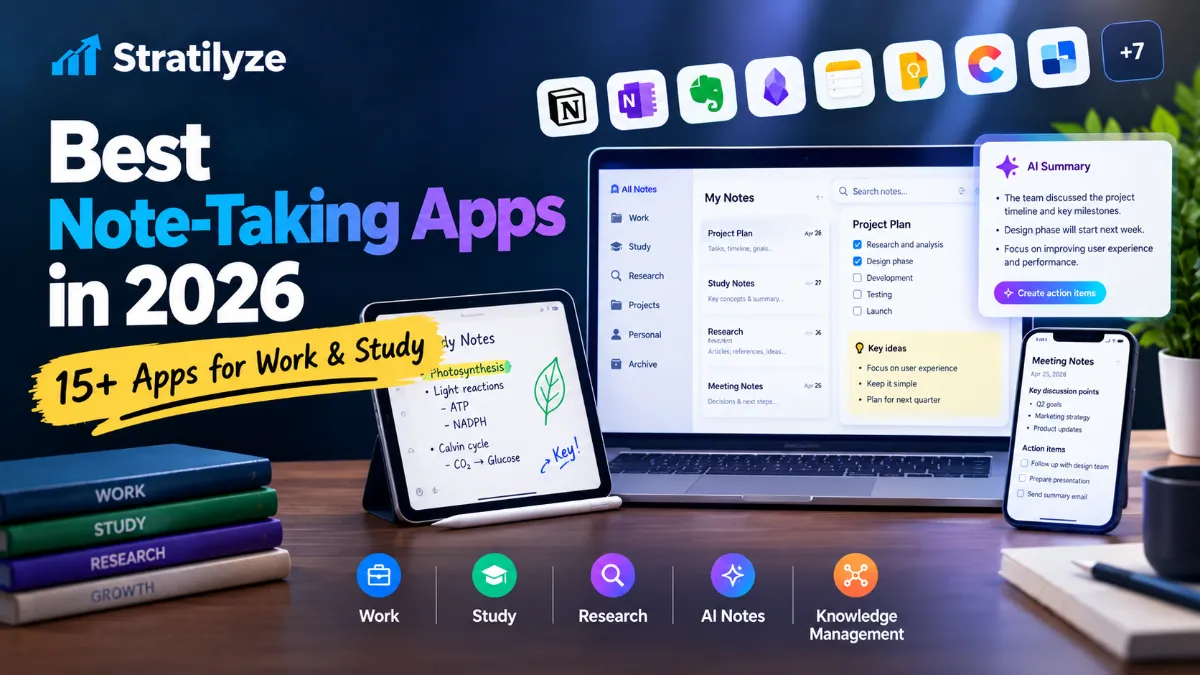
If you still keep important information in random documents, browser tabs, screenshots, or messaging apps, a good note-taking app can make a huge difference. The best note-taking apps in 2026 are no longer limited to simple text notes. Many now combine documents, task management, handwriting, web clipping, AI features, collaboration, search, file storage, and knowledge management.
But there is no single note-taking app that is perfect for everyone.
A student may want handwriting, lecture notes, PDF annotation, and quick search. A professional may need meeting notes, project documentation, tasks, and collaboration. Someone building a personal knowledge base may prefer backlinks and local files, while a privacy-focused user may care more about encryption and data ownership.
For this guide, we looked at 15+ of the most useful note-taking apps available in 2026 and compared them by features, platform support, organization, collaboration, AI capabilities, privacy, and practical use cases.
Quick Comparison of the Best Note-Taking Apps
| App | Best For | Key Strength |
|---|---|---|
| Notion | Work and knowledge management | Notes + databases + projects |
| Microsoft OneNote | Students and handwritten notes | Digital notebooks and ink |
| Evernote | Business and personal organization | Notes + tasks + calendar |
| Obsidian | Knowledge management | Local files and linked notes |
| Apple Notes | Apple users | Fast capture and deep Apple integration |
| Google Keep | Quick notes | Simplicity and fast capture |
| Bear | Apple users and writers | Clean Markdown-based writing |
| Craft | Documents and polished notes | Beautiful documents and collaboration |
| Joplin | Privacy and open source | Markdown + offline-first workflow |
| Standard Notes | Privacy-focused users | End-to-end encryption |
| Simplenote | Minimalist note-taking | Free cross-platform syncing |
| Zoho Notebook | Personal organization | Multimedia notes and organization |
| Capacities | Personal knowledge management | Object-based knowledge system |
| Heptabase | Research and visual thinking | Visual boards and knowledge mapping |
| Google Keep | Quick reminders and lists | Extremely fast note capture |
| Notta | Voice-heavy note-taking | Transcription and AI summaries |
Note: Some apps are designed primarily for traditional notes, while others are broader productivity or knowledge-management platforms.
What Makes a Good Note-Taking App in 2026?
The best note-taking app depends on how you actually take notes.
A useful app should make it easy to:
- Capture information quickly
- Organize notes without unnecessary complexity
- Find old information
- Sync across devices
- Add images, PDFs, audio, or other files when needed
- Create checklists and tasks
- Share or collaborate on notes
- Export your data
- Work offline when necessary
- Protect sensitive information
- Use AI where it genuinely saves time
AI is also becoming more common. Some apps can summarize notes, rewrite content, generate ideas, organize information, or work with meeting transcripts.
However, AI should be treated as an additional feature rather than the main reason to choose a note-taking app.
1. Notion
Best for: Workspaces, project documentation, students and personal knowledge management
Notion is one of the most flexible options on this list. Instead of thinking of it as just a note-taking app, it is better understood as a workspace that combines notes, documents, databases, tasks and project information.
The free plan is available at $0 per member per month, while the Plus plan currently starts at $10 per member per month. Notion also offers Business and Enterprise plans.
Why Notion stands out
You can create:
- Meeting notes
- Project documentation
- Study notes
- Task lists
- Research databases
- Content calendars
- Personal knowledge bases
- Team wikis
- Product documentation
Its database system is particularly useful when your notes contain structured information.
For example, instead of creating separate pages for every book you read, you could create a database with fields for:
- Book title
- Author
- Genre
- Rating
- Status
- Key ideas
- Notes
Notion also includes AI capabilities and AI Meeting Notes on its Business plan.
Best for
Best overall note-taking app for people who want notes plus a broader productivity workspace.
Potential downside
Notion can become complicated if you only want a simple place to write quick notes.
2. Microsoft OneNote
Best for: Students, handwritten notes and Microsoft users
Microsoft OneNote remains one of the strongest choices for traditional digital note-taking.
It uses a notebook structure that feels familiar if you have used physical binders:
Notebook → Sections → Pages
That structure works especially well for students.
Microsoft highlights features including digital ink, collaboration, voice transcription and Copilot in OneNote.
You can use OneNote for:
- Class notes
- Lecture notes
- Meeting notes
- Research
- Project documentation
- Handwritten notes
- Diagrams
- Checklists
The app supports handwriting and sketching, which makes it particularly useful on tablets with a stylus.
OneNote also works across Windows, Mac, mobile and the web.
Microsoft 365 subscriptions include OneNote alongside other Microsoft applications, although OneNote itself has free access options.
Best for
Students and people who prefer notebooks, sections, handwriting and Microsoft integration.
3. Evernote
Best for: Business users and people managing lots of information
Evernote has evolved considerably beyond basic note-taking.
Its current platform combines:
- Notes
- Tasks
- Calendar
- Web Clipper
- Search
- Templates
- Collaboration
- AI features
Evernote describes the product as a place where notes, tasks and schedules work together.
Its task system is particularly useful because tasks can live inside notes instead of forcing you to maintain a separate task application. You can add due dates, reminders and recurring tasks.
Calendar integration can also connect meetings and events with your notes.
Best for
Professionals who want notes, tasks and schedules in one application.
Potential downside
Evernote is more feature-heavy than minimalist apps, so casual users may prefer something simpler.
4. Obsidian
Best for: Knowledge management, research and long-term notes
Obsidian takes a very different approach.
Instead of putting your notes into a traditional cloud database, Obsidian stores notes locally as files. This makes it especially attractive to people who care about portability and long-term access to their information.
Obsidian is free without limits for core note-taking. Optional Sync currently starts at $4 per user per month when billed annually, while Publish starts at $8 per site per month annually.
One of its biggest strengths is linking.
You can connect one note to another and gradually build a network of related information.
For example:
Artificial Intelligence → Machine Learning → Neural Networks → Deep Learning
This makes Obsidian particularly useful for:
- Researchers
- Writers
- Developers
- Students
- Knowledge workers
- People building a personal knowledge base
Obsidian also supports Markdown and has a large plugin ecosystem.
Best for
People who want control over their notes and enjoy building connected knowledge systems.
Potential downside
It can take more time to learn than simpler apps such as Apple Notes or Google Keep.
5. Apple Notes
Best for: iPhone, iPad and Mac users
If you already use Apple devices, it is easy to overlook Apple Notes because it comes built into the operating system.
But in 2026, Apple Notes is much more capable than a basic notes app.
You can use:
- Text
- Checklists
- Drawings
- Scanned documents
- PDFs
- Audio recordings
- Tags
- Smart Folders
- Collaboration
- Handwriting
- AI-assisted features on supported devices
Apple Notes supports tags and Smart Folders for organizing information across folders.
It can also scan documents directly into notes.
On supported iPhones, Notes can record audio and generate searchable transcripts. Apple Intelligence can also summarize an audio recording on supported devices.
You can collaborate on notes and folders through iCloud with real-time updates.
Best for
Apple users who want a powerful note-taking app without installing another service.
Potential downside
It makes the most sense if you are already invested in Apple’s ecosystem.
6. Google Keep
Best for: Quick notes, lists and reminders
Google Keep is almost the opposite of Notion.
It does not try to become your entire productivity system.
Instead, it focuses on capturing information quickly.
You can create:
- Text notes
- Checklists
- Photo notes
- Drawings
- Audio
- Reminders
Google says Keep syncs notes across devices in real time and supports access from phones, computers and even smartwatches.
This makes it excellent for things such as:
“Buy a new laptop charger.”
“Ideas for next week’s article.”
“Things to ask during the meeting.”
“Books I want to read.”
Best for
People who want a fast, simple and lightweight note-taking app.
Potential downside
It does not offer the advanced knowledge-management features found in Notion or Obsidian.
7. Bear
Best for: Writers and Apple users who like Markdown
Bear combines a clean writing environment with more advanced organization.
It supports:
- Markdown
- Tags
- Images
- Sketches
- Document scanning
- PDF and image search
- Multiple export formats
- iCloud synchronization
Bear’s Pro plan currently costs $2.99 per month or $29.99 per year after a seven-day trial.
The app is particularly appealing if you want a distraction-free writing environment without giving up useful organization features.
Best for
Writers, bloggers, researchers and Apple users who want a polished writing experience.
Potential downside
Bear is primarily designed for Apple’s ecosystem.
8. Craft
Best for: Beautiful documents, personal notes and collaborative writing
Craft is aimed at people who want their notes to look more like polished documents.
It combines:
- Notes
- Documents
- Tasks
- AI assistance
- Collaboration
- Cross-device synchronization
- Sharing
Craft currently offers a free plan with limits, while Plus is displayed at $8 per month or $6.40 per month on annual billing on its current pricing page.
The free plan currently includes up to 1,500 blocks, 1 GB of storage and 15 AI assistant credits.
Craft is particularly useful for:
- Meeting notes
- Project documents
- Personal planning
- Study material
- Research
- Presentations and polished documents
Best for
Users who care about both writing quality and visual presentation.
9. Joplin
Best for: Open-source and privacy-conscious note-taking
Joplin is a free, open-source note-taking and to-do application built around Markdown.
It is also designed as an offline-first application, meaning your notes can remain available locally on your device.
Joplin supports:
- Notebooks
- Tags
- Markdown
- Full-text search
- Attachments
- Web Clipper
- Plugins
- Themes
- Offline use
- Cross-platform applications
It also supports end-to-end encryption for synchronized data.
Joplin can synchronize through several services, including Joplin Cloud, Nextcloud, Dropbox, OneDrive, WebDAV and others.
Joplin Cloud plans currently start at €2.99 per month when billed monthly, with additional plans for higher storage and features.
Best for
Users who want open-source software, Markdown and greater control over their data.
10. Standard Notes
Best for: Privacy and encrypted notes
If privacy is your highest priority, Standard Notes deserves serious consideration.
Its free plan includes:
- End-to-end encryption
- Unlimited device synchronization
- Plain-text notes
- Offline access
- Tags
- Note-level password protection
- Two-factor authentication
- Data export
- Encrypted backups
The paid Productivity plan currently costs $90 per year, while Professional costs $120 per year.
Standard Notes uses XChaCha20-Poly1305 encryption for its data.
The paid plans add richer note types, Markdown, checklists, spreadsheets, folders, web clipping and encrypted file storage.
Best for
People who put privacy and encryption above flashy productivity features.
11. Simplenote
Best for: Minimalist note-taking
Simplenote follows a straightforward philosophy.
Open the app, write something and move on.
It provides:
- Cross-platform syncing
- Tags
- Search
- Sharing
- Version history
- Markdown
- Publishing
- Offline access
Simplenote is available on iOS, Android, Mac, Windows, Linux and the web.
The biggest advantage is its price: Simplenote is free, including syncing, backups and sharing.
Best for
People who want a clean, distraction-free note-taking app without subscriptions.
Potential downside
It intentionally avoids many advanced features found in Notion, Craft or Obsidian.
12. Zoho Notebook
Best for: Personal organization and multimedia notes
Zoho Notebook provides a more visual approach to note-taking.
It supports different types of notes and includes features such as:
- Text
- Checklists
- Audio
- Video
- Document scanning
- Tags
- Reminders
- Smart Cards
- Search
- Sharing
Its current plans include Essential, Pro, Pro Plus and Business tiers, with free functionality available and additional storage and advanced features on paid plans.
The Pro Plus tier adds AI transcription, AI mind maps and generative AI.
Best for
People who want a more visual personal notebook with multimedia support.
13. Capacities
Best for: Personal knowledge management
Capacities is designed around the idea that information is easier to manage when you organize it by objects rather than simply putting everything into folders.
You can build collections around:
- People
- Books
- Projects
- Meetings
- Concepts
- Articles
- Places
- Tasks
The free Basic plan includes unlimited spaces, objects and blocks, cross-device synchronization, custom object types, import/export and full-text search.
The Pro plan currently starts at $9.99 per month and adds features such as an AI assistant, smart queries, related content, web link analysis, image analysis and API access.
Best for
Knowledge workers who want to connect ideas and build a structured personal knowledge base.
14. Heptabase
Best for: Research, studying and visual thinking
Heptabase is different from traditional note-taking apps because it focuses heavily on visual organization.
Instead of keeping everything in a long list of pages, you can work with visual boards and connect information spatially.
That can be useful for:
- Academic research
- Complex subjects
- Literature reviews
- Studying
- Planning
- Knowledge mapping
- Connecting ideas from multiple sources
Heptabase currently has Pro, Premium and Premium+ tiers. Its standard Pro plan is listed at $11.99 per month or $107.88 per year, with higher tiers adding more advanced AI capabilities.
Best for
Researchers and students who think visually and work with large amounts of connected information.
15. Notta
Best for: Audio notes and transcription
Notta is slightly different from traditional note-taking applications because its strength is turning spoken information into usable text.
It can be useful for:
- Interviews
- Lectures
- Meetings
- Voice notes
- Research
- Recorded conversations
This category has become increasingly important because many people do not want to type every word manually.
If your workflow involves a lot of spoken information, a transcription-focused application can be more useful than a conventional notes app.
For broader meeting-focused workflows, you can also compare it with our guide to Best AI Meeting Assistants when that article is available on your site.
Best for
People who capture a large amount of information through audio.
The Best Note-Taking App Depends on What You Do
Instead of asking which app is objectively number one, it is more useful to ask what you need your notes to accomplish.
Best note-taking app for students
Microsoft OneNote is one of the strongest choices for students.
It works particularly well for:
- Class notebooks
- Handwritten notes
- Diagrams
- Lecture material
- Research
- Collaboration
Apple users may also prefer Apple Notes, while students who need visual research organization may find Heptabase more suitable.
If you are specifically looking for AI-powered study tools, our guide to AI Tools for Students covers additional options.
Best note-taking app for work
For professional work, Notion and Evernote are particularly useful.
Notion is stronger when your notes need to connect with projects, databases and workflows.
Evernote is attractive if you want notes, tasks, calendar information and web research in one place.
OneNote is also a strong choice for organizations already using Microsoft 365.
Best free note-taking app
There are several strong free options.
Best free choices
- Google Keep for quick notes
- Microsoft OneNote for traditional notebooks
- Obsidian for local knowledge management
- Simplenote for minimalist notes
- Joplin for open-source workflows
- Standard Notes for privacy
- Notion for structured workspaces
- Apple Notes for Apple users
The “best free” choice depends more on your workflow than on the number of features.
Best Note-Taking Apps for Research
Research requires more than simply typing information.
You may need to connect ideas, save references, annotate documents and find information months later.
For that reason, consider:
Obsidian
Best when your research consists of interconnected ideas and long-term knowledge.
Heptabase
Best when you prefer visual research boards.
Notion
Best when you want research combined with databases and project organization.
Joplin
Best if you prefer Markdown, offline storage and an open-source approach.
Capacities
Best for people who want a structured knowledge system based around objects and relationships.
Best Note-Taking Apps for Meetings
For meetings, a traditional blank page may not be enough.
You may want:
- Meeting agenda
- Participants
- Discussion points
- Decisions
- Action items
- Follow-ups
- Searchable transcripts
Notion, Evernote and OneNote can handle traditional meeting notes well.
For meetings where audio transcription and AI summaries are important, dedicated AI meeting tools can be more appropriate.
You can also see our guide to Best Team Communication Software if your note-taking workflow needs to connect with broader team communication.
Best Note-Taking Apps for Handwriting
If you use an iPad, tablet or stylus, the choice becomes different.
Microsoft OneNote is one of the strongest general-purpose options because of its digital ink and notebook structure.
Apple Notes is another excellent choice for iPad users, particularly if you already use Apple Pencil and other Apple devices.
For visual research, Heptabase can be worth considering.
Best Note-Taking Apps for Privacy
If you are storing sensitive information, do not choose an app purely because it has a nice interface.
Look at:
- Encryption
- Local storage
- Data export
- Account security
- Backup options
- Privacy policies
- Whether the provider can access your notes
Strong privacy-focused choices
Standard Notes is particularly focused on end-to-end encryption.
Obsidian stores notes locally by default, while its optional Sync service uses end-to-end encryption.
Joplin also supports end-to-end encrypted synchronization.
That does not automatically make one application “more secure” for every situation. Your device security, account security, backups and password practices also matter.
Note-Taking Apps vs Knowledge Management Apps
This distinction is worth understanding before you choose.
A traditional note-taking app answers:
“Where can I write this down?”
A knowledge-management app asks:
“How can I connect this information with everything else I know?”
For quick notes, Google Keep or Apple Notes may be ideal.
For a long-term knowledge system, Obsidian, Notion, Capacities or Heptabase may be more suitable.
That is why a feature-by-feature comparison can sometimes be misleading.
A person who needs a five-second shopping list does not need the same software as someone building a ten-year research library.
How AI Is Changing Note-Taking Apps
AI is becoming a useful layer inside modern note-taking software.
Instead of simply storing information, some apps can now help you work with it.
Common AI features include:
- Summarizing notes
- Rewriting text
- Generating outlines
- Answering questions about your notes
- Extracting action items
- Transcribing audio
- Creating study material
- Searching large collections of information
- Connecting related content
Notion, OneNote, Apple Notes, Zoho Notebook, Capacities and other platforms now include different forms of AI functionality.
But AI should not replace your own judgment.
If an app summarizes a lecture, meeting or research document, review important details before relying on the result.
How to Choose the Right Note-Taking App
Before paying for anything, answer these questions.
1. What kind of notes do you create?
If you mostly write short reminders, choose something simple.
If you create long documents, research notes or project documentation, look at Notion, OneNote, Obsidian or Craft.
2. Do you need handwriting?
If yes, OneNote and Apple Notes should be high on your list.
3. Do you need advanced organization?
For databases and structured work, Notion is particularly strong.
For linked knowledge, Obsidian and Capacities are more interesting.
For visual research, Heptabase is worth considering.
4. Do you need strong privacy?
Look closely at Standard Notes, Joplin and local-first options such as Obsidian.
5. Do you use multiple platforms?
Cross-platform availability matters if you switch between Windows, Mac, Android and iPhone.
Simplenote, OneNote, Joplin, Notion and several others work across multiple platforms.
6. Do you need collaboration?
For teams, Notion, OneNote, Evernote and Craft are worth considering.
7. Do you need AI?
If AI is important, compare the actual AI features included in each plan rather than assuming every app’s “AI” feature works the same way.
What About Using More Than One Note-Taking App?
Sometimes the best solution is not choosing just one.
For example, you might use:
Google Keep for quick capture
↓
Notion for organized projects
↓
Obsidian for long-term research
However, using too many apps can create another problem.
If your information is scattered across five different systems, finding something later can become harder.
For most people, one primary note-taking system plus perhaps one specialized tool is enough.
A Simple Note-Taking System That Works
You do not need a complicated productivity system.
A simple workflow can look like this:
Capture
Write down the idea immediately.
Organize
Put it in the correct notebook, folder, database or tag.
Process
Turn useful information into tasks, project notes or reference material.
Connect
Link related information when it is useful.
Review
Regularly clean up old notes and remove information you no longer need.
This works whether you use Notion, OneNote, Obsidian, Apple Notes or another platform.
Final Verdict
There is no single winner for everyone.
If you want one flexible workspace, Notion is one of the strongest choices.
If you are a student, Microsoft OneNote is difficult to ignore, especially if handwriting and structured notebooks matter.
If you use Apple devices, Apple Notes provides an impressive amount of functionality without requiring another subscription.
If you want a personal knowledge base, Obsidian is one of the most interesting options.
If you prioritize privacy, look at Standard Notes or Joplin.
If you want simple notes, Google Keep or Simplenote may be all you need.
If you want beautiful documents, consider Craft.
If you work with visual research, Heptabase is worth exploring.
And if you want a more structured knowledge-management system, Capacities is an increasingly interesting choice.
The best note-taking app is ultimately the one that makes it easier for you to capture information, find it later and actually use it.
Frequently Asked Questions
What is the best note-taking app in 2026?
For most people, there is no universal winner. Notion is a strong all-around choice for work and structured information, OneNote is excellent for students and handwriting, Obsidian is strong for knowledge management, and Apple Notes is excellent for Apple users.
What is the best free note-taking app?
Simplenote, Google Keep, OneNote, Obsidian, Joplin, Apple Notes and Notion all offer free ways to take notes. The best option depends on the features you need.
Is Notion better than OneNote?
Not necessarily. Notion is stronger for databases, structured workspaces and project management, while OneNote is particularly strong for traditional notebooks, handwriting and education.
Is Obsidian good for students?
Yes. Obsidian can be excellent for students who want to connect class notes, research, concepts and long-term study material. However, it has a steeper learning curve than simpler apps.
What is the best note-taking app for iPad?
Apple Notes and Microsoft OneNote are strong choices for iPad users. Apple Notes is especially convenient within Apple’s ecosystem, while OneNote provides a more traditional notebook structure and strong handwriting support.
What is the best note-taking app for privacy?
Standard Notes is one of the strongest privacy-focused choices because of its end-to-end encryption. Joplin also supports end-to-end encrypted synchronization, while Obsidian stores notes locally by default.
Can AI replace traditional note-taking?
AI can reduce the work involved in transcription, summarization and organization, but it does not completely replace human note-taking. Important information should still be reviewed for accuracy.
Should I use one note-taking app for everything?
For most people, yes. Keeping your main notes in one place makes information easier to find. A second specialized application can make sense if you have a specific need such as transcription, visual research or advanced knowledge management.
Read More : Best AI Image Generators in 2026 | 15+ Tools Compared
Read More : Best Software for Small Business in 2026 | 20+ Essential Tools