

Two plumbing firms in the same town can do equally good work and end up with very different enquiry books. One posts now and then, a photo here, a tip there, whenever someone remembers. The other answers the same ten questions every buyer asks, publishes on a steady rhythm, and turns each answer into an email, a short video and a local search page. The difference is not talent, budget or luck. It is whether the firm has a content marketing strategy small service business owners can actually keep when jobs, staff and suppliers take priority.
That comparison matters because service buyers do not buy on a single post. They check a website after a referral, read a page that answers their exact worry, look for proof from a recent job, and only then make contact. Content marketing is the work of building that proof before the call, in a form search engines and people can both use. A good strategy does not ask a busy owner to become a publisher. It asks the business to capture what it already knows, publish it in a repeatable shape, and connect every piece to a clear next step.
Why Random Posting Fails Even When the Advice Is Good
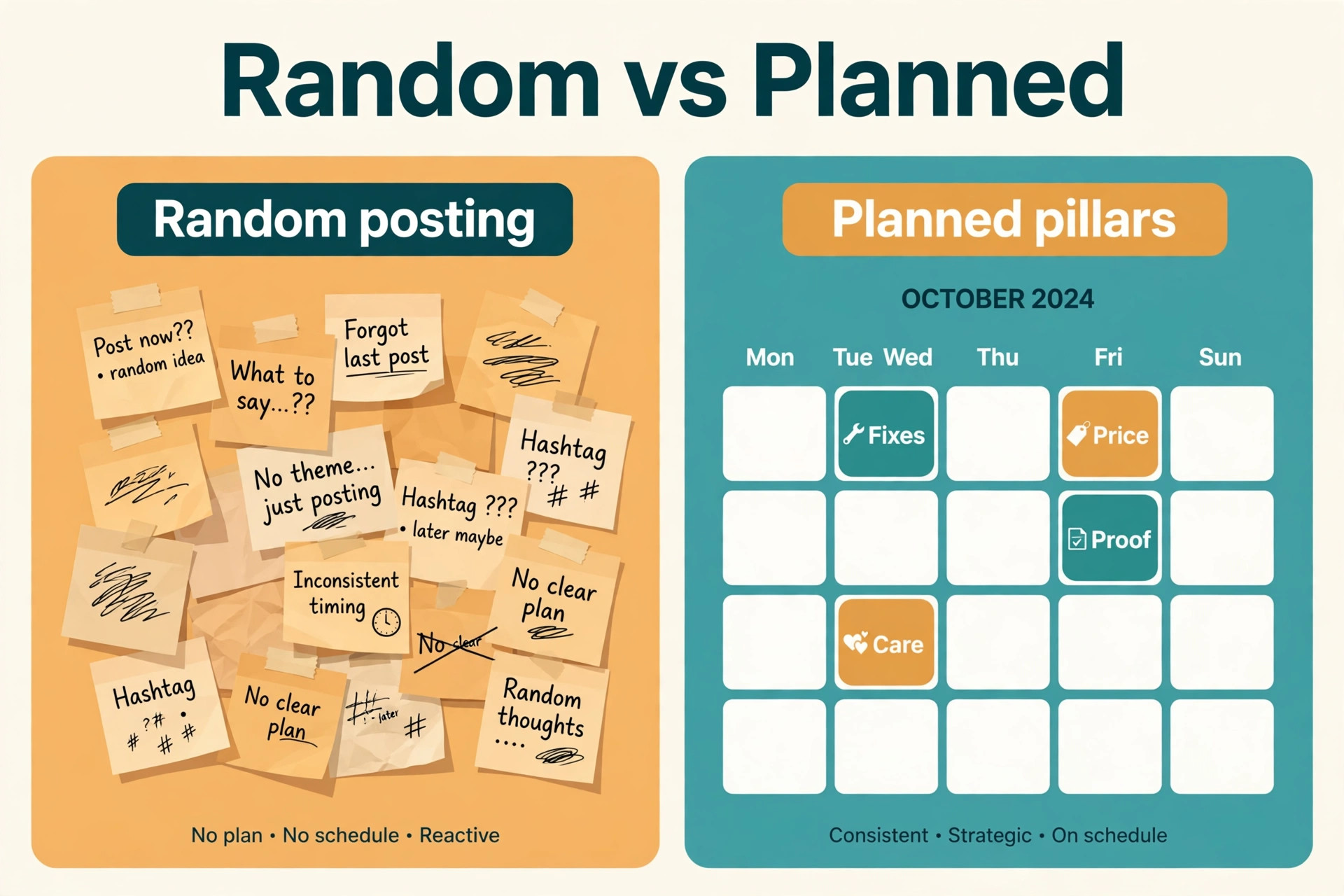
Random posting fails because it has no memory. A tip about drain care in March, a team photo in June and a price note in October do not add up to authority on any one subject. A buyer searching for a specific problem finds one thin page, clicks away, and never learns that the firm handles that problem every week. Search engines face the same problem. They need a cluster of related pages, linked together, to understand what a business is genuinely expert in.
Random posting also fails on time. When content depends on inspiration, it stops during busy weeks, which are exactly the weeks when new buyers are searching most. A strategy fixes this by separating planning from writing. Topics are chosen once a month, drafts are built from real job notes, and publishing follows a calendar that survives a busy diary. The goal is not more content. The goal is content that keeps working after the week it was published.
A third failure is the missing handoff. Many service posts end with nothing, or with a vague invitation to get in touch. A buyer who has just read a useful answer still needs a low friction next step, such as a checklist download, a quote form tied to that service, or a short call booking page. Without that step, good content earns attention and loses the enquiry. Every piece in this guide is therefore judged by three tests. Does it answer a real buyer question. Does it show proof. Does it offer a clear next step.
Building a Content Marketing Strategy Small Service Business Owners Can Keep
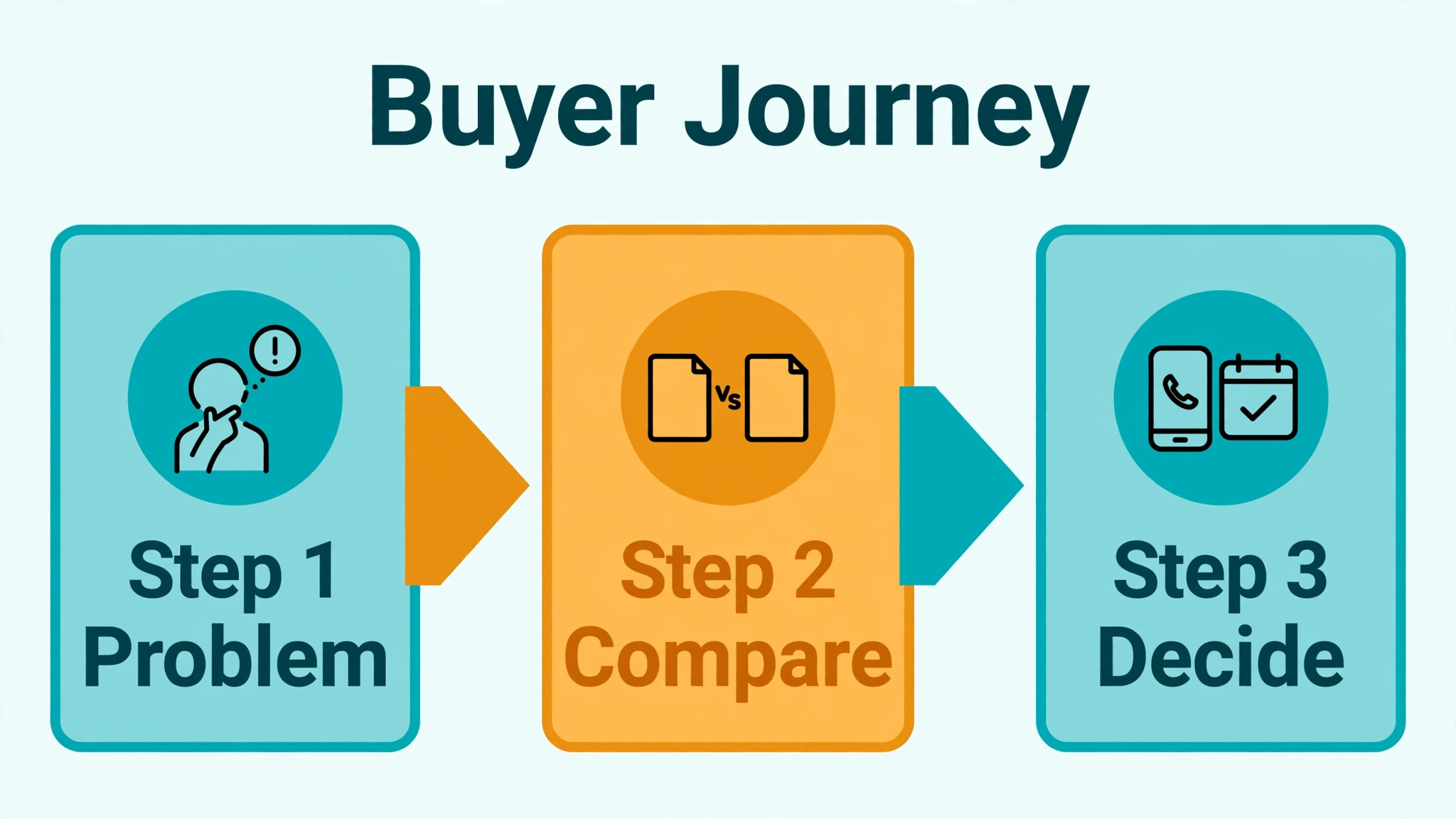
Start with the buyer journey for one service, not for the whole business at once. That narrow start is what makes a content marketing strategy small service business owners can run without a marketing team. A cleaning company, a bookkeeping firm and a tree care crew sell different outcomes, but their buyers move through the same stages. First comes a problem the buyer can name, such as a blocked drain, a tax deadline or a dangerous branch. Then comes comparison, where price, trust and availability matter more than features. Then comes a decision, where a short call or a written quote settles it. Content should match those stages, not fight them.
Write down the questions buyers ask at each stage, using real sources. Call logs, enquiry emails, review replies and the questions staff answer on site are better than keyword tools alone. A question bank of 30 real questions is worth more than a list of 300 guessed keywords, because each real question already carries intent. Group those questions into themes, and those themes become the pillars described in the next section.
Next, choose one anchor format and one support format, and no more. For most service firms, the anchor is a written guide page that can rank and be quoted, and the support format is either short video or email, depending on where buyers already pay attention. A firm that tries to run a blog, a podcast, a video channel and three social feeds at once will run none of them well. Depth in two formats beats thinness in five, and depth is what buyers remember.
Finally, set a capacity rule before setting a calendar. Count the honest hours available each month, including editing and publishing, not just writing. If the true number is eight hours, the plan must fit eight hours. A plan that needs twenty hours will collapse in month two and leave a gap that looks worse than a slower, steady rhythm. This guide is built around an eight hour monthly baseline, with options to scale up, not a fantasy schedule.
Choose Four Pillars That Cover Every Buyer Decision
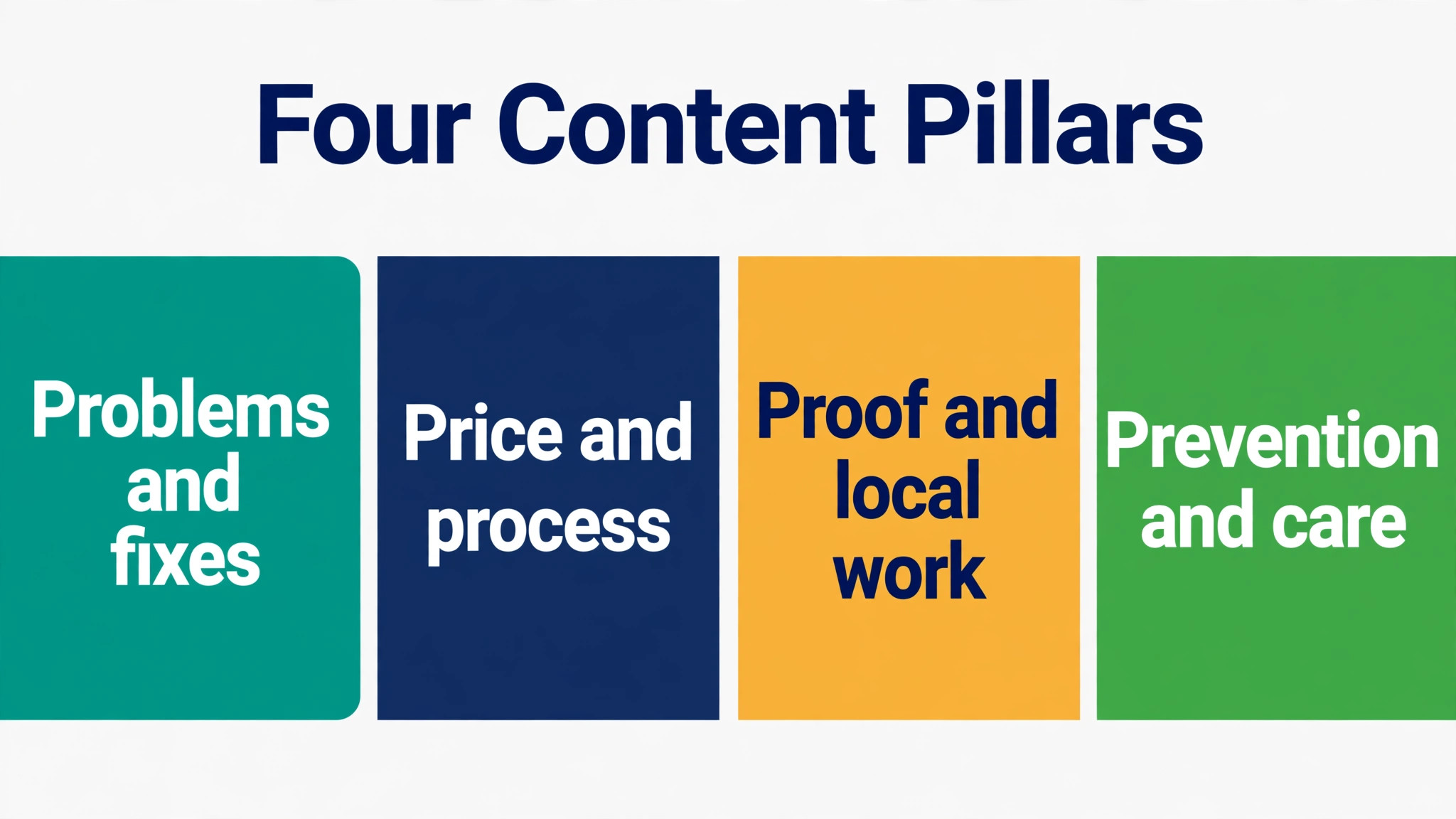
Pillars are the recurring themes every piece of content maps back to. Three to five pillars work for most small service firms. Fewer, and the content feels narrow. More, and the business never builds depth in any one theme. The table below shows a pillar set that works across service trades, with the buyer question each pillar answers.
| Pillar | Buyer question it answers | Example pages |
|---|---|---|
| Problems and fixes | What is wrong, and can it be fixed without a full replacement | How to tell a blocked drain from a broken pipe, five signs a roof leak needs urgent attention |
| Price and process | What will it cost, and what happens on the day | What a deep clean costs and what is included, how a bookkeeping onboarding week works |
| Proof and local work | Has this firm done this job near me, well | A recent job with before and after photos, a case note on a difficult site |
| Prevention and care | How do I avoid this problem again | Seasonal maintenance checklists, care guides for new installations |
Each pillar needs a flagship page, a page long and complete enough to be the best answer on that subject for local buyers. Cluster pages then support it, answering narrower versions of the same question and linking back to the flagship. That structure helps buyers navigate, and it helps search engines see a coherent body of work rather than isolated posts.
Pillars should also reflect what the business wants to be known for, not just what it already does. In practice, a content marketing strategy small service business owners build around pillars is easier to brief, easier to refresh, and easier to explain to staff. A firm trying to win more commercial cleaning work should weight its pillars toward commercial jobs, even if residential work pays the bills today. Content is a hiring signal for future work, and the pillar mix is where that choice is made, quietly, month by month.
The Publishing Cadence That Survives a Busy Month
Cadence is a promise to future buyers, so it must be modest enough to keep. For a one or two person service firm, one anchor page a month plus one email and four short social posts drawn from that page is a strong baseline. That is roughly eight hours of work, and it produces a library of twelve substantial pages in a year. A larger firm with a dedicated marketer can move to two anchor pages a month, but the structure stays the same.
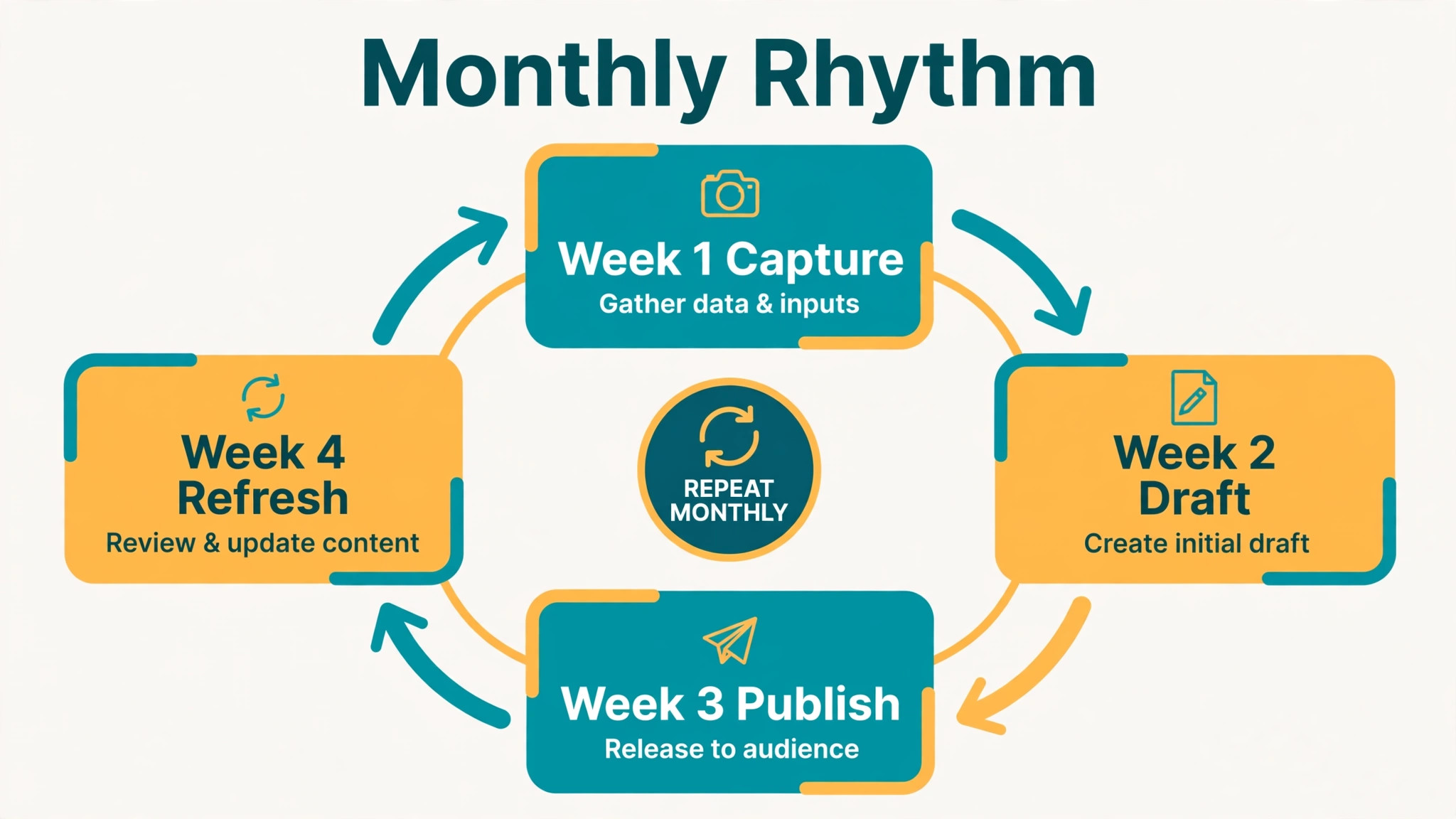
The monthly rhythm has four parts, and together they are the operating core of a content marketing strategy small service business teams can repeat without reinventing the plan each month. Week one is capture, logging questions from calls and jobs into the question bank. Week two is drafting, turning one question into a full answer with proof and a next step. Week three is publishing and distribution, putting the page live, sending it to the email list, and posting the short versions. Week four is refresh, updating an older page with new photos, prices or answers, so the library improves instead of only growing.
Batch planning helps, but batch writing often hurts. Planning a month of topics in one sitting keeps the calendar full, while writing closer to the publish date keeps prices, availability and examples current. Leave one slot each quarter unplanned, for a timely topic such as a regulation change, a storm response or a seasonal rush. A calendar with no slack will either break or force the business to ignore the topic buyers are actually asking about that week.
| Month rhythm | Task | Time guide |
|---|---|---|
| Week one | Capture questions from calls, jobs and reviews | One hour |
| Week two | Draft one anchor page with proof and a next step | Three to four hours |
| Week three | Publish, email and post short versions | Two hours |
| Week four | Refresh one older page and review results | One to two hours |
Turn One Answer Into Five Assets Without Rewriting It Five Times
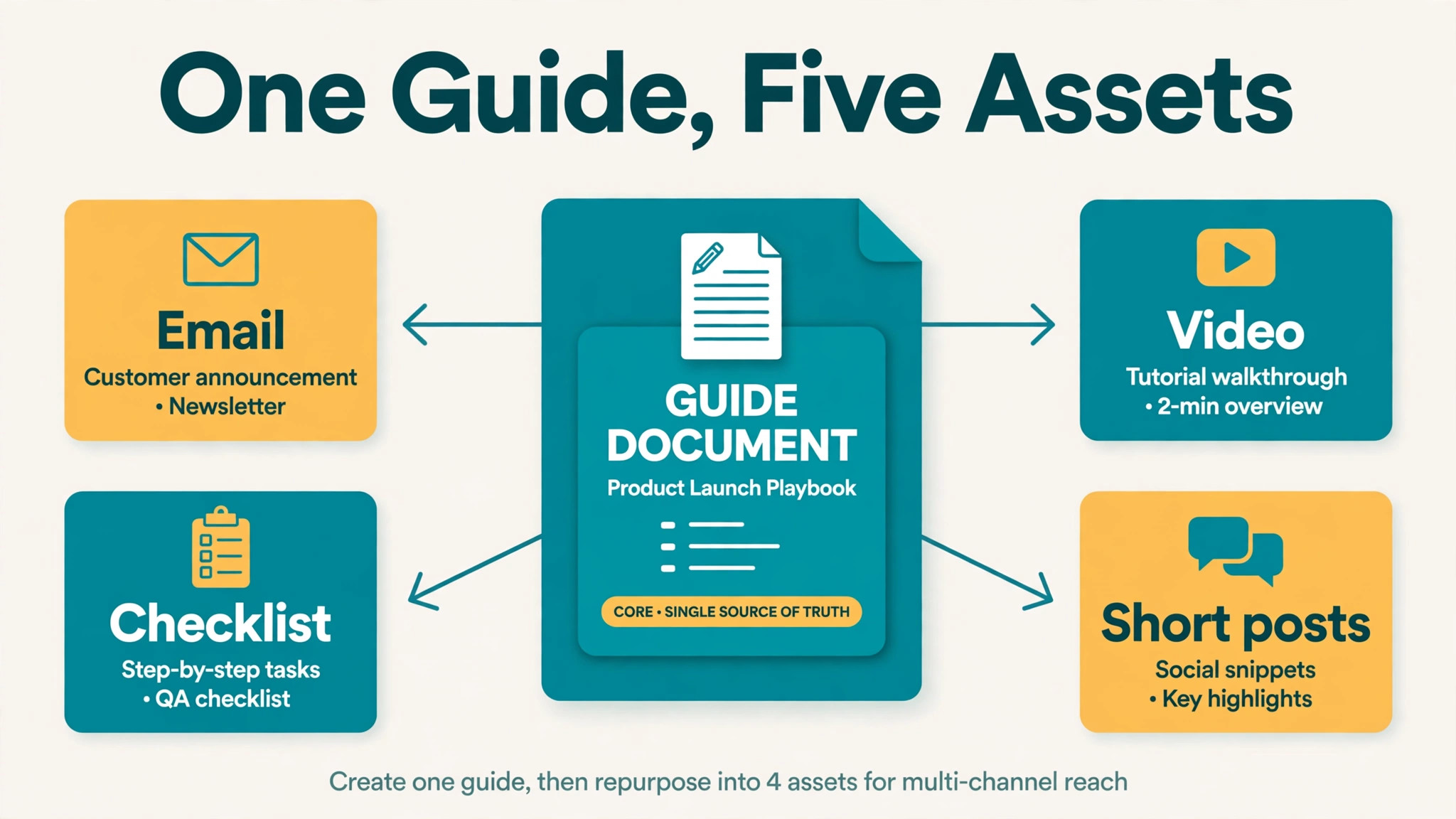
Repurposing is where small firms get their time back. One strong anchor page already contains the research, the examples and the structure. The job is to cut it into formats that fit different places buyers look, not to start from scratch each time. The table below shows a repurposing plan that a single owner can run without new research.
| Asset | Made from | Where it goes |
|---|---|---|
| Anchor guide page | Full answer with proof, price range and next step | Website, search |
| Email version | The three most useful points plus one job photo | Email list |
| Short video or voice note | One step from the guide, shown or explained in under two minutes | Social feeds, business profile |
| Checklist download | The steps as a printable list | Lead capture form on the guide page |
| Three short posts | One surprising fact, one common mistake, one before and after note | Social feeds across the month |
| Review reply or FAQ update | The same answer in plain language | Business profile, FAQ page |
The rule for repurposing is that each version must stand alone. A social post that only says a new guide is live helps no one. A post that gives one useful step, with a link for the full guide, earns attention even from people who never click. That distinction is the difference between distribution and noise, and it is why repurposing plans should be written into the calendar, not left to chance.
Photography deserves a note here. Service buyers trust photos from real jobs far more than stock images, and a phone photo taken on site, with permission, beats a polished generic image every time. Build a habit of taking three photos per job, one before, one during and one after, and storing them with the job address and date removed for privacy. That small habit supplies a year of proof material without a photo shoot.
Lead Capture That Fits How Service Buyers Actually Decide
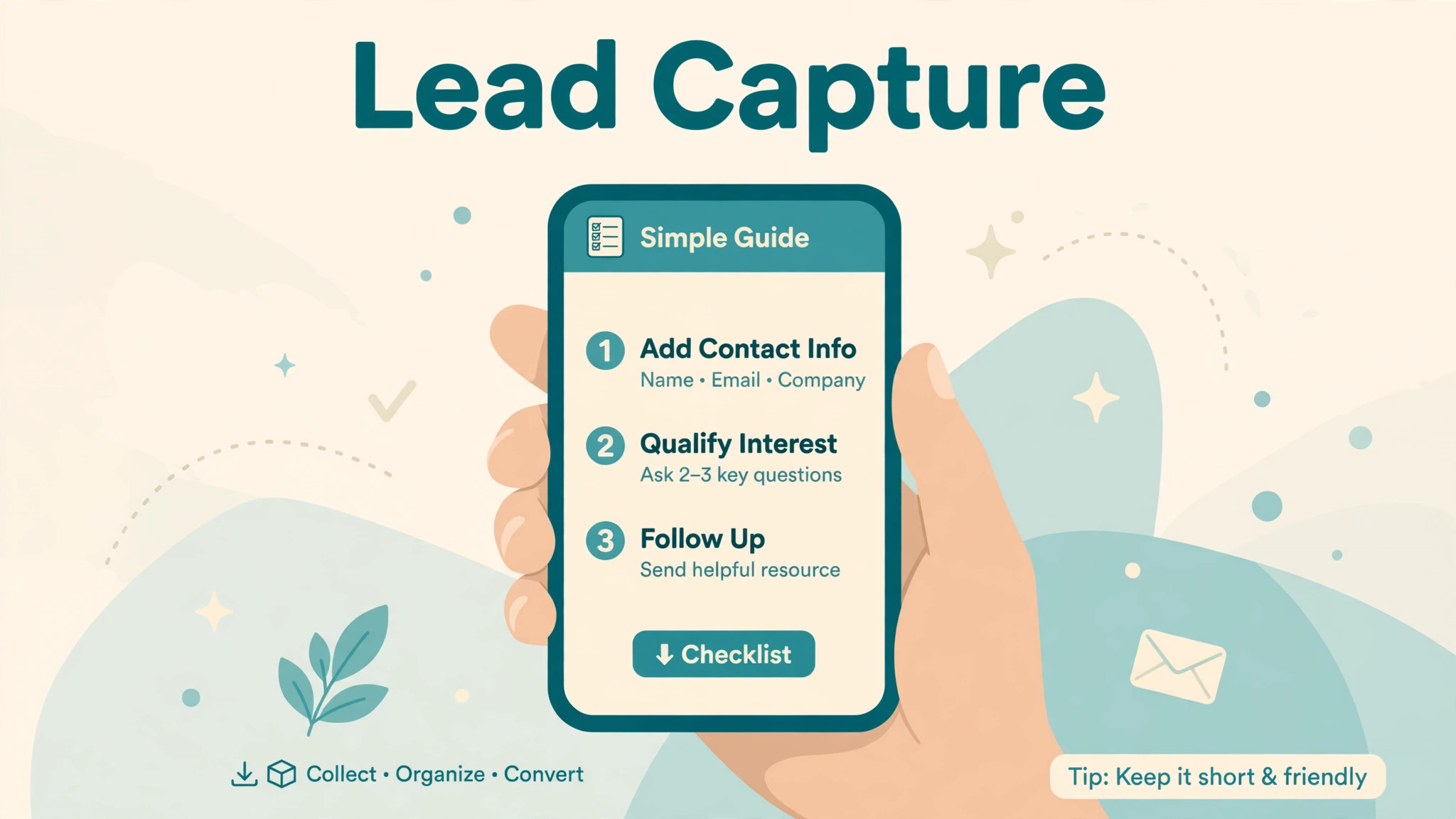
Service buyers rarely buy from a first page visit. They compare, check availability, and return later, often on a different device. Lead capture is the bridge between that first useful answer and the later enquiry, and it must be lighter than a sales pitch. A checklist, a price guide or a seasonal care sheet works because it is useful even if the buyer never hires the firm.
Place the offer inside the content, not only at the end. A reader halfway through a drain care guide is ready for a drain maintenance checklist. A reader at the end of a pricing guide is ready for a quote form. Match the offer to the page, and keep the form short. Name and email, or name and phone, is enough at this stage. Every extra field cuts completions, and a service firm can ask the detailed questions on the call.
Follow up matters more than the download itself, and it is the step most often missing from a content marketing strategy small service business owners describe as not working. A new subscriber should receive the promised file at once, a short welcome note that names the service they read about, and one useful follow up within a week, not a daily sales sequence. Service trust is built slowly, and an inbox that feels like pressure will undo the goodwill the content created. Measure lead capture by qualified enquiries that mention the content, not by raw download counts.
A simple lead capture checklist keeps this honest. Does the page offer something the reader can use this week. Is the form short enough to finish on a phone. Does the follow up arrive within a day. Does the offer match the page subject. If any answer is no, fix that page before writing a new one, because a library that captures nothing is a library, not a marketing system.
Measure What Pays, Not What Flatters
Vanity metrics mislead service firms more than most businesses, because a viral tip can bring thousands of views and zero local enquiries. The measures that matter are tied to the diary. How many enquiries mention a guide, a checklist or a video. How many quote requests come from a specific service page. How many returning visitors arrive through branded search, meaning they remembered the firm name after reading. Those numbers are smaller and far more useful.
Set a quarterly review, not a weekly panic. That patience is part of a content marketing strategy small service business owners can defend to themselves when early numbers look small. Content for services compounds over months, as pages rank, get linked from a business profile, and get shared by happy customers. A page that looks quiet in week two can become the top enquiry source in month four. Judge a pillar after a quarter of steady publishing, and judge a single page after it has had time to be found, linked internally and refreshed once.
The review should answer four questions. Which pillar brought the most qualified enquiries. Which page has the highest enquiry rate, not just the most views. Which pages are stale, with old prices or missing photos. Which buyer questions are still unanswered in the question bank. Those answers set the next quarter, and they stop the business from chasing formats that flatter the ego and starve the diary.
| Measure | What it tells you | Where to find it |
|---|---|---|
| Enquiries naming content | Whether content is reaching buyers ready to talk | Enquiry form notes, call logs |
| Quote requests per service page | Which services content actually sells | Form source, page analytics |
| Branded search growth | Whether buyers remember the firm | Search Console queries |
| Checklist downloads to enquiries | Whether lead capture is working | Email tool, enquiry logs |
| Refresh impact | Whether updating old pages beats writing new ones | Before and after enquiry counts |
Mistakes That Waste a Small Content Budget
The most expensive mistake is writing for other businesses in the trade instead of for buyers. A page full of trade terms impresses competitors and confuses the homeowner or manager who needs help. Write for the buyer who has the problem, in the words they used on the phone, and save trade detail for a short section that proves expertise without blocking the answer.
The second mistake is hiding price. Buyers who cannot find even a range will assume the worst and call a competitor who published one. A range with the factors that move it, such as property size, access or urgency, is honest and useful, and it filters out buyers who were never a fit. Exact prices change, so give ranges, explain what moves them, and check the vendor or supplier position before quoting a figure that may date quickly. Where a price depends on a site visit, say so plainly and explain what the visit covers.
The third mistake is publishing without proof. Claims about quality mean little without a job photo, a review quote with permission, or a specific outcome. One real example per page is enough, provided it is specific. Name the problem, the constraint and the result, without naming the customer. Vague success stories read as filler, while one concrete job note reads as evidence.
The fourth mistake is stopping at three months. Service content is often judged too early, during the quiet period before pages rank and referrals compound. Commit to four quarters before deciding the strategy has failed, and use that time to refresh, distribute and capture leads properly. A strategy abandoned at month three was never really tested.
A 90 Day Starter Plan With a Content Calendar Template
The first ninety days should build the system, not just publish pages. Days one to thirty are for foundations. Build the question bank, choose pillars, write one flagship page for the most profitable service, and set up one lead capture offer. Do not publish five thin pages in this phase. One strong page, distributed well, teaches the business more than five rushed ones.
Days thirty one to sixty are for rhythm. Publish a second anchor page, repurpose the first page into email and short posts, and refresh the flagship with a new photo or answer. Start the weekly capture habit, logging questions after jobs while they are fresh. By day sixty, the calendar should feel like a routine, not a project.
Days sixty one to ninety are for proof and review. Publish a third anchor page, ideally a proof page built around a recent job, and run the first quarterly review using the measures above. Decide which pillar earns more attention next quarter, which page needs a price update, and which question becomes the next flagship. That review turns a ninety day experiment into a continuing system.
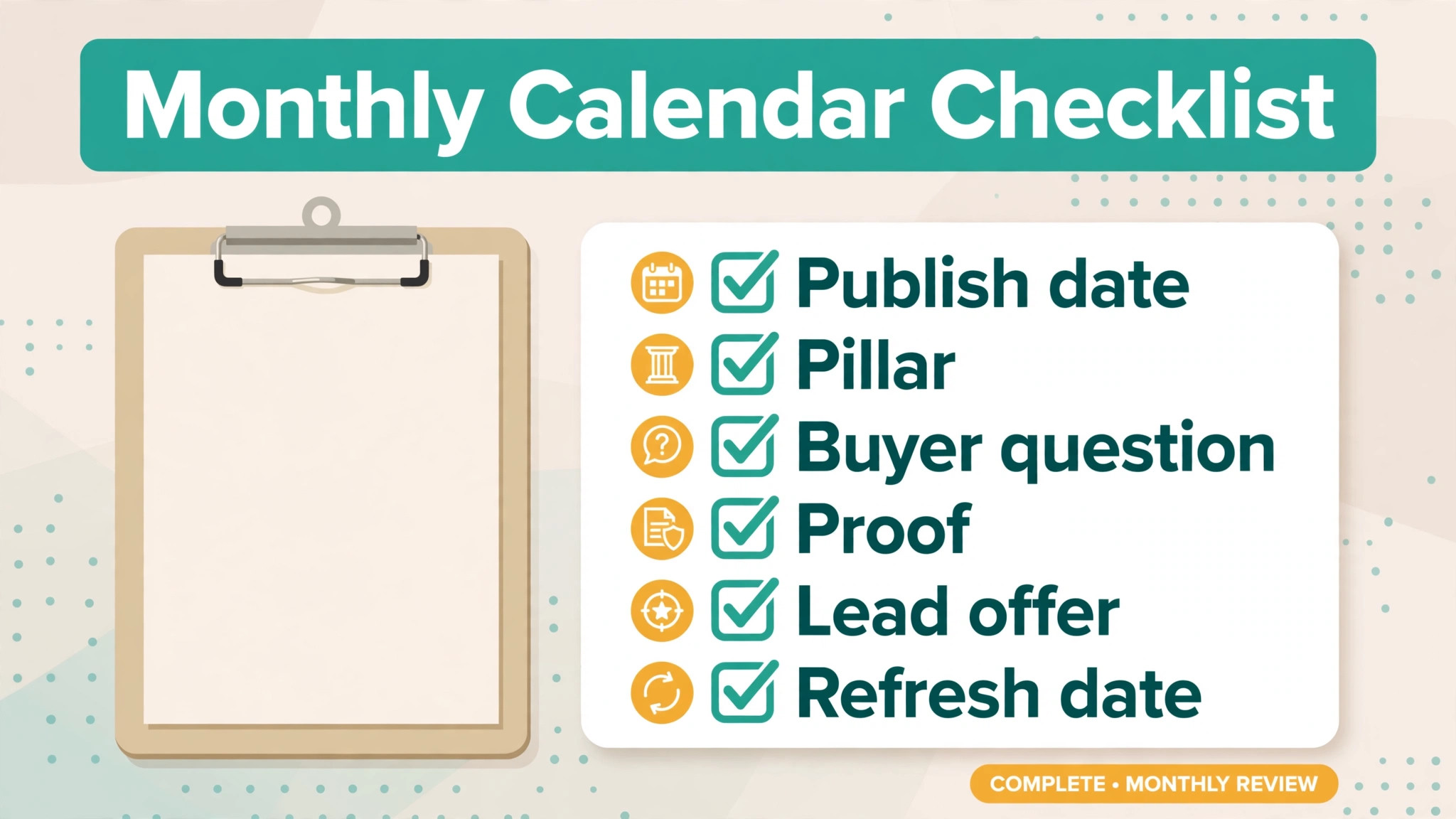
The content calendar template below fits on one page and can be kept in a spreadsheet or a notebook. Copy it for each month, and fill the topic column from the question bank, never from a blank page.
| Calendar field | What to enter | Example |
|---|---|---|
| Publish date | One anchor date per month | First Tuesday of the month |
| Pillar | One of the four pillars | Price and process |
| Buyer question | The exact question, in buyer words | What does a deep clean cost |
| Anchor page title | Working title for the guide | Deep clean costs and what is included |
| Proof to include | Job photo, review quote or outcome | Recent flat clean, before and after photos |
| Lead offer | Checklist, guide or quote form | Deep clean checklist download |
| Repurposing plan | Email, short video, three posts | Email week one, posts weeks two to four |
| Distribution | Business profile, email, social feeds | Profile post, email, two social posts |
| Refresh date | When to revisit the page | Three months after publishing |
A slipped month does not mean the plan has failed. It usually means the capture step broke down first. When ideas stop being written down in the week they occur, the next month starts empty and the team falls back on whatever feels urgent that day. The repair is small and boring on purpose. Spend one hour listing the questions clients asked in the last month, match each one to a pillar, and draft the next four pieces from that list alone. Momentum returns faster from a short list of real questions than from a fresh brainstorm about topics nobody asked for.
The second repair is to protect one publishing slot that nothing else can take. Pick the least busy morning of the week and treat it as a client appointment. Draft in that slot, publish in the next one, and let the remaining slots flex around client work. Teams that guard a single slot publish more in a year than teams that plan five slots and keep none of them. Consistency here is not about volume. It is about a reader being able to trust that new help will arrive, and a search engine being able to see a steady record of it.
Frequently Asked Questions
How long does a content marketing strategy small service business owners run take to bring enquiries?
Expect early signals in six to twelve weeks, such as more branded searches and enquiries that mention a page, and steadier enquiry flow after three to six months of consistent publishing. The timeline depends on local competition, how often buyers search for the service, and whether each page has a clear next step. A page that answers a rare, high value question can bring an enquiry sooner than a page chasing a crowded general term.
How many hours a month does a realistic plan need?
Eight hours a month supports one anchor page, one email and short posts drawn from that page, plus one refresh. That is the baseline used throughout this guide. Firms with more capacity can add a second anchor page, but they should protect the refresh and distribution time first, because an unpublished draft and an undistributed page both earn nothing.
Should a service firm blog, make video, or do both?
Start with written guides, because they rank, can be quoted, and are easy to repurpose. Add short video only for steps that are clearer shown than described, such as a maintenance task or a before and after walkthrough. A firm that tries every format at once usually produces thin work in all of them, while a firm that masters one anchor format can add a second format from strength.
What should a service firm write about first?
Write about the most profitable service, and the question buyers ask most often before booking it. Price, process and proof pages for that service will earn more than general tips about the trade. Once that service has a flagship page and a cluster of supporting pages, move to the next most profitable service, and repeat the pattern.
How do I get content ideas without staring at a blank page?
Use the question bank. Log questions from calls, enquiry emails, site visits and reviews every week, and choose the next topic from that list. Buyers have already told the business what they need to know, so the blank page problem usually means the business is not capturing those questions, not that it has run out of subjects.
Do I need to hire a writer or an agency?
Not at first. An owner or a senior staff member who knows the jobs can dictate or draft the core answer, and an editor can shape it for reading and search. Agencies help later, when the system works and needs more volume, or when a firm needs design and distribution help it cannot hire for. Hiring before the pillars and question bank exist usually buys volume without direction.
How do I handle prices in content without quoting wrong figures?
Publish ranges, name the factors that move the price, and date the page so readers can see when it was last checked. Explain what a site visit or a quote covers where the final price depends on inspection. Review price pages each quarter, and update them before they mislead a buyer. A range that is honest beats a precise figure that is out of date.
What is the single biggest sign a content plan is working?
Enquiries that mention the content by subject, such as a buyer who says they read the pricing guide or downloaded the checklist. Traffic alone can come from anywhere, but an enquiry that names a page proves the content reached a buyer, answered a worry, and carried them to contact. Track those mentions in the enquiry log, and let them guide the next quarter.
The 90 Day Test, Not a Slogan
A content marketing strategy small service business owners keep is judged by the diary after ninety days, not by the number of posts published. If the question bank is growing, one pillar has depth, each page offers a usable next step, and at least some enquiries mention the content, the system is working and deserves another quarter. If none of that is true, the fix is usually narrower, not louder. Fewer pillars, one anchor format, a shorter form, or a price range that buyers can actually use.
Start with the next buyer question that arrived this week. Answer it fully, show one real job, offer one useful download, and put it where the next buyer with the same question will find it. Then do the same next month, and the month after. That steady accumulation, pillar by pillar, is how a small service firm becomes the obvious choice in its town, without pretending to be a media company. For a related first step, see Win Your First Ten Clients Without a Big Budget and How to Set Up a Referral Program for a Small Service Business, which pair naturally with a content system that turns readers into callers.
More Reading on Stratilyze
– Win Your First Ten Clients Without a Big Budget – How to Set Up a Referral Program for a Small Service Business – Switch From Mailchimp to MailerLite for a Small Business – Fix Gmail Going to Spam for a Small Business