
Zylo reports that enterprises use just 54 percent of the SaaS licenses they pay for, and that 79 percent of IT leaders saw a price increase at their last renewal. Those two numbers explain why so many small firms feel squeezed at renewal time. They are paying for seats nobody opens, then accepting a higher price for the same bundle. If you want to know how to negotiate software renewal small business contracts with confidence, start with your own usage data, not with the quote the vendor sends you.
A renewal is not a bill you must pay. It is a new buying decision, and it arrives with a deadline you can prepare for. The vendor knows your contract end date, your seat count, and your payment history. Most buyers walk into that conversation knowing only the total on the invoice. That imbalance is fixable in a few hours of preparation, and it is worth fixing, because software is now one of the largest recurring costs in a small firm after payroll and rent.
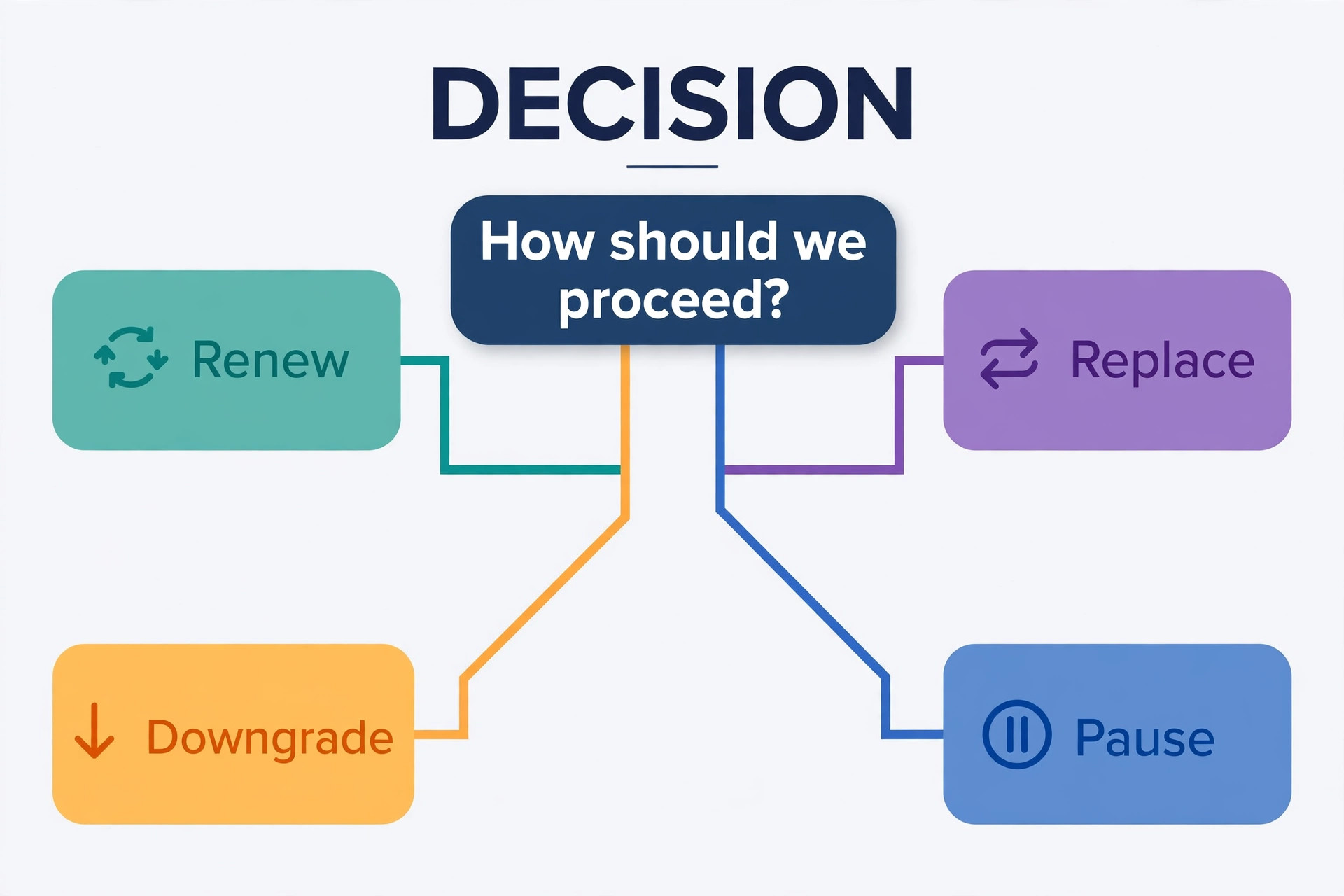
This guide walks through the full process in order. You will audit usage, set a walk away point, compare the real unit price you paid last term with the new quote, and negotiate terms that matter as much as price, such as price caps, seat flexibility, and exit rights. You will also get a decision table that sorts every renewal into renew, downgrade, pause, or replace, so the conversation ends with a decision instead of another year of autopilot spending.
The approach here works even if you have no procurement team and no formal buying process. It works for a five person firm and for a forty person firm alike. What matters is that you review before you renew, and that you never let a renewal date pass without a decision.
How to Negotiate Software Renewal Small Business Owners Actually Control
The first move in learning how to negotiate software renewal small business terms is to take the renewal off autopilot. Find the contract, not just the invoice. Note the end date, the notice period for non renewal, the auto renewal clause, the current seat count, the price per seat, and any uplift clause that lets the vendor raise the price each year. If any of those facts are missing, ask the vendor for the agreement in writing before you discuss price at all.
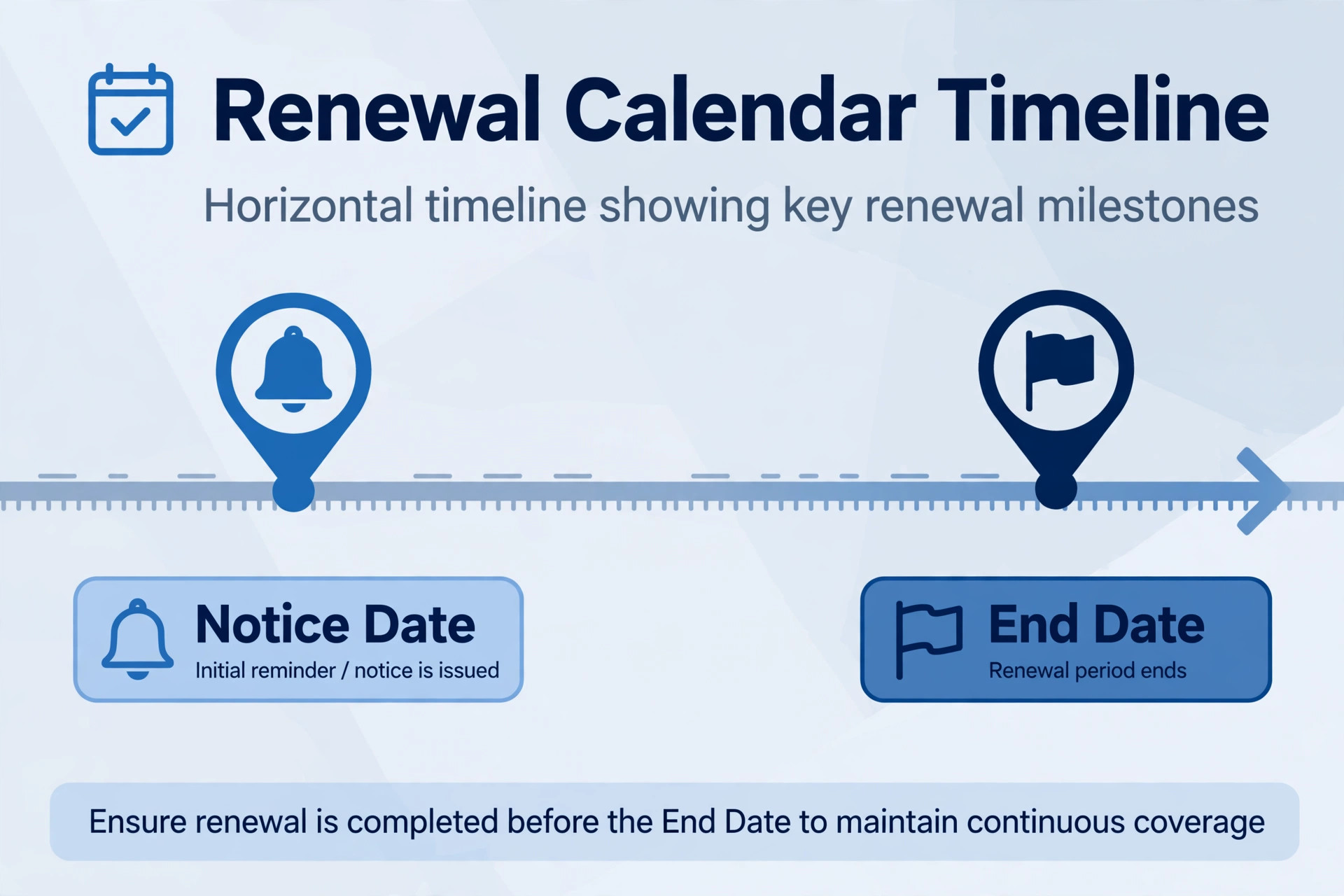
Put the renewal on a calendar 90 days before the end date, and set a second reminder at the notice deadline. Guides for renewal negotiation commonly recommend starting the internal review 90 to 120 days before renewal, and earlier when the product is expensive or hard to replace. That window matters because it gives you time to audit usage, test an alternative, and still walk away if the terms are poor. A negotiation started two weeks before expiry is not a negotiation. It is a plea for an extension.
Decide who owns the renewal before anyone talks to the vendor. In a small firm that owner is often the founder or the operations lead, with input from the team that uses the tool daily. Ask those users three questions. Which features do you use every week. Which features have you never opened. What would break tomorrow if this tool disappeared. The answers to those questions are the raw material for every later ask, from seat cuts to tier downgrades.
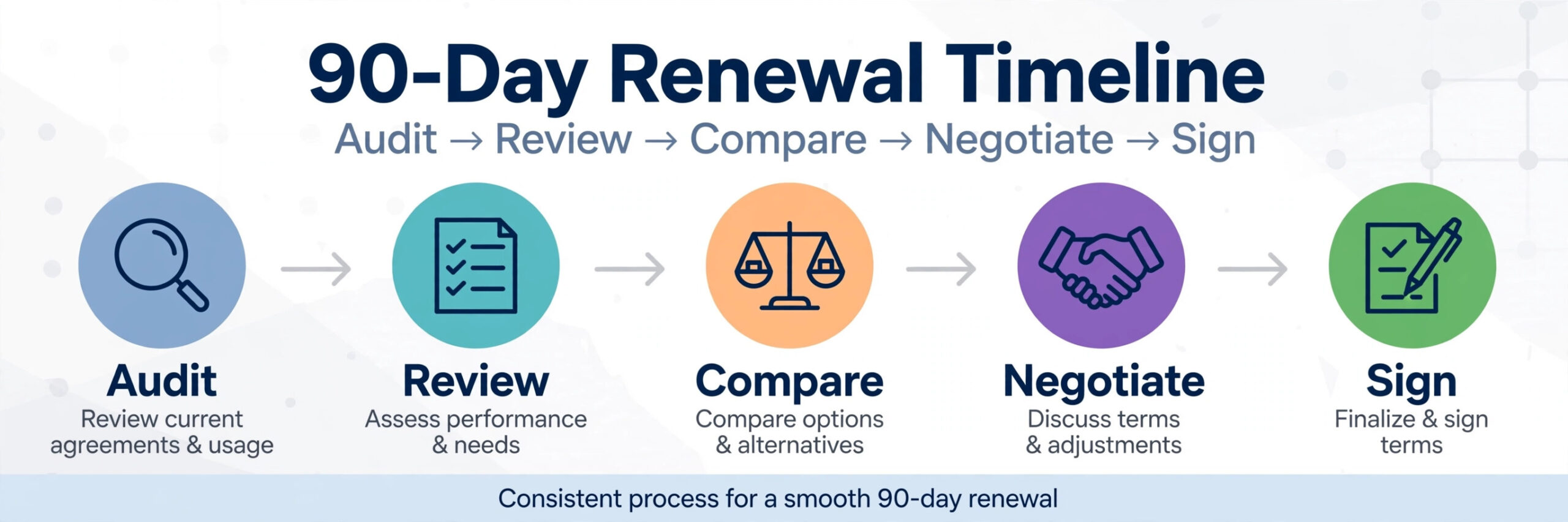
Start 90 Days Early and Read the Contract First
A renewal conversation that starts early changes the balance of power, and it is the first practical lesson in how to negotiate software renewal small business contracts. The vendor still wants your business, but you now have time to test an alternative, to let a trial run with real work, and to return with a credible comparison. Vendors can tell the difference between a buyer who has tested a rival product and a buyer who is bluffing about one, so use the early window for a real evaluation, even a short one, on the tool that matters most.
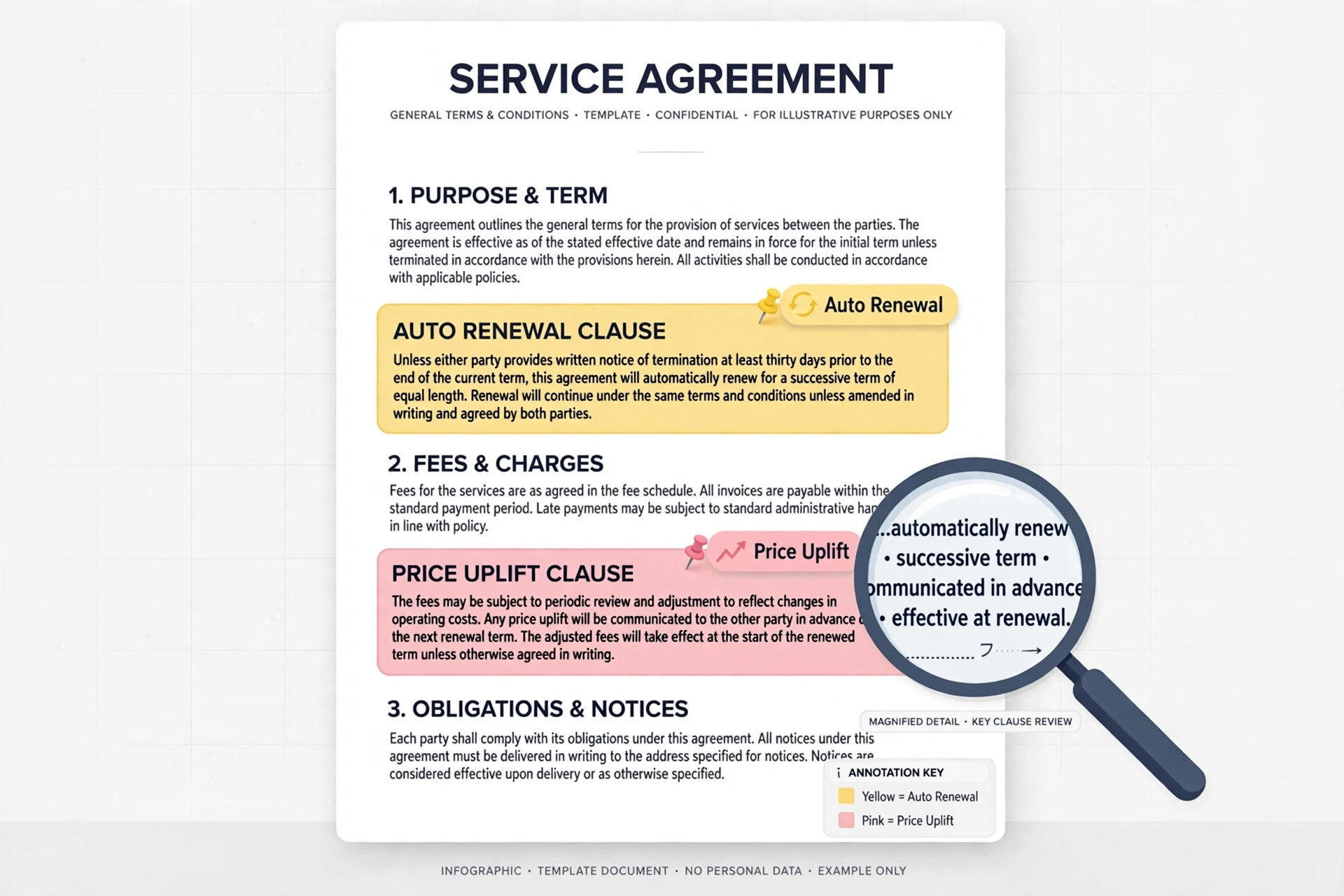
Read the auto renewal clause with care. Some contracts renew automatically unless you give notice 30, 60, or even 90 days before the end date. Missing that window can lock you into another full term at the new price, even if you intended to cancel. Write the notice date into your calendar the day you sign any contract, and treat it as a hard deadline. If the clause is unclear, ask the vendor to confirm the notice date and the notice method in an email you can keep.
Check the uplift clause next. Many SaaS contracts allow an annual price increase, sometimes tied to an index and sometimes set at the vendor discretion up to a stated cap. Compare the new quote against last term unit price, not against list price. List price is a number the vendor controls, and a discount off a raised list price can still leave you paying more than last year. The honest comparison is dollars per user per month last term against dollars per user per month in the new quote, for the same seats and the same tier.
Look for terms that quietly add cost. These include minimum seat commitments, bundled products you did not ask for, support tiers folded into the renewal, data storage limits with overage fees, and implementation fees for a product you already use. Ask the vendor to itemise the quote by seat, tier, add on, and fee, so each line can be challenged separately. An itemised quote also makes it easy to compare a rival offer line by line, instead of comparing two totals that hide different inclusions.
Audit Usage Before You Ask for Anything
Usage data is the strongest evidence in a renewal conversation, and it is the evidence most small buyers skip. Pull the admin report for the last 90 days before you contact the vendor. Count active users, logins, and feature use, and separate daily users from people who logged in once and never returned. Zylo reports that enterprises use just 54 percent of licenses, and while a small firm ratio will differ, the pattern is familiar. Dormant seats are common after hiring changes, role changes, and trial signups that were never cleaned up.
Right size before you negotiate price. If 22 percent of seats are dormant, cut those seats first, then negotiate the per seat price for what remains. Negotiating a discount on a bloated seat count saves less than cutting the count and then negotiating, and it leaves the waste in place for next year too. Ask the vendor to confirm whether seats can be reduced at renewal without penalty, and whether mid term reductions are possible, because that answer shapes how aggressively you can trim.
Talk to the team before you cut. A seat that looks dormant in a report may belong to a seasonal worker, a part time contractor, or a manager who reviews work monthly rather than daily. A quick check with team leads avoids cutting access someone needs once a quarter and then paying an urgent add on fee to restore it. The goal is a seat count that matches real work, not the lowest number the report suggests.
Document the audit in one page, because that page is the evidence base for how to negotiate software renewal small business pricing. Record the current seat count, the active seat count, the dormant seat count, the features used by each team, and the annual cost of the dormant seats. That page becomes your opening statement in the negotiation. It turns a general request for a discount into a specific case. You paid for a set number of seats, you used a smaller number, and you want the renewal priced on the smaller number, with flexibility to add seats back if hiring resumes.

Price Levers Beyond the Headline Discount
A lower headline price is only one lever in how to negotiate software renewal small business deals, and sometimes it is not the most valuable one. Annual billing in place of monthly billing often earns a discount, and one renewal guide reports that a 10 to 20 percent discount in exchange for a 12 month commitment is a common outcome. Treat that figure as a guide reported by a third party, not a promise, and confirm the exact discount on the vendor page or in the written quote before you rely on it in a budget.
Multi year deals deserve a careful look. Zylo benchmarks reported in its negotiation guide put average savings at 16 percent for 12 month contracts, 14 percent for 24 months, and 13 percent for 36 months. Those figures cut against the assumption that longer always means cheaper, and they argue for weighing a shorter term with a price lock against a longer term with a deeper first year discount. A multi year deal is reasonable when the tool has proved its value, demand is predictable, and the vendor gives real price protection and flexibility in return.
Ask for a price cap or an uplift limit in writing. A cap that limits annual increases to a stated percentage turns next year renewal from a surprise into a budget line. If the vendor will not cap the increase, ask for a fixed price for the full term, or for a notice period that lets you exit if an increase passes a threshold you name. Predictability has cash value for a small firm, and it is worth trading a small discount for a firm cap.
Trade non price value when the rate will not move. Training seats, premium support for a fixed period, additional storage, an extra integration, or a free pilot of a new module all have real internal cost. Ask for the value of each item in writing, so you can compare a discount offer against a value offer honestly, rather than accepting a bundle of extras you will never use.
Payment terms are a lever too. Quarterly billing instead of annual prepayment can protect cash flow, even at a small premium, and a vendor that insists on annual prepayment should be asked what discount that prepayment earns. If cash flow is tight, a smaller discount with quarterly billing may beat a larger discount that drains the bank account in January. Run both versions through a simple cash flow check before you accept either one.

Contract Terms That Cost More Than Price
Price gets the attention in how to negotiate software renewal small business terms, but contract terms decide what the price buys you over time. The auto renewal clause is first. Ask to remove it, or to shorten the notice window, so every renewal forces a fresh review. If the vendor refuses, set your own calendar reminder well before the notice date and treat that date as the real renewal deadline, not the contract end date.
Seat flexibility is second. Ask whether you can reduce seats at renewal, add seats mid term at the same unit price, and pause seats for seasonal staff. A contract that only lets seat counts grow will cost more every year as roles change. A contract with true up and true down rights, even with a notice period, keeps the seat count tied to headcount instead of tied to the highest headcount you ever reached.
Data and exit terms are third. Ask how you export your data, in what format, and within what time frame if you cancel. Ask whether exported data includes history and attachments or only current records. A tool that holds your client records, project history, or financial data should never be renewed without a tested export route, because the cost of leaving without your data can exceed a year of subscription fees. Test the export during the renewal window, while you still have full access.
Service levels and support terms are fourth. For a tool your daily work depends on, ask what uptime commitment the vendor gives, what support hours apply, and what response time applies to a critical fault. For a tool that holds sensitive data, ask about security practices and data processing terms, and confirm who owns the data you create in the product. These terms rarely appear in a renewal quote, which is exactly why you should ask for them before you sign.
Termination rights are fifth. Ask what happens if the business shrinks, if the vendor is acquired, or if a key feature is retired. A termination for convenience clause, even with a notice period, is valuable insurance for a small firm whose headcount and revenue can change quickly. If the vendor will not offer it, a shorter term is the practical substitute, because a one year commitment limits the damage from any of those events.
Renew, Downgrade, Pause or Replace
The decision table below is the centre of this guide. Work through it for each renewal, not for the software stack as a whole, because two tools from the same vendor can deserve different answers. Score usage, seat count, and contract terms honestly, and let the row choose the action before you talk price. A tool that scores well on daily use but poorly on contract terms may still renew, but with a term fix as the condition.
| Situation you find | Best action | What to ask for first |
|---|---|---|
| Daily use, seats match headcount, terms fair | Renew | Price cap for next term |
| Daily use, but seats exceed active users | Downgrade seats | Same unit price on fewer seats |
| Seasonal use, needed a few months a year | Pause or monthly term | Pause rights or monthly billing |
| Low use, rival does the job for less | Replace | Trial period and export help |
| High price, locked term, no exit route | Renegotiate terms first | Shorter term or exit clause |
| Critical tool, no rival, price rising | Renew with protection | Fixed price and cap |
A downgrade is not a failure. Dropping a tier, cutting seats, or removing a bundle module can save more than a discount on the full package, and it often improves the tool, because the team stops paying attention to features they never needed. Ask the vendor to price each tier separately, and check whether the lower tier still includes the integrations and export options you rely on. A cheaper tier that drops your accounting integration is not a saving.
A pause deserves a direct question. Some vendors offer a pause or a seasonal plan, and some do not, but many will offer monthly billing for a product normally sold annually if you ask during renewal. Monthly billing costs more per month, yet it can cost far less over a year for a tool used in only two quarters. Compare the annual total under monthly billing against the annual contract, not the monthly rate against the annual rate, because that comparison is the one that decides the cash outcome.
Replacement deserves a trial, not a guess. Run the rival tool on real work for two weeks, with the team that will use it daily, and measure the same tasks you measure in the current tool. A rival that looks cheaper on a pricing page can cost more in training time, migration work, and lost integrations. A rival that passes a real trial gives you a ceiling price for the renewal conversation, even if you stay. That ceiling is often worth more than any discount script.
Run the Conversation in the Right Order
Open with usage, not with a discount request, when you practise how to negotiate software renewal small business renewals. Present the audit page, the active seat count, and the unit price you paid last term. Then state the outcome you want, in one sentence, such as a renewal on the active seat count at last term unit price with a cap on next year increase. A specific ask gives the vendor something to approve, while a general request for a better price invites a small concession and a quick close.
Let silence do work after your ask. Vendors often need approval for a non standard price, and that approval takes time. Do not fill the pause with a weaker ask. If the vendor counters with a discount tied to a longer term or a larger seat count, check it against the decision table before you answer. A discount that requires you to buy back the dormant seats you just cut is not a discount at all. It is a return to the bloated count with a lower unit price.
Get every agreement in writing before you pay. The email that confirms the price, the seat count, the term, the cap, and the payment schedule is the contract that matters when the next invoice arrives. Check the invoice against that email line by line when it comes, because renewal invoices sometimes revert to list price or restore a removed add on. If the invoice differs, raise it before payment, not after, since a paid invoice is harder to correct than an unpaid one.
Keep a record of the conversation for next year. Note the vendor contact, the date, the ask, the counter, and the final terms, and file it with the contract. Next year renewal starts from that note, not from scratch, and the vendor will know that you keep records. A buyer with a file is harder to overcharge than a buyer who starts every renewal by asking what the price is this year.
When to Walk Away or Switch
Walking away is a real option, and naming it early makes every other option stronger. Set a walk away point before the call, based on unit price, total cost, and contract terms, and write it down. If the vendor cannot meet that point, the decision is already made, and you do not need to decide under pressure on the call. A walk away point also protects you from a discount that looks good in the room but fails your budget when the invoice arrives.
Switching costs deserve an honest estimate. Count migration time, training time, data export and import work, and the weeks when the team runs slower on a new tool. Add any overlap period when you pay for both tools. Compare that total switching cost against the annual saving from the switch, and check how many months the saving takes to repay the switch. A switch that pays back in three months is a strong move. A switch that pays back in eighteen months may be better deferred until the next renewal, when the current contract ends cleanly.
Timing a switch matters as much as choosing one. The cleanest switch starts before the current contract ends, with a trial overlap and a tested export, so the team is never without a working tool. A switch forced by a missed notice date, with the old contract already renewed, is the most expensive kind, because you pay for both tools for a full term. That is why the calendar reminder matters more than any negotiation script. The reminder is what turns a switch from a crisis into a plan.
If you do switch, close the old contract properly. Confirm cancellation in writing, confirm the final invoice amount, confirm the data export window, and confirm that auto renewal is off. Check the bank statement for the next two billing cycles to catch a stray charge. A switch that leaves the old subscription billing is not a saving, and it is a common one, because cancellation confirmations are filed and never checked.
Mistakes That Quietly Raise the Renewal Price
The most expensive mistake in how to negotiate software renewal small business contracts is renewing without reading the contract. Auto renewal, uplift clauses, minimum seats, and bundled add ons all hide in the agreement, not in the invoice, and each one can raise the price without any visible change to the product. A thirty minute contract read before the renewal call catches more cost than an hour of haggling over a discount percentage.
The second mistake is negotiating price before cutting seats. A discount on seats nobody uses feels like a win and leaves the waste untouched. Cut first, then negotiate, and repeat the audit every renewal, because headcount and roles change between renewals. A seat count set two years ago rarely matches the team today, and the gap grows silently with every renewal that skips the audit.
The third mistake is accepting a multi year deal for the first year discount alone. A deep first year discount with no price protection in later years can cost more over the full term than a smaller discount with a firm cap. Read the price for every year of the term, not just the first, and ask what happens to the unit price if you reduce seats in year two. A deal that punishes shrinkage is a poor fit for a growing or changing small firm.
The fourth mistake is letting one renewal set the price for a whole stack. Vendors sometimes bundle several products into one renewal with a single discount, which hides a price rise on one product behind a saving on another. Ask for itemised pricing for every product in the bundle, and judge each product against the decision table on its own. Bundling is fine when each product earns its place. It is a problem when it hides a weak product behind a strong one.
The fifth mistake is paying the invoice without checking it. Renewal invoices can restore list price, re add a removed module, or bill the old seat count after a cut was agreed. Check the invoice against the written agreement before payment, and query any difference in writing. That check takes ten minutes and it catches errors that otherwise repeat for a full term.

Tools That Help You Track Renewals
You do not need an enterprise procurement platform to run this process, but a tracking tool helps once the stack passes ten or twelve subscriptions. Spend and contract tools in this category typically offer a renewal calendar, contract storage, usage reporting, and alerts before notice dates. Compare them on whether they track the notice date as well as the end date, because the notice date is the deadline that actually controls your options.
For a smaller stack, a spreadsheet with one row per contract does the same job, provided someone owns it and reviews it monthly. Columns to include are vendor, product, end date, notice date, seat count, unit price, total cost, owner, and decision. A monthly review of that sheet, even a fifteen minute one, catches renewals before they become urgent, and it gives the owner time to run the audit and the trial that a good negotiation needs.
Accounting tools also help, because the bank and card statements show the real subscription spend, including tools nobody remembers buying. QuickBooks, Xero, and FreshBooks all surface recurring transactions in reports that can be compared against the renewal sheet, and a mismatch between the two lists is often the first sign of a forgotten subscription or a duplicate tool. Reconcile the sheet against actual spend at least once a quarter, and cancel anything that appears on the statement but not on the sheet, or that serves no current team.
Choose the tracking method the team will actually maintain. A complex platform nobody updates is worse than a simple sheet someone reviews monthly, because it creates false confidence that renewals are covered. The best system is the one with a named owner, a monthly review date, and a rule that no renewal is paid without a decision recorded in the sheet. That rule alone removes most autopilot spending.
Frequently Asked Questions
How early should a small business start a software renewal negotiation
Start the internal review 90 to 120 days before the end date, and earlier for an expensive or hard to replace product. Use the first weeks for the usage audit and the contract read, and the middle weeks for a rival trial if replacement is on the table. That schedule leaves time to meet the notice deadline with a decision already made.
What discount should a small business ask for at renewal
Ask based on your data, not on a standard percentage. A guide reported by a third party suggests 10 to 20 percent for a 12 month commitment is a common outcome, but that figure is a guide only, so confirm the exact offer on the vendor page or in the written quote. A stronger ask is a renewal on your active seat count at last term unit price, with a cap on next year increase, because that ask ties price to usage and to predictability at once.
Should a small business accept a multi year software deal
Accept one only when the tool has proved its value, demand is predictable, and the vendor gives price protection and seat flexibility in return. Check the unit price for every year of the term, and check what happens if you reduce seats in a later year. Zylo benchmarks reported in its guide put average savings at 16 percent for 12 month terms, 14 percent for 24 months, and 13 percent for 36 months, which argues against assuming longer always means cheaper.
What should I do if the vendor will not move on price
Trade non price value and better terms. Ask for training, premium support for a fixed period, extra storage, an integration, a price cap, seat flexibility, or a shorter term. Each of those items has real value, and a shorter term with a cap can be worth more than a small discount locked into a long term. If neither price nor terms move, run the decision table again and check whether replacement or a tier downgrade beats renewal.
Can a small business remove an auto renewal clause
You can always ask, and many vendors will shorten the notice window or remove the clause for a direct request, especially when you raise it at renewal rather than mid term. If the vendor refuses, protect yourself with your own calendar reminder set well before the notice date, and confirm the notice date and method in writing. Your own reminder is the practical substitute when the clause stays in place.
What is the single most useful renewal habit for a small firm
Keep a renewal sheet with one row per contract, including the notice date, and review it monthly with a named owner. That habit catches every renewal before it becomes urgent, and it forces a decision on each contract instead of a silent renewal. Combined with a usage audit before each renewal, it removes most of the waste that renewal guides report across software stacks.
More Reading on Stratilyze
For related cost guides, read cost of FreshBooks for small business monthly and cost of Xero for small business monthly. For a switching workflow with the same discipline, see switch FreshBooks to Xero small business.