

Pick the wrong image generator and you pay for it every week, in tokens wasted on re-rolls, in images you cannot use commercially, and in a style that never quite matches the brief. Pick the right one and the tool disappears into the work. That is the whole question behind leonardo ai vs midjourney for image generation, and the answer is not a single winner. It is two tools built for different creators, and the right choice follows what you actually make.
The short version is this. Leonardo AI wins on breadth, price flexibility, and control. It offers a free plan, more than 80 models, custom training, team plans, and a developer API. Midjourney wins on pure image quality and style direction, with one house model that produces the most art directed images in the field. A creator who needs volume, privacy, and variety should start with Leonardo. A creator who needs the most beautiful single image should start with Midjourney.
Prices here come from vendor pages and comparisons checked in late 2026, so check the vendor pricing page before committing, because both companies change plans and model versions often. Midjourney is now on V8.2, and Leonardo bundles its own Lucid Origin model with outside models such as GPT-Image-2, Nano Banana 2, and Seedream 5.0 Pro. Model names move fast, but the structural differences between the two tools change slowly, and those differences are what this guide compares.
Leonardo AI vs Midjourney for Image Generation at a Glance
| Point | Leonardo AI | Midjourney |
|---|---|---|
| Free plan | Yes, 150 fast tokens a day | No free plan or trial |
| Entry paid plan | Essential 12 dollars a month | Basic 10 dollars a month |
| Mid tier | Premium 30 dollars a month | Standard 30 dollars a month |
| Top tier | Ultimate 60 dollars a month | Mega 120 dollars a month |
| Image models | 80 plus, own and third party | One house model, V8.2 |
| Private generations | From Essential, 12 dollars | Pro and Mega only, Stealth mode |
| Team plans | Yes, from 72 dollars for 3 seats | None |
| Video | Text and image to video, with audio | Image to video only, silent clips |
| Custom training | Yes, 10 to 50 models a month | No |
The table shows the structural gap clearly. Leonardo is a platform that bundles many models, while Midjourney is a single model done very well. Leonardo gives a free plan and private work at 12 dollars a month. Midjourney charges 60 dollars a month before your images are private. Those two facts alone decide the choice for many creators, before image quality is even discussed.
The pricing detail matters too. Leonardo Essential costs 10 dollars a month billed yearly or 12 dollars monthly, Premium costs 24 dollars billed yearly or 30 monthly, and Ultimate costs 48 dollars billed yearly or 60 monthly. Midjourney Basic costs 8 dollars a month billed yearly or 10 monthly, Standard costs 24 dollars billed yearly or 30 monthly, Pro costs 48 dollars billed yearly or 60 monthly, and Mega costs 96 dollars billed yearly or 120 monthly. At the mid tier both cost 30 dollars a month, but what that 30 dollars buys is very different, as the sections below show.
The Verdict by Creator Type
| Creator type | First pick | Why |
|---|---|---|
| Hobbyist testing AI images | Leonardo AI | Free plan with 150 tokens a day costs nothing to try |
| Illustrator and concept artist | Midjourney | Strongest style direction and most art directed output |
| Small business and marketer | Leonardo AI | Private work, many models, and team plans at a low price |
| Game and product asset maker | Leonardo AI | Custom training keeps characters and products consistent |
| Social content creator | Leonardo AI | Free start, video with audio, and fast iteration |
| Fine art and poster seller | Midjourney | Native 2K images and a distinctive house look |
A hobbyist has nothing to lose by starting with Leonardo, since the free plan gives 150 fast tokens a day with commercial use included. An illustrator who sells a distinctive look should start with Midjourney, since its house model produces images that clients recognise and pay for. A small business that needs private generations for client work should start with Leonardo, because private work costs 12 dollars a month there and 60 dollars a month on Midjourney.
A game developer or product designer who needs the same character or product across hundreds of images should start with Leonardo, since custom model training is the only reliable way to hold consistency at volume. A poster seller who needs large, detailed, art directed images should start with Midjourney, since native 2K output and the house aesthetic suit print. Most creators will try both, and the table above tells them which one to try first.
Pricing: What Your Money Actually Buys
At the entry tier, price per prompt is roughly the same. Midjourney Basic at 10 dollars and Leonardo Essential at 12 dollars each buy about 200 four image prompts a month, so the cheaper tool is not the deciding factor. The deciding factor is what sits around the generations. Leonardo Essential gives 8,500 fast tokens a month and private creations. Midjourney Basic gives 3.3 hours of fast GPU time and public generations.
At the mid tier, the gap widens in Leonardo favour on paper. Midjourney Standard at 30 dollars a month gives 15 hours of fast GPU time plus unlimited Relax image generation. Leonardo Premium at 30 dollars a month gives 25,000 tokens plus unlimited relaxed image generation on select models, such as Lucid Origin. Both offer unlimited relaxed images at this tier, but Leonardo adds video, 3D generation, and music tools that Midjourney does not offer at any price.
At the top tier, the comparison flips by use case. Leonardo Ultimate at 60 dollars a month gives 60,000 tokens plus relaxed video generation with synced audio on select models. Midjourney Pro at 60 dollars a month gives 30 hours of fast GPU time plus Stealth mode for private generations, and Mega at 120 dollars gives 60 hours.
A creator who needs video with audio should pay Leonardo, and that is one of the clearest splits in the whole leonardo ai vs midjourney for image generation comparison. A creator who needs maximum fast GPU time for still images should pay Midjourney. Companies earning more than 1 million dollars a year must use Midjourney Pro or Mega, while Leonardo shows no revenue threshold on its pricing page.

Image Quality and Models
Midjourney runs one house model, currently V8.2, and that focus is its strength. Every image carries the same polished, art directed look, with strong composition, lighting, and texture. The model handles illustration, photography, and stylised art with a consistency that no multi model platform matches. Style References, Moodboards, and Personalization let a creator steer the look precisely, and native 2K images from V8.1 onward suit print work. The weakness is variety. If the house look does not suit the brief, there is no second model to switch to.
Leonardo runs the opposite strategy. It bundles its own Lucid Origin model with outside models such as GPT-Image-2, Nano Banana 2, Nano Banana Pro, Krea 2 Turbo, and Seedream 5.0 Pro, listing more than 80 models on paid plans. A creator can pick the best model for each job, switching from a photoreal model to an illustration model to a text heavy model in one session. The weakness is inconsistency. Quality varies by model, and the creator must learn which model suits which brief.
The practical test is simple. Generate the same five prompts on both tools, and judge the results against your actual brief rather than against each other. A fantasy book cover, a product photo, a logo concept, a social post, and a poster will each favour a different tool, and the pattern across five prompts tells you more than any review.
Most creators find Midjourney wins on two of the five and Leonardo wins on three, and the split follows the brief rather than the brand. Save the best result from each prompt, show them to a friend who does not know which tool made which, and ask which image they would click or buy. That blind test is worth more than a week of reading comparisons.

Workflow, Interface, and Speed
Midjourney runs in the browser at midjourney.com and in Discord, with a clean editor that focuses on prompting, varying, upscaling, and editing. The Edit Model, released with V8.2, replaces the older Omni Reference and Character Reference, and lets a creator place characters from up to four reference images into new scenes. Image to video animates a still image into a 5 second silent clip, extendable to around 21 seconds. The workflow is simple, fast, and focused, which suits creators who want to generate and move on.
Leonardo runs in the browser with a fuller studio. It offers image editing, upscaling, canvas tools, and a prompt generation helper, plus text to video and image to video with synced audio on select models. The interface carries more options, which means a longer learning curve, but also more control. A creator who wants to iterate inside one tool, from generation to edit to upscale to video, will find Leonardo the fuller workshop.
Speed depends on the plan. Both tools offer fast and relaxed generation, with relaxed being slower and cheaper. Midjourney Standard and above include unlimited relaxed images, which suits a creator who generates in bulk and can wait. Leonardo Premium and Ultimate include unlimited relaxed images on select models only, so heavy users should check which models qualify before choosing a tier. For a creator who generates a few images a day, the difference is small. For a creator who generates hundreds, it decides the monthly bill.
Learning curve is the other workflow difference. Midjourney can be learned in an evening, because the interface is small and the choices are few. Leonardo takes a week to learn well, because the model library, the canvas tools, and the training options each need an hour of practice. A creator who wants results tonight should start with Midjourney. A creator who wants control over every part of the pipeline should invest the week in Leonardo, because the control pays off on every project after that.
Privacy, Commercial Rights, and Teams
Privacy is the biggest cost gap in this comparison. Midjourney keeps images public unless you pay for Stealth mode on the 60 dollar Pro plan or the 120 dollar Mega plan. Leonardo makes generations private from the 12 dollar Essential plan. That is a five times difference for confidential client work, and it is the single strongest reason a commercial creator picks Leonardo first.
Commercial rights are simpler. Both tools grant commercial use on paid plans, and Leonardo includes commercial use even on its free plan. Midjourney has no free plan, so every generation is a paid generation with commercial rights attached. Check the current terms on each site before selling client work, since terms change, but neither tool blocks commercial use on a paid tier.
Teams are a Leonardo only feature. Team plans start from 72 dollars for 3 seats, with a shared token pool, permission controls, and SOC2 compliance. Midjourney offers no team or enterprise plans at any price, which means a studio must manage separate individual accounts. A team of three or more that shares assets and budgets should treat this as a deciding factor, not a footnote.
Video, 3D, and Audio: Where the Tools Diverge
Image generation is the shared job, but the two tools diverge sharply beyond it, and that divergence decides the choice for creators who work across media. Leonardo offers text to video and image to video with the latest models, including Seedance 2.5, FLUX 3 Video, MiniMax H3, Hailuo 2.3, and Kling 3.0 Turbo, with synced audio on select models.
It also offers 3D generation through Rodin V2 and music and audio generation, which means one subscription can cover stills, motion, sound, and 3D assets for a small production. A creator who makes a product launch video, a social ad with a voiceover, or a game asset pack can stay inside one tool from first image to final export.
Midjourney offers image to video only. It animates a still image into a 5 second silent clip, extendable to around 21 seconds, with no text to video and no audio. The video tool is good at what it does, and the motion quality matches the house image quality, but it is a companion feature rather than a production system. A creator who needs a talking head video, a product animation with sound, or a 3D asset will not find it on Midjourney at any price.
The practical consequence is simple. A creator who works in stills only can choose on image quality alone. A creator who works across stills, video, and audio should weigh the extra media heavily, because buying a separate video tool and a separate audio tool costs more than the price gap between the two image tools. The leonardo ai vs midjourney for image generation comparison is really a comparison of two different product scopes, and the wider scope wins whenever the brief goes beyond a single still image.
Who Should Pick Which Tool
The decision comes down to four questions. Do you need a free plan to start. Do you need private generations on a small budget. Do you need custom training or a team plan. And do you need video with audio. If the answer to any of the first three is yes, Leonardo is the pick, and that is the short answer most creators need from the leonardo ai vs midjourney for image generation debate. If the answer to all of them is no, and image quality is the only thing that matters, Midjourney is the pick.
A creator who makes social content, product mockups, and client work on a budget should choose Leonardo, because the free plan, the 12 dollar private tier, and the model variety cover every job at a low price. A creator who makes art prints, book covers, and concept art where the image itself is the product should choose Midjourney, because the house model produces the most distinctive and art directed images available.
The honest middle path is to use both. Generate the hero image on Midjourney, generate variations, textures, and supporting assets on Leonardo, and keep the monthly cost under 50 dollars by combining Leonardo Essential with a Midjourney month when a project needs it. Many working creators do exactly this, and it is cheaper than paying for the top tier of either tool alone.
How to Test Both Tools in One Week
Do not decide from reviews alone. Run a one week test with the same five prompts on both tools, and judge the results against your real work. Day one, sign up for Leonardo free and Midjourney Basic, and generate the same product shot, portrait, illustration, poster, and social graphic on each. Day two, test editing. Change the background on one image, fix a detail on another, and upscale the best result to print size. Day three, test consistency. Generate the same character in three different scenes using reference images on each tool, and note which one holds the face and outfit steady.
Day four, test the workflow you will actually use. Export the images, drop them into your design tool, and check the file size, resolution, and format. A tool that makes beautiful images in a format your printer cannot use is a problem, not a solution. Day five, test the cost. Count how many generations each prompt needed to get a usable result, and multiply by your monthly volume. A tool that needs three re-rolls per usable image costs three times its sticker price in practice.
By day seven you will know which tool fits your brief, your budget, and your patience. Keep the winner, cancel the loser, and revisit the test when either tool releases a major model update. The test costs about 10 dollars plus a week of evenings, and it saves months of paying for the wrong tool. The leonardo ai vs midjourney for image generation question is best answered with your own prompts, not with a review score, because your brief is the only brief that matters.
Monthly Cost Worked Out for Three Creators
| Creator | Leonardo plan | Midjourney plan | Monthly total |
|---|---|---|---|
| Hobbyist, 100 images a month | Free, 0 dollars | None | 0 dollars |
| Freelancer, 500 images a month | Essential, 12 dollars | None | 12 dollars |
| Freelancer, 500 images, needs privacy | Essential, 12 dollars | None | 12 dollars |
| Studio, 2,000 images, needs privacy | Premium, 30 dollars | None | 30 dollars |
| Artist, 500 images, needs best quality | None | Standard, 30 dollars | 30 dollars |
| Artist, 500 images, needs privacy | None | Pro, 60 dollars | 60 dollars |
| Team of 3, mixed work | Team, 72 dollars | None | 72 dollars |
| Heavy user, both tools | Premium, 30 dollars | Standard, 30 dollars | 60 dollars |
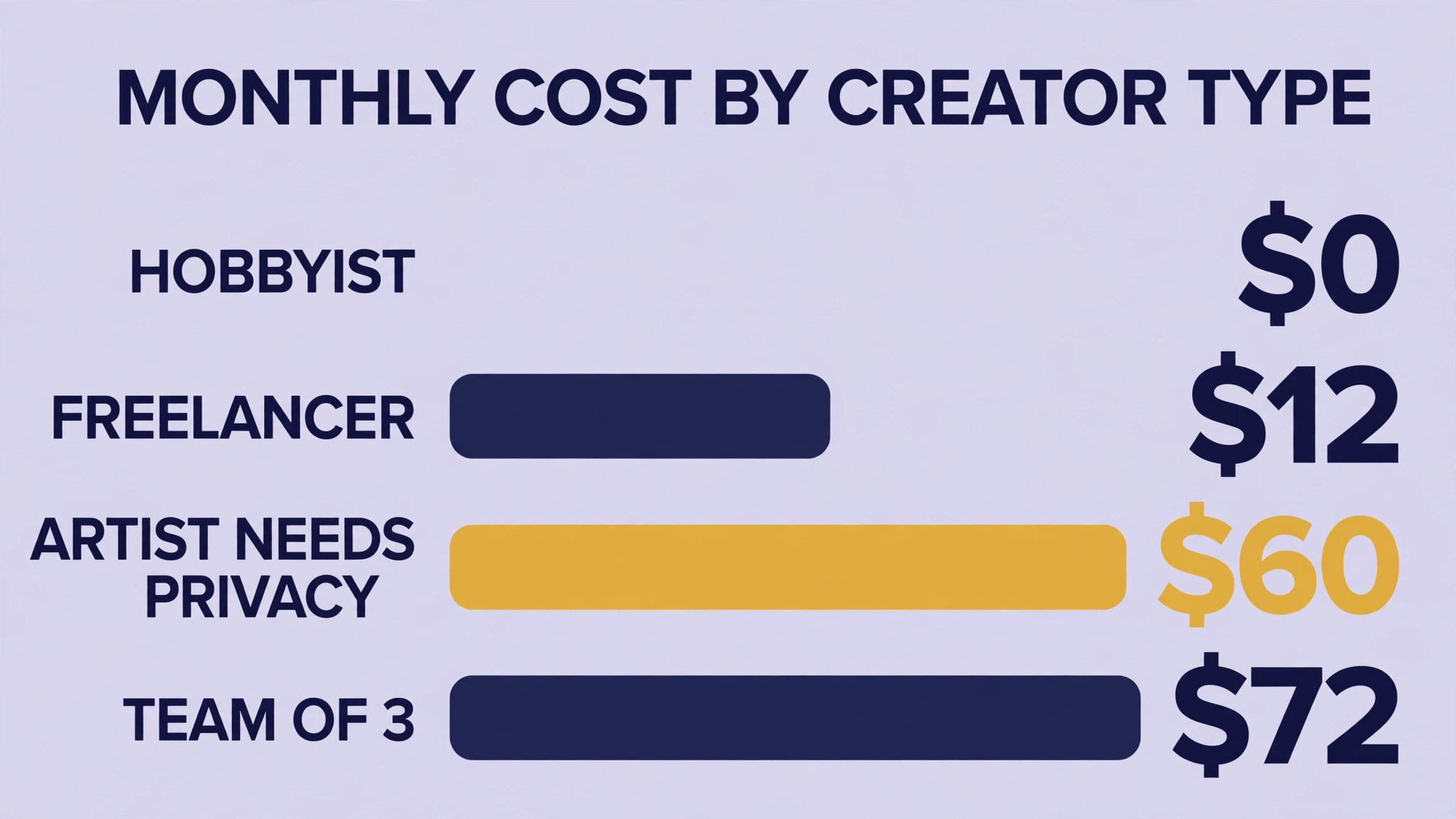
A hobbyist pays nothing on Leonardo and 10 dollars on Midjourney, which is why the free plan matters so much at the start. A freelancer who needs private work pays 12 dollars on Leonardo and 60 dollars on Midjourney, a 48 dollar gap every month. An artist who needs the best quality and privacy pays 60 dollars on Midjourney, and that is the honest price of the house model with Stealth mode.
A team of three pays 72 dollars on Leonardo and cannot buy a team plan on Midjourney at any price, which settles the question for studios. A heavy user who wants both tools pays 60 dollars for Leonardo Premium plus Midjourney Standard, and that combination covers more jobs than either top tier alone. Work out your own row in this table before subscribing, because the plan that fits your volume is the plan that saves you money.
Mistakes Creators Make When Choosing
The first mistake is choosing on image quality alone. Quality matters, but it is only one of six factors, and the other five decide whether the tool fits your work. A creator who picks Midjourney for quality and then discovers their client images are public has made an expensive mistake. A creator who picks Leonardo for price and then discovers the model they need is not included has made the same mistake in reverse. Judge the tool on your whole workflow, not on one beautiful image.
The second mistake is ignoring the token and GPU time model. Leonardo meters by tokens, Midjourney meters by GPU hours, and neither model is intuitive at first. A creator who generates at high resolution, with many variations, burns through either allowance fast. Check your usage after the first week, and move up a tier before you run out mid project. Running out of credits the day a client deadline lands is a failure of planning, not of the tool. The leonardo ai vs midjourney for image generation decision should include a usage check after week one, because the plan that looked cheap on the pricing page may not be cheap at your real volume.
The third mistake is skipping the commercial terms. Read the terms for the plan you actually buy, not the plan you wish you had. Check who owns the output, whether free tier images can be sold, and what happens to your images if you cancel. Both tools are fair on paid plans, but the details differ, and a creator who sells client work needs to know them before the first invoice, not after a dispute.
Switching Checklist
Use this checklist if you move from one tool to the other, and keep a copy with your project notes.
- Export your best prompts, style references, and reference images from the old tool.
- Rebuild your three most used styles on the new tool and compare the results side by side.
- Check privacy settings on the new plan before generating any client work.
- Test commercial terms, file formats, and print resolution on a real project.
- Move your team or client seats together, and confirm who can see shared assets.
- Keep both subscriptions for one month, then cancel the loser after the test week.
- Review your token or GPU usage after 30 days and adjust the tier to fit.
- Save your winning prompts and model choices in one document for the next project.
Related Guides
Keep exploring with these guides on Stratilyze:
- Midjourney vs DALL-E in 2026: Which Image Generator Wins?
- Midjourney vs Flux in 2026: Which AI Image Generator Wins?
- Leonardo Alternatives: 12 Best AI Image Generators in 2026
Frequently Asked Questions
Is Leonardo AI better than Midjourney?
Neither is better in general. Leonardo is better for a free start, private work on a budget, model variety, custom training, and team plans. Midjourney is better for pure image quality, style direction, and art directed output. The right tool follows your brief, your budget, and whether you need privacy. The leonardo ai vs midjourney for image generation answer is a fit question, not a quality ranking, and most working creators test both before deciding.
Can I use Leonardo AI for free?
Yes. Leonardo offers a free plan with 150 fast tokens a day, with commercial use included, though generations are public. Paid plans start at Essential, 12 dollars a month, which adds 8,500 fast tokens a month and private creations. The free plan is enough to test the tool properly and to make images for a hobby project.
Does Midjourney have a free plan?
No. Midjourney has no free plan or trial, and plans start at Basic, 10 dollars a month or 8 dollars billed yearly. Every generation is a paid generation, and images are public unless you pay for Stealth mode on the Pro plan at 60 dollars a month or Mega at 120 dollars a month.
Which tool is better for consistent characters?
Leonardo, for most creators, because custom model training and up to six reference images on its Omni models hold a character steady across many panels and scenes. Midjourney holds characters well through its Edit Model with up to four reference images, and its style consistency is strong, but it offers no trained model option. For a comic or game with the same character in hundreds of images, trained models win.
Can I sell images made with these tools?
Yes, on paid plans for both tools, and on Leonardo free plan as well, according to its published terms. Check the current terms on each site before selling client work, since terms change, and note that Midjourney requires companies earning more than 1 million dollars a year to use Pro or Mega. Keep a record of the plan and terms under which each image was made.
Should I pay for both tools?
Many working creators do, and it costs 60 dollars a month for Leonardo Premium plus Midjourney Standard. That combination gives model variety, privacy, video, and the house model quality in one stack. Start with one, test the other for a month when a project needs it, and keep both only if each one earns its subscription every month.
A Final Word Before You Choose
There is no universal winner here, because the two tools were built for different creators. A creator who needs volume, privacy, variety, and a free start should choose Leonardo AI. A creator who needs the most beautiful single image, the strongest style direction, and native 2K print output should choose Midjourney. A creator who needs both should pay for both and stop debating the choice.
Whichever you choose, run the one week test with your own prompts, check the privacy and commercial terms for the plan you actually buy, and measure your token or GPU usage after thirty days. The tool that fits your brief, your budget, and your workflow is the right tool, and the test will tell you which one that is faster than any review.
Keep your winning prompts, your reference images, and your model choices in one document, so the next project starts from what worked rather than from scratch. Both tools reward a creator who builds a repeatable process, and the process matters more than the subscription. Start the test this week, and let your own images decide.