

The verdict is clear. For a small pharmacy, repeat customers matter more than new footfall, because a patient who returns for every refill, buys everyday health items in the same visit and trusts the pharmacist with questions is worth far more than a one time discount hunter. A small pharmacy customer loyalty system built around that reality does not need to be large or flashy. It needs to reward the next visit, make refills easy to remember and keep the promise it makes at the counter.
This guide shows how to build that system in a way a small team can actually run. You will set a points structure that protects margin, design refill reminders that help patients without exposing health details, choose a tool that fits a walk in store rather than an online shop, and measure whether repeat visits are really rising. Prices quoted here come from vendor pages and recent comparison listings, and they change often, so check the official pricing page and the checkout total before you pay for any tool named here. This guide gives general business advice only. It is not medical or legal advice, and pharmacies must follow their local rules for patient data, controlled medicines and advertising.
Why Repeat Customers Matter More in a Pharmacy Than in Most Shops
A clothing shop can survive on passing trade. A pharmacy usually cannot, because its strongest asset is trust built over repeated, often personal, visits. A patient who has collected the same prescription for a year already knows where to park, which pharmacist explains things clearly and how long a wait normally takes. Switching to another pharmacy means re-explaining a history and learning a new routine. That switching cost is your advantage, but only if you protect it.
Repeat visits also change the economics of a small store in a quiet way. A returning patient is cheaper to serve, because staff already know the usual items, the usual questions and the usual preferences for delivery or collection. The visit is shorter, the advice is more accurate and the chance of a second item being added to the basket is higher.
There is also a health reason to care about repeat visits, and it should shape every reward you offer. A patient who collects on time is more likely to stay on treatment, while a patient who drifts or runs out may return later with a worse problem. Refill reminders, simple collection prompts and a friendly check when a regular patient has not been seen for a while are therefore not just marketing.

How a Small Pharmacy Customer Loyalty System Earns Repeat Visits
A small pharmacy customer loyalty system earns repeat visits when it does three things in the same visit. It recognises the patient, it makes the next visit easier, and it gives a small reason to come back soon. Recognition can be as simple as a pharmacist greeting a regular by name. Ease can be a refill that is ready when promised or a text that says the order is ready for collection. The reward works best when it is modest, clear and quick to reach. A reward that takes a year to earn will be forgotten.
Start by defining what a return visit looks like for your store. For most small pharmacies, it means a prescription collection, a repeat over the counter purchase, a health check, a vaccination visit where offered, or a delivery order. Write those visit types down before you choose any software, because the tool must record them without extra work at the till. If staff have to open a second screen and type a code for every transaction, the system will be skipped on busy days, and busy days are exactly when regular patients visit.
Design a Points Structure That Protects Margin
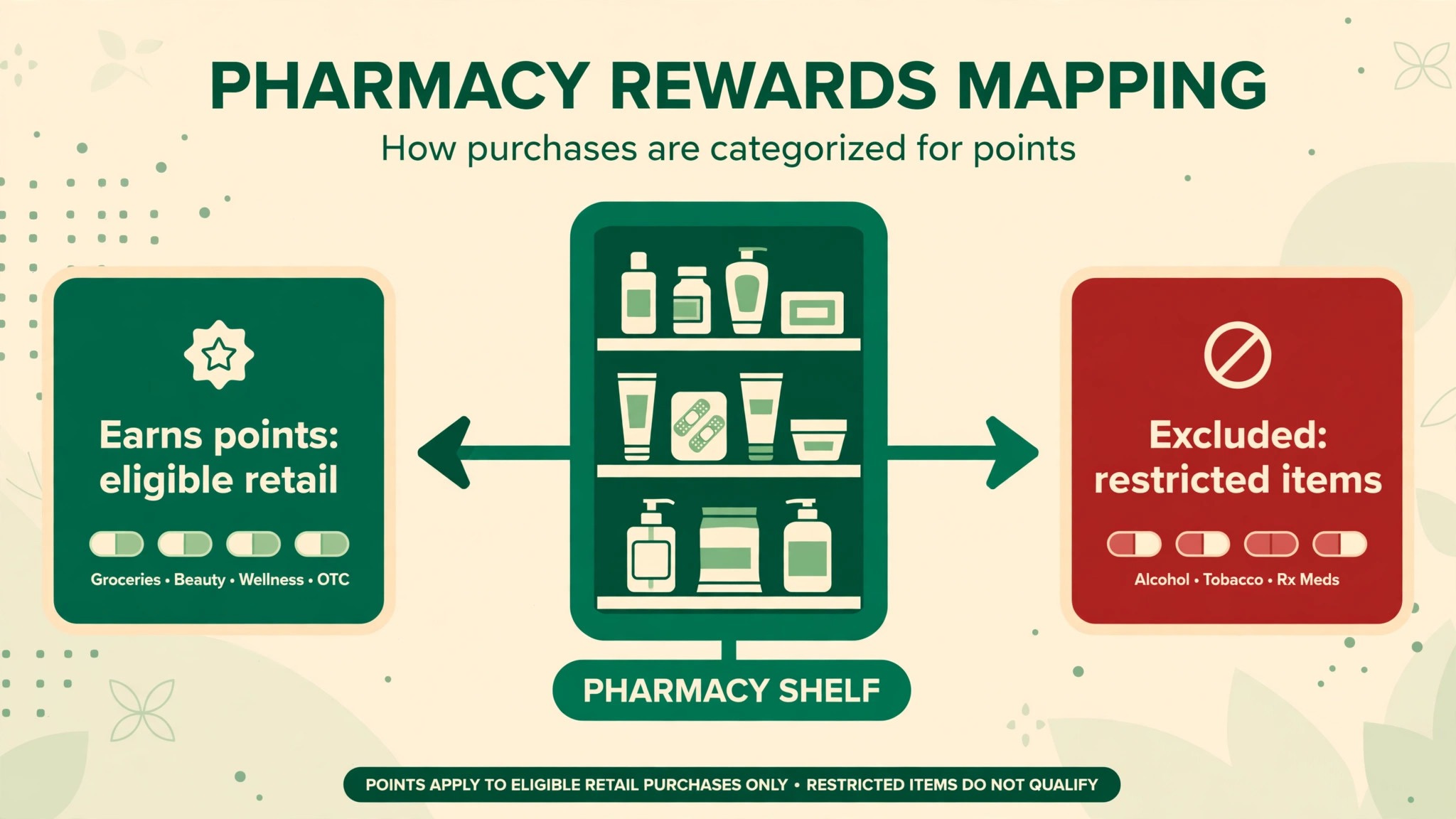
Points fail in pharmacies for one common reason. The reward is set from what sounds generous, not from what the margin can carry. Before you publish any earning rate, work out the margin on the items that will earn points, and separate prescription items from general retail. In many settings, prescription pricing and reimbursement leave little room for a discount, and local rules may restrict rewards on prescription medicines altogether. That is a critical check to make before launch.
A simple structure that small pharmacies can run without a spreadsheet at the counter looks like this. Give one point for each pound or dollar spent on eligible retail items, with a clear minimum spend for earning and a clear value for redemption. For example, 100 points might equal a small fixed saving on a future eligible purchase, or a free low cost health item from a short list. Keep the maths visible. If a patient cannot work out in five seconds how close they are to a reward, the points will feel like a trick, even when they are fair.
Use three reward levels rather than a long ladder. The first reward should arrive quickly, after a small number of visits, so a new member experiences a win early. The second reward should be a little more valuable and tied to a habit you want to encourage, such as collecting a refill on time or trying a health check. The third reward can be a thank you for longer loyalty, such as free delivery for a month or a seasonal health item.
Expiry rules deserve the same simplicity. Points that never expire sound generous but create a growing liability and a list of dormant balances that distort your accounts. Points that expire without warning feel like a penalty. A fair middle path is a 12 month expiry with a reminder at 90 days and again at 30 days before expiry, and a rule that any eligible purchase refreshes the balance.
Decide what points will never buy. Keep controlled medicines, prescription items where restricted, and any item that should never be encouraged by a discount outside the programme. Decide whether points can be combined with other offers, and whether a reward can be transferred to a family member. Family collection is common in pharmacy work, so a rule that blocks a spouse or carer from using a reward can cause real friction.
The table below summarises a starter structure you can adapt, after discussion with your accountant and, where needed, your local regulator.
| Element | Starter setting | Why it helps |
|---|---|---|
| Earning | One point per unit of currency on eligible retail | Easy to explain and check |
| First reward | After a small number of visits | Gives a new member an early win |
| Second reward | Tied to on time collection or a health service | Rewards the habit, not just spending |
| Long term thank you | A service benefit, such as free delivery for a period | Feels personal without cutting margin deeply |
| Expiry | 12 months, with reminders at 90 days and 30 days | Limits liability while giving fair warning |
| Excluded items | Prescription items where restricted, plus controlled lines | Protects compliance and safety |
Test the structure on paper before you launch. Take the last 100 eligible transactions, apply the earning rate, and work out what the total reward cost would have been. If that cost is more than a small share of the margin on those sales, lower the reward value or raise the points needed, rather than hoping volume will fix it. Volume does not fix a reward that loses money on every sale. It multiplies the loss.
The Refill Workflow That Turns a Reminder Into a Return Visit
The refill workflow is where a small pharmacy customer loyalty system proves its worth, because a refill is a visit that should happen anyway. Your job is to remove the reasons it does not happen. Those reasons are usually ordinary. The patient forgets, the prescription runs out on a weekend, the patient is unsure whether a new prescription is needed, or the patient assumes the pharmacy will call when it is ready.
Build the workflow around four moments. The first moment is at collection, when staff confirm the next due date and ask how the patient wants to be reminded. The second moment is a few days before the due date, when a reminder goes out through the channel the patient chose. The third moment is on the due date, when the refill is prepared or the patient is prompted to confirm it. The fourth moment is a short time after a missed collection, when a polite follow up checks whether help is needed.
Use the numbered steps below as the core routine for a regular refill patient. Adapt the timing to the medicine type, the prescription length and local rules, and keep pharmacist oversight on any step that involves a clinical decision.
- At collection, confirm the quantity and the date the supply will run out, and record the patient preferred reminder channel.
- Three to five days before the due date, send a short reminder that names only what is needed to act, such as a collection date and a reply option.
- If the patient confirms, prepare the refill, check stock and set a collection or delivery time, then send a ready message through the same channel.
- If the patient does not reply within two days, send one gentle second reminder and offer a phone option.
- If the refill is still uncollected three days after the due date, make a brief pharmacist led check, by phone or in person, to find out whether there is a supply, access or understanding problem.
- Record the outcome in the dispensing record, not only in the loyalty tool, so the next reminder is based on what actually happened.
7.
Message wording matters more than message frequency. A reminder that is long, formal or full of health detail will be ignored or will worry the patient. A short message that says the refill is due, gives a collection window and offers a simple reply for yes, no or call me back will get more responses. Keep the tone warm and practical, and never use a reminder to push an unrelated sale.
Send reminders during daytime hours the patient has agreed to, and avoid early morning or late evening messages unless the patient has asked for them. For patients who collect on a set weekday, anchor the reminder to that pattern rather than to a generic calendar date. A patient who always collects on a Saturday will respond better to a Thursday reminder about Saturday collection than to a Monday reminder that arrives too early to act on.
Finally, build a fallback for patients who do not use text or email. A printed slip at collection with the next due date, a phone call for patients who prefer voice contact, and a note on the bag for a carer collecting on behalf of the patient can cover the gap.

The Setup Checklist for Launch Week
A small pharmacy customer loyalty system works best when launch is treated as a short project with a checklist, not as a software install. The checklist below covers the decisions, the staff preparation and the first week of live running. Work through it in order, and do not announce the programme until the items marked as essential are complete.
- Confirm which items can earn points and which are excluded, in writing, after checking local rules for prescription and controlled items.
- Set the earning rate, the first reward, the second reward and the expiry rule, and test the cost on 100 recent eligible transactions.
- Choose the sign up method, either a card, a phone number or an app account, and decide what information you will collect and why.
- Write the one page privacy note for patients, covering what data you hold, how reminders use it, how to opt out and who to contact.
- Write the staff script for sign up, redemption and expiry, with one sentence answers for the five questions patients ask most.
- Train every counter staff member on the script, the till steps and the fallback when the system is offline or a card is forgotten.
- Set the refill workflow timings, message templates and owners for each of the four moments described above.
- Load a small starter list of regular patients who have already agreed to reminders, rather than importing a full customer list without consent.
- Put up one clear counter sign explaining the programme in plain words, without small print that contradicts the headline.
- Run a two day internal trial with staff accounts and a handful of willing regular patients, and fix till, receipt and message problems first.
- Set the monthly measures for repeat visits, redemption and reminder response, and assign one person to review them each month.
- Plan the first review after 30 days, with a decision point to adjust the reward value, the reminder timing or the sign up method.

Choose a Tool That Fits a Walk In Pharmacy
Loyalty tools fall into three groups, and the group matters more than the brand name. The first group is general loyalty apps built for online shops, which work well when most sales pass through a website checkout. The second group is stamp and card apps built for walk in retail, which work well when the sale happens at a till and the patient may not want another account. The third group is pharmacy point of sale and management systems with loyalty built in, which work well when loyalty, stock and dispensing data already live in one system.
Smile is a useful example of the first group, and its pricing shows why fit matters. Recent listings put Smile at free for up to 200 orders a month, Essential at 15 dollars a month for up to 500 orders, Standard at 79 dollars a month for up to 1,000 orders, and Growth at 199 dollars a month for up to 2,500 orders. Those tiers are priced by online order volume, which suits a web store, but a walk in pharmacy may find the order counting and the online focus less natural than a stamp based tool.
Stamp Me sits in the second group and is closer to how a small pharmacy actually trades. Recent listings put Stamp Me at Lite at 29 dollars a month for up to 500 users and one physical location, Pro at 49 dollars a month for up to 5,000 users and up to two locations, and Elite at 119 dollars a month for unlimited users and up to six locations, with no set up fee on those tiers. A stamp model is easy for patients to understand, because a visit earns a stamp and a set number of stamps earns a reward.
Pharmacy specific point of sale systems sit in the third group. A Tech.co comparison of pharmacy point of sale systems lists BestRx BestPOS at 3,250 dollars to 4,250 dollars upfront, with the BestRx management system at 2,750 dollars upfront and point of sale upkeep at 90 dollars a month, and notes a customer loyalty programme with custom perks, reward values and expiry rules among its features. Those upfront figures buy a full pharmacy system, not only loyalty. For a pharmacy already using such a system, turning on its built in loyalty feature may be cheaper than adding a separate app.
A paper stamp card and a simple spreadsheet remain a legitimate starter option. A printed card costs very little, needs no login, works when the internet fails and can be understood by every patient. Its limits are real. Cards are lost, balances cannot be checked remotely, refill reminders still need a separate list, and reporting is manual.
When you compare tools, price the whole monthly cost, not only the subscription. Add text message credits if they are charged separately, add any fee for extra locations or extra users, and add staff time for training and monthly reporting. A tool that looks cheap at 29 dollars a month but needs two hours a week of manual balance fixes is more expensive than a 49 dollar tool that runs itself. Ask each vendor four questions before you commit. Can loyalty work at the till without a second login. Can you export your member list at any time. Can you set different rules for eligible and excluded items.
| Tool or approach | Recent starting price from listings | Best fit |
|---|---|---|
| Paper stamp card plus spreadsheet | Very low, mainly printing cost | A 90 day starter test |
| Stamp Me | Lite from 29 dollars a month | Walk in retail, one location |
| Smile | Free up to 200 orders a month, then from 15 dollars a month | A pharmacy with strong online sales |
| Pharmacy point of sale with built in loyalty | Varies widely, with upfront system costs in some cases | A store already on that system |
Prices change often, so treat every figure in this section as a starting point for a vendor check, not as a quote. Check the official pricing page, confirm whether the price is monthly or annual, and confirm the checkout total for your user count and location count before you commit.

Privacy Care for Health Data
Loyalty data and health data must be kept apart in practice, even when they sit in the same store. A loyalty record needs a name, a contact channel, a points balance and a purchase history for eligible retail items. It does not need a diagnosis, a prescription history or a clinical note.
Consent and opt out need to be separate for loyalty marketing and for refill reminders, because they are different kinds of message. A patient may be happy to receive a refill reminder and unhappy to receive a general offer, or the reverse. Record those choices separately, honour them separately, and make opt out easy in every message. The sign up form should therefore have two clear choices, one for refill reminders and one for loyalty offers, each with its own tick box and its own plain wording.
In the United States, the Health Insurance Portability and Accountability Act privacy rule includes a refill reminder exception that covers reminders about a drug currently prescribed for the individual, including generic equivalents, adherence communications and communications about prescriptions that lapsed within the last 90 days, provided any payment from a manufacturer is reasonably related to the cost of making the communication. That exception does not turn every pharmacy message into a permitted message. Marketing messages about other products and messages about drugs not currently prescribed still need separate care, and in many cases written authorisation.
Practical privacy habits matter as much as the legal position. Use a messaging platform that offers access controls, encryption and audit logs if messages will carry health related content, and sign a business associate agreement where the vendor handles protected health information and local rules require one. If a vendor will not sign such an agreement, do not use that vendor for health related messages. Limit what staff can see to what their role needs. Counter staff need to see a points balance and a collection status. They do not need to see a full prescription history to redeem a retail reward.
Message content is the daily privacy test. A refill reminder should contain the minimum needed to act, such as the pharmacy name, a collection date and a reply option, and should avoid naming a medicine in a text preview where a shared phone, a lock screen or a family member might see it, unless the patient has clearly agreed to that level of detail. Where a patient collects on behalf of another person, check that permission is recorded and current, and do not share health detail with the collector beyond what is needed for collection.
Data retention should be set at launch, not discovered later. Decide how long you will keep inactive loyalty accounts, how long you will keep message logs, and how you will delete data when a patient asks to leave the programme. A patient who leaves should lose marketing contact and loyalty access, but clinical and dispensing records must still be kept under their own retention rules. Write that distinction into the privacy note, so staff do not delete the wrong record when a patient asks to be removed from loyalty.

Measuring Repeat Visits Without a Complicated Dashboard
A small pharmacy customer loyalty system should be judged by repeat visits, not by how many cards were handed out. Set up four measures and review them once a month, on the same day, with the same definitions. The first measure is the return rate, meaning the share of patients who visit again within 35 days of a previous visit. The second measure is the on time refill rate, meaning the share of refill patients who collect within three days of the due date. The third measure is the reminder response rate, meaning the share of reminders that get a reply or a collection.
Use a small pharmacy customer loyalty system review sheet with one row per month and one column per measure, plus a notes column for what changed that month. A rise in sign ups with a flat return rate means the programme is collecting names, not changing behaviour. A rise in on time refills with a flat redemption rate means reminders are working but rewards are too distant or too small to matter.
Set review thresholds before you need them. If the return rate has not moved after 90 days, change one element only, either the first reward, the reminder timing or the sign up prompt, and test for another 30 days. If redemption is very low after 90 days, lower the first reward threshold rather than adding a new tier. If reminder response is low, check the channel first, because a message sent to an old number or an unchecked email address cannot work, however well it is written.
| Measure | How to count it | First target |
|---|---|---|
| Return rate | Patients visiting again within 35 days, divided by all patients | A steady rise over three months |
| On time refill rate | Refills collected within three days of due date, divided by refills due | Higher than the launch baseline |
| Reminder response rate | Reminders answered or followed by collection, divided by reminders sent | Above half, by channel |
| Redemption rate | Points redeemed, divided by points earned | High enough to show rewards feel reachable |

Mistakes That Quietly Break a Pharmacy Loyalty Programme
The first mistake is rewarding the wrong behaviour. A programme that gives the biggest reward for the biggest basket will push patients toward buying more, not toward collecting on time or seeking advice.
The second mistake is letting the programme drift into discount culture. If every visit ends with a new offer, patients learn to wait for the next offer and the normal price starts to feel like a penalty. Limit general offers to a small number each year, keep refill reminders free of sales content, and let the loyalty reward itself be the regular thank you.
The third mistake is ignoring the patients who do not join. A programme must never make a non member feel like a second class patient at the counter. Keep the same advice, the same collection service and the same respect for every patient, member or not.
The fourth mistake is poor data hygiene. Duplicate accounts, old phone numbers, unrecorded opt outs and balances that do not match receipts will each create a counter argument. Fix one account properly when a problem is found, rather than creating a second account to work around it, and review the member list monthly for duplicates and for accounts with no activity for a year.
For related reading, the guide to pharmacy inventory alerts covers stock and expiry routines that sit beside refill work, best AI tools for pharmacies covers the wider tool field, and best CRM software for small business helps if you want a fuller customer record beyond loyalty points. The guide to automate small business with AI is useful if you plan to connect reminders and reporting without adding manual work.
Frequently Asked Questions
Can a small pharmacy run a loyalty programme without buying software
Yes. A printed stamp card, a simple spreadsheet and a phone list for refill reminders can run a starter programme for 90 days.
Should prescription medicines earn loyalty points
That depends on local rules, and you must check them before launch. In many settings, prescription pricing and reimbursement leave little room for a discount, and rewards on prescription medicines may be restricted.
How much should the first reward be worth
The first reward should be small, clear and reachable within a handful of visits. A reward that is too large will strain margin and attract discount hunters, while a reward that takes months to reach will be forgotten.
What should a refill reminder say, and what should it leave out
A refill reminder should say the pharmacy name, the collection date or window, and how to reply or to ask for a phone call. It should leave out extra health detail, unrelated offers and any medicine name in a lock screen preview unless the patient has clearly agreed to that level of detail.
How do you handle patients who do not use text or email
Keep a non digital path for every reminder step.
When should a pharmacy change or stop a loyalty reward
Review the programme monthly and change one element at a time if a measure is not moving. Lower the first reward threshold if redemption is very low, change the reminder timing if response is low, and simplify the sign up prompt if sign ups are high but return visits are flat.
Keep the Promise Small, Then Grow It
A good pharmacy loyalty programme is not a campaign. It is a habit, built visit by visit, that tells a patient the pharmacy remembers them, prepares their refill on time and thanks them in a way they can understand. Start with a fair points structure, a refill workflow with a named owner for each moment, a privacy note patients can actually read, and four monthly measures you will honestly review.
After 90 days, grow only what the numbers support. If on time refills have risen, keep the reminder timing and improve the message wording. If the first reward is redeemed often, keep its threshold and add a service benefit for longer loyalty. If a tool is saving staff time, keep it and check its total monthly cost again, including text credits and extra users. A small pharmacy customer loyalty system that grows in that careful way will do the job it was built for.