
About 10 percent of global bread production is wasted, according to Kerry, and 32 percent of consumers say they regularly throw bread away. For a small bakery, that waste does not stay abstract. It sits in trays at closing time, in flour and butter already paid for, and in hours already worked. When you use AI for bakery waste reduction planning, you are not buying a miracle. You are building a tighter link between what you bake, what you sell, and what you do with what is left.
This guide gives you that link in full. It starts with measuring waste honestly for two weeks, then builds a forecasting workflow you can run with a spreadsheet and your sales records, then adds a day-old sales plan that protects your full price trade, and finally covers donations, repurposing and disposal in the right order. Tool prices were checked against vendor pages at draft time. Check the price again before you pay, because plans and limits change.
Why Unsold Stock Costs More Than the Ingredients
A tray of unsold croissants looks like a small loss. Add up a month of trays and the picture changes. You paid for flour, butter, eggs, sugar, packaging and power, plus the time to mix, prove, bake, cool and display, plus the shelf space that tray occupied while a faster selling product could have taken its place. Waste is therefore not one cost. It is ingredient cost plus labour plus energy plus lost display space, all in a product that earned nothing.
French artisan bakery research cited by MAE Innovation puts unsold rates at 9 to 12 percent depending on the item, with yearly losses of 5,000 to 8,000 euros for an artisan baker. Your numbers will differ by city, product mix and foot traffic, but the pattern is familiar to most small bakeries. A small daily overbake, repeated six days a week, becomes the largest quiet leak in the business. It shows up as a margin that never quite matches the effort.
There is a second cost that is easy to miss. Overbaking trains customers badly. When the case is always full at closing time, regulars learn that they can arrive late and still get anything they want. A waste plan is also a customer expectation plan. It teaches the shop, over time, that popular items sell out and that day-old deals have a set time and place.
A third cost is decision fatigue at 4 am. Without a forecast, the baker on duty guesses, leaning on yesterday or on a vague sense that Saturday was busy once. Some days the guess is high and waste spikes. Other days the guess is low and the shop sells out by 10 am. A written forecast removes much of that pressure. It gives the baker a number, a reason for that number, and a clear rule for a second smaller bake later in the day.
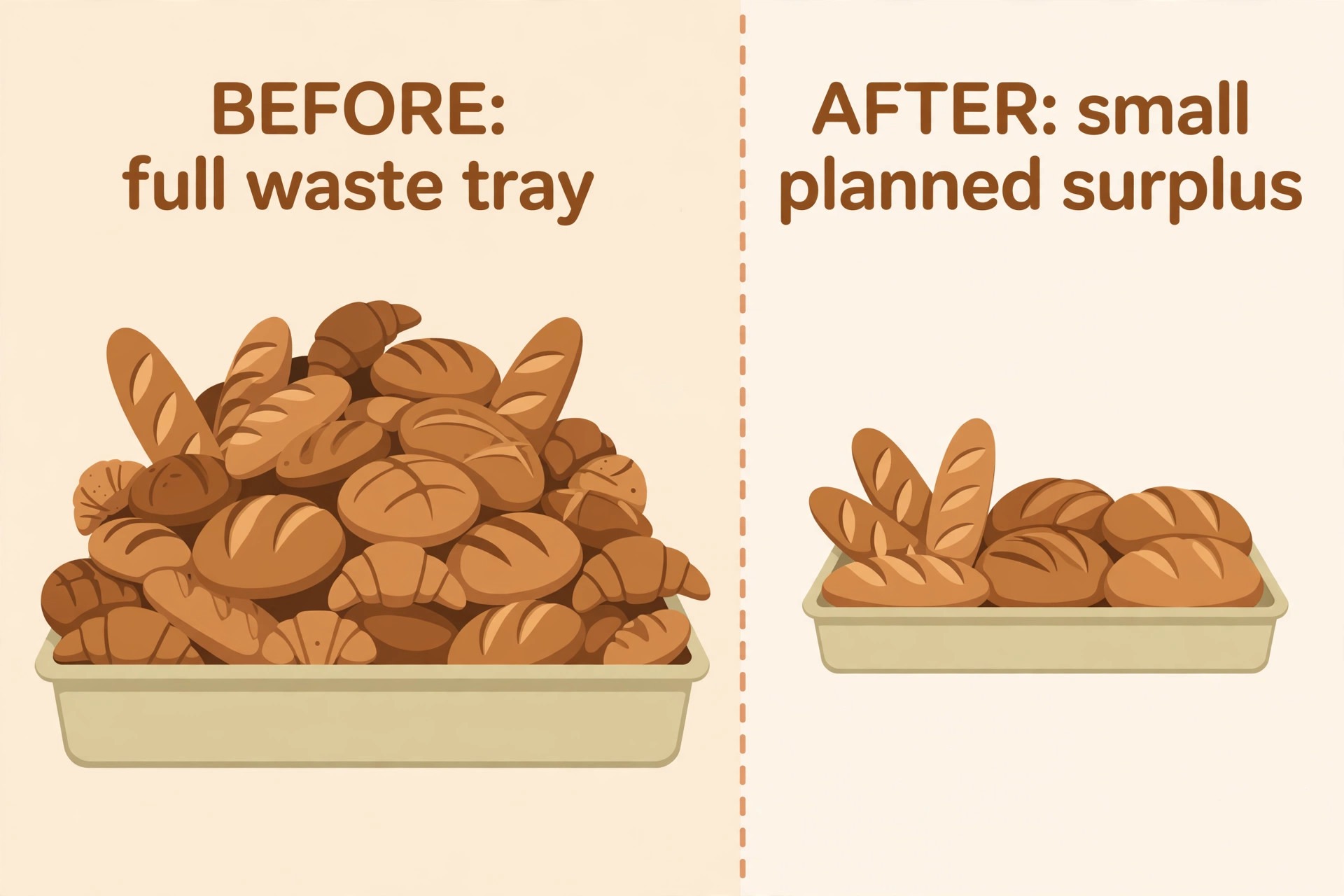
Measure Waste for Two Weeks Before You Change Anything
Do not buy software in week one. Measure first. A forecast built on guesses will only produce confident guesses. Two weeks of simple counting gives you the baseline every later step depends on.
Set up one waste log sheet per day with six columns. Product name, quantity baked, quantity sold at full price, quantity sold at a reduced price, quantity donated or repurposed, and quantity thrown away. Add a short notes column for weather, a local event, a school holiday, or a broken oven. Those notes explain the strange days later.
Count at the same time every day, ideally at closing, and count in units, not in vague handfuls. A half tray of rolls is not a number you can forecast from. Twelve rolls is. Keep the unit the same for the whole two weeks, and keep one person responsible for the count so the method does not drift. Donated food still counts as unsold at full price for forecasting, so record it in its own column rather than hiding it.
At the end of two weeks, calculate four numbers per product. Sell through rate, which is units sold at full price divided by units baked. Total clearance rate, which adds reduced price sales, donations and repurposing to full price sales, then divides by units baked. True waste rate, which is units thrown away divided by units baked. And average daily leftover, which is total unsold units divided by fourteen. Sell through shows demand strength. Clearance shows how well your end of day system works. True waste shows what still goes in the bin.
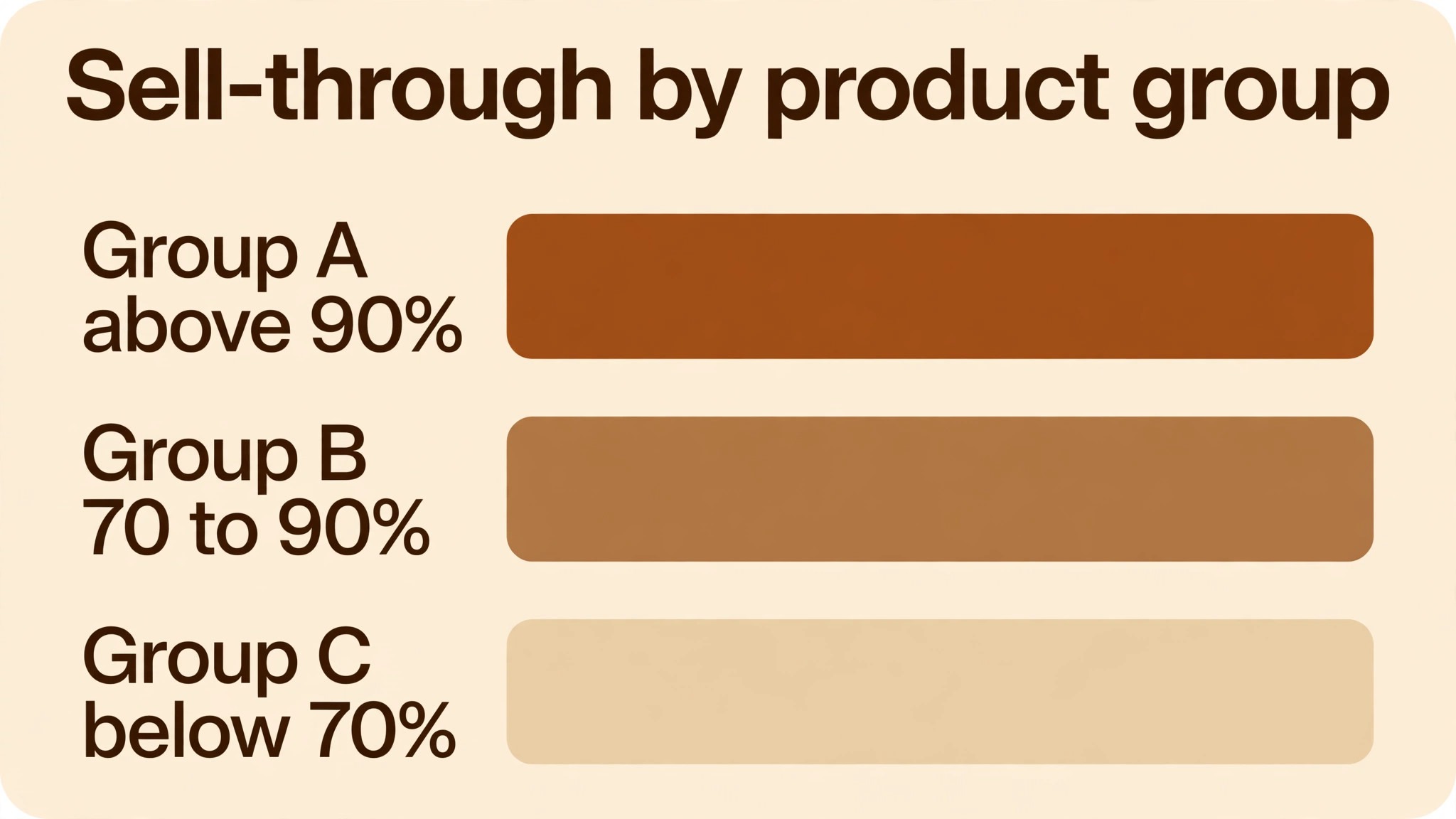
Sort products into three groups. Group A sells through above 90 percent most days and sometimes sells out. Bake these with care, and consider a second bake rather than a larger first bake. Group B sells through between 70 and 90 percent, with leftovers that usually clear through discount or donation. These are your day-old plan candidates. Group C sells through below 70 percent, or swings wildly from day to day. These need a smaller batch, a pre-order only rule, a recipe change, or removal from the daily case. Most bakeries find that a handful of Group C products cause a large share of waste, and fixing those few lines matters more than a general plea to bake less.
Keep the log going after the first two weeks, but simplify it. Log problem products daily and everything else weekly. A system that takes five minutes will survive a busy Saturday.
How to use AI for bakery waste reduction planning in a Small Bakery
This section is the core workflow. It uses AI as a forecasting assistant, not as a replacement for the baker. You bring the sales history, the calendar, and the judgment about quality. The AI tool brings fast pattern spotting across weeks of data that no one has time to read line by line at 4 am.
Start with clean data. Export daily sales by product from your point of sale system for at least eight weeks, or type the two week waste log plus till totals into a spreadsheet if you do not have that history yet. Include date, day of the week, product, units baked, units sold, and price. Add columns for weather in simple words, such as hot, mild, rainy or cold, and for local events, school holidays and public holidays. A model that does not know it rained all Saturday will treat that Saturday as weak demand, when the real lesson was about weather, not about your croissants.
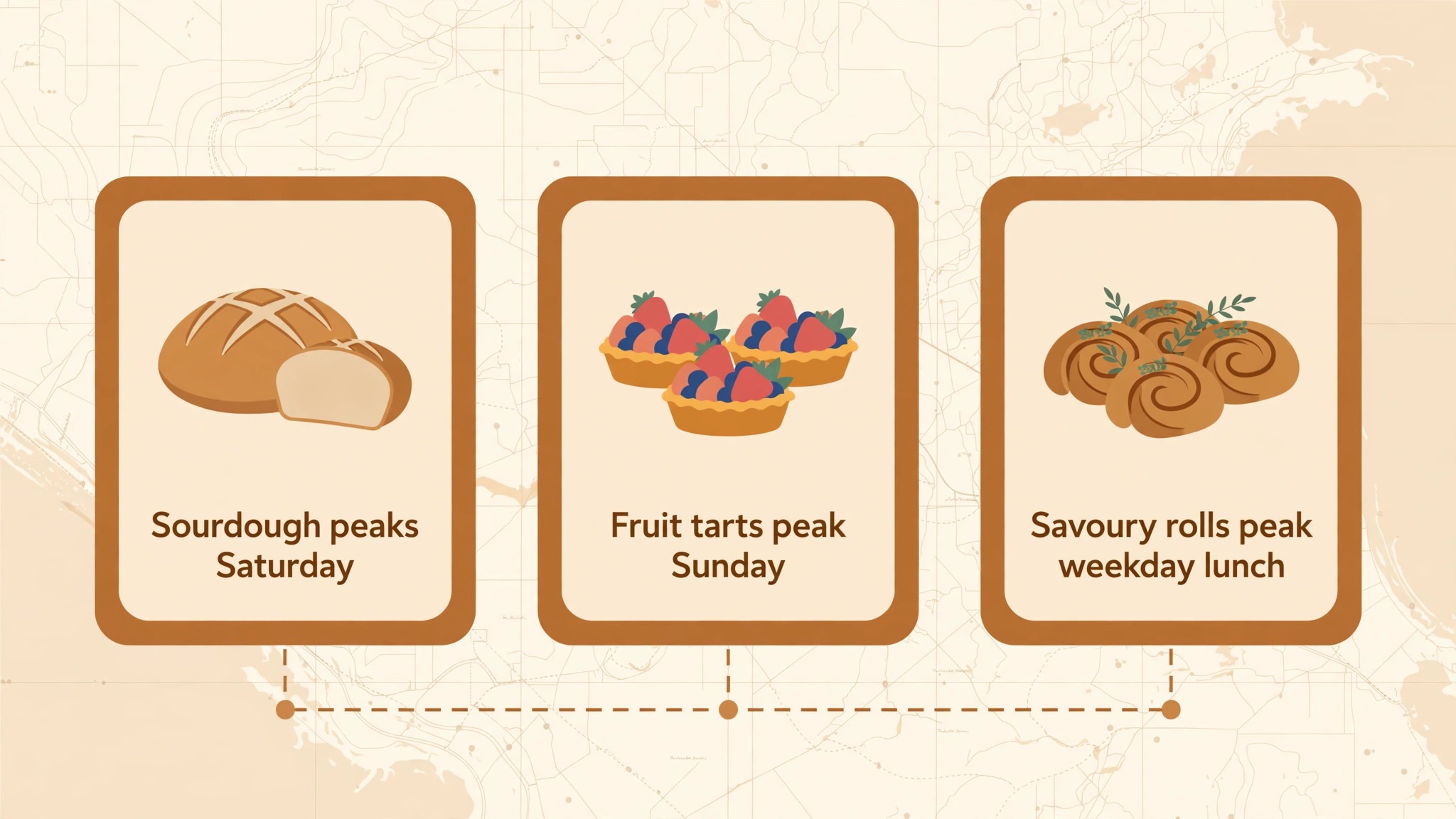
Next, ask the AI tool to find patterns product by product, not for the shop as a whole. A shop total hides the fact that sourdough peaks on Saturday while fruit tarts peak on Sunday and savoury rolls peak at lunch on weekdays. Ask for a table with one row per product and one column per weekday, so you can check it against what you already know. If the table contradicts your experience sharply, check the data before you trust the model. A mislabelled product or a missing week can flip a result.
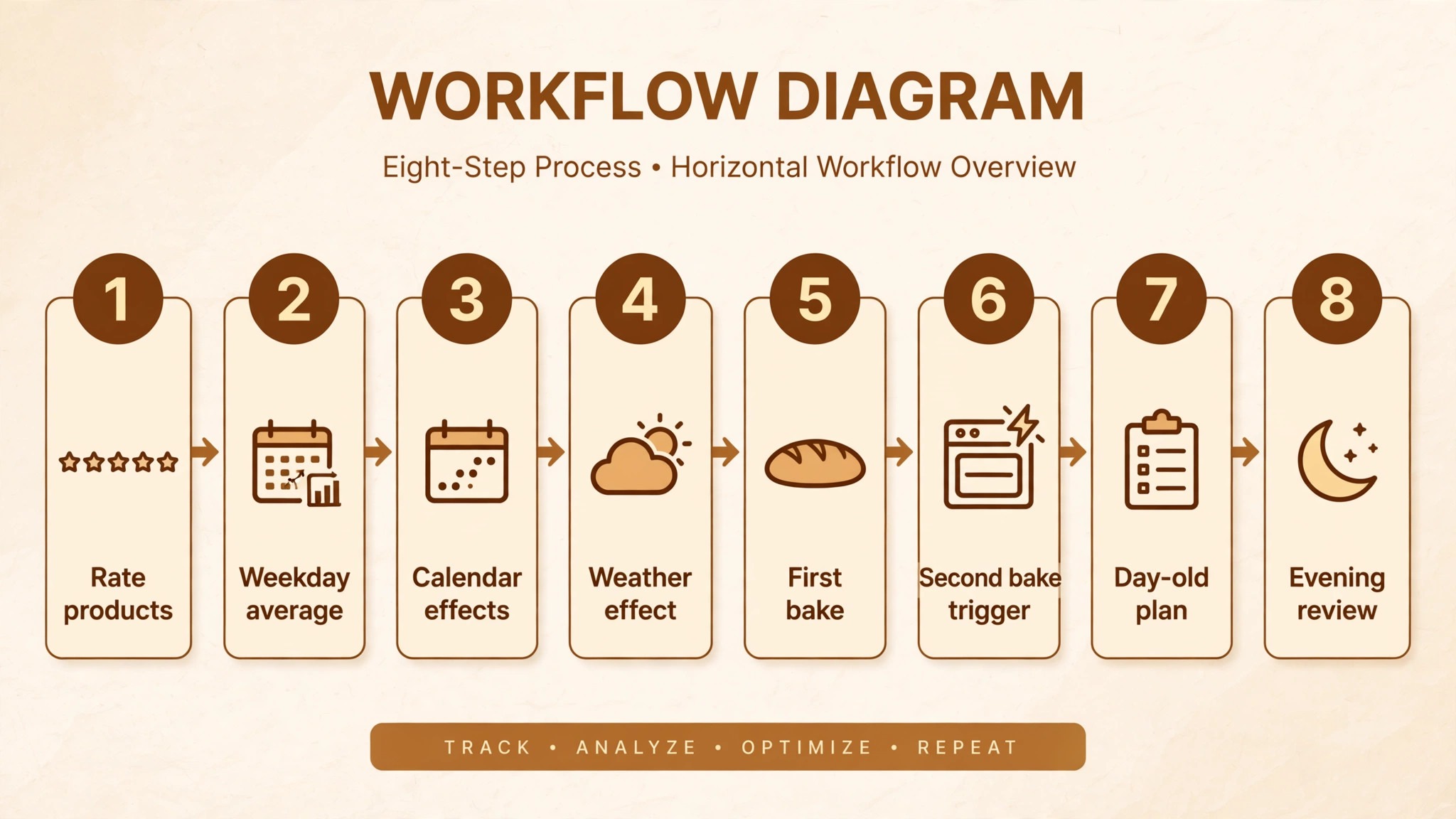
Then build the weekly forecast in eight steps.
- List every daily product with its Group A, B or C rating from your waste log.
- For each product, take the same weekday average from the last four weeks, not the overall average. Monday demand is not Saturday demand.
- Adjust that average for known calendar effects in the coming week, such as a public holiday, a school break, a market day, or a large local event.
- Adjust again for weather only where your data shows a real effect. Rain may cut foot traffic but lift delivery orders. Heat may cut heavy cakes and lift light pastries. Do not apply a weather guess to every product.
- Set a first bake at 85 to 90 percent of the forecast for Group B and C products, and at 95 percent for Group A products that regularly sell out. The gap leaves room for a second bake.
- Set a second bake trigger, such as when a Group A product falls below six units before noon, or when a Group B product sells half its first bake by 11 am. Write the trigger on the production sheet.
- Set a day-old and donation quantity in advance, based on the expected gap between first bake and forecast. If the forecast says 100 rolls and the first bake is 88, the planned second bake covers the upside.
- Review the forecast against actual sales every evening for the first month, and note where it was high or low and why. A forecast that is never reviewed is a ritual, not a tool.
This workflow works with a general AI chat tool and a spreadsheet, and it also works inside bakery software that has forecasting built in. Built in forecasting pulls sales automatically. A spreadsheet plus AI chat workflow needs a weekly export and a careful prompt, but it costs far less and it keeps the owner close to what customers actually buy.
One caution matters more than any tool choice. Never let a forecast override a quality rule. If dough needs a full prove, if a cake needs cooling time, or if a filling is unsafe after a set number of hours at room temperature, the forecast must fit inside those limits. AI tools do not know your oven capacity, your cold storage, or your local food safety rules. You do. Treat every AI number as a draft for a human to approve, and keep that approval step on the production sheet with initials and a time.
Build a Forecast You Can Actually Bake From
A forecast that lives in a dashboard and never reaches the bench is decoration. A usable forecast fits on one production sheet, uses the same product names as the till, and states quantities, bake times and second bake triggers in plain numbers. If a relief baker cannot follow it without calling the owner, it is not finished yet.
Start each week with a simple table. Rows are products. Columns are days. Each cell holds the first bake quantity, with the second bake trigger in brackets beside it where one applies. Print it or pin it where dough is scaled, not only on a phone that will run out of battery or get flour on the screen.
Treat weekdays and weekends as different shops. Many bakeries bake the same range every day out of habit, then wonder why Monday waste is high and Saturday sells out. Monday often needs a smaller range with deeper stock of staples. Saturday often needs a wider range with smaller quantities per line, because customers browse and buy variety. Forecast by weekday, bake by weekday, and review by weekday.
Add three adjustments that generic forecasts often miss. The first is pre-orders. Subtract confirmed pre-orders from the forecast before you set the walk in bake, or add them on top of the walk in forecast, but do it one way only and write which way on the sheet. Double counting pre-orders is a common cause of a sudden waste spike on celebration cake weekends. The second is wholesale. A wholesale order is not foot traffic. It is a fixed commitment with its own bake time and packing time, and it should sit on its own line. The third is promotions.
A two for one offer, a market stall, or a post about a limited flavour will move demand, and the forecast for that day should say so in words, so the team knows why the quantity looks unusual.
Small batch second baking is the single most practical waste reducer for fresh products with short shelf life. A croissant or a fruit tart has a sales window of a few hours at its best, so baking everything at 5 am guarantees that the last units are tired by late afternoon. Baking 85 percent at dawn and 15 percent late morning keeps the case fresh twice a day and cuts end of day waste. The trade is labour and oven time. A second bake needs dough or batter staged the night before and someone available mid morning.
Plan that labour in the forecast week, not on the day, or the second bake will be skipped when the shop gets busy, which is exactly when it is needed most.
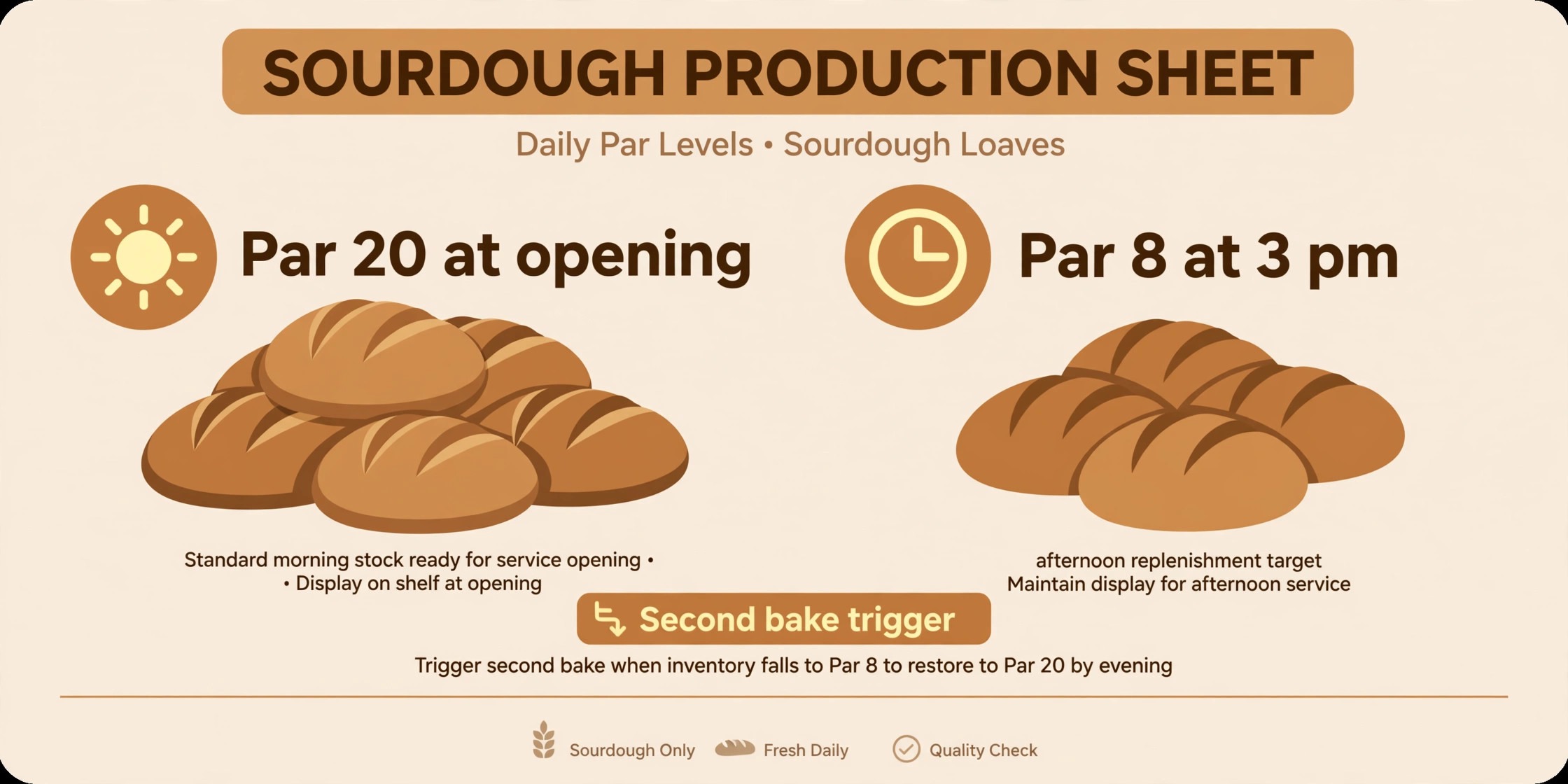
Par levels help here. A par level is the minimum stock you want on display at a set time, such as 20 sourdough loaves at opening and 8 at 3 pm. When stock falls below par before the set time, bake or move stock. When stock stays above par late in the day, move the surplus to the day-old plan early rather than waiting until closing. Set pars from your forecast, review them monthly, and change them only after a week of evidence, not after one strange day.
Finally, keep a forecast error log. Each evening, write the forecast, the actual sales, and the difference for your top ten products. After a month, you will see whether you consistently overbake Mondays or underbake rainy Saturdays. When you use AI for bakery waste reduction planning in this disciplined way, the tool improves with your shop instead of repeating the same error every week.
Tools That Help, and What Each One Really Costs
You do not need the most expensive system to cut waste. You need sales data you trust, a forecast you will actually use, and an end of day outlet for surplus. Start cheap, prove the habit, then pay for automation only where manual work is clearly costing you time or accuracy.
A spreadsheet plus a general AI assistant is the starting point for most single shop bakeries. Export sales by product and day, add weekday and event labels, and ask the assistant to summarise patterns and suggest first bake quantities. There is no extra software cost if you already use a spreadsheet for orders or accounts. The cost is time, roughly one hour a week at first and less once the template is set. The limit is manual data entry. If product names differ between the till and the spreadsheet, the forecast will be messy too. Fix product names first. One name per product, spelled the same everywhere, is unglamorous work that pays for itself.
A point of sale system is the next step, because it creates the sales history automatically. Square is a common starting point for small food businesses. Its Free plan costs 0 dollars per month per location, with in person card processing at 2.6 percent plus 15 cents. Its Plus plan costs 49 dollars per month per location, with in person processing at 2.5 percent plus 15 cents, and its Premium plan costs 149 dollars per month per location, with in person processing at 2.4 percent plus 15 cents. Check those figures on Square’s own pricing page before you commit. Square’s value for waste planning is clean daily sales by item, which feeds any forecast.
Bakery specific software adds recipe costing, production planning and ingredient deductions. FlexiBake lists its Base plan at 295 dollars per month, its Professional plan at 375 dollars per month, and its Corporate plan at 495 dollars per month, with Enterprise on a custom quote. That suits wholesale and mid size bakeries that need lot tracking, delivery routes and wholesale ordering in one system more than it suits a single counter shop. Cybake prices on a custom quote that varies by bakery size, locations, users and selected products, so ask for a written quote tied to your product count and sites before you judge it.
Profito offers AI driven sales forecasting using transaction history, weather and events, plus invoice scanning and recipe costing. Its pricing is not a single public starting figure in the sources checked for this guide, so request a quote.
Larger operations sometimes use analytics layers across point of sale, labour and inventory. Tenzo lists pricing from 75 dollars per location per month, rising with modules and locations selected. PreciTaste offers an oven linked baking on demand system billed at 1 euro per sensor per day. That is closer to production automation than to forecasting.
When you compare tools, compare total cost, not headline price. Add monthly subscription, card processing on day-old and surplus sales, staff training time, and the cost of changing product names or till buttons. A cheap tool that no one uses costs more than a dearer tool the team actually opens every morning. Ask every vendor three questions before you sign. Can you export daily sales by product in a spreadsheet without extra fees. Does forecasting use my weekday history or only a shop total. Can I set a second bake trigger or a par level inside the system. If the answer to the first question is no, walk away.
A final tool note matters. When you use AI for bakery waste reduction planning, keep a human approval step even inside paid software. Approve the forecast, approve the second bake, approve the day-old quantity. Software can spot that sourdough rises on Saturdays. It cannot smell that today’s dough is slow, see that a fridge is full, or know that a neighbouring shop closed and foot traffic spiked. Your team can. The best system is a fast forecast plus a baker who is allowed to overrule it for a stated reason, with that reason written on the sheet for next week’s review.
The Day-Old Sales Plan That Protects Full Price Sales
Forecasting cuts waste. It will never cut it to zero, and it should not try. A shop that never has leftovers regularly sells out early and disappoints customers. The goal is a small, predictable surplus with a planned home, not a large surprise surplus with nowhere to go. That home is the day-old sales plan, and it needs rules as clear as the bake plan.
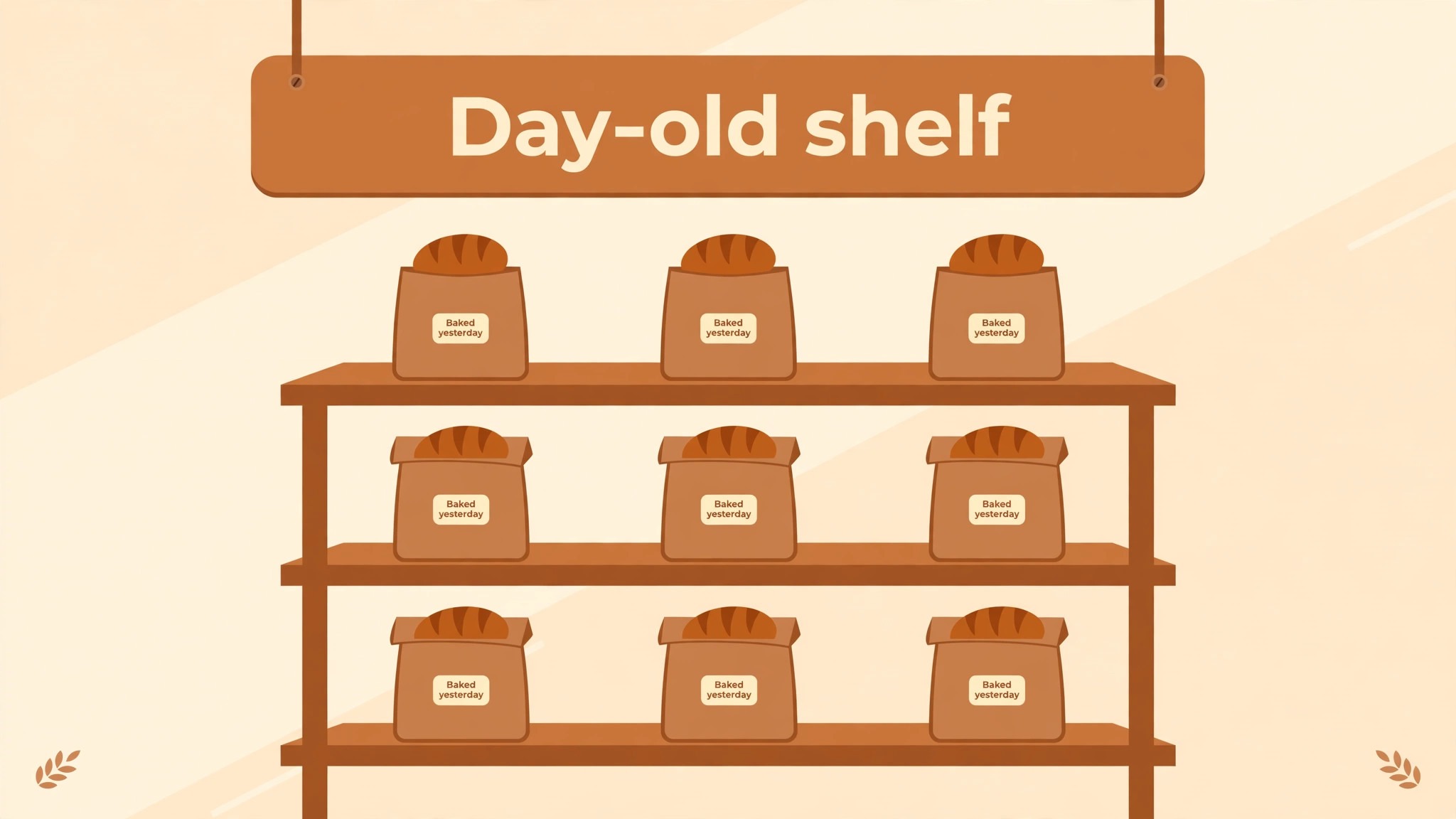
First, decide what day-old means in your shop, and write it down. Day-old usually means baked yesterday, stored correctly overnight, still safe and pleasant today, but no longer at peak freshness. It does not mean stale, damaged, or past a safety limit. Products with cream, custard, or a short chilled life may not be suitable for a next day sale at all. Check your local rules before you build a day-old shelf, and keep a written list of which products qualify. Staff should not have to guess at closing time.
Second, set the discount ladder in advance. A common structure is full price until a set evening time, then a single reduced price for the last hour, then a day-old price the next morning. For example, full price until 5 pm, 25 percent off from 5 pm to closing for same day surplus, and 50 percent off the next morning for qualifying day-old stock, sold only from a marked day-old shelf or bag. The exact percentages matter less than the consistency. Protect full price trade by keeping day-old quantities small, by selling day-old only from one clearly marked area, and by never discounting a product that is still selling well at full price that day.
Third, build the channels before you need them. A day-old plan with one channel will fail on a high surplus day. Aim for four channels.
- In shop day-old shelf or bag, priced and labelled, placed away from the fresh case so customers can tell the difference at a glance.
- Pre-order and subscription customers, such as a weekly bread bag or a Friday pastry box at a set reduced price for loyal buyers who accept a surprise mix.
- A surplus app, such as Too Good To Go, where unsold baked goods are sold as Surprise Bags for collection at a set time. Signing up is free, and the platform takes a commission on each bag sold, with the rate varying by bag price, plus a recurring admin fee in some regions. Confirm the current fee in writing for your country before you list. Payments arrive monthly or quarterly depending on region, so treat this channel as clearance plus new customer discovery, not as same day cash flow.
- Staff, neighbours and community buyers at closing time, under a simple rule, such as staff may buy one bag at day-old price after paying customers have had their chance, and no product leaves without a record.
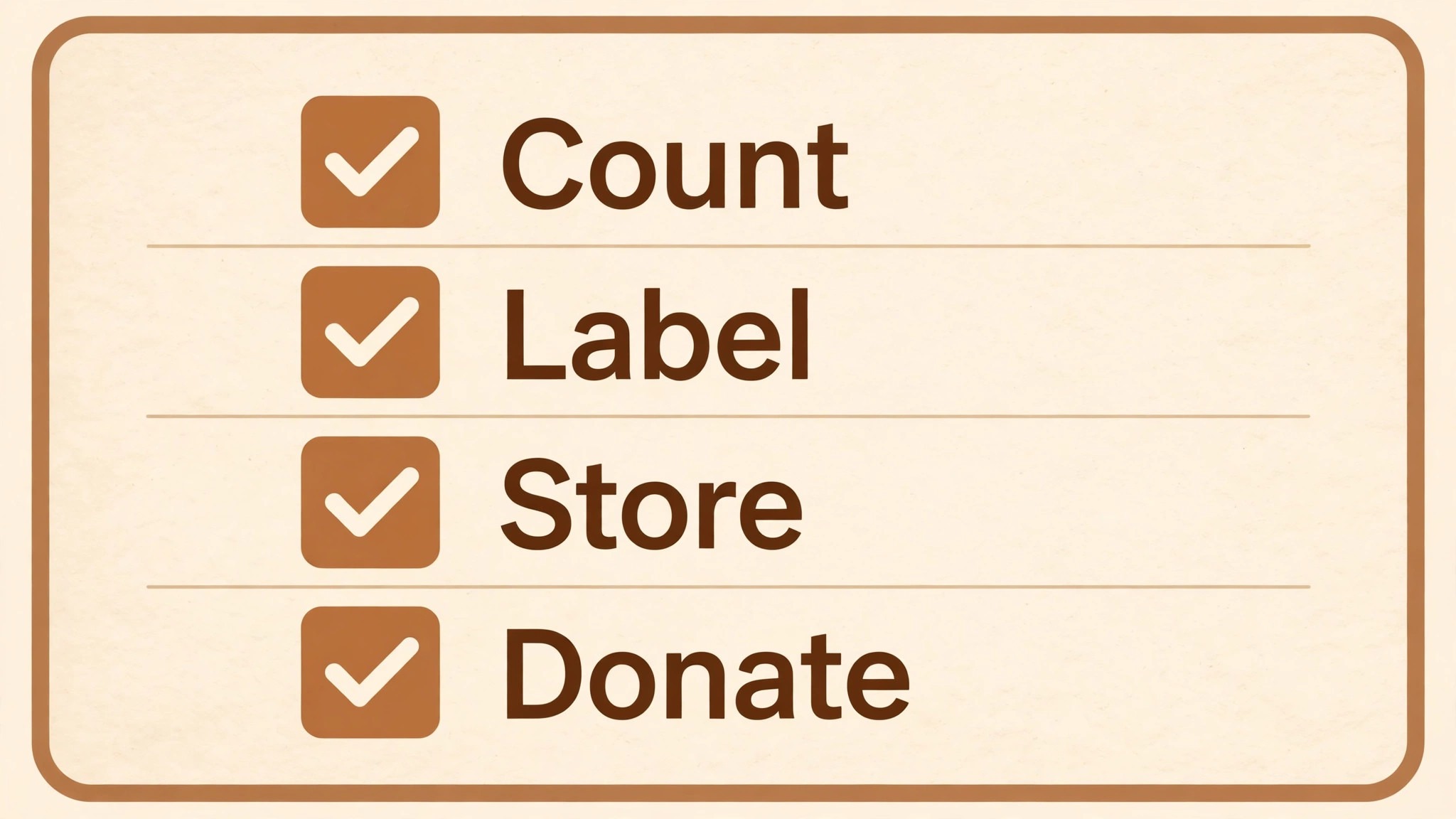
Fourth, write the daily timetable. At 4 pm, check pars and move likely surplus to the evening discount list. At closing, count, label and store qualifying day-old stock correctly, and record the rest for donation or disposal. In the morning, put the day-old shelf out at opening, with a clear sign stating the bake date and the price. At midday, check what remains. Anything unsold by a set time, such as 1 pm for day-old bread, moves to donation or repurposing, not to a second day of discount.
Fifth, protect the brand in the wording. Day-old should sound honest and appetising, not apologetic. Labels such as baked yesterday, still delicious toasted, or yesterday’s sourdough, perfect for toast, tell the truth and give a use. Avoid hiding the bake date, mixing fresh and day-old stock in one tray, or discounting silently at the till without a shelf sign. Customers accept a fair discount for yesterday’s bake. They do not accept feeling tricked about freshness.
Sixth, watch for the discount trap. Research on bakery overproduction shows that making leftovers cheaper can make it rational to bake more, which then creates more leftovers. That is why the forecast comes first and the discount comes second. If day-old sales rise while true waste stays flat, you are probably baking to feed the discount shelf. The fix is to cut the first bake for the products that dominate day-old sales, not to celebrate higher discount revenue. A healthy day-old shelf is small, varied, and shrinking as forecasting improves.
Donations, Repurposing and Disposal, in That Order
Once day-old sales close, donation comes next, then repurposing, then disposal. Contact one food bank or community kitchen before you need it, agree a pickup day and time, and agree what you will pack and label. Donated food must be apparently wholesome, meaning it meets quality and labelling rules even if it is past a sell by date or imperfect in appearance. Keep a simple donation record with date, product, quantity and recipient, and ask the charity for a written statement confirming it will feed people in need and will not resell the food.
In the United States, business food donations may qualify for an enhanced deduction, generally the lesser of twice the cost basis or cost plus half the profit margin, capped for most non corporate businesses at 15 percent of net income from that business. Ask your accountant how that rule applies to you. When you use AI for bakery waste reduction planning, donation data belongs in the same log as sales, because a rising donation total with flat waste means forecasting needs work.
Repurposing sits below donation for food that is safe but no longer presentable alone. Day-old bread becomes croutons, breadcrumbs, bread pudding or toast points where your recipes and rules allow. Anything mouldy, damaged, or past a safety limit goes straight to disposal. Never repurpose food to hide a quality failure, and never donate food you would not describe honestly to the recipient.
Measuring Waste After the Change
Review three numbers weekly. True waste rate, which is units thrown away divided by units baked. Sell through rate at full price. And recovered value, which is day-old plus surplus app plus donation record value in your own consistent terms. If true waste falls but full price sell through also falls, you cut too far and lost sales. If day-old revenue rises while true waste stays flat, you are baking for the discount shelf. When you use AI for bakery waste reduction planning week after week, compare the same weekday four weeks earlier, not yesterday, because weekday patterns swamp daily noise.
For related reading, see how a bakery can turn daily content into orders in the bakery Instagram marketing workflow and how another food business plans costs in the food truck guide. Both help when you use AI for bakery waste reduction planning, because waste falls fastest when marketing, ordering and baking share the same numbers.
Frequently Asked Questions
How much bakery waste is normal for a small shop
There is no single normal figure, because product mix and foot traffic vary widely. French artisan data puts unsold rates at 9 to 12 percent, while Kerry estimates about 10 percent of global bread production is wasted. Use your own two week log as the baseline, then judge progress against it.
Can a small bakery forecast without buying software
Yes. A spreadsheet with eight weeks of sales by product and day, plus weekday and event labels, is enough to start. Ask an AI assistant to summarise weekday patterns and suggest first bake quantities, then approve every number yourself before baking.
What is the best first bake percentage to reduce waste
For most shops, 85 to 90 percent of forecast for slower lines and 95 percent for lines that regularly sell out works well, with a planned second bake covering the gap. When you use AI for bakery waste reduction planning, set the second bake trigger in advance so the team acts on stock levels, not on guesswork.
Which products should never go on a day-old shelf
Anything with cream, custard or a short chilled life that your local rules or your own quality standard excludes, plus anything mouldy, damaged or past a safety limit. Keep a written list of qualifying products so staff never have to guess at closing time.
Does Too Good To Go pay straight away
No. Signing up is free and the platform takes a commission per Surprise Bag sold, with the rate varying by bag price. Payments arrive monthly or quarterly depending on region, so treat it as clearance and new customer discovery, not same day cash flow.
Is donated bakery food tax deductible
In the United States, business donations of apparently wholesome food to a qualifying charity may qualify for an enhanced deduction under section 170, subject to limits and valuation rules. Keep donation records and a written statement from the charity, and confirm your position with your accountant.
Bake Less Blind, Sell More of What You Bake
Waste planning is not about baking less for its own sake. It is about baking the right amount, selling the small surplus well, donating what remains in good faith, and learning from every week. Start with two weeks of counting. Build one weekday forecast. Set one second bake trigger. Open one marked day-old shelf. Review three numbers every week. When you use AI for bakery waste reduction planning this way, the tool stays in its proper place, as a fast assistant to a baker who already knows the shop and the customers.