

Most buyers check what other customers say before they buy, and the scale of that habit is hard to ignore. BrightLocal’s 2025 Consumer Review Survey, as reported in recent coverage, found that 87 percent of consumers read online reviews before choosing a local business, and 73 percent said positive reviews make them trust a business more. Those two numbers explain why a social proof strategy small business owners build deliberately outperforms one left to chance, because buyers are already looking for proof whether you provide it or not. If they find it on your pages, they stay. If they do not find it, they move to a competitor who shows it.
Social proof is evidence that other people have made the same choice a buyer is considering, and that the choice worked out well. It takes many forms, including reviews, testimonials, case studies, client logos, ratings, user photos, press mentions, and trust badges. Each form answers a different doubt, and a strategy, rather than a random collection, matches each form to the doubt it answers and to the place where the buyer feels that doubt most strongly.
The mistake most small businesses make is treating social proof as decoration. A testimonials page that nobody visits, three quotes on a homepage that never change, and a star rating buried in a footer do not form a strategy. A strategy collects proof continuously, places it where decisions happen, refreshes it regularly, and measures whether it changes buying behaviour. That system is the subject of this guide, and it is built to run on a small team with a weekly habit, not on a large marketing budget.
The Proof Types and the Doubt Each One Answers
Different proof answers different doubts, and matching them correctly is the first skill of the strategy. Reviews answer the doubt about whether strangers trust you, because they are public, independent, and searchable. Testimonials answer the doubt about whether people like the buyer got a good result, because they are specific stories in the customer’s own context. Case studies answer the doubt about whether a complex or expensive purchase will work, because they show the problem, the approach, and the result in full.
Client logos answer the doubt about whether serious buyers trust you, at a glance, provided the logos are genuinely familiar to your audience. Numbers answer the doubt about scale, such as how many customers you have served or how long you have operated, provided the numbers are true and current. User photos and videos answer the doubt about whether the product looks real in real life, rather than only in studio images. Trust badges and guarantees answer the doubt about risk at the moment of payment, by showing security, clear returns, or a plainly stated promise.
| Proof type | Doubt it answers | Where it works hardest |
|---|---|---|
| Public reviews | Do strangers trust this business | Search results and local profiles |
| Testimonials | Did people like me get a good result | Service and product pages |
| Case studies | Will this work for a complex need | High-value service pages |
| Client logos | Do serious buyers trust this business | Homepage and proposal pages |
| Customer numbers | Is this business established | Homepage and about pages |
| User photos and video | Does this look real in real life | Product pages and social channels |
| Trust badges and guarantees | Is it safe to pay or book | Checkout and contact pages |
A small business does not need every type at once. A social proof strategy small business owners build in stages starts with reviews and testimonials, then adds deeper proof as it becomes available. Start with reviews and testimonials, because they are the most widely checked and the easiest to collect. Add case studies when you sell high-value or complex work. Add logos, numbers, and badges as they become genuinely available, and never invent a logo, a number, or a badge you have not earned. Fake proof is worse than no proof, because buyers who spot it will never trust you again.
Collecting Proof Without Begging or Faking It
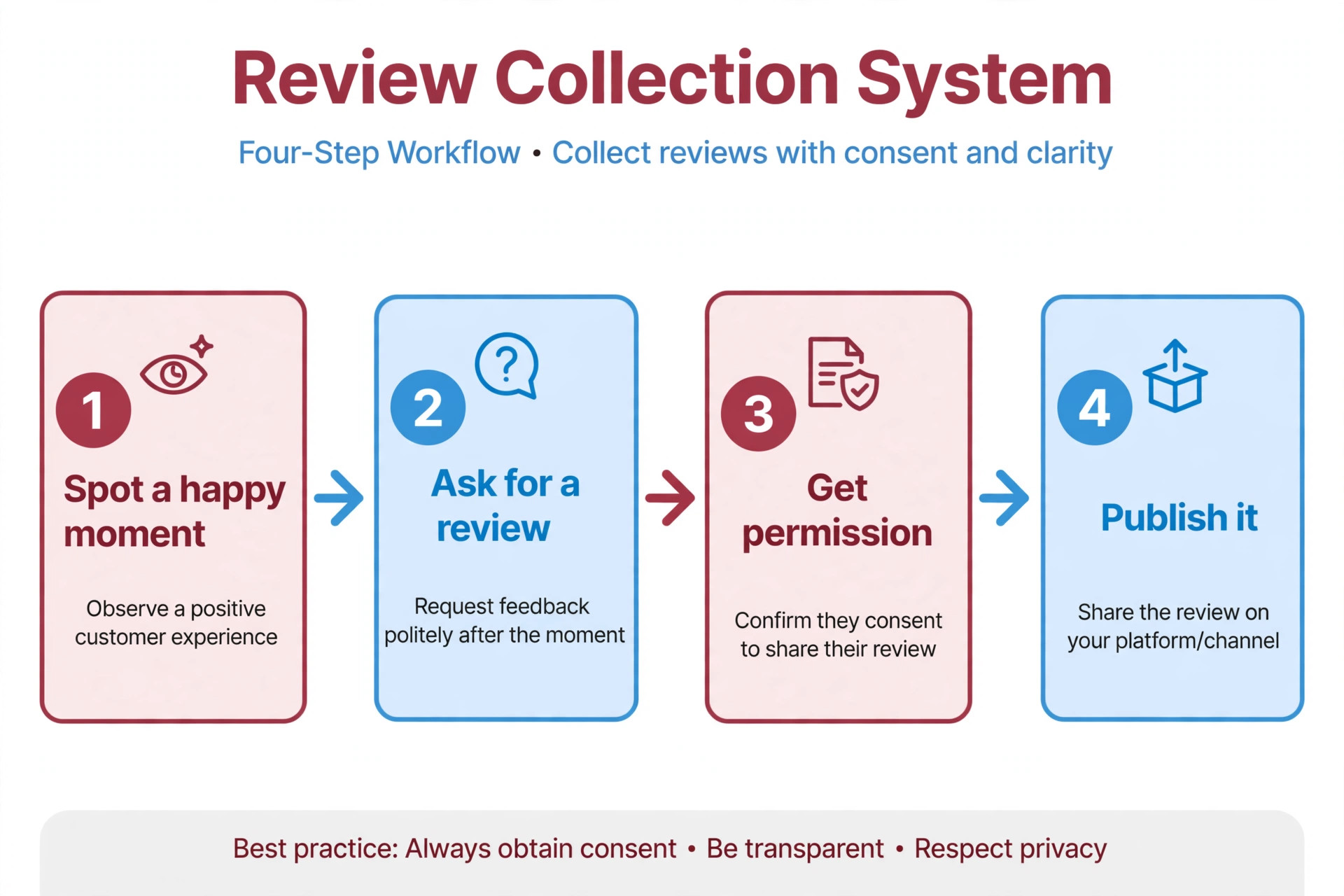
Collection fails when it depends on remembering to ask, so build asking into moments when customers are happiest. The best moment is right after a good result, such as a completed project, a successful delivery, a solved problem, or a compliment the customer just gave you. Ask in that moment, while the experience is fresh, and make the ask easy by giving one link and one short prompt, rather than a long form that feels like homework.
The prompt matters more than the platform. Ask a question that produces a specific answer, such as what problem you solved, what changed after working with you, or what the customer would tell a friend considering you. Specific prompts produce specific proof, while a generic request for a review produces generic praise that persuades nobody. A testimonial that says the work was great tells a buyer nothing. A testimonial that says delivery time fell or bookings rose tells a buyer everything, provided it is true and permissioned.
Make the ask part of your normal process, not a special campaign. Add a review link to the final delivery message, to the post-service thank-you, and to the invoice follow-up, and assign one person to check new proof weekly. A process that asks every happy customer will collect steadily, while a campaign that asks once a year will collect in bursts and then go silent. Steady collection also keeps proof fresh, which matters, because buyers trust recent proof far more than proof from years ago.
Incentives need care. Offering a reward for a review can be legitimate in some settings, but it must be disclosed where required, and it must never be tied to a positive rating. An incentive for an honest review is defensible. An incentive for a five-star review is not, and it risks both platform penalties and buyer trust. When in doubt, ask without an incentive, and let the quality of the work earn the review. Check the rules of each review platform you use, since platforms differ on what they allow.
Permission, Honesty, and the Rules That Protect You
Every piece of proof you publish needs permission, and that rule is non-negotiable. Permission discipline is what keeps a social proof strategy small business owners run from becoming a reputation risk. Get written permission before using a customer’s name, photo, quote, or results, and keep that permission on file with the proof itself. A testimonial used without permission is not a marketing asset. It is a relationship risk, and one complaint about it can undo months of good collection work.
Honesty rules are equally strict. Publish only genuine quotes, in the customer’s own words, with only light editing for length or clarity that does not change meaning. If you edit a quote, keep the original on file, and never add results, numbers, or claims the customer did not state. If a customer gives you a great quote but asks to stay anonymous, respect that choice and use the quote without a name, or do not use it at all. Anonymous proof is weaker, but it is still honest, while a named quote without permission is not.
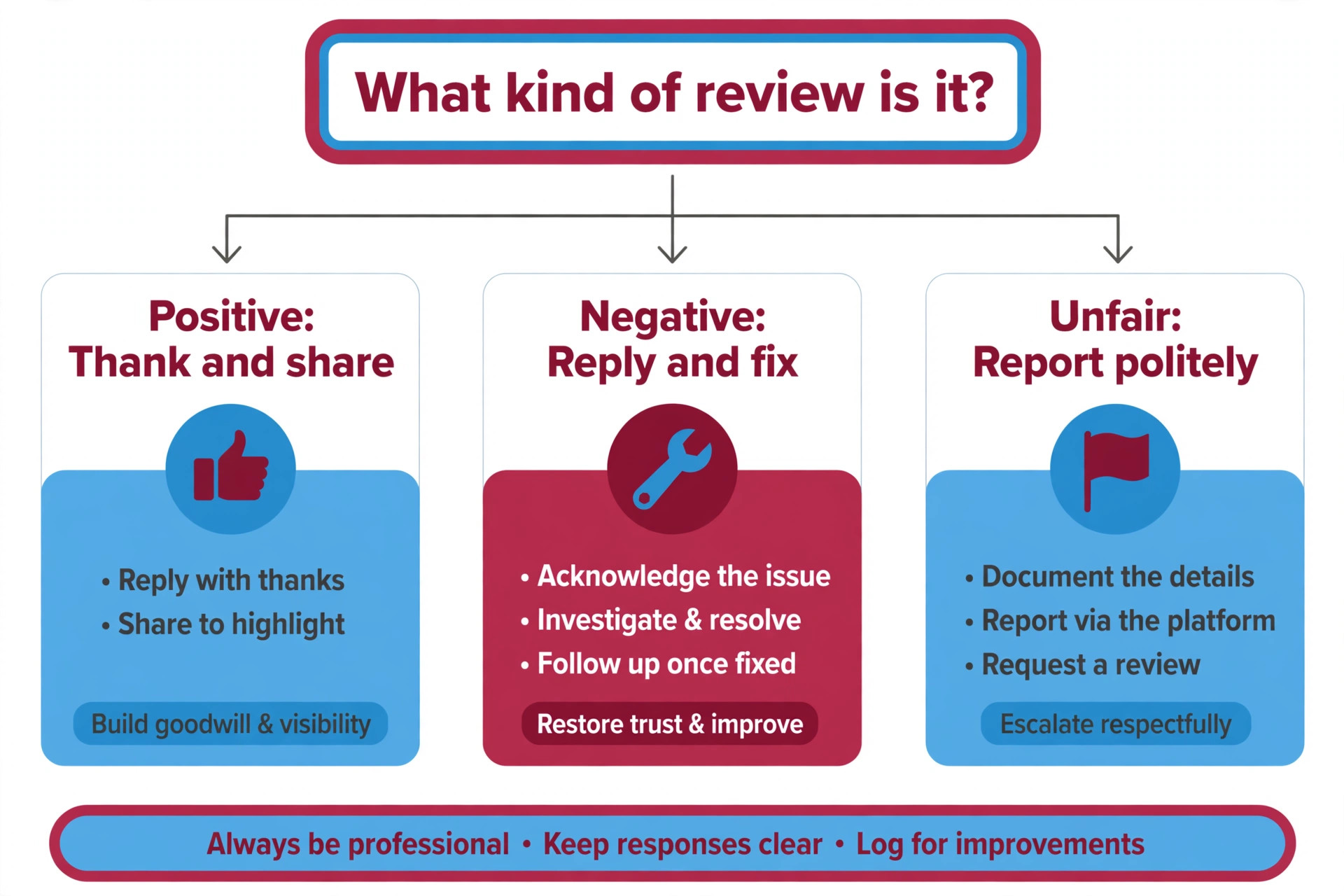
Negative proof deserves a plan too, because no business with real customers will hold a perfect rating forever. Respond to negative reviews promptly, politely, and helpfully, addressing the issue rather than arguing with the reviewer. A thoughtful public response often persuades future buyers more than the negative review deters them, because it shows how you handle problems. Never hide, delete, or fake responses to negative feedback, and never post fake positive reviews to bury a real complaint. Buyers recognise patterns, such as many reviews on the same date or identical wording, and those patterns destroy trust instantly.
Social Proof Strategy Small Business Placement Checklist
Proof placed in the wrong place is wasted, because buyers look for reassurance at decision points, not on a page they never visit. The principle is simple. Put proof where the buyer makes a decision, and match the proof type to that decision. The checklist below gives the standard placements, and the sections after it explain each one.
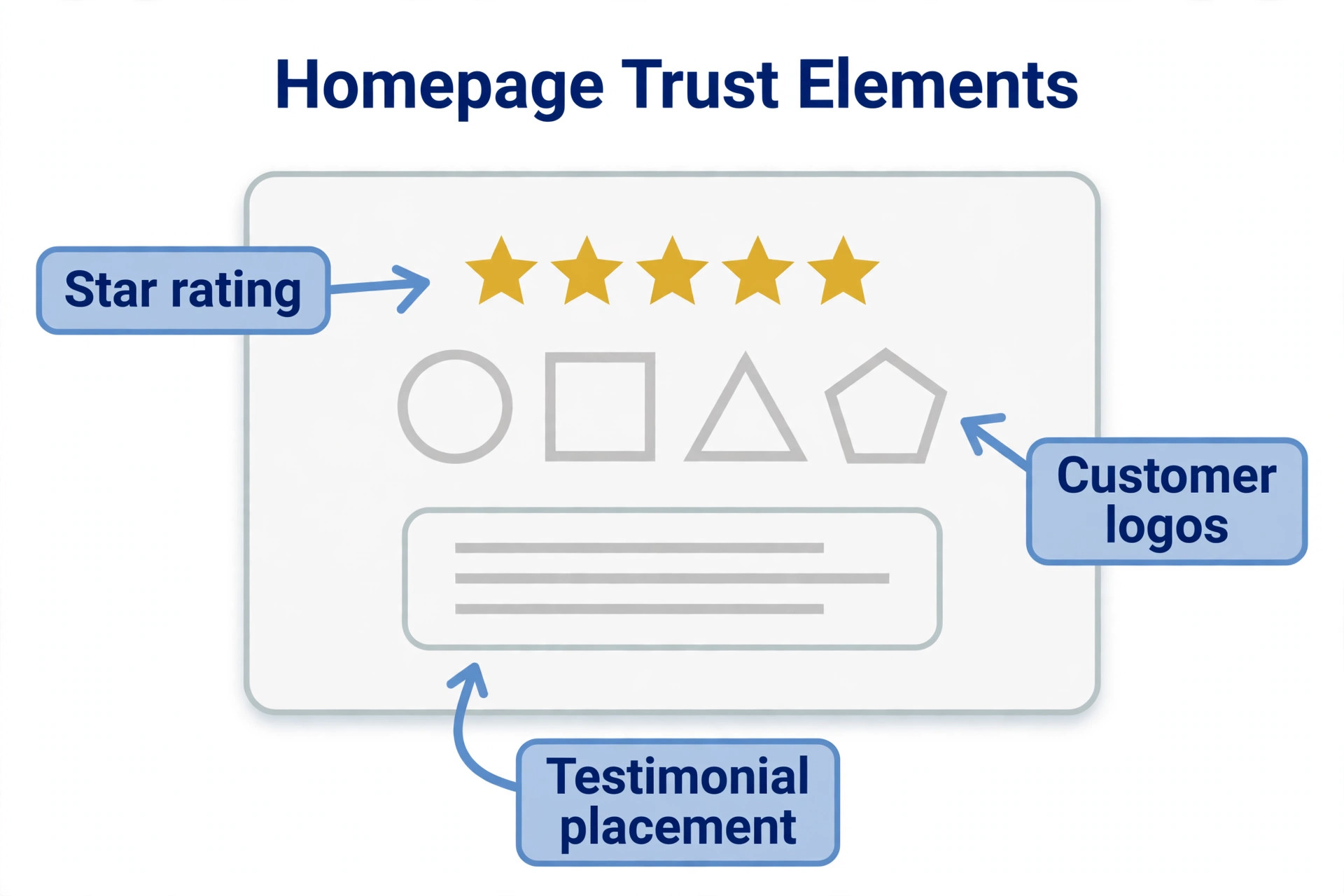
– Homepage, with aggregate rating, a small set of client logos, and one strong result or testimonial near the top, so first-time visitors form a trusting first impression. – Service and product pages, with testimonials and case study excerpts specific to that service or product, so buyers see proof for the exact thing they are considering. – Pricing pages, with proof that addresses value doubts, such as results achieved or satisfaction from buyers at a similar level. – Contact and booking pages, with rating, guarantee, and a short testimonial, so hesitation at the final step is answered before the buyer leaves.
– Checkout pages, with trust badges, security notes, and a guarantee stated plainly, so payment risk feels managed. – Email sequences, with a relevant testimonial at the point where a subscriber is deciding, not in every message, so proof feels helpful rather than repetitive. – Proposals and quotes, with a case study or testimonial matched to the prospect’s industry or problem, so the proposal carries evidence, not just promises. – Social channels, with user photos, short video testimonials, and reshared customer posts, with permission, so proof lives where buyers already spend time.
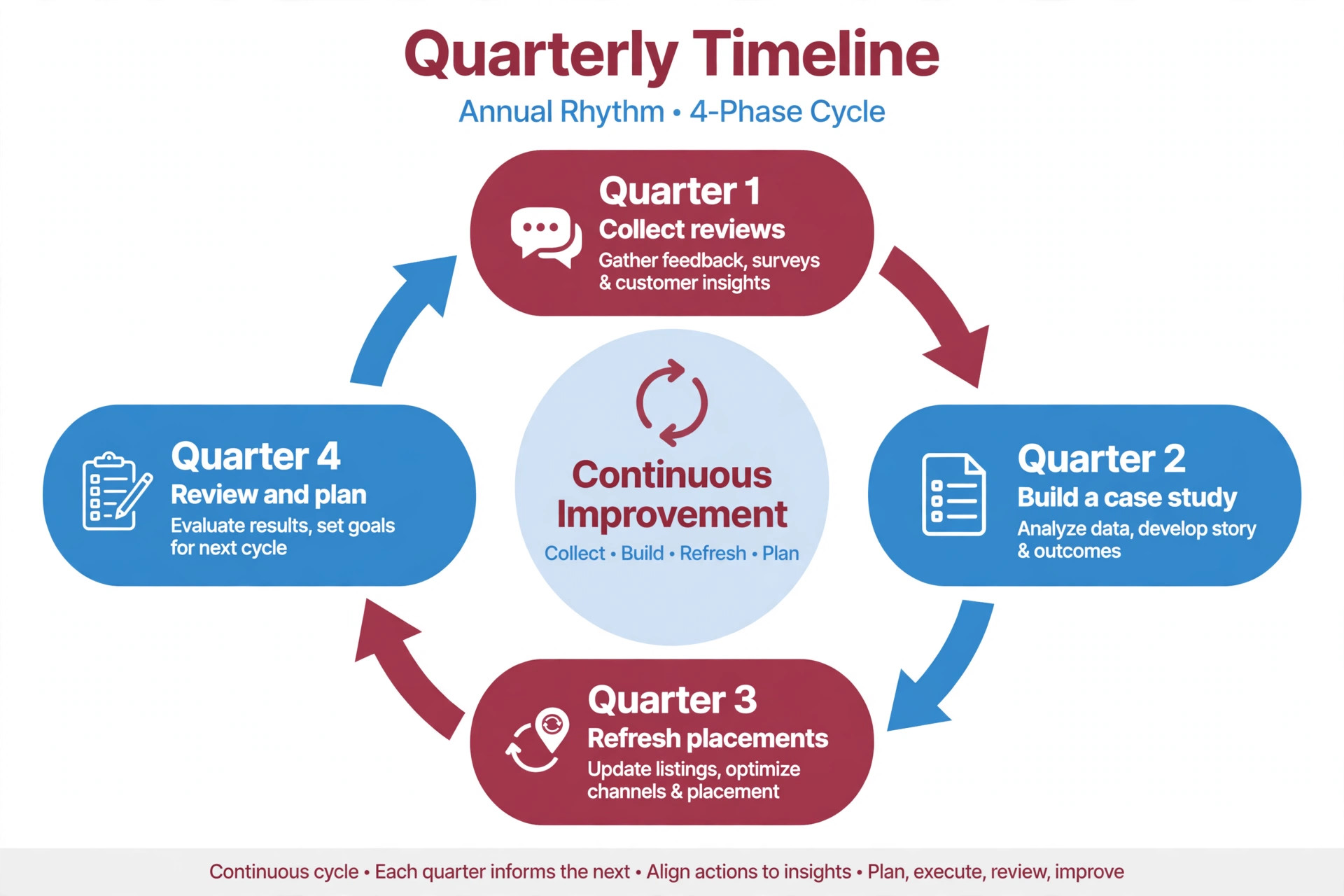
Review placements quarterly, because pages change, offers change, and proof goes stale. A testimonial from three years ago on a homepage signals that nothing good has happened since, even when the business is thriving. Fresh proof, rotated regularly, signals a living business with current happy customers, which is exactly what a buyer wants to see.

Proof on the Homepage, Done Right
The homepage has seconds, not minutes, to build trust, so it should carry proof that works at a glance. An aggregate rating with the review source named, a row of genuinely familiar client logos, and one specific testimonial with a result will do more than a wall of quotes that nobody reads. Keep the homepage set small, with two or three testimonials at most, and rotate them as new proof arrives, so returning visitors see fresh evidence rather than the same quotes year after year.
Numbers on the homepage must be true, current, and meaningful to the buyer. A count of customers served, years in business, or projects completed can help, provided the number is verified and updated. A vague claim, such as thousands of happy customers, helps nobody and invites doubt. If you cannot verify a number, leave it off. One true number beats three impressive ones that a buyer cannot believe.
The homepage should also link to fuller proof, such as a reviews profile or a case study page, so buyers who want depth can find it in one click. A homepage that shows a little proof and hides the rest feels selective. A homepage that shows a little proof and links to the full record feels confident, because it invites the buyer to check. That invitation is itself a trust signal, and it costs nothing to offer.
Proof on Product, Service, and Pricing Pages
Product and service pages need proof specific to that offer, because generic praise does not answer a specific doubt. A buyer considering a particular service wants to know whether that service worked for someone with a similar problem, not whether the business is generally nice. Place two or three testimonials for that exact service on its page, and add a case study excerpt when the service is high value or complex. Relevance beats volume here, and three relevant quotes will outperform ten general ones.
Pricing pages need proof that addresses value, which is the doubt that price creates. A buyer who sees a price and hesitates is asking whether the result is worth the cost, and proof that names a result answers that question directly. Place a testimonial that mentions value, a case study result, or a satisfaction note near the price, and avoid placing discount language beside proof, since the combination suggests the price needed justifying. Proof should support the price, not apologise for it.
Checkout and booking pages need proof that reduces risk, not proof that sells the product again. Trust badges, a plainly stated guarantee, a short rating summary, and one reassuring testimonial will do the job. Too much proof at checkout creates clutter and slows the buyer down, which is the opposite of what checkout needs. Keep checkout proof small, credible, and close to the payment or booking button, where hesitation actually happens.

Case Studies That Buyers Actually Read
A case study is the deepest form of proof, and it works when it follows a simple structure that buyers can follow quickly. Start with the customer’s situation and problem, in their terms, not in your service language. Then describe what you did, in plain steps, without turning the case study into a sales pitch for every service you offer. End with the result, in the customer’s words where possible, and in specific terms where the customer permits numbers. That three-part shape, problem, approach, result, is easy to read and easy to trust.
Keep case studies short for most small businesses, at one page or one web page, with a clear headline that states the result or the problem solved. A long case study that nobody finishes is less useful than a short one that buyers read to the end and remember. Use headings, a pull quote, and one image or chart of the result if the customer permits it, and link the case study from the relevant service page, the proposal template, and the email sequence where it fits.
Build one case study at a time, starting with your happiest customer in your most important service area, and aim for one new case study per quarter. That pace is realistic inside a social proof strategy small business teams can sustain without a large budget. That pace is sustainable for a small team, and after a year you will have four strong case studies covering your main offers. A library of four real case studies beats a library of twenty thin ones, because buyers read for depth when the purchase matters, and depth is what a real case study provides.
User Content, Video, and the Proof Buyers Trust Most
User photos and videos carry a credibility that polished marketing cannot match, because they show the product or service in real life, with real people, in real settings. Encourage customers to share photos or short videos of their experience, with permission to reshare, and make sharing easy by suggesting a simple prompt, such as showing the result or describing the experience in one sentence. Reshare the best user content on your social channels and product pages, crediting the customer, and thank every customer who shares, whether or not you reshare their post.
Video testimonials deserve special attention, because a buyer can hear tone and see sincerity in a way text cannot convey. A short video, even one minute, recorded on a phone, often outperforms a polished studio testimonial, because it feels real. Ask the customer three questions, which are what problem they had, what you did, and what changed, and let them answer in their own words without a script. A scripted testimonial sounds scripted, and buyers can tell.
Influencer and expert endorsements fit only when the endorser is genuinely relevant to your buyers and has actually used your offer. A recommendation from a well-known person in your niche, who can speak specifically about the result, carries real weight. A recommendation from a famous person with no connection to your market carries little weight and can look bought. Relevance and honesty matter more than follower count, and any paid endorsement must be disclosed plainly, following the rules of the platform and the market you operate in.

Handling Negative Reviews as Part of the Strategy
Negative reviews are not a failure of the strategy. They are part of it, because a business with only perfect reviews looks filtered, while a business with mostly positive reviews and thoughtful responses to the rest looks real. The strategy for negative reviews has three steps, which are respond fast, fix what can be fixed, and learn from the pattern. A fast, polite response shows future buyers that you pay attention. A fix shows the reviewer that you care. A pattern review shows your business where to improve.
Look for patterns in negative reviews monthly, because a repeated complaint about one step, such as delivery, communication, or booking, points to an operations problem that marketing cannot fix. Fix the operation, then let future reviews show the improvement. A business that answers complaints publicly but never fixes the underlying issue will keep collecting the same complaint, and buyers will notice that the responses never lead to change.
Never argue with a reviewer in public, never reveal private customer detail in a response, and never offer a reviewer a reward to remove a genuine review without disclosing the arrangement where required. Those actions create larger problems than the original review, and they are visible to every future buyer who reads the exchange. A calm, helpful response that invites the reviewer to contact you directly is almost always the right move, and it protects both the relationship and your reputation.
Measuring Whether Proof Changes Buying
Measure social proof the way you measure any marketing work, by comparing behaviour before and after a change. Record conversion rates on key pages before adding or moving proof, then measure again after a defined period, keeping other page changes minimal during that period. If conversion rises and nothing else changed, the proof likely helped. If conversion does not move, try a different proof type or placement, rather than adding more proof to the same spot. More proof is not always better proof, and clutter can reduce conversion even when each individual quote is strong.
Track review volume, recency, and average rating monthly, alongside page conversion and enquiry quality. Those monthly numbers are the dashboard of a social proof strategy small business owners can judge honestly, instead of guessing from anecdotes. Review volume shows whether collection is working. Recency shows whether proof stays fresh. Enquiry quality, judged by how many enquiries become customers, shows whether proof attracts the right buyers or merely more buyers. A proof programme that raises enquiries but lowers enquiry quality may be attracting bargain hunters rather than ideal customers, and the placement or message may need adjusting.
Test one change at a time, such as moving a testimonial higher on a page, swapping a generic quote for a specific one, or adding a rating near a booking button. Small, single tests produce clear lessons, while large redesigns that change everything at once produce confusion about what worked. A social proof strategy small business owners improve monthly, with one test and one review of new proof, will outperform a strategy launched once and left alone, because proof, like any asset, needs maintenance to stay valuable.
Mistakes That Make Proof Backfire
The first mistake is faking proof, in any form, including invented quotes, bought reviews, or logos used without permission. Buyers spot fakes through patterns, and platforms penalise them, so the short-term gain of a fuller testimonials page is never worth the long-term loss of trust. Build proof slowly and honestly, and let a smaller honest set outperform a larger fake one.
The second mistake is collecting proof and never placing it, so testimonials sit in an inbox while pages that need them stay bare. Collection without placement is wasted effort, and placement should happen weekly, as new proof arrives, not in an annual website update. Assign placement to the same weekly check as collection, so the two halves of the system move together.
The third mistake is using only generic praise, which tells buyers nothing specific enough to act on. Replace generic quotes with specific ones as soon as you have them, and keep asking specific prompts until your proof library is full of results, contexts, and problems solved. Specificity is the difference between proof that decorates a page and proof that converts a visitor.
The fourth mistake is letting proof go stale, with old testimonials, outdated numbers, and dead links to review profiles. Review proof quarterly, retire outdated items, update numbers, and check that every review link still works. Fresh proof signals a living business, while stale proof signals a business that stopped earning praise, even when that is not true.
The fifth mistake is overloading pages with proof, so visitors face a wall of quotes, badges, logos, and numbers that feels desperate rather than confident. Use the placement checklist as a limit, not just a guide, with two or three testimonials per page, one rating summary, and badges only where risk is felt. Confidence shows in restraint, and restraint is what makes the proof you do show believable.
The Social Proof Collection Template
Use this template to collect, permission, and place each piece of proof, and keep one row per item so nothing gets lost between collection and publication. A simple shared sheet works well for a small team, and it prevents the common problem of a great quote sitting in an email that nobody can find later.
| Template field | What to record |
|---|---|
| Customer name and business | Full name as permissioned for publication |
| Date and offer | When the work happened and which offer it relates to |
| Original quote or result | Exact words, plus any result the customer stated |
| Permission record | Date permission was given and how it was recorded |
| Proof type | Review, testimonial, case study, photo, or video |
| Placement planned | Page, email, or proposal where it will appear |
| Date published | When it went live, for freshness tracking |
| Review date | When to check whether it is still current |
Fill the template at the moment proof arrives, not later, because details fade and permission becomes harder to confirm with time. Review the sheet weekly, publish new items promptly, and retire items that are outdated or no longer permissioned. A template used weekly turns proof from a lucky accident into a reliable system, and that reliability is the heart of a social proof strategy small business owners can sustain for years.
Frequently Asked Questions
How many reviews does a small business need before proof starts working?
There is no magic number, because buyers judge recency, specificity, and rating together, not count alone. A small set of recent, specific reviews on the right platforms will outperform a large set of old, generic ones, so focus first on steady collection from happy customers and on placing that proof where decisions happen. Growth in review volume follows naturally from a weekly collection habit.
Should a business respond to every review?
Yes, to positive reviews with a short thank-you that mentions something specific, and to negative reviews with a prompt, polite, helpful response that invites direct contact. Responding to every review signals attentiveness to future buyers, and it keeps the business close to customer sentiment. Keep responses short and human, and never reveal private customer detail in a public reply.
Are testimonials on your own website as trusted as public reviews?
Public reviews carry extra trust because they are independent and searchable, while testimonials on your own site carry trust when they are specific, named with permission, and linked to real results or case studies. Use both, with public reviews for broad trust and website testimonials for specific offers, and link from your site to your public review profiles so buyers can verify the record themselves.
Can a business ask customers for reviews without breaking platform rules?
Yes, when the ask is for an honest review, with no condition on the rating, and when any incentive is disclosed where required and never tied to a positive score. Check the rules of each platform you use, since platforms differ, and keep the ask simple with one link and one specific prompt. Asking at the moment of a good result, rather than months later, produces the most honest and useful proof.
What should a business do with a fake or unfair review?
Respond calmly and factually in public, without arguing or revealing private detail, and use the platform’s reporting process where a review genuinely breaks its rules, such as a review from someone who was never a customer. Focus energy on collecting more genuine reviews, since a strong record of real proof outweighs a single unfair entry far more effectively than a public dispute. Never post fake positive reviews to bury it.
How often should social proof be refreshed?
Publish new proof weekly as it arrives, rotate homepage testimonials as new ones come in, and review all placements quarterly for staleness, dead links, and outdated numbers. Fresh proof signals a living business, while stale proof suggests nothing good has happened recently, even when the business is thriving. A quarterly review plus a weekly publishing habit keeps proof current without becoming a burden.
The Trust System to Start This Week
Start this week by asking your three happiest recent customers for an honest review with one specific prompt, and by placing one relevant testimonial on each of your two most important pages. Build the collection template, record permission for every item, and protect one hour a week for collecting, placing, and responding to proof. Add a case study each quarter, review placements quarterly, and test one placement change a month.
That steady system is what turns social proof from decoration into a growth asset, because buyers already look for proof before they buy. The only question is whether they find yours, or your competitor’s. For related strategy reading, see the guide on how to set up a client feedback loop, the community marketing strategy guide, and the content marketing strategy guide.