
The verdict is straightforward. A consultant who sends a clear, scoped, priced proposal within two business days of a discovery call wins more work than a more experienced consultant who sends a vague document a week later. Speed matters, but speed alone does not close deals. What closes them is a proposal that shows the client their own problem restated accurately, a scope they can approve without a meeting, a fee tied to outcomes rather than hours, and terms that remove the fear of an open ended engagement. This guide shows how to produce that document consistently, and how to use AI for consulting business proposal writing without letting the software flatten the expertise the client is actually buying.
Why Consultants Should Use AI for Consulting Business Proposal Writing
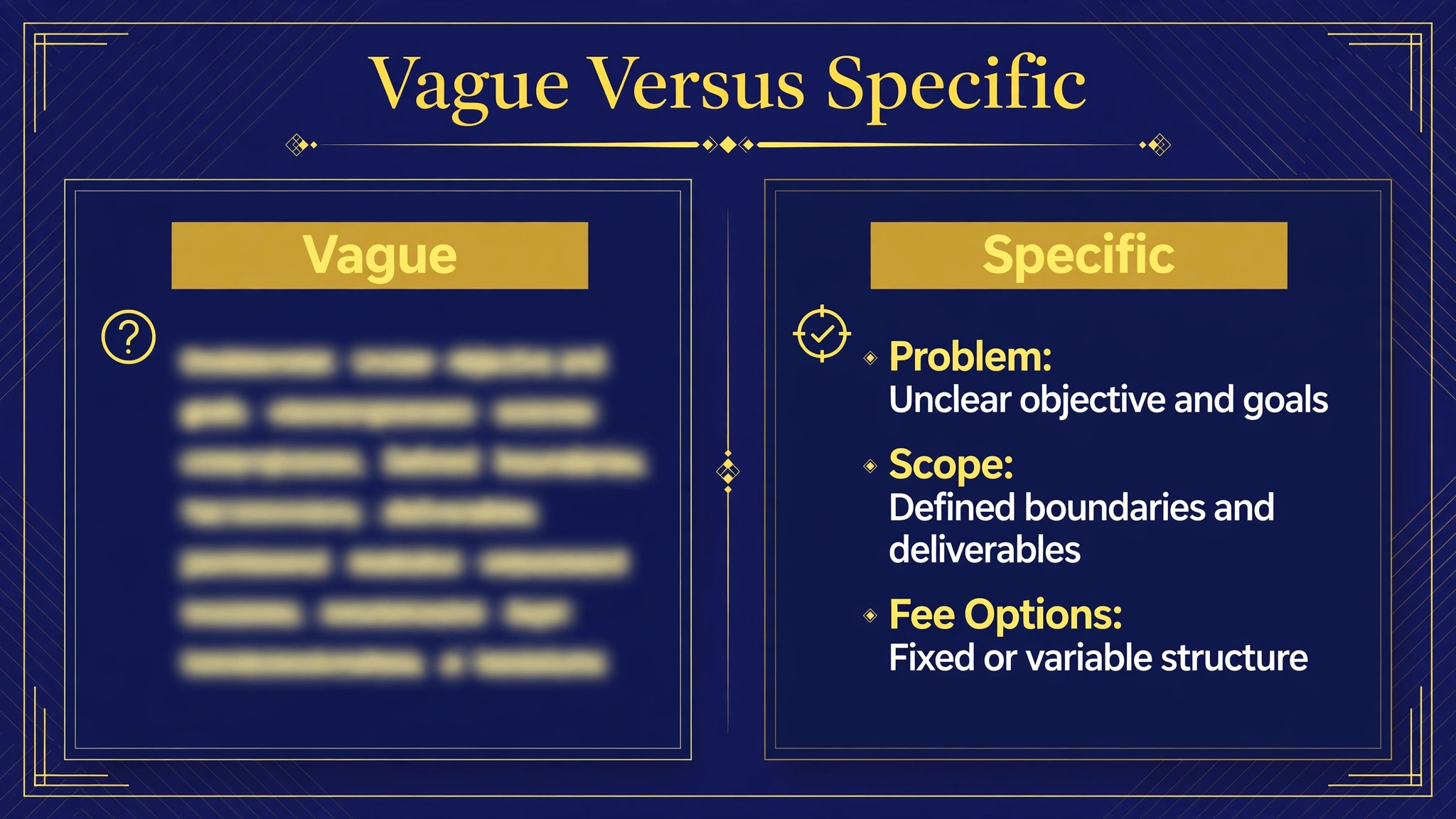
Most consultants lose proposals in the same three places. The first is delay. A proposal that takes a week to write arrives after the client’s enthusiasm has cooled and after a competitor’s proposal has already framed the decision. The second is vagueness. A scope written as “marketing support” or “operations advice” gives the client nothing to approve and everything to worry about, so the client asks for another call, and the deal stalls. The third is fee fog. An hourly rate with no total, no options, and no sense of what the client gets invites price comparison against every cheaper alternative, including doing nothing.
AI drafting attacks the delay problem directly. A consultant who feeds the tool a discovery call summary, the client’s stated goal, and a scope outline gets back a structured first draft in minutes, not days. The consultant then does the work that actually wins the deal, which is sharpening the problem statement, tightening the deliverables, and choosing the fee structure. That division matters. Software drafts fast and generic. Consultants win by being specific. A proposal that names the client’s actual bottleneck, quotes their own words back accurately, and promises a defined result in a defined window reads as written by someone who listened.
A proposal that could be sent to any company in the industry reads as written by someone who did not.
There is a second, quieter benefit. Proposal software tracks opens, time on each section, and client comments, which tells the consultant where deals actually stall. If clients spend minutes on the fee page and never reach the signature page, the fee structure needs work, not the cover design. If clients never open the proposal at all, the follow up sequence needs work, not the writing. Consultants who review that data monthly improve their close rate steadily, while consultants who only count wins and losses keep guessing about what went wrong.

What a Winning Proposal Contains
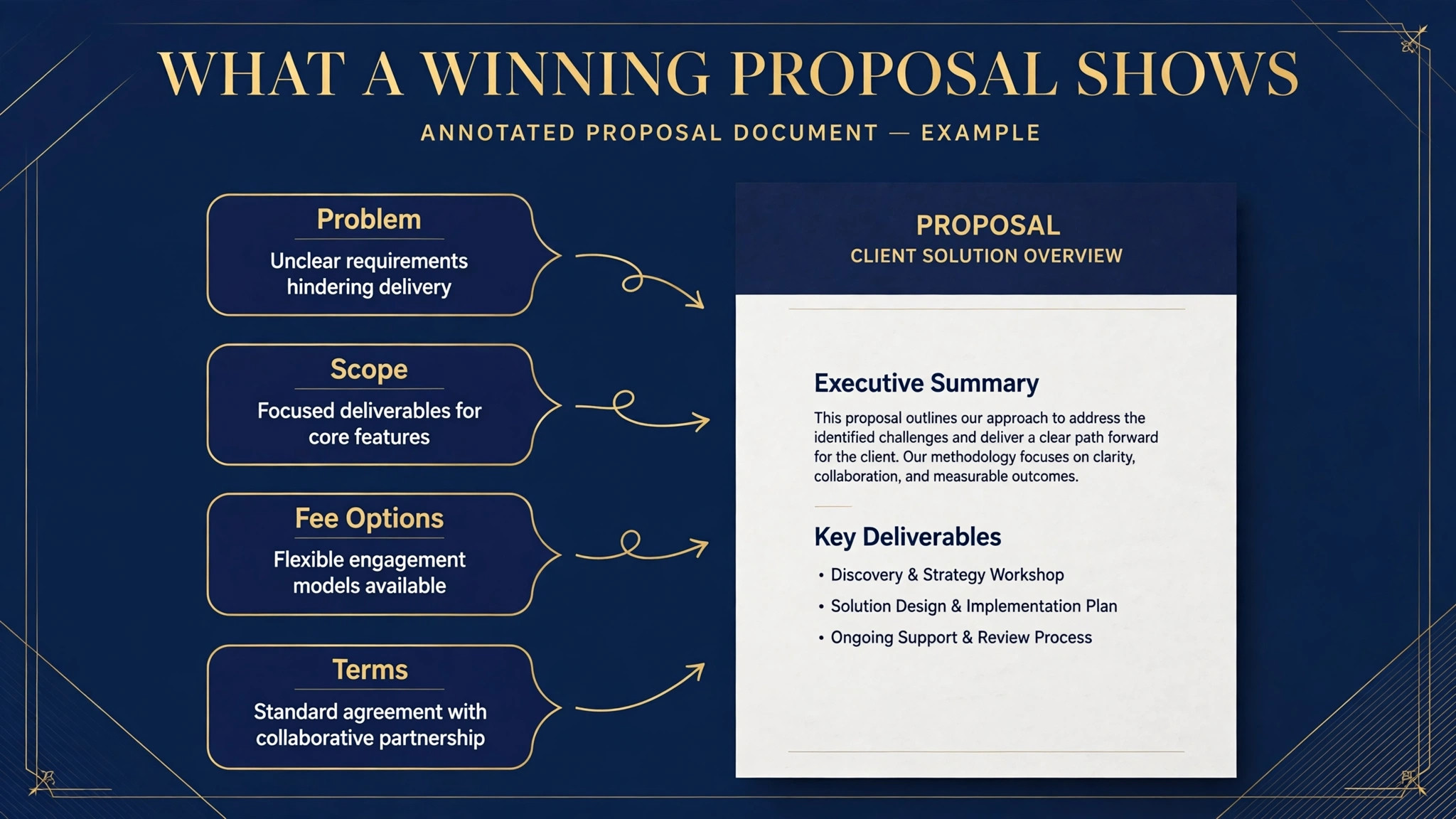
A strong consulting proposal answers seven questions in order, and the order matters because clients read proposals the way they read any risky decision, looking for reasons to stop. The cover names the client, the project, and the date, and nothing else needs to compete for attention. The executive summary restates the client’s problem in the client’s own terms and names the outcome the engagement will produce. A summary that praises the consultant’s experience before naming the client’s problem loses the reader in the first paragraph. Lead with their world, not yours.
The approach section explains how the work will happen in phases, with a deliverable at the end of each phase. Phased work protects both sides. The client can stop after a diagnostic phase without a large sunk cost, and the consultant can prove value before asking for a larger commitment. The scope section lists what is included and, just as importantly, what is excluded. Exclusions prevent the slow scope creep that turns profitable engagements into resentful ones, like unlimited revisions, implementation work, or access to the consultant between phases. The fee section presents options, usually two or three tiers, with the recommended tier marked clearly. The timeline gives start dates, phase dates, and decision points.
The terms cover payment schedule, cancellation, confidentiality, and ownership of deliverables. The next step tells the client exactly what to do, sign, pay the deposit, or book the kickoff call, with no ambiguity about what happens after they say yes.
| Proposal section | Question it answers | Common failure |
|---|---|---|
| Cover | Who is this for | Generic title with no client name |
| Executive summary | What problem are we solving | Consultant biography first |
| Approach | How will the work happen | One big phase with no milestones |
| Scope | What is included and excluded | Vague verbs with no deliverables |
| Fee options | What does it cost and why | Single hourly rate, no total |
| Timeline | When does value arrive | No start date or decision points |
| Terms | What if things change | Missing payment and exit terms |
| Next step | What do I do now | No signature or deposit instruction |
Length deserves a decision, not a habit. A proposal for a two week diagnostic can be three pages. A proposal for a six month transformation program may need eight. Length should follow decision risk. The more money and internal reputation the client risks by signing, the more evidence the proposal must carry. Short proposals win small deals. Thorough proposals win large ones. The mistake is sending a long proposal for a small deal, which looks expensive, or a short proposal for a large deal, which looks careless.
Consultants who use AI for consulting business proposal writing should set the length from the deal size before drafting begins, so the tool expands or compresses the draft to fit the decision, not the other way around.
The Proposal Workflow From Discovery Call to Signature
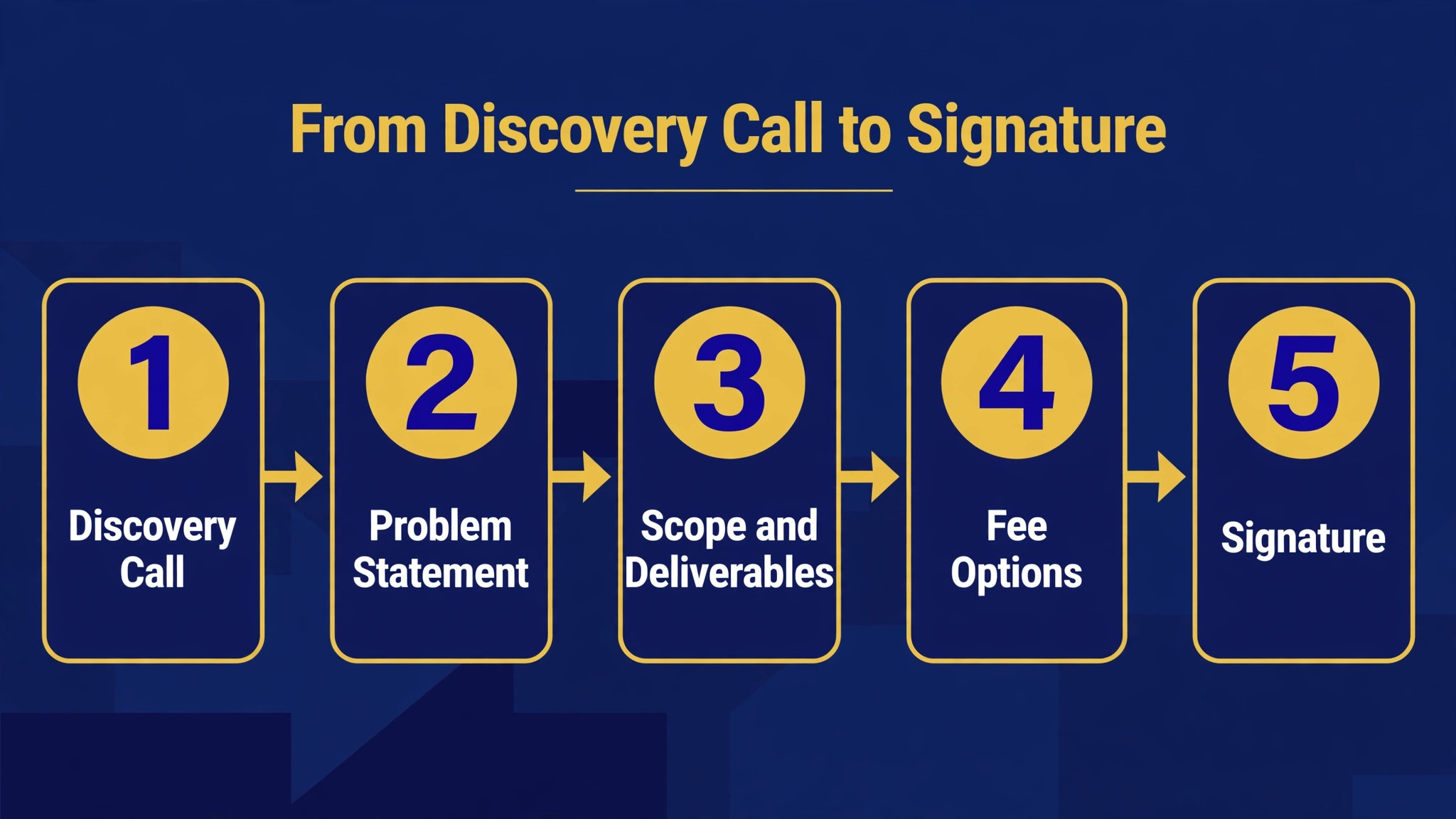
A reliable workflow turns proposal writing from a creative crisis into a repeatable process. It starts before the call, with a one page intake form that captures the client’s goal, current situation, decision maker, budget range, and deadline. Consultants who skip intake write proposals for the wrong problem, because discovery calls wander and memory edits the details. The intake form keeps the call honest and gives the drafting tool accurate raw material.
Step one after the call is a same day recap message. It restates the problem, the agreed scope direction, and the proposal delivery date, and it asks the client to correct anything wrong. That recap does two jobs at once. It proves the consultant listened, and it locks the scope before drafting begins, which prevents the proposal from being written against a moving target. Step two is drafting, where the consultant feeds the recap, the intake form, and a scope outline into the drafting tool and receives a structured first draft. Step three is the consultant’s edit, and it is the longest step by design.
The consultant rewrites the executive summary in the client’s words, sharpens every deliverable into something countable, checks every fee figure, and deletes any sentence that could apply to another client.
Step four is internal review for larger proposals. A colleague or a trusted peer reads for clarity and risk, asking two questions only. Would a busy executive understand this in five minutes, and does any sentence promise something the consultant cannot deliver. Step five is sending through proposal software with tracking and e-signature enabled, accompanied by a short message that names the decision date and the next step. Step six is follow up on a fixed cadence, which the next section covers in detail. Consultants who use AI for consulting business proposal writing inside this workflow cut drafting time from days to hours, while keeping the human edit that makes the proposal specific enough to win.
Timing targets keep the workflow honest. The recap goes out the same day as the call. The draft is complete within one business day. The consultant’s edit finishes within two business days of the call. The proposal is sent within two business days, not five. Consultants who miss the two day window should say so in the recap, with a reason and a date, because a promised date kept builds more trust than a fast proposal that arrives late without warning. Clients forgive a stated delay. They do not forgive silence.
The Scope and Fee Template
This template is the overview proof of this guide. Copy it, fill it for each engagement, and refuse to send a proposal that leaves any field blank. Blank fields become misunderstandings, and misunderstandings become unpaid work.
| Template field | What to write | Example of a strong entry |
|---|---|---|
| Client goal | Outcome in the client’s words | Reduce customer churn by 15 percent in two quarters |
| Current situation | Facts from discovery, not guesses | Churn at 8 percent monthly, no exit interviews |
| Phase 1 deliverable | One countable output | Audit report with ten findings ranked by impact |
| Phase 2 deliverable | One countable output | Playbook with scripts, templates, and training |
| Excluded work | Named explicitly | Implementation coding, paid advertising spend |
| Fee option 1 | Limited scope, lower price | Diagnostic only, fixed fee |
| Fee option 2 | Recommended scope | Diagnostic plus playbook, fixed fee |
| Fee option 3 | Full scope with support | Everything plus ninety days of support |
| Payment schedule | Deposit and milestones | 50 percent at signing, 50 percent at delivery |
| Timeline | Start, phase ends, decision points | Start in two weeks, phase 1 in three weeks |
| Revision policy | Number of revision rounds | Two rounds per deliverable included |
| Exit terms | How either side ends the work | Either side with fourteen days notice |
Fee structure deserves its own thought, because it shapes how clients judge value. Fixed project fees beat hourly rates for most consulting work, because the client buys an outcome with a known cost, and the consultant is rewarded for efficiency rather than slowness. Value based fees, tied to a share of measured improvement, suit engagements where the consultant can directly influence revenue or cost, but they require clean baseline data and a measurement agreement signed before work starts. Retainers suit ongoing advisory relationships where the client needs regular access, and they should name a monthly deliverable, not just availability, or the retainer quietly becomes a subscription the client resents.
Whatever structure the consultant chooses, the proposal should state the total, the payment schedule, and what triggers each payment, so the client never has to ask what the next invoice will be. Deposit size also signals confidence. A fifty percent deposit is standard for project work and filters out clients who are not serious, while a small deposit with milestone payments suits larger programs where the client needs internal approvals between phases. State the deposit in the fee section, not buried in the terms, because a client who discovers the deposit late feels ambushed, while a client who sees it beside the total treats it as normal business.

Four Tools That Carry Proposal Writing Well
PandaDoc for Full Document Workflow
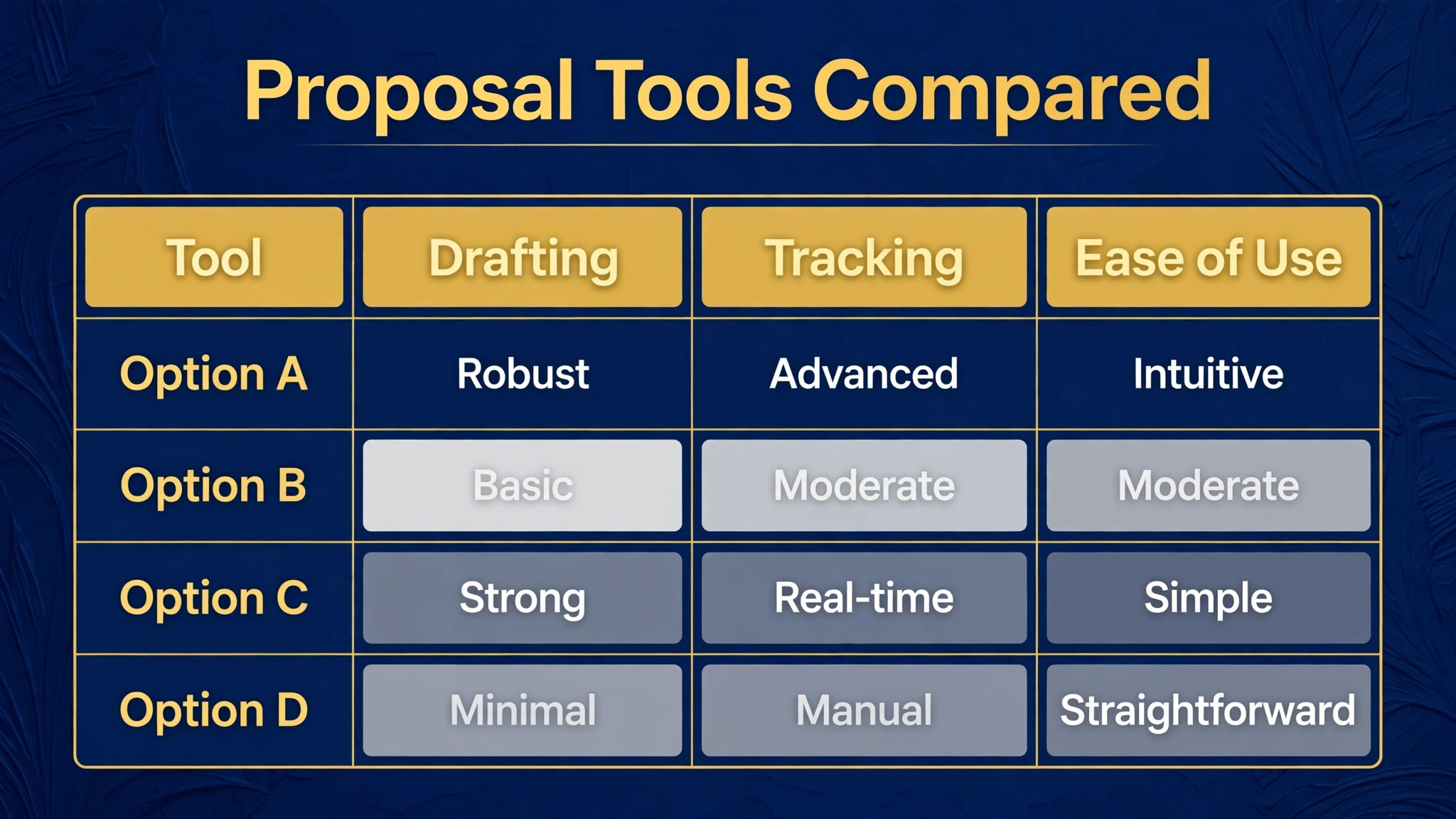
PandaDoc suits consultants who want the whole document lifecycle in one place, from drag and drop editing and templates through e-signature, tracking, and payment collection. Reported starting prices run around 19 dollars per user per month, with a Business tier around 49 dollars adding custom quotes, CRM integrations, and approval workflows. Its breadth is the selling point. A consultant can build a proposal, send it, watch the client open it, collect a signature, and take a deposit without leaving the platform. Its weakness is template depth for pure proposal design compared with tools that focus only on proposals.
Consultants who mainly need polished proposals and deep engagement analytics sometimes prefer a narrower tool, while consultants who also manage contracts and quotes will value PandaDoc’s range.
Proposify for Polished Proposals and Engagement Analytics
Proposify suits consultants who care most about how the proposal reads and how the client interacts with it. Its template library, content library, and interactive pricing tables speed up creation, and its analytics show views, time on each section, and client interactions in detail. Reported pricing starts around 19 to 29 dollars a month depending on the source and billing term, with team tiers adding interactive pricing and advanced analytics. The analytics change how a consultant follows up. A client who spent ten minutes on the fee page gets a different follow up call than a client who never opened the document, and Proposify makes that distinction visible.
Its limits show up for consultants who also need full contract management, which sits outside its core focus.
Qwilr for Interactive Web Page Proposals
Qwilr suits consultants whose clients are visually driven and who want proposals that feel like a web page rather than a document. Interactive widgets, embedded video, and clean mobile reading make Qwilr proposals easy to forward inside a client organization, which matters when the person who reads the proposal is not the person who signs it. Reported pricing starts around 35 dollars per user per month. The trade off is structure. Consultants who need heavy contract language or complex approval chains may find Qwilr lighter than a full document platform, while consultants selling strategy, brand, or marketing work often find its presentation closes deals that a plain document would not.
ChatGPT for First Drafts and Tone Repair
ChatGPT helps consultants turn a discovery recap and a scope outline into a structured first draft, rewrite a vague deliverable into a countable one, and adjust tone for different readers, like a board versus an operations manager. It works best when the consultant feeds it specific material, because generic prompts produce generic proposals, and generic proposals lose. The consultant must verify every claim, figure, and client detail in the draft, since drafting tools can invent plausible sounding specifics. Client confidential material should be handled under the consultant’s own data policy, with sensitive figures anonymized where possible.
Used inside that discipline, ChatGPT cuts the blank page problem entirely, and the consultant spends proposal time editing and sharpening rather than staring at an empty document. Many solo consultants find that they use AI for consulting business proposal writing most profitably here, in the first draft hour, while keeping the final edit entirely human.
Follow Up and Negotiation Without Chasing
Most proposals do not die from rejection. They die from silence, because the consultant sends the document and waits politely until the client forgets. A fixed follow up cadence prevents that quiet death. Day one after sending, a short message confirms receipt and names the decision date agreed in the proposal. Day three, a message asks one specific question about the proposal, like whether the phase structure fits the client’s timeline, because a specific question gets a reply while a general check in gets ignored. Day seven, a short video or voice note restating the outcome and the recommended option adds a human touch that text cannot carry.
Day fourteen, a closing message offers a smaller first step, like the diagnostic phase alone, and sets a date to close the file if there is no reply. That last step is not pressure. It is honesty, and clients respect a consultant who will close a file cleanly.
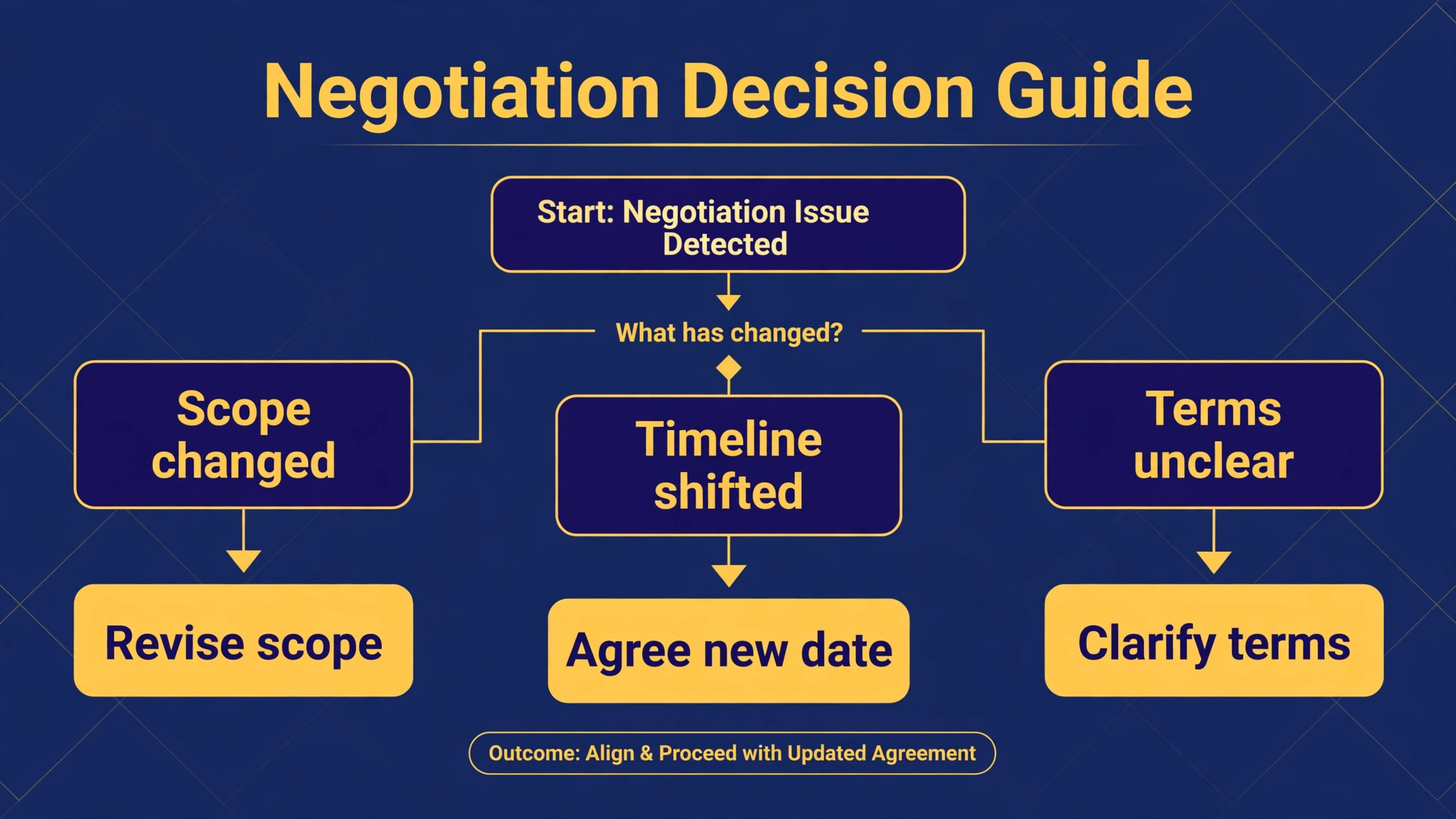
Negotiation usually centers on three levers, and the consultant should decide their limits before the call. Scope can shrink, which lowers the fee without lowering the rate. Timeline can shift, which helps a client with budget timing. Payment terms can flex, which helps a client with cash flow. The rate itself should move last, because discounting the rate teaches the client that the first price was inflated, and it permanently lowers the value of the consultant’s time. When a client asks for a discount, the strongest reply offers a smaller scope at a lower total, keeping the rate intact and the relationship honest.
Consultants who use AI for consulting business proposal writing should also keep a library of past proposals, anonymized, so that fee and scope decisions improve from real history rather than from memory of the last deal only.
Running a Proposal Review Before You Send
A proposal that has never been read by anyone except its author carries avoidable risk, so build a ten minute review into the workflow for every engagement above a modest fee threshold. The reviewer does not need consulting expertise. A capable colleague, a business partner, or even a sharp friend can answer the four questions that matter. Can you state the client’s problem in one sentence after reading the summary. Can you list the deliverables without guessing. Can you state the total fee and the payment schedule. Can you say what the client must do next. Any hesitation on any question marks a section for rewriting, and the rewrite usually takes minutes because the reviewer has named the exact confusion.
The review should also hunt for promises the consultant cannot keep. Phrases like guaranteed results, unlimited support, or full availability sound generous in a proposal and become disputes in week six. Replace guarantees with targets plus assumptions, replace unlimited with a named number of rounds or hours, and replace availability with response windows. A second hunt covers numbers. Every figure in the fee section, every date in the timeline, and every percentage in the problem statement gets checked against the discovery notes, because a single wrong number destroys trust faster than a weak argument.
Consultants who use AI for consulting business proposal writing benefit most from this review, since drafting tools produce confident prose that can hide a wrong figure behind fluent sentences.
The final review step is reading the proposal aloud, or at least reading the executive summary aloud. Awkward sentences reveal themselves in speech in a way they never do on screen, and a proposal that sounds stiff when spoken will read stiff to the client. Cut every sentence that does not survive reading aloud. Then send, and record the send date, the decision date, and the follow up cadence in the same place every time, so no proposal ever depends on memory. Consultants who use AI for consulting business proposal writing with a review step like this send fewer proposals and win more of them, because each document reaches the client already tested against a real reader.
Mistakes That Cost Consultants the Deal
The costliest mistake is sending a proposal before confirming the decision maker and the budget range. A beautiful proposal sent to a champion with no signing authority becomes an internal document the champion must defend without the consultant present, and it usually loses to a competitor who spoke with the signer directly. A second mistake is promising outcomes the consultant cannot control, like guaranteed revenue growth, without naming the client’s responsibilities that make the outcome possible. Guarantees feel persuasive in the proposal and become disputes in the engagement. Promise deliverables and effort, describe expected outcomes as targets with assumptions, and put the client’s responsibilities in writing.
A third mistake is the copy and paste proposal. Clients recognize a template that was barely customized, and the recognition itself damages trust, because it tells the client the consultant did not think hard about their situation. Every proposal should contain at least five sentences that could only be written for that client, drawn from the discovery call. A fourth mistake is hiding the fee at the end of a long document. Clients scroll to the fee first anyway, so burying it only creates suspicion. Present fee options clearly, early enough that the client reads scope with price context, and let the value argument sit beside the number rather than pages away from it.
Consultants who review their lost proposals quarterly, and who use AI for consulting business proposal writing with a mandatory human edit before sending, catch these mistakes while they are still cheap to fix.
More Reading on Stratilyze
Readers who sell professional services may also enjoy AI tools for freelance writing client management and AI tools for fitness coaching client progress tracking, since both cover the same discipline of turning regular client communication into retention and repeat work. AI tools for daycare parent communication is useful too, because its daily report template shows how short, specific updates build trust between a provider and the families or clients who depend on them.
Frequently Asked Questions
How long should a consulting proposal be?
As long as the decision risk requires, and no longer. A diagnostic engagement for a small business can be won with three pages that name the problem, the deliverable, the fee, and the next step. A six month program for a large company may need eight pages with phases, risks, and terms. The test is whether a busy decision maker can understand the outcome, the scope, the fee, and the next step in five minutes. If they cannot, the proposal is too long or too vague, and cutting words will help more than adding evidence.
Should a proposal include an hourly rate?
Usually not as the headline price. Clients compare hourly rates with every cheaper alternative, including doing nothing, while fixed project fees let the client compare outcomes with costs. An hourly rate can appear inside the terms for extra work beyond scope, so that out of scope requests have a clear price, but the main fee should be a project total tied to deliverables. Retainers and value based fees follow the same logic. The client should always know the total and what triggers each payment.
How fast should a proposal go out after a discovery call?
Within two business days, with a same day recap message in between. Speed signals professionalism and keeps the client’s enthusiasm alive, while delay lets competitors frame the decision first. If the proposal genuinely needs more time, say so in the recap with a reason and a date. Clients forgive a stated delay and a kept promise. They do not forgive silence, and silence is how most lost proposals actually die.
What should a consultant do when a client asks for a discount?
Offer a smaller scope at a lower total before cutting the rate. Shrinking scope protects the consultant’s rate, keeps the engagement profitable, and gives the client a real choice rather than a negotiation game. If the client still needs a lower price, adjust payment terms or timeline before touching the rate, and record the reason for any exception so the next proposal does not inherit an accidental precedent. Consultants who discount rates casually train clients to expect discounts every time.
Can AI write a whole proposal on its own?
It can draft one, but it should not send one. Drafting tools produce structured, fluent documents from good input, and they also invent plausible details, soften hard truths, and miss the client’s real politics. The consultant’s edit is where the proposal becomes winnable, by restating the problem in the client’s words, sharpening deliverables, checking figures, and deleting anything generic. A proposal sent without that edit reads as competent and forgettable, which is the most expensive kind of proposal to send.
How do you handle a proposal that gets no reply?
Follow a fixed cadence and then close the file cleanly. Confirm receipt on day one, ask a specific question on day three, send a personal voice or video note on day seven, and offer a smaller first step on day fourteen. If there is still no reply, send a closing message that thanks the client, names the date the proposal expires, and invites them to reopen the conversation later. Closing cleanly preserves the relationship and the consultant’s time, and many clients return months later precisely because the consultant behaved professionally at the end.
The Closing Standard to Hold Every Proposal To
A proposal earns its send when a stranger could read it and answer four questions without asking the consultant anything. What problem does this solve, what exactly will be delivered, what does it cost in total, and what happens next. If any answer is missing, the proposal is not ready, and no amount of design polish will fix it. Build the workflow in this guide, keep the scope and fee template beside every draft, and let drafting software carry the speed while you carry the specificity.
When you use AI for consulting business proposal writing as a disciplined workflow rather than a shortcut, that combination wins work steadily, and it wins the kind of work that leads to the next engagement.