

The verdict is straightforward. A solar installer who quotes regularly should use AI for solar installer quote estimates, because the alternative, manual roof measurements and spreadsheet math for every prospect, costs hours per quote and loses deals to faster competitors. AI quoting does not replace the site survey, the electrician, or the engineer. It replaces the slowest part of the sales process, which is turning an address and a utility bill into a credible system design and price. Installers who adopt it quote in minutes, follow up the same day, and spend site visits confirming rather than discovering.
This guide is written for installers, not homeowners, and it covers the workflow end to end. It explains how AI quoting tools work, walks through an eight step workflow, and provides a quote template covering roof details, system size, incentives, and financing options. Tool prices and incentive figures come from vendor pages and industry guides checked at writing time, and both change often, so confirm every figure on the vendor page or the relevant government page before quoting a customer. Where a figure is reported rather than published, the text says so plainly.
When AI Quoting Pays, and When It Does Not
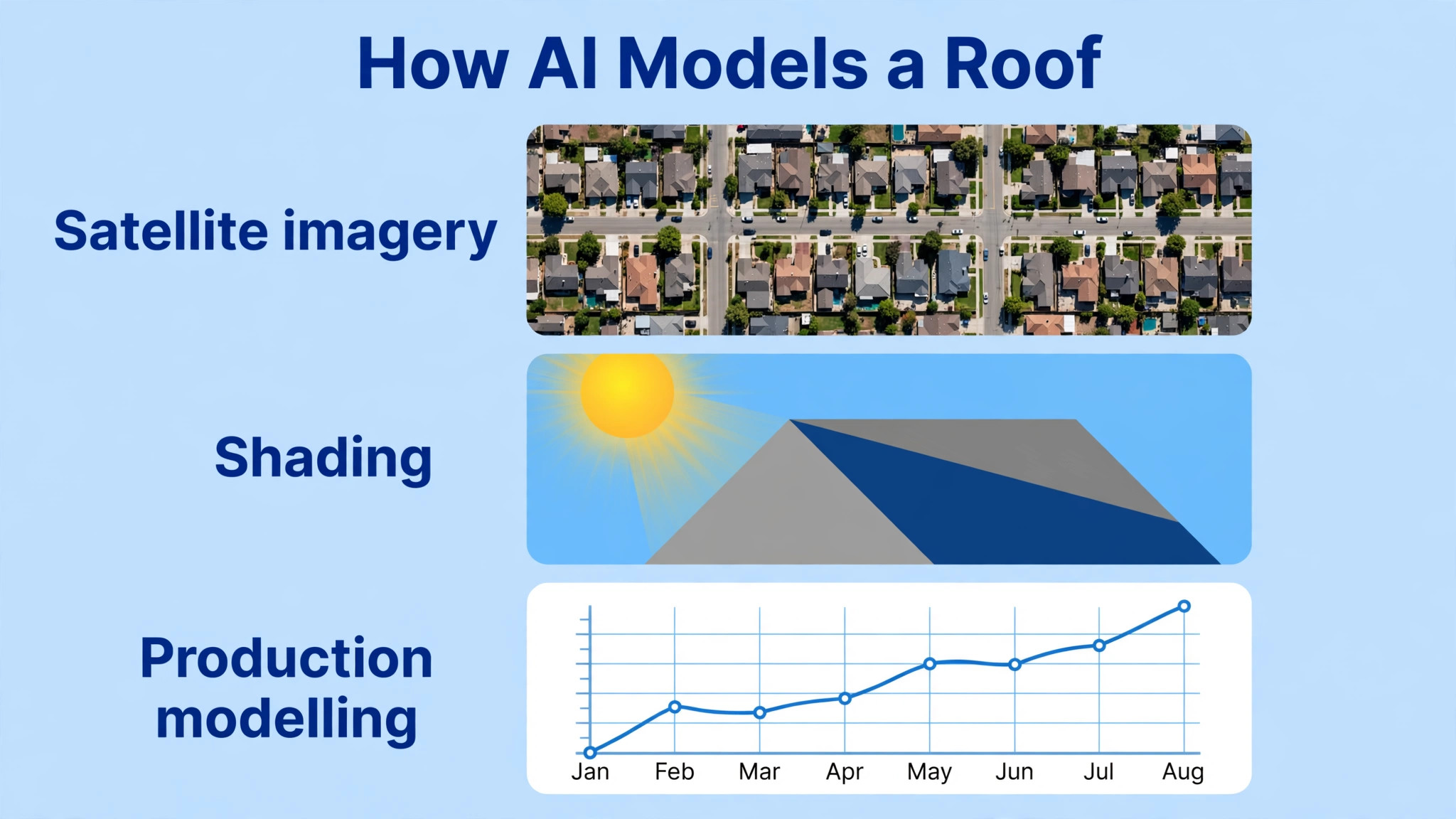
AI quoting pays when volume is the bottleneck. An installer quoting ten homes a week cannot afford a truck roll and a manual design for every prospect, because most prospects never buy. AI tools measure roofs from satellite imagery, model shading and production, and generate a priced proposal before anyone drives anywhere, so the team spends site visits only on prospects who already like the numbers. That filtering effect is the real return, even more than the time saved per quote.
AI quoting pays less for complex roofs, historic homes, ground mounts, and commercial projects, where satellite imagery cannot capture structural details, shading from nearby trees, or roof condition. It also pays less for an installer quoting two homes a month, where a subscription tool costs more than the hours it saves. A small installer in that position should use a pay per quote tool or a free calculator for screening, and reserve full design software for confirmed projects.
The honest test is quote volume against close rate. If the team quotes many homes and closes few, faster quoting with better filtering improves the business immediately. If the team closes most of what it quotes, the bottleneck is installation capacity, not quoting speed, and AI quoting helps less. Run that test on the last quarter of sales data before buying a tool, because a subscription justified by volume is an investment, while one justified by excitement is a cost.
How AI Solar Quoting Actually Works
AI quoting tools combine four inputs that used to require separate work. The first input is imagery. Satellite and aerial imagery, sometimes with LiDAR data, measures roof dimensions, pitch, azimuth, and usable area, and identifies obstructions such as vents, chimneys, and skylights. The second input is shading and weather data. Sun path algorithms and local weather records model how much sunlight each roof section receives through the year, and production models such as the PVWatts approach estimate annual output from those inputs.
The third input is usage data. The customer utility bill, or twelve to twenty four months of consumption pulled through a utility integration, shows how much energy the home uses and when. That usage profile decides the target system size and the offset percentage, commonly aimed at ninety to one hundred and ten percent of annual usage according to quoting guides. The fourth input is pricing and incentives. Equipment prices from supplier data, labour costs by system complexity, and incentive databases combine into a net price, while financing engines generate cash, loan, lease, and power purchase agreement scenarios with monthly payments.
The output is a proposal, usually with a roof visualisation showing panel placement, production graphs, savings projections over twenty five years, and financing comparisons. The best tools let the homeowner adjust system size, equipment, and financing on screen, with numbers recalculating instantly. That interactivity matters, because a homeowner who can test a smaller system or a battery option stays engaged, while a homeowner handed a fixed PDF either accepts or walks away.
Accuracy limits matter as much as features. Satellite imagery can be months old, trees grow, and a roof that looks clean from above may hide soft spots, old shingles, or a full electrical panel. Treat every AI quote as an estimate clearly labelled as such, confirm roof condition and electrical capacity on the site survey, and never let a proposal promise production figures the survey has not validated. Installers who overpromise on AI numbers and underdeliver after survey lose trust faster than installers who quote conservatively and beat expectations.
Data handling deserves the same care as accuracy. Roof imagery and utility usage are personal household data, so the installer should explain what data the tool collects, where it is stored, and who can see it, and should get homeowner consent before pulling usage data through a utility integration. A short privacy note in the proposal, written in plain language, prevents awkward questions later and shows the installer treats customer data as carefully as it treats the roof.
How to Use AI for Solar Installer Quote Estimates Every Day
The daily workflow below assumes the installer already chose a tool and set up pricing, equipment lists, and incentive data. The first week is for calibration, meaning every AI quote gets checked against a manual measurement until the team trusts the tool on local roof types.
1. Capture the prospect properly. Record the full address, the utility provider, and the average monthly bill or, better, twelve months of kilowatt hour usage. A quote built on a guessed bill is a guess, however good the roof model looks. 2. Run the AI roof analysis. Enter the address, let the tool pull satellite imagery, and check the roof measurement, pitch, azimuth, and usable area against the imagery by eye. Correct any missed obstruction or wrong roof section before designing, because every later number inherits roof errors. 3. Model shading and production. Review the shading analysis and the annual production estimate, and sanity check the result against local benchmarks, such as expected output per kilowatt for the region. A production figure far above or below the local norm signals a bad input, not a miracle roof. 4. Size the system to the goal. Set the target offset from the customer goal and roof capacity, usually ninety to one hundred and ten percent of annual usage, and generate good, better, and best options where the tool supports tiered proposals. Three options on one document close better than one option that feels take it or leave it. 5. Select equipment and check pricing. Choose panels, inverter type, and battery options from the approved list, confirm current supplier pricing, and check that the bill of materials matches the design. A quote priced on last quarter equipment costs will either lose margin or need an awkward revision. 6. Apply incentives and financing. Pull current federal, state, and local incentives for the property location and installation date, and generate cash, loan, lease, and power purchase agreement scenarios with monthly payments. Flag any incentive that needs customer action, such as a tax filing, so the homeowner understands what is automatic and what is not. 7. Build and send the proposal. Assemble the branded proposal with the roof visualisation, system specifications, production chart, savings breakdown, warranty details, and installation timeline, and send it the same day the prospect enquires. Speed matters, because a prospect who waits a week for a quote has usually talked to two other installers. 8. Follow up and confirm on site. Run an automated follow up sequence, answer questions with the interactive proposal where possible, and confirm roof condition, shading, and electrical capacity on the site survey before finalising the contract. Update the quote if the survey changes anything, and explain the change plainly rather than burying it.
That workflow takes minutes per quote once calibrated, and the calibration week is what makes it trustworthy. An installer who skips calibration and sends unchecked AI quotes will discover errors through customer complaints, which is the most expensive way to learn a tool.
The Solar Quote Template
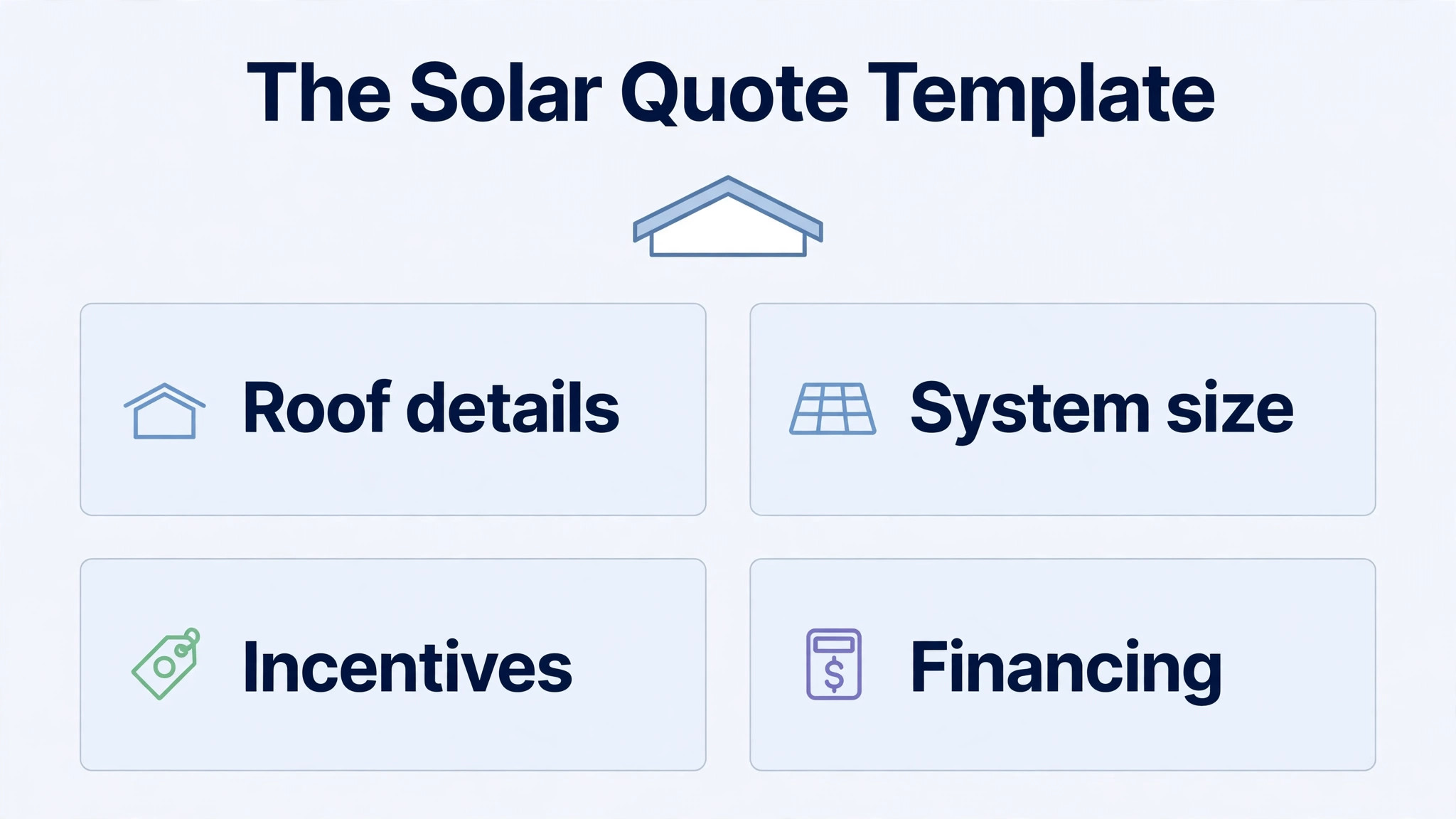
A good quote template answers every question a homeowner asks before signing, in the order they ask it. The template below covers roof details, system size, incentives, and financing options, and it works as a checklist for the proposal the AI tool generates. Copy the structure into the chosen tool, and fill every field, because a blank field reads as a hidden cost.
| Template section | What to include | Why it matters |
|---|---|---|
| Customer and property | Name, address, utility provider, roof type and age | Proves the quote is for this home, not a generic sheet |
| Roof details | Roof sections used, total usable area, pitch, azimuth, obstructions noted | Shows the design fits the actual roof |
| Shading and production | Shading factor, year one production estimate in kilowatt hours, production source | Sets honest expectations for output |
| System size | System size in kilowatts, panel count and model, inverter type | Lets the homeowner compare quotes like for like |
| Equipment and warranties | Panel warranty, inverter warranty, workmanship warranty | Warranties decide long term value as much as price |
| Battery and extras | Battery model and size if included, EV charger or panel upgrade if quoted | Prevents surprise add ons after signing |
| Gross system price | Equipment, labour, permitting, and inspection as separate lines | Itemised pricing builds trust and eases comparison |
| Incentives applied | Each incentive by name, amount, and whether it is automatic or needs action | Stops the homeowner assuming a credit they cannot claim |
| Net system price | Gross price minus incentives, with the maths shown | The number the homeowner actually compares |
| Price per watt | Net price divided by system watts, and gross price per watt | The fairest comparison metric across quotes |
| Financing option, cash | Total cash price, payment schedule | The simplest option, and the baseline for comparison |
| Financing option, loan | Loan amount, term, rate, monthly payment, total interest, dealer fee if any | Dealer fees can run 10 to 30 percent of the cash price according to a consumer finance spotlight as reported in industry guides, and are usually financed into the loan rather than listed separately |
| Financing option, lease or PPA | Monthly payment, term, escalation rate, buyout terms | Escalation turns a cheap first year into an expensive decade |
| Savings projection | Year one bill savings, payback period, twenty five year savings, assumptions stated | Projections without assumptions are marketing, not math |
| Installation timeline | Survey, permitting, installation, inspection, permission to operate | Sets expectations and reduces chasing calls |
| Next steps | Expiry date of the quote, deposit terms, how to accept | A quote without a next step sits unread |
Two template rows deserve extra care. The first is price per watt. Homeowners increasingly compare quotes on this metric, and industry guides note spreads of around ninety cents per watt between quotes for similar systems, which is about eight thousand dollars on a nine kilowatt system as reported in a 2026 pricing guide. A quote that hides price per watt invites suspicion, while one that shows it invites a fair comparison. The second is dealer fees on loans. If a loan quote includes a dealer fee, state it plainly, because a homeowner who discovers it later feels misled, even if the monthly payment looked attractive.
Incentives and Financing, Stated Honestly
Incentive honesty is now a competitive advantage, because the incentive picture changed sharply. Industry guides report that the federal residential clean energy credit is gone for systems placed in service after December 31, 2025, which removes the cushion that used to forgive overpricing. State rebates, solar renewable energy certificate values, and utility incentives still vary widely by location and change often, so the quote must name each incentive, its amount, and its source date, rather than bundling them into a single discount line.
Financing honesty matters just as much. Cash purchase gives the lowest lifetime cost and the simplest paperwork, but it ties up capital many homeowners prefer to keep. Solar loans spread the cost and keep ownership and incentives with the homeowner, but dealer fees and interest add up, and the quote should show total interest, not only the monthly payment. Leases and power purchase agreements lower the upfront cost to near zero, but the homeowner does not own the system, monthly payments often escalate, and selling the home gets more complicated. Present all options the installer genuinely offers, with the same production and savings assumptions, so the homeowner compares financing, not different versions of the system.
A practical rule helps. Show the cash price first, then the loan total cost, then lease or PPA terms, in that order, and never lead with a monthly payment that hides the total. Homeowners who understand the total cost sign with confidence, while homeowners sold on a monthly payment alone often cancel during the cooling off period or complain after installation. Honest financing costs a few deals and saves far more in cancellations and reputation.

Tool Options and What They Cost
Tool choice should follow workflow, not marketing. Fast residential sales teams often choose a speed first design and proposal platform, while operations heavy installers choose a CRM with quoting built in, and both approaches appear in current pricing guides with very different price points.
Solargraf, owned by Enphase according to industry guides, is reported at 229 dollars a month for a starter pack, 345 dollars for a small business edition, and 459 dollars for a teams edition, with AI assisted 3D roof modelling, automated shading analysis, integrated financing, and electronic signature built in.
QuoteIQ, a solar CRM with quoting, is reported from 29.99 dollars a month for essentials and 149.99 dollars a month for pro, with satellite roof measurement, tiered good, better, and best estimates, and permitting to permission to operate pipeline tracking. Sunbase proposal software is reported at 159 dollars per user a month for basic and 259 dollars for premium. Confirm all of these figures on the vendor page before buying, since tool pricing changes and plan contents shift.
The right comparison is cost per closed deal, not cost per month. A 459 dollar a month tool that helps close two extra deals a month pays for itself many times over, while a 29.99 dollar tool that nobody uses costs little and delivers nothing. Trial each shortlisted tool on ten real prospects, measure quote speed, proposal open rates, and close rates, and choose on those numbers rather than on feature lists. A tool the sales team actually opens every day beats a tool with a longer feature list that sits unused.

Errors to Watch When You Use AI for Solar Installer Quote Estimates
The most common error is a stale image. Satellite imagery can be months old, and a roof that gained a new dormer, a tree that grew over a south facing section, or a neighbour extension that now shades the array will all mislead the model. Check the imagery date where the tool shows it, and ask the homeowner for a recent phone photo of the roof when anything looks uncertain. A two minute photo check prevents a redesign after survey, which costs far more than the minutes saved by skipping it.
The second error is a wrong usage baseline. A quote built on one summer bill, or on a bill from a previous owner, sizes the system for the wrong home. Always ask for twelve months of usage, and flag quotes built on less as provisional in the proposal itself. The third error is an incentive copied from another state or an old program year. Incentive databases update, programs close, and a quote that promises a dead rebate creates a dispute at contract stage. Verify incentives for the property location and the expected installation date on every quote, not only on the first quote of the quarter.
The fourth error is subtler, and it comes from the tool itself. When installers use AI for solar installer quote estimates every day, they start trusting default settings, such as default panel wattage, default degradation, or default soiling losses, without checking whether those defaults fit local conditions. Review defaults quarterly, compare them with real installed system performance, and adjust them where local data disagrees. Defaults are a starting point chosen by a vendor for a national market, not a measurement of the roofs in the installer own territory.
Selling the Quote, Not Just Sending It
A fast quote that sits unopened helps nobody, so the sending step deserves as much design as the pricing step. Send the proposal the same day, with a short personal message naming the system size, the net price, and the monthly payment for the financing option the homeowner seemed to prefer. Homeowners open messages that name their numbers, while generic messages saying a proposal is attached get buried. Follow up within two days, not two weeks, and use the interactive proposal to answer questions live, adjusting system size or battery options on screen while the homeowner watches.
Objections usually cluster around price, roof worries, and timing, and each has a prepared answer. Price objections get a price per watt comparison and a total cost comparison across financing options, not a discount offered in panic. Roof worries get the survey promise, meaning the installer confirms condition and structure before finalising anything, with a plain explanation of what happens if the survey finds a problem.
Timing objections get an honest installation timeline and a quote expiry date, which creates urgency without pressure. A homeowner who understands the timeline, the survey step, and the expiry date can decide calmly, while a homeowner left guessing about any of the three delays the decision. Installers who use AI for solar installer quote estimates well treat the proposal as the start of a conversation, not as a document that sells itself.
Quality Control Before Any Quote Leaves the Office
AI speed creates a new failure mode, which is sending plausible looking quotes with quiet errors. A quality control pass takes five minutes and prevents most of them. Check the address and roof against the imagery, because a wrong house or a wrong roof section invalidates everything after it. Check the system size against usage, because a system sized to a guessed bill will overshoot or undershoot badly. Check the production estimate against local benchmarks, and investigate any figure that looks too good.
Check the price build next. Confirm equipment prices are current, labour matches system complexity, and incentives are named with amounts and dates. Check financing maths, especially loan totals and dealer fees, and confirm the monthly payment matches the term and rate quoted. Finally, read the proposal as the homeowner will, looking for jargon, missing warranties, and vague timeline language. A proposal that reads clearly to a non expert will close better than a technically perfect proposal that confuses its reader.
Set a rule for who checks what. Salespeople check their own quotes against the roof and usage inputs, while a team lead spot checks one quote per salesperson per week in full. That light touch catches systematic errors, such as a shading setting wrong for the region, before they reach dozens of homeowners. Log every error found, fix the input or the template that caused it, and the error rate will fall month by month, which is how a team learns to use AI for solar installer quote estimates with real confidence.

What to Do on Monday Morning
Start with data, not with a purchase. Pull the last quarter of quotes and measure how long each took, how many closed, and where prospects dropped out. If quoting speed or follow up delay appears in the drop out reasons, trial one AI quoting tool on the next ten prospects and measure the same numbers again. Set up pricing, equipment, and incentive data before the trial, because a trial run on default data produces default looking quotes that prove nothing.
Next, adopt the template in this guide as the proposal standard, even before buying a tool, because a clear template improves manual quotes immediately. Then choose the tool on trial results, calibrate it against manual measurements for a week, and roll it out with the quality control pass as a required step.
Measure again after thirty days, comparing quote speed, proposal open rates, and close rates with the baseline from the previous quarter. If speed improved but close rates did not, the problem is proposal quality or follow up, not quoting tools, and the fix belongs in the template or the sales process. If both improved, expand the rollout, train the rest of the team, and keep the quality control pass in place as volume grows. Within a month, the team should quote faster, follow up sooner, and close more of the prospects it already talks to, which is the whole point when installers use AI for solar installer quote estimates as a daily habit rather than an occasional experiment.

More Reading on Stratilyze
For a related quoting topic, read quoting software for pressure washing companies and estimating software for tree care companies. For a different way to organise installer work, see project management software for interior designers.
Frequently Asked Questions
Can AI measure a roof accurately without a site visit
AI tools measure roofs from satellite and aerial imagery, including dimensions, pitch, azimuth, and usable area, and they identify obstructions such as vents and chimneys. That measurement is usually good enough for an estimate, but it cannot confirm roof condition, structural strength, or electrical panel capacity, so a site survey remains necessary before finalising the contract. Treat every AI quote as an estimate, and update it plainly if the survey changes anything.
How long does an AI solar quote take to generate
Once the tool is set up with pricing, equipment, and incentive data, a standard residential quote takes minutes, from address entry to a sendable proposal. The first week takes longer, because the team should calibrate AI measurements against manual checks on local roof types before trusting the tool unchecked. Speed without calibration produces fast errors, while a team that takes time to use AI for solar installer quote estimates properly produces fast quotes it can stand behind.
What system size should the quote target
Most quoting guides aim for ninety to one hundred and ten percent of annual usage, based on twelve to twenty four months of consumption data where available. The right target depends on the customer goal, roof capacity, net metering rules, and whether a battery is included, so generate good, better, and best options where the tool supports tiered proposals. A system sized to a guessed bill will overshoot or undershoot, so always start from real usage data.
Are federal solar incentives still available in 2026
Industry guides report that the federal residential clean energy credit is gone for systems placed in service after December 31, 2025, so quotes should not promise it. State rebates, solar renewable energy certificate values, and utility incentives still vary by location and change often, so name each incentive, its amount, and its source date in the quote. Confirm current incentives on the relevant government page before quoting a customer.
Should the quote show the dealer fee on a solar loan
Yes, state any dealer fee plainly, because industry guides report dealer fees typically running 10 to 30 percent of a system cash price, usually financed into the loan rather than listed separately. Show the loan amount, term, rate, monthly payment, and total interest alongside the cash price, so the homeowner compares financing options on total cost rather than on monthly payment alone. Hidden fees discovered later cause cancellations and damage trust.
Does AI quoting replace the site survey
No, AI quoting replaces the slow design and pricing work before the survey, not the survey itself. The site visit confirms roof condition, shading from trees, structural details, and electrical capacity, and any change found there should update the quote with a plain explanation. Installers who quote conservatively from AI data and beat expectations after survey keep trust, while installers who overpromise on AI numbers lose it.