
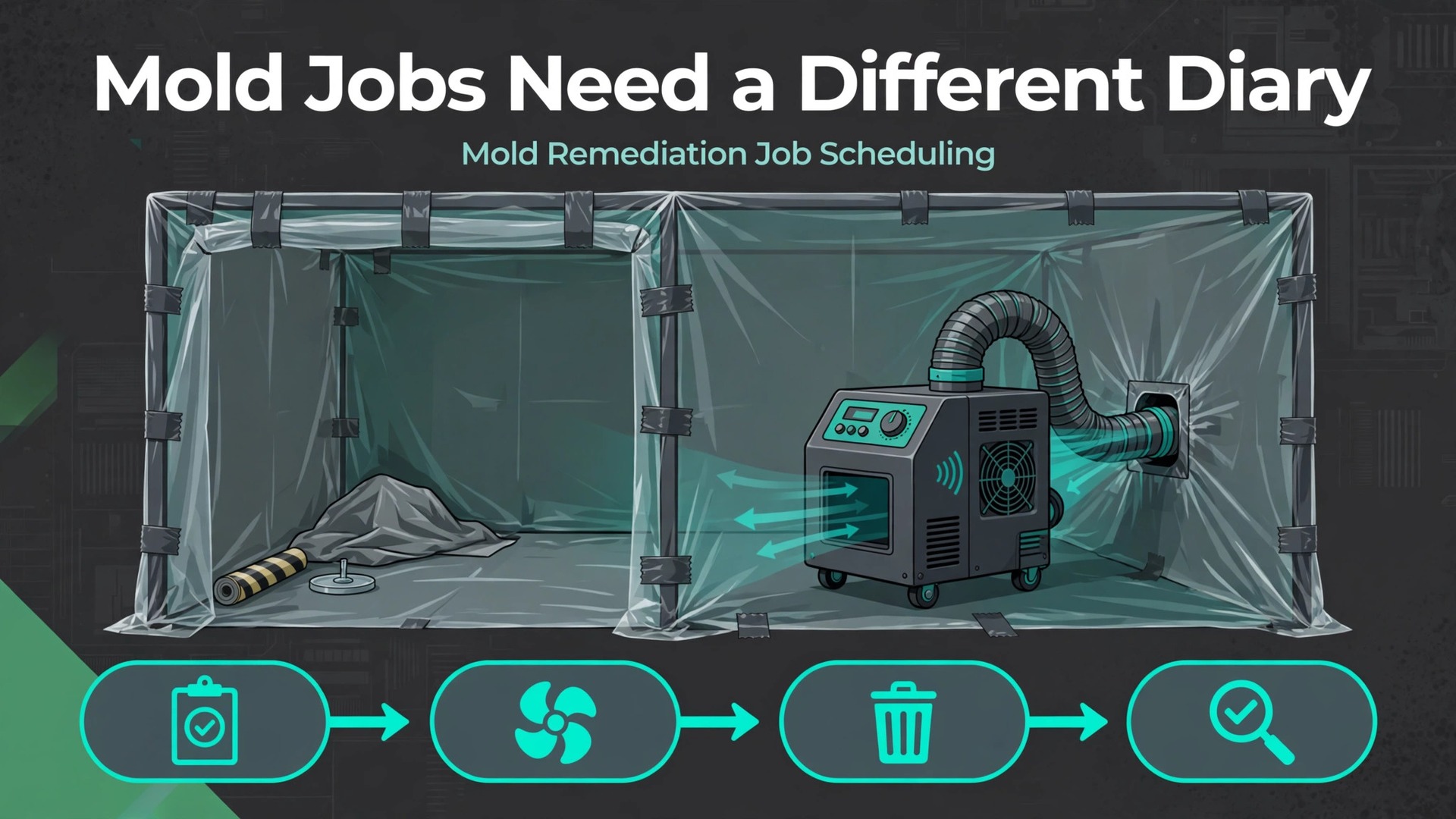
A plumbing job and a mold job look similar on a calendar, and that similarity is exactly what causes trouble. A plumbing job is usually one visit, one crew, and one invoice, and if it runs long, the next job shifts by an hour. A mold job is a sequence of visits that must happen in order, with waiting time between them, safety steps that cannot be skipped, and a final test by someone independent before the job can close. The decision to use AI for mold remediation job scheduling is a decision about whether that sequence gets managed as a sequence, or squeezed into a diary built for single visit jobs.
The comparison matters because the failure modes are different. A plumbing diary failure is a late arrival. A mold diary failure is a containment crew arriving before the assessment is complete, a clearance test booked before drying finishes, or a crew returning to a property where the previous stage was never signed off. Each of those failures wastes a visit, and some of them create a safety or compliance problem that a simple apology cannot fix. Mold work needs a diary that understands stages, dependencies, and waiting periods, not just dates and times.
This guide sets out an eight step scheduling workflow, a complete remediation job checklist, a comparison of real scheduling tools, and the timing and clearance rules that keep a mold job safe and auditable. Tool details come from vendor pages and comparison guides checked at writing time. Where a price or a feature is reported rather than published on the vendor’s own page, the text says so, and you should confirm the current position on the vendor page before buying.
Why Mold Jobs Break a Normal Diary
A normal trade diary assumes each job is independent, and that assumption fails on the first mold job. Mold jobs have stages that depend on each other in a fixed order, starting with inspection and moisture diagnosis, then testing where needed, then containment, removal, cleaning, drying, and finally clearance verification. Skipping the moisture diagnosis and removing mold without fixing its cause only schedules the next outbreak, as remediation firms themselves point out. A diary that lets a crew book removal before assessment is complete invites exactly that mistake, because the calendar shows a free slot and hides the missing dependency.
Multi visit structure is the second break. A remediation job can stretch across several visits, with different crews at different stages, and an independent assessor who may need access before the job moves forward. The containment crew finishes, the removal crew comes next, and someone must confirm which rooms are ready, what still needs cleaning, and whether follow up work has been assigned. A single visit booking record cannot carry that handover, so information lives in messages and memory, and the next crew arrives under briefed. The result is repeat visits that the client experiences as disorganisation and the firm experiences as lost margin.
The third break is timing that is not in the firm’s control. Drying takes as long as it takes, lab results arrive when they arrive, and clearance testing has waiting periods and certification requirements that vary by jurisdiction and contract. Firms that use AI for mold remediation job scheduling handle this break with buffers and automatic rebooking, because a diary that books clearance on a fixed date at job start will be wrong whenever drying or lab work slips.
How to Use AI for Mold Remediation Job Scheduling Without Missing Clearance
To use AI for mold remediation job scheduling well, build the job as a stage chain rather than as a single appointment. Each stage, assessment, containment, removal, cleaning, drying, and clearance, becomes its own scheduled visit under one job record, with a dependency rule that blocks the next stage until the previous one is marked complete. The AI then does what it does best. It finds the next available crew with the right certification, checks travel time between jobs, books the stage, sends confirmations, and moves later stages automatically when an earlier stage slips. The office stops rebuilding the job every time someone needs to return.
Certification matching is the second requirement. Clearance testing and certain remediation tasks need people with the right credentials, and the system should only offer those stages to qualified staff or to an independent assessor where independence is required. Vendor automation for clearance scheduling describes exactly this pattern, with the system checking requirements, matching available certified inspectors, booking the slot, and notifying all parties. That pattern is worth copying even without buying that vendor’s tool, because manual matching of certifications across a busy week is where unqualified assignments happen.
The third requirement is a single job record that every crew can read. Tasks, photos, moisture logs, containment notes, and clearance reports should live on the job, not in separate messages, so the next crew starts informed. Specialist tools built for remediation, such as Cinderblock, keep before, during, and after photos, containment notes, moisture logs, and clearance reports on the job record for this reason. A general calendar with job titles cannot do that, and the gap shows up as crews asking the client questions the previous crew already answered.

The Eight Step Scheduling Workflow
The workflow below follows one mold job from first call to signed clearance, and it keeps the stage order intact even when dates move. Firms that use AI for mold remediation job scheduling run these eight steps as a stage chain, so a slip in one stage moves later stages cleanly instead of breaking the whole diary.
- Triage the enquiry and set urgency honestly. Record the property, the affected areas, any known water event, health concerns raised by the client, and whether the property is occupied during work. Urgent cases, such as active leaks or occupied bedrooms, go first, while contained spots with no active moisture wait their turn. Triage prevents the diary error of treating every mold call as an emergency, which burns crew capacity on minor jobs while serious ones wait.
- Book assessment before any remediation promise. Schedule an inspection visit to find the mold and, more importantly, the moisture feeding it, with testing and lab analysis where the job needs it. Do not promise a remediation date or a price before assessment, because scope without assessment is a guess, and a guessed scope produces a guessed schedule that will move. Send the client a written report and scope of work after assessment, ideally the same day.
- Build the stage chain from the agreed scope. Create one job record with stages for containment, removal, cleaning, drying, and clearance, each with its crew, duration estimate, and dependency on the previous stage. Assign the containment crew first, and let later stages sit as planned rather than booked, so they move cleanly when earlier stages shift. A stage chain built at this point is the single most valuable scheduling habit in mold work.
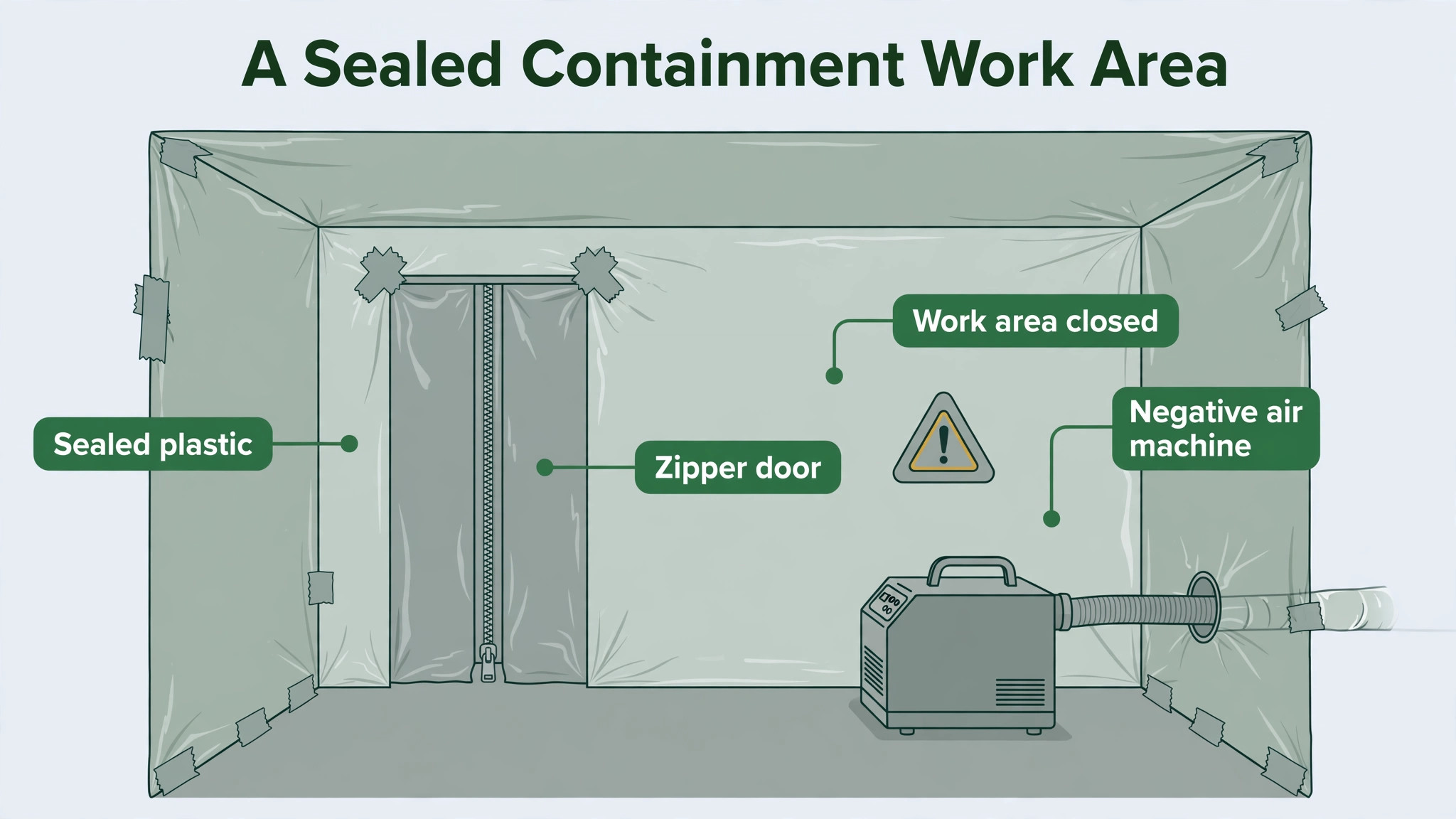
- Schedule containment and set the work area rules. Book the containment visit, assign the crew, and record the rooms sealed, the negative air equipment placed, and the access rules for occupants. Confirm with the client what areas are closed, how long they stay closed, and what preparation the household must do, such as clearing access and keeping pets out of the work area. Clear rules at containment prevent the mid job argument about access that otherwise derails the schedule.
- Schedule removal and cleaning as dependent visits. Book removal only after containment is marked complete, and cleaning only after removal is complete, with the system blocking any attempt to book out of order. Give each visiting crew a task list for its stage, with photos required at completion, so the next crew can verify what was done without a phone call. Require a short progress note at the end of each visit, covering what was removed, what was cleaned, and what remains.
- Track drying with moisture readings, not with dates. Record moisture readings at each visit on the job record, and let the readings decide when drying is complete rather than a calendar guess. Schedule follow up drying checks as needed, and move the clearance stage automatically when readings show the area is not yet dry. Drying judged by readings protects the clearance result, because a clearance test run on a damp area is a test the job may fail for a preventable reason.
- Book clearance with an independent assessor where required. When the job record shows removal, cleaning, and drying complete, trigger clearance scheduling with a certified inspector who meets the jurisdiction, contract, and insurance requirements for the job. Send the assessor the property details, access instructions, and the work completed summary, and notify the client of the appointment and what it will check. Independence matters here, because a clearance signed by the firm that did the work carries less weight with clients, insurers, and property managers than a clearance from an independent assessor.
- Close the job only on a passed clearance. Record the clearance result, attach the report to the job, send the final report and any completion certificate to the client, and only then close the job and invoice any balance. If clearance fails, the system should reopen the failed stage, schedule rework, and rebook clearance, rather than leaving the job in a vague “almost done” state. A job closed without clearance is an open liability wearing a closed label, and the diary should refuse to let it happen.

The Remediation Job Checklist
Use this checklist for every job, and do not mark a stage complete until its items are done. The checklist is the audit trail, and it is what the client, the insurer, and the assessor will ask to see if anything is later questioned.
- Containment set and verified. Work area sealed, negative air equipment running where the scope requires it, and access rules communicated to occupants.
- Safety measures in place. Crew protective equipment worn, occupant safety briefed, pets and vulnerable occupants kept out of the work area, and any hazardous material handling recorded.
- Moisture source identified and fixed or referred. Leak, condensation, drainage, or ventilation cause named, with repair done or referred to the right trade before clearance is booked.
- Removal complete and photographed. Affected materials removed as scoped, with before, during, and after photos attached to the job record.
- Cleaning complete and verified. Surfaces HEPA vacuumed and cleaned as scoped, with waste bagged and disposed of according to the firm’s procedure.
- Moisture readings recorded. Readings taken at each drying check, stored on the job record, and showing the area dry before clearance is triggered.
- Drying confirmed by readings. No clearance booking until readings support it, with any extra drying visit scheduled and completed first.
- Clearance test booked with a qualified assessor. Assessor certification checked, appointment confirmed, and access and work summary sent in advance.
- Clearance result recorded. Passed or failed result attached to the job, with rework scheduled and clearance rebooked if the result is a fail.
- Client handover complete. Final report, clearance certificate where issued, prevention advice, and any follow up inspection date given to the client in writing.
Run the checklist as a live job document, not as paperwork completed at the end. A firm that decides to use AI for mold remediation job scheduling should keep the checklist visible on every job record, because a checklist updated at each visit shows the office exactly where every job stands and which stage is blocking the next.

Scheduling Tools Compared
Remediation scheduling tools split into specialist platforms built for the trade and general field service platforms that handle scheduling well but know nothing about stages or clearance. A firm planning to use AI for mold remediation job scheduling should decide first whether stage control or general business features matter more, because no tool in the table leads on both.
| Tool | Type | Stage and clearance handling | Reported position |
|---|---|---|---|
| Cinderblock | Remediation specialist | Stages, crews, moisture logs, clearance reports on one job | Free trial reported at 14 days |
| Jobber | General field service | Scheduling plus quoting plus invoicing, no remediation stages | Core plan reported at 49 dollars a month for one user |
| Housecall Pro | General field service | Drag and drop scheduling, dispatch, payments | Basic plan reported at 79 dollars a month billed monthly |
| Fieldproxy automation | Workflow automation | Auto clearance scheduling on job completion | Automation pattern described on the vendor site |
| General calendar tools | Calendar only | Dates and reminders, no job record | Low cost but no stage control |
Cinderblock is the strongest fit for a firm whose main pain is multi visit mold work, because it schedules assessment, containment, removal, and clearance visits under one job, assigns crews per visit, and keeps containment notes, moisture logs, and clearance reports on the record. Its estimate builder also itemises containment, demolition, HEPA vacuuming, cleaning, and disposal separately, so the client approves a scope that matches the stage chain. Pricing is not stated in the material reviewed here, so confirm it on the vendor page, and trial it on two live jobs with a real clearance stage before judging it.
Jobber and Housecall Pro suit firms that do mold work alongside other trades and already run their business on a general platform, because they handle scheduling, dispatch, quoting, invoicing, and payments well.
Their weakness for pure remediation work is the missing stage chain, so a firm using them should enforce stage order with a written checklist and a rule that no stage is booked until the previous one is marked complete in the job notes.

Containment to Clearance. Timing the Job Honestly
Honest timing starts with telling the client that mold jobs have waiting time built in, and that waiting time is part of doing the job properly rather than a delay to apologise for. Firms that use AI for mold remediation job scheduling build that waiting time into the stage chain as buffers, so drying, lab analysis, and clearance availability appear in the schedule from the start instead of arriving as surprises.
Buffers belong between stages, not only at the end of the job. A half day buffer between removal and cleaning, and a day between drying checks and clearance, absorbs small slips without moving the clearance appointment. Firms that book stages back to back save diary space on paper and lose it in practice, because one slip cascades through every later booking and forces a round of apologetic rescheduling. Buffers look wasteful on a quiet week and prove their value on the first week when two jobs slip at once, which in mold work is a normal week rather than a bad one.
Communication timing matters as much as crew timing. Confirm each stage with the client and the crew the day before, send an on the way message on the day, and report stage completion the same day with the next stage date. Clients tolerate waiting far better when they are told what happened, what happens next, and when, than when they sit in a sealed house wondering whether anyone is coming. Automated confirmations and reminders handle most of that communication, provided the office checks that they actually went out, since an automation that silently fails is worse than a manual call that never happened.

Safety, Independence and the Clearance Test
Safety runs through every stage, and scheduling must protect it rather than pressure it. Crews need time to set containment properly, to wear protective equipment, and to clean thoroughly, and a diary packed so tightly that crews cut corners to stay on time will eventually produce a safety failure. Schedule realistic stage durations, protect travel time between jobs, and never let a diary gap be filled by shortening a containment or cleaning stage. The cost of a realistic schedule is a few fewer jobs per week, and the cost of an unrealistic one is a failed clearance, a sick crew member, or a client complaint that follows the firm for years.
Independence of clearance testing deserves a clear firm policy. Where jurisdiction, contract, or insurance requires an independent assessor, the scheduling system should enforce it by only offering clearance slots to assessors outside the remediation crew. Where independence is not legally required, the firm should still consider it, because an independent pass carries more weight with buyers, tenants, and property managers than a self certified pass. State the policy on the job record and in the client scope, so nobody has to argue about it after the work is done.
Clearance failure should be treated as a normal outcome with a planned response, not as a crisis. If a clearance test fails, the job reopens at the failed stage, rework is scheduled, drying is rechecked with readings, and clearance is rebooked, with the client told plainly what failed and what happens next.
The client message after a failed clearance matters as much as the rework itself. Explain the failed area in plain language, name the stage that will be repeated, and give the new clearance date at once, rather than leaving the client to imagine the worst. A client who hears a clear plan usually stays patient, while a client who hears only that the test failed starts calling other firms for a second opinion.
Measuring Scheduling Performance Across a Month
Three numbers tell a remediation firm whether its scheduling works, and all three should be tracked monthly from the job records rather than guessed. Wasted visits, meaning crew trips where the stage could not proceed because a previous stage was incomplete or the property was not ready, should fall as stage discipline improves. Clearance first pass rate, meaning the share of jobs that pass clearance on the first test, shows whether drying and cleaning stages are genuinely complete before testing is booked.
Days from assessment to passed clearance captures the whole client experience in one number, including waiting time that the firm cannot control and rework time that it can. A firm that watches this number monthly will spot a slow assessor, a drying bottleneck, or a crew that rushes cleaning, because each problem moves the number in a recognisable way. Firms that use AI for mold remediation job scheduling can pull all three numbers from stage timestamps and clearance records without extra reporting work, which is one of the quieter benefits of a stage based system.
Set targets modestly at first, such as cutting wasted visits by a third within two months and holding first pass clearance steady while speed improves. Speed gained by booking clearance earlier is not an improvement if first pass rate falls, because a failed clearance costs more time than the early booking saved. Review the three numbers with the whole team monthly, celebrate the month where wasted visits fall, and treat a falling first pass rate as a signal to slow clearance booking down, not as a reason to blame the assessor.
What to Put in Place This Week
A firm does not need a new platform to start scheduling mold work better, and the first week should focus on habits that work on any tool. Build a stage chain template with the eight stages in this guide, add a dependency rule that no stage books until the previous one is complete, and put the job checklist on every job record. Book clearance only from a complete record with moisture readings attached, and send stage completion messages the same day. Those four habits alone will remove most of the wasted visits that make mold scheduling feel chaotic.
The platform decision can follow in week two, once the firm knows whether its pain is stage control, crew assignment, clearance matching, or client communication. A firm drowning in stage handover should trial a specialist tool, while a firm drowning in general scheduling should first fix its general platform habits and add stage discipline manually.
Either way, judge the change on wasted visits, clearance first pass rate, and days from assessment to passed clearance, because those three numbers capture the client experience, the quality, and the speed of the whole system in one view. If the numbers do not move within a month, the problem is probably a habit rather than a tool, and no new software will fix a stage that crews still mark complete from the van.
One last habit closes the loop. At the end of every job, ask the client one short question about scheduling, such as whether the visit times were clear and the waits felt reasonable, and record the answer on the job. Those answers, collected over a month, tell the firm more about its diary than any dashboard, because they come from the people who lived inside the schedule while the work happened. A firm that listens to those answers will keep improving its diary long after the new tool stops feeling new, week after week.

More Reading on Stratilyze
For a related field service comparison, read best job management software for junk removal companies and best dispatch software for locksmiths. For a different scheduling business, see best route scheduling software for pool service companies.
Frequently Asked Questions
How is mold remediation scheduling different from normal trade scheduling
Mold jobs run as a sequence of dependent stages, including assessment, containment, removal, cleaning, drying, and clearance, with waiting time and an independent test at the end. Normal trade jobs are usually single visits that can move by an hour without consequence, while a mold stage booked out of order or before drying finishes wastes a visit and can create a safety or compliance problem. Scheduling must therefore manage stages and dependencies, not just dates.
Who should perform the clearance test after mold remediation
Clearance should be performed by a certified assessor who meets the jurisdiction, contract, and insurance requirements for the job, and independently of the remediation crew where independence is required or promised. The scheduling system should check certification and independence before offering clearance slots, and the result should be recorded on the job with the report attached before the job closes.
How long does a typical mold remediation job take from assessment to clearance
Timing varies with size, moisture source, drying conditions, and assessor availability, so firms should quote ranges per stage rather than a single fixed date. Small contained jobs may complete within a week, while larger jobs with drying and lab work take longer, and any clearance failure adds rework and retesting time. Clients should be told the stages, the ranges, and what could extend them at scope stage, not after work starts.
What happens if a mold clearance test fails
The job reopens at the failed stage, rework is scheduled, drying is rechecked with moisture readings, and clearance is rebooked, with the client told plainly what failed and what happens next. Failure should be treated as a planned procedure rather than a crisis, and the job should not close or fully invoice until a passed clearance is recorded on the job.
Can AI scheduling handle emergency mold calls
AI can triage urgency, find the next available qualified crew, and book the assessment visit quickly, but a human should confirm urgency where health concerns, occupied bedrooms, or active leaks are involved. Emergency handling works best as AI speed plus human judgment, with the AI proposing the earliest qualified slot and a person confirming that the triage matches the client’s actual situation.
Should a small remediation firm buy specialist software or use a general platform
A firm doing mold work as its main trade should trial a specialist tool that handles stage chains, moisture logs, and clearance records on one job, while a firm doing mold work alongside other trades can often manage with a general platform plus strict stage discipline. Judge the choice on wasted visits, clearance first pass rate, and days from assessment to passed clearance, rather than on monthly price alone.