
A walk in customer who wants a suit altered this week and a bride who booked a fitting three months ago are both in the same small shop, and both expect the tailor’s full attention. The walk in gets turned away, the bride waits, and the tailor loses a day to a diary never built for fittings. Compare that with a shop where every fitting has a measured slot, a fabric note, and a pickup date agreed before arrival. Shops that decide to use AI for tailor fitting appointments usually start from that comparison, a chaotic Saturday against a calm one, and choose the calm one.
Tailoring is a poor fit for generic appointment tools, because a fitting is not a haircut. One fitting may take fifteen minutes for a hem, while another takes an hour for a first basted fitting with a full set of measurements, fabric checks, and alteration notes. The tailor also needs the garment, the fabric, and sometimes the shoes the customer will wear with the outfit, and if any of those are missing, the fitting cannot do its job. A booking system that treats every fitting as an identical thirty minute slot will overbook the complex work, underbook the simple work, and leave the tailor explaining delays to customers who arrived on time.
This guide builds a fitting workflow that matches slot length to fitting type, captures measurements and fabric decisions at booking, and protects pickup dates that customers plan weddings and events around. It covers the fitting appointment checklist, the tools that suit small tailoring shops, the deposit and alteration policies that prevent disputes, and the measures that show whether the system is helping or just adding another screen. Prices quoted here come from vendor pricing pages and reputable comparison guides checked at writing time, so confirm the current price on the vendor page before buying.
The Saturday Problem in a Tailor Shop
Saturdays expose every weakness in a tailor’s diary, because that is when working customers can visit, wedding parties arrive together, and urgent alterations land without warning. A shop that books fittings by phone messages and memory will find three customers booked for the same tailor at the same hour, a bride waiting while a trouser hem takes the fitting room, and a regular customer who drove across town for a pickup that is not ready. None of these failures comes from lack of skill. They come from a diary that records names and times but not fitting types, garment status, or pickup promises.
The cost of a bad Saturday is larger than one lost sale. A wedding party that waits an hour tells friends, a groom who collects a suit late tells colleagues, and a regular who is turned away tries the shop across the street. Tailoring runs on trust and repeat work, so a diary failure damages the exact asset the business depends on. The fix does not require a large system. It requires slot types that match real fitting lengths, a rule for how many fittings one tailor can take in an hour, and a booking form that asks the questions the tailor would ask on the phone.
Start by counting the real fitting types in the shop. Most shops run four or five, such as a quick measurement, a first fitting, a second fitting, a final collection and try on, and an urgent alteration. Each type has a different length, a different room need, and a different preparation list. Once those types are written down with honest lengths, the diary stops being a list of names and becomes a plan for the day, and Saturdays become manageable instead of dreaded.

Fitting Types and Honest Slot Lengths
A quick measurement for a new customer usually takes fifteen to twenty minutes, provided the customer arrives with the right shoes and undergarments where relevant. A first fitting for a made to measure garment takes longer, often forty five to sixty minutes, because the tailor checks the basted garment, marks changes, discusses fabric behaviour, and records a full set of notes. A second fitting is usually shorter, around thirty minutes, because most decisions are already made and the work is checking corrections. A final try on and collection can take fifteen to thirty minutes, depending on whether small finishing touches are needed on the spot.
Urgent alterations break every plan unless they have their own slot type. Give urgent work a limited number of slots per day, a clear surcharge, and a realistic turnaround promise, rather than squeezing it between booked fittings and hoping nobody notices. Customers who pay for urgency accept a higher price when the promise is clear, but they do not accept a vague promise that turns into a late pickup. The same rule applies to group fittings for wedding parties. Book the party as one block with a named contact, rather than as five separate bookings that collide in the fitting room.
Write these slot lengths into the booking tool as separate appointment types, each with its own duration, buffer, and preparation message. A buffer of five to ten minutes between fittings lets the tailor finish notes, reset the room, and greet the next customer without rushing. That buffer looks like lost time on a screen, but it is what prevents the twenty minute delay that cascades through the whole afternoon. A diary with buffers finishes on time. A diary without them finishes late and tired.

The Fitting Workflow, Step by Step
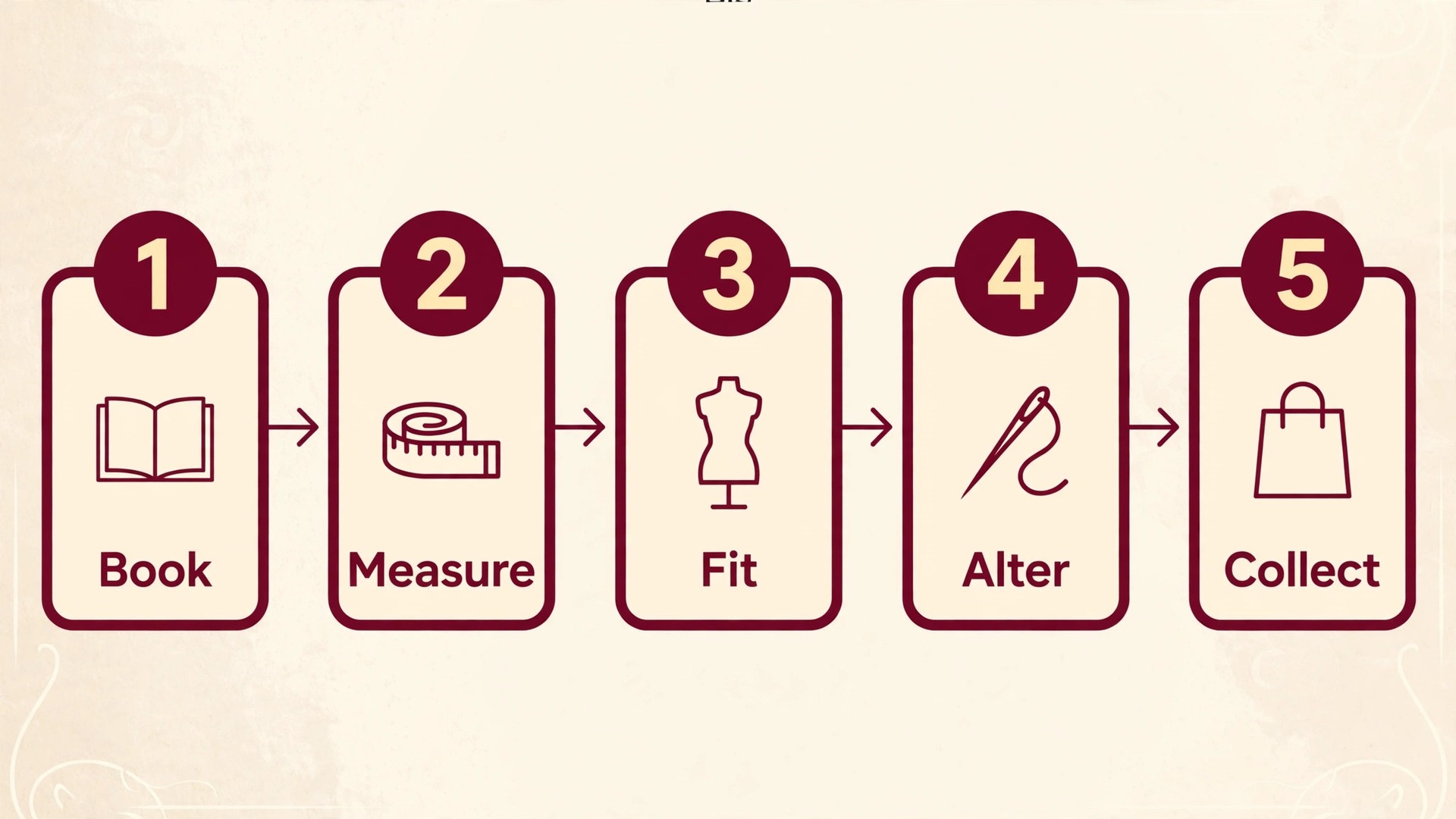
A fitting workflow that works for tailors moves the customer from first contact to a collected garment without a single lost detail. Each step below has one owner, either the system or a person, and the handover between them is where most shops lose information. Keep the handover explicit, so nothing depends on memory alone.
1. Capture the enquiry with the garment and occasion. The booking form or phone answer service records the customer name, contact, garment type, occasion, and date the garment is needed, before any slot is offered. 2. Match the fitting type to the slot length. The system offers only slots that fit the fitting type, so a first fitting never lands in a fifteen minute gap, and a quick hem never wastes an hour. 3. Collect measurements status and fabric choice. Ask whether measurements exist on file, whether fabric is chosen or still to decide, and whether the customer will bring shoes or accessories that affect the fit. 4. Record alteration notes in structured form. Use fields for garment, area, change requested, and tailor notes, rather than a single free text box that different staff read differently. 5. Agree the pickup date and the price basis at booking. State whether the price is fixed, an estimate, or dependent on fabric and complexity, and state what happens if the customer changes the design mid process. 6. Confirm with a deposit where the shop uses one. A deposit for made to measure work and for urgent alterations protects the shop when fabric is ordered or other work is turned away. 7. Send preparation reminders. Remind the customer what to bring, what to wear, and what time to arrive, the day before and the morning of the fitting, with a simple way to reschedule. 8. Close the fitting with a clear next step. Before the customer leaves, agree the next fitting date or the pickup date, and send a written summary the same day, so the customer and the shop hold the same record.
The Fitting Appointment Checklist
The checklist below turns the workflow into a form the shop can use at booking, on the phone, and in the fitting room. If an item is blank, the appointment is not ready, and the system should chase it rather than let the fitting go ahead on guesswork. Print it for the fitting room as well, because a digital form that nobody checks during the fitting is no better than a paper diary.
| Checklist item | What to record | Why it matters |
|---|---|---|
| Customer and contact | Name, phone, preferred contact method | Reminders and pickup notices reach the right person |
| Garment and occasion | Suit, dress, shirt, or other, plus event date | Decides urgency and realistic turnaround |
| Fitting type | Measurement, first, second, final, urgent alteration | Decides slot length and room use |
| Measurements | On file, new set needed, or update only | Prevents a fitting wasted on missing data |
| Fabric | Chosen, to choose, customer supplied, or shop supplied | Decides ordering time and price |
| Alteration notes | Garment area, change, tailor notes | Keeps every tailor reading the same instruction |
| Shoes and accessories | To bring, already noted, or not relevant | Affects hem length and overall fit |
| Pickup date | Agreed date, time window, and collector name | Prevents disputes about when work is ready |
| Price and deposit | Fixed or estimate, deposit paid, balance due | Prevents a collection day argument |
| Special notes | Allergies, sensitivities, delivery needs | Protects the customer and the garment |
Keep the booking form to these items and nothing more. A form that asks about marketing preferences or long surveys before a fitting will lose customers who just want to book. Ask the essential questions at booking, and leave style discussion for the fitting itself, where the tailor can see the garment and the customer together. Review the forms monthly, and drop any field that staff keep leaving blank, because a field nobody uses is clutter that slows every booking.

Fabric, Measurements and Alteration Notes Done Properly
Measurements are the most valuable record a tailor holds, and the booking system should treat them that way. A customer whose measurements are on file should be able to book a new garment without a full remeasure, while a customer whose weight or posture has changed should be flagged for an update. The booking form should ask whether measurements are current, and the fitting room record should note the date of the last full set, so the tailor can judge at a glance whether to remeasure or trust the file.
Fabric decisions need the same care, because fabric availability decides the pickup date more than sewing time does. If fabric must be ordered, the booking confirmation should say so and give a realistic date range, rather than promising a pickup that depends on a delivery nobody has confirmed. Customer supplied fabric needs its own note, including amount received, condition, and any shortage risk, because a dispute about fabric is far harder to resolve after cutting than before it.
Alteration notes should be written so another tailor could pick up the garment and understand them. That means naming the garment, the area, the exact change, and the measurement where relevant, instead of shorthand that only one person understands. A shop with two tailors, or a tailor who falls ill before a pickup date, depends on notes that survive absence. Good notes are also what make a second fitting short, because the tailor is checking work against a clear instruction rather than reconstructing a conversation from memory.

Tools Compared for Tailor Fitting Appointments
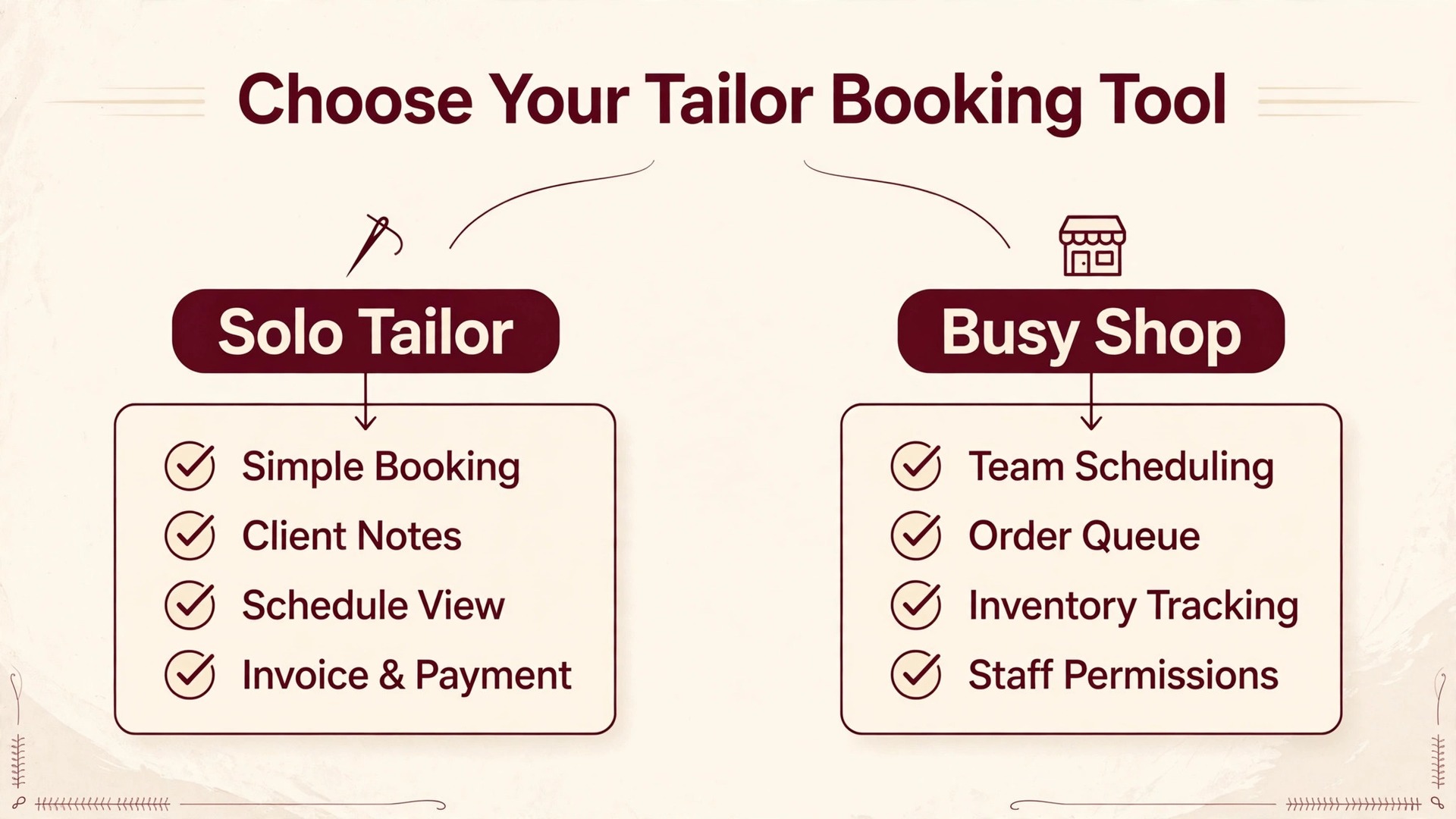
Tailor shops need booking tools that support different appointment types, deposits, and reminders, without forcing the shop into a salon or clinic template that does not fit garment work. Prices below are reported from vendor pages and comparison guides, so confirm the current price on the vendor page before choosing. The best tool is usually the simplest one the whole shop will actually use, not the one with the longest feature list.
| Tool | Best for | Reported starting price | Trade off |
|---|---|---|---|
| Setmore | Small shops wanting a free start with several staff calendars | Free for up to four users, Pro about $5 a user a month on annual billing in recent guides | Cheap and easy, but no garment or measurement records |
| Acuity Scheduling | Shops needing deep intake forms and deposits at booking | About $16 a month on annual billing in recent guides | Strong forms and payments, but priced per account not per tailor |
| Square Appointments | Shops already taking card payments through Square | Free plan available, Plus about $49 a month per location in recent guides | Payments built in, but fitting specific fields need setup |
| Calendly | Solo tailors booking consultations and measurements | Free for one event type, paid from about $10 a seat a month on annual billing in recent guides | Familiar and simple, but weak for group and multi step fittings |
| SimplyBook.me | Multi tailor shops needing staff calendars and service lists | Free for up to 50 bookings, paid from about $11.90 a month on annual billing in recent guides | Good staff matrix, but the interface takes learning |
| Zoho Bookings | Shops already using other Zoho tools | Free for one user, paid from about $6 a user a month on annual billing in recent guides | Good value inside Zoho, but less polished as a standalone booking page |
Setmore suits a shop that wants to start free and test online booking before spending, especially where several tailors need their own calendars. Acuity suits a shop that lives on detailed intake, because its forms can capture garment, fabric, and pickup details at booking and take a deposit in the same flow. Square suits a shop that already uses Square for payments, since deposits and balances then live in one place, though the shop must still build its own measurement and alteration records outside the booking tool.
No general booking tool holds measurements and alteration history well, so pair the booking tool with a simple customer record, even a structured spreadsheet or a customer notes field used consistently, until the shop can justify tailoring specific software. The booking tool owns the diary. The customer record owns the measurements. Confusing those two jobs is how shops end up with measurements buried in booking notes that nobody can find when the customer returns a year later.
Deposits, Pickup Dates and Alteration Disputes
Deposits protect both sides when they are explained before work starts. For made to measure garments, a deposit that covers fabric cost is fair and easy to explain, because the shop orders material that cannot be resold if the customer disappears. For alterations, a smaller deposit or a card hold works for urgent work and for large jobs, while simple hems rarely need one. Whatever the rule, state it at booking, repeat it in the confirmation, and apply it consistently, because a rule applied to some customers and waived for others becomes a dispute waiting for a busy Saturday.
Pickup dates need the same clarity. Agree a date and a time window at booking, state what happens if fabric delivery slips or the customer misses a fitting, and send a message when the garment is ready rather than leaving the customer to guess. A pickup date that moves without notice is the most common cause of a bad review for a tailor, even when the work itself is excellent. If a date must move, tell the customer early, explain the reason plainly, and offer the earliest alternative, because early honesty preserves trust that a last minute apology cannot rebuild.
Alteration disputes usually come from unclear instructions, not poor sewing. When a customer says a garment was supposed to be taken in more, or less, the shop needs the written note from the fitting to resolve it fairly. That is why the checklist insists on structured alteration notes and a same day summary to the customer. If the summary says one thing and the customer remembers another, the disagreement surfaces while it can still be fixed, not at collection when the garment is finished and the event is tomorrow.
No Shows, Late Arrivals and Wedding Party Blocks
No shows hurt tailors more than many trades, because a fitting slot cannot be resold at short notice and the tailor cannot simply move to the next job when the next job is a different garment in a different stage. Shops that use AI for tailor fitting appointments find that reminders cut no shows more than any other single measure, so send one the day before and one on the morning of the fitting, with the garment, the time, and what to bring in the message itself. A reminder that only says an appointment is tomorrow, without saying what it is for, is far less useful than one that names the garment and the preparation.
Late arrivals need a published grace period, agreed at booking. Ten minutes is a fair grace period for most fittings, after which the fitting is shortened or rescheduled rather than allowed to push every later customer late. Staff must apply the rule kindly but consistently, because one late customer allowed to run long becomes five late customers by the afternoon. Offer the late customer the next available slot or a shorter fitting for the most urgent item, so the rule feels like help rather than punishment.
Wedding parties and group bookings need a named contact and a single block, with each person’s garment and fitting type listed inside the block. The contact receives the reminders and confirms attendance for the group, which saves the shop from chasing five people separately. Book a longer block than the sum of individual fittings suggests, because groups chat, compare, and change their minds together, and a block that allows for that will finish on time while a tight block will not.
Measuring Whether the Diary Is Working
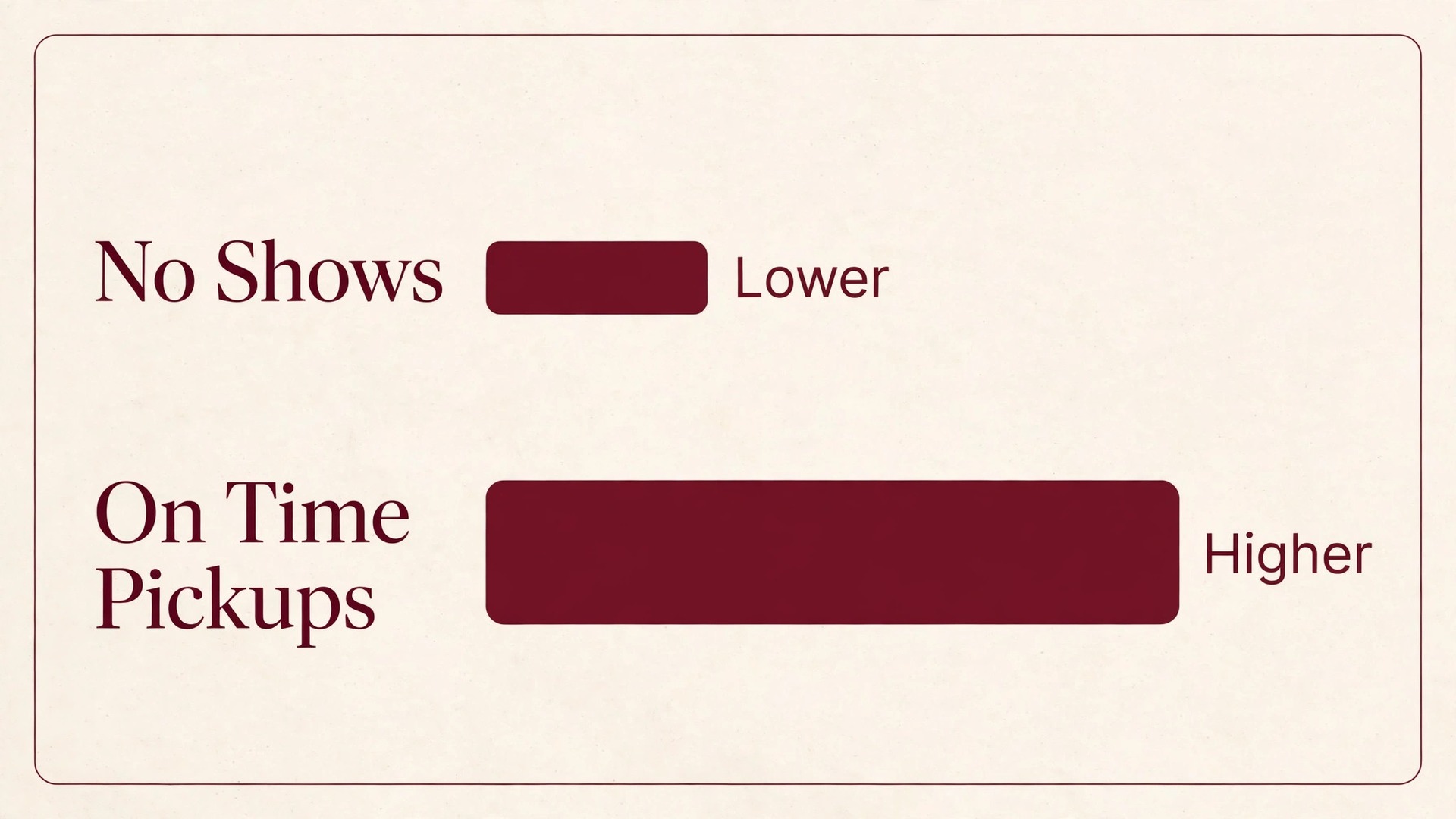
A tailor shop needs only a few numbers to judge its booking system, and they are all easy to collect from the diary itself. Start with the no show rate and the late start rate, because those two numbers show whether reminders and slot lengths are working. Then look at the pickup on time rate, meaning the share of garments collected on the agreed date, because that is the number customers judge the shop by, even if they never see the diary.
Add the repeat customer rate, meaning the share of customers who return within a year, and the average days from booking to pickup, which shows whether turnaround promises are realistic. If no shows fall but pickup on time does not improve, the problem is in the workshop or in fabric ordering, not in booking. If pickup is on time but repeat bookings fall, the problem may be the fitting experience itself, and no booking tool will fix that. Numbers point to the problem. They do not solve it on their own, and the shop still needs to act on what they show.
Review these numbers monthly, with the tailors in the room, and change one rule at a time. A shop that changes slot lengths, reminder timing, and deposit rules in the same week cannot tell which change helped. A shop that changes one rule, watches it for a month, and keeps what works will build a diary that fits its real work within a quarter. That steady approach suits tailoring, because the craft itself rewards patience and small corrections over dramatic overhauls.
Mistakes That Undo a Good Fitting Diary
The first mistake is copying slot lengths from another trade. A thirty minute default works for many services, but it fits almost no fitting type well, so first fittings run over and quick hems waste time. Set slot lengths from the shop’s own timings, measured over two real weeks, not from a software default. A diary built on measured lengths will look uneven on screen, with fifteen, thirty, and sixty minute slots mixed together, and that uneven look is exactly right, because it mirrors real work.
The second mistake is letting online booking accept every request without a garment check. A customer who books a first fitting without fabric, without measurements, and without the shoes for a hem will waste the slot and leave disappointed. Shops that decide to use AI for tailor fitting appointments wisely use the booking form as a gate, not just a calendar, so incomplete bookings trigger a message asking for the missing item before the slot is confirmed. That message feels like care when it names the missing item clearly, and it saves a wasted fitting.
The third mistake is keeping measurements only in one tailor’s head or notebook. When that tailor is away, the shop cannot serve returning customers properly, and a new tailor must remeasure work that was already done. Move measurements into a shared customer record at the same time as launching online booking, and make updating that record part of finishing every fitting, not an extra task done when time allows. A record that is updated at the fitting stays accurate. A record updated later stays forgotten.
Verdict, Is It Worth It to Use AI for Tailor Fitting Appointments
For a busy tailor shop, the answer is yes, with one condition. The system must be built around fitting types, not around generic appointment slots, because a generic diary will recreate the Saturday chaos faster than a paper diary did. When slot lengths match real fittings, the intake form captures fabric and measurement status, and reminders name the garment and the preparation, the diary stops fighting the craft and starts supporting it. The cost is modest, often starting free or at a few dollars per user a month for the booking tool itself, and the return is measured in Saturdays that finish on time.
The answer is no, or not yet, for a shop with very low volume or with a single tailor who prefers phone booking and has no no show problem. In that case, a simple online form for out of hours enquiries may be enough, without a full booking system. Forcing a full system onto a shop that does not need it creates work without benefit, and the tailor will abandon it within a month. Shops that decide to use AI for tailor fitting appointments should therefore start from their own pain, missed calls, no shows, or late pickups, and choose only the features that address that pain.
Start with three moves in the first month. Write down the fitting types with honest lengths, build the booking form around the checklist in this guide, and turn on reminders that name the garment. Run that setup for a month, measure no shows and late starts, and only then add deposits, group blocks, or answering tools. A diary built in that order earns the shop’s trust, because each step solves a visible problem before the next step arrives.
More Reading on Stratilyze
For a related appointment system, read best scheduling software for home care agencies and best CRM for cleaning companies. For a different small business comparison, see best route scheduling software for pool service companies.
Frequently Asked Questions
How long should a first fitting take
A first fitting for a made to measure garment usually takes forty five to sixty minutes, because the tailor checks the basted garment, marks changes, and records notes. A quick measurement takes fifteen to twenty minutes, and a second fitting usually takes about thirty minutes. Shops that decide to use AI for tailor fitting appointments should set these lengths as separate appointment types, rather than using one default length for every fitting.
Do customers accept booking fittings online
Most customers accept online booking readily when the form asks sensible questions about garment, occasion, and pickup date, and when the confirmation states what to bring. Customers resist forms that ask too much before they have spoken to a tailor, so keep the booking form to the checklist items and leave style discussion for the fitting itself. A short form with a clear confirmation builds more trust than a long form that feels like an interrogation.
Should a tailor take a deposit at booking
A deposit makes sense for made to measure work where fabric is ordered, and for urgent alterations where other work is turned away. Simple hems and small alterations rarely need one. State the deposit rule at booking and in the confirmation, apply it consistently, and explain it as covering fabric cost rather than as a penalty. Consistency matters more than the exact amount, because a rule applied unevenly becomes a dispute.
What should a customer bring to a fitting
The customer should bring the shoes and undergarments they will wear with the outfit, any accessories that affect the fit, and the garment itself where the fitting is an alteration. Shops that decide to use AI for tailor fitting appointments should put this list in the reminder message itself, not just on a website page, because reminders are read while booking pages are often forgotten. A fitting with the right shoes takes half the time of one without them.
How do I handle a wedding party booking
Book the party as one block with a named contact, list each person’s garment and fitting type inside the block, and allow more time than the sum of individual fittings suggests. The contact receives reminders and confirms attendance for the group, which saves the shop from chasing several people separately. Book the block early in the day where possible, so any overrun does not push the whole afternoon late.
Can a small tailor shop run this without expensive software
Yes. A free or low cost booking tool with several appointment types, plus a shared customer record for measurements, covers most small shops well. Shops that decide to use AI for tailor fitting appointments do not need tailoring specific software to start, though they should keep measurements in a consistent record from day one. Spend on software only after the diary rules are proven, not before.