

Around 196,000 businesses use Klaviyo, and the most useful number for a small store is not that total but the price jump waiting inside it. A store with 500 active profiles pays $20 a month for email, a store with 10,000 profiles pays $150, and a store with 100,000 profiles pays $1,380. The cost of Klaviyo for small business monthly therefore starts small, grows steadily, and then accelerates, which is exactly why a store should price Klaviyo at the list size it will reach, not the list size it has today.
That growth pattern is the whole story of Klaviyo pricing. Klaviyo bills on active profiles, meaning contacts who can receive messages, rather than on emails sent, and the send allowance is generous at ten times the profile count. A store rarely runs out of sends. What it runs into is the next price band, because every signup, every past buyer and every browse abandoner who can still be emailed counts toward the bill. Growth feels like success and bills like success too.
Prices in this guide are United States list prices reported in 2026, before tax, and Klaviyo changes prices and promotions often. Treat every figure here as a starting point and check the vendor page at checkout. Where sources differ on a band boundary, this guide uses the commonly reported tier figures and names the band, so the owner can verify the exact step for the store’s own count.
Why Active Profiles Change the Bill
An active profile is any contact Klaviyo can send to, even if the store has not emailed that person this month. Suppressed profiles, meaning unsubscribes, hard bounces and manually suppressed contacts, do not count, which is the most important sentence in Klaviyo billing. A store with 12,000 names but 2,000 suppressed profiles bills like a 10,000 profile store, while a store with 12,000 active profiles bills at the higher band. The difference between those two stores is list hygiene, not list size.
The February 2025 change to active profile billing pushed bills up for many stores with large lists, because contacts who were previously stored cheaply became billable. Legacy customers saw the initial rise capped at 25 percent of the old bill as an ongoing discount in some cases, but new customers face the current bands directly. A store migrating to Klaviyo should therefore clean its list before importing, because importing a dirty list means paying from day one for contacts who will never buy.
Send allowances deserve a calm reading. Paid email tiers include roughly ten times the profile count in monthly sends, so 500 profiles bring 5,000 sends, 2,000 profiles bring 20,000 sends and 10,000 profiles bring 100,000 sends. A store emailing weekly uses about four sends per contact per month, well inside the allowance, and flows add sends that still fit comfortably for most stores. The constraint is almost never sends, it is profiles, and a store that buys extra sends it does not need is solving the wrong problem.
The Fee Breakdown, Email Versus Email Plus SMS
Klaviyo has one email plan with all standard features, plus a mobile messaging add on that adds SMS, rather than three separate feature tiers. The free plan covers up to 250 active profiles with 500 emails a month and 150 SMS credits, but it carries Klaviyo branding, limits support to email for the first sixty days and withholds testing in campaigns and flows. It suits testing, not trading, and a store with more than 250 profiles needs a paid plan.
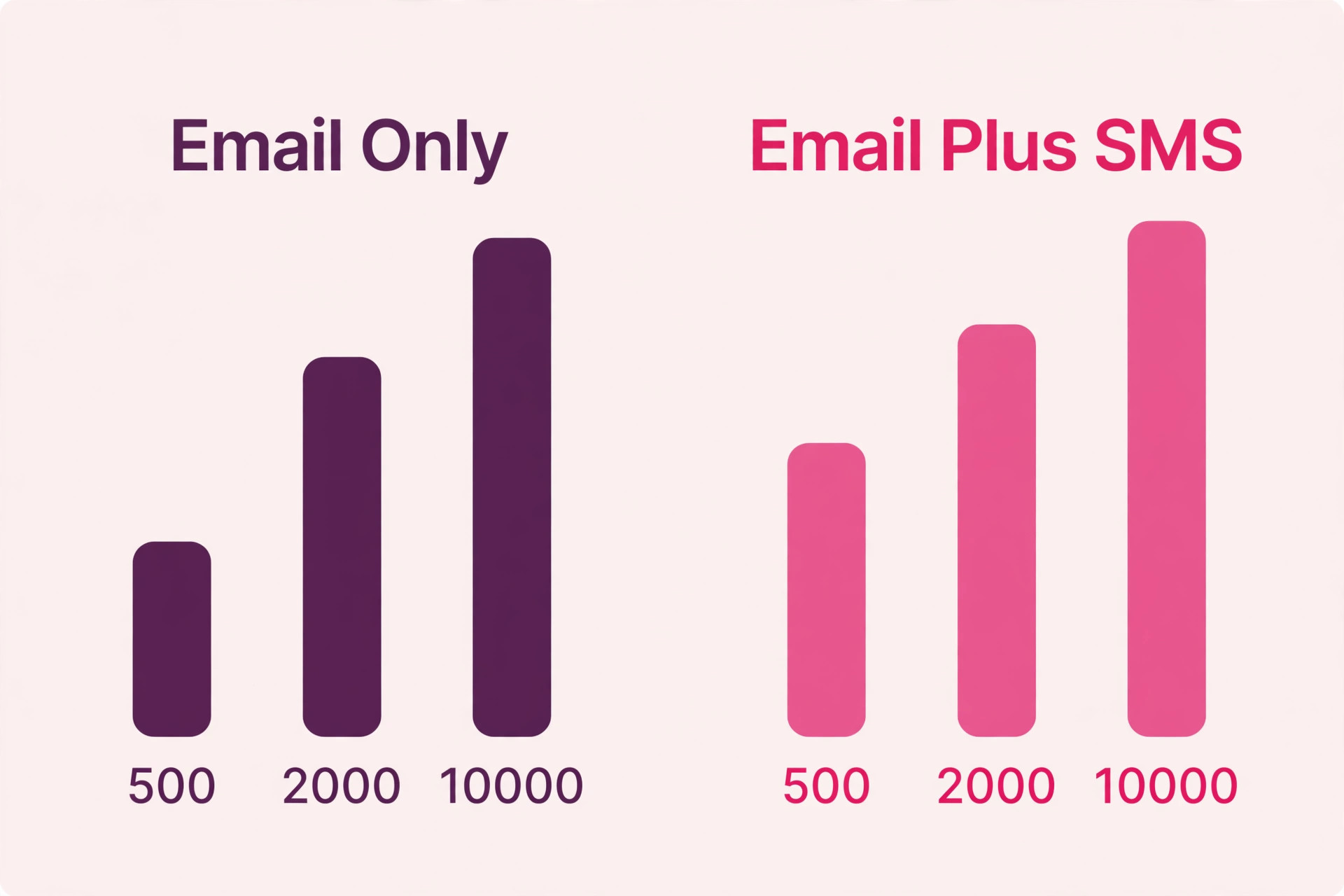
The email plan starts at $20 a month for 251 to 500 profiles, with 5,000 sends, then steps to $30 for 501 to 1,000 profiles, $45 for 1,001 to 1,500, and $60 for 1,501 to 2,500. Larger steps follow, reaching $100 at 5,000 profiles, $150 at 10,000, $400 at 25,000 and $720 at 50,000. Email plus SMS starts at $35 a month for 500 profiles, $75 at 2,500 profiles and $165 at 10,000 profiles, with the SMS portion reflecting a base credit bundle rather than unlimited texting.
| Contacts | Email per month | Email plus SMS per month | Email sends per month |
|---|---|---|---|
| Up to 250 | Free | Free | 500 |
| 500 | $20 | $35 | 5,000 |
| 2,000 | $60 | $75 | 20,000 |
| 10,000 | $150 | $165 | 100,000 |
Read the email plus SMS column carefully, because it does not mean unlimited texts. It means the email plan plus a base SMS credit bundle, commonly 1,250 credits, with extra credits bought separately. A United States text consumes one credit and a multimedia message consumes three, so a store texting its full list monthly needs far more credits than the base bundle. SMS pricing is therefore a second calculation, not a footnote, and it is covered in its own section below.
There is no annual billing discount on self serve plans, which separates Klaviyo from many competitors. The monthly rate is the rate, whether the store commits for a month or a year, and enterprise contracts are the exception rather than the rule for small businesses. That makes monthly budgeting simple, because there is no prepayment saving to chase, but it also removes a lever other platforms offer. A store should not wait for an annual discount that does not exist on its plan.
Worked Monthly Totals at 500, 2,000 and 10,000 Contacts
At 500 contacts the bill is easy to justify for a store that sells online. Email alone costs $20 a month, or $240 a year, and email plus SMS costs $35 a month, or $420 a year, at the base credit bundle. A store sending four campaigns a month to 500 contacts uses 2,000 sends, well inside the 5,000 allowance, and flows add a few hundred more. The per contact cost at this size is four cents for email, which is the highest per contact rate Klaviyo charges, but the absolute bill is small enough that a single recovered cart can cover it.
At 2,000 contacts the bill steps up sharply. Email costs $60 a month, or $720 a year, and email plus SMS costs about $75 a month, or $900 a year, at the base bundle. The per contact cost falls to three cents for email, which looks like a saving, but the absolute bill triples from the 500 contact level. A store at this size should be earning real revenue from flows, because $720 a year for email that only sends a monthly newsletter is poor value. The test is revenue per flow, and a store that cannot name its top three flows by revenue is not yet using Klaviyo properly.
At 10,000 contacts the bill becomes a major budget line. Email costs $150 a month, or $1,800 a year, and email plus SMS costs $165 a month, or $1,980 a year, at the base bundle. A store emailing weekly to 10,000 contacts uses 40,000 sends a month, well inside the 100,000 allowance, so sends are not the issue. The issue is whether email drives at least several times $1,800 in attributable revenue, which most serious stores clear easily through abandoned cart, welcome, post purchase and win back flows. A store that does not clear that bar should ask whether it needs Klaviyo depth or merely a cheaper sender.
A store crossing from 10,000 toward 25,000 contacts should plan for the steepest part of the curve. The price rises from $150 at 10,000 to $400 at 25,000, nearly tripling while contacts rise two and a half times, and the jump from 40,000 to 50,000 profiles, from about $450 to $720, is another sharp step reported by reviewers. Those steps are not a reason to avoid growth, but they are a reason to suppress inactive profiles aggressively before crossing a boundary, because a few hundred suppressed contacts can hold the store in a lower band for months.

SMS Math, the Second Bill Inside the First
SMS credits are bought in bundles, starting around $15 a month for 1,250 credits, with larger bundles offering better value, for example 5,000 credits for about $45 a month in some reports. That means a store on the $20 email plan that wants 5,000 texts a month pays $20 plus $45, or $65 in total, before any extra credits. A store texting 10,000 contacts once a month needs 10,000 credits, which costs roughly $90 a month for the credit bundle alone in reported figures, plus the email plan. SMS is powerful for time sensitive offers, and it is priced like a powerful channel.
International SMS costs more and consumes credits differently by country and carrier, so a store selling internationally should check its own markets rather than assuming United States rates. Multimedia messages cost three credits each in the United States, which triples the cost of image led texts, and a store sending weekly image texts to a large list can spend more on SMS than on email. The practical rule is to reserve SMS for messages that need immediacy, meaning flash offers, back in stock alerts and shipping updates, and to let email carry everything else.
Consent and quiet hours add a compliance layer that also affects cost. Klaviyo enforces consent and quiet hours across channels, which protects the store from complaints but means some messages wait or never send. A store that buys credits for a campaign that partly suppresses for consent reasons still holds those credits for later use in most cases, but the campaign result will be smaller than the list size suggests. Build SMS lists with explicit consent from the start, because a text list built carelessly is both a legal risk and a wasted spend.
Add Ons That Sit on Top of the Plan
Reviews start from about $25 a month, Marketing Analytics from about $100 a month, and the customer data platform from about $500 a month in reported 2026 figures. None of these is required for a small store, and each should be bought for a named job. Reviews suit a store that needs product reviews flowing into email and on site displays, Marketing Analytics suits a store attributing revenue across channels, and the data platform suits a larger operation unifying profiles across systems. A small store buying all three on day one is spending $625 a month on add ons before sending a single campaign.
Accounts spending over $10,000 a month carry a mandatory surcharge of 20 percent in some reports, which matters only to very large stores and not to a typical small business. The more relevant warning for small stores is the opposite, namely paying for add ons that duplicate tools already owned. A store with a review app, an analytics tool and a data warehouse should check for overlap before adding Klaviyo modules, because duplicate tools cost twice and report differently, which creates arguments about which number is true.
Support also scales with plan in a way worth noting. Free accounts receive email support for the first sixty days only, while paid accounts receive live chat and ongoing email support, plus testing and branding removal. A store that needs help setting up flows should therefore move to a paid plan early, even at 500 profiles, rather than struggling on free and blaming the tool. The $20 entry price buys support as much as sends, and support is often the difference between flows that launch and flows that sit half built.

Who Klaviyo Fits, and Who Should Skip It
Klaviyo fits a store where email and SMS drive revenue and where purchase data should shape every message. Shopify and direct to consumer stores are the natural fit, because the integration syncs purchase history, browsing and lifetime value quickly, and prebuilt flows cover abandoned cart, browse abandonment, post purchase and win back out of the box. A store with repeat buyers, a catalogue worth segmenting and a team willing to learn flows will get value that cheaper tools cannot match, because the value lives in segmentation and attribution, not in templates.
Klaviyo does not fit a business that only sends a monthly newsletter, a business without an online store, or a business with a small list and no automation plans. A newsletter only business pays for depth it never uses, and a service business without purchase data gains little from ecommerce segmentation. Those businesses should choose a cheaper general email tool and revisit Klaviyo when the store, the list and the automation habit all exist. Buying Klaviyo early in hope that it will create demand is backwards, because demand must exist for flows to recover it.
The middle case is a growing store on a general tool that is starting to feel limits. Signs include segments the owner cannot build, flows the owner cannot trigger on purchase behaviour, and revenue the owner cannot attribute to a specific email. When those limits cost sales, Klaviyo becomes worth its price, and the migration should be planned around flows first, meaning rebuild the top three revenue flows on Klaviyo before moving the full list. A migration that moves the list but not the flows gains cost without gaining revenue.

List Hygiene as a Cost Control
Suppressing inactive profiles is the single most effective Klaviyo cost control, and it should run quarterly at minimum. Identify contacts who have not opened or clicked in six to twelve months, send a re engagement campaign, and suppress those who do not respond. That habit can hold a store in a lower band for months, improve deliverability, and raise engagement rates, which improves inbox placement for everyone else. A list that grows without cleaning is a bill that grows without revenue.
One catch deserves attention, because it changes timing. Once a profile is unsuppressed, it cannot be re suppressed for ninety days, so that contact stays billable for at least three months. That rule means re engagement should be deliberate, not accidental, and bulk unsuppression should never happen without a plan. Suppress in batches, watch the band, and keep a record of what was suppressed and when, so the next review can see whether the habit is working.
Sunset flows automate the habit. A flow that identifies long term non engagers, sends a final offer or preference check, and then suppresses non responders keeps the list healthy without manual work each quarter. The flow itself costs sends, but it saves profile fees, which are larger, and it protects deliverability, which is larger still. A store that builds one sunset flow has built the cheapest cost control Klaviyo offers.
The Revenue Test Before Renewal
Before each renewal, or each quarter for a monthly plan, run a simple revenue test. Add revenue attributed to flows and campaigns in Klaviyo reporting, divide by the plan cost for the same period, and see how many times email paid for itself. A store earning ten times its plan cost from email has no pricing problem, even at $150 or $400 a month, because the tool is a profit centre. A store earning barely twice its plan cost should fix flows, segments or offers before blaming price, because a cheaper tool with weaker flows may earn less in total.
Also test the counterfactual honestly. Ask what revenue the same list would earn on a cheaper tool with simpler flows, and whether the difference exceeds the price gap. If Klaviyo earns $5,000 a month from flows and a cheaper tool would earn $4,000, the $1,000 difference justifies a large price gap. If the difference is $100, it does not. That comparison is harder than comparing plan prices, and it is the only comparison that matters, because the owner keeps profit, not low prices.

Switching Away, and What It Really Costs
Leaving Klaviyo costs time rather than a fee, but the time is real. Flows must be rebuilt on the new platform, segments must be recreated from purchase data, templates must be moved, and sending reputation must be warmed on the new system. A store with ten flows and twenty segments should budget days of work, and a store with complex predictive segments should budget longer. Export lists and suppression records first, because losing suppression data means emailing people who opted out, which damages reputation and breaks trust.
Timing matters. Move in a quiet period, not before a major sale, and run the new platform alongside Klaviyo until the top flows prove themselves. Warm the new sending domain gradually, starting with engaged contacts, and keep Klaviyo live until deliverability on the new platform is stable. A rushed move that lands mail in spam costs more in lost sales than a month of overlapping subscriptions, so overlap is not waste, it is insurance.
Klaviyo Verdict for a Small Business Budget
For a store starting out, email at $20 a month for 500 profiles is a fair price for the depth Klaviyo offers, and email plus SMS at $35 is fair if the store texts lightly. At 2,000 contacts, $60 for email or about $75 for email plus SMS demands that flows earn their keep, and at 10,000 contacts, $150 or $165 demands serious revenue attribution. The cost of Klaviyo for small business monthly is therefore not a single number but a curve, and the owner should price the curve, clean the list quarterly, reserve SMS for urgent messages, and run the revenue test before every renewal.
A store that does those things can justify Klaviyo at every size, because the tool pays for itself many times over when flows work. A store that does not will watch the bill climb with every signup while revenue stays flat, and at that point a cheaper tool is not a downgrade, it is a correction. Price the list you will have, not the list you have, and let revenue, not habit, decide the renewal.
What the Cost of Klaviyo for Small Business Monthly Means for a Store Budget
A store budget should treat email as a variable cost tied to list size, not as a fixed subscription that stays put. The cost of Klaviyo for small business monthly rises with every signup, which means a successful lead magnet, a viral product or a busy sale season all raise the bill in the same month they raise revenue. That timing is usually fine, because revenue rises first, but a store should still forecast the band step that follows a big growth event rather than discovering it on the next invoice.
Cash flow planning needs the same honesty. Because there is no annual prepayment discount on self serve plans, the store pays the monthly rate every month, and a growing list means that monthly payment grows through the year. A store budgeting a flat $60 a month for email will understate costs by year end if the list doubles, so budget the expected December list size, not the January list size. The cost of Klaviyo for small business monthly is a moving figure, and a budget that moves with it will not surprise the owner.
Comparing Klaviyo with a flat priced tool requires care, because flat pricing looks cheaper at large list sizes and Klaviyo looks cheaper at small ones. A flat tool charging $50 a month regardless of list size beats Klaviyo at 10,000 contacts on price alone, but the comparison is incomplete if Klaviyo flows earn more revenue. The owner should compare profit after tool cost, meaning revenue attributed to email minus plan cost, across tools, rather than comparing plan prices in isolation. A tool that costs more and earns much more is the cheaper tool in the only sense that matters.
Seasonal stores face a particular version of this problem. A store that collects thousands of holiday signups in December will carry those profiles into January, February and beyond, even if many never buy again. The cost of Klaviyo for small business monthly in the quiet months therefore reflects December growth, which is why post holiday cleaning matters so much. Suppress holiday only contacts who never engaged by February, and the spring bill will reflect the real customer base rather than a one off seasonal spike.
A store with multiple brands or stores should also check whether profiles are counted per account or across accounts, because separate stores can mean separate bills. Klaviyo accounts are typically billed per account, so a business running three stores on three accounts pays three times, while a business consolidating under one account may face a higher band but a single bill. The right structure depends on whether customer data should be shared across brands, and that decision should be made with pricing in view, not discovered after launch.
Finally, treat the Klaviyo bill as a prompt to improve the store, not only as a cost to cut. A rising bill means more people can be emailed, and the question is whether the store is converting them. If conversion lags, fix the offer, the product page or the welcome flow before cutting the list, because cutting engaged contacts to save a band step loses revenue. The cost of Klaviyo for small business monthly should prompt better marketing first and cost cutting second, with list cleaning aimed at the truly inactive rather than at anyone who might still buy.
One practical habit closes the loop. Each month, note the profile count, the plan price and the revenue attributed to email in a single row of a simple spreadsheet. After six months that record shows whether growth is paying for itself, which bands were crossed and when, and whether cleaning actually lowered the bill. Decisions made from that record will beat decisions made from memory every time.
Frequently Asked Questions
How much does Klaviyo cost per month for a small business?
A small business pays $20 a month for email at 500 profiles, $60 at 2,000 profiles and $150 at 10,000 profiles, with email plus SMS at about $35, $75 and $165 at those sizes. The free plan covers up to 250 profiles with 500 sends a month. There is no annual discount on self serve plans, so the monthly rate is the rate.
What is an active profile in Klaviyo pricing?
An active profile is any contact Klaviyo can send to, even if the store has not emailed that person recently. Suppressed profiles, including unsubscribes, hard bounces and manually suppressed contacts, do not count toward billing. Cleaning inactive contacts therefore lowers the bill directly, which makes list hygiene a cost control.
How much does Klaviyo SMS cost on top of email?
SMS is sold as credit bundles, starting around $15 a month for 1,250 credits, with larger bundles such as 5,000 credits for about $45 a month in reported figures. A United States text uses one credit and a multimedia message uses three, so a store texting its full list monthly needs a bundle sized to that volume, not only the base bundle.
Does Klaviyo offer an annual discount?
No annual discount applies to self serve plans in reported 2026 pricing, so monthly and annual commitment cost the same per month for a small business. Enterprise contracts may differ, but a typical small store should budget the monthly rate without expecting a prepayment saving. Check the vendor page for any current promotion before buying.
When is Klaviyo worth it over a cheaper email tool?
Klaviyo is worth it when purchase data, segmentation, flows and revenue attribution earn more than the price gap over a cheaper tool. A store with repeat buyers, abandoned carts and win back opportunities usually clears that bar easily, while a newsletter only business does not. Run the revenue test each quarter and compare profit, not plan price alone.
How can a small business lower its Klaviyo bill?
Suppress long term non engagers quarterly, use a sunset flow to automate cleaning, avoid importing dirty lists, and reserve SMS for urgent messages. Do not buy add ons such as Reviews, Marketing Analytics or the data platform until each has a named job, because those modules add $25, $100 or $500 a month respectively in reported figures.
More Reading on Stratilyze
– Best Email Marketing Software for Restaurants – Mailchimp vs Klaviyo – Cost of Mailchimp for Small Business Monthly – Migrate Mailchimp to Klaviyo Checklist – Best Email Tool for Small Business Newsletters