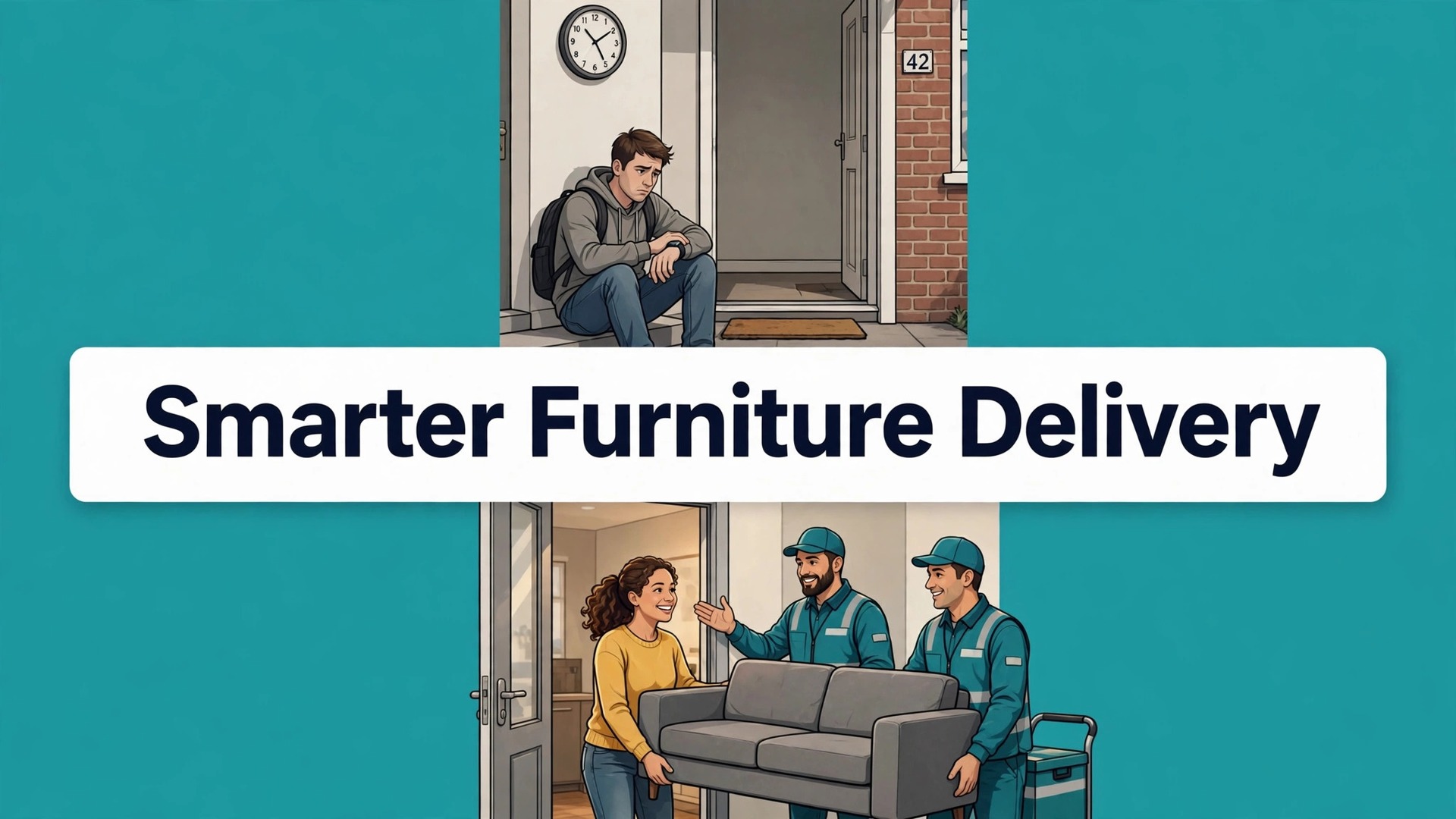
Consider two furniture stores on the same street. The first promises delivery “sometime next week”, sends no update, and leaves the customer waiting at home all day for a truck that arrives late, with a crew unprepared for the stairs or the assembly. That gap is what you close when you use AI for furniture store delivery scheduling.
The second confirms a three-hour window the day before, texts a live ETA on the morning, arrives with the right crew and the right tools, assembles the piece, checks it with the customer, and takes the packaging away. Both stores sold the same sofa. Only the second store gets the repeat purchase, the referral, and the five-star review, and the difference is almost entirely scheduling. When you use AI for furniture store delivery scheduling, you are building the second store’s operation, one window, one route, and one crew at a time.
Furniture delivery is harder than parcel delivery, and that difficulty is where most scheduling systems fail. Pieces are bulky, fragile, and often custom. Homes have stairs, narrow doorways, elevators, gated access, and building rules that change by address. Some deliveries need two crew members, some need three, some need assembly, and some need haul-away of an old piece. A schedule that treats every delivery as an identical stop will produce late arrivals, damaged pieces, and crews that run out of time before the last stop. This guide gives you a step workflow for delivery windows, crew routing, and assembly add-ons, plus a delivery-day checklist you can copy for every route.
Artificial intelligence fits this work in a specific way. It can group deliveries into efficient routes, match crew size and skills to each stop, predict how long each stop will take, and draft ETA updates that go out before customers have to call. It cannot measure a doorway, judge whether a sectional will turn a stairwell, or calm a customer whose building elevator is booked for someone else. Those calls stay human. The rest of this guide keeps that boundary clear, and it qualifies every figure that comes from a vendor page rather than from your own delivery data, so you can test the system against your own on-time rate instead of trusting a marketing claim.
What White Glove Really Means, and Why It Changes Scheduling
White glove is a term customers hear often and understand rarely, so defining it clearly is a scheduling decision, not a marketing one. Vendor guides describe the full version consistently. A trained crew schedules an appointment, carries the item into the room of choice, unpacks it, assembles it where assembly is included, inspects it with the customer, and removes all packaging. Baer’s describes the same pattern, with a delivery day scheduled in advance and a three-hour window given the day before, plus assembly by delivery staff and inspection before the crew leaves.
Other guides warn that not every service labelled white glove includes all of that, and that some limit setup time, stairs, or building types, so check exactly what is covered before you promise it.
That definition matters for scheduling because each element costs time. Room-of-choice placement costs more time than threshold delivery. Assembly costs more time than placement alone. Haul-away costs time and truck space. A schedule that books six white glove stops in a day, using parcel-style time estimates, will fail by mid-afternoon, and the last customers will bear the delay. When you use AI for furniture store delivery scheduling, the first job is to give every stop a realistic time budget based on its actual scope, not on an average. A sofa with assembly, stairs, and haul-away is not a thirty-minute stop, and pretending otherwise helps nobody.
Service tiers also change the promise you make at sale. Curbside delivery leaves the boxed item at the curb. Doorstep delivery leaves it at the door. Threshold delivery brings it just inside. Room-of-choice delivery carries it to the room. White glove adds unpacking, assembly, and debris removal, where the service includes them. Publish which tier each customer bought, confirm it in the scheduling message, and make sure the crew sheet shows it, because most delivery disputes start with a customer expecting a tier the crew was never told to deliver. AI can carry that tier through from sale to schedule to crew sheet without retyping, which removes the most common source of mismatch.
Why Furniture Routes Fail in Predictable Ways
Furniture routes fail for a small set of reasons, and naming them is the first step to fixing them. The first is flat time estimates. Every stop gets the same slot, regardless of stairs, assembly, or haul-away, so the route drifts late from the second stop onward.
The second is missing access information. The crew arrives to find a gated community, a freight elevator that needs booking, a walk-up with no parking, or a customer who is not home, and the stop takes twice as long or fails outright. The third is wrong crew matching. A two-person crew is sent to a stop that needed three, or a crew without assembly experience is sent to a complex build, and the job stalls.
The fourth failure is warehouse readiness. The piece is not picked, not inspected, or not loaded in route order, so the crew wastes time at the warehouse or arrives with the wrong item. The fifth is silent delay. A route runs late, nobody tells the later customers, and each one calls the store, pulling staff away from fixing the route. Measure your own failures before you automate. Track, for one month, on-time arrival by route, failed deliveries and their reasons, average minutes per stop by scope, and callbacks before arrival. Those numbers tell you whether your problem is time estimates, access data, crew matching, warehouse readiness, or communication, and automating the worst number first earns trust fast.
A Step Workflow for Windows, Routing, and Assembly
This workflow assumes a furniture store with a warehouse, one or more delivery crews, a scheduling tool, and an AI-assisted routing and messaging tool, with a dispatcher or delivery manager approving every route. Adapt the tools, keep the order, and run it daily, not only on busy weekends.
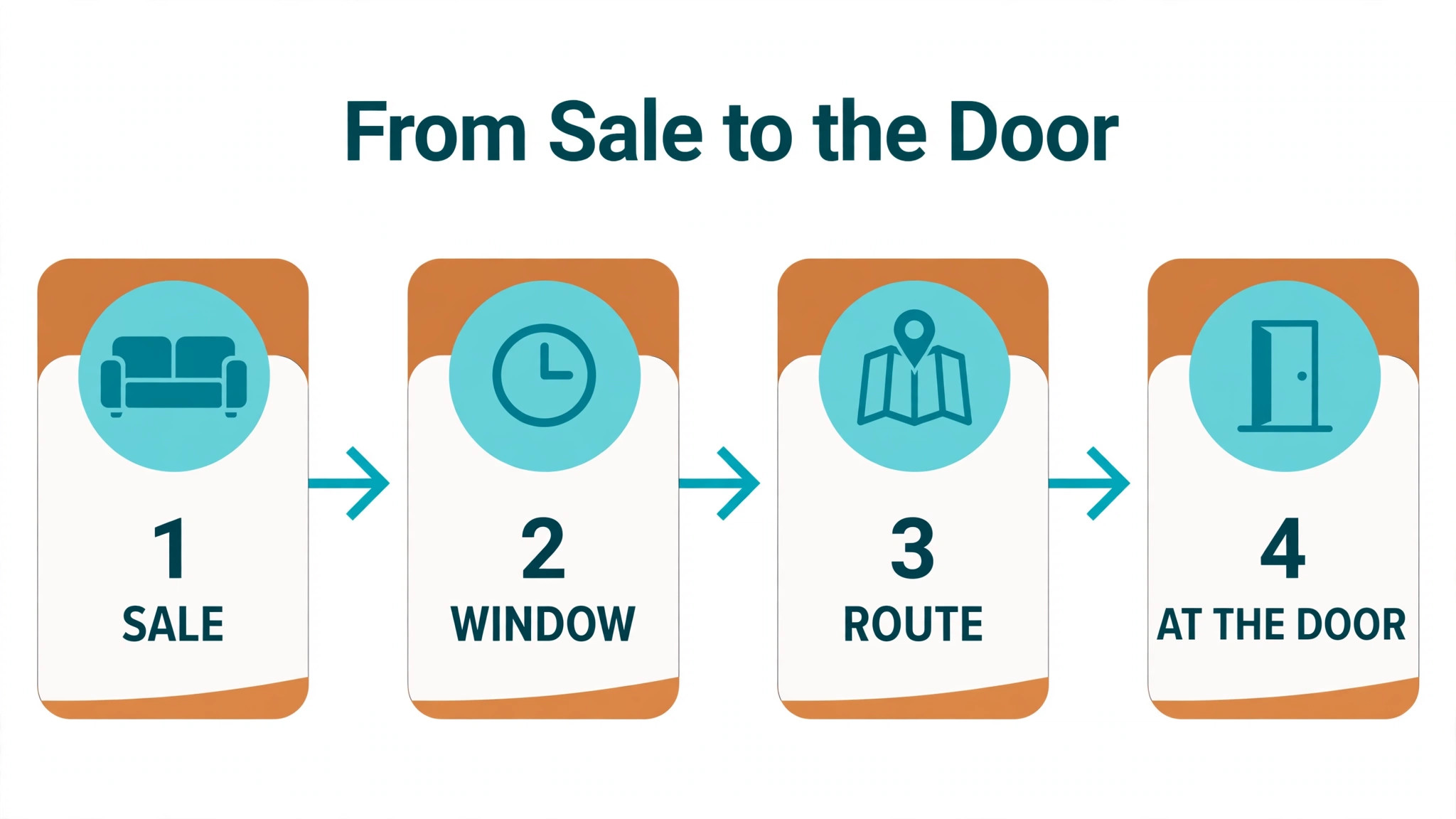
Step 1, confirm scope and access at sale, not at the door
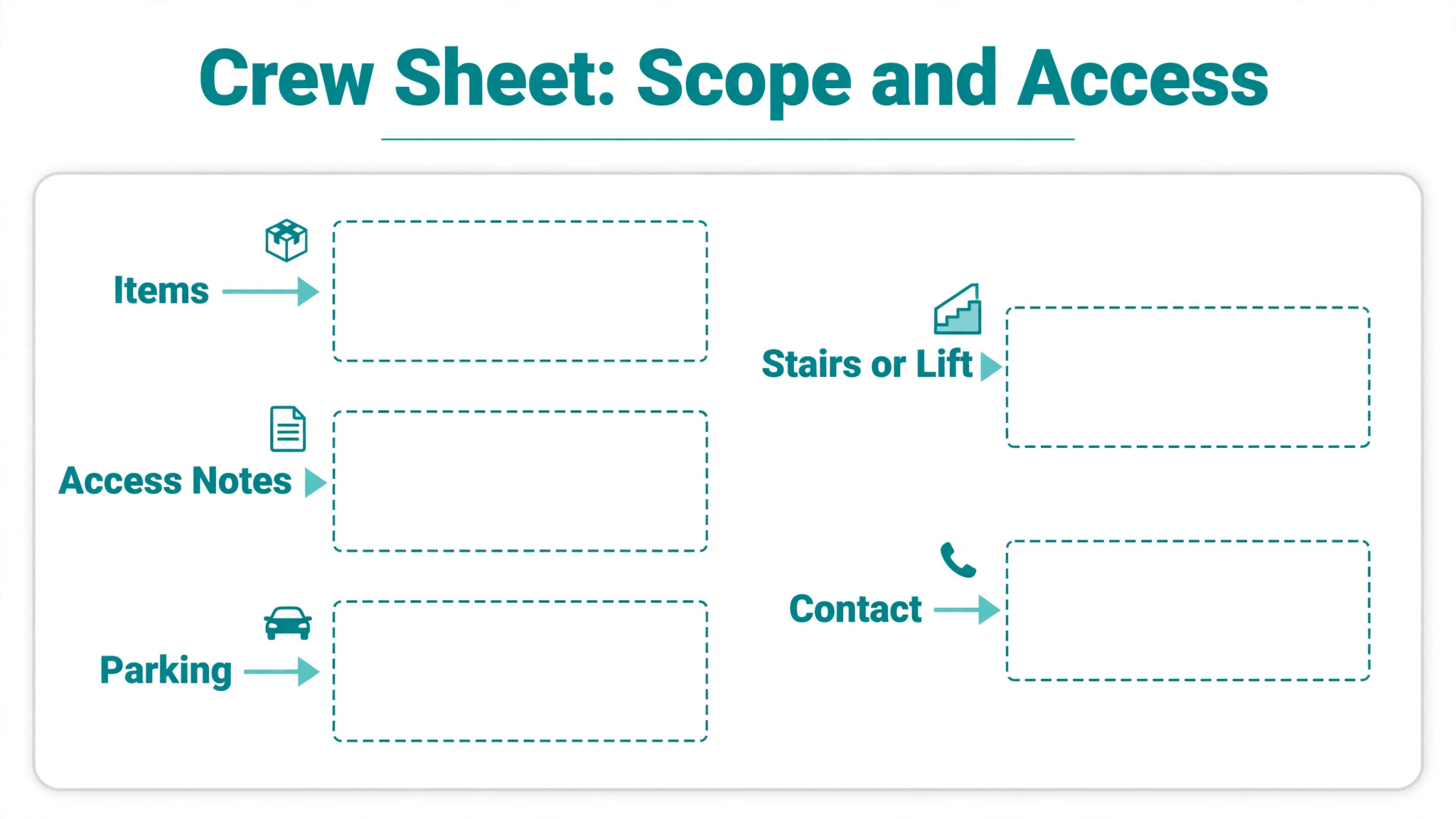
At purchase, record delivery tier, assembly needs, haul-away needs, stairs, elevator, gate or building rules, parking notes, and the customer’s availability. Use AI to draft the confirmation message from those fields, and have sales staff check it before it goes out, because a missing stairs note will cost an hour later. If building rules require a certificate of insurance or an elevator booking, flag that at sale, not the day before delivery, when it may be too late to arrange.
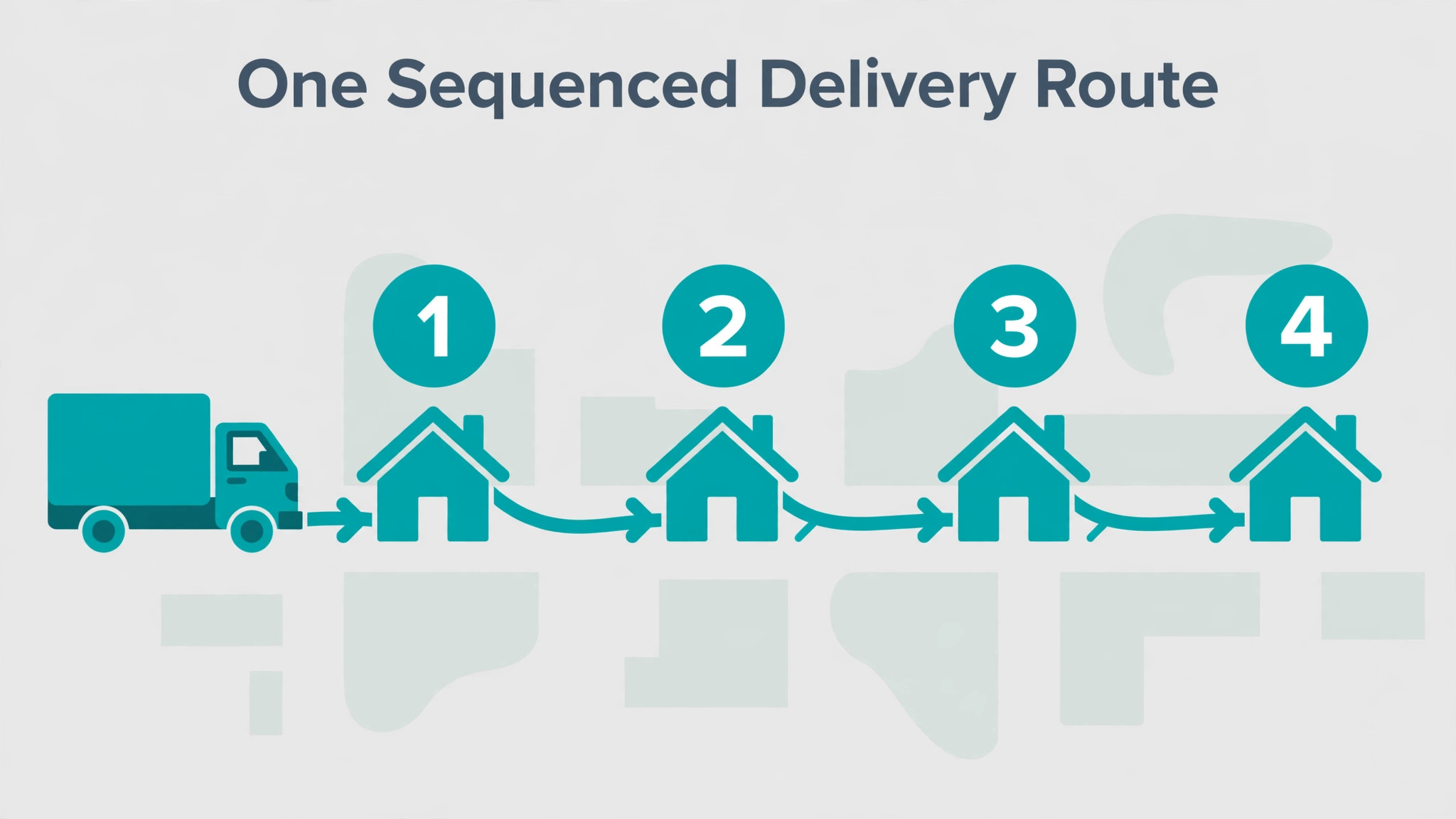
Step 2, build routes by scope, geography, and crew capability
Group stops by area first, then sequence them by time window, access constraints, and crew capability. A stop with a booked elevator window must be sequenced around that window, not around geography alone. A stop needing three crew members or assembly skill must be matched to a crew that has them. AI can propose the route by weighing distance, stop duration by scope, window constraints, and crew skills together, and it should show its reasoning in plain language, such as why a distant stop was placed first. A route nobody can explain will be overridden, and rightly so.
Step 3, confirm windows the day before, with a narrow range
The day before delivery, confirm each customer’s window, and narrow it where you can, following the pattern vendor guides describe of confirming a day and then giving a shorter window closer to delivery. Include what the crew will do, what the customer should prepare, such as clearing a path or arranging building access, and a number for changes. AI can draft those messages and flag customers who have not confirmed, so staff call them rather than discovering an empty home the next day. A confirmed window is a commitment, so only confirm windows the route can actually keep.
Step 4, run the morning load and crew check
Each morning, check that every piece is picked, inspected, and loaded in reverse route order, that assembly tools and parts are on the truck, and that haul-away space is reserved where needed. AI can generate the load list from the route and flag missing items before the truck leaves, when they can still be fixed. A crew that leaves with a missing leg, a missing tool, or a piece in the wrong order will lose the day to workarounds, and no routing improvement can recover that time.
Step 5, update ETAs before customers have to ask
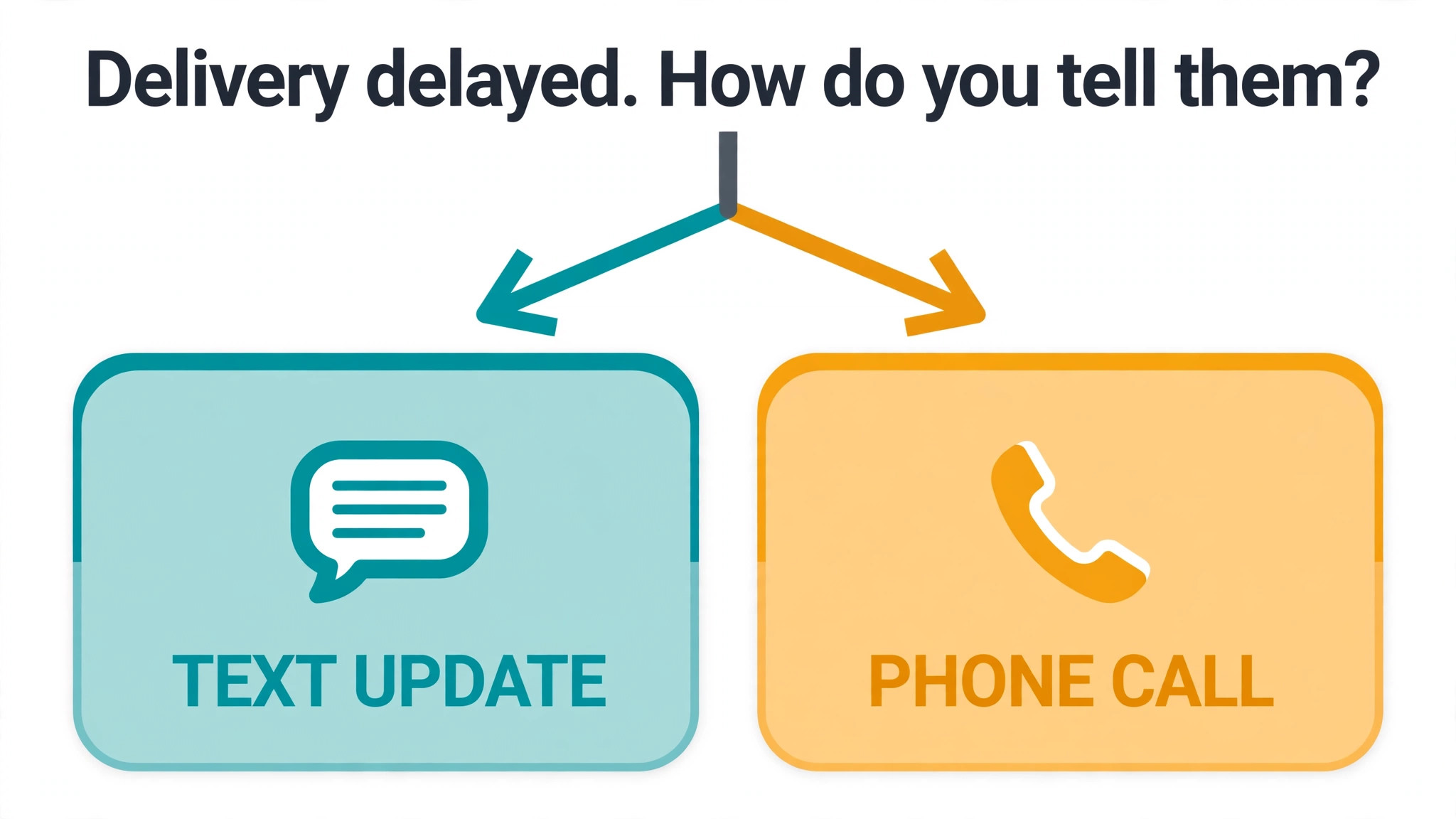
As the route progresses, update each remaining customer with a live ETA, and update early when the route slips. AI can draft the update and flag the threshold breach, such as a slip past 30 minutes, but the delivery manager decides whether the update goes by text or by call. A short delay suits a text. A long delay, a missed window, or a distressed customer suits a call. Never let a customer learn about a delay from silence, because silence is what generates the callback storm that then slows the whole operation.
Step 6, close each stop with inspection, photos, and a clean record
At each stop, the crew places the piece, assembles where included, inspects it with the customer, records any damage honestly, and captures photos before leaving. AI can check the photo set for completeness and flag missing images while the crew is still on site. The customer signs for the delivery, notes any concern, and receives care information. That close protects the customer, the crew, and the store, because most damage disputes are decided by what was recorded at the door, not by what anyone remembers a week later.
The Delivery-Day Checklist
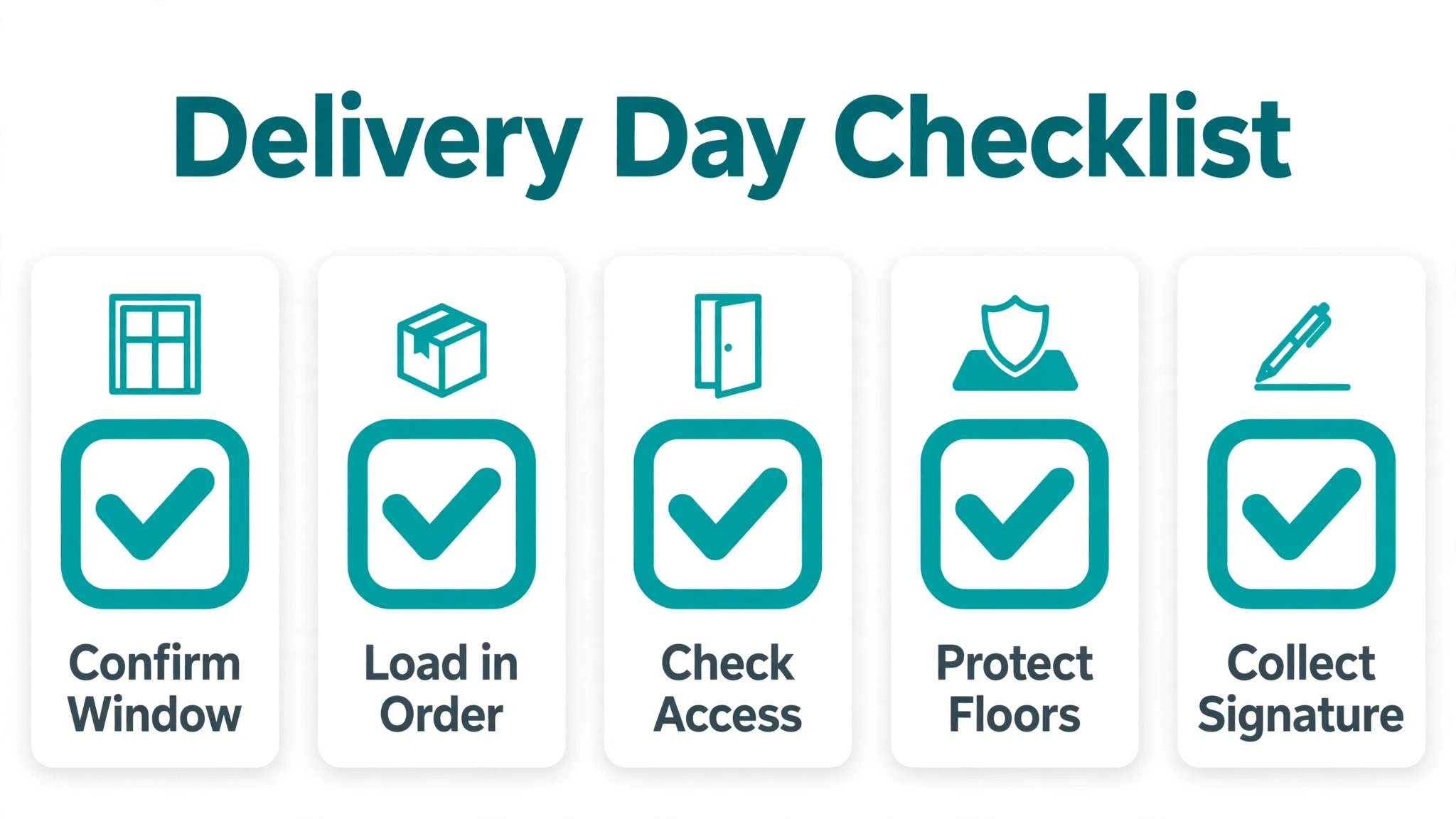
Copy this checklist for every route, and keep one copy per crew per day, so handover and review are a read, not a retelling. It covers the warehouse, the road, and the door, and it gives AI a clean structure to read from.
Warehouse check. Every piece picked and inspected. Load in reverse route order. Assembly tools, parts, and hardware on board. Haul-away space reserved. Damage noted before loading, not discovered at the customer’s home.
Crew check. Crew size matched to the heaviest stop. Assembly skill matched to the builds on the route. Driver hours and break plan confirmed. Phones charged, route and customer contacts loaded, offline access tested for areas with weak signal.
Customer check. Window confirmed the day before. Access notes read, including stairs, elevator, gate, and parking. Customer contact number tested. Special instructions, such as a pet, a sleeping child, or a building rule, noted on the crew sheet.
On the road check. ETAs updated before customers ask. Delays communicated by text for short slips and by call for long ones. Route changes logged with a reason, so the next route learns from them. No stop skipped without a customer message and a rebooking offer.
At the door check. Piece placed in the room of choice where the tier includes it. Assembly completed and tested where included. Inspection done with the customer. Photos captured. Packaging removed where the tier includes it. Signature obtained, concerns recorded, care information left.
End of day review. Stops completed, stops failed with reasons, on-time rate, ETA misses, damage notes, and callbacks before arrival. One action chosen for the next day, not a list of complaints. That review is where AI earns its keep, by turning the checklist into a weekly pattern report by area, by scope, and by crew.
Crew Routing, Truck Space, and the Constraints AI Must Respect
Routing for furniture is not parcel routing, because the truck itself is a constraint. A truck fills up, and a route that looks efficient on a map may be impossible if the largest pieces must be loaded last and delivered first, or if haul-away pieces need space that the outbound load already occupies. Sequence loads in reverse delivery order where possible, and let AI propose sequences that respect both geography and load order, rather than geography alone. When a route requires a reload mid-day, schedule it explicitly, with warehouse time included, instead of letting it appear as a surprise delay.
Crew capability is a second hard constraint. Assembly skill, experience with heavy or fragile pieces, and familiarity with building procedures all change which crew should take which stop. A crew that assembles well but has never handled a piano or a marble top should not be assigned that stop because they are closest. Record crew skills per team, update them when staff are trained, and let AI rank within those skills, never across them. The same applies to driver hours and fatigue. A crew near the end of a long day should not be sent to a distant complex stop simply because they are available, and the ranking must include hours worked and rest breaks.
Building rules are a third constraint that AI must respect rather than optimise away. Freight elevator bookings, delivery windows set by a building, certificate of insurance requirements, and parking restrictions are not suggestions, and violating them can mean a failed delivery and a fine. Record building rules per address after the first delivery, so repeat deliveries to the same building inherit the knowledge. A store that remembers a building’s rules looks professional. A store that relearns them at the door, every time, looks careless, and the customer pays for the lesson.
Cost, Damage, and the Conversation About Responsibility
Delivery cost questions arrive at sale, and handling them badly creates disputes at the door. Publish delivery tiers and their prices clearly, including what assembly, haul-away, stairs, and out-of-area delivery cost, and make sure AI drafts never quote a price that is not on your current price list.
Vendor guides report white glove costs ranging widely, with one guide citing 150 to 500 dollars or more depending on location, stairs, and assembly complexity, and noting that standard carrier liability defaults far below the value of most white glove items. Treat those figures as vendor-reported ranges, check your own carrier terms, and confirm your pricing with your provider before quoting, because a price quoted by an automated message feels like a promise.
Damage responsibility should be stated just as clearly. Who inspects, when, and what happens if damage is found, whether before loading, at delivery, or after the crew leaves. The crew’s photos and the customer’s signature at the door are the evidence that settles most disputes, which is why the close step in the workflow matters so much. AI can check that the photo set is complete and that the damage note matches the photos, but it cannot judge damage, and a damage claim should always go to a person promptly, with the photos attached. A store that responds to damage fast, honestly, and with a clear remedy keeps customers that a slow, defensive response would lose.
Insurance deserves a plain conversation too. Confirm what your delivery cover includes, whether it covers full replacement value or a per-pound default, and whether high-value pieces need additional cover. Customers buying expensive pieces will ask, and staff should be able to answer without guessing. Keep a short written answer at the sales desk, and make sure AI templates never promise cover that the policy does not provide. A promise made by a message is still a promise, and correcting it after a loss damages trust beyond repair.
Mistakes That Quietly Break Delivery Schedules
The first mistake when you use AI for furniture store delivery scheduling is trusting flat time estimates. A route built on averages will drift late from the second stop onward, and the last customers will always bear the delay. Build time budgets by scope, and review them monthly against actual stop times. The second mistake is collecting access information at the door instead of at sale. Stairs, elevators, gates, and parking must be known before the route is built, not discovered by the crew. The third mistake is letting the warehouse stay out of the system. A route is only as good as its load, and a missing piece or a wrong load order will undo the best routing.
The fourth mistake is silent delay. A route that slips without telling later customers generates callbacks, and callbacks pull staff away from fixing the route, which makes the delay worse. Update early, update honestly, and call for long delays. The fifth mistake is measuring only completed stops, and ignoring on-time rate, failed deliveries, and customer experience. A route that completes every stop but arrives hours late to the last three has not succeeded. Track on-time arrival, failures by reason, and callbacks alongside completions, and let those numbers change the route, not just describe it.
How to Use AI for Furniture Store Delivery Scheduling for Custom and Oversized Pieces
Custom and oversized pieces break standard schedules, because they cannot be treated as just another stop. A custom sectional built to order, a marble table, a piano, or a wardrobe that must be carried up a narrow stairwell each needs its own plan, and that plan should be made at sale, not on delivery day. Record the piece dimensions, weight, access route through the home, and any assembly or installation steps that need specialist skill, and keep those fields on the crew sheet where they cannot be missed.
When you use AI for furniture store delivery scheduling for these pieces, the routing must treat them as anchor stops. Place the anchor stop first or around its building window, build the rest of the route around it, and do not stack a second complex stop on the same crew on the same day unless the time budgets clearly allow it. AI can flag anchor stops, suggest crew sizes, and warn when a route holds two anchors, but the delivery manager should approve the final plan, because a custom piece that fails delivery costs a remake, a redelivery, and a customer relationship, not just a delay.
Preparation also changes for oversized pieces. Measure doorways, stair turns, and elevator dimensions in advance, and ask the customer to send photos of tight turns where measurement is uncertain. Confirm that the piece can be protected in transit with blankets and wrapping suited to its finish, and that the truck has room for it alongside the day’s other load.
A short pre-delivery call for anchor stops, made two days before, catches problems that a message cannot, such as a renovation blocking access or a building rule that changed since the sale. When you use AI for furniture store delivery scheduling with anchor stops handled this way, custom orders stop being the deliveries your team dreads, and become the deliveries that earn the strongest reviews.
Measuring Whether Delivery Scheduling Is Improving
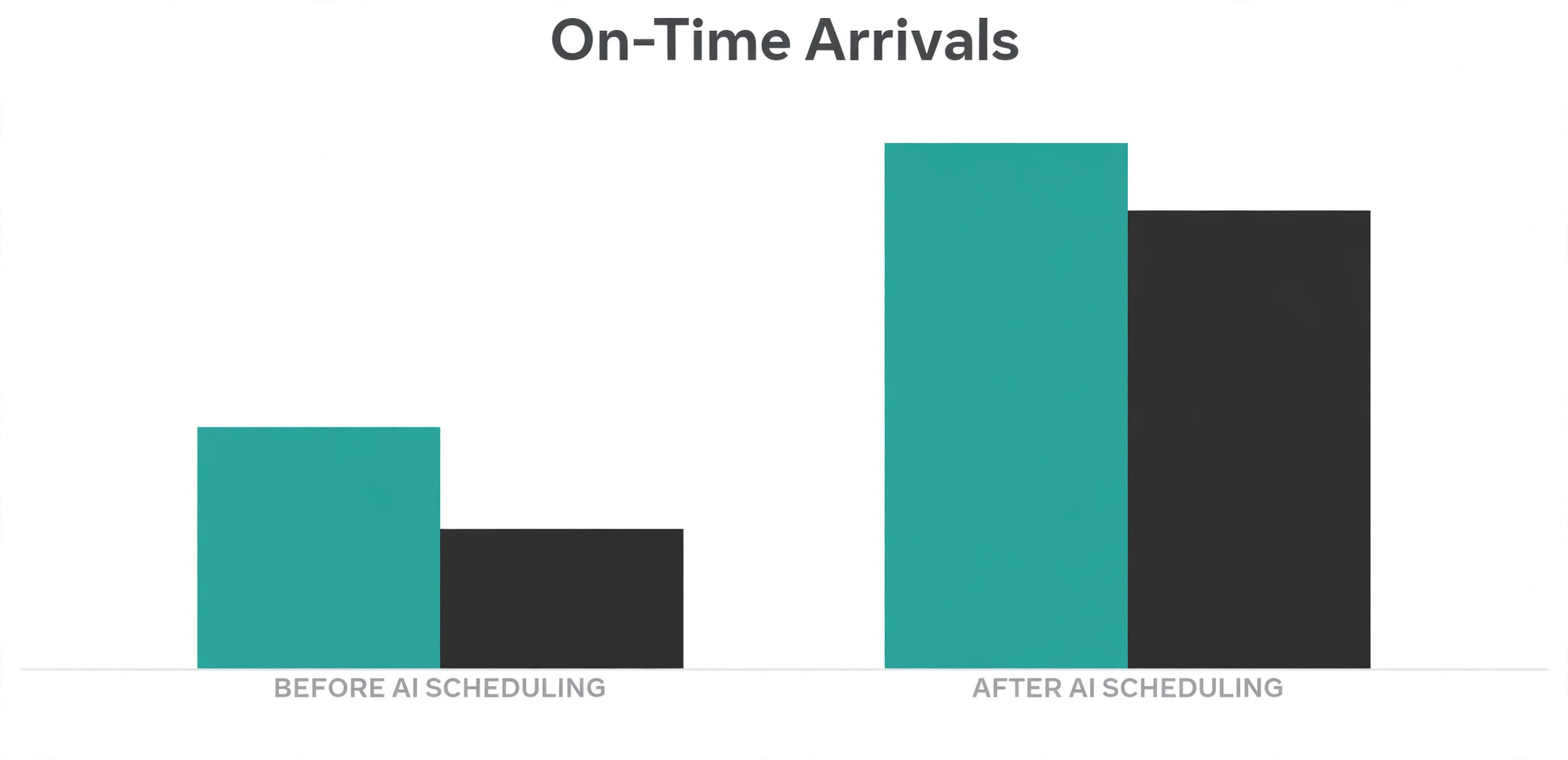
After one month using AI for furniture store delivery scheduling, compare your numbers with the previous month, using the same definitions. On-time arrival rate, failed deliveries by reason, average minutes per stop by scope, callbacks before arrival, and damage notes per hundred deliveries. Look at the breakdown by area, by crew, and by scope, because an overall improvement can hide a worsening pattern in one area. If city routes improved but rural routes worsened, your time estimates or your access data for rural stops needs work, not your routing logic.
After three months, add business measures. Repeat purchases from delivery customers, referrals, reviews mentioning delivery, and staff hours saved on scheduling calls, with a note on where that time went. Also track crew experience, because a system that improves numbers but exhausts crews with impossible routes will not last. If crew feedback turns negative, review time budgets and route density before adding more stops, because a route that looks efficient on a screen may be punishing on the road.
Keep a log of routing rule changes, time budget changes, and template changes, with dates. When a number moves suddenly, that log helps you tell whether the cause was a rule change, a holiday peak, a staffing change, or a system error. Without a log, every change becomes a debate about memory. With a log, it becomes a testable question, and that discipline is what turns a scheduling tool into a scheduling system.
For related reading, see cancellation policy, setting up a waitlist, setting up a client feedback loop, nutritionist meal plan follow-up and payment processor choice. Those posts cover adjacent scheduling and follow-up problems, and the same lesson applies when you use AI for furniture store delivery scheduling. Automate the routing and the updates, keep a human for the access call and the damage decision, and measure on-time arrival, not just completions.
Frequently Asked Questions
How narrow should a furniture delivery window be?
As narrow as your route can honestly keep. Vendor guides describe confirming a day and then giving a three-hour window the day before, which is a useful pattern, but only if your time budgets support it. A narrow window that you miss consistently is worse than a wider window that you keep, because customers plan their day around the promise. Narrow the window as your on-time data improves, not before.
Can AI build a furniture route without a dispatcher?
No, and it should not. AI can propose routes by weighing geography, stop duration, windows, and crew skills, but the final route involves building rules, load order, and local knowledge that a proposal cannot fully capture. The best model is AI proposal with delivery manager approval, plus an override that is logged with a reason, so the system learns from overrides instead of hiding them.
What access information should be collected at sale?
Delivery tier, assembly and haul-away needs, stairs, elevator and booking requirements, gate or building rules, parking notes, and customer availability. If building rules require a certificate of insurance or an elevator booking, flag that at sale, not the day before delivery. Access information collected at the door is usually too late to fix the route, and the customer pays for the delay.
How should a store handle a delivery that runs late?
Update the customer before they call you, with a revised window and an honest reason, by text for short delays and by call for long ones. Offer a rebooking option where the new window does not work, and record the cause, so the pattern can be fixed. A late delivery handled early and honestly loses far fewer customers than a late delivery discovered by silence.
Who is responsible if a piece is damaged during delivery?
That depends on your terms, your carrier cover, and when the damage was found, so state the process clearly at sale and confirm it at the door. The crew should inspect with the customer, photograph the piece, and record any damage before leaving, and damage claims should go to a person promptly with the photos attached. Check your own cover terms rather than assuming a vendor guide’s description applies to your operation.
Should small furniture stores use AI scheduling at all?
A small store benefits most from the basics, which are scope-based time budgets, access data at sale, confirmed windows, and proactive ETA updates, with AI routing added once those basics are solid. You do not need an enterprise system to get value. A route built on real stop times, a crew sheet that shows scope and access, and updates that go out before callbacks arrive will improve a two-crew operation as surely as a large one.
A Measured Verdict
Delivery scheduling improves when scope is confirmed at sale, routes are built on real stop times and crew skills, windows are confirmed the day before, ETAs are updated before customers ask, and every stop closes with inspection, photos, and a signature.
AI helps with routing, time prediction, and updates, but it does not replace the manager who knows a building’s rules, the crew who judges a stairwell, or the person who handles a damage claim. Stores that use AI for furniture store delivery scheduling as a helper for crews and dispatchers, rather than a replacement for them, tend to arrive on time more often, fail fewer deliveries, and earn the reviews that bring the next customer. That is the honest claim, and it is enough.