
Compare two practices and the software choice changes completely. One is a single doctor exam practice that lives on medical eye care, insurance billing and precise clinical records. The other is an optical retail practice where frame sales, lens orders and recall messages pay the bills, and the exam is the start of a retail journey rather than the whole business. The first practice needs exam depth, the second needs dispensing strength, and a tool that serves one well often serves the other badly. This guide to the best practice management software for optometry clinics therefore judges every tool on both sides of that divide, because most real practices live somewhere between the two.
Optometry software also carries a pricing problem that buyers underestimate. Some vendors charge per provider, some per user, some per location and some by feature tier, and the published price rarely reflects the total once implementation, training and optical modules are added. A practice that compares headline prices without mapping them to its own doctor count, location count and dispensing volume will choose the wrong tool for the wrong reason. The fifteen tools below are compared on exam workflow, optical workflow, billing, recall and the real price structure, so the shortlist can survive contact with a real practice.
The first step is to name the practice honestly. Count the doctors, the locations, the share of revenue from exams versus optical sales, and the payers that dominate the book. A practice that is 80 percent medical eye care needs different software from a practice that is 80 percent retail, even if both call themselves optometry clinics. That single honest split will remove half of this list before any demo begins.
The Best Practice Management Software for Optometry Clinics Balances Two Businesses
An optometry practice is really two businesses sharing one front desk. The clinical business needs exam documentation, diagnostic device integration, e prescribing, medical billing and coding, and recall for disease monitoring. The retail business needs frame and lens inventory, lab orders, insurance authorisation for materials, point of sale and dispensing records. Software that handles only one side forces staff to run the other side in a second system or a spreadsheet, and that split is where orders go missing and inventory counts drift.
The exam side has its own depth test. A strong optometry EHR offers exam templates built for eye care, drawing tools, device imports from refractors and retinal cameras, and coding support that reflects how optometrists actually bill medical versus vision plans. A general medical record can document an eye exam, but it will not import device data cleanly or separate a vision plan claim from a medical claim with the same ease. That distinction matters daily, because vision and medical billing follow different rules and different authorisation paths.
The retail side has an equally sharp test. Frame inventory must track style, colour, size and quantity across locations, lens orders must flow to the lab with the right measurements, and the sale must connect to the exam record so staff can see what the patient bought and when they are due back. A system that treats optical as an afterthought will show its weakness at the dispensing table, where a missing frame or a wrong lens turns a satisfied patient into a return visit. Judge every tool on both businesses, and weight the side that produces more revenue more heavily.
Exam Room Versus Optical Floor
Practices that lean clinical should weight the EHR above the point of sale. Their daily pain is charting speed, device integration, coding accuracy and payer follow up, and their software must make a comprehensive exam, a medical follow up and a contact lens fitting each feel native rather than adapted. That exam first test belongs at the top of any shortlist for the best practice management software for optometry clinics run by a clinically led practice, because a pretty retail screen cannot compensate for a slow exam workflow.
Diagnostic integration deserves a specific demo test, because vendors promise it broadly and deliver it narrowly. Bring the actual device models the practice owns to the demo conversation, and ask which data flows automatically and which must be typed by hand.
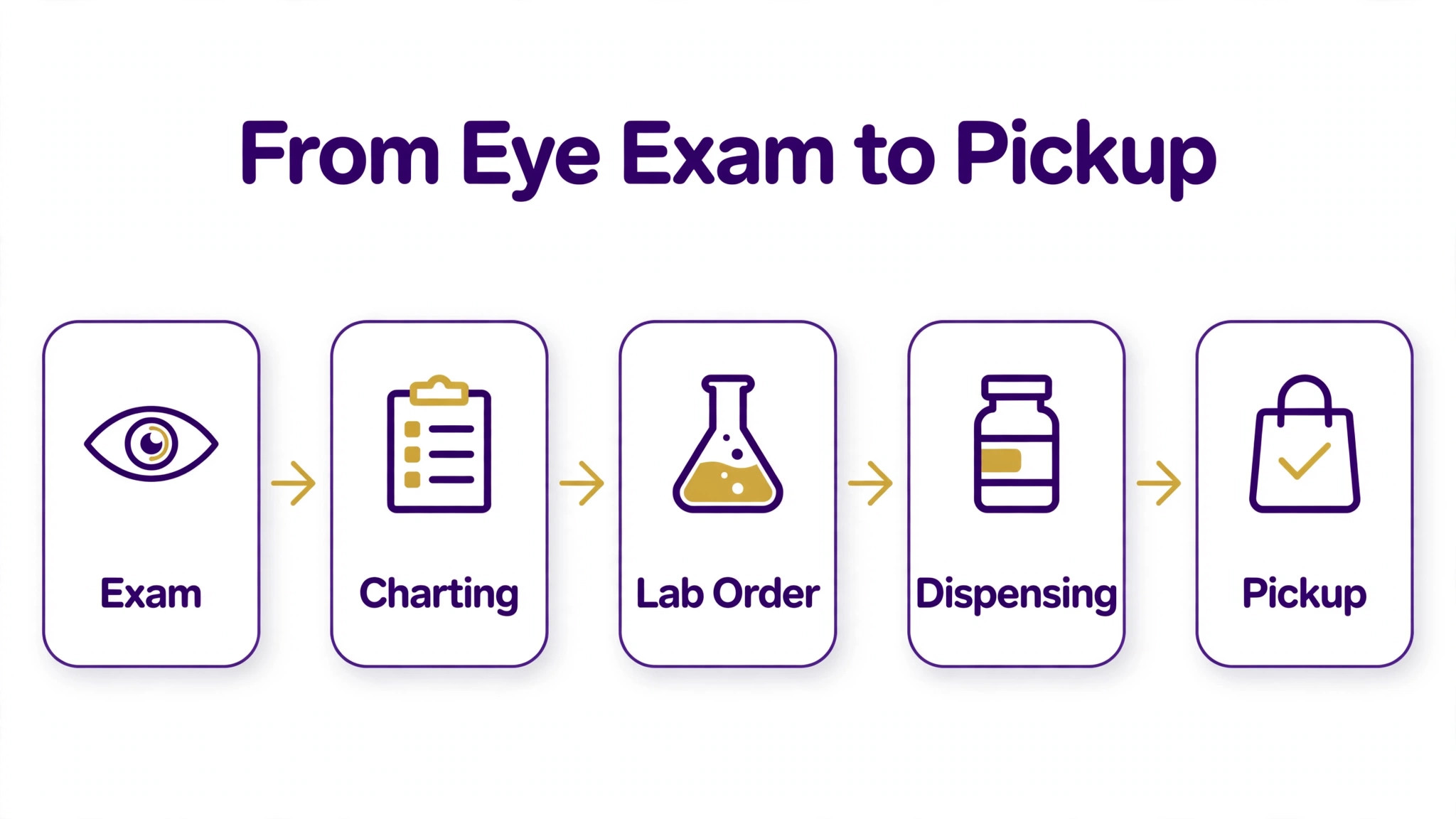
Practices that lean retail should weight the optical workflow above exam depth. Their daily pain is inventory accuracy, lab turnaround, frame board management and recall for annual exams and contact lens renewals. A tool with a strong lens catalogue, frame inventory and lab integration will save more money than a tool with a marginally better exam template, because lost frames and delayed lab orders cost real margin every week. Test the full dispensing journey in the trial, from exam to order to pickup to recall, rather than testing the exam alone.
Multi location practices need a third test, which is control. Centralised pricing, inventory visibility across stores, consolidated reporting and permission controls matter more than any single location feature, because a group that cannot see stock in another store cannot transfer a frame or balance inventory. A tool that works beautifully for one store can still fail a group, and the failure appears in stockouts and inconsistent pricing rather than in the exam room. Run the trial with at least two locations in view before committing a group to any platform.
Fifteen Platforms, Side by Side
The fifteen platforms below range from legacy optometry specialists to modern AI assisted newcomers. Each section states the practice it fits, the price where one is published, and the reason to skip it.

1. RevolutionEHR
RevolutionEHR is the cloud specialist for independent optometry practices that want a dedicated eye care EHR without on premise servers. It covers exam documentation, scheduling, billing, patient engagement and optical workflows in a system built only for eye care, and its cloud design means updates, backups and remote access come standard rather than as IT projects. Independent practices value that focus, because every screen reflects optometry work rather than general medicine adapted to it.

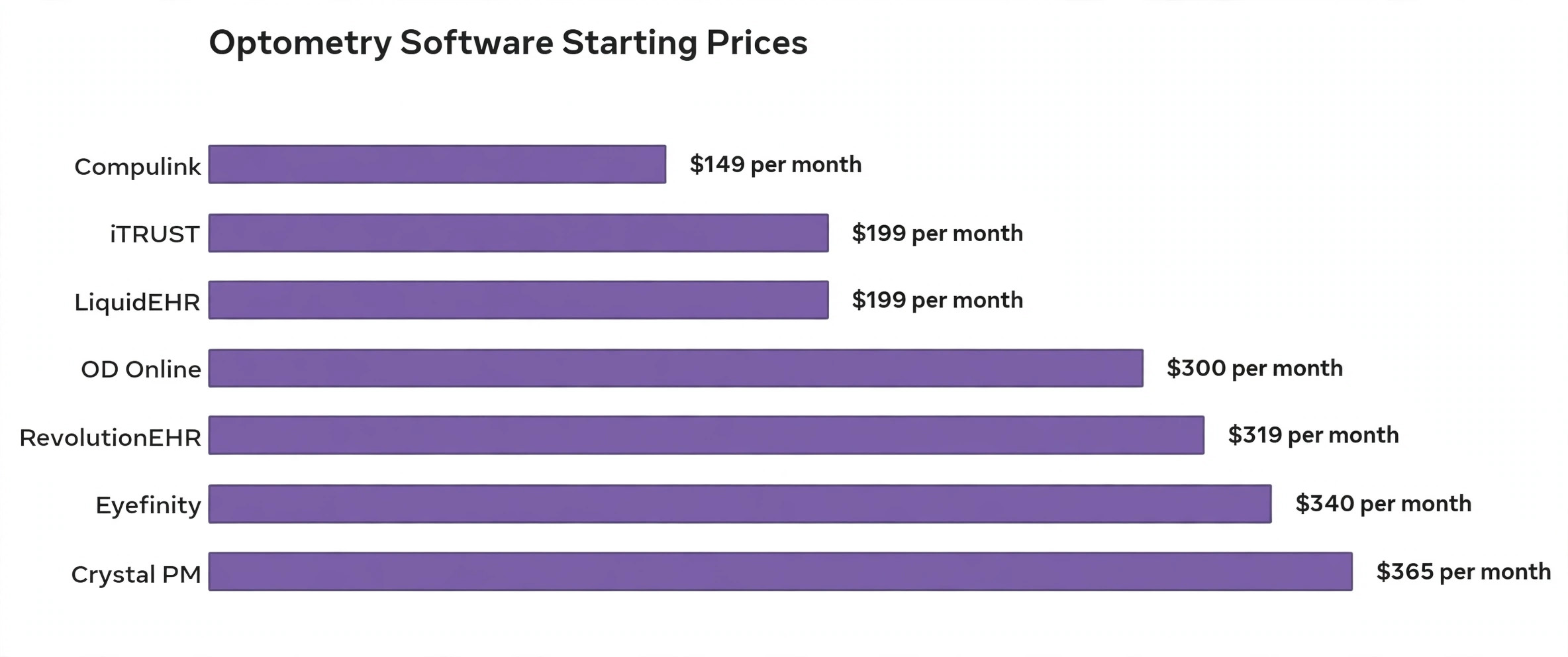
RevolutionEHR pricing starts at around $319 a month for exam only or optical only locations, structured to grow with practice needs. Choose RevolutionEHR if the practice is independent, cloud first and wants a dedicated optometry system. Skip it if the practice needs the lowest possible entry price, because several rivals undercut it, or if it needs a general medical platform for mixed specialties.

2. Eyefinity EHR
Eyefinity EHR is the VSP connected choice for practices where VSP is a dominant payer. It covers EHR, practice management, scheduling, billing and optical workflows with a tight connection to VSP authorisation and claims, which removes a large share of manual eligibility and authorisation work for VSP heavy books. Practices that process VSP claims daily will feel that integration in reduced front desk time and fewer authorisation errors.
Eyefinity EHR is listed from $340 a month in published comparisons, with higher tiers adding capacity and features. Choose Eyefinity EHR if VSP dominates the payer mix and the practice wants that integration depth. Skip it if the payer mix is diverse and VSP is a minor share, because the integration advantage will matter less than exam or optical strengths elsewhere.
3. Crystal Practice Management
Crystal Practice Management, often called Crystal PM, is the multi location workhorse for eyecare practices that need claims, inventory, scheduling and reporting across sites. It combines EHR and practice management with strong inventory management, which suits groups that must see frame stock, lab orders and billing performance across locations in one view. Its longevity in the market means its billing and inventory workflows have been refined over many years of eyecare use.
Crystal PM is listed at $365 per user a month in published comparisons, so price it at the real user count, including front desk and optical staff. Choose Crystal PM if the practice is multi location and needs strong inventory plus claims control. Skip it if the practice is a single doctor office, because the per user price and setup weight will exceed what that practice needs.
4. MaximEyes
MaximEyes is the multi location optometry EHR for practices that want clinical documentation, scheduling and insurance management in a system that scales with user count. It covers exam workflows, billing and reporting with a structure that suits groups adding doctors and locations, and its optical features support the dispensing side without forcing a second system. Groups that value a single vendor for clinical and operational work will find that breadth reassuring.
MaximEyes has a starting price of $325 a month, tailored by practice size and user count, plus a one time implementation fee. Choose MaximEyes if the practice is growing across locations and wants a scalable optometry EHR. Skip it if the budget cannot absorb the implementation fee, or if the practice is a small retail led store that needs optical strength above exam depth.
5. Compulink Healthcare
Compulink is the AI assisted optometry platform for larger groups that want EHR, practice management and optical point of sale in one AI supported system. It covers clinical documentation with AI assistance, revenue cycle management, patient engagement and inventory, which suits a group that needs both exam depth and retail control under one vendor. Its scale makes it a better fit for larger organisations than for solo practices.
Compulink is listed at $149 per user a month in published comparisons, so the total depends heavily on user count. Choose Compulink if the practice is a larger group that wants AI assisted documentation plus full optical point of sale. Skip it if the practice is small, because the per user total and the enterprise setup will outweigh the benefits.
6. iTRUST
iTRUST is the transparently priced cloud EHR for mid sized eye care practices that want modern software without long contracts or hidden setup fees. It covers EHR, practice management, patient engagement, telemedicine, claims and billing in a cloud system created by optometrists for optometrists, and its straightforward pricing makes budgeting simple. Practices that have been burned by opaque enterprise quotes often value that transparency as much as any feature.
iTRUST pricing starts at $199 per doctor per location a month, with no long term contracts or hidden setup fees in its published terms. Choose iTRUST if the practice is mid sized, cloud first and wants clear pricing. Skip it if the practice needs the deepest enterprise reporting or the largest device integration library, where older specialists may go further.
7. DrChrono
DrChrono is the tech comfortable option for eye practices that want a modern, flexible EHR with revenue cycle management, telehealth and lab integrations. Its platform is broader than pure optometry, which suits a practice that mixes eye care with other services or that values a modern interface and mobile access above eye specific depth. The flexibility appeals to younger practices building their own workflows rather than inheriting legacy ones.
DrChrono is listed at $199 per provider a month in published comparisons. Choose DrChrono if the practice is tech comfortable and values flexibility, telehealth and modern access. Skip it if the practice needs the deepest optometry specific optical workflow, because a general platform will need shaping to match the specialists here.
8. EyePegasus
EyePegasus is the independent practice specialist for one to three doctor clinics that want automated coding, revenue cycle management and simultaneous chart access. It covers exam documentation with automated ICD 10 coding support, billing and scheduling in a system sized for small practices rather than scaled down from an enterprise product. That sizing shows in the workflow, which stays simple enough for a small team to run without dedicated IT support.
EyePegasus sells fixed price packages, with Standard at $349 per doctor a month and Professional at $499 per doctor a month, plus a custom tier for large groups. Choose EyePegasus if the practice has one to three doctors and wants fixed, predictable pricing with automated coding. Skip it if the practice is a large multi location group, because the custom tier will need a separate quote and comparison.
9. Barti
Barti is the modern AI newcomer for practices with complex billing that want an AI scribe, billing tracking and a smart calendar in one system. It covers exam documentation with AI assistance, billing follow up and scheduling in a contemporary interface that appeals to practices frustrated by legacy software design. The AI scribe is the headline, because it promises to cut charting time for doctors who currently finish notes after hours.
Barti is listed at $500 a month in published comparisons, so check the vendor pricing page for what that price covers by doctor and location. Choose Barti if the practice wants modern AI documentation and can justify a premium price for it. Skip it if the budget is tight or the practice needs proven optical inventory depth above AI charting.
10. AdvancedMD
AdvancedMD is the tech savvy option for optometry practices that want a broad medical platform with EHR, billing, telehealth, scheduling and a patient portal. Its strength is breadth and reporting, which suits a practice that mixes optometry with other medical services or that wants strong analytics across the business. The platform is well established, and its integrations cover a wide range of practice needs beyond eye care alone.
AdvancedMD is listed at $429 a month in published comparisons. Choose AdvancedMD if the practice is tech savvy, mixed specialty or reporting driven. Skip it if the practice is a pure independent optometry office, because the optometry specific specialists in this guide will match its exam and optical workflows more closely.
11. OD Online
OD Online is the cloud solution created by eye care professionals for eye care professionals, covering integrated EHR and practice management with a focus on profitability and patient experience. It handles patient records, exam and lab results, scheduling, billing, insurance and recalls in a system shaped by people who ran eye practices themselves. That practitioner origin shows in workflows that follow the exam and dispensing journey rather than a generic medical template.
OD Online is listed at $300 a month in published comparisons. Choose OD Online if the practice wants a practitioner built cloud system at a mid range price. Skip it if the practice needs the largest enterprise feature set or the deepest multi location inventory control, where Crystal PM or MaximEyes go further.
12. LiquidEHR
LiquidEHR is the speed focused optometry EHR for practices that want fast, certified electronic records combined with practice management. It covers exam documentation, scheduling, billing and patient management with an emphasis on quick charting and ease of use, which suits a busy exam practice where doctors see a high volume of patients per day. Speed is a clinical feature here, because a slow EHR backs up the exam lane and shortens the time available per patient.
LiquidEHR is listed at $199 a month in published comparisons. Choose LiquidEHR if the practice values charting speed and a certified EHR at a moderate price. Skip it if the practice is retail led and needs the strongest optical inventory and lab workflow, because LiquidEHR leads on the exam side rather than the optical side.
13. Glasson
Glasson is the optical practice platform for independent optical stores and optician led practices where dispensing is the core business, not an afterthought to the clinical suite. It covers lens search, client records with purchase history, frame and lens inventory, sales processing and automated client communication in modules designed to work together from the start. That dispensing first design is its defining advantage, and it fills a gap that broad optometry roundups often miss.
Glasson offers a 7 day free trial with no card required, and its price list should be checked on the vendor pricing page, since plans vary by store needs. Choose Glasson if the practice is optical led and the dispensing floor drives revenue. Skip it if the practice is exam heavy and medical, because Glasson is built for the optical business first and the clinical suite second.
14. ModMed EMA
ModMed EMA is the specialty EHR for practices that want adaptive documentation, automated coding suggestions and deep analytics in a premium platform. Its EMA system learns each provider documentation style and suggests codes from chart notes, which can cut charting time for doctors who handle their own notes. The platform also covers practice management, billing and analytics, making it a full system rather than a charting add on, though its heritage spans several specialties including ophthalmology.
ModMed is listed from $500 per provider a month in published comparisons, with full licensing and support adding to the total. Choose ModMed EMA if the practice wants adaptive AI documentation and premium analytics and can justify the price. Skip it if the budget is modest, because several strong optometry specialists cost considerably less per provider.
15. Eyefinity OfficeMate
Eyefinity OfficeMate is the established on premise practice management system for eye care practices and optical retail businesses of many sizes. It covers appointment scheduling, patient and insurance billing, electronic remittance, inventory and reporting, with a general ledger integration that suits practices that want financial control alongside clinical operations. Its long history means many practices already know it, and its workflows reflect decades of eye care administration.
OfficeMate does not publish a standard price, so check the vendor pricing page or request a written quote based on locations and users. Choose OfficeMate if the practice wants a proven, on premise eye care management system with strong billing and ledger control. Skip it if the practice wants a cloud first system with self serve signup, because OfficeMate follows a more traditional deployment path.
Fees Hiding Behind the Quote
Implementation fees are the first hidden line. MaximEyes charges a one time implementation fee, and other vendors charge for training, data migration or device integration without listing those fees on the pricing page. Ask for a written total that includes implementation, training, migration and first year support, because a $199 a month headline can become a multi thousand dollar first year once those lines are added. A vendor that refuses to itemise them is telling you something about the relationship that will follow.
Per user versus per provider versus per location pricing is the second hidden line. A $149 per user price looks cheaper than a $319 per location price until the practice counts optical staff, front desk staff and part time doctors who all need seats. Map every quote to the same headcount before comparing, and ask whether viewers, part time staff and optical only users are charged at the full rate. The cheapest quote on paper is often the most expensive quote at real headcount, and that reversal is common enough to check every time.
The third hidden line is the optical module. Some vendors include frame inventory, lab integration and point of sale in the base price, while others charge for them as add ons, and the difference can exceed the subscription itself. Ask which optical features are included, which are add ons and what the lab integration costs per order or per month. Any buyer comparing the best practice management software for optometry clinics should get that optical answer in writing, because a practice that discovers its optical modules are add ons after signing will either pay the extra or run dispensing in a spreadsheet, and neither outcome is acceptable for a retail led practice.
Picks for Three Practice Shapes
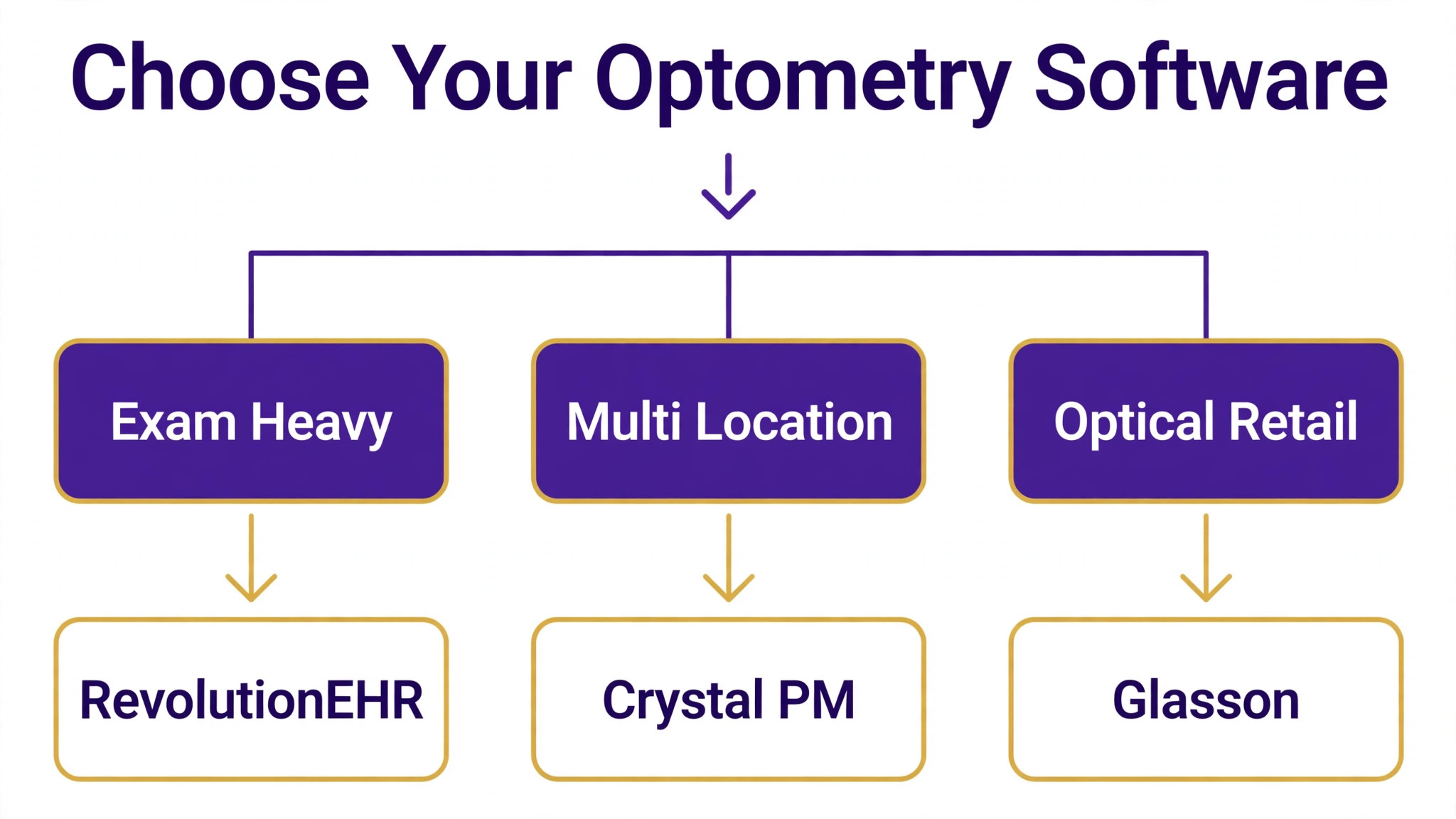
| Practice shape | Best pick | Why it wins for that shape |
|---|---|---|
| Independent practices | RevolutionEHR | Dedicated cloud EHR sized for one practice |
| Multi-location practices | Crystal PM | Inventory and claims control across sites |
| Optical-retail practices | Glasson | Dispensing first design for the optical floor |
Independent practices should buy a system that a small team can run without IT support, and RevolutionEHR earns its pick for cloud delivery and eye care focus at a price a single practice can justify. Multi location practices should buy for control across stores, and Crystal PM earns its pick for inventory visibility and claims management that hold together across sites.
Optical retail practices should buy for the dispensing floor, and Glasson earns its pick because its lens search, inventory and client communication were built for retail first, not added to an exam system afterwards. That shape first logic drives this best practice management software for optometry clinics ranking, where practice shape outranks any single feature. Owners weighing the scheduling side may also want the AI tools for optometrists guide, and the AI for optometry clinic appointment scheduling roundup covers booking automation in more depth.
Implementation in Seven Steps
1. Map exam types, vision plans, medical payers and optical products before choosing a finalist. 2. Test device imports with the actual refractors and cameras the practice owns. 3. Build exam templates, coding rules and recall intervals before importing patients. 4. Import frame inventory with style, colour, size and quantity checked location by location. 5. Connect lab ordering, insurance authorisation and card payments, then test one full sale. 6. Train doctors on exams, optical staff on dispensing, and front desk on billing separately. 7. Run both systems in parallel for two weeks, then reconcile inventory and billing before cancelling.
Where Practices Overpay
The most common overpayment is buying exam depth the practice never uses. A retail led store that buys a premium medical EHR pays for device integration, medical coding and analytics that its exam volume cannot justify, while its frame inventory and lab workflow stay weak. That mismatch is the easiest way to waste money on the best practice management software for optometry clinics shortlist, because the premium tool is genuinely good, just good at the wrong job for that store.
The reverse overpayment is buying a cheap booking tool and then paying for billing, inventory and recall as separate subscriptions, which together cost more than a proper optometry platform. Both mistakes come from comparing headline prices instead of comparing the total system the practice will actually run.
The second overpayment is the long contract signed before the optical workflow is proven. A practice should test the full journey from exam to lab order to pickup to recall during the trial, because that journey is where optical revenue is won or lost. A contract signed on the strength of a good exam demo, without a dispensing test, locks the practice into a system that may fail at the counter. Insist on the full journey test, and prefer a shorter initial term until it passes with real patients and real orders.

Frequently Asked Questions
How much does optometry practice management software cost each month
Published prices in this guide run from $149 per user a month for Compulink and $199 a month for iTRUST, LiquidEHR and DrChrono, up to $500 a month for Barti and $500 per provider a month for ModMed, while several vendors price by quote. The honest budget is the total at your real doctor, user and location count, plus implementation, training and optical module fees. A practice that compares only headline prices will almost certainly misrank its finalists for the best practice management software for optometry clinics, because the total, not the headline, is what the practice actually pays.
Do I need optometry specific software, or will a general medical EHR work
A general medical EHR can document exams and bill claims, but it struggles with vision versus medical plan separation, diagnostic device imports, frame inventory and lab ordering as native workflows. An optometry specific system builds those workflows in, which saves front desk and optical staff time every day. A mixed specialty practice can sometimes accept a general system, but a pure optometry practice will feel the gap at the dispensing table and in device heavy exams.
What is the best software for a single doctor optometry practice
RevolutionEHR and iTRUST are the strongest starting points, with EyePegasus as a fixed price alternative for one to three doctor clinics. RevolutionEHR suits a cloud first independent practice, iTRUST suits a practice that values transparent pricing and no long contract, and EyePegasus suits a practice that wants automated coding with predictable package pricing. Trial all three with real exam types and real payers before deciding.
How does optical retail software differ from exam focused software
Optical retail software centres on frame and lens inventory, lab orders, point of sale and purchase history, with recall driven by purchase and exam dates. Exam focused software centres on clinical documentation, device data, coding and medical billing, with optical features added around that core. A practice should buy for the side that produces more revenue, and test the weaker side in the trial, because the weaker side is where staff workarounds appear first.
Can optometry software handle multiple locations well
Yes, but the tools differ on consolidated control. Crystal PM and MaximEyes handle multi location inventory, pricing and reporting most completely, while single location tools handle extra calendars but offer thinner consolidated views. A group should test stock visibility across stores, centralised pricing changes and location level billing during the trial, because those features separate a true multi location system from a single location tool with extra calendars.
How long does it take to switch optometry software
A single doctor practice can switch in three to four weeks, while a multi location group with inventory, lab integrations and many payers should allow six to ten weeks. The slow steps are exam template building, device integration testing and inventory reconciliation, not software installation. Running both systems in parallel for two weeks catches inventory and billing errors before they affect patients, and that parallel period should be treated as mandatory.
What to Choose on Monday Morning
Buy for the side of the business that pays the bills, then for the other side, and only then for price. An exam heavy independent practice that follows that order lands on RevolutionEHR or iTRUST. A multi location group lands on Crystal PM or MaximEyes. An optical retail practice lands on Glasson, with Eyefinity or Crystal PM alongside it if exam billing depth is also required. Each pairing reflects a real workflow difference, and each survives a trial that tests the full journey from exam to pickup.
The best practice management software for optometry clinics is the one doctors chart in without delay, optical staff dispense from without workarounds, and front desk staff bill from without manual authorisation chasing. Trial the full journey, price the total at real headcount, and check the data export before signing. The tool that passes those three tests is the right purchase, even if it is not the cheapest on the list, because a smooth exam and dispensing flow pays for itself in retained patients and recovered staff hours.