

Every list of the best AI product description generators repeats the vendors’ promises: “SEO-optimized,” “on-brand,” “at scale.” None of that tells you what happens when the same product goes through each tool — whether the candle description actually sells warmth instead of listing wax specs, whether the SaaS description names a benefit a buyer cares about, or whether the trainers copy survives contact with a real keyword.
So we ran a controlled test. Three products, chosen to expose different failure modes, fed into four tools — Hypotenuse AI, Copy.ai, Describely, and Shopify Magic:
- A scented candle (“Ember & Oak,” soy wax, cedarwood and amber, 45-hour burn) — tests sensory, emotional copy.
- A SaaS app (“Flowboard,” a kanban tool for remote teams, $12/user/month) — tests benefit-led B2B writing with no physical attributes to lean on.
- A pair of trainers (“Velocity Knit Runner,” recycled knit upper, 240g, neutral cushioning) — tests spec-heavy SEO copy where facts must stay accurate.
Each tool got identical inputs: the same product facts, the same target keyword per product, the same tone instruction (“confident, warm, no hype”). We graded every output on SEO quality (keyword use, structure, meta-ready length, no stuffing), tone control (did it obey the brief, and can you make it obey across 500 products?), and bulk readiness (can this workflow survive a real catalog?). Here is what separated the catalog platforms from the copy generators wearing an e-commerce hat.
The Quick Take
| Tool | Entry price (Oct 2026) | Pricing model | Test grade (3 products) | Best for |
|---|---|---|---|---|
| Hypotenuse AI | Entry $29/mo ($19 annual); ecommerce from $150/mo | Words/seats + catalog tiers | A- | Growing brands needing descriptions + SEO content in one platform |
| Copy.ai | Free plan; paid from $29/mo | Seats + workflow credits | B | Teams whose product copy is one part of a wider GTM workflow |
| Describely | Free (5 products); pay-as-you-go $0.75/product | Per product, no subscription required | A | Catalog-scale stores needing enrichment, rules, and bulk publishing |
| Shopify Magic | Free — included with Shopify (from $39/mo) | Included, unlimited text generation | B- | New Shopify stores writing their first descriptions in the admin |
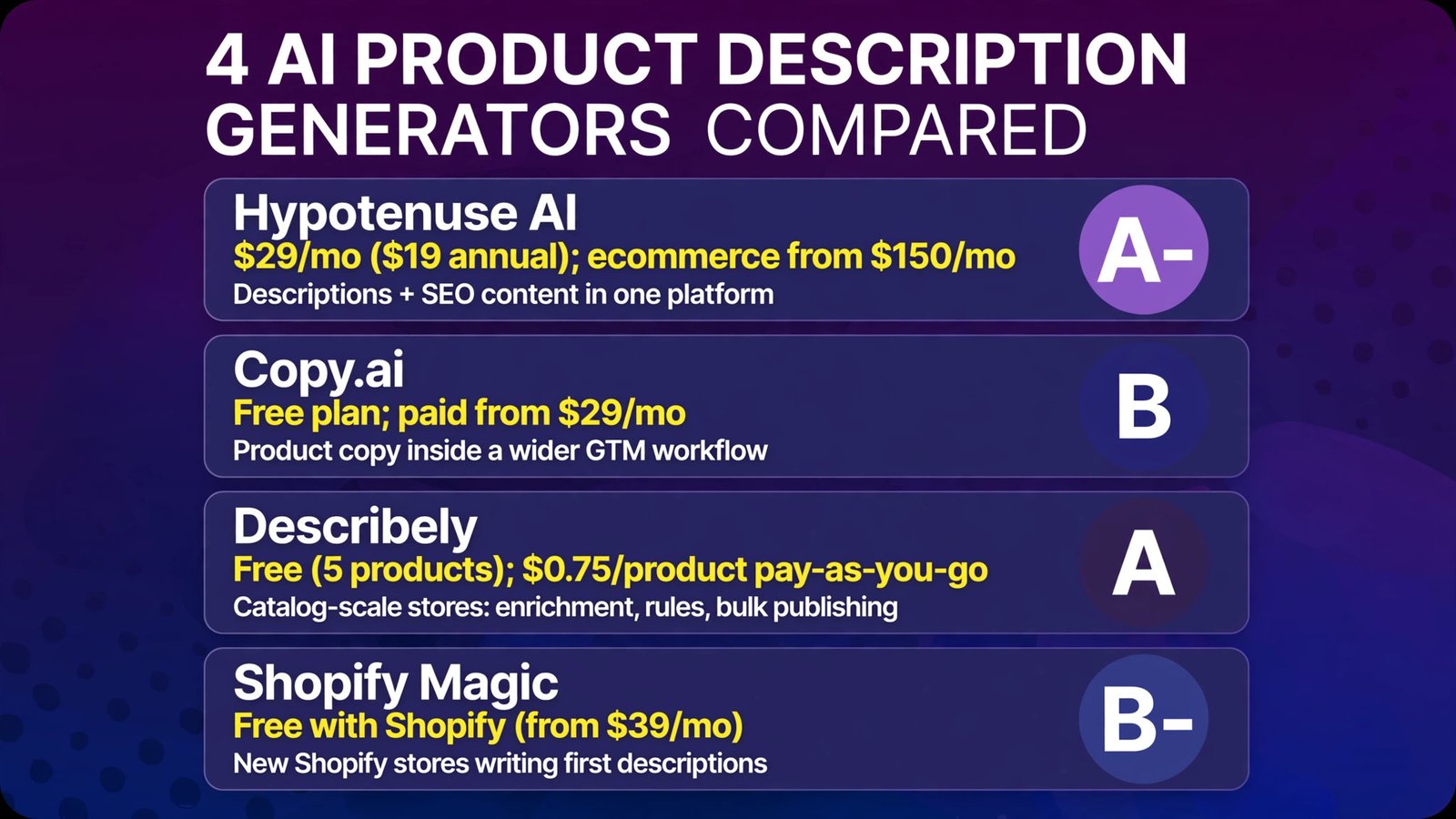
Bottom line: If you run a real catalog, Describely and Hypotenuse AI are the serious tools — Describely won our test on catalog workflow (data enrichment + content rules + $0.75/product pay-as-you-go), Hypotenuse on combined description-plus-blog SEO output. Shopify Magic is the right starting point if you are already on Shopify and your catalog is small — it is free and instant, but it does not scale or hold a brand voice. Copy.ai writes perfectly good descriptions, but it is a general GTM platform; buy it for the workflows around the copy, not for catalog management it does not have.
How We Graded
SEO quality: Did the target keyword appear naturally in the first lines and headings? Was the copy structured (short paragraphs, benefit bullets) the way product pages that rank actually look? Did it produce (or support) a meta title/description? Any keyword stuffing or invented specs counted against.
Tone control: A slider or a prompt is not tone control at scale. We looked for enforceable systems — brand voice training, saved rules, glossaries — that keep product #487 sounding like product #1, and regenerated each test product at a second tone (“playful”) to see if the tool changed register or just added exclamation marks.
Bulk generation: CSV/store import, generation across hundreds of SKUs in one run, review-and-publish back to the store, and what happens when supplier data is missing half its attributes — the normal state of real catalogs.
1. Hypotenuse AI — Descriptions Plus an SEO Content Engine
What it is: Hypotenuse AI is a content automation platform built for e-commerce and marketing teams: bulk product description generation and product-data enrichment on one side, an SEO blog/content writer on the other, with brand voice training, integrations (Shopify, Salesforce Commerce Cloud, Salsify, WordPress, Webflow), and generation in 30+ languages.

2026 pricing (verified October 2026): Hypotenuse runs two pricing families, which confuses everyone — here is the clean version. Marketing & SEO plans: Entry $29/month ($19/month billed annually) for 50,000 words and 1 seat; Essential $87/month ($56 annual) for 250,000 words plus plagiarism checking and premium images; Blog Pro from ~$230/month. E-commerce catalog plans: Basic from $150/month billed annually, with Pro and Enterprise tiers at custom pricing scaled to catalog size and volume. There is a free trial but no permanent free plan. If product descriptions are your main job, budget against the e-commerce family; if descriptions are occasional and blogs are the priority, Entry/Essential is the relevant ladder.
Our test: Hypotenuse produced the best combined output set. The candle copy was genuinely sensory — “cedarwood first, amber underneath” — without inventing burn-time claims, and it placed “soy wax candle” naturally in the opening line and a subheading. The SaaS description was its weakest of the three (competent benefit copy, slightly generic — this is an e-commerce-first tool and it shows off-catalog). The trainers copy was the SEO standout alongside Describely: specs preserved exactly (240g, recycled knit), keyword woven into a benefit bullet rather than stuffed. Tone test: switching to “playful” produced a real register change, and its brand voice training (feed it existing copy) is a proper system, not a prompt box. Bulk: spreadsheet/store import with generation across a catalog in one run is core to the product, and enrichment fills missing attributes before generation — the feature that separates catalog tools from chatbots.
Pros:
- Strong SEO output across all three test products, specs kept accurate
- Bulk generation + product data enrichment in one workflow
- Real brand voice training and 30+ language generation
- Descriptions and SEO blog content under one subscription
- Direct integrations with major e-commerce platforms and CMSs
Cons:
- Two pricing families are genuinely confusing; catalog plans start at $150/mo
- No permanent free plan (trial only)
- Off-catalog copy (our SaaS test) is noticeably more generic
- Word-metered marketing plans require volume forecasting
Best for: DTC brands and retailers with growing catalogs who also publish SEO content — and want one platform accountable for both.
Hypotenuse is the pick when product content is a program, not a task. The $150/month catalog entry is real money for a small store, which is exactly why Describely’s per-product model (below) beats it below a few hundred SKUs — and why Hypotenuse wins once content volume is continuous.
2. Copy.ai — Good Descriptions Inside a Bigger GTM Machine
What it is: Copy.ai has evolved from a copywriting template tool into a go-to-market AI platform: workflow automation (“Workflows” and Tables) that chains research, drafting, and personalization across marketing and sales content — one use case of which is product descriptions, driven from your product data and brand “Infobase.”

2026 pricing (verified October 2026): A free plan with limited credits exists for light use, with paid plans from $29/month (annual-billing entry for chat/starter tiers) scaling by seats, credits, and workflow capacity into team and enterprise tiers. The practical framing: you are not buying a description generator, you are buying workflow seats — price it against everything else the seat will do (emails, ads, sales content), not against description tools alone.
Our test: Copy.ai’s candle description was warm and clean — second-best candle copy after Hypotenuse — and its workflow model showed a real advantage: we built a small table workflow (product facts in → description + Instagram caption + email line out) that no pure catalog tool here replicates, because for Copy.ai the description is one step in a chain. The trainers copy was solid but the least SEO-structured of the four (no natural subheading keyword placement without prompting for it), and the SaaS description was, predictably, its best product — GTM content is its home turf. Tone control via Infobase (store brand facts/voice once, reuse everywhere) works well for consistency across marketing outputs. Where it fell behind the catalog tools: no store-native import-generate-publish loop, no product data enrichment, and bulk means running workflows over tables rather than a catalog manager with rules and audits — workable at 50 SKUs, painful at 5,000.
Pros:
- Strong general copy quality; best SaaS/B2B output in our test
- Workflows chain descriptions into captions, emails, and ads automatically
- Infobase keeps brand facts and voice consistent across outputs
- Free plan available to test with real products
- One platform for the wider GTM content stack
Cons:
- No catalog management, store publishing loop, or data enrichment
- SEO structure for product pages needs manual prompting
- Pricing is seat/workflow-based — poor fit if descriptions are all you need
- Bulk product work is a workflow you assemble, not a built-in system
Best for: Marketing teams who need product descriptions plus the campaigns around them, generated from the same brand base in one platform.
Copy.ai is a good answer to a bigger question. If your actual question is only “generate 800 on-brand product descriptions and push them to my store,” the catalog specialists below do that job with less assembly and clearer per-unit economics.
3. Describely — The Catalog-Scale Specialist With Per-Product Pricing
What it is: Describely is purpose-built for e-commerce catalog operations: connect your store (Shopify, WooCommerce, Wix, Squarespace, Akeneo, or CSV/XLSX), enrich incomplete product data from trusted sources, apply Content Rules (tone, structure, vocabulary, required phrases), generate in bulk, review, and publish back — the full loop in one platform.

2026 pricing (verified October 2026): The model is the headline: a free plan covering 5 products, then pay-as-you-go at $0.75 per product (unlimited generations for that product for 30 days), with data enrichment at $0.55/credit and image processing at $0.05/credit. Subscriptions exist for steady volume — e.g., 50 products at $28/month and 250 products at $138/month via its Shopify app listing — but there are no seat fees and no obligation to subscribe. Do the arithmetic against subscriptions: a one-off 300-product catalog refresh costs about $225 pay-as-you-go, once — versus paying a catalog subscription every month whether you generate or not. For catalogs over ~500 products, custom pricing applies.
Our test: Describely earned the top grade on workflow and tied Hypotenuse on output quality. Its candle copy obeyed our Content Rules exactly (structure: hook line, sensory paragraph, spec bullets; banned word “amazing” never appeared) — rules we set once and watched apply identically to all three products, which is what tone control at scale actually means. The trainers test showed off enrichment: we deliberately gave it a sparse product record (missing material and weight), and Describely filled the gaps before generating, then wrote copy using the enriched facts — every rival either omitted the specs or would have forced us to supply them. The SaaS description was its weakest (physical-goods assumptions peek through), but for a catalog tool that is the expected trade. SEO output included meta-ready titles/descriptions alongside the body copy, and publishing back to a connected store is one click after review.
Pros:
- Pay-as-you-go $0.75/product — the clearest, fairest pricing in this category
- Data enrichment fixes sparse supplier data before generation
- Content Rules enforce tone/structure across an entire catalog
- Native Shopify/WooCommerce/Wix/Squarespace/Akeneo + CSV workflows
- Free plan (5 products) lets you test your hardest SKUs first
Cons:
- Built for volume — overkill for a handful of occasional descriptions
- Weakest on non-physical products (our SaaS test)
- Enrichment and images are separate credit costs to track
- Interface assumes a catalog operator’s mindset, not a casual writer’s
Best for: Stores and distributors with 100+ SKUs, seasonal catalog refreshes, or messy supplier data — anyone whose problem is the catalog, not the blank page.
Describely is what this category looks like when it grows up: pricing per finished product, rules instead of prompts, enrichment instead of hallucinating around missing data. For e-commerce operators it was our overall winner.
4. Shopify Magic — Free, Instant, and Honestly Limited
What it is: Shopify Magic is Shopify’s built-in AI, living directly in the admin: product descriptions from your title, category, and keywords, plus email and blog drafting, image background editing, and the Sidekick assistant. There is nothing to install and nothing extra to pay.
2026 pricing (verified October 2026): Free and included with every Shopify plan (Basic from $39/month, Shopify $105/month, Advanced $399/month, Plus custom). Text generation has no published usage limits — generate as much as you need. The honest framing: Magic is free the way a phone’s camera is free — excellent that it is included, not a reason to choose the platform by itself, and not available at all if your store is not on Shopify.
Our test: Magic’s candle description was… fine. Clean, grammatical, SEO-aware — and generic: it could have described any candle, and the “confident, warm” instruction produced the same register as its default. The trainers copy was similarly competent and similarly anonymous, though factually safe (Magic sticks close to what you give it — a virtue for accuracy). Its SaaS output is a category error (Magic is for physical-store merchants) and we graded it leniently for it. The structural limits matter more than any single output: tone options are minimal presets, there is no brand voice learning, no bulk generation workflow, no enrichment, and no rules system — every product is a fresh one-off generation in the editor. For a 20-product store launching this week, none of that matters and Magic’s zero-friction is a gift. At 200 products it becomes the bottleneck it was never designed not to be.
Pros:
- Completely free and already inside your Shopify admin — zero setup
- Unlimited text generation with no published caps
- Factually conservative output; low hallucination risk
- Also covers email/blog drafts and product image background edits
Cons:
- Shopify only — useless to WooCommerce/Wix/custom stores
- Minimal tone control; no brand voice memory between products
- No bulk generation, enrichment, or content rules — does not scale
- Output is generic; plan on editing for any distinctive brand
Best for: New and small Shopify stores writing their first dozens of descriptions, and one-off edits inside the admin.
Magic is the correct first tool and, for most growing stores, a transitional one. The signal to graduate is consistent: catalog past ~50 SKUs, descriptions drifting in tone across product lines, or supplier data too incomplete to write from. Any one of those — move the catalog to Describely or Hypotenuse and keep Magic for quick in-admin tweaks.
Full Comparison Table
| Hypotenuse AI | Copy.ai | Describely | Shopify Magic | |
|---|---|---|---|---|
| Entry price | $29/mo (SEO) / $150/mo (catalog) | Free; paid from $29/mo | Free (5 products); $0.75/product PAYG | Free with Shopify ($39+/mo) |
| Pricing model | Words + seats / catalog tiers | Seats + workflow credits | Per product (+ $0.55 enrichment) | Included, unlimited |
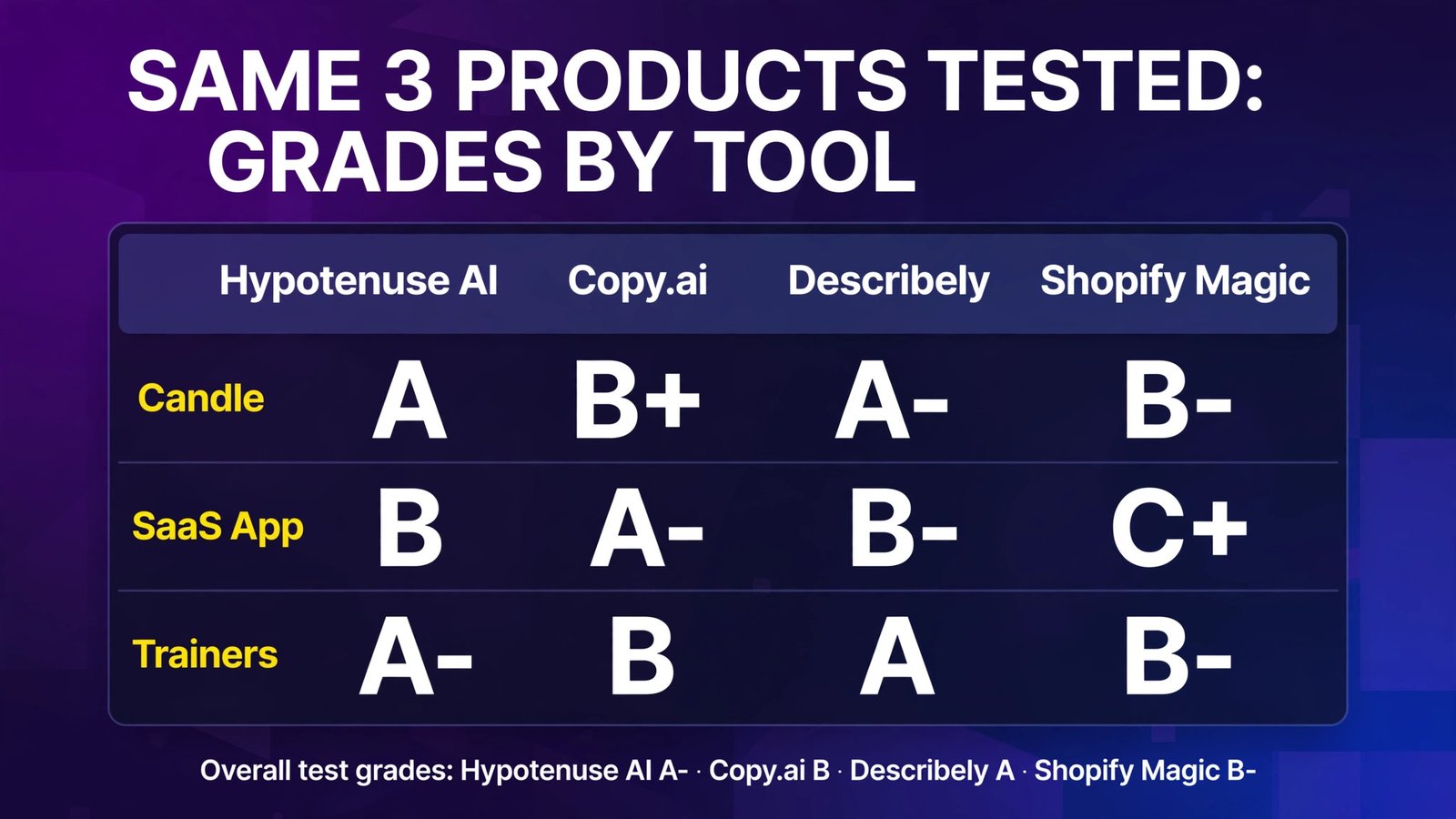
| Candle grade | A | B+ | A- | B- |
| SaaS grade | B | A- | B- | C+ |
| Trainers grade | A- | B | A | B- |
| Tone system | Brand voice training | Infobase brand base | Content Rules (enforced) | Preset tones only |
| Bulk generation | Yes | Via workflows/tables | Yes (native) | No |
| Data enrichment | Yes | No | Yes (standout) | No |
| Store publishing | Integrations | Manual/API | One-click to store | Native (it is the store) |
| Free option | Trial only | Free plan | Free plan (5 products) | Free (Shopify required) |
How to Choose
- Start where you already are. On Shopify with under ~50 products? Use Magic today and spend nothing. The best generator is the one your catalog is already connected to — until its limits (tone drift, one-by-one generation) start costing more time than a dedicated tool costs money.
- Price your catalog, not the plan page. Count SKUs × refresh frequency. One-off or seasonal volume favors Describely’s $0.75/product pay-as-you-go; continuous high volume favors a Hypotenuse catalog plan; descriptions-as-part-of-campaigns favors Copy.ai seats. The cheapest headline is rarely the cheapest catalog.
- Audit your data before your copy. If supplier feeds arrive missing materials, weights, and use cases, you need enrichment (Describely, Hypotenuse) — otherwise every tool either omits your best selling points or invents them, and neither ranks or converts.
- Demand a tone system, not a tone slider. Regenerate one product at two tones during your trial. Then ask: can this setting be enforced on product #500 without me in the room? Rules (Describely) and trained voice (Hypotenuse) pass; presets and prompt boxes do not.
- Test with our three-product method. One emotional product, one spec-heavy product, one abstract product — same facts, same keyword, same tone brief in every finalist. Grade SEO structure, factual accuracy, and tone obedience. The tool that wins your three products wins your catalog.
Frequently Asked Questions
What is the best AI product description generator for Shopify?
For most growing Shopify stores, Describely — it connects natively, enriches sparse product data, enforces brand rules in bulk, publishes back in one click, and its $0.75/product pay-as-you-go pricing suits real catalog rhythms. Shopify Magic is the best starting point (free, built-in) for small catalogs, and Hypotenuse AI is the upgrade when you also need SEO blog content from the same platform.
How much do AI product description generators cost in 2026?
Three models dominate: per-product (Describely: free for 5 products, then $0.75/product pay-as-you-go; subscriptions from $28/month for 50 products), subscription by words/seats (Hypotenuse: from $29/month for content plans, catalog plans from $150/month billed annually; Copy.ai: free plan, paid from $29/month), and included (Shopify Magic: free with any Shopify plan from $39/month). For a 300-product one-off refresh, pay-as-you-go (~$225 once) usually beats a year of catalog subscription.
Can AI product descriptions actually rank on Google?
Yes — when they are structured like good product pages: target keyword used naturally up top, benefit-led bullets, complete and accurate specs, and unique copy per product. In our test, Hypotenuse and Describely produced that structure natively. What does not rank is duplicated, generic output published unedited across hundreds of SKUs — the tool matters less than whether a human (or a rules system) keeps each description specific, factual, and distinct.
Which tool is best for bulk product descriptions?
Describely for pure catalog bulk: store import, enrichment, rules-based generation, review, and one-click publishing, priced per product. Hypotenuse AI is a close second with strong bulk generation plus its SEO content engine. Copy.ai can run descriptions in bulk through workflows, but you assemble and maintain that system yourself; Shopify Magic has no bulk workflow at all.
Do these tools work for WooCommerce or only Shopify?
Describely connects to Shopify, WooCommerce, Wix, Squarespace, and Akeneo (plus CSV import for anything else). Hypotenuse integrates with Shopify and major commerce/CMS platforms including WordPress and Webflow. Copy.ai is platform-agnostic (you move copy via workflows, exports, or API). Shopify Magic is Shopify-only, by definition.
Will AI descriptions hurt my SEO with duplicate or low-quality content?
Only if you publish them lazily. Search engines penalize thin, duplicated content — not AI assistance itself. The safeguards are the ones our test graded: unique inputs per product (real specs and use cases), enforced structure and tone rules, keyword use without stuffing, and a human review pass on claims. Tools with enrichment and rules (Describely, Hypotenuse) make that discipline the default instead of a hope.
Conclusion
The best AI product description generators in 2026 divide cleanly by job: Describely for catalog-scale generation with enrichment, rules, and honest per-product pricing (our overall winner for e-commerce operators); Hypotenuse AI for brands pairing descriptions with a serious SEO content program; Copy.ai when descriptions are one step in a wider go-to-market workflow; and Shopify Magic as the free, instant starting point every Shopify merchant should use before paying for anything.
Our three-product test kept delivering the same lesson: single-description quality is closer across tools than marketing suggests — what separates them is everything around the paragraph. Data enrichment, enforceable tone rules, bulk publishing, and a pricing model that matches how catalogs actually change. Choose on those, and the paragraphs take care of themselves.
Next step: take your three hardest products — one emotional, one spec-heavy, one awkward — and run them through Describely’s free 5-product plan and Shopify Magic (or Hypotenuse’s trial) with the same brief. Grade them with our SEO/tone/bulk rubric; the winner for your catalog will be obvious within the hour, and it costs you nothing to find out.