
About 62 percent of renters in small urban apartments work from a table, a kitchen counter or a bed at least part of the week, according to repeated housing and remote work surveys, and most of them name the same obstacle. The desk they want does not fit, or the one that fits wobbles, eats the room or leaves nowhere to put a notebook, a printer or a bag. Finding the best standing desk for small apartments is therefore not a search for the tallest, strongest or cheapest desk on the market. It is a search for the narrowest desk that still holds your real setup, stays steady at standing height and leaves the room usable for everything else.
This guide answers that search with measurements first and marketing second. You will get a size comparison table for desks that genuinely work in studios and small bedrooms, a space checklist to run before you order, a plain explanation of why some compact desks wobble and others do not, and a verdict for each common small apartment situation. Prices are ranges checked in October 2026, so check checkout before you pay.
The Short Verdict for Small Rooms
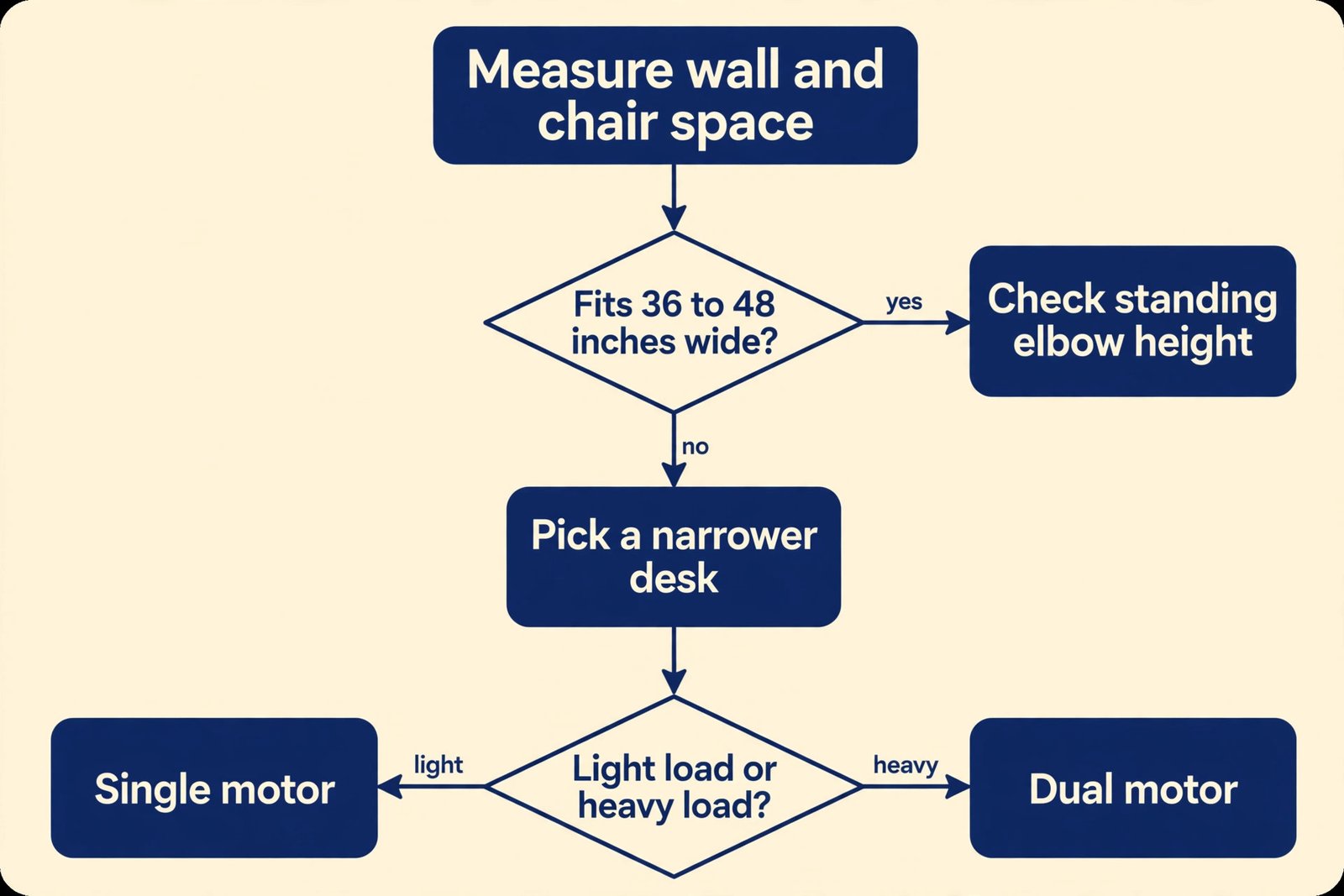
For most small apartments, a 36 to 48 inch wide desk with a 24 inch depth is the sweet spot. That width holds a laptop plus one external monitor, or two small monitors on arms, without pushing your chair into the bed or the door swing. A 24 inch depth keeps the desk close to the wall, while still giving your keyboard room and your monitor enough distance from your eyes.
Within that size band, the right pick depends on what you put on the desk. A laptop only worker does well with a light single motor desk and a built in drawer. A dual monitor worker needs a dual motor frame, a higher lift capacity and a monitor arm, because stands eat surface fast on a narrow top. A tall worker needs a high maximum height and a three stage frame more than a heavy frame. Do not buy a 60 inch desk for a 10 foot wide bedroom, and do not buy a 32 inch desk for a dual monitor desktop PC setup.
How to Pick the Best Standing Desk for Small Apartments
Start with the room, not the desk. Measure the wall where the desk will sit, then measure the depth from that wall to the nearest obstacle. That obstacle might be a bed, a wardrobe door, a radiator or the swing of the room door. The desk depth plus the chair space behind it is your real footprint, not the desktop size printed on the box.
A typical office chair needs about 24 to 30 inches behind the desk edge to roll back and stand up without hitting furniture. Add that to a 24 inch deep desk and you need roughly 48 to 54 inches of clear depth from the wall. Add it to a 30 inch deep desk and you need roughly 54 to 60 inches. In a bedroom that is only 10 feet deep, that extra 6 inches of desk depth can be the difference between a room that works and a room where you climb over the bed to sit down.
Next, measure the width with the same honesty. Leave at least 2 inches of clearance on each side for cables, a power strip and your hands when you move the desk for cleaning. A wall that measures 48 inches does not comfortably hold a 48 inch desk. It holds a 42 or 44 inch desk with breathing room. Then measure your seated and standing elbow heights. Sit in your chair, relax your shoulders and measure from the floor to the underside of your elbow for your seated height, then stand and measure again for your standing height. A desk that cannot reach both numbers will fail every day.
Shorter users often fail on the low end, because many budget desks stop at 28 inches. Taller users often fail on the high end, because a desk that tops out at 45 inches forces a tall person to hunch.
Finally, list everything that must live on the desk at the same time, including the monitor, the laptop, the keyboard, the notebook and the lamp. If the list does not fit on paper within the desktop dimensions, it will not fit in the room either. A monitor arm, a wall shelf and a drawer are not accessories in a small apartment. They are how a narrow desk stays usable.
Size Comparison Table for Small Apartment Desks
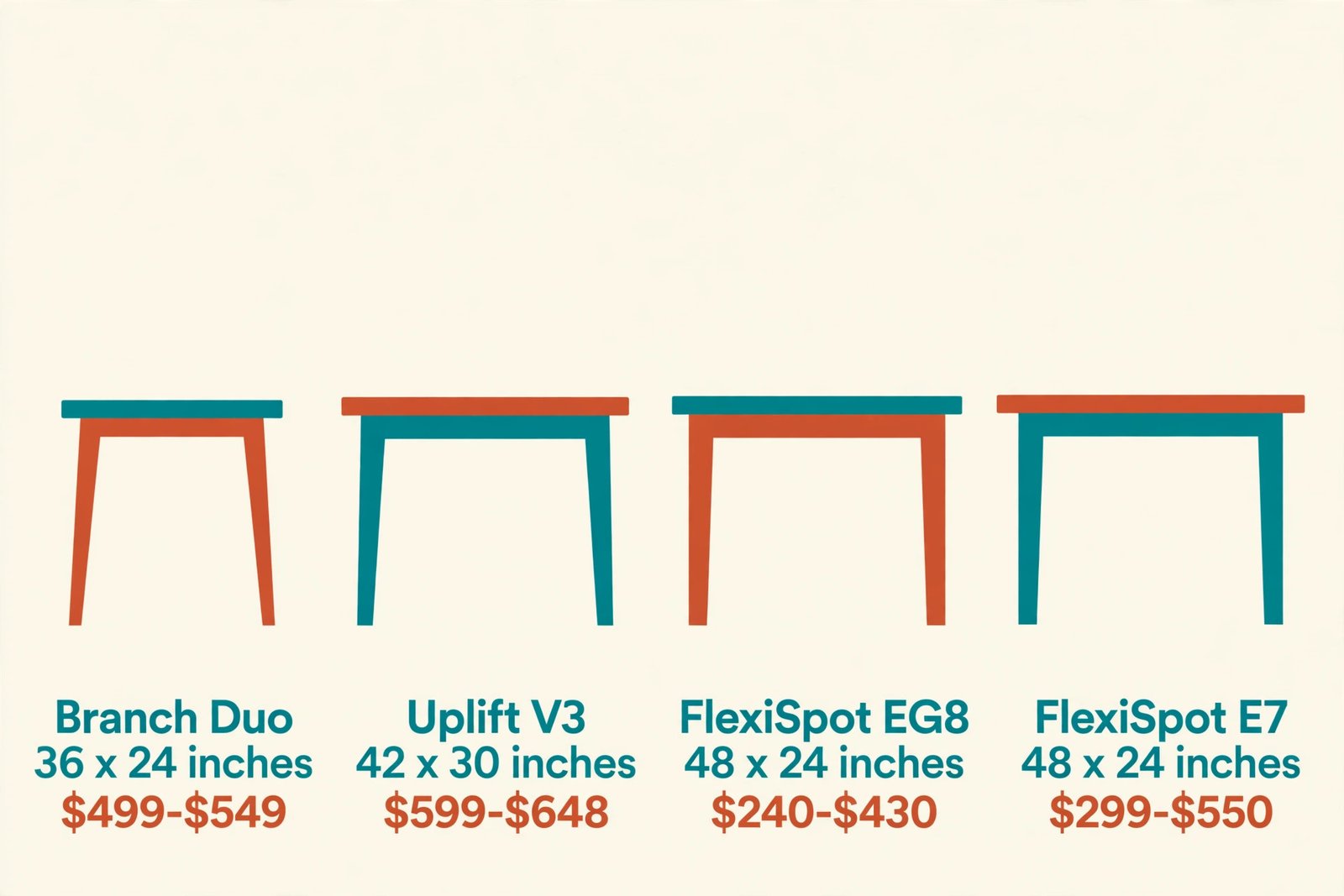
The table below compares desks that appear again and again in small space shortlists, using the compact desktop size for each model rather than the largest size on offer. Prices are typical ranges seen in October 2026 listings, including common sale prices, and they change with desktop material and retailer. Check the vendor page at checkout for the exact configuration you want.
| Desk and compact size | Desktop | Height range | Lift capacity | Motors | Typical price range | Warranty |
|---|---|---|---|---|---|---|
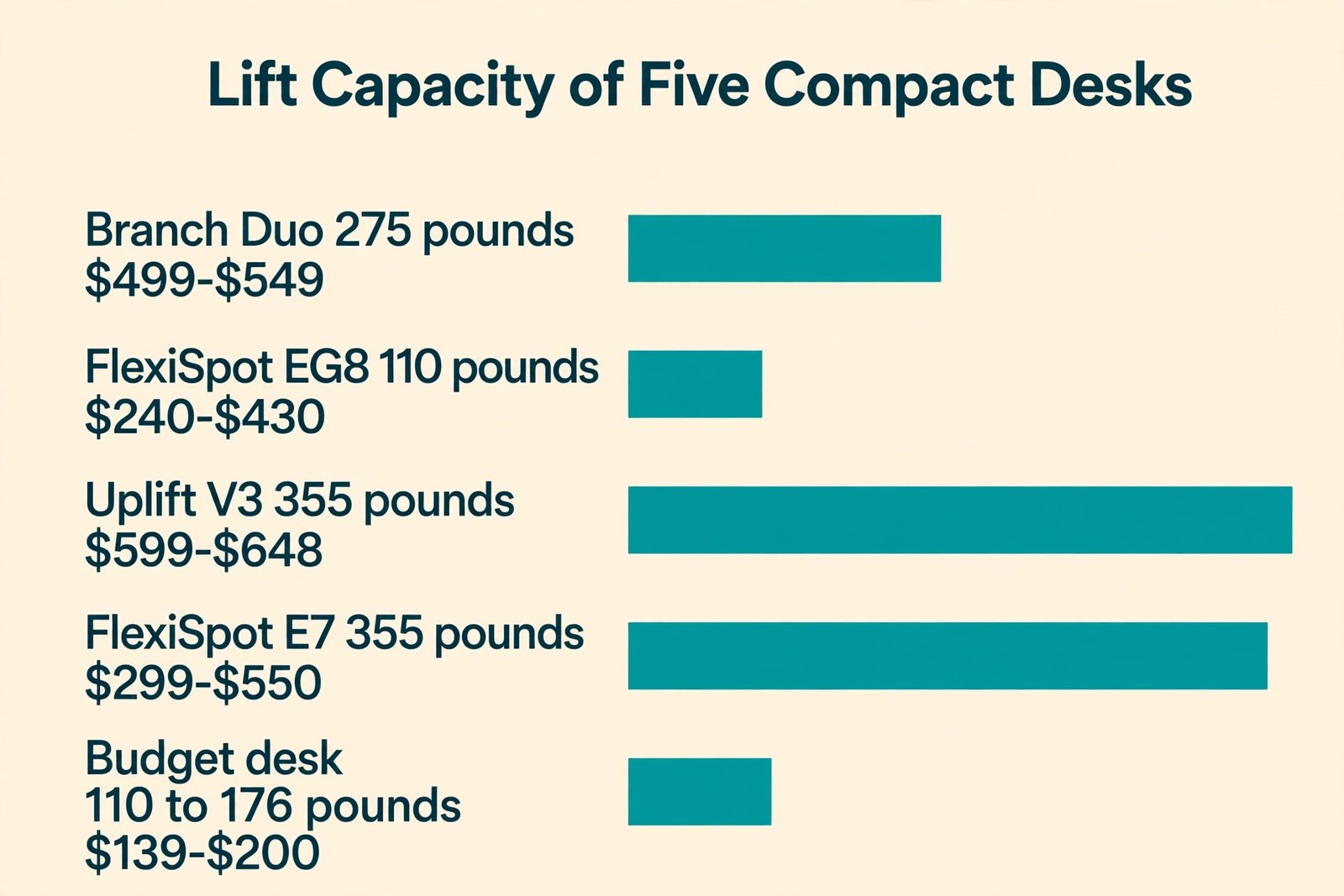
| Branch Duo, 36 inch | 36 by 24 inches | 28 to 47.3 inches | 275 pounds | Dual | 499 to 549 dollars | 10 years |
| FlexiSpot Comhar EG8, 48 inch | 48 by 24 inches | 28.3 to 47.6 inches | 110 pounds | Single | 240 to 430 dollars | 5 years on frame and motor in common listings |
| Uplift V3, 42 inch | 42 by 30 inches | 22.6 to 50.1 inches | 355 pounds | Dual | 599 to 648 dollars | 15 years |
| FlexiSpot E7 frame with 48 inch top | 48 by 24 inches | About 22.8 to 48.8 inches without top, about an inch higher with top fitted | 355 pounds | Dual | 299 to 550 dollars for frame plus top depending on material | 15 years on frame in common listings |
| Budget single motor desk, 40 inch | 40 by 24 inches | 28 to 45 inches in most listings | 110 to 176 pounds | Single | 139 to 200 dollars | Varies by seller, often 1 to 3 years |
Read the table as a set of trade offs, not a ranking. The Branch Duo wins on the smallest honest footprint, because 36 inches wide is genuinely narrow and the frameless design leaves legroom. The FlexiSpot Comhar EG8 wins on storage and fast setup, but its 110 pound limit rules out a heavy desktop PC. The Uplift V3 wins on height range and capacity, but its 30 inch depth suits a nook or a living room wall better than a tight bedroom corner.
The FlexiSpot E7 frame route wins on flexibility, because you can reuse the frame with a different top after a move, and weighing those trade offs is the practical way to pick the best standing desk for small apartments.
A 42 inch desk needs about 7 square feet of floor for the desktop alone, while a 60 inch desk needs close to 10 square feet before you add a chair. That 3 square foot gap is a walkway in a studio or the difference between opening a wardrobe door fully and opening it halfway. Buy the smallest desk that passes the elbow height test and the gear list test, not the largest desk you can squeeze against the wall.
The Space Checklist Before You Order
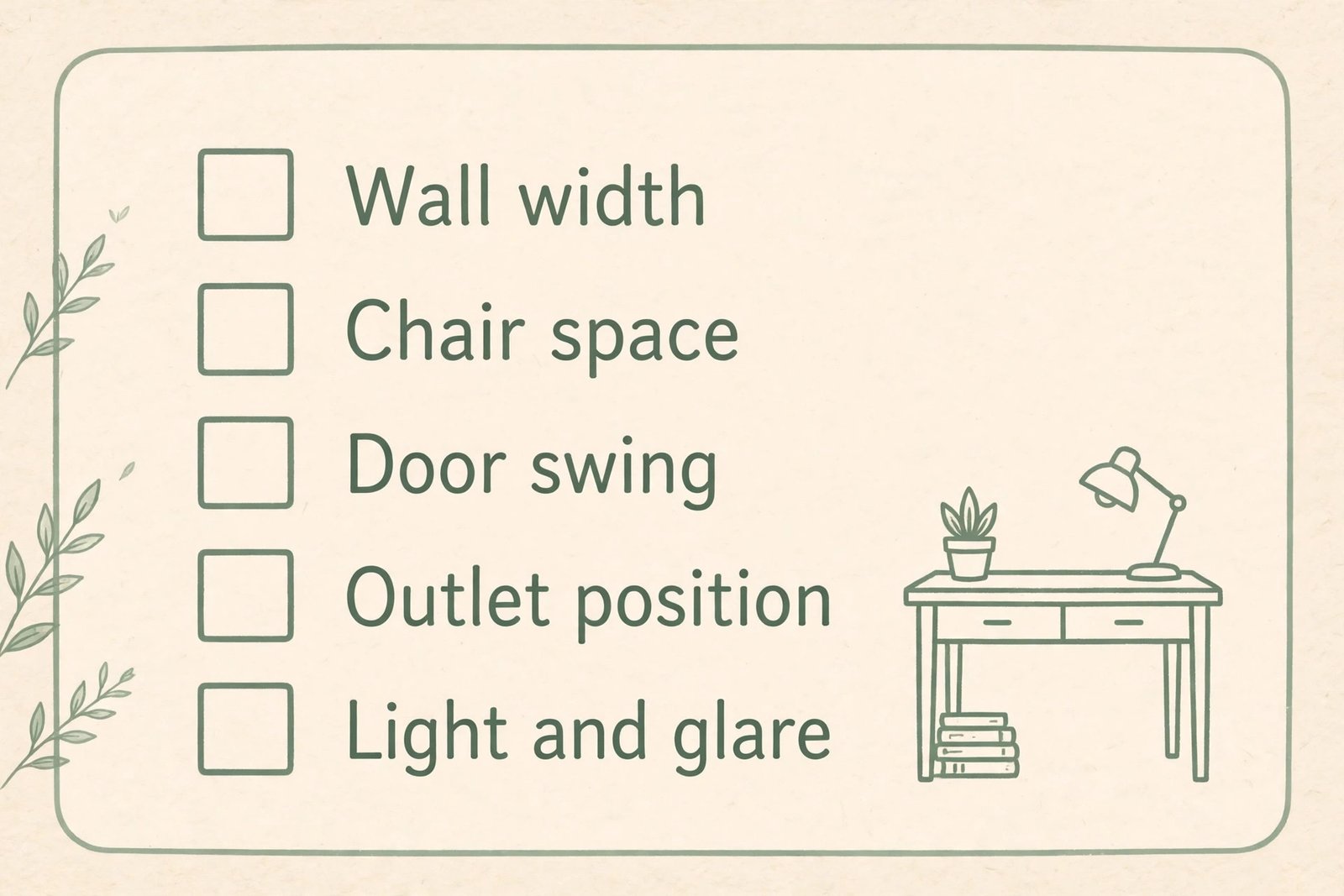
Run this checklist with a tape measure in your hand, not from memory. It takes ten minutes and it prevents the most common small apartment desk mistake, which is ordering a desk that fits the wall but not the life around the wall.
First, confirm the wall width and the clear depth. Measure the wall, subtract 4 inches for side clearance, and write down the maximum desktop width that leaves that clearance. Measure from the wall to the nearest obstacle, subtract the chair space you need, and write down the maximum desktop depth that leaves that clearance. If those two numbers point to different desks, trust the smaller result.
Second, check the door, the window, the radiator and the power outlet. Open every door near the desk fully and watch where it swings. Open the window and check the handle, the blind cord and the curtain fall. Check the heater clearance, because a desk pressed against a heater can warp a top over time. Check the outlet position, because a desk that hides the only outlet behind a leg will force an extension lead across the floor, and that lead becomes a trip hazard in a small room.
Third, check the floor, the delivery route, the chair and the standing space. Measure the lift door, the stair turn and the apartment door against the longest box dimension on the product page. Sit in your chair at the planned desk position and roll back, then stand and check that your head clears any shelf, sloped ceiling or hanging light.
Fourth, check the light, the screen glare and the storage you will lose. A desk facing a bright window can make a monitor unreadable at midday, while a desk with its back to the window can put your face in shadow on video calls. A desk also replaces whatever stood in that spot before, so plan where those things go before it arrives, using a wall shelf, an under desk drawer or a hook on the door. If any checklist item fails, change the layout or the desk size before you order.
Why Stability Matters More in a Small Room
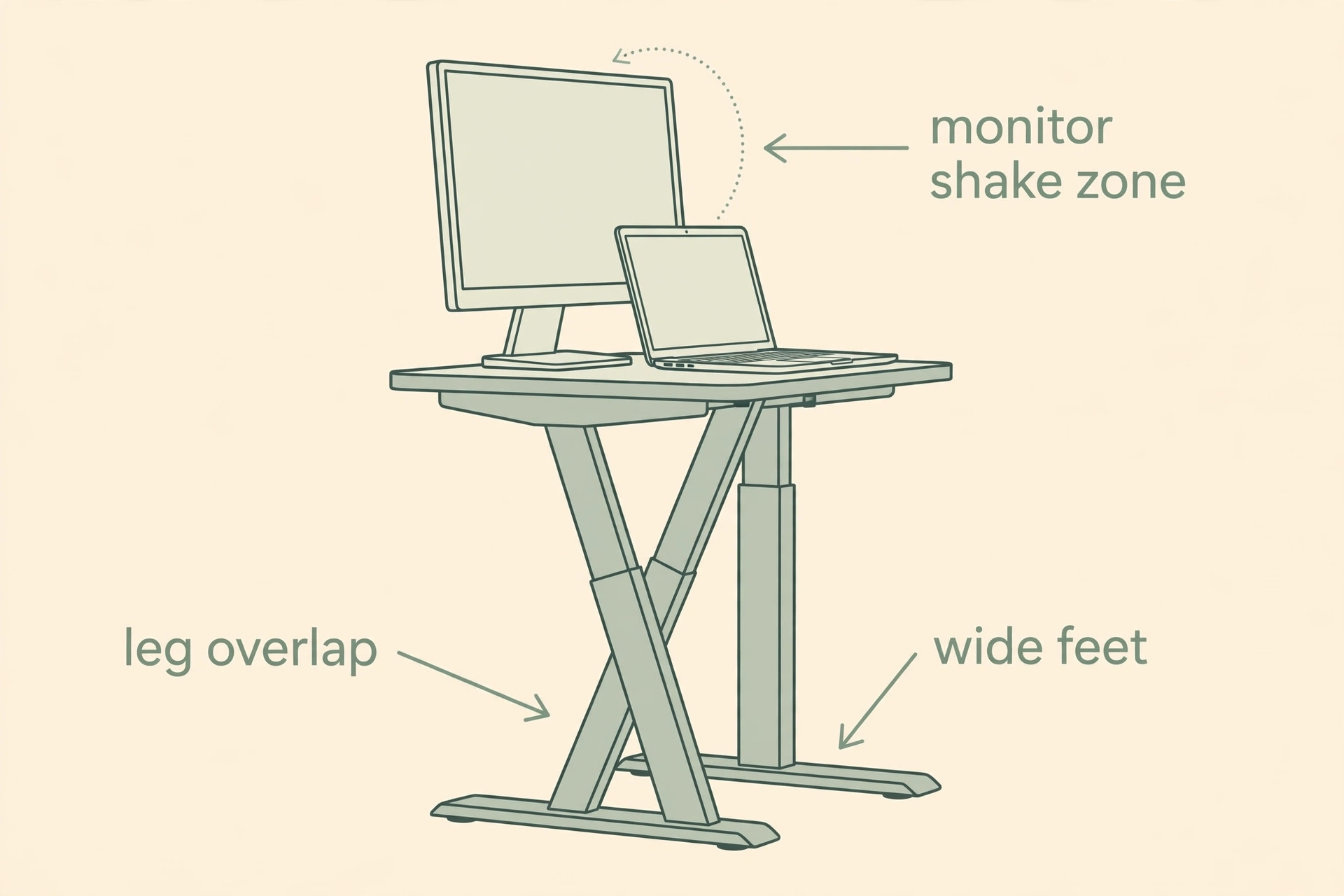
Stability is not a luxury feature on a compact desk. It is the feature that decides whether you actually stand up to work. A desk that wobbles at standing height makes typing feel uncertain, makes a monitor shake and makes you sit back down. In a small room, that wobble feels worse, because the desk is closer to the bed, the wall and your line of sight, and every shake is visible. Judging the best standing desk for small apartments on stability, not just size, is therefore essential.
Three design choices decide stability. The first is the number of lifting stages. A three stage frame has more overlap between leg sections at a given height than a two stage frame, so it tends to stay steadier when extended, especially for taller users. The second choice is the number of motors. A dual motor frame lifts each leg independently and tends to stay level under an uneven load, such as a heavy monitor on one side and a laptop on the other. A single motor frame can still be steady for a light load, but it has less margin when you add a monitor arm, a speaker and a stack of books to one side.
The third choice is the frame width and the foot design. A frame that can adjust to nearly the full width of the desktop spreads the load better than a narrow frame under a wide top, and levelling glides help on uneven apartment floors, which are common in older buildings.
Test stability the way you will use the desk. Put your real monitor, laptop and notebook on it, raise it to your standing height, type a paragraph and nudge the desk lightly from the side. If the monitor shakes for more than a second or two, the desk is too light for your load or too extended for your height. Weight capacity is a related but different number. Lift capacity tells you how much the motor can raise, not how steady the desk will feel at that load. Aim for a rated capacity at least double your real load if you want a calm typing feel at standing height.
A desk that reaches your standing height near its maximum extension will wobble more than one that reaches it mid range.
Storage Verdict for Small Apartments
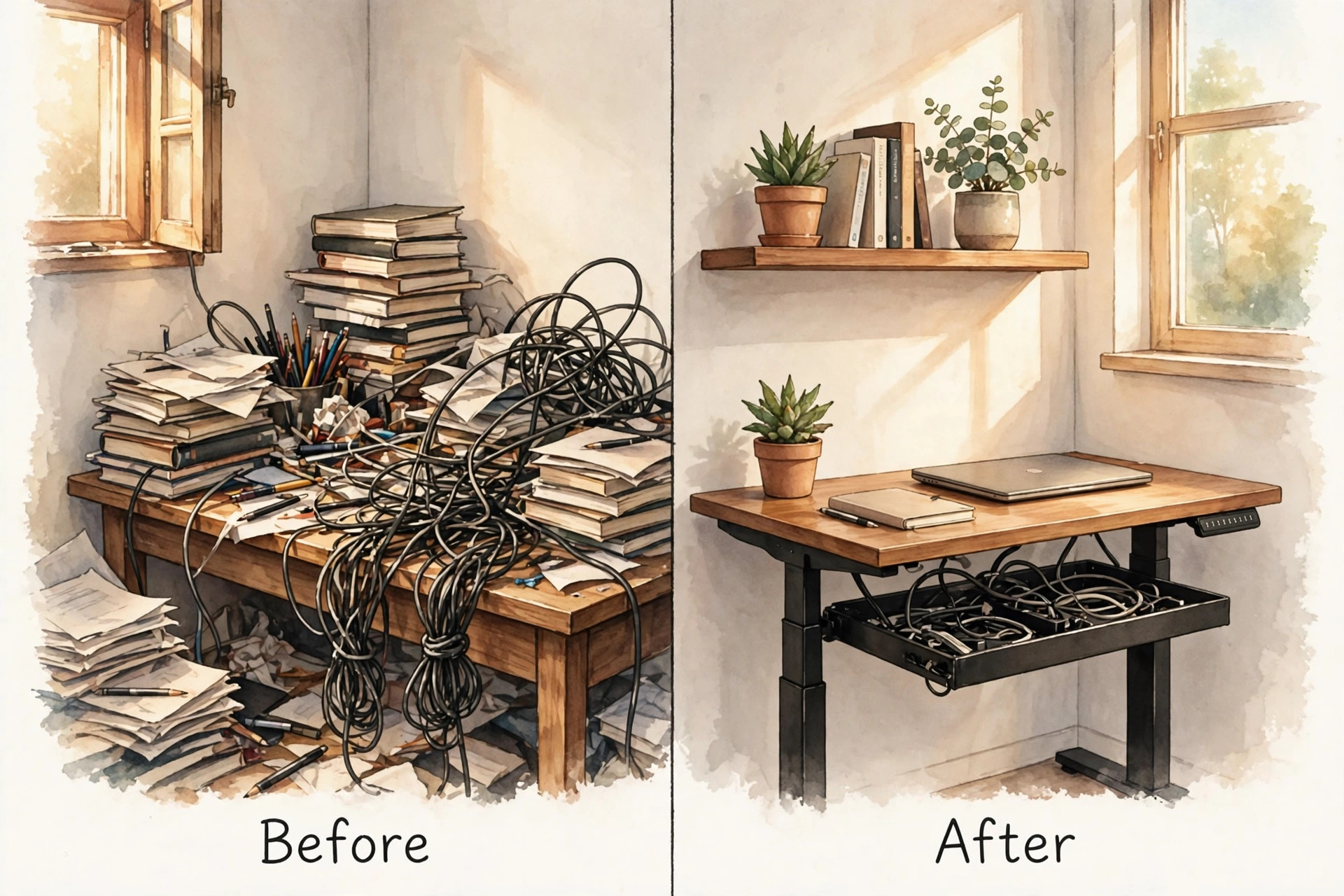
Storage is where small apartment desks succeed or fail, because a small room has no spare surface to absorb overflow. The best storage for a compact desk is storage that does not take floor space. That means a drawer built into the desktop, a cable tray under the desk, a monitor arm that frees the surface, a wall shelf above the desk and a hook or tray on the side of the desk for a bag or headphones. This is a core test for the best standing desk for small apartments, because a tidy surface matters more when the surface is narrow.
The FlexiSpot Comhar EG8 is the clearest storage example in this size band. Its pull out drawer holds notebooks, pens, chargers and small accessories, and its built in USB charging ports mean a phone and a tablet can charge without a power strip on the surface. The trade off is capacity and cable management. The EG8 has no full cable tray in common listings, so a desktop PC with several cables will look messy unless you add an aftermarket tray.
The Branch Duo takes a different storage route. It has no built in drawer as standard, but it offers a drawer, a cable organiser, a tray and a hook as add ons, and its frameless design leaves room under the desktop for those add ons without crowding your knees. That modular route costs more once you add two or three accessories, with a drawer often adding around 99 dollars and a cable organiser around 69 dollars in older retailer listings, so check current accessory prices at checkout. The Uplift V3 takes the widest storage route, with cable trays, monitor arms, desk shelves and power grommets available, but every add on takes back space you saved by choosing a compact top.
Buy the cable tray and the monitor arm first, then add storage one piece at a time.

Desk by Desk Verdict
This section gives a verdict for each desk family in the comparison table, in the situation where it makes sense. It is not a ranked list of every desk on the market. It is a decision aid for the situations small apartment buyers actually face.
Branch Duo for the Smallest Honest Desk
The Branch Duo in its 36 by 24 inch size is the desk to shortlist first if your wall is short, your room is a studio or your desk must share space with a bed and a wardrobe. Branch lists the Duo from 549 dollars in current site listings, with a 28 to 47.3 inch height range, dual motors, two memory presets, sit stand reminders and a 275 pound capacity. The frameless design leaves legroom, and the reusable threaded inserts make assembly and disassembly less damaging than desks that rely on cam locks. The Duo suits a laptop plus one monitor, a single ultrawide on an arm, or dual 24 inch monitors on arms.
It does not suit a heavy desktop tower plus two large monitors, because the surface will fill up even though the frame can lift the weight. (Branch Duo guide)
FlexiSpot Comhar EG8 for Storage and Fast Setup
The FlexiSpot Comhar EG8 suits a renter who wants a desk that arrives nearly complete, sets up in minutes and keeps small things out of sight. Common listings put the 48 inch version in the 240 to 430 dollar range depending on sale timing and top material, with a 28.3 to 47.6 inch height range, four memory presets, USB charging ports and a 110 pound capacity. The glass top version looks clean in a studio. The EG8 suits a laptop worker, a student or a video caller who uses one monitor. It does not suit a heavy multi monitor desktop setup, because the 110 pound limit leaves little headroom once you add a monitor arm and a dock.
Check the top size carefully, because some listings show a 38 inch compact version and others show the 48 inch version. A 38 inch top is a laptop only desk. (FlexiSpot EG8 review)
Uplift V3 for Height Range and Long Term Value
The Uplift V3 in its 42 by 30 inch size is the desk to shortlist if you have a nook, a living room wall or a bedroom wall of at least 8 feet, and you want the most height range and capacity in a still compact desk. Uplift lists the V3 from 599 dollars, with a 22.6 to 50.1 inch height range, dual motors, a 355 pound capacity and a 15 year warranty in vendor listings. The low minimum suits shorter users better than most compact rivals, and the high maximum suits taller users with room to spare. The trade off is depth.
A 30 inch deep desk plus chair space needs about 60 inches from the wall, which is more than half the depth of a 10 foot wide bedroom. Buy the V3 if you plan to keep the desk for many years or your household includes people of very different heights. Do not buy it if your room fails the depth test above. (Uplift V3 guide)
Budget Single Motor Desks for Tight Budgets
A budget single motor desk in the 139 to 200 dollar range, such as a 40 inch SHW or FEZIBO style desk in common retailer listings, suits a short term need, a student budget or a first standing desk test. These desks usually offer a 28 to 45 inch height range, four memory presets and a 110 to 176 pound capacity, which is enough for a laptop and one monitor. The limits are stability, warranty and height range, so plan to upgrade the frame within a couple of years if you love standing rather than adding heavier gear to a light frame.
How to Choose in Five Steps
Step one is to lock the size. Use the checklist measurements to write down your maximum width and depth, then shortlist only desks that fit both numbers. Step two is to lock the height range. Use your seated and standing elbow measurements, and if you share the desk, use the shortest and tallest user in the household, not the average. Step three is to lock the load. Weigh your gear honestly, double that number and shortlist desks with at least that rated capacity. If your doubled load is above 200 pounds, you are in dual motor territory.
Step four is to lock the storage plan and add the cost of a drawer, a cable tray, a monitor arm or a wall shelf to the desk price before you compare desks. Step five is to lock the move plan by checking the box size and whether the desk comes apart cleanly. Run those five steps in order and the shortlist usually narrows to one or two desks, which is how you land on the best standing desk for small apartments for your room rather than the most popular desk online.
Mistakes That Ruin a Small Apartment Desk Setup
The first mistake is buying for the wall, not the room. A desk that fits between two walls but leaves no chair space is not a fit. Measure the depth, not just the width, and test the chair movement before you order. The second mistake is buying a desk that is too deep for the monitor distance. A monitor arm solves this by letting you set the distance independently of the desk depth, but glass tops and thin tops need a grommet mount or a freestanding stand instead of a heavy clamp, so check the top material first. The third mistake is ignoring the cable route.
Plan the route from the desk to the outlet before the desk arrives, using a tray, a raceway along the wall or a power strip mounted under the desk. The fourth mistake is putting everything on the desk. If an item has not been used in a week, it moves to a shelf, a drawer or a cupboard. The fifth mistake is skipping anti collision and child lock features if you share the home. The sixth mistake is buying a standing desk and never standing. Set two memory presets, one for sitting and one for standing, and start with 20 to 30 minute standing periods. Alternating is the goal, and a desk that makes alternating easy will be used more.
Avoiding these mistakes matters as much as picking the best standing desk for small apartments in the first place.
Renters, Movers and Small Room Layouts That Work
Renters face a different set of constraints from homeowners. The desk must fit the current room, survive a move and fit the next room, which may be smaller or shaped differently. A frame plus top route helps here, because you can change the top after a move without replacing the frame. A complete desk with a 48 inch top helps too, because 48 inches fits most rental walls, while 60 inches does not, and that flexibility is part of choosing the best standing desk for small apartments as a renter.
For a studio, the best layout is often a desk against the longest uninterrupted wall, with a wall shelf above it and a rolling cart beside it that can slide under the desk when not in use. That layout keeps the sleeping area separate from the work area, even in one room. For a bedroom office, the best layout is often a corner position furthest from the bed, with the chair facing away from the bed. Avoid placing the desk between the bed and the door. For a living room office, place the desk against a wall that is not the television wall. For a hallway nook, check the width at both desk height and standing height.
When you move, photograph the desk before you take it apart and bag the screws by step.
A standing desk converter sits on top of a fixed desk and raises the monitor and keyboard to standing height. Converters suit a renter who cannot replace a fixed desk or a budget buyer who wants to test standing work for under 200 dollars in many listings. The limits are surface area and stability, because a converter takes up the centre of the fixed desk and can wobble when typing at full height. A motorised desk is the right choice if you work from home most days or share the desk with someone of a different height.
If you are planning the whole room around the desk, a few related guides on this site help with the next decisions. For layout and visual planning, best AI floor plan generators can help you test a desk position on paper before you move furniture, and best AI tools for interior designers covers tools that visualise a small room with a desk in place. For the work itself, best AI tools for freelance writers is useful if your desk is mainly a writing desk, and how to use AI to renovate your home covers the wider room changes that often come with a new home office, such as lighting, storage and wall colour.
Frequently Asked Questions
What size standing desk fits a small apartment?
A 36 to 48 inch wide desk with a 24 inch depth fits most small apartments, because it holds a laptop plus one monitor without pushing the chair into the bed or the door. Measure your wall width minus 4 inches and your depth minus chair space, then buy the smallest desk that passes both tests.
Is a 36 inch standing desk too small for two monitors?
A 36 inch desk can hold two 24 inch monitors, but only on monitor arms, not on stands, because stands take up surface width and depth that a narrow top cannot spare. If you use two 27 inch monitors or larger, move up to a 48 inch desk, because 36 inches will feel cramped.
How do I stop a compact standing desk wobbling?
Buy capacity headroom, keep the load balanced, and avoid using the desk at its absolute maximum height every day. A dual motor frame with a capacity at least double your real load will feel steadier than a single motor frame carrying the same load near its limit.
What height range do I need for a standing desk?
Use your elbow measurements, not your total height. Sit in your chair and measure from the floor to the underside of your elbow for your seated height, then stand and measure again for your standing height. Choose a desk that covers both numbers with a couple of inches to spare at the top. If you share the desk, cover the shortest and tallest user, not the average.
Is a single motor desk good enough for a small apartment?
A single motor desk is good enough for a laptop plus one monitor, a light load and a user who stands for part of the day. It is less suitable for a dual monitor desktop PC setup, a heavy monitor arm load or a tall user who works at full extension for hours, because the frame will flex more and the motor will work harder.
Do I need a drawer on a small standing desk?
A drawer is not essential, but it solves the most common small room problem, which is where small things go. Without one, pens, chargers and keys end up on the surface and shrink the usable area fast.
The Small Room Verdict That Saves Your Floor
The best standing desk for small apartments is not the desk with the longest feature list. It is the desk that passes your tape measure test, your elbow height test and your gear list test, and then stays steady and tidy for months after the novelty wears off. For most small rooms, that desk is 36 to 48 inches wide, 24 inches deep, dual motor if you use two monitors, and paired with a monitor arm, a cable tray and a storage plan that keeps the surface clear.
Buy the Branch Duo if your room is truly tight and you want the smallest honest desk with a long warranty. Buy the FlexiSpot Comhar EG8 if you want storage and fast setup for a laptop plus one monitor. Buy the Uplift V3 if you have a nook or a living room wall and you want the widest height range and capacity for years of use. Buy a budget single motor desk only if you are testing standing work or your budget is tight this year, and plan the upgrade path now rather than overloading a light frame later.
Measure first, order second, and live with the desk for a month before you add accessories. A small apartment rewards that patience, because every inch you save on the desk is an inch you keep for living, walking and breathing in the room. The right desk will not make a small apartment feel large. It will make it feel organised, calm and easy to work in, and that is a better result than a large desk in a room you can no longer move around in.