Most people who start a small food delivery operation do not run out of customers first. They run out of margin. The orders look healthy on a phone screen, the kitchen stays busy through the dinner rush, and yet the bank balance at month end is flat or lower than it was at the start. That gap between busy and profitable is the central problem in this business, and it is why the cost of running a food delivery side business deserves a full month of numbers before you buy a single container or sign up for a single platform.
This guide works through those numbers in the order you will meet them. It compares selling through a marketplace with delivering orders yourself, it sets out a worked monthly budget for 300 orders, it breaks down one typical order line by line, and it flags the costs that new operators most often miss. Prices and platform fees vary by city, plan and order mix, so figures here are presented as ranges drawn from published merchant pages and industry cost guides, and you should confirm the exact rate on the merchant page and at checkout before you commit.
Why Most Side Delivery Budgets Fail in Month One
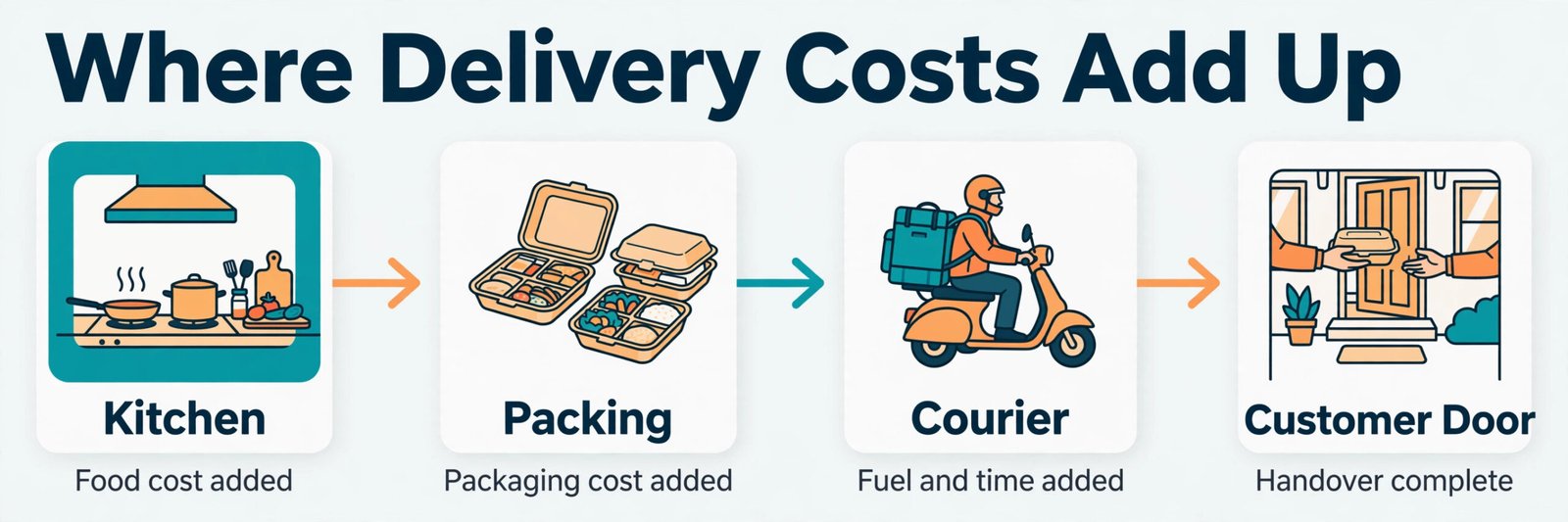
A side business fails in month one for a reason that has little to do with cooking skill. The operator prices from the cost of ingredients only, adds a hopeful markup, and discovers later that commission, packaging, fuel, refunds and time were never in the price. Food cost is visible because you pay for it at the store. Commission is less visible because it is taken before the payout arrives. Fuel is easy to forget because it leaves the tank a little at a time. Refunds arrive as a single unpleasant line in a weekly statement, long after the food has been eaten.
The second failure is volume optimism. A plan that assumes 40 orders a day from week one will almost always disappoint, because a new listing has no reviews, no repeat customers and no ranking on a marketplace. A plan that assumes 10 orders a day, with a clear path to 20 and then 30, gives you a budget you can survive while the listing earns trust. The safest way to test the cost of running a food delivery side business is to model a low month, a middle month and a strong month, and to check that the low month does not put you in debt.
The third failure is treating your own time as free. If you cook for three hours, pack for one hour and drive for two hours, that is six hours of work, even if no wage leaves your account. A side business that only pays when you ignore your own hours is not profitable. It is a hobby that subsidises strangers. Price your time into the model from day one, even if you choose to reinvest the early surplus rather than draw it as pay.
The cost of running a food delivery side business on a marketplace
Selling through DoorDash, Uber Eats or Grubhub is the fastest way to reach customers who are already hungry and already inside an app. It is also the most expensive way to sell a meal, because the platform takes a large share of every order before food cost, packaging or labour is paid. Understanding that share is the first step in judging whether marketplace volume is worth the price.
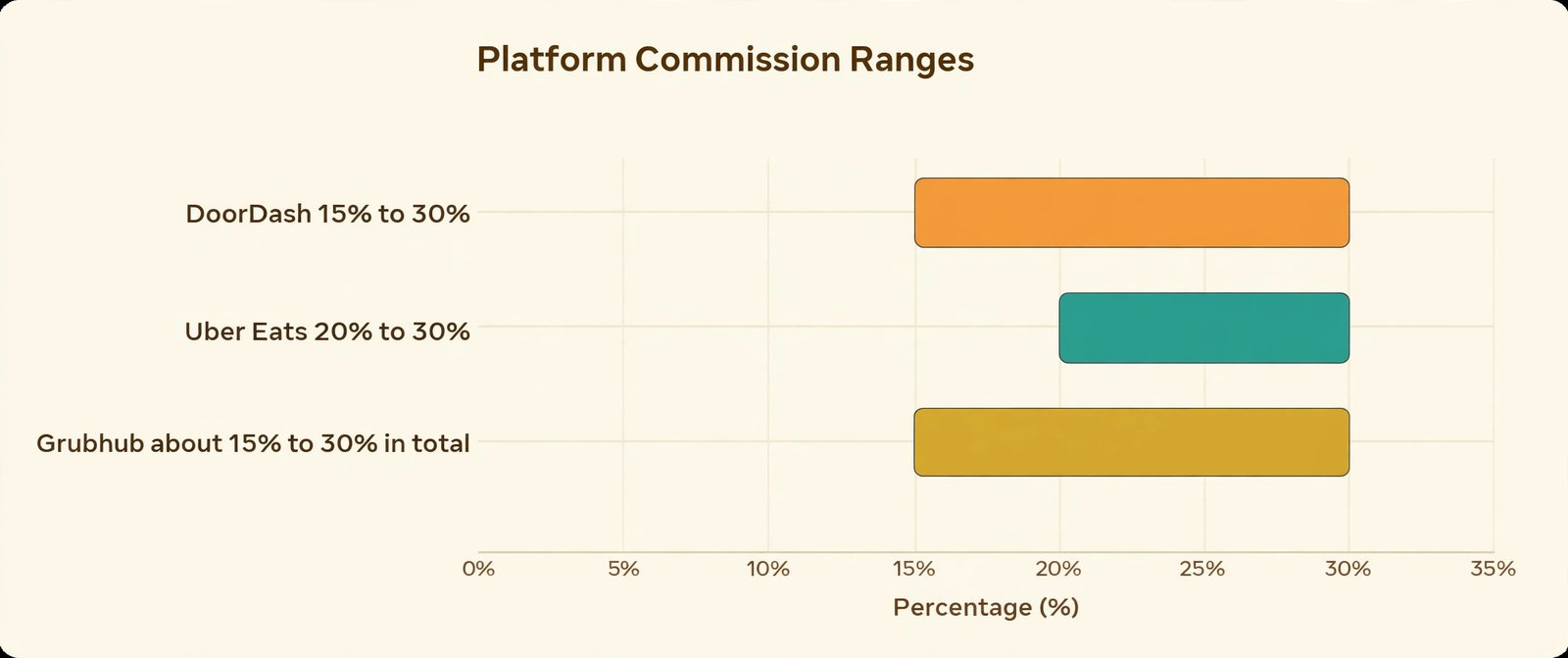
DoorDash publishes three main merchant plans for delivery in the United States. Basic charges 15 percent commission on delivery orders, Plus charges 25 percent, and Premier charges 30 percent, with pickup at 6 percent across the plans. The higher plans add a wider delivery area, access to DashPass members and, on Premier, automatic advertising and a growth guarantee. You can check the current plan details on the official DoorDash merchant pricing page.
Uber Eats changed its United States marketplace fees in March 2026. Lite now charges 20 percent on delivery orders, Plus charges 25 percent, rising to 30 percent on Uber One member orders, and Premium charges 30 percent. Pickup is 7 percent where in store pricing is validated, and 10 percent where it is not. Fee structures differ by market, so the official Uber Eats merchant pricing page and the payments section of your merchant account are the final word for your city. A useful secondary summary of all three platforms is available from Maple, which sets out the same plans side by side.
Grubhub works differently, because it separates a marketing commission from a delivery charge. Marketing commissions run from 5 percent to 20 percent depending on the plan, and using Grubhub drivers adds a delivery fee starting at about 10 percent. A full marketplace and delivery setup therefore lands in a similar range to the other two platforms, roughly 15 percent to 30 percent in total, but the split matters, because a self delivery restaurant on Grubhub pays a different total from a restaurant that uses Grubhub drivers.
Some cities also cap delivery commissions by local law, with New York City as the best known example at 15 percent for delivery, so always check your local rules before you use a national rate in your budget.
| Platform | Delivery commission range | Pickup commission | What the higher tier buys |
|---|---|---|---|
| DoorDash | 15 percent to 30 percent | 6 percent | Wider area, DashPass access, ads on Premier |
| Uber Eats | 20 percent to 30 percent | 7 percent to 10 percent | Uber One access, wider reach on higher tiers |
| Grubhub | About 15 percent to 30 percent in total | Varies by plan | Marketing reach plus driver delivery when selected |
The Self Delivery Model and What It Really Costs
Self delivery changes the cost of running a food delivery side business, because it removes the marketplace commission, but it replaces it with a different set of costs that you now carry yourself. You pay for the driver, the vehicle, the fuel, the insurance and the time spent waiting at restaurants or at customer doors. You also carry the customer service cost, because a late or cold order is now your problem to fix, not a platform support ticket.
The simplest self delivery setup is one person, one vehicle and a small delivery zone. Published small operator cost guides put monthly fuel at roughly 500 dollars to 1,500 dollars, vehicle maintenance at 300 dollars to 800 dollars, and delivery insurance at 600 dollars to 1,200 dollars for a small operation, with wide variation by city and vehicle type. Add insulated bags at 100 dollars to 200 dollars each, a phone mount, a charger and a basic ordering page, and the fixed monthly cost of self delivery often lands between 1,500 dollars and 3,500 dollars before food or labour. That figure is not a quote.
It is a planning range, and your insurer and your mechanic will give you the real numbers for your vehicle and your area.
Labour is the largest variable in self delivery. If you pay a driver 18 dollars to 25 dollars an hour including payroll costs, and a driver completes two to three deliveries an hour in a tight zone, labour alone costs 6 dollars to 12 dollars per order. In a wide zone, where a driver completes only one delivery an hour, labour can cost more than the food margin on a small order. That is why route density matters more than total area. A tight three mile zone with many orders beats a sprawling fifteen mile zone with the same number of orders, because every extra mile is fuel, time and wear that no customer pays for directly.
A Worked Monthly Budget for 300 Orders
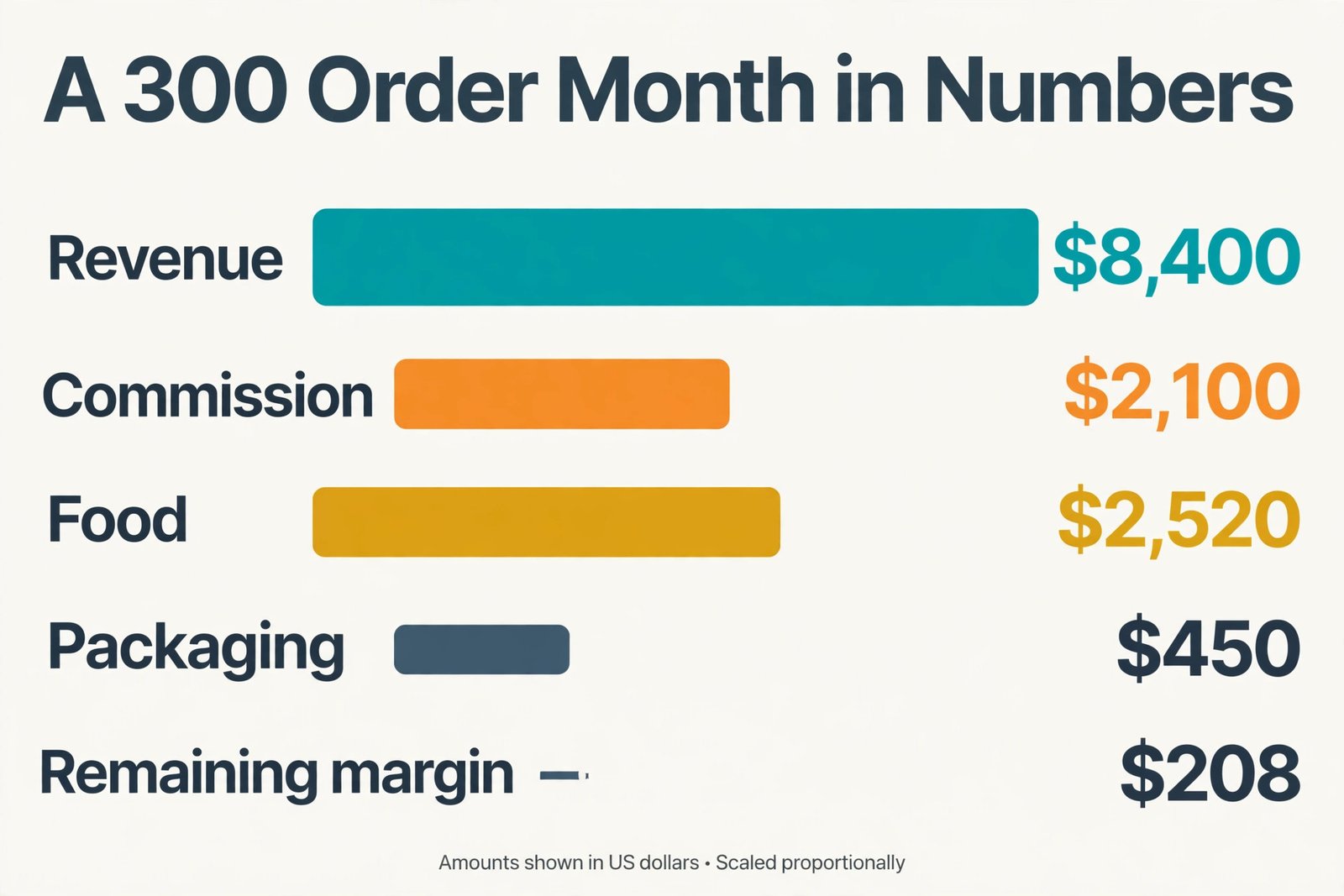
The budget below models the cost of running a food delivery side business for a small side operation selling through a marketplace at a 25 percent commission, with an average order value of 28 dollars and 300 orders in the month. That is 10 orders a day, a realistic first or second month for a part time operator, rather than a launch week fantasy. The same structure works for self delivery, but the commission line falls and the vehicle and labour lines rise, so read both models together before you choose.
| Monthly line | Amount | Notes |
|---|---|---|
| Revenue, 300 orders at 28 dollars | 8,400 dollars | Before refunds and discounts |
| Marketplace commission at 25 percent | 2,100 dollars | Taken before payout |
| Food cost at 30 percent of revenue | 2,520 dollars | Ingredients only, before waste |
| Packaging at 1.50 dollars per order | 450 dollars | Containers, bags, cutlery, labels |
| Refunds, remakes and discounts | 252 dollars | Budgeted at 3 percent of revenue |
| Marketing and promoted placement | 300 dollars | Capped weekly, not left open ended |
| Software, ordering page and phone | 120 dollars | Subscriptions and payment tools |
| Insurance allocation | 250 dollars | Share of annual cover for the operation |
| Fuel and vehicle wear | 400 dollars | Marketplace model, light driving only |
| Owner time, 120 hours at 15 dollars | 1,800 dollars | Counted even if not drawn as pay |
| Remaining margin | 208 dollars | After every line above |
That remaining margin of 208 dollars on 8,400 dollars of revenue is the honest picture for a small marketplace operation at 10 orders a day. It is not a failure. It is a starting point that shows exactly which lines must move. Raise the average order to 32 dollars, lift volume to 400 orders, cut food cost to 28 percent, or move a third of orders to direct ordering, and the margin changes fast. Leave the numbers as they are, and the business pays you little for 120 hours of work, which is a clear signal to change price, menu or channel before you scale.
Now look at the same 300 orders under a self delivery model with a tighter zone, a direct ordering page and one part time driver for peak hours. Commission falls to payment processing of about 3 percent, or 252 dollars, but driver labour, fuel and vehicle costs rise sharply. The table below uses the same revenue and food cost, so the comparison stays clean.
| Monthly line, self delivery | Amount | Notes |
|---|---|---|
| Revenue, 300 orders at 28 dollars | 8,400 dollars | Same volume and ticket as above |
| Payment processing at 3 percent | 252 dollars | Direct orders, no marketplace commission |
| Food cost at 30 percent of revenue | 2,520 dollars | Ingredients only, before waste |
| Packaging at 1.50 dollars per order | 450 dollars | Same kit as the marketplace model |
| Refunds, remakes and discounts | 252 dollars | Budgeted at 3 percent of revenue |
| Driver labour, peak hours only | 1,200 dollars | Part time help, owner covers the rest |
| Fuel and vehicle wear | 700 dollars | Higher than the marketplace model |
| Insurance allocation | 350 dollars | Higher cover for own delivery |
| Software and ordering page | 150 dollars | Direct ordering plus route tools |
| Owner time, 120 hours at 15 dollars | 1,800 dollars | Counted even if not drawn as pay |
| Remaining margin | 726 dollars | Higher, but only with enough density |
Self delivery leaves 726 dollars in this model, more than three times the marketplace remainder, but it depends on two conditions that the table hides. First, you must actually win 300 direct orders without a marketplace bringing customers to you, which takes marketing work and time. Second, your zone must be tight enough that driver labour and fuel stay at the budgeted levels. If the zone widens or orders scatter, fuel and labour can eat the entire advantage in a single month. The cost of running a food delivery side business is therefore not a single number.
It is a number that belongs to a specific model, a specific zone and a specific order volume, and changing any one of those three changes the answer.
Fee Breakdown on a Single 28 Dollar Order
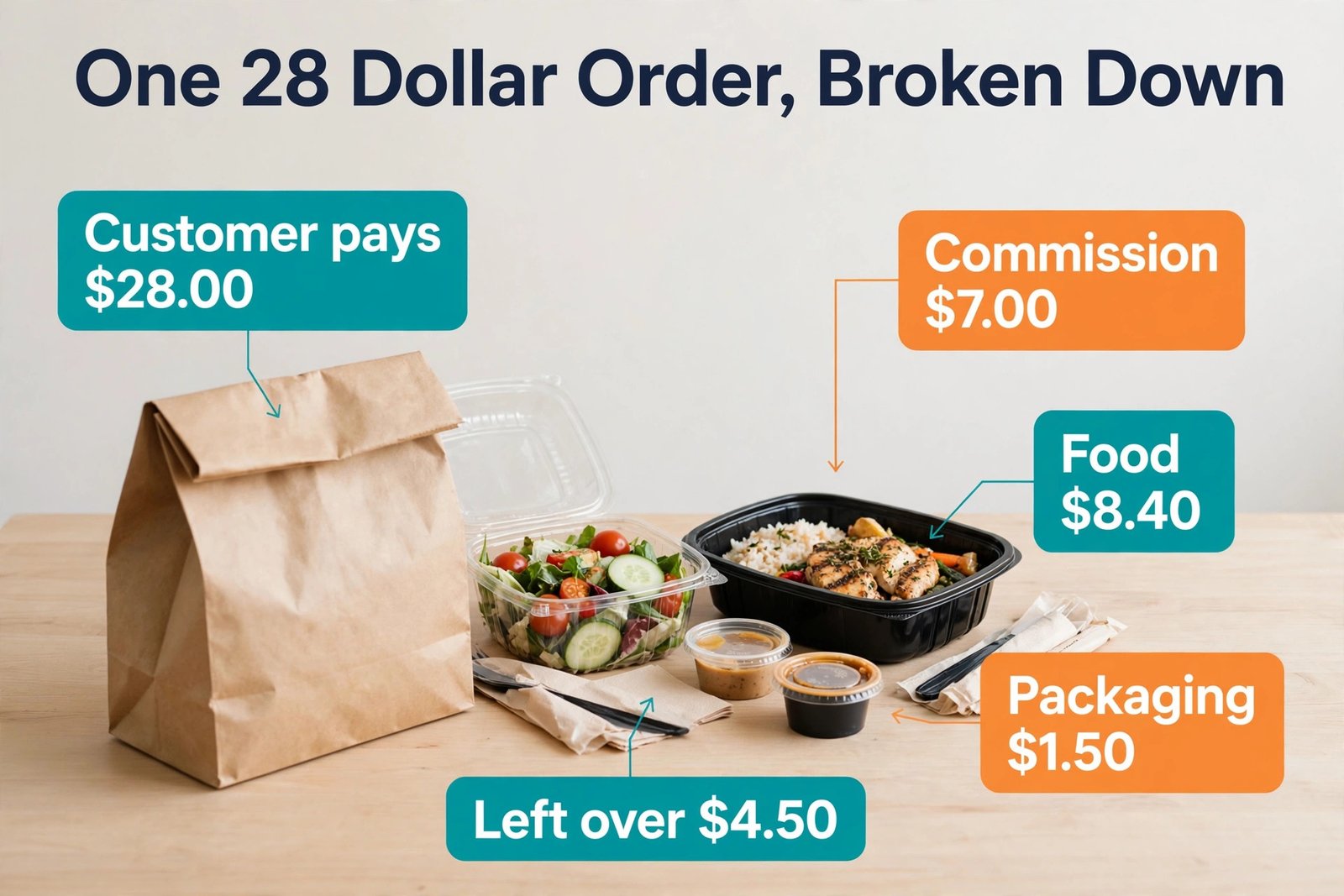
A monthly budget can hide where the money goes in the cost of running a food delivery side business. A single order breakdown makes it visible, and it is the most useful page to keep beside your pricing sheet. The order below uses the marketplace model at 25 percent commission, a food cost of 30 percent, and packaging of 1.50 dollars. Your figures will differ, but the structure will not.
| Line on one order | Amount | Share of the order |
|---|---|---|
| Customer pays | 28.00 dollars | 100 percent |
| Marketplace commission at 25 percent | 7.00 dollars | 25 percent |
| Food cost at 30 percent | 8.40 dollars | 30 percent |
| Packaging | 1.50 dollars | About 5 percent |
| Refund and discount reserve at 3 percent | 0.84 dollars | 3 percent |
| Labour and delivery allocation | 4.00 dollars | About 14 percent |
| Software, insurance and marketing share | 1.76 dollars | About 6 percent |
| Left for profit and owner pay | 4.50 dollars | About 16 percent |
That 4.50 dollars is the amount that must cover your time, your tax reserve and any surprise cost that month. If the order is discounted by 20 percent for a promotion, the customer still pays less, but your food and packaging costs do not fall, so the leftover can vanish entirely. That is the single most important lesson in delivery pricing. Discounts are paid from your margin, not from the platform share, and a promotion that looks generous on a menu can turn a profitable order into a loss. Before you run any offer, price it through this same breakdown, with the discounted total, and check that the leftover still covers your time.
Food, Packaging and Waste Costs
Food cost is the line most operators understand best, and also the line they most often understate. A recipe cost that counts only the main ingredient will miss oil, seasoning, garnish, cooking loss and the portion that sticks to the pan. A disciplined recipe sheet counts every ingredient, weighs portions for the first month, and prices the dish from the full recipe cost, not from a guess. For most small delivery menus, a food cost of 28 percent to 32 percent of the menu price is a healthy target. Below 25 percent, check that portions and quality have not been cut to hit the number.
Above 35 percent, check that the menu price or the recipe needs to change, because little margin will survive commission on top of that food cost.
Packaging is a smaller line that adds up fast. Published guides put packaging at about 0.50 dollars to 2.00 dollars per order, depending on containers, bags, cutlery and branding. At 300 orders, the difference between 0.75 dollars and 1.75 dollars per order is 300 dollars a month, which is more than the entire margin in the marketplace budget above. Buy packaging in bulk where storage allows, test containers for leaks and heat retention before you commit to a large order, and avoid double boxing unless the dish genuinely needs it. A container that keeps food hot and intact is worth a few extra cents.
A container that leaks, crushes or looks cheap costs you a refund and a review, which is far more expensive.
Vehicle, Insurance and Labour Costs
Insurance is not optional, and personal car insurance may not cover commercial food delivery. Tell your insurer exactly what you plan to do, get the answer in writing, and budget for commercial or delivery cover where it is required. Published small operator guides put delivery insurance in the range of 600 dollars to 1,200 dollars a month for a small operation, but that range covers very different vehicles, cities and cover levels, so treat it as a prompt to get a quote, not as a price. A single uncovered accident can end a side business and create personal liability, which makes insurance one of the few lines where cutting cost is a false economy.
Licences and permits are a modest line in most cities, but they are a line that must be paid before the first order. Published startup guides put licensing and permits at roughly 500 dollars to 2,000 dollars at setup for a small food operation, with variation by city and by whether you cook at home under cottage food rules or in a rented kitchen. Home cooking rules vary widely, and some areas restrict which foods can be sold from a home kitchen, how they must be labelled and whether delivery is allowed at all.
Check your local food safety authority and your local business licensing office before you buy equipment, because a licence problem discovered after launch is far more expensive than a licence fee paid before launch.
How to Choose Between Marketplace, Self Delivery and a Mix
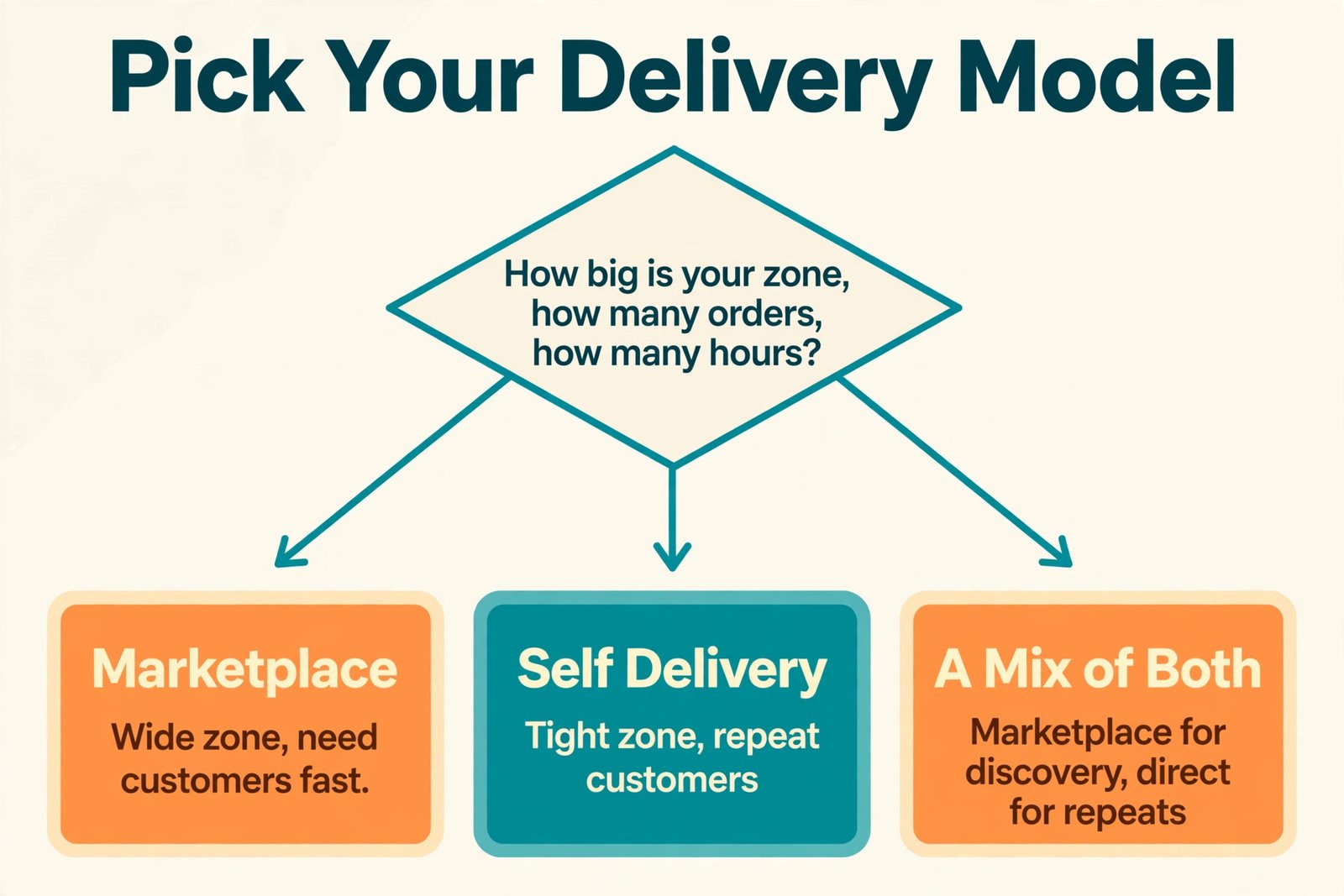
Choosing a model changes the cost of running a food delivery side business, and it is not a loyalty decision. It is a maths decision that depends on your zone, your menu and your available hours, and the right answer can change as the business grows. The questions below give you a decision path that uses the numbers in this guide rather than a general preference for one platform or another.
Start with your zone, not your platform
Draw your delivery zone on a map, count the homes and workplaces inside it, and drive the longest route at dinner time. If the longest round trip takes more than 40 minutes, the zone is too wide for a side operation, and marketplace delivery, where couriers are already nearby, will usually beat self delivery. If the zone is tight, with many orders inside a few miles, self delivery becomes realistic, and direct ordering becomes worth building. Zone first, platform second, because no commission saving survives a zone that burns fuel and time on every order.
Take your five best dishes, price them for a marketplace at your expected commission, price them for direct ordering with a delivery fee, and price them for pickup only. The marketplace price will usually need to be 15 percent to 25 percent higher than the in store price to hold the same margin, and some platforms require menu prices to match in store prices for the lowest pickup rates, so check that rule before you set two price lists. If customers will not pay the marketplace price, the dish is not a delivery dish, and it should stay off the delivery menu rather than being sold at a loss for volume.
Test for four weeks before you commit
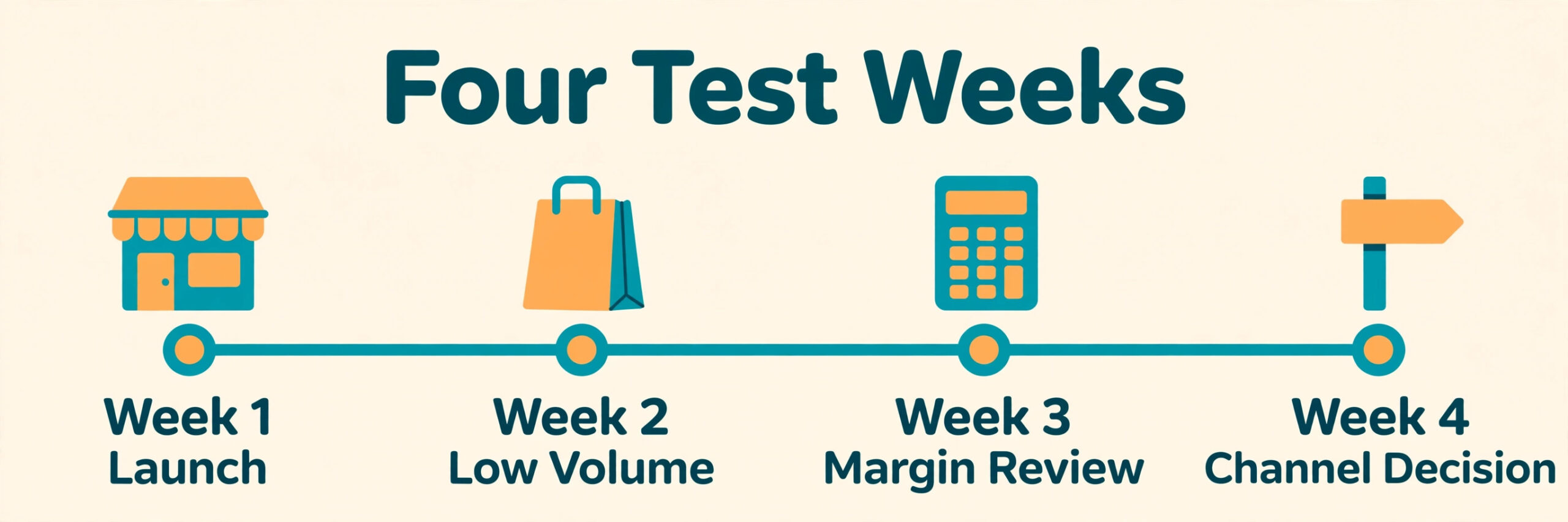
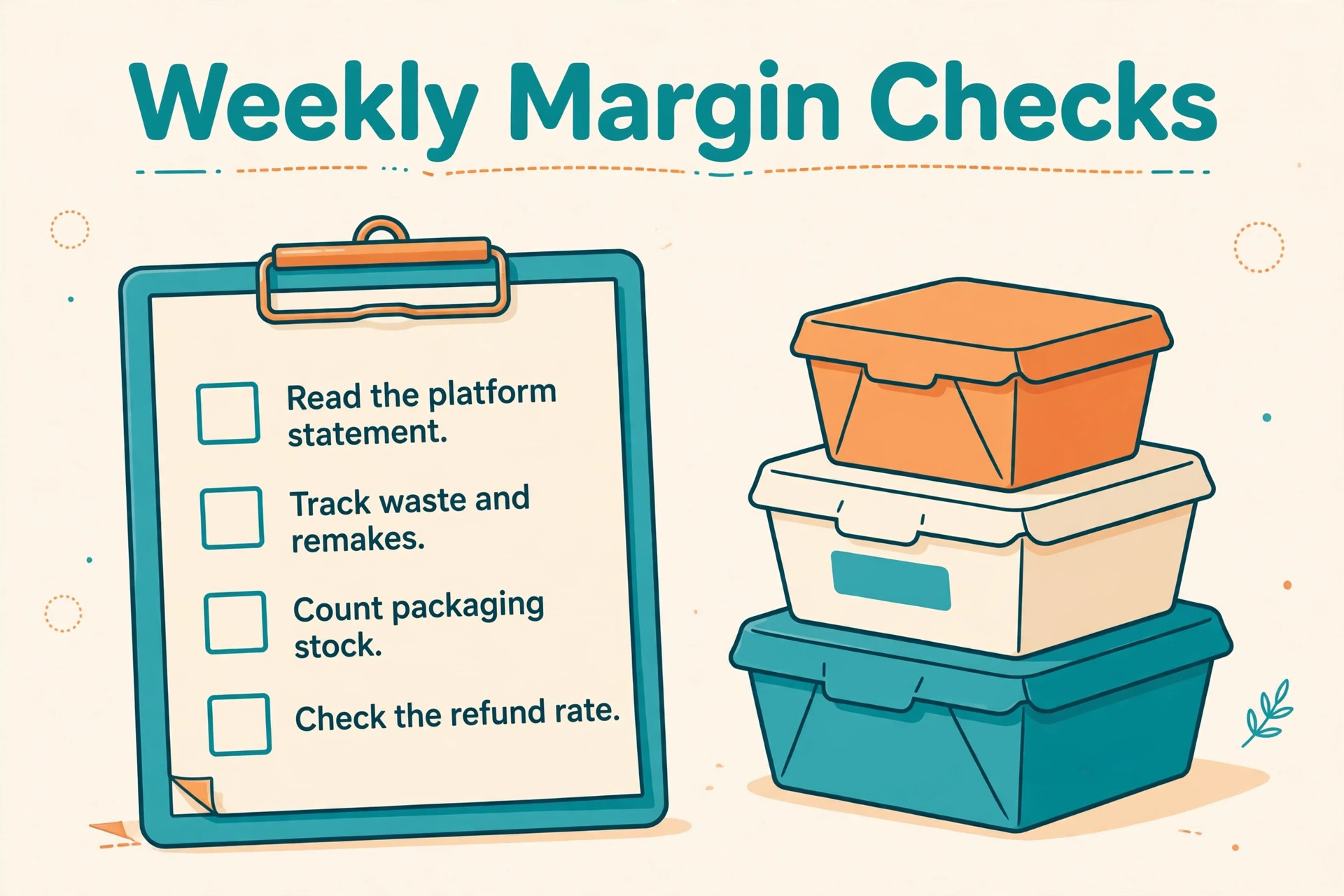
Run one model for four weeks, with a weekly margin check, before you sign a long term kitchen lease, buy a large packaging order or hire regular help. Four weeks is long enough to see a quiet week, a busy weekend and at least one problem order, and short enough that a wrong choice does not become a debt. At the end of the four weeks, compare contribution per order, hours worked and customer complaints across the model you tested, and only then decide whether to add a second channel. A side business that tests cheaply can afford to be wrong once. A side business that commits heavily before testing cannot.
Grow by density, not by distance
Mistakes That Eat the Margin
The first mistake is pricing from a competitor menu without checking that competitor cost base. A rival with a rented kitchen, a full time team and a high volume deal on packaging can sell at a price you cannot match, and copying that price will lose money on every order. Price from your own recipe sheets, your own commission and your own hours, and let a competitor price be a market check, not a price setter.
The second mistake is running an open ended discount. A first order discount, a buy one get one offer and a free delivery week can each bring new customers, but each one must have a budget, a cap and an end date. An offer that runs until you remember to stop it will run through your best weeks as well as your quiet weeks, and it will train customers to wait for the next discount rather than pay the normal price. Set the cap in orders, not just in days, so a viral offer cannot eat a month of margin in a weekend.
The third mistake is ignoring the weekly statement. Marketplace statements show commission, refunds, adjustments, promotions and payouts in one place, and they are the fastest early warning system in the business. Read the statement every week, reconcile it against your own order count, and query any adjustment you do not understand within days, not months. Operators who read the statement weekly catch a wrong commission tier, a duplicate refund or a promotion that never ended. Operators who read it quarterly discover the problem after the money is gone.
The fourth mistake is a menu that does not travel. Soups that spill, fried food that goes soft in 15 minutes, salads that wilt in a hot bag and dishes that need precise plating will all generate refunds, even when the cooking is good. Test every dish as a delivery dish, packed, held for 20 minutes and eaten from the container, before it goes on the menu. A dish that fails that test should be reworked, repackaged or removed, because the refund cost of a travelling failure is higher than the profit on several good orders.
For related reading, this site guide to side hustles that use AI helps you compare delivery with other part time income ideas, while best accounting software for small business covers bookkeeping tools for tracking the costs in this guide, and best AI tools for restaurants looks at ordering and operations tools for food businesses. If you are comparing food formats, how to start a food truck business with AI is a useful next read, and automate small business with AI covers the routine tasks that eat owner time in any small operation.
Frequently Asked Questions
How much money do I need to start a food delivery side business?
A marketplace only start can be very low, often a few hundred dollars for packaging, containers, insulated bags and licences, because the platform provides the ordering app and the couriers. A self delivery start costs more, because you need a reliable vehicle, delivery insurance and an ordering page, and published startup guides put the wider range at several thousand dollars depending on vehicle and kitchen setup. Start with the marketplace model if cash is tight, and add self delivery only after the margin check in this guide shows it pays.
What is a healthy profit margin for a small delivery operation?
A healthy target after food, packaging, commission or delivery labour, refunds and software is roughly 10 percent to 20 percent of revenue, before owner pay is counted separately. Many small operators land below that range in the first months, while they pay for visibility and learn their true costs. If your margin stays below 5 percent after three months of steady volume, change price, menu or channel, because volume alone rarely fixes a margin problem that is built into the price.
Is DoorDash or Uber Eats cheaper for a small seller?
Neither platform is cheaper in every city or on every plan. DoorDash Basic at 15 percent can be cheaper than Uber Eats Lite at 20 percent, but the higher tiers on both platforms reach 30 percent, and the cheapest plan may bring less visibility. Compare the plan you will actually use, check whether your city caps commissions, add any promoted placement spend, and model the result on your own average order value before you choose.
Should I deliver orders myself or use a marketplace?
Use a marketplace if you need customers fast, your zone is wide, or you have no driver help. Deliver yourself if your zone is tight, you already have repeat customers, and the labour and fuel maths in this guide leaves more margin than the commission you save. Most side operators do best with a mix, using the marketplace for discovery and direct ordering for repeat customers, and reviewing the split every month.
How many orders a day do I need to break even?
Break even depends on fixed costs divided by contribution per order. In the worked budget above, fixed lines plus owner time need about 300 orders a month at a contribution that leaves a small surplus, which is 10 orders a day. If your fixed costs are lower, or your contribution per order is higher, break even falls. If your zone is wide or your commission is high, break even rises. Run your own numbers with the formula in this guide, rather than borrowing a break even figure from another city or another menu.
What costs do new food delivery operators forget most often?
The most forgotten costs are refunds and remakes, packaging, fuel and vehicle wear, software subscriptions, tax reserves and owner time. Each one looks small on its own, and together they can remove 15 percent to 25 percent of revenue. A weekly check that lists every cost line, including a line for your own hours, will catch these costs before they become a month end surprise.
The Margin Check That Decides Your Next Move
A food delivery side business is worth running, and the cost of running a food delivery side business is under control, when the numbers survive contact with a real month. That means a menu priced from full recipe costs, a commission or delivery cost that is budgeted before payout, a packaging and waste line that is tracked weekly, and an owner time line that is counted even when it is not drawn as pay. If those four lines are honest, the business can grow by density, by repeat direct orders and by a tighter menu, and each improvement will show up in the margin rather than just in the order count.
Start with the model that fits your zone and your hours, test it for four weeks, and let the weekly statement decide the next step. If the marketplace margin is thin, raise the average order with a bundle or a minimum order, move repeat customers to direct ordering, or cut the dish that wastes most. If self delivery is eating your evenings, tighten the zone, shorten the window or add peak help only where the contribution test passes. The operators who last in this business are not the ones who work the most hours.
They are the ones who know, order by order, what each hour earns, and who change price, menu or channel as soon as the numbers tell them to. That discipline is what turns a busy side business into a profitable one, and it starts with the budget on the first page of this guide, checked weekly, until the margin is no longer a surprise.