
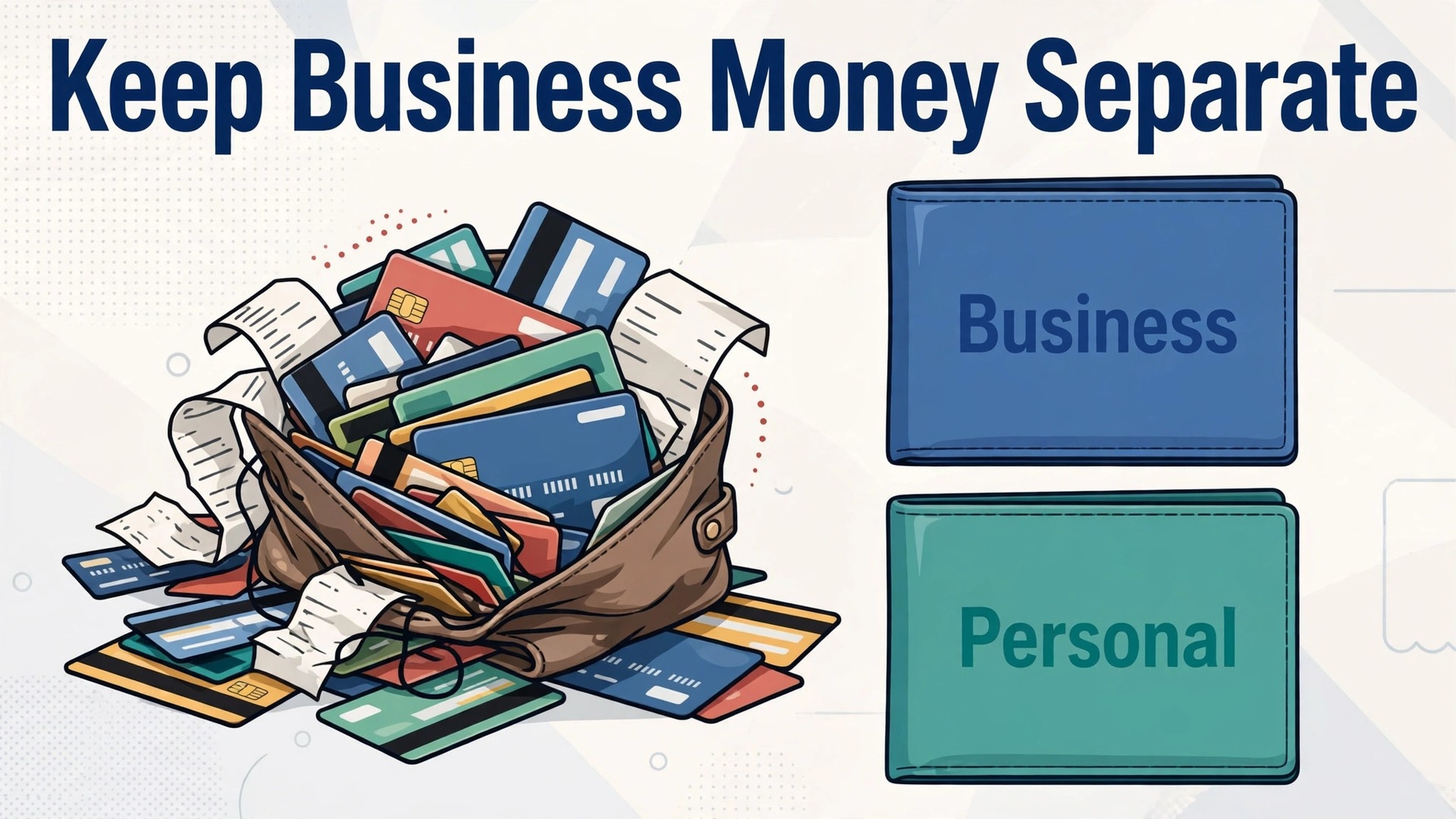
You paid for groceries with the business card again. It was faster at the checkout, and you told yourself you would sort it out later. Later never came, and now the bookkeeper is asking about six months of mixed transactions, the tax return is due, and nobody can say with confidence which expenses were business and which were personal. If that scene feels familiar, learning how to separate business personal expenses small business owners keep clean is not an admin luxury. It is the fix that makes your books, your tax return, and your liability protection believable.
Mixed money creates three problems at once. First, it makes bookkeeping slow and error prone, because every transaction has to be sorted months later by someone trying to remember a purchase. Second, it puts deductions at risk, because personal expenses are generally not deductible, and the tax authority guidance cited in this guide says so plainly. Third, for a limited liability company or a corporation, it weakens the separation that liability protection depends on, because a creditor lawyer looks first for owners who treat the company account as a personal wallet.
The fix is not complicated, but it does require a system rather than good intentions. You need a business account and a business card that business money moves through, a fixed method for paying yourself, a rule for shared costs such as a phone or a vehicle, a log for owner payments, and a monthly cleanup that catches mistakes while they are still fresh. Set those five pieces up once, and separation becomes a habit instead of a year end rescue project.
This guide gives you that system in order. It starts with why separation matters for taxes and liability, then covers account setup, paying yourself by entity type, card rules, shared expenses, the owner draw log, the monthly cleanup checklist, and how to fix books that are already mixed. Where a rule comes from tax authority guidance, the guide names the source, and where a practice comes from a third party guide rather than an official page, the guide says so and advises confirming the detail with your own adviser.
How to Separate Business Personal Expenses Small Business Owners Keep Clean
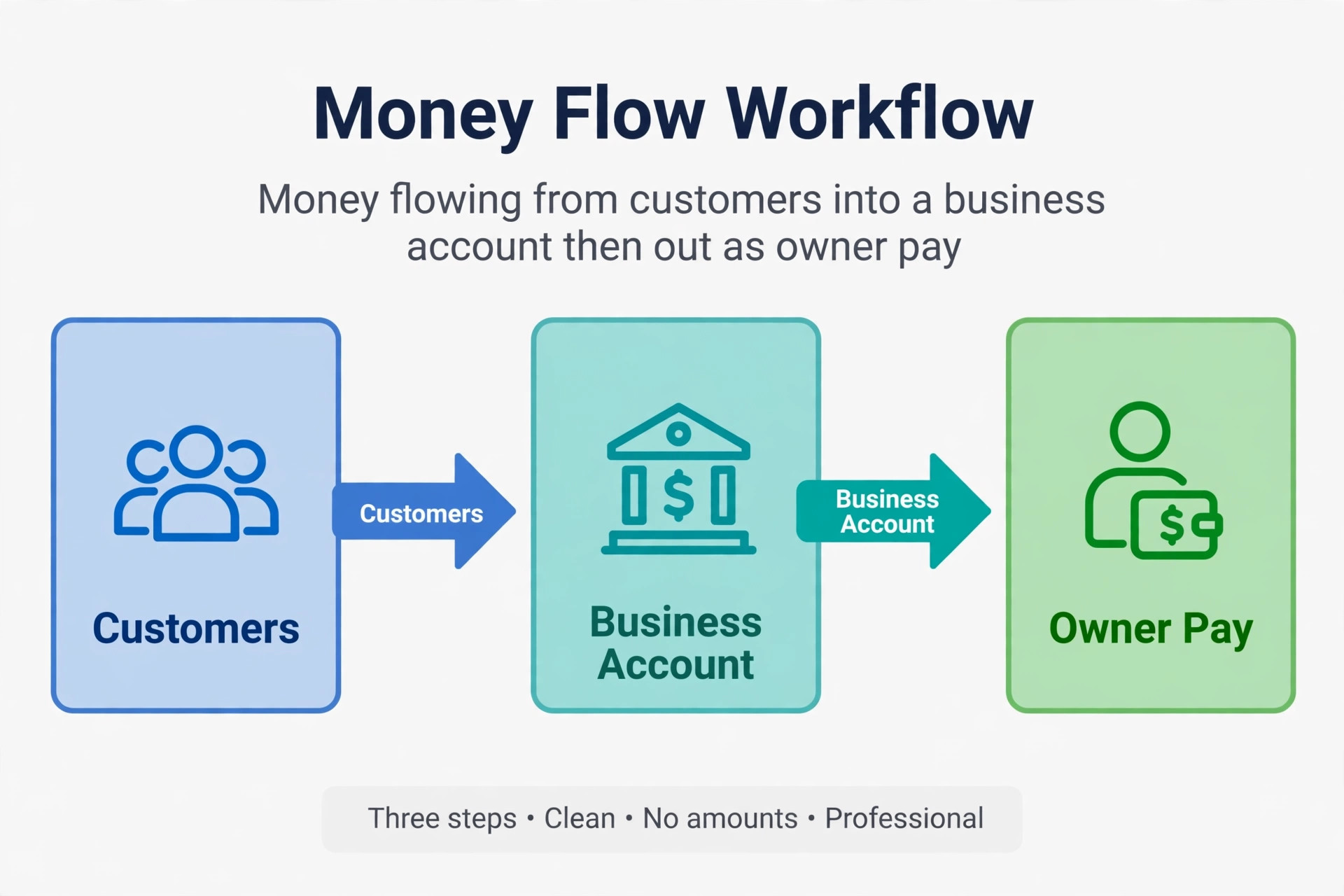
The core rule for how to separate business personal expenses small business finances is simple to state and takes discipline to keep. Every dollar the business earns or spends moves through accounts in the business name, and money only crosses to you through a recorded owner payment or a documented reimbursement. Business money pays for business costs. Personal money pays for personal costs. Everything else is an exception that gets recorded the week it happens, not at tax time.
Start with a snapshot of where money moves today. List every account and card you use, and mark each one business, personal, or mixed. Most owners find at least one mixed account, often a personal card used for business purchases because the business card was not at hand, or a business account used for a personal bill because the personal account was short that week. That list is your cleanup map, and it tells you which accounts to close to business use, which to close to personal use, and which transactions need reclassifying.
Set a cutover date and stick to it, because a date is what turns how to separate business personal expenses small business advice into action. From that date, business income goes only to the business account, and business spending comes only from the business account or the business card. Tell your team, your bookkeeper, and anyone who pays you about the change, and update payment links, subscription billing, and marketplace payouts to the business account before the cutover. A cutover announced but not implemented in billing settings will keep producing mixed transactions for months, because subscriptions quietly keep charging the old card.
Write the rule down in one page and keep it where you pay bills. The page should name the business account, the business card, the method for paying yourself, the rule for shared costs, and the fix for a mistaken swipe. Separation fails most often not from ignorance but from a busy day, so the system has to be easier to follow than the shortcut.
Why Separation Matters for Taxes and Liability
Tax authority guidance is direct on this point. The Internal Revenue Service says in Publication 583 that one of the first things you should do when you start a business is open a business checking account, and that you should keep it separate from your personal checking account. The agency also answers a common owner question plainly. Money used for personal expenses out of a business account is business income when earned, personal expenses are generally not deductible, and keeping separate accounts makes records easier to keep. That guidance is the foundation for everything in this guide.
Deductions depend on proof, not on intention. A deductible business expense must be ordinary and necessary for your trade, and you must be able to show the amount, the date, the vendor, and the business purpose. A mixed account makes that proof harder, because a bank statement line for a large retailer could be office supplies or household goods, and a statement alone rarely shows which. Separate accounts plus receipts give you that proof without reconstruction, and reconstruction after an inquiry arrives is far weaker than a record made at the time.
Liability protection depends on separation too, though the legal test varies by state and this guide is not legal advice. A limited liability company or corporation is meant to keep business debts with the business, and courts that consider whether to hold an owner personally liable look at whether the business maintained a genuinely separate financial identity. Mixing funds is one of the facts such a court looks for first. Keeping clean accounts does not guarantee protection, but mixing funds hands an opposing lawyer an easy argument, and that argument is avoidable with a system that costs little to run.
Lending is a third reason. A lender reviewing a loan application wants clean business financials, and mixed accounts force the lender to guess which income and expenses belong to the business. Clean accounts produce a profit figure a lender can rely on, and that reliability affects the loan decision and the terms.
Set Up Business Accounts and Cards That Stay Clean
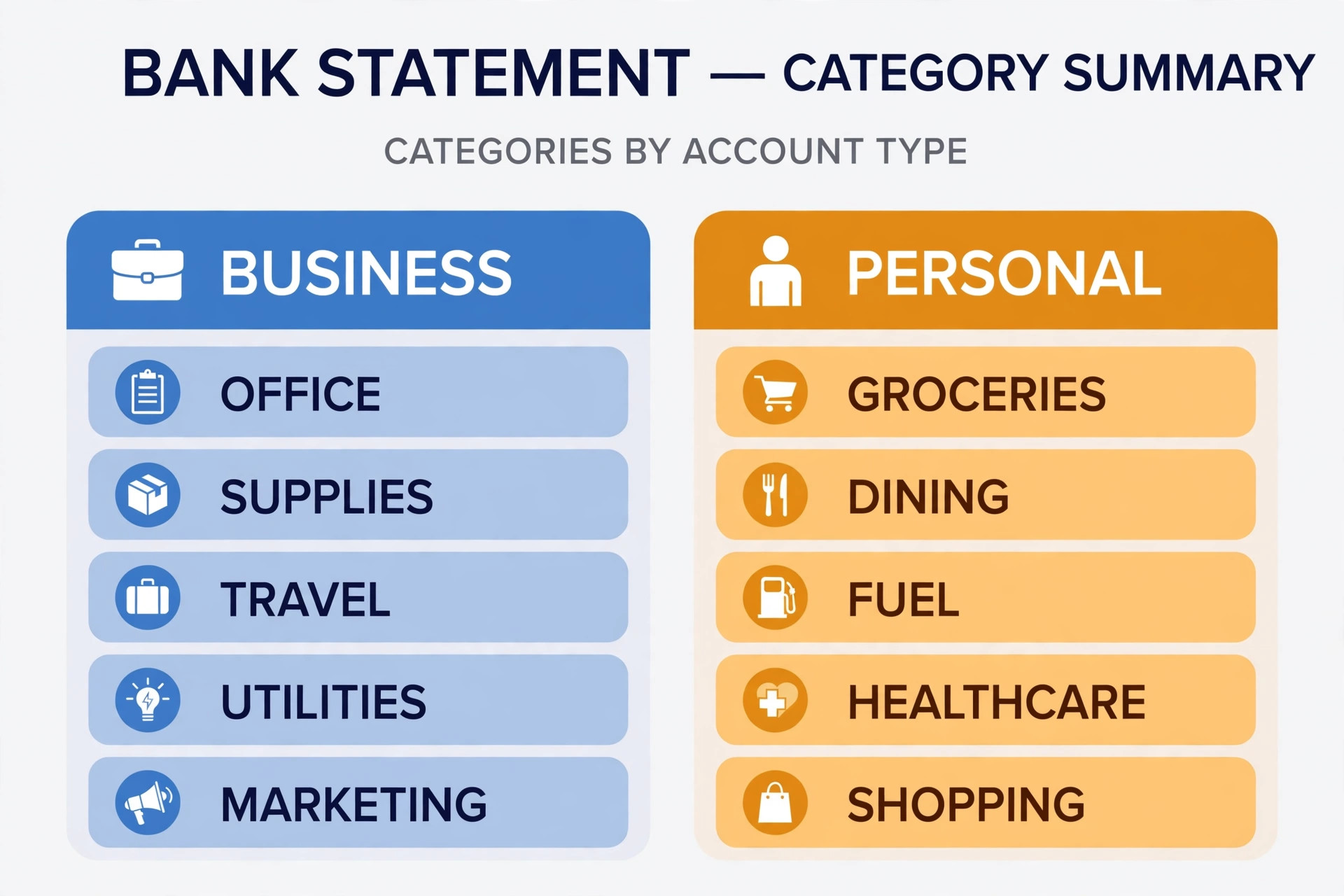
Open a dedicated business checking account in the business name, using your formation documents and employer identification number where the bank requires them. Open at least one dedicated business credit card in the business name as well. From the cutover date, all business income goes into the business checking account, and all business expenses come out of it or off the business card.
Choose account features that support separation rather than undermine it. A business account with sub accounts or buckets can separate tax savings, operating cash, and owner pay, which helps owners who otherwise pay themselves whatever is left and discover at tax time that nothing was set aside. A business card with per user limits and transaction alerts helps a team spend within the system instead of around it. Ask the bank what reporting and export options the account offers, because a monthly export that feeds your accounting software cleanly saves bookkeeping time every close.
Route every income source to the business account. Update marketplace payouts, payment processor settlements, client bank transfers, and subscription billing to the business account, and check the first settlement after each change to confirm it landed correctly. A single income source still paying into a personal account will keep the books mixed even after spending is clean, and it will force the bookkeeper to move money between accounts every month, which creates its own trail of transfers to explain.
Keep personal accounts for personal life, and resist the temptation to keep a personal card as a business backup. If the business card is declined or unavailable, pay from the business account by another route, or record the personal payment as a reimbursement the same week, using the process in the shared costs section. A backup plan that produces a documented reimbursement is a system. A backup card that produces a mystery transaction is not.

Pay Yourself on Purpose, Not by Accident
Paying yourself is where most mixed books start, because owners take money when they need it, in whatever amount is available, without recording it as a payment. Replace that habit with a fixed method. Move money from the business account to your personal account by a transfer, on a regular rhythm if you can, and record every transfer as an owner payment in the accounting software. The rhythm matters more than the amount, because a regular transfer creates a record a bookkeeper, an adviser, and a lender can all follow.
How that transfer is treated depends on your business structure, so confirm the treatment with your adviser before you set the rhythm. A sole proprietorship or a single member limited liability company typically records owner transfers as owner draws. A partnership records partner distributions under its agreement. An S corporation generally pays owner employees through formal payroll for reasonable compensation, supplemented by scheduled distributions, and a C corporation pays through payroll and dividends under its own rules. Do not copy another owner method without checking your structure, because the tax treatment differs and a wrong method creates a correction later.
Set a pay amount you can sustain, and review it quarterly against actual profit and cash. A draw that exceeds profit drains the business account and creates a negative capital balance that an adviser will question. A draw set too low starves personal cash flow and pushes the owner back to paying personal bills from the business account, which restarts the mixing cycle. Review the draw alongside the monthly close, when profit and cash are both visible, and adjust it in a recorded decision rather than by silent drift.
Separate tax savings from owner pay. Set aside a portion of profit for taxes in a business savings account or sub account, on the same rhythm as your draw, so tax money is not mistaken for spendable profit. Third party guides commonly suggest setting aside roughly a quarter to a third of net income as a starting estimate for new owners without a prior year reference, but that figure is a guide reported by a third party, not a tax rule, so confirm the right percentage for your situation with your adviser and adjust it once you have a real tax history. A tax reserve turns a quarterly tax bill from a crisis into a transfer.
Card rules are the daily discipline in how to separate business personal expenses small business spending. The rule is that the business card pays for business costs only, and the personal card pays for personal costs only. When a mistake happens, and it will, the fix is to record it the same week, not to leave it for the bookkeeper to guess. A personal cost on the business card is recorded as an owner draw or distribution, not as an expense. A business cost on a personal card is recorded as a reimbursement, with the receipt attached, not as a personal expense that disappears.
Receipts matter because a card statement alone rarely proves business purpose. Keep an itemised receipt for business purchases, especially for larger amounts, and note the business purpose on the receipt or in the accounting record at the time. Guides on record keeping commonly note that documentation should show the date, the amount, the vendor, and the business purpose, and that card statements alone are often insufficient proof for an itemised purchase. Photograph the receipt into your accounting or expense tool the day of purchase, so the proof exists even if the paper fades.
Shared costs need a written rule, because some costs genuinely serve both business and personal life. A mobile phone, home internet, a vehicle, and a home office are the usual examples. The clean method reported in third party guides is an accountable plan style process. Pay the vendor from your personal account, submit a monthly report calculating the business use percentage, and have the business reimburse that percentage. Confirm the plan rules and the tax treatment with your adviser before you rely on them, because accountable plan requirements are specific and a casual reimbursement does not automatically qualify.
Vehicle costs deserve special care. The tax authority requires mileage records kept at or near the time of travel, showing the date, the destination, the miles driven, and the business purpose, and reconstructed records after an inquiry are far weaker. Use a mileage app or a simple log kept daily, and claim only the business portion you can document. A vehicle used for both purposes should never be paid entirely from the business account on the assumption that the split can be sorted later, because later sorting without a log is guessing.
Home office costs follow the same logic. Only the portion that meets the applicable rules belongs in the business books, and the calculation should be documented each month or each year rather than estimated at tax time. Keep the measurement, the bills, and the calculation together in the close file, so the figure can be checked without reconstructing a year of utility bills. Shared cost rules feel like extra work in the month, and they save far more work than they cost at tax time, because they replace a year of guessing with a monthly calculation.

The Owner Draw Log and Monthly Cleanup Checklist
The owner draw log is a simple record at the heart of how to separate business personal expenses small business payments, and it prevents the most common mixed book error, which is an owner transfer with no label and no explanation. Each entry in the log records the date, the amount, the direction of the transfer, the account it came from, the account it went to, and a short note of what it was for. A transfer from business to personal is an owner draw or distribution. A transfer from personal to business is an owner contribution. A reimbursement is neither, and it should be labelled as a reimbursement with the expense it covers.
Keep the log in your accounting software where possible, so the log and the books are the same record rather than two records that can drift apart. If you keep a separate spreadsheet, reconcile it to the accounting record monthly, because a log that disagrees with the books helps nobody. Review the log during the monthly close, when bank reconciliations will surface any transfer you forgot to log, and add missing entries while the reason is still fresh. A log reviewed monthly stays accurate. A log reviewed annually becomes a reconstruction exercise.
The monthly cleanup checklist below is the overview proof element for this guide. Run it in the same order every month, and keep it with the close file. It catches mistakes while receipts are findable and memories are fresh, and it turns separation from a year end project into a thirty minute monthly habit.
- Confirm all business income landed in the business account, and move any stray income with a recorded transfer.
- Confirm all business spending came from the business account or business card, and reclassify any stray spending.
- Record every owner transfer in the draw log, with date, amount, direction, and note.
- Record every personal payment of a business cost as a reimbursement, with the receipt attached.
- Record every business payment of a personal cost as an owner draw, not as an expense.
- Reconcile the business bank and card accounts to their statements, and investigate any difference.
- Review shared cost calculations for the month, including phone, vehicle, and home office portions.
- File receipts for the month, and note any missing receipt with the vendor and amount for follow up.
- Check that subscriptions and payouts still route to the business account, not a personal one.
- Save the checklist, the draw log, and the reconciliation reports in the monthly close file.
That checklist is short on purpose. Thirty minutes, once a month, on the same day as the bank reconciliation, is a rhythm most owners can keep, and keeping it is what makes the books believable at year end.

Fix Books That Are Already Mixed
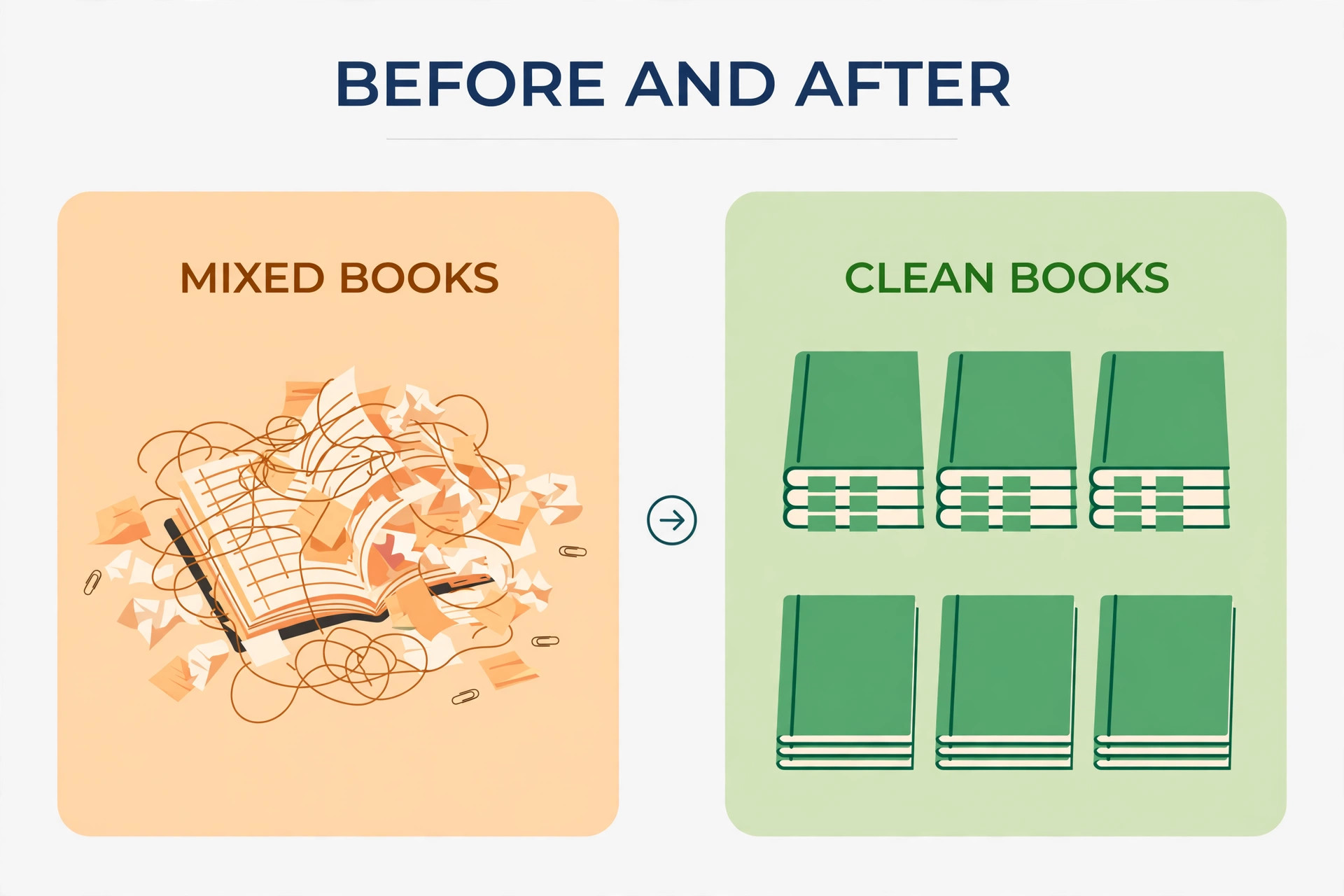
Mixed books can be fixed, but the fix needs a method for how to separate business personal expenses small business books already mixed, rather than a bulk reclassification done in a hurry. Start by choosing a clean date, usually the start of the current month or the current quarter, and commit to clean books from that date forward using the system in this guide. Then work backwards through prior months one month at a time, reclassifying transactions with the best evidence available, and marking any transaction you cannot classify as an open item rather than guessing.
For each prior month, separate transactions into three groups. Business transactions stay as business expenses with their receipts where available. Personal transactions move to owner draws or distributions, and they leave the expense accounts entirely. Unclear transactions go to a suspense or open item list with the date, amount, and vendor, and you work that list with bank statements, receipts, calendars, and messages to resolve each one.
Talk to your adviser before you finalise a cleanup that touches a filed return. If a prior return already claimed a personal cost as a business expense, correcting it may require an amended return, and your adviser should decide that, not a spreadsheet. If the cleanup only affects the current unfiled year, reclassifying in the books is usually sufficient, but confirm that with your adviser too, because entity type and filing status affect the answer. A cleanup that creates a new tax problem while fixing a bookkeeping problem has not helped.
Set a deadline for the cleanup, and work it in weekly sessions rather than one marathon. A month of mixed transactions takes an hour or two to sort with statements at hand. A year takes several sessions, and several sessions need a schedule or they will not happen. Track progress by month completed, not by transactions touched, because a month completed is a month you can close cleanly, while a pile of half sorted months helps nobody. When the cleanup finishes, file the working papers with the close files, so a future reviewer can see what was reclassified and why.
Tools That Keep Separation Automatic
Mercury and Novo are business banking options commonly discussed for owners learning how to separate business personal expenses small business banking, and both are built around business accounts rather than personal ones, though features, fees, and eligibility differ, so confirm the current terms on the vendor page before opening an account. The value of a business focused bank is less about any single feature and more about the separation it enforces, because income and spending that start in a business account are far easier to keep clean than income and spending that must be moved into one later.
Expensify and similar expense tools help with the receipt and reimbursement part of the system, by capturing a receipt photo, categorising the expense, and routing it for approval or reimbursement. The tool does not decide business purpose for you, but it makes the record at the time, which is the part owners skip when they rely on memory. Choose an expense tool that exports cleanly to your accounting software, because a receipt captured in one system and retyped into another will eventually be mistyped or lost in the gap.
QuickBooks and similar accounting tools hold the draw log, the reconciliations, and the monthly close together, and they surface mixed transactions through bank feed review and uncategorised transaction reports. Run the uncategorised report monthly as part of the cleanup checklist, because an uncategorised transaction is often a mixed transaction waiting to be sorted. A tool that shows you the uncategorised list is only useful if you clear that list monthly, so diary the clearing session alongside the reconciliation.
Avoid tool sprawl in this area. One business bank, one business card, one expense capture tool, and one accounting system are enough for most small firms, and each additional tool adds a reconciliation point where money can go missing between systems. If a tool does not export to your accounting software, or if nobody on the team uses it after the first month, replace it with a simpler method that the team will actually maintain. Separation depends on a system people use, not on a system that looks complete on a pricing page.
Mistakes That Mix Books Again After a Cleanup
The first mistake in how to separate business personal expenses small business books after a cleanup is keeping a personal card as a business backup. A backup card used twice a month recreates a mixed account, and the cleanup will need repeating. Remove the backup temptation by keeping the business card available, by using a business account transfer for urgent payments, or by using the reimbursement process the same week. A system with no backup that produces mixed transactions is better than a backup that produces them regularly.
The second mistake is paying yourself without recording the transfer. An unlabelled transfer from business to personal looks like an expense, a loan, or a mystery to a bookkeeper, and it will be classified by guess if nobody labels it. Record every transfer at the time, with the draw log note, even when the amount is small. Small unlabelled transfers accumulate into a large unexplained total, and a large unexplained total is the first thing an adviser or lender asks about.
The third mistake is estimating shared costs at tax time instead of calculating them monthly. A phone percentage guessed in April for the whole prior year is not a record, and a vehicle split guessed without a mileage log is not defensible. Calculate shared costs monthly, file the calculation, and let the tax return sum twelve monthly calculations instead of inventing one annual estimate. Monthly calculation takes minutes, and it replaces a year of guessing with a file of evidence.
The fourth mistake is letting subscriptions drift back to a personal card. A subscription moved to the business card during setup can revert when the card expires, when a free trial converts, or when a team member signs up with a personal card for speed. Audit subscription billing quarterly, and check the business card statement for any subscription that should be there but is not, as well as for any personal subscription that should not be there. A quarterly billing audit catches drift before it becomes a year of mixed charges.
The fifth mistake is treating separation as a tax season task. Separation kept only in March and April will fail in the other ten months, because transactions happen all year and memories fade within weeks. The monthly cleanup checklist exists to prevent that failure, and it works only if it runs monthly. Diary it, keep it short, and treat a missed month as a task to catch up the following week, not as a reason to abandon the system until next tax season.

Frequently Asked Questions
Is a separate business bank account legally required for a sole proprietor
Tax authority guidance does not impose a general legal mandate for sole proprietors to hold a separate account, but it strongly recommends separation, and guides on this topic consistently note that separate banking records are treated as strong evidence of a genuine business. For a limited liability company or corporation, separation also supports the liability shield, so the practical answer is to hold a separate account regardless of structure. Confirm any state specific requirement with your adviser, because banking and entity rules vary.
What should I do when I accidentally pay a personal bill from the business account
Record it the same week as an owner draw or distribution, not as a business expense, and note what it was for in the draw log. Do not leave it for the bookkeeper to guess, and do not net it against a later business expense. A same week correction keeps the expense accounts clean and the draw log complete, while a correction made months later relies on memory and often misstates the amount or the date.
Can I pay a business bill from my personal account
Yes, but record it as a reimbursement the same week, with the receipt attached and the business purpose noted. Paying from a personal account occasionally is not a problem when the reimbursement process captures it promptly. Paying from a personal account regularly is a problem, because it recreates a mixed record and forces a monthly hunt for personal payments that should have gone through the business account in the first place.
How do I handle a phone or vehicle used for both business and personal purposes
Use a documented monthly calculation for the business portion, and keep the calculation in the close file. For a vehicle, keep a mileage log at or near the time of travel, showing date, destination, miles, and business purpose, and claim only the documented business portion. For a phone, calculate the business use percentage on a reasonable basis each month. Confirm the exact method and tax treatment with your adviser, because shared cost rules are specific.
How long should I keep business expense records
Guides on record keeping commonly note a retention period of at least three years for supporting documentation, with longer retention where a particular item is questioned, and they note that documentation should show date, amount, vendor, and business purpose. Treat that figure as a guide reported by third party sources, and confirm the retention period that applies to your returns with your adviser, because the period can vary by tax type and by filing history. Keep records in the monthly close file so retention is automatic.
What is the fastest way to fix a year of mixed transactions
Choose a clean date, work backwards one month at a time, and sort each month into business, personal, and unclear groups, resolving unclear items from statements, receipts, and calendars rather than by guess. Talk to your adviser before finalising any cleanup that touches a filed return, because a correction to a filed return may need an amended filing. Work in weekly sessions with a deadline, and track progress by month completed, so the cleanup produces closed months instead of half sorted piles.
More Reading on Stratilyze
For related money systems, read cost of FreshBooks for small business monthly and cost of Xero for small business monthly. For a payroll problem that often exposes mixed accounts, see fix payroll direct deposit failed small business.