
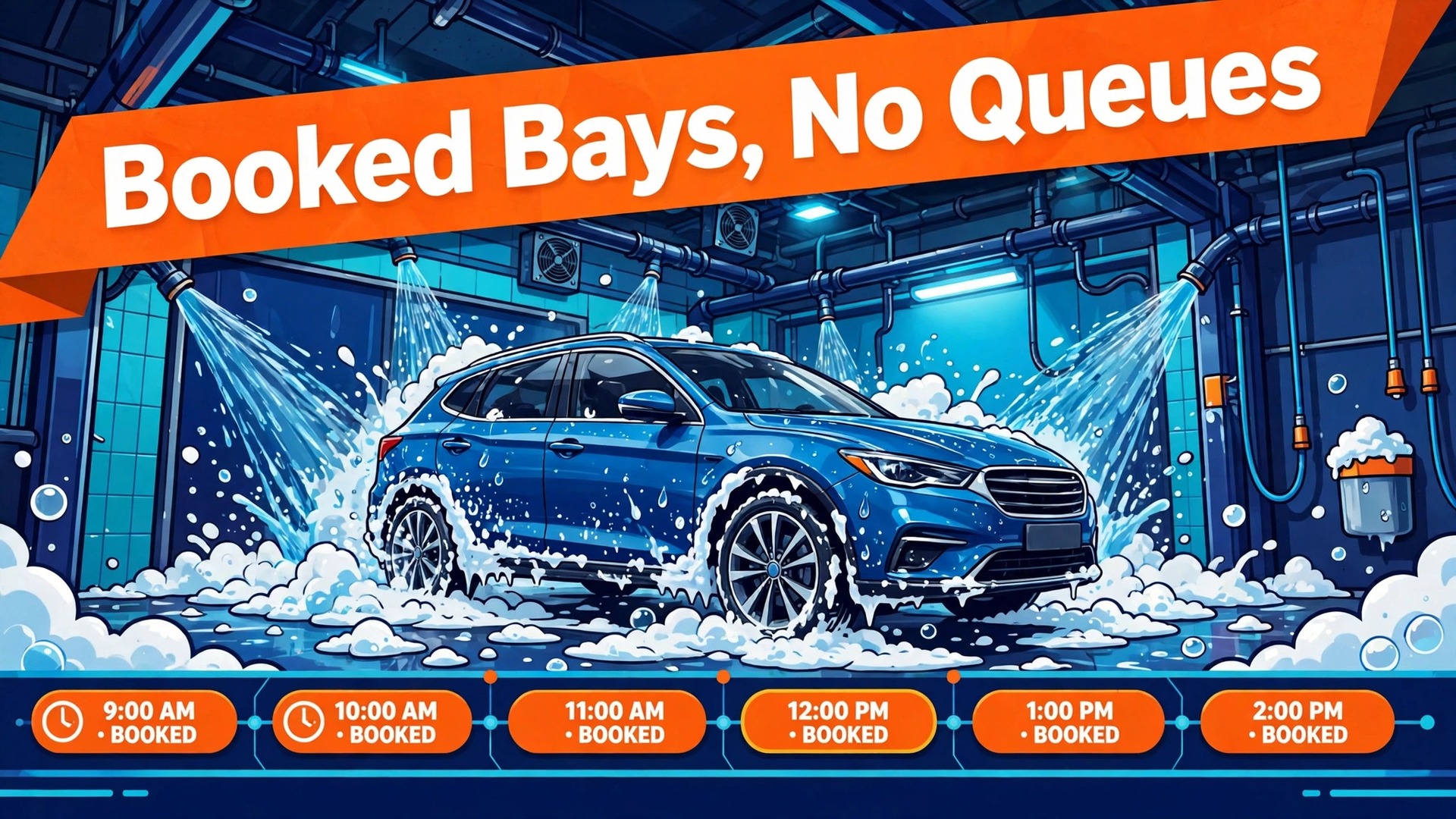
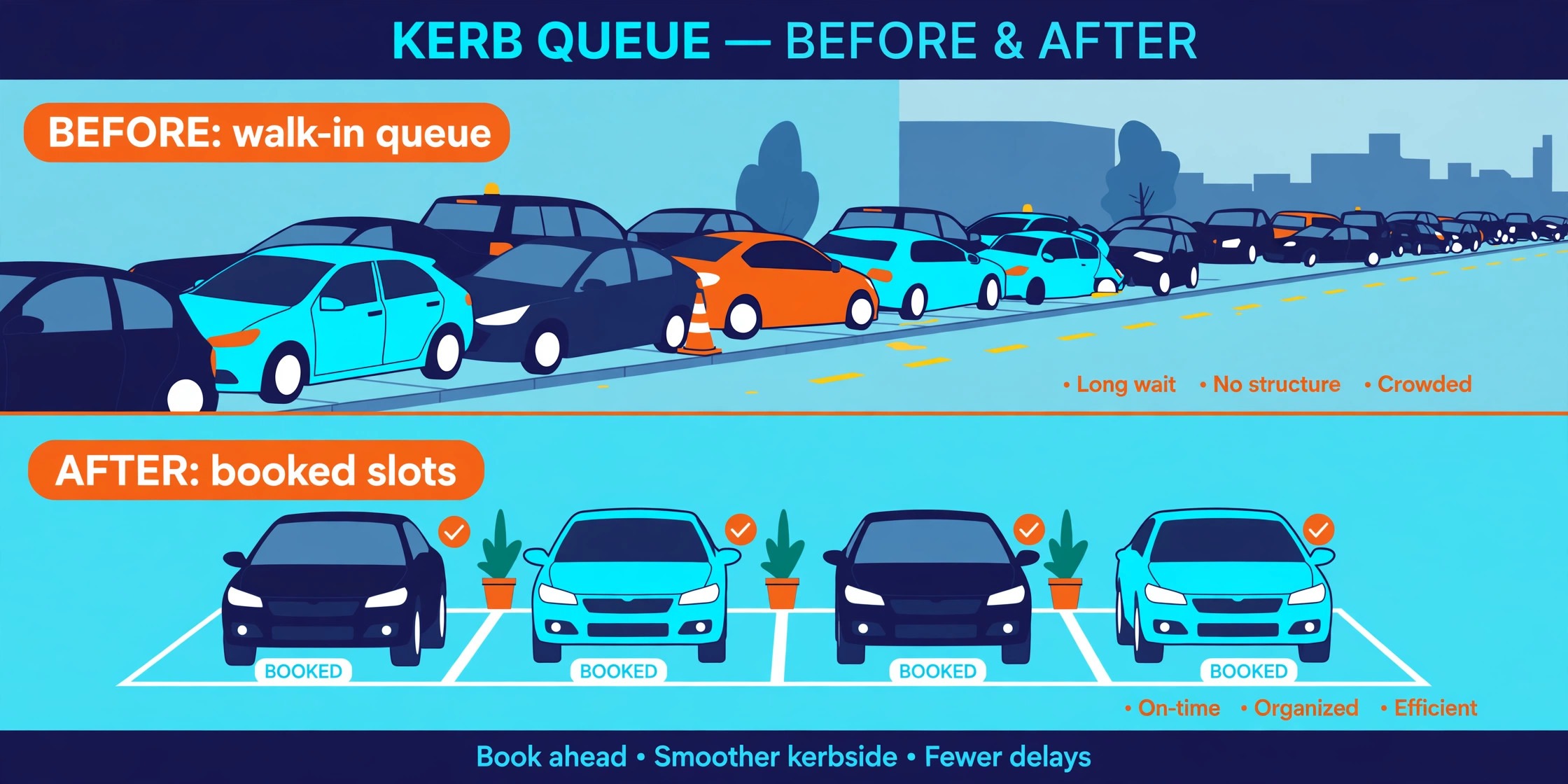
A walk-in queue looks like success until you count what it costs. Cars idle at the kerb, drivers wander off to ask how long the wait is, and your best bay sits empty for twenty minutes because the job before it finished early and nobody knew. Meanwhile a booked-out rival down the road runs a calm, full schedule. The difference is rarely better soap or faster staff. It is that one business sells time in advance and the other hopes people turn up in the right order. When you use AI for car wash booking management, you move from hoping to planning. Customers pick a slot, pick a package, get reminded automatically, and arrive when a bay is actually free.
This guide builds that system from the ground up. It covers how to set slot lengths, how to price package tiers so customers rebook, how to write reminders that cut no-shows, and how to survive Saturday mornings and rainy-week backlogs without turning drivers away. It also compares real booking tools with published prices, so you can pick one that fits a single bay or a multi-bay site. Every step can be running within a week.
Why Walk-In Queues Cost a Car Wash Real Money
A queue feels free because nobody pays to stand in it. In practice it leaks money in four places. First, uncertain waits push drivers away. A driver who cannot see a wait time will often drive on rather than risk a forty minute delay before work. Second, idle gaps appear between jobs. One car leaves early, the next has not arrived, and a bay earns nothing for half an hour. Third, peak bunching overloads staff. Five cars arrive at once after a dry Saturday morning, quality drops, and the last driver in line gets a rushed wash. Fourth, you learn nothing.
Without bookings you have no record of who came, what they bought, or when they are due back, so repeat business depends on memory and luck.
Booked slots fix all four leaks at once. A driver who holds a 10 am slot is far more likely to show up than a driver who only intended to drop by. Gaps shrink because the schedule shows exactly when each bay frees up. Staff can be rostered to the booked load instead of guessed demand. And every booking becomes a customer record you can use for reminders, packages and win-back offers. None of this requires fancy technology. A booking page, a calendar and automatic reminders are enough to change the shape of a week.
How to Use AI for Car Wash Booking Management Without Overhauling Your Day
The phrase sounds grander than the reality, and that is good news. In this context, AI means software that handles the repetitive decisions in your booking flow. It suggests the next free slot instead of making a customer guess. It sends reminders without you remembering. It spots a quiet Tuesday morning and offers a discount to fill it. It flags a customer who used to come every fortnight and has not booked in six weeks. You still wash the cars. The software handles the diary.
Start with the four jobs that matter most. Slot management decides which services fit in which bays and for how long. Package management sells bundles and memberships instead of one-off washes. Reminder management keeps the diary full by cutting forgetfulness. Demand management moves bookings away from crush periods and into quiet ones. A tool that covers those four jobs well beats a tool with fifty features you never open.
The Booking Workflow, From First Tap to Finished Wash
A good workflow has no dead ends. Every step tells the customer what happens next, and every step gives your team the information they need. The flow below is also the clearest picture of what happens when you use AI for car wash booking management in daily work, since the software handles nearly every step for you. Here is the version that works for most small washes, whether fixed-site or mobile.
- Discovery. The customer finds your booking link on Google, social media, a flyer or a QR code at the wash. The link opens a page that shows services, prices and the next available slots, with no account creation forced up front.
- Service choice. The customer picks a service and adds extras such as wax, interior cleaning or pet hair removal. Each service carries a fixed duration, so the calendar blocks the correct bay time automatically.
- Slot choice. The calendar shows only real availability. Fully booked times are greyed out rather than offered and then rejected, which is one of the fastest ways to lose trust.
- Vehicle details. The customer adds make, model, colour and registration, plus any notes such as a roof box, a dog guard or heavy mud. These details let your team prepare before the car arrives.
- Payment or deposit. The customer pays in full or leaves a deposit, depending on your policy. Deposits matter most for long detailing jobs, where a no-show wastes hours rather than minutes.
- Confirmation and reminders. The system sends an instant confirmation, then reminders before the appointment. The customer can reschedule from the message without phoning you.
- Arrival and handover. Staff see the booking on a bay screen or tablet, check the car in with one tap, and mark the job complete when it is done. That completion triggers a thank you message and, a few days later, a rebooking prompt if you have one set up.
Notice what is missing from that list. There is no phone tag, no paper diary to decipher, and no moment where a customer has to guess whether a slot is really theirs. Each step removes one phone call from your day, and for a two or three person team, those saved calls are the difference between washing cars and answering questions about washing cars.

Mobile rounds need one extra step
If you run a mobile wash, add a route step between booking and arrival. Group nearby bookings into a single round, confirm the order of stops the evening before, and send each customer a short arrival window rather than an exact minute. A route that clusters four jobs within a few miles beats one that zigzags across town, and customers accept a window happily when the alternative is a vague all-day wait. Check route planning in a trial if mobile work is a large share of your income.
Setting Up Slots That Match Your Real Capacity
When you use AI for car wash booking management, the slot grid is the product, and it is where most new systems fail, because operators copy a generic calendar instead of their own bay reality. A slot is not just a time. It is a bay, a service duration, a buffer and a staff member, all lined up at once. Get one wrong and the diary looks full while the site falls behind.
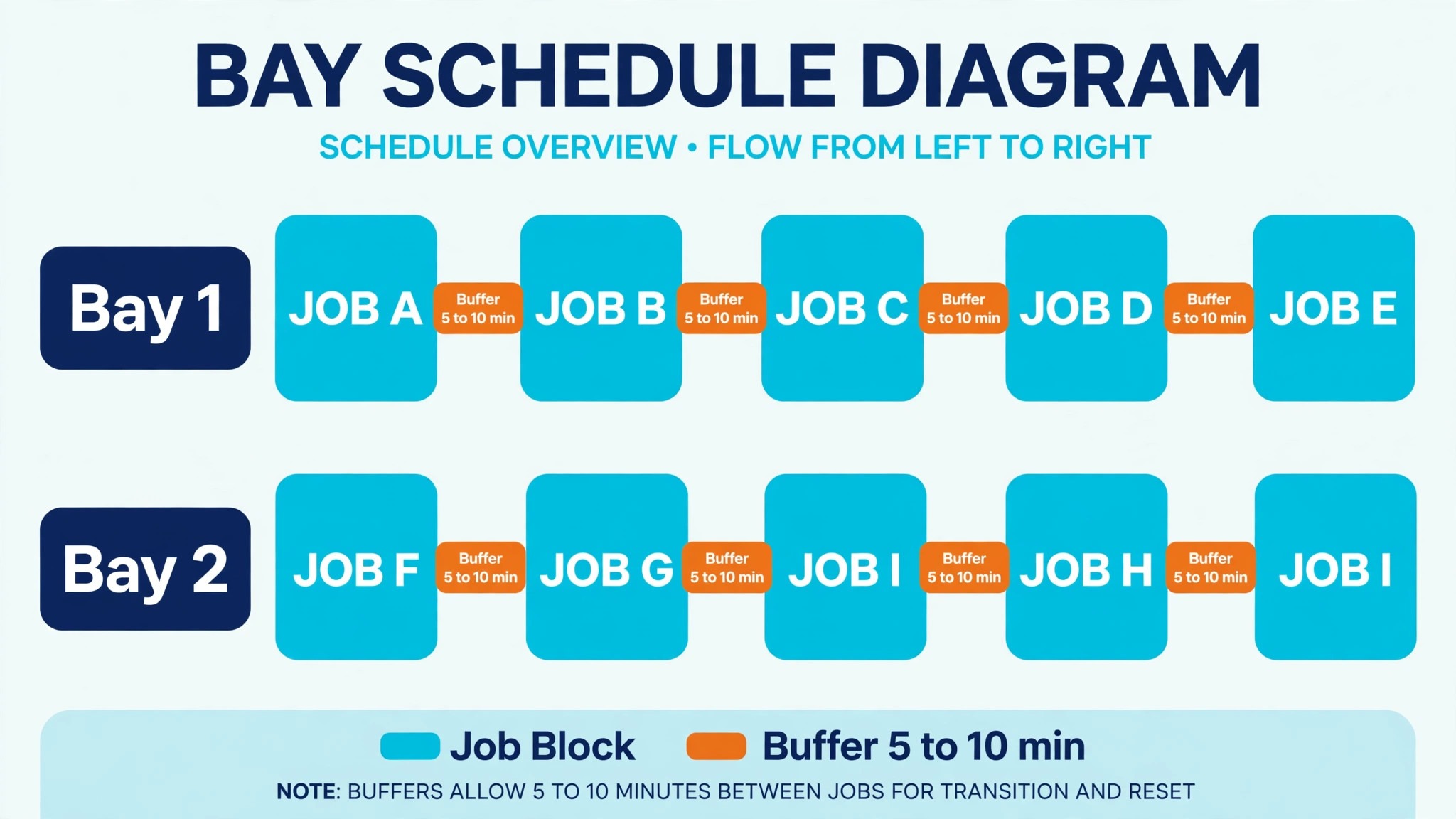
Start by timing your real jobs. An express exterior wash may take fifteen minutes, a full wash with interior work may take forty five, and a full detail can run two to three hours. Time ten jobs of each type across different staff members and use the slower end of the range, not the fastest. A diary built on your fastest worker will run late every day. Then add a buffer of five to ten minutes between jobs for handover and inspection. Buffers look wasteful on a screen, but they are what keep a 10 am booking from becoming an 11 am apology.
Build the grid around bays, not staff
If you have two bays, you have two parallel slot grids, even if one person moves between them. A detailing job that occupies a bay for two hours blocks that bay for two hours, whatever the staffing looks like. Tools that schedule by staff only will happily double book a single bay, so check during your trial that the tool blocks bay time. For mobile teams, the equivalent of a bay is a van and a worker pair, so the same rule applies.
Decide your booking rules before you open the diary
Four rules prevent most diary arguments. First, a cut-off time for same-day bookings, so a 9 am slot cannot be grabbed at 8.55 am while your team is setting up. Second, a cancellation window, such as free cancellation up to twelve hours before, with deposits kept after that point. Third, a late arrival rule, such as a fifteen minute grace period before the slot is released. Fourth, a maximum advance booking window, such as four weeks, which keeps the diary honest. Publish these rules on the booking page itself. Customers accept rules they can see.
Package Tiers and a Template Customers Actually Rebook
Single washes sell once. Packages sell the second, third and tenth visit, and that habit is the commercial reason to use AI for car wash booking management, since packages only pay off when renewals and reminders run themselves. A good tier structure gives every customer an obvious next step up, without making the cheapest tier feel like a punishment. Three or four tiers are enough. More than that and the booking page turns into a comparison exercise that drivers abandon.
A workable structure for a small wash looks like this. Express covers the exterior, wheels and windows for drivers who want a quick refresh. Full adds interior vacuuming, dashboard cleaning and door jambs. Detail adds deep interior work, wax and trim care for drivers preparing a car for sale or a long trip. Membership turns the best tier into a monthly plan with a set number of washes. Each tier should name exactly what is included, because vague tier names are the top cause of “I thought that was included” arguments at pickup.
Copy this template and replace the example prices with your local rates.
| Tier | What it includes | Example price | Best for |
|---|---|---|---|
| Express | Exterior wash, wheels, windows, tyre dressing | 12 | Weekly drivers who want a quick refresh |
| Full | Everything in Express plus interior vacuum, dashboard and door jambs | 25 | Family cars and commuters every fortnight |
| Detail | Everything in Full plus deep interior clean, wax and trim care | 60 | Cars before a sale, a trip or a special event |
| Monthly plan | Two Full washes per month, priority slots, free air freshener | 40 per month | Regulars who want a standing habit |

Sell the plan at the moment of delight
The best time to offer a membership is not at the till with a script. It is in the thank you message after a great wash, when the car looks its best and the customer is happiest. A message that says the same wash next month is already reserved, at the member price, converts far better than a leaflet handed over with the keys. The same logic applies to rebooking prompts. A prompt sent three weeks after a Full wash, offering the customer’s usual slot, feels like service. A generic discount blast sent to everyone feels like spam.
Add-ons belong outside the tiers
Wax, ceramic spray, pet hair removal, odour treatment and engine bay cleaning work best as add-ons at checkout, not as extra tiers. Add-ons let a regular upgrade one visit without changing their package, and they protect your base prices from creeping upward. Keep the add-on list short, five or six items at most, and price each one with a duration attached, so a fifteen minute add-on extends the bay booking automatically.
Reminders That Cut No-Shows Without Annoying Customers
No-shows are the quiet tax on a wash diary. An empty slot at 11 am cannot be sold at 11.05 am, and a day with three no-shows can turn a profitable Saturday into a loss. Reminders are the cheapest fix available, because most no-shows are forgetfulness, not bad intent. This is one of the most immediate wins when you use AI for car wash booking management, because the software sends every reminder on time without you remembering a single one.
A sequence that works well is three touches. The confirmation arrives instantly at booking and repeats the date, time, service and address. A reminder goes out the day before, with a reschedule link. A final nudge goes out two to three hours before the appointment for same-day reassurance. Each message should let the customer reschedule in one tap. A customer who reschedules frees the slot for someone else. A customer who simply does not turn up frees nothing.

Timing beats wording
Operators often obsess over reminder wording and ignore timing. A reminder sent a week early is forgotten. A reminder sent ten minutes before is useless. For washes, the day-before message does most of the work, because it lands while the customer can still rearrange their day. For long detailing jobs, add a second reminder two days before, since those customers need more notice. Watch your own no-show rate by reminder step for a month, and only add a same-day nudge if mornings still suffer.
Deposits change behaviour for long jobs
For a fifteen minute express wash, a deposit creates more friction than it saves. For a two hour detail, a deposit is sensible protection. A small deposit, or full prepayment for detailing, turns a vague intention into a commitment, and it gives you a fair policy when someone cancels late. State the deposit rule on the booking page and in the confirmation, not as a surprise at checkout. Customers accept a deposit they understood when booking. They dispute one they did not see coming.
Handling Peak Days Without Turning Drivers Away
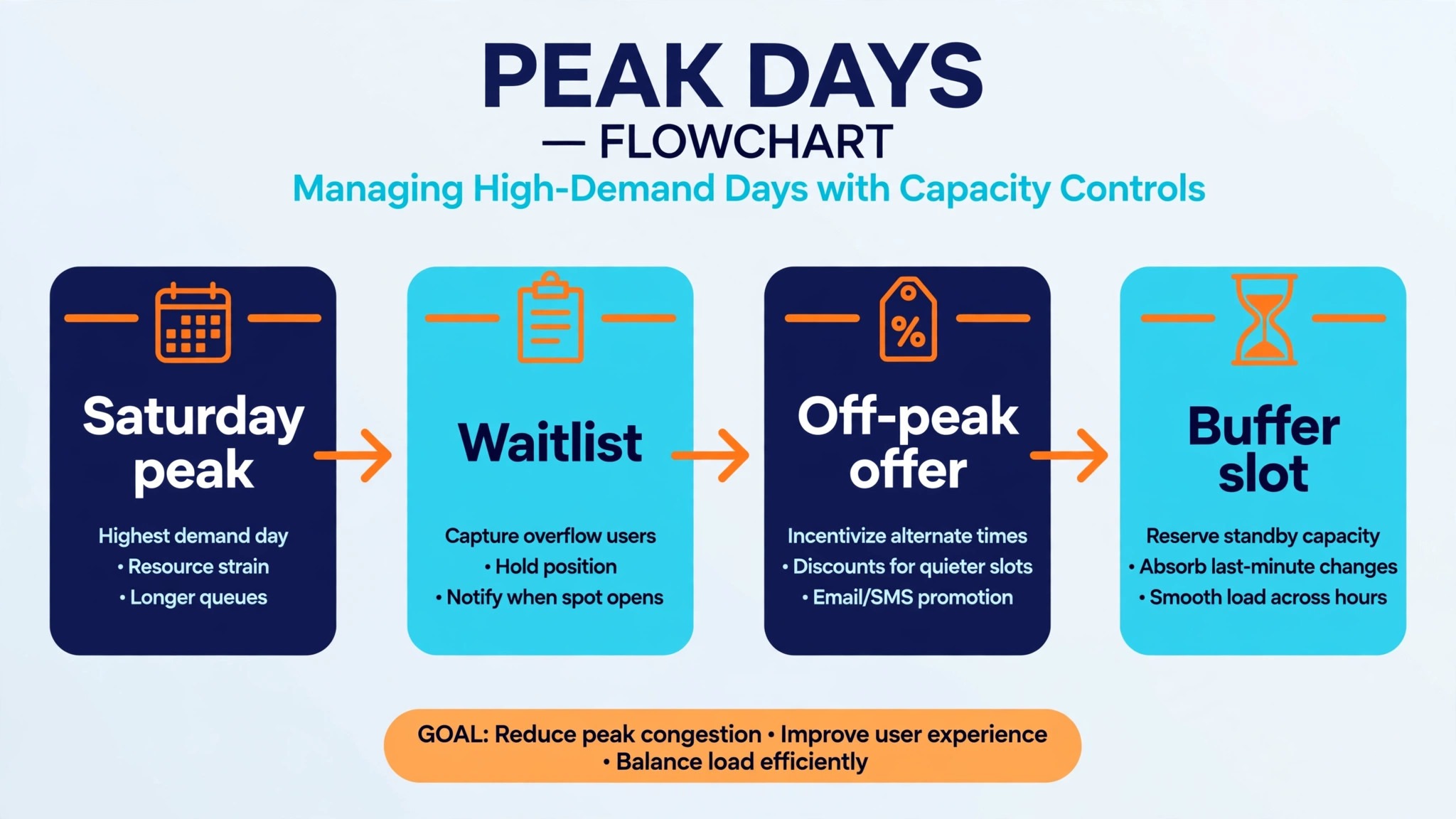
Every wash has a crush period, usually Saturday morning, the first dry day after a rainy week, and the days before a holiday. Peak handling is not about working harder for four hours. It is about moving demand to the edges of the peak and protecting quality in the middle of it.
Start by pricing the edges. A small discount for weekday mornings or late afternoons pulls flexible customers out of Saturday, and a waitlist captures the drivers you cannot fit. When a Saturday slot frees up through a cancellation, the waitlist fills it within minutes if the offer goes out by text. That kind of demand shifting is hard by hand and easy when you use AI for car wash booking management, since the system can offer off-peak prices and run the waitlist without staff intervention.
Cap the diary below maximum
A diary booked to one hundred percent looks great on Friday night and falls apart on Saturday. Leave one buffer slot per bay per peak day, held back for overruns, late arrivals and the loyal regular who phones in a panic. That buffer slot is not lost income. It is the reason the rest of the day runs on time, and it can be released for booking a few hours ahead if the day is running smoothly. Operators who run at full capacity all day also burn out staff, and tired staff produce the swirl marks and missed door jambs that cost you reviews.
Weather is a demand signal, not an excuse
Rain changes wash demand more than any promotion. A dry forecast after a wet week is your biggest booking day, so watch the forecast on Thursday and open extra slots or extend hours for the weekend before customers start phoning. A wash booked during a downpour will often no-show, so a same-day message offering a free move to the next dry day saves both the slot and the relationship. Some tools help here too. Anolla offers a dynamic pricing module that adjusts wash package rates by time of day, day of the week, season and weather, which suits washes whose demand swings with the forecast.
Booking Tools Compared, With Real Published Prices
Tool choice matters less than diary discipline, but the wrong tool will fight you every day. Judge any tool on how well it lets you use AI for car wash booking management day to day, not on a feature list you will never open. The tools below all offer online booking, reminders and service menus, and their prices come from their published pricing pages at the time of writing. Confirm the current rate before you subscribe, since booking tools change prices more often than most software.
Bookeo is the most flexible general booking tool for a wash. Its car wash booking pages run on a flat monthly subscription with no commission per booking. Plans start at 14.95 dollars per month for Solo, which covers one staff login and 200 bookings a month, and rise through Small at 29.95 dollars, Standard at 39.95 dollars, Large at 79.95 dollars and X-Large at 119.95 dollars for larger operations. A 30 day free trial needs no card, and paid plans carry a 30 day money back guarantee. Bookeo suits both fixed sites and mobile operators, with staff rosters, recurring visits and automatic email and text reminders.
DetailCommand is built specifically for detailing businesses. Starter costs 390 dollars per year, about 32 dollars per month, and covers up to 100 appointments a month, 250 customer records, a booking page, email and text reminders with 50 texts a month, invoicing and card payments. Pro costs 690 dollars per year, about 58 dollars per month, with unlimited appointments and customers, a customer self-service portal and 200 texts a month. Business costs 890 dollars per year, about 74 dollars per month, adding multi-location scheduling and unlimited texts. Every plan includes a 14 day free trial with no card required.
AutoHustl is a car wash booking tool with a booking page, customer records, invoicing and text and email reminders. Paid plans start from 39 dollars per month, with a free trial on all plans and no card required. It is a strong fit for a small wash that wants wash-specific features without paying for a general platform it will only half use.
Square Appointments suits a wash that already takes card payments through Square. The free plan covers a single location with online booking and reminders, while Plus costs 49 dollars per month per location and Premium costs 149 dollars per month per location. Card processing on the free plan runs at 2.6 percent plus 15 cents in person and 3.3 percent plus 30 cents online. The free plan removes the cost question at the start, but check the transaction fees against your volume, since they rise with every wash you sell.
WashPro is a budget option at 9.99 dollars per month per business, with appointment scheduling, customer and vehicle tracking, a live queue display, loyalty campaigns and staff commission tracking. It is designed for staff on the wash floor rather than for back office admin, and it works offline before syncing, which matters on sites with patchy signal. Anolla rounds out the list with a free starting plan, an AI assistant that answers customer chats around the clock, and dynamic pricing for packages and seasonal offers, which suits hybrid businesses that mix fixed site work with mobile rounds.
| Tool | Starting price | Standout strength | Watch out for |
|---|---|---|---|
| Bookeo | 14.95 dollars per month | Flat fee, no per booking commission | Booking limits on the cheapest plan |
| DetailCommand | About 32 dollars per month | Built for detailers, invoicing included | Yearly billing on all plans |
| AutoHustl | 39 dollars per month | Wash specific features and reminders | Smaller ecosystem than general tools |
| Square Appointments | Free for one location | Payments built in from day one | Processing fees rise with volume |
| WashPro | 9.99 dollars per month | Floor friendly, works offline | Fewer back office reporting features |
| Anolla | Free plan available | AI chat assistant and dynamic pricing | Pricing for larger plans varies by setup |

How to choose in ten minutes
Pick Bookeo if you want the cheapest flexible diary with no commission. Pick DetailCommand if detailing jobs dominate your income and you need invoicing built in. Pick AutoHustl if you want wash-specific software without a learning curve. Pick Square if you already run Square payments and want one system for bookings and till. Pick WashPro if budget is tight and your team works from the floor. Run the free trial of your top two choices with real services and real slot lengths, and choose the one your team actually opens every morning. The tool your staff ignores is the wrong tool at any price.
The Mistakes That Undo a New Booking System
Most booking systems fail for boring reasons, not technical ones. The slot lengths are copied from a guess instead of timed. The booking page is buried three clicks deep on a social profile. Reminders are switched on but never tested, so customers get a confirmation with the wrong address. The diary is opened for bookings before staff know how to check a car in. The common thread is that nobody checked whether the team could use AI for car wash booking management in daily work before the diary went live. Each of these is fixable in an afternoon, but only if you look for them before launch.
Run this checklist in launch week. Book a wash from your own phone on mobile data. Check that the confirmation shows the right address, service and price. Send yourself the reminder sequence and read every message. Train every staff member to check in a car and mark a job complete. Print the QR code and put it at the till, on the door and on your vehicle if you run mobile rounds. Set the cancellation window and deposit rule, then test a cancellation yourself to see what the customer experiences. Finally, decide who owns the diary each day. A diary with no owner drifts. A diary with one named owner stays accurate.
Customer records deserve the same care as the diary. Every booking should capture a name, a phone number, a vehicle and a service history. That record is what turns a one-off wash into a repeat customer, and it is what makes reminder and rebooking messages feel personal instead of generic. If you want a deeper comparison of record keeping options, the guide to the best CRM software for small business sets out the leading choices for small teams. For detailing add-ons and interior services, the roundup of the best AI tools for car detailing businesses is a useful companion read.
If this system appeals to you, the next step is to connect it with the rest of your small business setup. The guide to the best AI workflow automation tools for small business shows how booking, reminders and follow up messages can run as one automated flow, and the companion piece on the best AI tools for car detailing businesses covers the detailing services that pair well with a package membership. Read those two next, then build your slot grid before you choose a tool, since the grid decides which features you actually need.
Frequently Asked Questions
Do I need a booking system if most of my customers are walk-ins?
Walk-ins will not disappear, and a booking system should not try to remove them. The point is to protect part of your day with booked work, so walk-ins fill the gaps instead of causing the queue. Many washes start by making half their bays bookable and keeping the rest for walk-ins, then adjust the split once they see which side earns more. Keep a walk-in lane open and let the diary handle the rest.
How far ahead should customers be able to book?
Four weeks ahead works well for most small washes. It is long enough for customers to plan a weekend wash, and short enough that speculative bookings do not clog the diary. For detailing jobs that need parts or a full day, six weeks is reasonable. Whatever window you choose, publish it on the booking page so customers are not surprised when dates beyond it are greyed out.
What should I do when a customer no-shows twice?
Contact them once, politely, and ask whether the reminder timing or the slot itself was the problem. Some no-shows are a wrong number or a reminder that went to spam. If it happens again, require a deposit or full prepayment for their next booking. A policy applied calmly and consistently keeps the customer while protecting your diary. Never argue about a no-show at the kerb in front of other customers.
Should I charge a deposit for every wash?
No. Deposits make sense for long detailing jobs where a no-show wastes hours, but they add friction to a fifteen minute express wash that a customer might otherwise book on impulse. Use deposits where the cost of an empty slot is high, and keep short washes as easy to book as possible. State the deposit rule clearly on the booking page so nobody discovers it at checkout.
Can a booking tool handle both a fixed site and mobile rounds?
Yes, if you check that feature in the trial. The tool needs separate calendars for the site and each van, plus a way to group mobile bookings into a route. Bookeo and Anolla both support mobile operators alongside fixed sites, and WashPro plans mobile days as routes with arrival and departure times per stop. Test a mixed week in the trial, with site bookings and mobile stops on the same day, before you commit.
How do I keep regular customers from drifting to a cheaper wash?
Regulars stay for convenience and recognition, not for the lowest price. A booking history that remembers their car, their usual service and their preferred slot makes rebooking effortless, and a membership that reserves their slot each month makes leaving feel like work. Add a small loyalty benefit, such as every tenth wash free or a free wax after three months, and send the offer when the customer is due, not as a random blast. Convenience plus recognition beats a one dollar discount.
Your First Booked Week
You do not need a perfect system to start. You need a booking page, a slot grid built from timed jobs, a reminder sequence you have tested on your own phone, and a package template with three tiers and one membership. That is the whole point when you use AI for car wash booking management. The software carries the diary so your team can carry the wash. Set those four pieces up this week, open half your bays to bookings, and keep the rest for walk-ins while you learn. Watch three numbers for a month, namely no-shows, empty bay minutes and repeat bookings, and adjust one rule at a time until all three move in the right direction.
A calm diary, a full Saturday and customers who arrive knowing their slot is waiting are worth more than any single promotion, and they compound. Every booked week makes the next one easier to fill.