
The problem is sitting on your rails right now. A rack of beautiful items that nobody buys, because each one is priced a little too high, while the consignors who trusted you with those items wait months for a payout that never arrives. At the same time, a different rack moves fast, because those items were priced too low, and you and your consignors both earned less than the items were worth. That twin failure, overpricing that stalls and underpricing that leaks, is the central pricing problem in consignment, and it is why shops that use AI for consignment shop inventory pricing with clear rules do better than shops that price by gut feel.
The root cause is not laziness. It is scale. A consignment shop may hold thousands of one of a kind items, each from a different consignor, each with a different condition, brand, size and season, and each needing a price, a markdown date and a payout calculation. No single person can hold all of that in their head, and a spreadsheet that only one staff member understands will break the week that person is away. This guide shows how to use AI for consignment shop inventory pricing in a disciplined way, so pricing becomes consistent, markdowns happen on time, and payouts become a routine report instead of a monthly crisis.
Consignment is a trust business before it is a retail business. The consignor hands you something they own, and trusts you to price it fairly, sell it honestly, and pay them correctly. Every pricing decision is therefore also a relationship decision. An item priced fairly and sold in six weeks builds a consignor who brings more items. An item priced ambitiously and returned unsold after ninety days builds a consignor who tells friends to avoid your shop. AI helps here not by replacing judgement, but by making judgement consistent, so two staff members pricing the same brand on different days arrive at similar answers, and consignors see a system rather than a mood.
This guide covers the full loop. It starts with intake and grading, moves through opening prices and markdown timing, and ends with payout rules and a pricing rule worksheet you can copy. Figures here are reported examples from vendor pages and shop guides, or ranges to test on your own stock, not guarantees. Check current vendor terms on their own pages before you buy a tool, and test every pricing rule on a small batch of items before you apply it to the whole floor.
The Intake Desk Decides the Price
Pricing starts at intake, not at the tagging table. When an item arrives, the intake conversation sets expectations that no later markdown can fix. The consignor needs to hear, in plain language, the split, the contract length, the markdown schedule, the minimum price, and what happens to unsold items. Shops that skip this conversation get disputes later, and disputes cost more than any single sale is worth. AI can draft the intake script and the contract summary, but a human should have the conversation, because a consignor who feels rushed at intake will not trust the payout later.
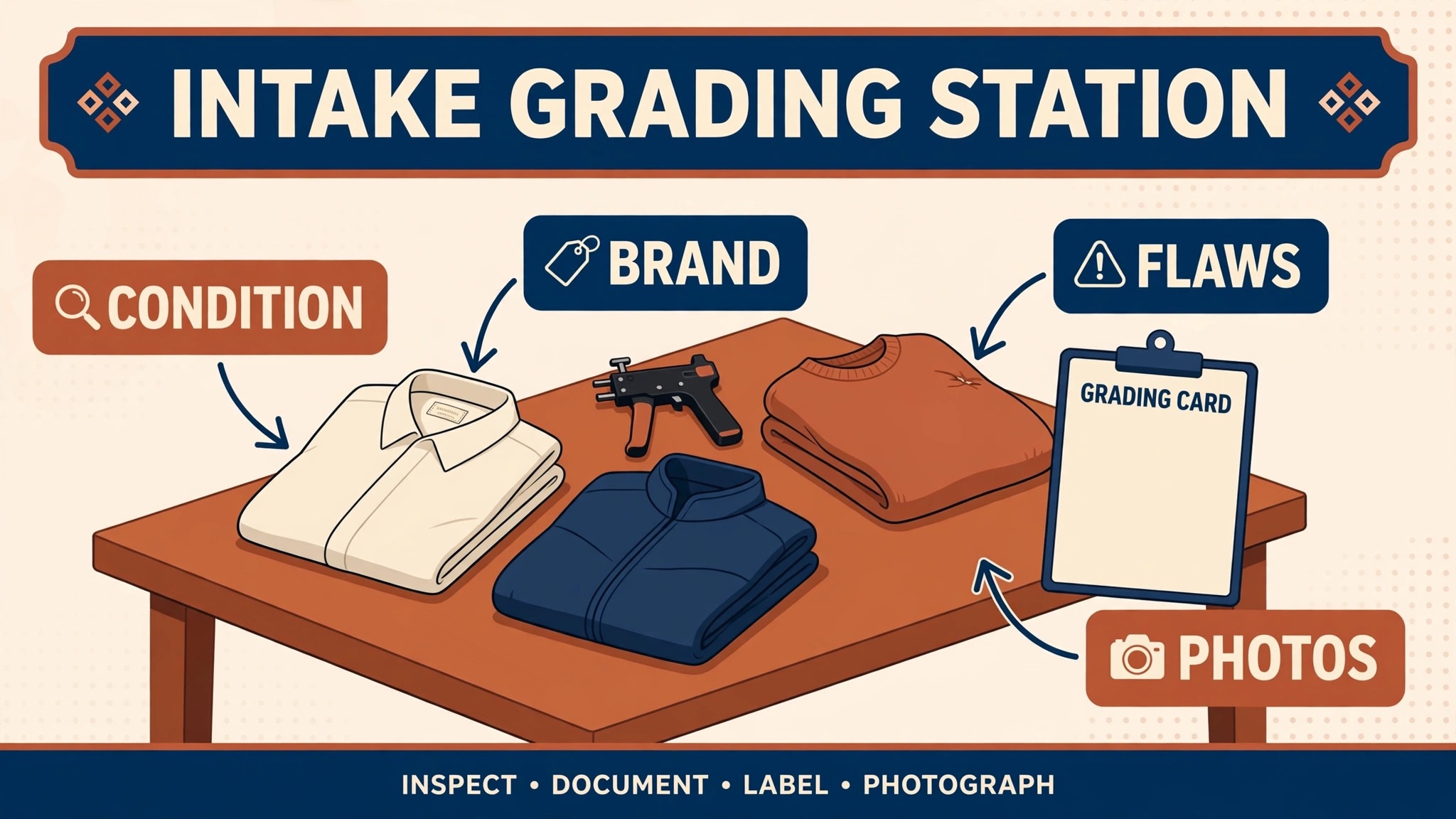
Grading is the second intake job, and it needs a scale every staff member uses the same way. A simple four grade scale works for most shops. New with tags, excellent with no visible wear, good with light wear, and fair with visible wear or a flaw that must be disclosed. Photograph each item in consistent light, note the flaw in plain words, and record brand, size, colour, material and season. AI can help here by drafting the item description from your notes and photos, and by flagging a description that omits a flaw, but it should not invent a brand or a condition grade from a blurry photo. The grade must come from the person holding the item.
Intake volume needs a rule too. A shop that accepts everything will drown in slow stock, and a shop that accepts too little will have empty rails. Set a weekly intake cap based on floor space and selling speed, and set category limits for the season. If coats already fill two rails in September, stop taking coats until some sell, however good the next coat is. AI can track intake against those caps and warn you when a category is full, but the cap itself is a business decision, based on your floor and your sales history, not a number a tool should invent for you.
Finally, record the consignor agreement in a form you can actually find later. The item record should link to the consignor, the agreed split, the contract end date, and the minimum price, so that when an item sells, the payout math is automatic, and when it does not sell, the return or donation decision is clear. Shops that keep consignor terms in a separate notebook, or in one person’s memory, create payout errors. Shops that keep terms on the item record create payouts that consignors can check and trust.
How to Use AI for Consignment Shop Inventory Pricing for a Fair Opening Price
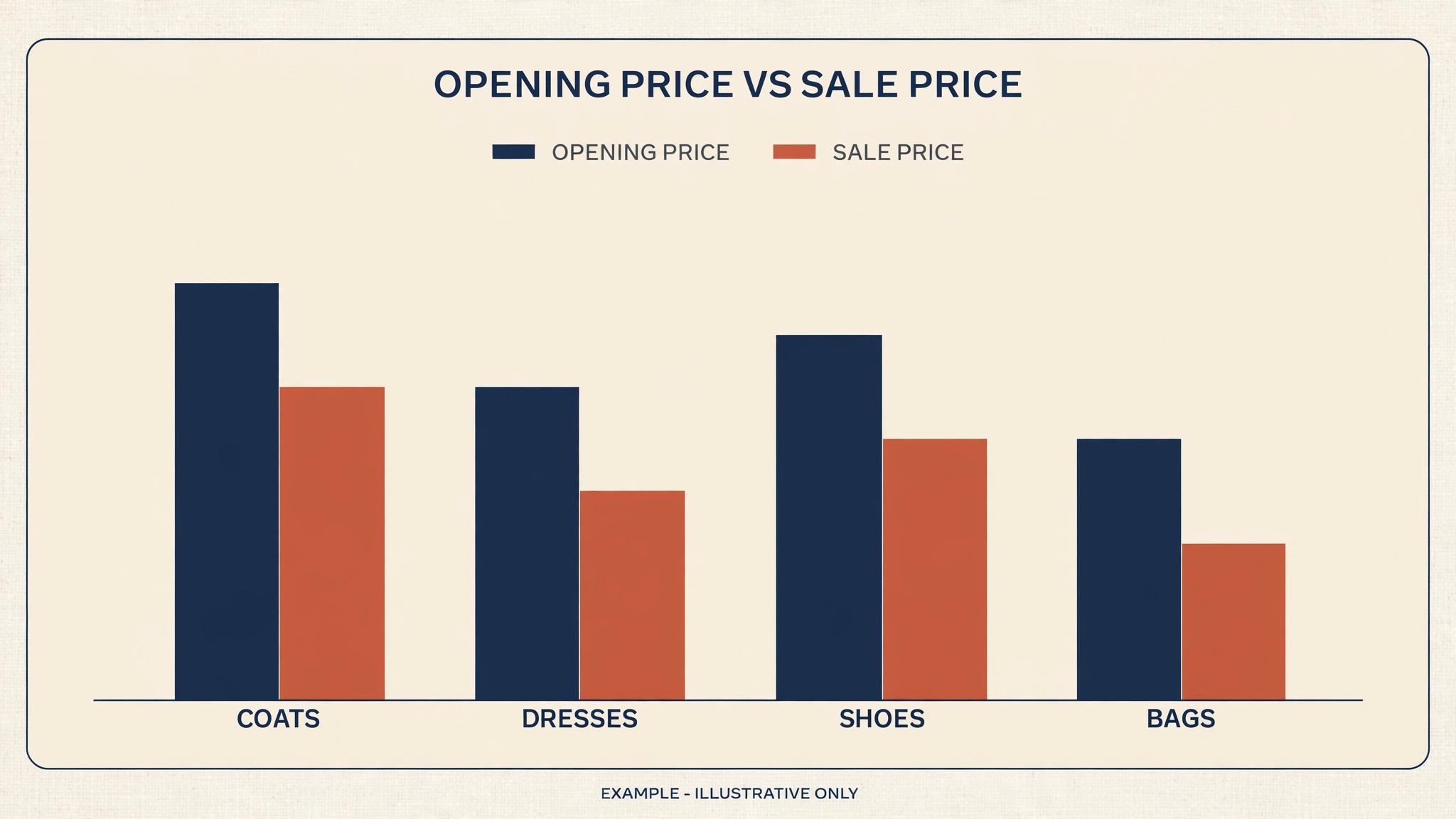
A fair opening price is not the highest price someone might pay. It is the price most likely to sell the item within its contract window, while leaving a reasonable margin for the shop and a reasonable return for the consignor. Consignment guides commonly describe splits in the range of 40 to 60 percent to the consignor, with the shop keeping the rest, and some shops pay a higher consignor share on high value items. Those are reported ranges, not rules, and your split should reflect your rent, labour and selling effort, not a number copied from another shop.
Comparable sales are the best evidence for an opening price, and AI is genuinely useful here. Give it the brand, item type, condition grade and size, and ask it to summarise recent comparable sales from resale marketplaces and your own sales history, with sources noted. Then check the result yourself. A comparable for a different size, a different condition grade, or a different season is not a comparable, and a tool that averages unlike items will mislead you. The right workflow is AI gathers, human judges. A tool that gathers ten comparables in a minute saves real time. A human who spends two minutes checking them prevents real errors.
Season and timing change the answer as well. A winter coat priced in October has a different market from the same coat priced in February, when buyers are already thinking about spring. A formal dress priced before a local events season has a different market from the same dress priced after it. AI can remind you of seasonal patterns from your own sales data, but it cannot know your town’s events calendar unless you tell it. Feed it your local season dates, school terms and event peaks, and its price suggestions will improve. Leave those out, and its suggestions will be generic in exactly the way that costs sales.
Floor placement is the quiet partner of price. An item priced fairly but hung at the back, in poor light, behind larger items, will sell slowly, and the shop may wrongly conclude the price was too high. Before you mark an item down, check its placement, its tag visibility, and whether it has been photographed for your online listings, if you sell online. AI can produce a weekly list of slow items with placement checks attached, so staff review the rail before they cut the price. Cutting the price on a hidden item wastes margin. Moving the item first often solves the problem for free.
Markdown Timing, the Decision Shops Get Wrong Most
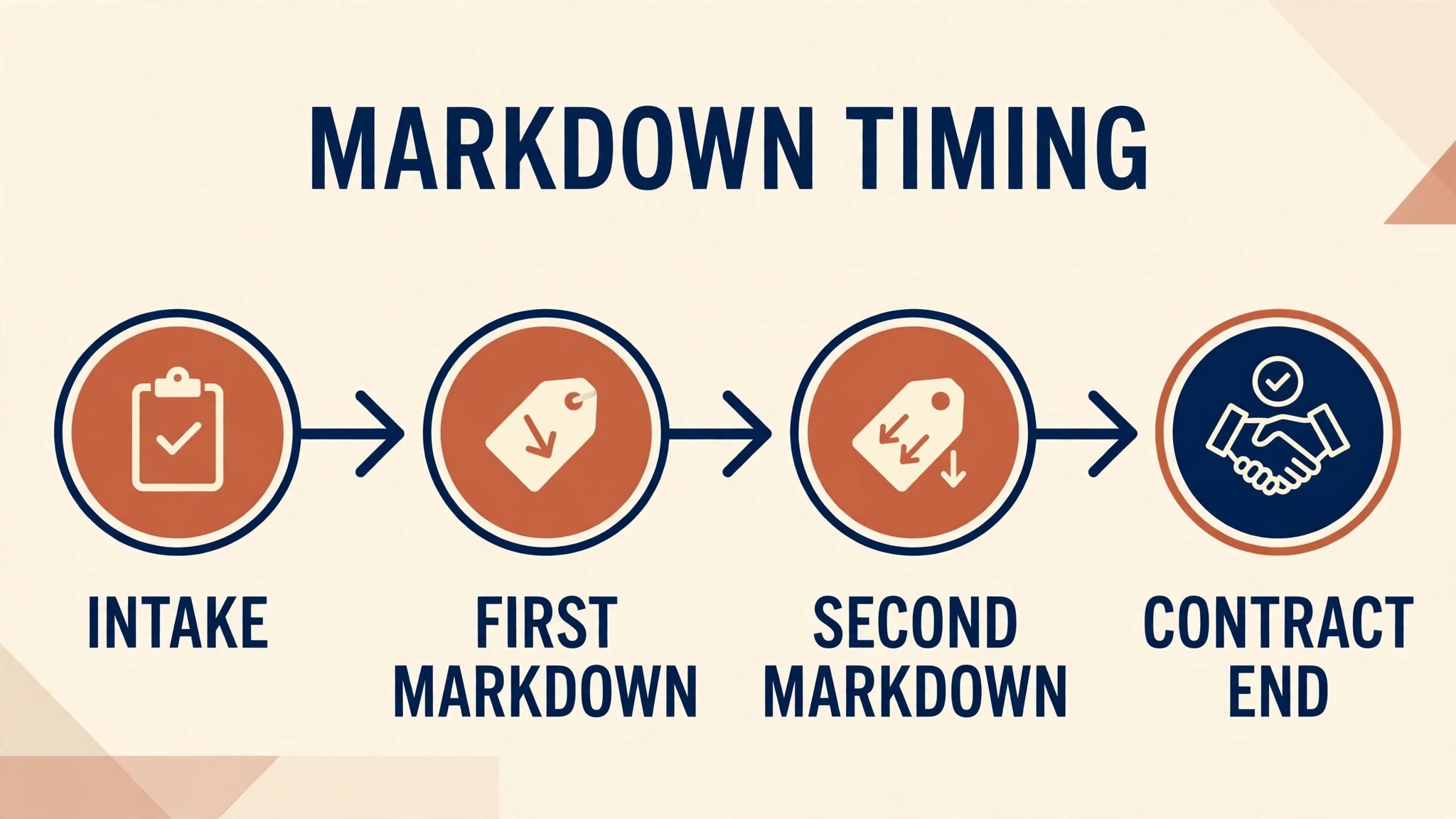
Markdowns are where consignment shops lose the most money, in both directions. Mark down too early, and you give away margin on items that would have sold at full price. Mark down too late, and the item sits past its season, then returns unsold, and both shop and consignor earn nothing. A published schedule, agreed at intake, solves most of this. Many shops use a pattern like a first reduction after 30 days and a second after 60 days, with the contract ending around 90 days. That pattern is widely reported in consignment software guides, and it is a sensible starting point, but you should test it against your own sell through data before treating it as fixed.
AI earns its place in markdown work by building the weekly markdown list, not by deciding the schedule. Each Monday, or whatever day fits your week, the system should list items that have reached a markdown date, their current price, their proposed new price under your rule, and their consignor and minimum price. Staff review the list, check placement and season for the slow items, and approve or hold each markdown. That review step is essential, because a blanket automatic markdown will cut prices on items that only needed moving to a better rail, or on items whose season is about to start.
Minimum prices protect consignors and the shop alike. At intake, agree the lowest price an item may reach before it is returned or donated, and record it on the item record. AI should never propose a markdown below that minimum without flagging it, and staff should never approve one without contacting the consignor. A consignor who discovers their item sold for far less than they expected will not return, and a shop that sells below the agreed minimum has broken a promise, even if the sale itself felt like progress. The minimum price is a trust boundary, and tools must respect it visibly.
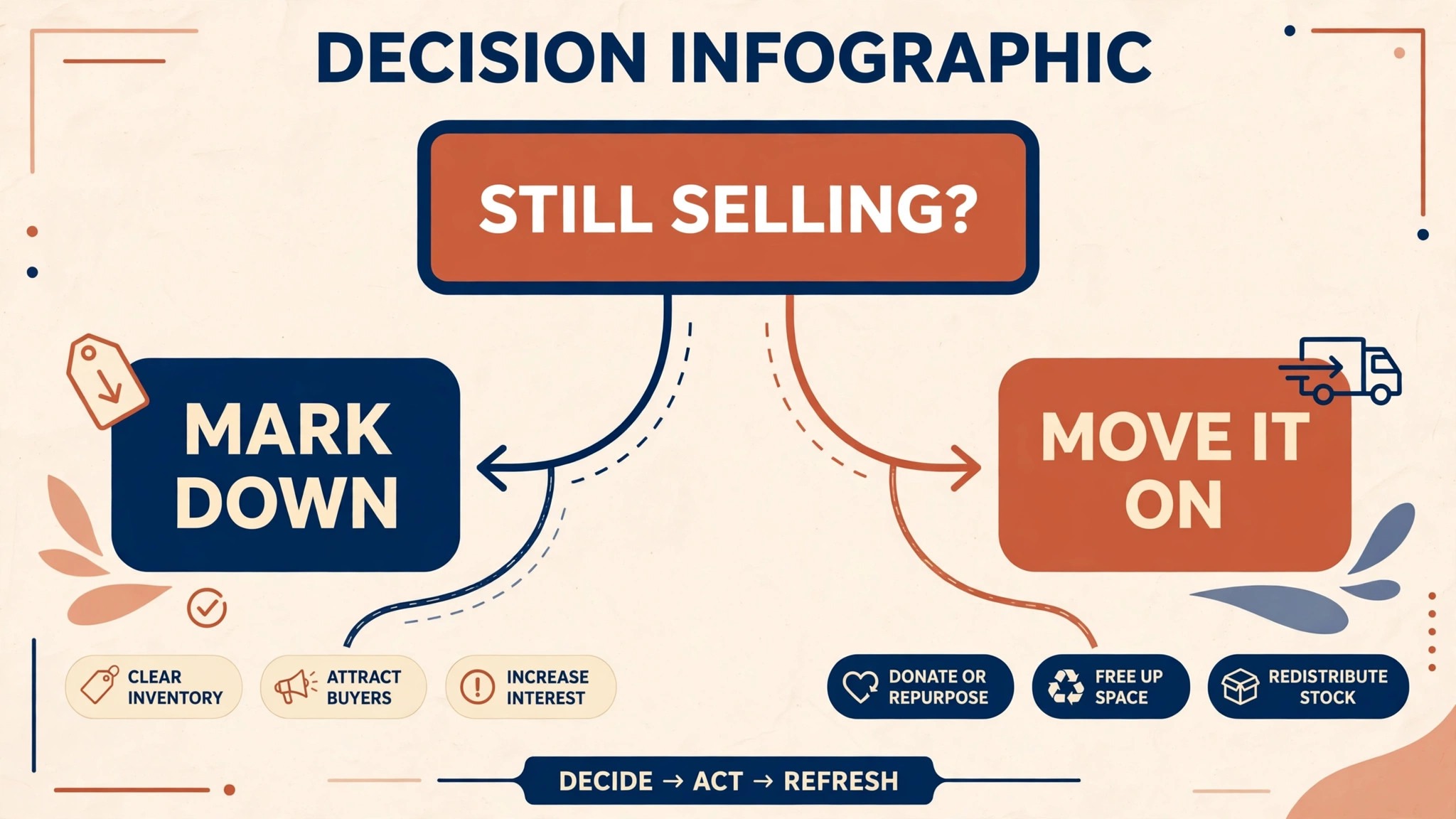
End of contract handling needs the same discipline. When an item reaches its contract end unsold, the consignor should hear promptly, with a clear choice, collect the item by a stated date, donate it, or extend the contract at a new price. AI can draft that message and list the items due for collection each week, but the message should go out on time, every time, because late return messages are a common source of consignor complaints. A shop that returns unsold items promptly and politely keeps consignors. A shop that keeps unsold items in a back room for months loses them, and often loses the items as well.
| Stage | Timing | Action | Who decides |
|---|---|---|---|
| Intake | Day zero | Grade, photograph, agree split and minimum | Staff with consignor |
| Opening price | Day zero | Price from comparables and season | Staff, AI gathers evidence |
| First markdown | Around day 30 | Reduce by your rule, after placement check | Staff approves list |
| Second markdown | Around day 60 | Reduce again, or move online or to a feature rail | Staff approves list |
| Contract end | Around day 90 | Return, donate or extend at a new price | Consignor chooses |
A Step Workflow From Drop Off to Payout
The workflow below assumes a small shop with two or three staff, a consignment system that tracks items and splits, and AI used for drafting, listing and summarising, with human approval at every money decision. Keep the order, and keep the approval steps, because the approval steps are what keep automation honest.
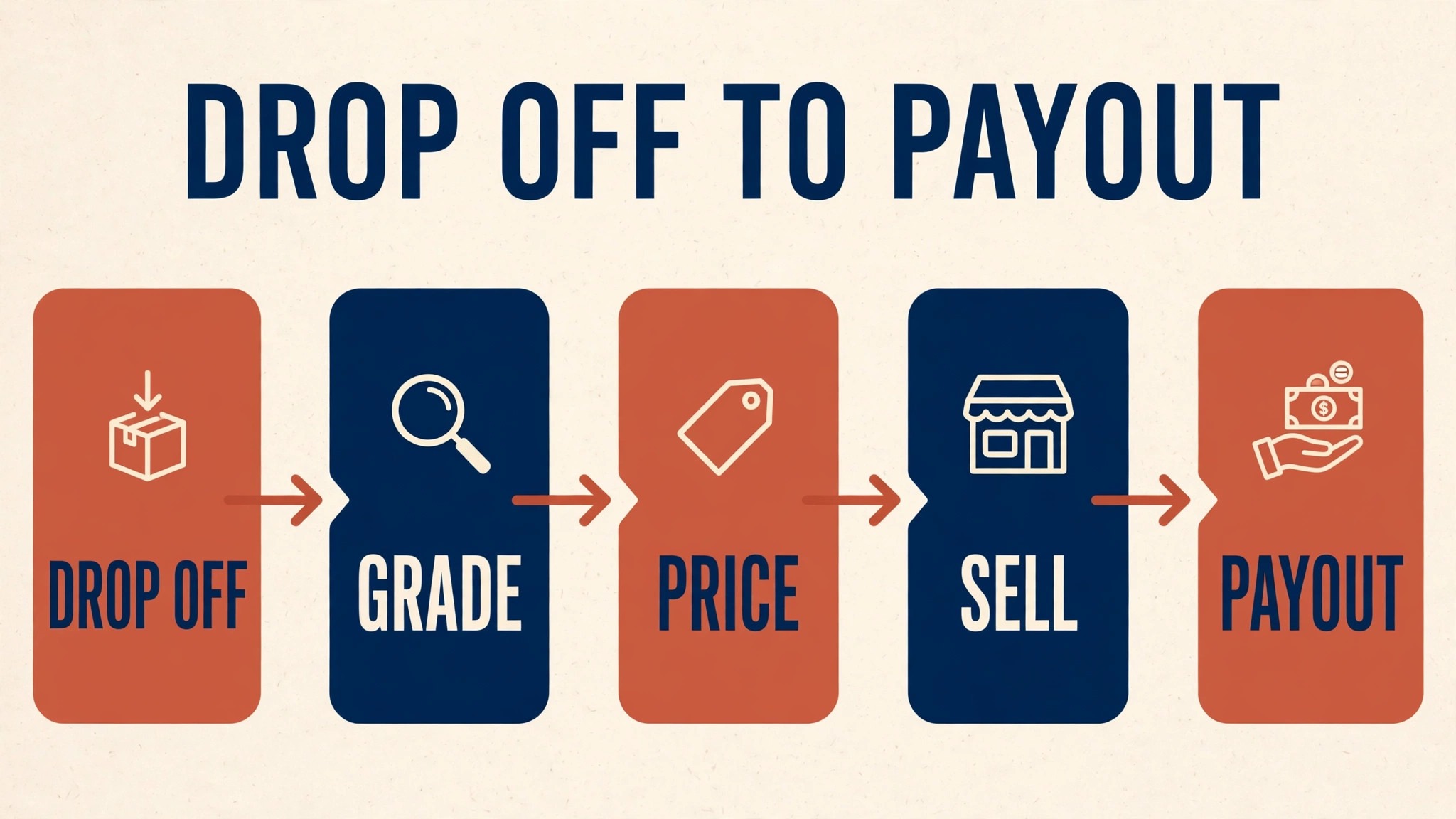
Step 1, intake and grade with the consignor present
Inspect each item with the consignor, agree the grade, note flaws in plain words, photograph the item, and record brand, size, season, split, contract length and minimum price. Give the consignor a written summary before they leave, so there is no later dispute about what was agreed. AI can draft the summary from the intake notes, but staff should read it before handing it over, because an error in a split percentage on paper becomes a dispute at payout.
Step 2, price from comparables, not from memory
For each item, gather comparable sales, check them for matching brand, size, condition and season, and set the opening price. Use AI to gather and summarise comparables, and to draft the item description and tag text, but set the price yourself, or approve the proposed price explicitly. Record the reasoning in one line on the item record, such as the comparable price range you used, so another staff member can understand the price later without asking you.
Step 3, place, photograph and list the item
Hang or display the item where its buyer will actually look, make sure the tag is visible and accurate, and photograph it for online listings if you sell online. Log the placement zone on the item record, so slow item reviews can check placement before price. A shop that skips this step will mark down hidden items and blame the price, when the real problem was the rail.
Step 4, run the weekly markdown review
Each week, review the markdown list, check placement and season for each slow item, and approve, hold or adjust each proposed reduction. Do not approve the whole list without reading it, because the list will contain at least one item that needs a different action, such as a move, a repair note, or a consignor call. Log each decision, so the consignor statement later shows a clear price history, not a mystery discount.
Step 5, sell, record and reconcile daily
Record each sale against the exact item and consignor on the day it happens, and reconcile the till against item records at close. AI can draft the daily sales summary and flag a sale recorded against the wrong item, but reconciliation is a human job, because a sale attributed to the wrong consignor becomes a payout error that is hard to unwind. A shop that reconciles daily finds errors while they are small. A shop that reconciles monthly finds them when consignors already noticed.
Step 6, pay consignors on a fixed, published schedule
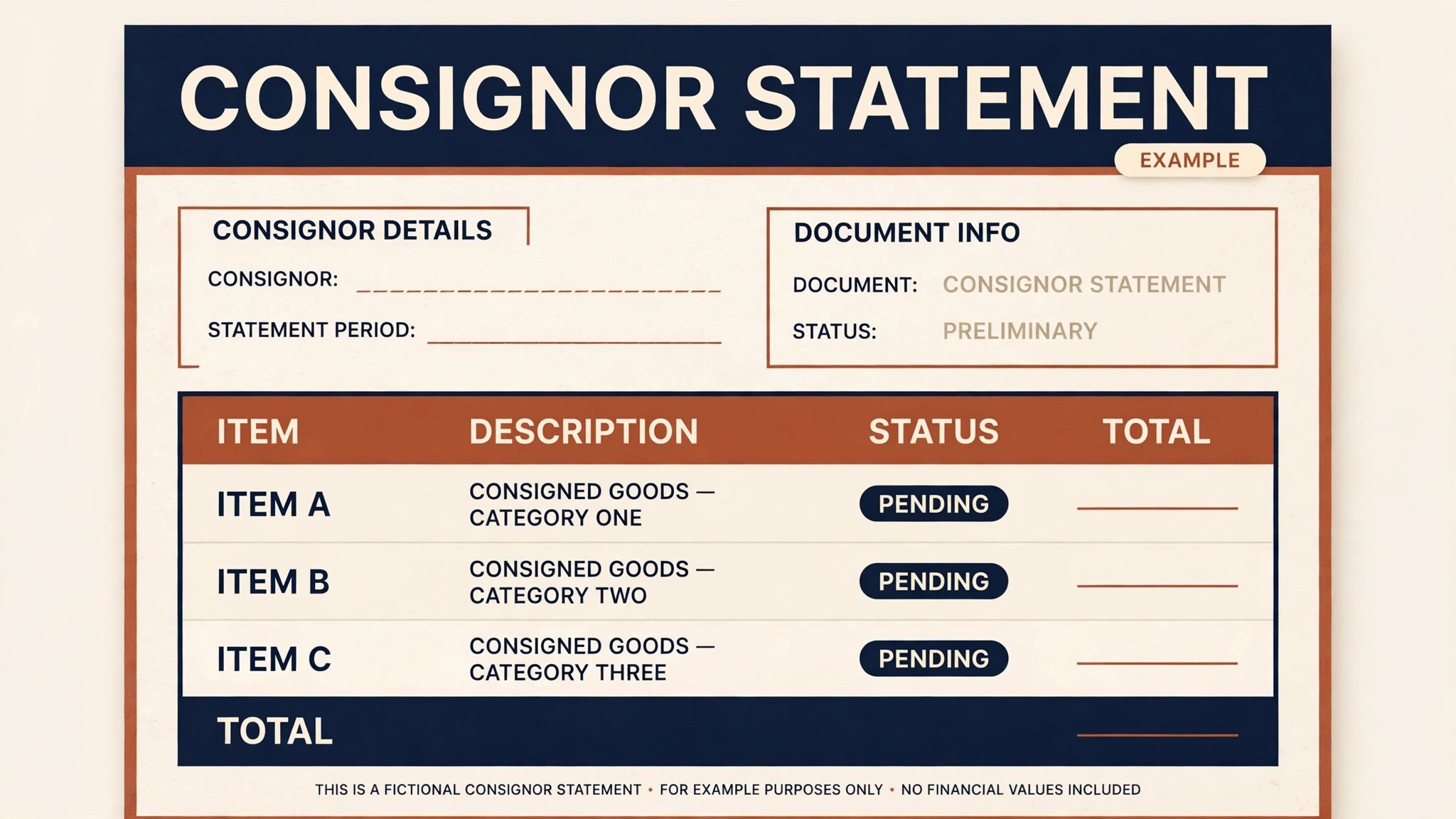
Pay on the same day each month, or each cycle you promised, with a statement that lists each item sold, its sale price, the split, and the amount owed. AI can build the statement and the payout list, but staff should review the list for errors, minimum price breaches, and duplicate payments before money moves. Paying late, or paying without a statement, damages trust faster than a slow sale does, because consignors judge a shop most harshly on money handling.
Payouts, Statements and the Trust They Build
A consignor statement should be readable by someone who has never seen your system. Each line needs the item description, the sale date, the sale price, the split applied, and the amount owed, with a total at the bottom and a clear note of any items still unsold. If a consignor cannot follow the statement, they cannot trust it, and they will call to ask questions that a clear statement would have answered. When you use AI for consignment shop inventory pricing, AI can format statements consistently and draft the covering message, but the numbers must come from your sales records, and staff should spot check a few statements each cycle before they go out.
Payment method matters as well. Offer the methods your consignors actually use, such as bank transfer, cheque, cash in store, or store credit, and record the method and date for each payment. Store credit deserves a clear rule, because a consignor who expected cash and received credit will feel misled, even if credit was mentioned somewhere in the contract. State the payment method choice at intake, confirm it at payout time, and never change it without asking. AI can track payment preferences and flag a consignor whose preference is missing, so staff can ask before payout day, not after.
Tax and record keeping sit behind payouts, and this guide does not give tax advice. Keep item, sale and payout records for the period your accountant and local rules require, export them regularly, and share annual totals with consignors who need them for their own records. Some consignment systems produce the data an accountant needs for annual reporting forms, and you should check what your system provides and what your accountant expects before year end, not during it. AI can summarise records for your accountant, but the underlying records must be accurate, and accuracy comes from daily reconciliation, not from a year end cleanup.
Disputes will still happen, and a good system makes them short. When a consignor questions a price or a payout, the item record should answer most questions in under a minute. What was the grade, what were the comparables, when were markdowns applied, what was the sale price, and what split was agreed. If the record answers those questions, the dispute becomes a short conversation. If the record does not answer them, the dispute becomes an argument about memory, and memory loses to paperwork every time. Build records that answer disputes before they are asked.
The Pricing Rule Worksheet
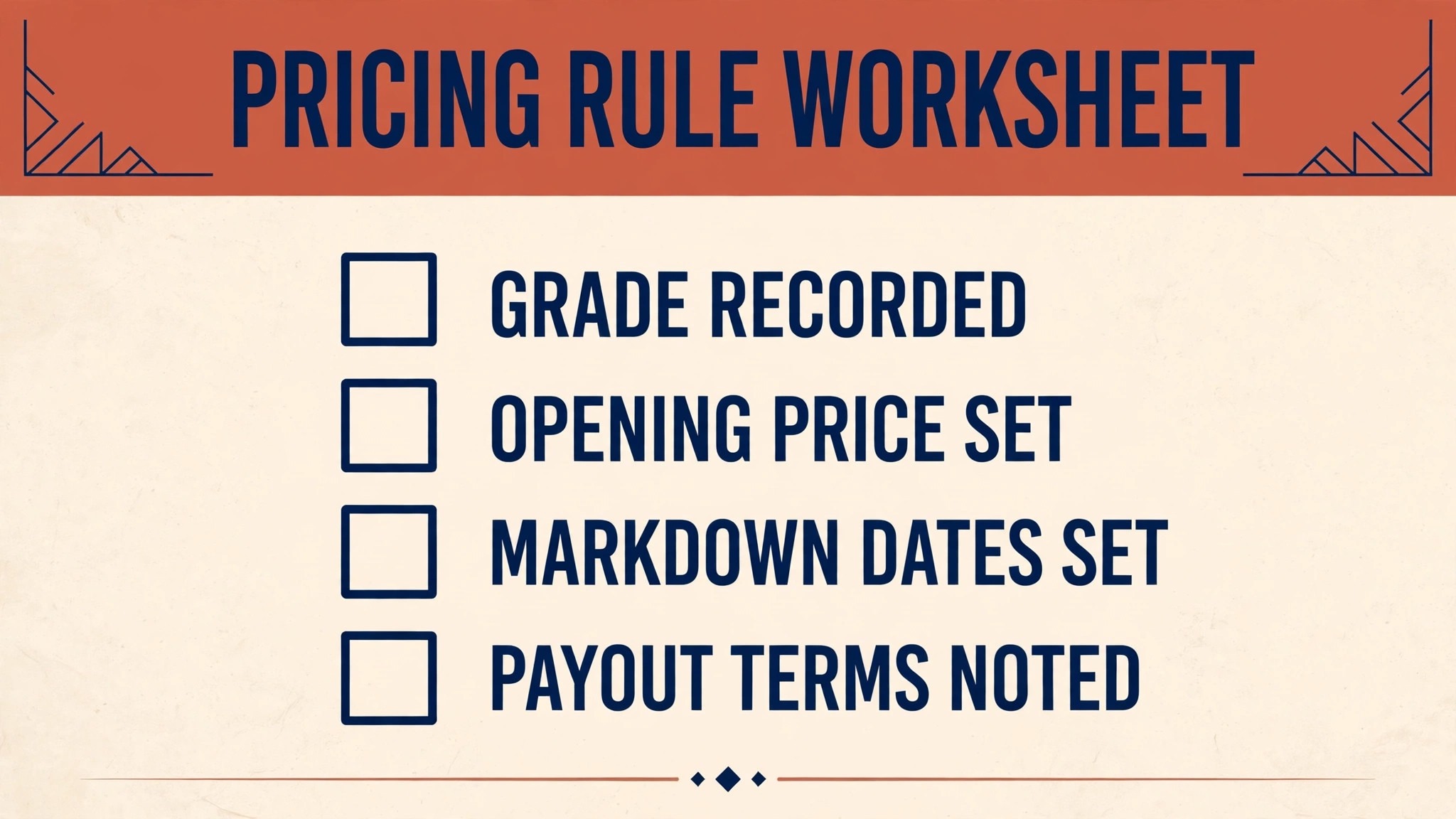
Copy this worksheet, fill it in for your shop, and use it to train every staff member who prices items. Keep it to one page at the intake desk, and review it each season. Do not let AI rewrite the worksheet without you approving the change, because the worksheet is your pricing policy, not a draft.
Worksheet – split rule – Consignor share for standard items, and any higher share for high value items, with the value threshold stated
Worksheet – contract length – Number of days an item stays on the floor before return, donation or extension
Worksheet – markdown schedule – First reduction timing and size, second reduction timing and size, stated as rules, not as vague intentions
Worksheet – minimum price rule – How the minimum is set at intake, and who may approve a sale below it, with consignor contact required
Worksheet – grading scale – Four grades with a plain description and a photo example for each grade
Worksheet – comparable check – Brand, size, condition and season must match before a comparable is used, with the source noted
Worksheet – placement check – Slow items are checked for rail, light and tag visibility before any price cut
Worksheet – payout schedule – Fixed payout day each cycle, statement contents, and payment methods offered
Worksheet – return rule – How many days a consignor has to collect unsold items, and what happens after that date
Worksheet – dispute rule – Who handles a pricing or payout question, and how fast the consignor gets an answer
Review the worksheet when a rule stops working. If first markdowns rarely lead to sales, the markdown may be too small, or the opening price may be too high, and the worksheet needs a test, not a guess. Change one rule at a time, apply it to new intake only, and compare sell through before and after. Changing three rules at once tells you nothing about which change helped, and a pricing policy built on guesses will drift back to gut feel within a season.
Mistakes That Cost Shops Margin and Consignors
The first mistake is pricing from the consignor’s hope rather than from comparable sales. A consignor may believe an item is worth far more than the market pays, and a shop that accepts that price to avoid an awkward conversation will hold unsold stock for ninety days. The kinder conversation is the honest one at intake, with comparables shown, a realistic range explained, and a clear choice offered. Consignors respect honesty at intake far more than they respect a high price that never sells.
The second mistake is letting AI set prices without a human check. A tool that averages unlike comparables, or that uses a sale from a different season, will produce confident wrong prices at scale, and staff who approve them without reading will multiply the error across the floor. The workflow in this guide prevents that, because AI gathers and staff decide, and the decision is recorded. Any workflow that removes the human decision from pricing should be treated as a risk, not as an efficiency gain.
The third mistake is forgetting the minimum price. Shops get busy, markdown lists get approved in bulk, and an item sells below its agreed minimum. The consignor notices, because consignors notice money, and the shop faces a dispute it cannot win, because the agreement is in writing. The fix is simple. The system must flag any proposed price below the minimum, and staff must contact the consignor before approving it. No exceptions for busy weeks, because busy weeks are when the error happens most.
The fourth mistake is paying late or without a statement. A shop may sell well and still lose consignors, because payout day slips, statements arrive without item detail, or payments go out by a method the consignor did not choose. Payout reliability is the most visible sign of a well run shop, because it is the moment the consignor judges whether the whole system worked. Put payout day on the calendar, protect it like a rent payment, and treat a missed payout day as a serious failure, not as a scheduling slip.
For related reading, see content marketing strategy, nutritionist meal plan follow-up, setting up a waitlist, payment processor choice and yoga studio waitlist management. Those posts cover adjacent inventory, follow-up and feedback problems, and the same lesson applies when you use AI for consignment shop inventory pricing. Automate the lists, keep a human on every money decision, and let the records answer disputes before they are asked.
Measuring Whether Pricing Is Working
When you use AI for consignment shop inventory pricing, measure four numbers monthly, and compare them with the same month last year where you have data. Sell through rate, meaning the share of items that sold within their contract window. Average days to sale, meaning how long items sit before selling. Average discount from opening price, meaning how much markdown was needed to move stock. And payout accuracy, meaning how many payout statements needed correction after sending. Those four numbers tell you whether opening prices are right, whether markdown timing is right, and whether money handling is trusted.
Sell through by category matters more than overall sell through. If coats sell through at a high rate and formal dresses do not, the problem is category specific, and it may be price, season, placement, or intake volume. Break the numbers down by category, by grade, and by price band, and look for the pattern before changing a shop wide rule. A shop wide price cut in response to a single slow category wastes margin on categories that were selling well, and it teaches staff that pricing rules change on feeling rather than evidence.
Also measure consignor return rate, meaning how many consignors bring items again after their first contract ends. That number is the long term verdict on your pricing. A shop with good sell through but poor consignor return has a trust problem, often in payouts, returns, or communication, and it will eventually run out of stock, however good its rails look today. Ask departing consignors why they left, in a short message, and log the answers in broad categories. AI can summarise those answers into themes, but the asking must be human, prompt, and genuinely open to an uncomfortable answer.
Frequently Asked Questions
How do you use AI for consignment shop inventory pricing without losing control?
Use AI to gather comparables, draft descriptions, build markdown lists and format statements, and keep every price, markdown and payout decision with a human. Record the reasoning for each opening price in one line, flag any proposal below the agreed minimum, and review the weekly markdown list item by item. That division, AI gathers and staff decide, keeps pricing consistent without handing money decisions to a tool.
What split should a consignment shop offer consignors?
Reported ranges commonly fall around 40 to 60 percent to the consignor, with some shops paying a higher share on high value items, but the right split depends on your rent, labour, selling effort and local market. Set the split so the shop covers its costs and the consignor feels fairly paid, state it clearly at intake, and apply it consistently. A split that changes by consignor, without a stated reason such as item value, will create disputes and damage trust.
When should a consignment item be marked down?
A widely reported starting pattern is a first reduction after about 30 days and a second after about 60 days, with the contract ending around 90 days, but you should test that pattern against your own sell through data. Before any markdown, check placement, light, tag visibility and season, because a hidden item or an out of season item may need a move, not a price cut. Agree the schedule at intake, so markdowns never surprise the consignor.
What should happen to unsold consignment items?
The consignor should hear promptly at contract end, with a clear choice to collect the item by a stated date, donate it, or extend the contract at a new price. AI can draft that message and list items due for collection each week, but the message must go out on time. Keeping unsold items in a back room for months, without telling the consignor, is a common source of complaints and lost consignors, even when the shop meant no harm.
How can a shop prevent payout errors?
Record each sale against the exact item and consignor on the day it happens, reconcile the till against item records daily, and review the payout list before money moves. Statements should list each item sold, its sale price, the split applied, and the amount owed, so a consignor can check the math. Shops that reconcile daily find errors while they are small. Shops that reconcile monthly find them after consignors already noticed.
Should AI write item descriptions for resale listings?
AI can draft descriptions from your intake notes and photos, which saves real time, but staff should check every description for brand, size, condition and flaws before it goes live. A description that omits a flaw, or invents a brand from a blurry photo, creates returns and disputes that cost more than the time saved. Use AI as a first drafter, keep the grade and flaw notes human, and photograph items in consistent light.
A Plain Verdict for Consignment Shops
Consignment pricing rewards shops that grade honestly at intake, price from comparables, mark down on a published schedule, and pay on time with a readable statement. It punishes shops that price by hope, approve markdown lists without reading them, and treat payout day as flexible. AI fits the disciplined shop well, because it gathers evidence, builds lists and formats statements, while staff keep every money decision. Shops that work that way, and that use AI for consignment shop inventory pricing as a helper rather than a price setter, will usually sell more stock, keep more consignors, and spend less of each month untangling payout disputes.