
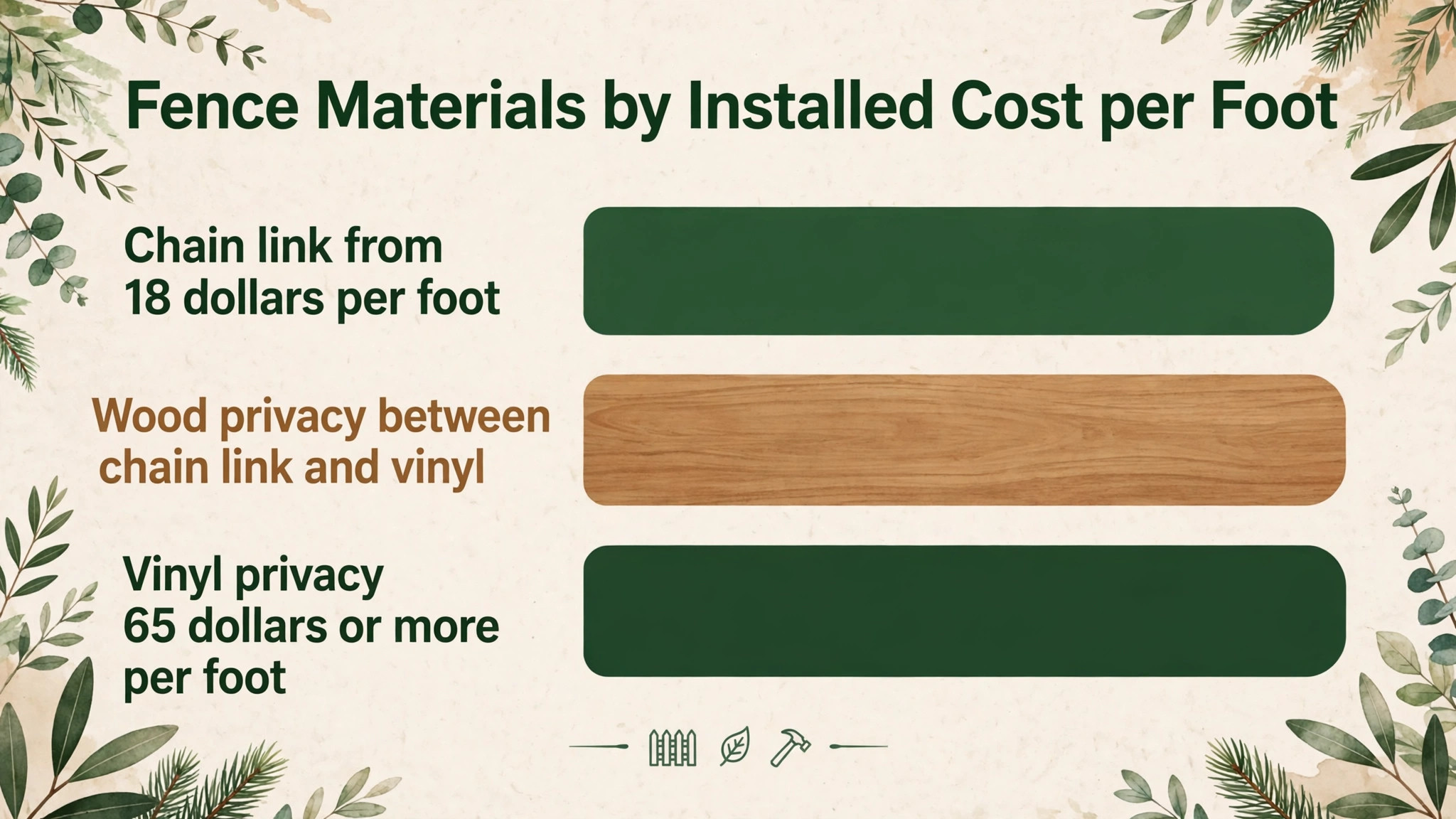
Fence contractors lose more money to bad measurements than to bad marketing, and that is why they use AI for fencing contractor quote estimates. Industry estimating guides put typical installed costs for a residential six foot fence anywhere from roughly 18 dollars per linear foot for basic chain link to 65 dollars or more for vinyl privacy, with wood privacy landing between, and a single miscounted run can swing a bid by thousands of dollars. A contractor who measures 180 feet when the property needs 210 feet has not just underpriced the job. The contractor has promised a price that cannot cover materials, labor, and the gates the homeowner already expects.
The contractors who win profitable fence work consistently are the ones whose quotes start from accurate measurements, honest material math, and a written scope, and that discipline is far easier to hold when you use AI for fencing contractor quote estimates instead of pricing from a notebook and a supplier sheet from last year.
How to Use AI for Fencing Contractor Quote Estimates Without Losing Margin
A fence quote has four cost layers, and every layer must be priced before the total is shown to the homeowner. Materials come first, including posts, rails or panels, pickets, concrete, hardware, caps, and gates, with waste added for cuts and damaged pieces. Labor comes second, priced from crew production rates rather than from optimism, since a two person crew installs roughly 100 to 150 feet of wood privacy per day on flat ground, and less on slopes or rocky soil. Access and site conditions come third, covering steep grades, tree roots, concrete removal, and haul away of an old fence.
Overhead and profit come fourth, and they belong in every quote, because a contractor who prices jobs at cost plus hope cannot replace a broken auger, pay insurance, or survive a slow month.
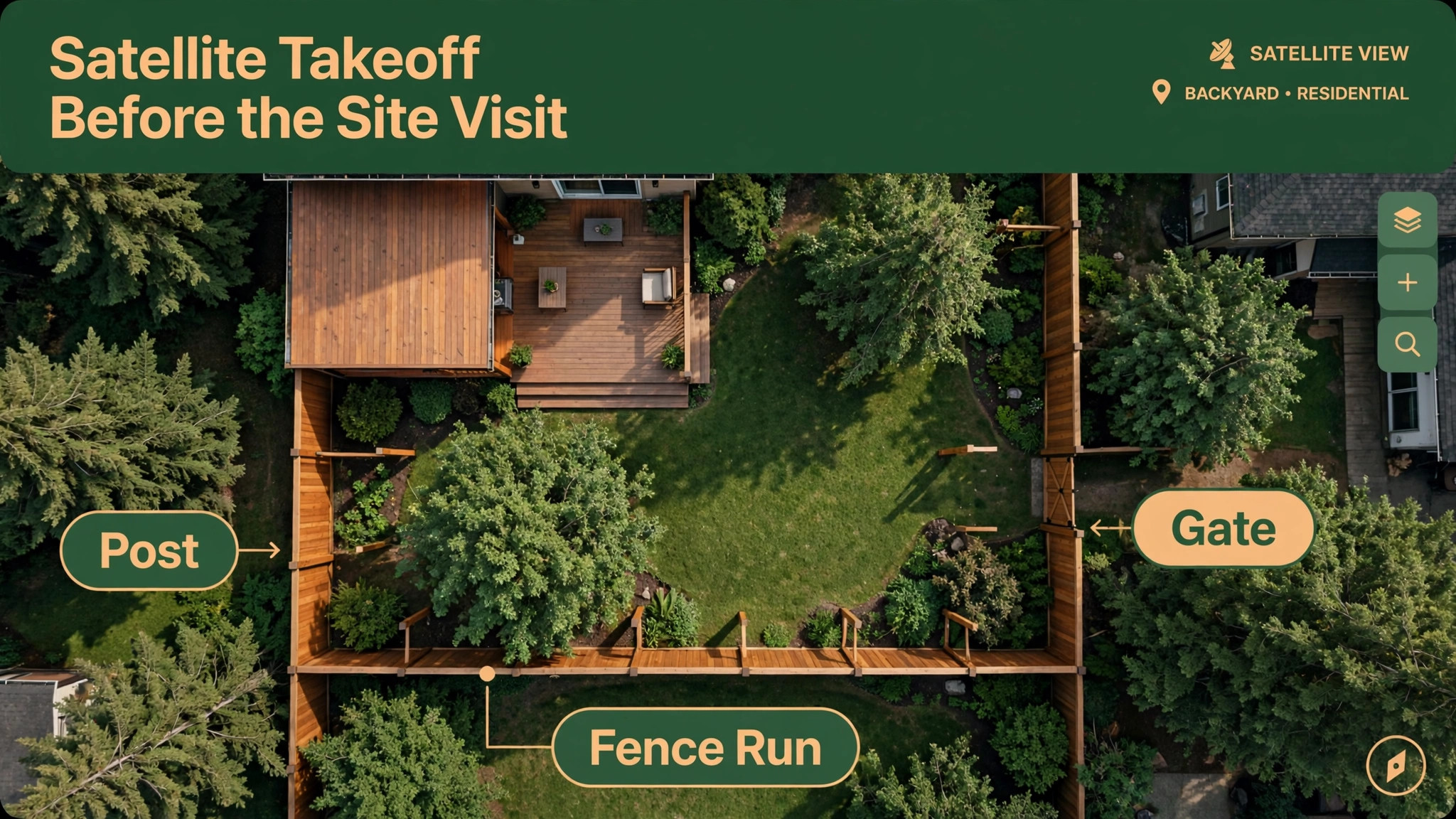
AI tools help at two points in that math. Satellite measurement tools draw fence lines on an aerial view of the property and return linear feet before anyone drives to the site, which lets the contractor give a realistic range on the first call and arrive at the site visit already knowing the rough shape of the job. Drafting tools then turn the measured quantities into a clean, itemized quote with material options, gate counts, and exclusions, in the time it once took to handwrite a single page estimate. The contractor still walks the property, still checks soil and slope, and still confirms gate locations with the homeowner.
The software only removes the arithmetic errors and the delay, and those two removals protect margin more than any discount ever will.
The habit that protects margin most is updating material prices monthly. Lumber and steel prices have moved sharply in single quarters in recent years, and a quote built from a supplier sheet three months old can be wrong by enough to erase the profit on the job. Contractors should collect two supplier quotes each month, update their price book in the estimating tool, and date every quote with a validity window, usually fourteen to thirty days. A homeowner who delays past the window gets a refreshed quote, not an argument, and the contractor never absorbs a price rise that happened after the quote was written.
Measuring a Property Right the First Time
Measurement starts before the site visit, with a satellite drawing that traces each fence run, marks each gate, and notes where the fence meets the house, a driveway, or a neighbor’s existing fence. That drawing gives the contractor a linear foot total and a gate count to discuss on the first call, and it prevents the most common quoting error, which is forgetting a short run behind a garage or a side return that adds twenty feet nobody priced. The site visit then verifies the drawing against reality, because satellite views hide slopes, show old fences that will be removed, and cannot tell rocky soil from soft loam.
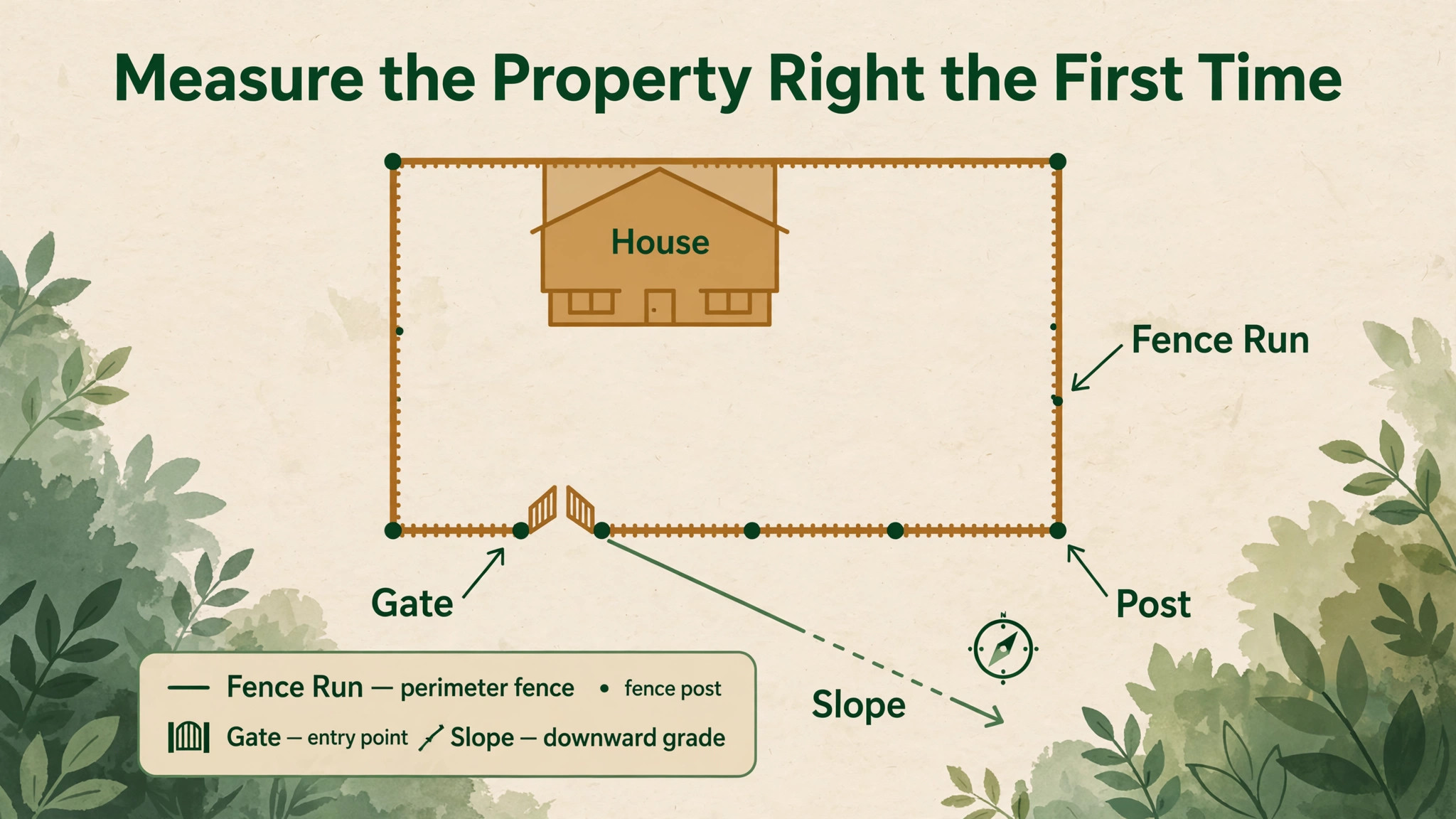
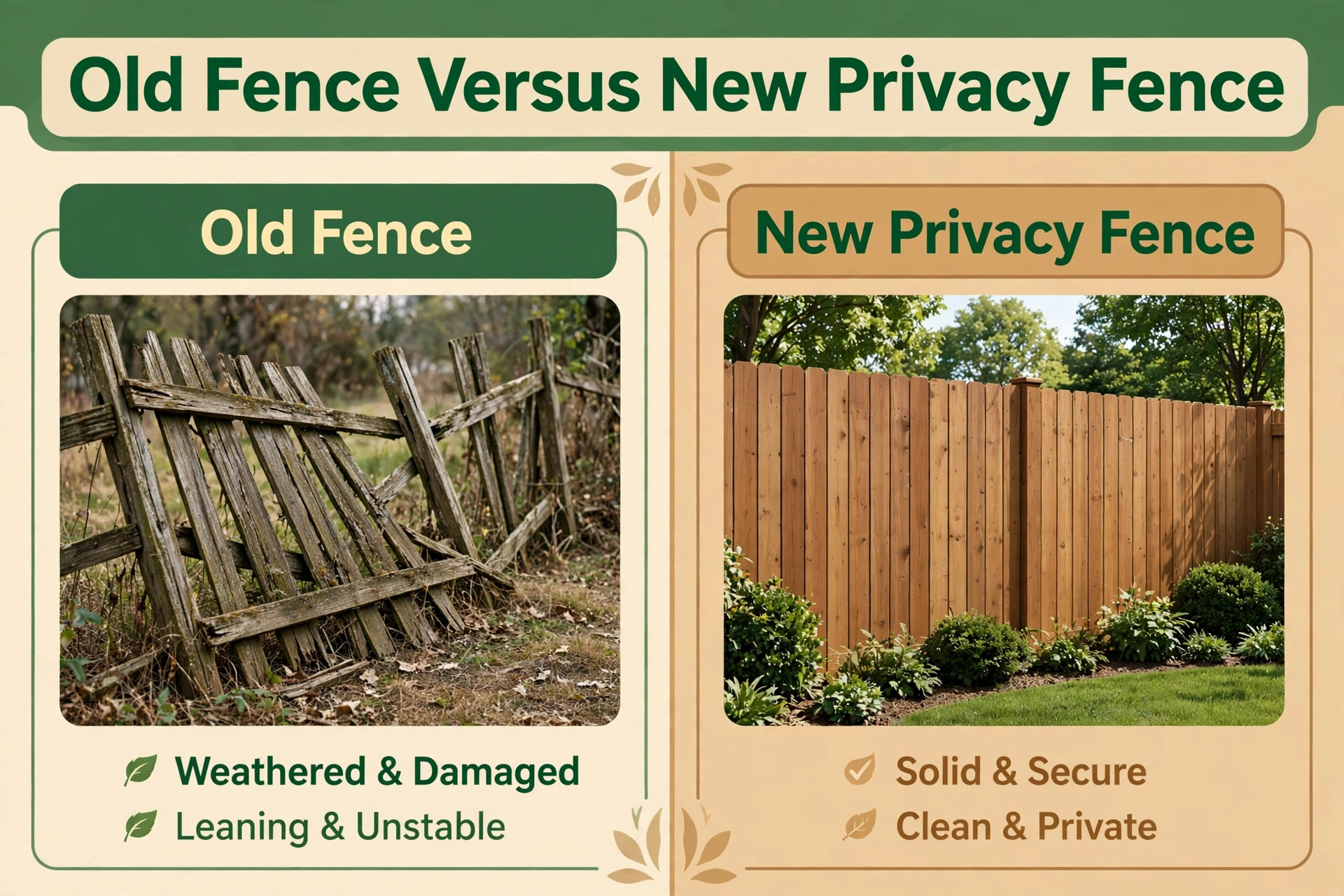
On site, the contractor walks every run with the homeowner, confirming the line, the height, and the gate positions, and checking five site factors that change price. Slope changes labor and sometimes material, since stepped panels on a steep grade take longer than a straight run on flat ground. Soil changes post setting time, since rocky or clay soil slows digging and sometimes needs a different footing. Access changes equipment choices, since a narrow side yard may rule out a machine auger and force hand digging. Existing fence removal changes disposal cost, priced typically at a few dollars per foot plus haul away.

Underground utilities change everything, because posts cannot go where lines run, and the contractor should confirm that utility marking has been requested before digging day, not after.
Corner posts, end posts, and gate posts deserve separate attention, because they carry more load and need deeper footings and more concrete than line posts. A quote that prices every post the same underprices the posts that matter most and overprices the rest, which looks sloppy to a homeowner who compares quotes line by line. The estimate template in this guide separates post types for exactly that reason, so the homeowner sees why the gate posts cost more and the contractor’s crew knows what to build. A final measurement habit closes the loop.
The contractor photographs each run, each gate location, and each obstacle, and attaches the photos to the quote record, so the crew that installs the fence sees the same property the estimator saw.
The Fence Quote Workflow From First Call to Signed Job
A reliable fence quoting workflow moves a lead from first call to signed job in days, not weeks, because homeowners compare fence contractors fast and choose the contractor who responds professionally first. The workflow below assumes a small crew doing residential work, with the owner estimating and one crew installing.
Step one is the first call, where the contractor asks for the address, the approximate fence purpose, the material preference if any, and permission to draw the property from satellite views. That call ends with a realistic range and a site visit date, not with a firm price, because a firm price without a site walk is a guess dressed as a quote. Step two is the satellite measurement, done the same day, which produces linear feet, gate count, and a rough material list. Step three is the site visit, where the contractor verifies measurements, checks slope and soil, confirms gate positions, and discusses material options with samples or photos.
Step four is the quote itself, built in the estimating tool from the verified measurements and current material prices, with good, better, and best material options where the homeowner has not decided.
Step five is sending the quote with a clear validity window, a deposit requirement, and a start window, accompanied by a short message that names the next step. Step six is follow up, with a message at three days if there is no reply, and a second message at seven days offering to answer questions or adjust an option. Contractors who use AI for fencing contractor quote estimates inside this workflow typically cut quote turnaround from several days to the same day as the site visit, and same day quotes close at a higher rate, because the homeowner decides while the conversation is still fresh.
Step seven is the signed job, where the deposit is collected, materials are ordered against the quote’s material list, and the crew receives the photos, the measurements, and the gate schedule from the same record.
| Workflow step | When it happens | Output | Time target |
|---|---|---|---|
| First call | Day zero | Range and visit date | Same day |
| Satellite measure | Day zero | Feet and gate count | Same day |
| Site visit | Within 2 days | Verified measurements | 30 to 60 minutes |
| Quote built | Visit day | Itemized options | Same day |
| Quote sent | Visit day | Valid dated quote | Same day |
| Follow up | Day 3 and day 7 | Reply or adjustment | Two messages |
| Signed job | On acceptance | Deposit and material order | Same day |

The Fence Measurement Estimate Template
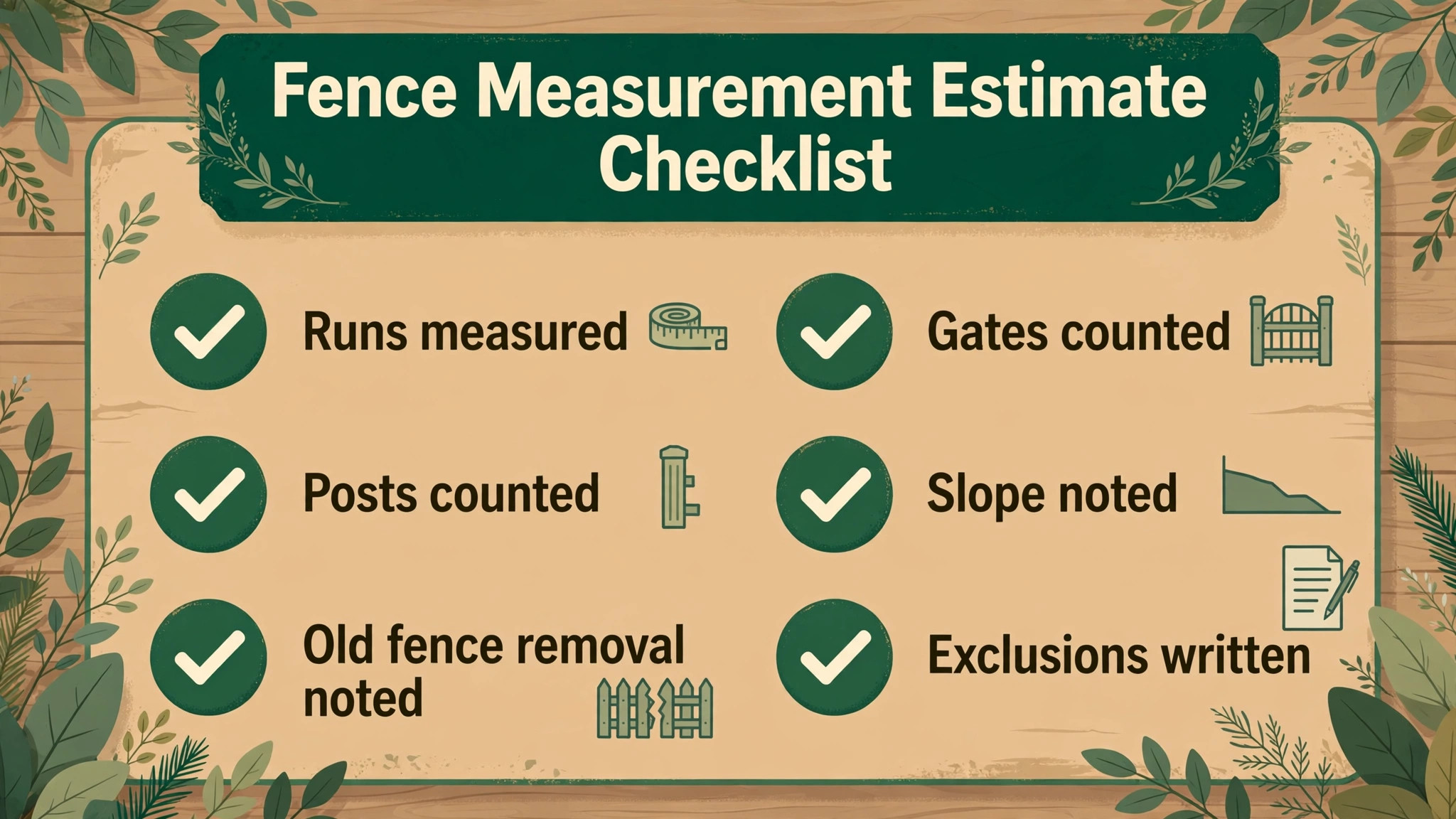
This template is the overview proof of this guide. Fill every field for every job, and the quote that follows will be accurate, comparable, and defensible when the homeowner asks why one option costs more than another.
| Template field | What to record | Why it changes price |
|---|---|---|
| Total linear feet | Sum of all runs | Base for all material math |
| Run breakdown | Each run length separately | Reveals forgotten side runs |
| Fence height | Height per run | Taller fences need more material |
| Material choice | Wood, vinyl, chain link, aluminum, composite | Largest price driver |
| Line posts | Count and spacing | Standard footing and concrete |
| Corner and end posts | Count separately | Deeper footing, more concrete |
| Gate posts | Count separately | Heaviest footing, hardware |
| Gates | Count, width, type | Hardware and labor per gate |
| Slope grade | Flat, moderate, steep per run | Labor and panel stepping |
| Soil type | Loam, clay, rocky | Digging time and footing |
| Old fence removal | Feet to remove and dispose | Disposal and haul cost |
| Access limits | Narrow gates, no machine access | Hand digging premium |
| Concrete per post | Bags or volume per post type | Material total accuracy |
| Waste allowance | Percentage added | Covers cuts and damage |
| Permit and marking | Required or not | Fee and schedule risk |
| Quote validity | Date range | Protects against price moves |
Material math follows the template directly. Line posts are spaced typically eight feet apart for wood and vinyl panel systems, so a 160 foot run needs about twenty line post positions plus corners and gates, before waste. Concrete runs roughly one bag per line post and more per gate post, depending on hole size and local practice. Pickets, rails, and panels follow the manufacturer’s coverage per foot, and the contractor should use the supplier’s stated coverage, not a remembered rule, because panel widths vary. Gates need hardware priced per gate, including hinges, latches, and drop rods for double gates, which homeowners forget and contractors must not.
A quote that shows this math, even in summary form, earns trust faster than a single lump sum, because the homeowner can see what they are buying.
Material Prices and Options Homeowners Actually Choose
Homeowners usually choose among four materials, and each one sells on a different promise. Chain link sells on price and security, with approximate installed ranges from 18 to 30 dollars per foot for standard six foot galvanized, and higher for vinyl coated. Wood privacy sells on looks and privacy at a mid range price, with approximate installed ranges from 25 to 50 dollars per foot depending on pine versus cedar and on local labor. Vinyl privacy sells on low maintenance and clean looks, with approximate installed ranges from 35 to 65 dollars per foot, and it wins with homeowners who never want to stain a fence again.
Aluminum ornamental sells on appearance and durability, with approximate installed ranges from 40 to 75 dollars per foot for residential work, and it wins on front yards and pool enclosures where looks matter most.
| Material | Installed range per foot | Best selling point | Watch out for |
|---|---|---|---|
| Chain link galvanized | 18 to 30 dollars | Lowest price, fast install | Least privacy |
| Wood privacy pine | 25 to 40 dollars | Natural look, good privacy | Staining and upkeep |
| Wood privacy cedar | 35 to 50 dollars | Better looks, longer life | Higher material cost |
| Vinyl privacy | 35 to 65 dollars | Almost no maintenance | Higher upfront price |
| Aluminum ornamental | 40 to 75 dollars | Premium appearance | Panel sizes limit custom runs |
| Composite | 50 to 80 dollars | High end look, durable | Niche availability |
Presenting three options, good, better, and best, helps homeowners decide without a second visit. The good option meets the basic need at the lowest price, usually chain link or pine. The better option balances price and longevity, usually cedar or vinyl. The best option delivers the premium result, usually vinyl or ornamental, with upgraded gates and caps. Contractors should mark the recommended option based on the property, not on the highest price, because a recommendation that fits the home builds more trust than a recommendation that maximizes the ticket. Every option should carry the same gate count, height, and scope, so the homeowner compares materials, not hidden scope differences.
Contractors who use AI for fencing contractor quote estimates to generate all three options from one measurement set give homeowners a real choice in minutes, instead of a single price that invites a competitor’s call.
Five Tools That Carry Fence Estimating Well
Leap for Full Sales and Production Workflow
Leap suits fence and home improvement contractors who want lead management, estimating, material ordering, scheduling, and payments in one system. Its estimating tools produce error free quotes from measurements, and its integrations reach accounting and photo documentation tools that crews already use. Pricing is quoted by the vendor and varies with team size and modules, so contractors should request a current quote rather than budgeting from a published figure. The breadth is the selling point and the cost driver at once. Small one crew operations may find Leap more system than they need, while growing companies with multiple crews gain from having sales and production in one record.
Lineal for Satellite Fence Takeoff
Lineal suits fence contractors who want the fastest path from a property address to a material list. The contractor draws on a satellite map or enters linear feet, and the tool returns a full material list and profit numbers in under a minute, with pricing starting around 99 dollars a month on published pages. That speed changes the first call, because the contractor can discuss a realistic range before the site visit and arrive already knowing the job shape. Lineal is a quoting and takeoff tool first, so contractors pair it with a CRM or scheduling tool for the rest of the business, but for the estimating step itself it is the most fence specific option in this group.
JobProgress for Job Management Around the Quote
JobProgress suits contractors who want the quote to flow into scheduling, crew assignment, and customer communication without retyping. Its job records carry the estimate, the photos, and the customer messages together, which helps the crew install what was quoted rather than what someone remembered. Pricing varies by plan and team size, so contractors should confirm current rates. The strength here is continuity from quote to install, which matters most for companies where the estimator and the installer are different people and handoff errors would otherwise eat margin.
CompanyCam for Photo Proof at Every Stage
CompanyCam suits any contractor who wants before, during, and after photos organized by project and available to the crew and the customer. The estimator photographs runs, gates, and obstacles at the quote visit, the crew photographs post holes and progress during install, and the finished photos become the record that settles disputes about what was built. Pricing is subscription based with a trial available, and the photo record integrates with estimating tools so photos attach to the right job automatically. For fence work, where property lines and gate positions cause most disputes, a photo record is cheap insurance that pays for itself the first time a neighbor questions a line.
ChatGPT for Quote Explanations and Follow Up Drafts
ChatGPT helps fence contractors turn a material list into a clear homeowner explanation, draft the follow up message after a quote goes out, and rewrite a technical scope note in plain language a homeowner understands. It works best when the contractor feeds it the verified measurements and material choices, because generic prompts produce generic quotes that miss the gate posts, the slope, and the removal work that make each job specific. The contractor must verify every figure in a draft before sending, since drafting tools can invent plausible quantities.
Used inside that discipline, contractors who use AI for fencing contractor quote estimates in the writing step send quotes that homeowners actually read and approve, instead of single page lump sums that invite a cheaper competitor’s call.
Closing More Quotes Without Discounting
Discounting is the fastest way to look cheaper and the slowest way to go broke, because a discounted fence job still costs full materials and full labor. Contractors close more quotes by improving the quote itself, not the price. Same day delivery beats a lower price delivered a week later, because homeowners decide while excitement is high. Itemized options beat a lump sum, because the homeowner can choose a lower option without asking for a discount. A validity window with a reason, like material prices or schedule availability, creates honest urgency without pressure. A short video walkthrough of the proposed fence line, recorded on the site visit phone, shows care that a paper quote cannot.
Follow up closes the rest. A quote with no reply after three days gets a message asking one specific question, like whether the gate width works for the homeowner’s mower or trailer, because a specific question gets a reply while a general check in gets ignored. A quote with no reply after seven days gets an offer to adjust one option, like a different material on the back run only, which reopens the conversation without reopening the price. Contractors should track close rate by material and by lead source, because a low close rate on one material usually means the options were framed poorly, while a low close rate on one lead source usually means the leads were weak.
Both problems have different fixes, and the contractor who measures them fixes the right one.
Handling Permits, Property Lines, and Neighbors
Permits, property lines, and neighbors cause more fence disputes than materials ever do, so the quote process should surface them before the deposit, not after the first post hole. Permit rules vary by municipality, with many areas requiring a permit for fences over a certain height, for corner lots, or for fences near sidewalks and easements. The contractor should check the local rule for the property, state the permit responsibility in the quote, and never promise a start date that depends on a permit nobody has applied for. A quote that names the permit step looks slower than a quote that ignores it, and it is the quote that survives contact with the city office.
Property lines deserve the same plain treatment. Fences built on the wrong line become neighbor disputes, removal costs, and legal letters, and no estimating tool can fix a line the contractor guessed. The contractor should ask for a survey where one exists, walk the line with the homeowner, and note any uncertainty in the quote record, with the homeowner confirming the line in writing before work starts. Shared fences need a neighbor conversation before the job, not during it, covering cost sharing if any, access to the neighbor’s side for installation, and the finished side orientation.
Contractors who use AI for fencing contractor quote estimates should keep these notes in the same job record as the measurements, because the crew needs the line agreement and the neighbor notes on install day, not just the material list. A fence built on the right line, with the neighbor informed, installs faster and generates referrals. A fence built on a disputed line generates the opposite, and the opposite costs far more than the job was worth.
Mistakes That Eat Fence Profit
The most expensive mistake is quoting from the street or from memory without walking the line. Satellite views hide slopes, fences, and access problems, and a quote built without a site walk becomes a loss the day the crew arrives. A second mistake is forgetting gates, which cost far more per unit than fence footage and require hardware, deeper footings, and more labor. A third mistake is pricing every post the same, which underprices gate and corner posts and makes the quote look careless to anyone who compares line items. A fourth mistake is leaving removal and disposal out of the quote, then absorbing the cost to avoid an awkward conversation with the homeowner.
A fifth mistake is quoting without a validity window, which leaves the contractor exposed when material prices move between quote and acceptance. Contractors who run the template in this guide, and who use AI for fencing contractor quote estimates with a site walk every time, avoid all five mistakes as a matter of routine rather than memory.
More Reading on Stratilyze
Readers who run a trade or service business may also enjoy AI tools for painting contractor estimate quotes and AI tools for lawn care service route scheduling, since both cover the same discipline of turning field measurements into accurate prices and efficient schedules. AI tools for real estate open house follow up is useful too, because its scoring checklist shows how to prioritize the leads that a good quote system produces.
Frequently Asked Questions
How accurate is satellite measurement for fence quotes?
Satellite measurement gives a strong starting figure for linear feet and gate positions, usually close enough for a first call range, but it should never be the final quote without a site walk. Satellite views hide slopes, show old fences that may be removed, and cannot judge soil or access. The right use is speed, giving the contractor a realistic range on day zero and a measurement to verify on site. Contractors who quote final prices from satellite views alone absorb the difference when reality differs, and reality differs often enough to matter.
What should a fence quote include besides the total price?
A strong quote includes the material and height, the linear feet by run, the gate count with widths and types, the post schedule, removal and disposal if any, the validity window, the deposit and payment schedule, the start window, and the exclusions. Exclusions matter as much as inclusions, because they prevent disputes about staining, permits, utility marking, and work beyond the fence line. A quote that shows this detail earns trust and makes comparison with competitors fair, since the homeowner compares scope, not just totals.
How do you price a fence on a steep slope?
Price slope as a labor and material adjustment, not as a guess. Stepped panels take longer to install than straight runs, and some materials handle stepping better than others, with panel systems needing more cutting and racking on grades. Walk the slope, note the grade per run, and add a labor factor the contractor has measured from past jobs, rather than a flat surcharge invented for the quote. Tell the homeowner why the slope run costs more, in plain words, because a homeowner who understands the reason accepts the price, while a homeowner who sees an unexplained surcharge shops for a contractor who explains it.
Should fence quotes offer good, better, and best options?
Yes, in most residential cases, because options let the homeowner choose a price without asking for a discount, and they reveal what the homeowner actually values. Keep the scope identical across options except for material and upgrades, so the comparison is honest, and mark the recommended option based on the property. Options also protect the contractor, because a homeowner who chooses the premium option has chosen it, not been sold it, and that choice reduces price regret after the job starts.
How long should a fence quote stay valid?
Fourteen to thirty days covers most residential work, with fourteen days for volatile material markets and thirty days when prices are stable and the schedule allows. State the validity date on the quote itself, and refresh the price without argument when it expires, rather than honoring a stale price out of embarrassment. A validity window is not pressure. It is honesty about costs the contractor does not control, and homeowners respect a contractor who explains it plainly.
Can AI quoting replace the site visit for fences?
No, and contractors who try it learn why on the first rocky property. AI measurement and drafting handle the arithmetic, the material math, and the document, but they cannot feel soil, judge slope, confirm a property line, or agree gate positions with a homeowner standing in the yard. The site visit is where the quote becomes accurate and where trust is built, and no software replaces that walk. Contractors who use AI for fencing contractor quote estimates as a measurement and drafting assistant, with a site walk every time, get the speed of automation without the losses of guessing.
The Quote That Wins Is the Quote That Is True
Fence work rewards contractors whose numbers survive contact with the property. Measure every run, separate the posts that carry load from the posts that fill space, price materials from this month’s supplier sheet, and put a validity date on every quote. Let satellite tools and drafting software carry the arithmetic and the document, while you carry the site walk and the judgment. When you use AI for fencing contractor quote estimates as that kind of assistant, on every job for one season, the close rate, the margin, and the number of awkward conversations with homeowners will all move in the right direction.