
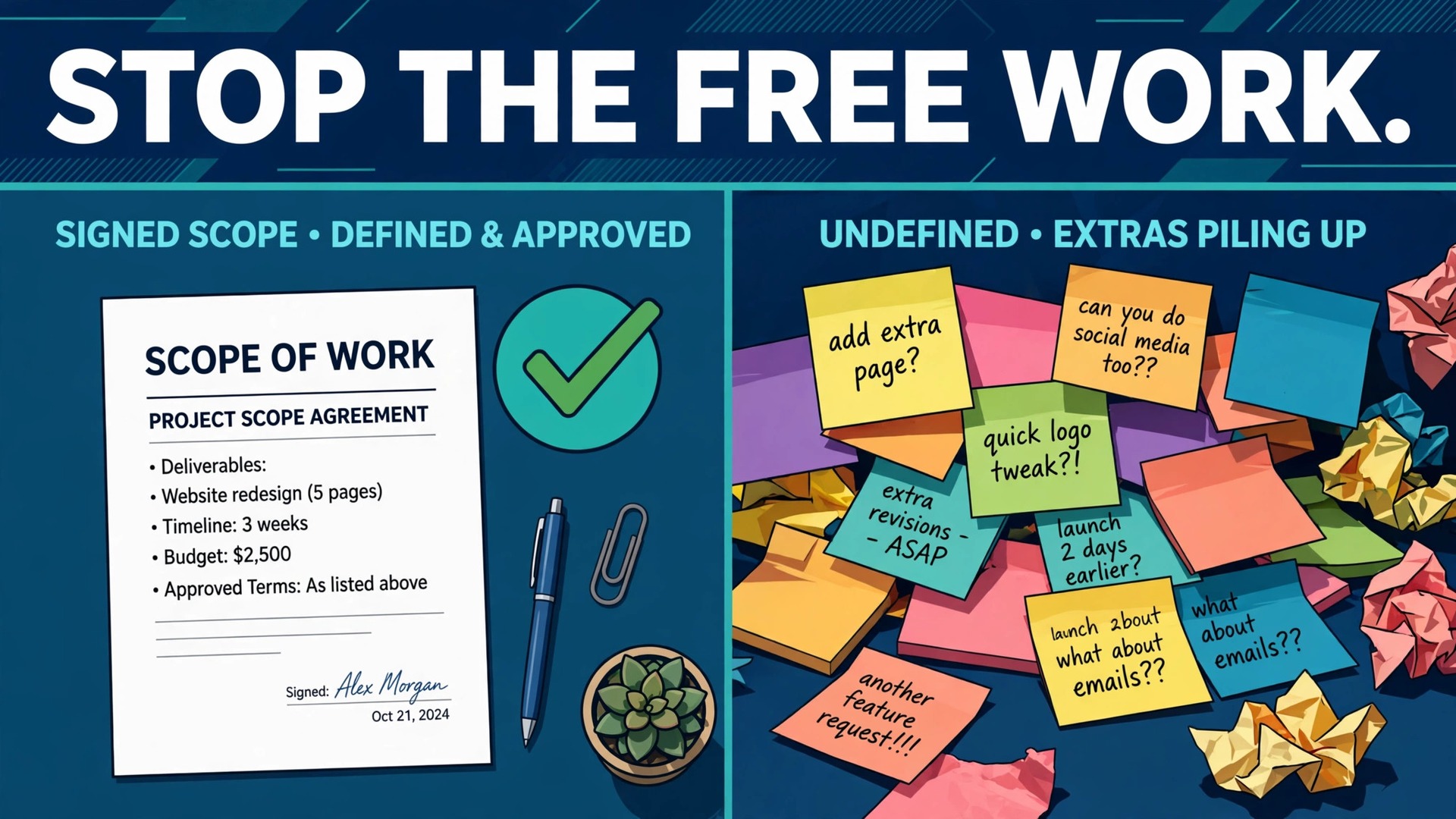
The verdict is blunt. If you keep saying yes to every extra request for free, you are not being generous, you are funding the client’s project out of your own margin. The fix is not a harder personality or a tougher contract. It is a small, repeatable method for how to handle scope creep small business owners can run on every job, starting with a written baseline, a short change form, and a calm price for anything outside the original agreement. Put that method in place and most creep stops being a fight. It becomes a decision the client makes with full information.
Scope creep is the slow growth of a job after work has started, with no matching change to the deadline, the budget, or the team. It rarely arrives as one dramatic demand. It arrives as a steady drip of small, reasonable sounding additions. One extra page. One more revision round. One quick call that turns into a redesign.
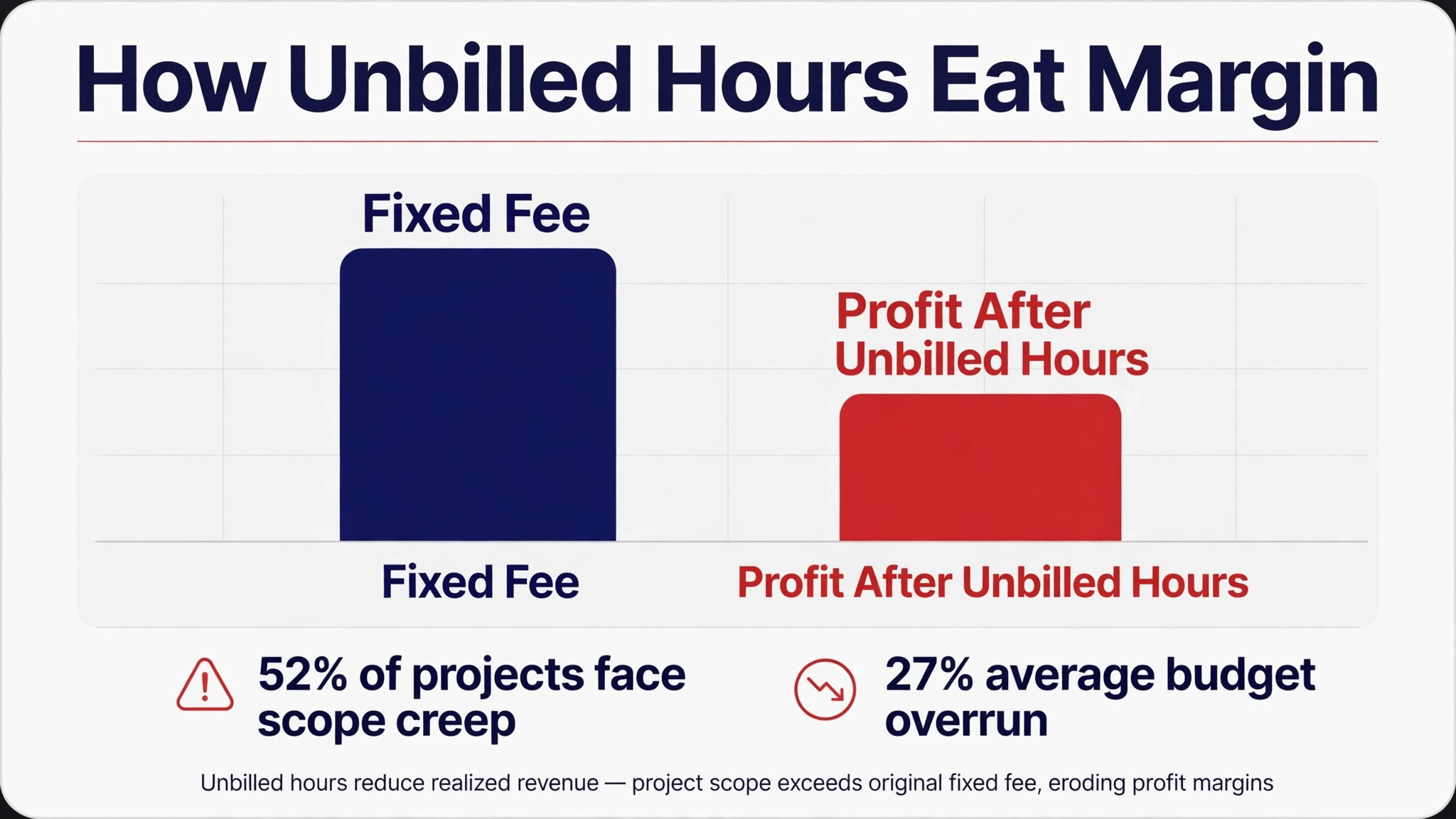
The Project Management Institute found in its 2018 Pulse of the Profession survey that 52 percent of projects completed in the prior year had experienced scope creep or uncontrolled changes, up from 43 percent in 2013. A separate PMI linked figure puts the average budget overrun on affected projects near 27 percent. For a small business running fixed price work, that overrun usually comes straight out of profit. That pattern is exactly why a written method for how to handle scope creep small business owners can trust matters more than good intentions.
The reason creep hurts small firms more than large ones is simple arithmetic. A large firm can absorb unbilled hours across many projects. A five person firm cannot. SPI Research benchmarks put professional services project overruns near 10.7 percent, and on a fixed fee job that shortfall lands on a margin that is often already thin. Every unbilled hour also delays the next paying job, which means one creeping project can quietly eat two projects worth of profit. The good news is that the same research points to the cure. Firms that hold a written baseline and review scope at milestones catch drift weeks earlier than firms that reconcile at the end.
What Counts as Scope Creep and What Does Not
Not every change is creep. A client who discovers a genuine problem mid project and asks to fix it is raising a legitimate change. A client who keeps adding features because nobody wrote down what was agreed is creating creep. The difference is whether the request goes through a decision. If it is written down, priced, and approved before work starts, it is a change. If it is absorbed silently, it is creep, even when the client is polite and the request is small.
Three tests separate the two. First, was the item in the original written scope. Second, does it change the time, cost, or deliverables. Third, has someone with authority approved that change. If the answer to the first question is no and the second is yes, the request needs a decision before work begins. That rule applies to a two hundred dollar tweak and a twenty thousand dollar addition alike. Small requests deserve the same process, only faster. A ten minute form for a small change is what keeps ten small changes from becoming a month of free work.
Watch for the quiet forms of creep, because they are the ones that do most damage. Revision rounds that never end are creep. A client who asks for “just one more option” five times has expanded the deliverable five times. Stakeholder creep is another. A new manager joins mid project and asks to revisit decisions already signed off. So is channel creep, where feedback arrives by text, voice note, and hallway comment instead of the agreed review channel, and nobody can reconstruct what was actually approved. Naming these patterns in your kickoff conversation makes them easier to stop later, because the client has already heard that they count.
Build the Scope Baseline Before Work Starts
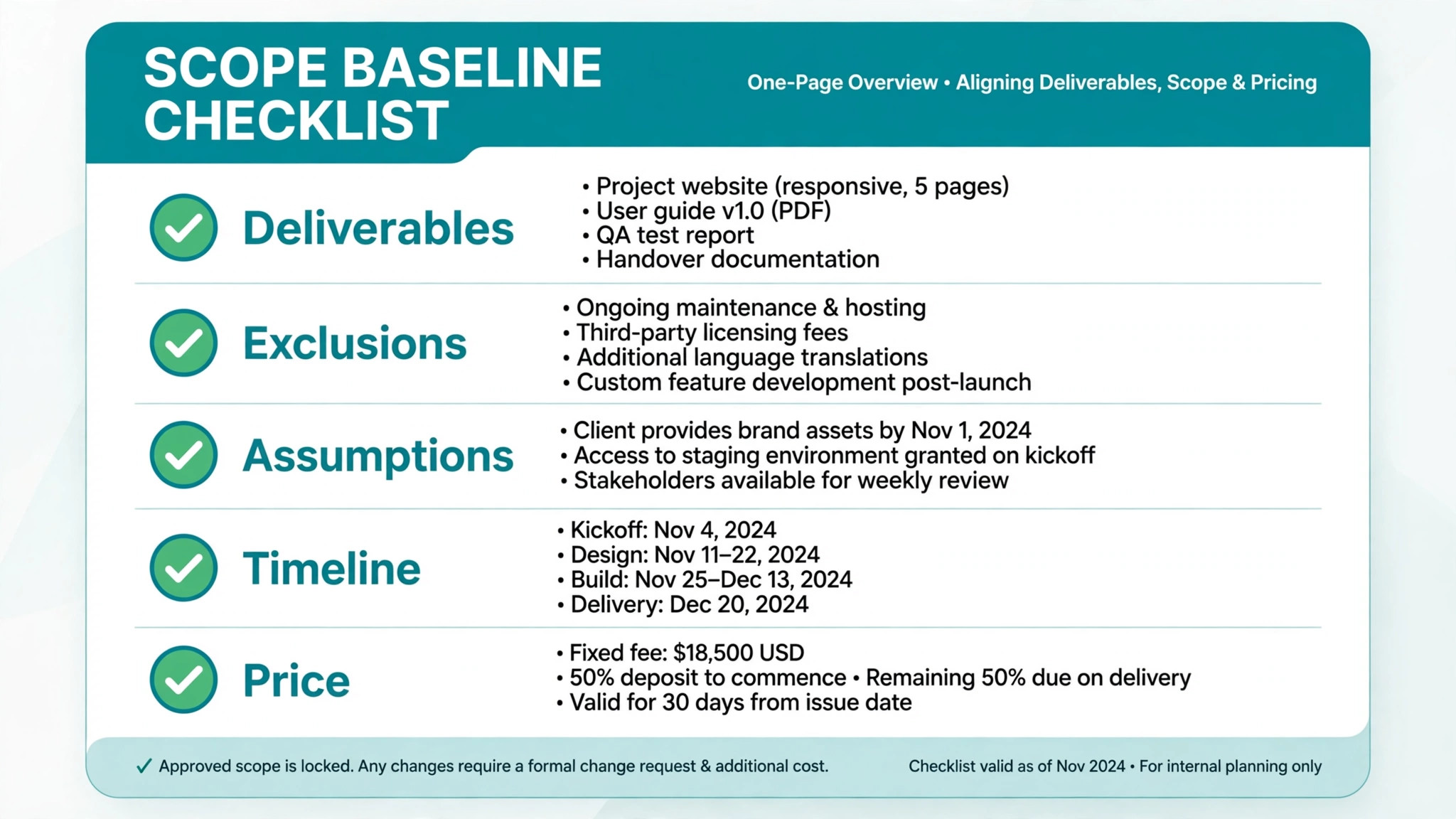
Everything else in this guide depends on one document, the scope baseline. This is the approved statement of what the job will and will not deliver, against which every later request is measured. For a small business it does not need to be long. One page is often enough. It needs five parts. Deliverables, meaning the exact items you will hand over. Exclusions, meaning the items you will not do. Assumptions, meaning the things you are taking as given, such as the client supplying content by a date. Timeline with milestones. And price with payment terms.
The exclusions list is the most overlooked part and the most valuable. Most scope disputes start not with what was promised but with what was never ruled out. If you are building a website, say plainly whether copywriting, photography, logo design, and ongoing updates are included or not. If you are cleaning a property, say whether ovens, windows, and inside appliances are included. Clients rarely argue with an exclusions list at signing time, because it reads as thoroughness. They argue later, when the exclusion was never written and both sides remember the conversation differently.
Get the baseline signed, even on small jobs. A signature does not need a lawyer. An email that says “Please reply yes to confirm this scope” and a yes in reply is a workable record for most small jobs. For larger jobs, put the baseline inside the proposal or statement of work and have the client sign that document. Then keep the baseline where the team can see it. A baseline filed in one person’s inbox protects nobody. Print it, pin it in the project folder, and open it at every status meeting. The baseline only works if it is the reference point for decisions, not a document everyone forgot.
How to Handle Scope Creep Small Business Owners Face Every Week
Here is the method in full, because this is the section you will actually use on a live job. When a new request arrives, run it through five steps and do not skip one because the request looks small. Step one, write it down in one sentence, with who asked and the date. If it is not written, it cannot be weighed. Step two, size the impact on schedule, budget, and other work, asking the people who will do the work rather than guessing.
Step three, offer options, usually two. Move the date, or swap out something of similar size. Occasionally a third option is to add resources at a price. Step four, get a decision from the person who owns the priorities, not just the person who asked. Step five, record the decision in the change log and mention it in the next status update so nobody is surprised later. Any serious guide to how to handle scope creep small business teams rely on comes back to these five steps, because they turn a vague request into a priced decision.
This loop works because it hands the trade off back to the client. A request stops being abstract when the client can see it costs a week and a defined amount, and that something else must move to make room. The most useful sentence in scope control is a version of this. Yes, we can add that. It adds about a week of work and a defined fee.
We can either move the delivery date by a week, or take the reporting dashboard out of this phase and deliver it next month. Which would you prefer. Notice what that sentence does not do. It does not refuse. It does not apologize. It does not argue about whether the request is fair. It simply prices the choice and asks the client to make it. That habit sits at the heart of how to handle scope creep small business owners manage without damaging the relationship.
Speed matters here. A change process that takes a week to answer a small question will be bypassed, and bypassed processes are worse than no process, because they teach everyone that the process is optional. Aim to answer small requests within one working day and larger ones within three.
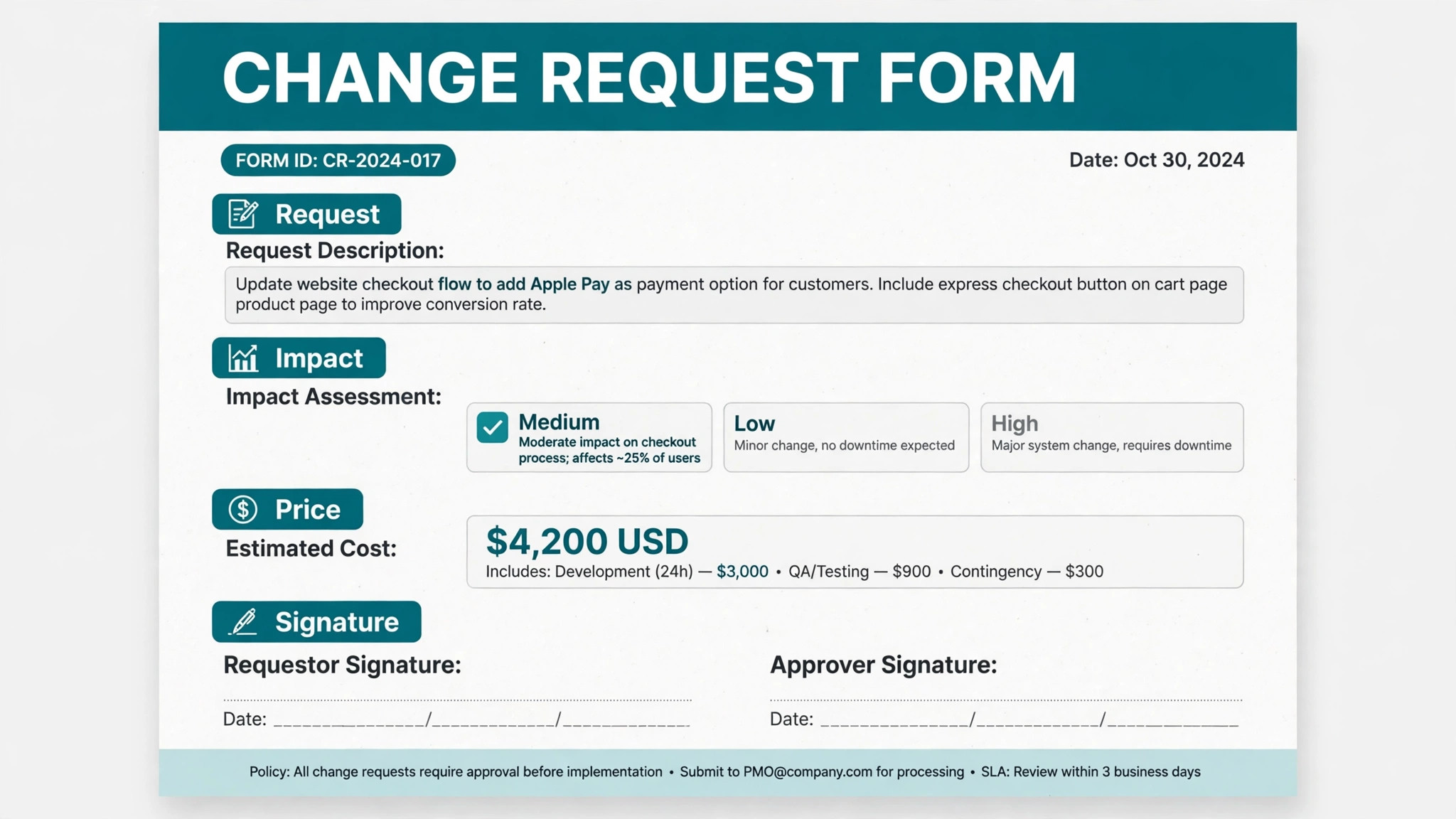
Use a one page form, kept in the project folder, with fields for the request, the impact, the options, the price, and the signature. For a request under a threshold you set in advance, such as a small fee or a few hours, you can approve by email instead of a full form, as long as the email states the price and the effect on the date. The threshold keeps the process light without making it invisible, which is a practical part of how to handle scope creep small business teams actually sustain.

Run Every Extra Request Through the Change Request Form
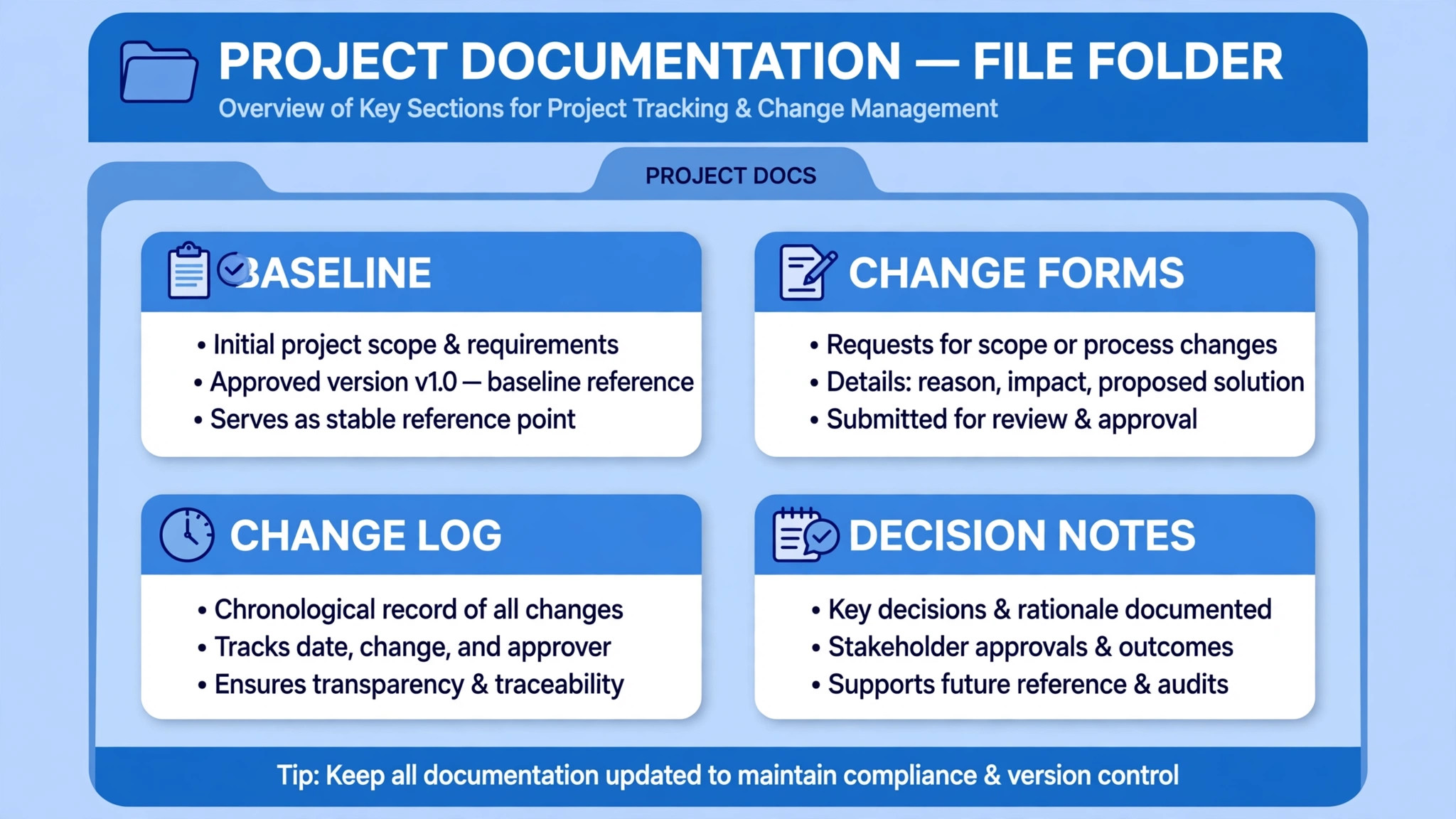
The change request form is the single document that turns creep into managed change. Keep it short enough that using it feels easier than skipping it. A good form has eight fields. Project name. Date. Requested by. Description in one or two sentences. Reason for the request. Impact on schedule. Impact on price. And decision, with a signature or email confirmation. That is all. Anything longer will sit unused, and an unused form is how creep returns through the side door.
Set two rules about the form at kickoff, and state them in plain words. Rule one is that no work outside the baseline starts before the form is approved. Rule two is that verbal requests get a same day written follow up from you. The follow up can be a short email.
It says what you understood the request to be, what it will cost, and what it does to the date, and it asks for confirmation. This matters because most creep does not start with a formal request. It starts with a hallway yes, a text message, or a comment in a meeting. The same day email converts a casual yes into a priced decision, and it does so without confrontation, because it reads as diligence rather than resistance.
Keep a running change log beside the form. One line per request, with the date, the description, the price, and the status. Review the log at every milestone meeting. The log does two jobs. It gives the client a visible total, which is often the first time they see that ten small yeses add up to real money. And it gives you a record if a dispute arises later. A client who can see the log rarely disputes it, because the log was shared all along. A client who never saw a log can honestly believe the extras were included, and that honest misunderstanding is the hardest dispute to win.
Price the Change and Re-Quote Without Apology
Pricing a change is where most small firms hesitate, and hesitation is what makes creep expensive. The rule is straightforward. Price the change the way you priced the original job, using the same rates and the same honesty. If the original job was priced by the hour, price the change by the hour. If it was fixed price, estimate the hours, apply your rate, and add a margin for the disruption of rework, because changes mid project cost more than the same work planned from the start. Rework means reopening finished work, retesting, and redoing documentation, and that cost is real whether or not you charge for it.
Use this re-quote script as a starting point and adapt the words to your own voice. Thanks for the detail on this addition. I have sized it. It adds roughly a set number of hours, which comes to a set fee at our agreed rate, and it moves delivery from one date to a later date.
If you would like to go ahead, I will send the change form today and we can start once it is confirmed. If you would prefer to hold it for a later phase, we can keep the current date and price unchanged. Which works better for you.
The script works because it does three things at once. It thanks the client, which keeps the tone warm. It states price and date together, so the client cannot accept the work and dispute the cost later. And it offers a genuine alternative, which makes the price feel like a choice rather than a penalty. That combination is central to how to handle scope creep small business owners price fairly and still keep clients.
Three pricing habits protect you further. First, never price a change at zero to be nice, because a zero price sets the precedent that changes are free, and the next ten requests will assume the same. If you genuinely want to absorb a tiny change as goodwill, write it in the log at its real value and mark it as absorbed as goodwill.
The client sees generosity with a value attached, and the precedent is generosity, not freeness. Second, bundle small changes into one priced update rather than issuing a tiny invoice for each, because a single clear invoice is easier for a client to approve than a drip of small charges. Third, collect payment for approved changes on the same terms as the original job, and do not start the extra work until the change is confirmed in writing.
Say No to the Right Things With a Boundary Script
Some requests should be refused, not priced. A request that conflicts with the purpose of the project, that would break something already built, or that arrives so late it would endanger the delivery date is a candidate for a no. So is a request from someone without authority to approve the cost. Refusing well is a skill, and it starts with separating the person from the request. You are not rejecting the client. You are protecting the delivery they already paid for.
Use a boundary script that gives a reason, an alternative, and a next step. A useful form runs like this. I want to protect the launch date we agreed, and adding this now would put it at risk because it touches work that is already tested.
The cleanest path is to finish this phase as agreed and put this item first in the next phase, where it gets proper testing. I can price that phase now if it helps planning. Notice the structure. Reason first, tied to the client’s own goal. Alternative second, so the client is not left empty handed. Next step third, so the conversation ends with action rather than argument. A no that offers a path forward is rarely experienced as a rejection, and it is a key part of how to handle scope creep small business owners face from well meaning clients.
Set boundaries early in the relationship, not in the middle of a dispute. At kickoff, say in plain words how changes work, how revision rounds are counted, and who can approve extra cost. Clients accept rules stated at the start far more easily than rules invented mid project, because early rules read as professionalism and late rules read as defensiveness.
The same applies inside your team. Give every team member a sentence they can use when a client asks them directly for an extra. A useful one is this. I can note that for you and send it to the project lead to price today, so it gets done properly. That sentence stops the hallway yes without making the team member feel disloyal to the client.

Keep a Documentation File That Protects You
Scope control is also legal protection, and the documentation file is what makes it real. Keep one file per project, digital or paper, holding the signed baseline, every change form, the running change log, approval emails, and dated notes of key decisions. When a dispute arises, this file is the difference between a memory contest and a record. A dated file ends that contest.
Write decision notes the same day decisions happen. A decision note can be three lines. Date, decision, who made it. Send it to the client as a brief email when the decision matters, because an email the client received and did not dispute is strong evidence of agreement. This habit also protects the relationship, since it prevents the most common source of scope arguments, which is not bad faith but honest misremembering. People genuinely forget what they agreed in a busy meeting. A short note sent the same day removes that fog before it hardens into a dispute.
Review the file at project close, not just at dispute time. A ten minute close review answers three questions. How many changes were approved and at what total value. How many hours went unbilled, if any, and why. And what should the next baseline include that this one missed. The answers feed directly into better estimates and better baselines for the next job. Firms that do this review find their estimates improving steadily, because each project teaches the next one what to exclude, what to price separately, and which client requests recur often enough to become a standard priced option.
Fix Creep That Is Already Underway
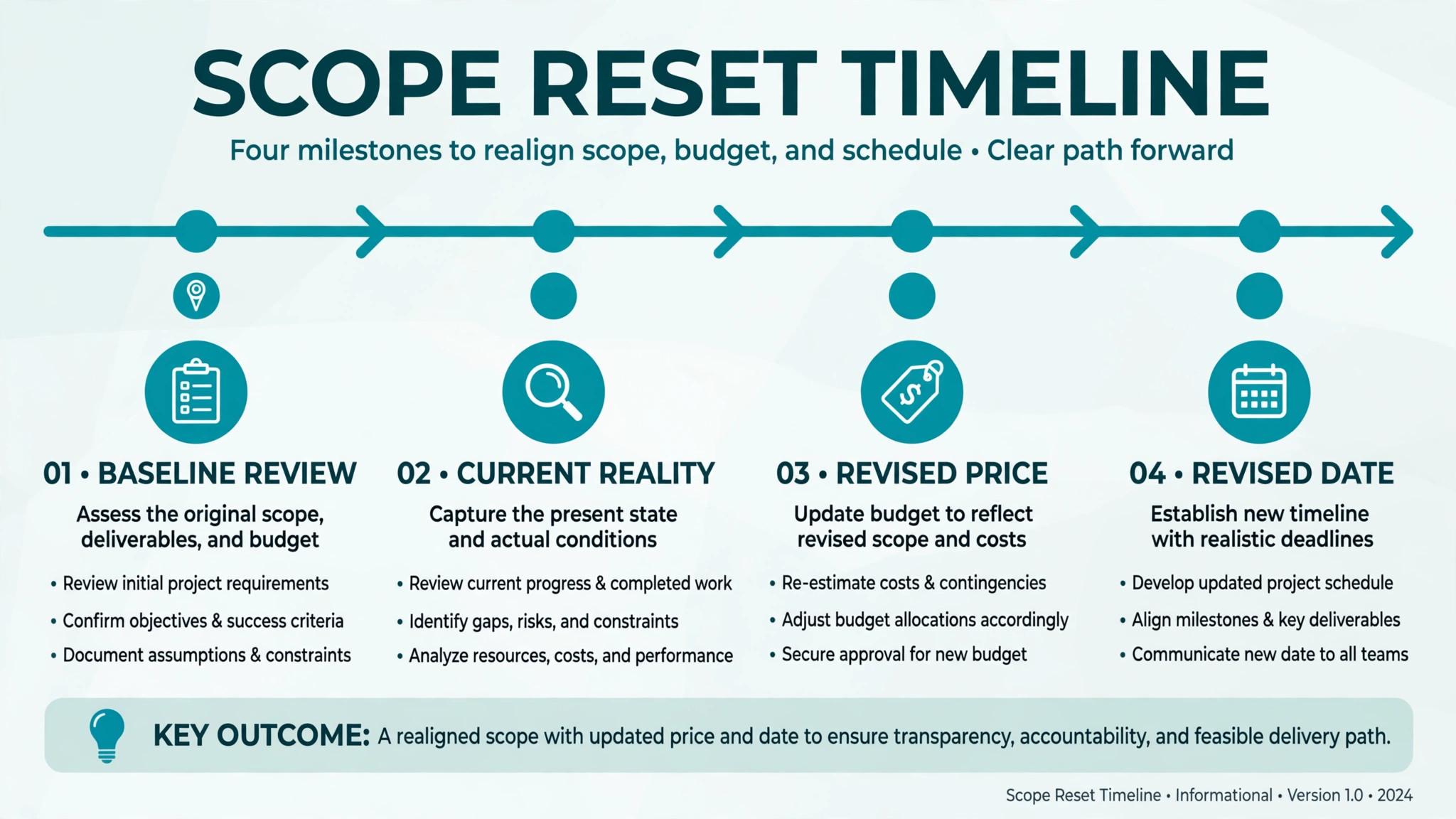
If you are reading this with a project already overgrown, the method still works, but the first step is different. Stop the quiet growth before you negotiate anything. Pick a date, this week, and call it a scope reset. In that meeting, lay out the original baseline beside the current reality, with the change log or, if no log exists, a reconstructed list of extras and their hours. Present it without blame. The point is not to accuse the client of overreaching. The point is to agree, together, on what the project has become, so the remaining work can be priced honestly.
Then split the extras into three groups. Work already done that you will absorb, work already done that must be paid for, and work not yet done that needs a decision. Absorbing a small amount of completed work as goodwill is often wise, because it shows good faith and buys cooperation for the paid items.
But absorb a defined amount, state it, and write it in the log. Absorbing everything teaches the client that the reset has no teeth. For the paid items, present one combined figure rather than a long list of small charges, and tie it to a revised delivery date. Clients accept a reset more easily when it arrives as a single clear proposal with a single date.
For work not yet done, apply the five step method from now on, without exception. Tell the client plainly that this is how the rest of the project will run, and frame it as protection for them as much as for you, because it is. A client who knows the price and date effect of every change can make better decisions about their own budget. If the client refuses any process at all, that refusal is information. It tells you the project will keep growing and you will keep funding it, and you should decide, before the next milestone, whether the relationship is worth that cost or whether a professional pause is the honest move.
| Situation | Response | What to say in one line |
|---|---|---|
| One small extra, first time | Log it, price it or mark it as goodwill | Noted, priced, and confirmed in writing today |
| Repeated small extras | Bundle into one change form | These add up, so let us price them together |
| New stakeholder reopening decisions | Return to the baseline | That decision was signed off, so changing it needs a form |
| Extra that endangers the date | Offer a swap or a later phase | We can add it if we move the date or defer another item |
The Scope Control Checklist to Copy Into Every Job
Use this checklist at kickoff, at each milestone, and at close. It is the whole method on one page, and it is the document to hand to a new team member or a new hire who will run projects for you.
– Baseline written with deliverables, exclusions, assumptions, timeline, and price, and signed by the client – Kickoff conversation covers how changes work, how revision rounds are counted, and who can approve extra cost – Change request form ready in the project folder, with a threshold for email approval of small changes – Same day written follow up sent for every verbal request, stating price and date effect – Change log updated at every change and reviewed at every milestone meeting – Re-quote script used for every priced change, with price and date stated together – Boundary script ready for requests that would endanger the delivery or the purpose of the project – Documentation file holds the baseline, forms, log, approvals, and dated decision notes – Close review records approved change value, unbilled hours, and lessons for the next baseline
Run through the list honestly at each milestone. A missed item is not a failure, it is the warning that tells you where creep will enter next. Most firms find the same two items missed repeatedly, usually the same day follow up and the milestone log review. Fixing just those two often cuts unbilled hours sharply, because they are the points where informal requests become invisible work.
Mistakes That Turn Small Creep Into a Loss
The first mistake is pricing by hope. A firm that estimates the original job tightly, with no margin for the ordinary friction of real projects, has no room to absorb even a small change. Build a margin into the original price that reflects the reality that some small extras will be absorbed. That margin is not dishonesty. It is the cost of doing business with real clients, and it is what lets you absorb a genuinely tiny request with grace instead of resentment.
The second mistake is the apology discount. When a change is priced and the client hesitates, many owners immediately cut the price to keep the peace. That teaches the client that the first price was negotiable, and the next change will be negotiated harder. Hold the price, and offer a smaller scope instead. A smaller deliverable at a lower price is a real choice. A discounted price for the same deliverable is a precedent. The same logic applies to deadlines. Do not promise the original date for an expanded job and then work nights to meet it. A moved date stated early is a professional decision. A missed date discovered late is a broken promise.
The third mistake is blaming the client, even privately in a way that leaks into tone. Clients who feel blamed stop telling you about changes, and hidden changes are worse than open ones, because they surface as rework at the end. Keep the language factual. Talk about the baseline, the change, the price, and the date, not about who caused what. The fourth mistake is keeping the process in your head. A method only you know is not a method, it is a habit, and habits break under pressure. Write it down, share it with the team, and use it on the easy jobs too, so it is automatic on the hard ones.
Frequently Asked Questions
How do I handle scope creep when the client is my biggest source of income?
Protect the relationship by protecting the work, not by absorbing unlimited extras. Use the change process exactly as you would for any client, and be warmer, not looser, in tone. Big clients respect a supplier who prices changes clearly, because it signals that the supplier will still be in business next year. If a major client refuses every change charge, calculate the true cost of serving them, including unbilled hours, and decide whether the volume justifies it. A client who costs you money at scale is a bigger problem, not a smaller one.
What should a scope baseline include for a very small job?
The same five parts, only shorter. Deliverables, exclusions, assumptions, timeline, and price. On a job worth a few hundred dollars, this can be a short email that the client confirms with a yes. The length is not the point. The point is that both sides can point to the same written agreement when a new request arrives. Small jobs creep just as readily as large ones, and a short baseline costs minutes to write.
How do I charge for a change the client says should have been included?
Return to the baseline and read it together. If the item is genuinely in the baseline, do it without argument, because the baseline is your promise. If it is not in the baseline, say so plainly and price it, offering the option to defer it to a later phase. If the baseline is vague on the point, be honest about the ambiguity, split the difference once, and rewrite the baseline so the next job is clear. Ambiguity you created is not the client’s fault, and owning it once buys credibility for the firmer line next time.
Can scope creep ever be good for a small business?
Yes, when it arrives as a priced change. A client who keeps asking for more is a client who values the work and has budget. Managed change is one of the best sources of extra revenue a service firm has, because it comes from an existing relationship with no selling cost. The difference between good growth and harmful creep is entirely in the process. Priced, approved, and documented growth is business. Silent, unbilled growth is a loss.
What if the client refuses to sign anything?
Start with the lightest form of agreement, a confirming email that states the scope and asks for a yes in reply. Most clients who resist a formal signature will accept an email confirmation. If a client refuses even that, treat it as a warning sign. You can still proceed, but keep your own written record, confirm decisions by email after every conversation, and require payment in stages so your exposure stays limited. A client who will not confirm anything in writing is telling you how disputes will go.
How often should I review scope during a project?
At kickoff and at every milestone, plus whenever a new stakeholder appears or priorities shift. On a short project that may mean two reviews. On a project running months, it means a short scope check in every status meeting. The review takes ten minutes. Open the baseline, open the change log, and ask whether anything since the last review belongs in either document. That question alone catches most drift before it becomes a dispute.
More Reading on Stratilyze
– How to Write a Scope of Work as a Small Business – How to Fire a Client Professionally as a Small Business – How to Set Service Prices for a Trades Business – How to Collect Deposits Before Work as a Small Business