
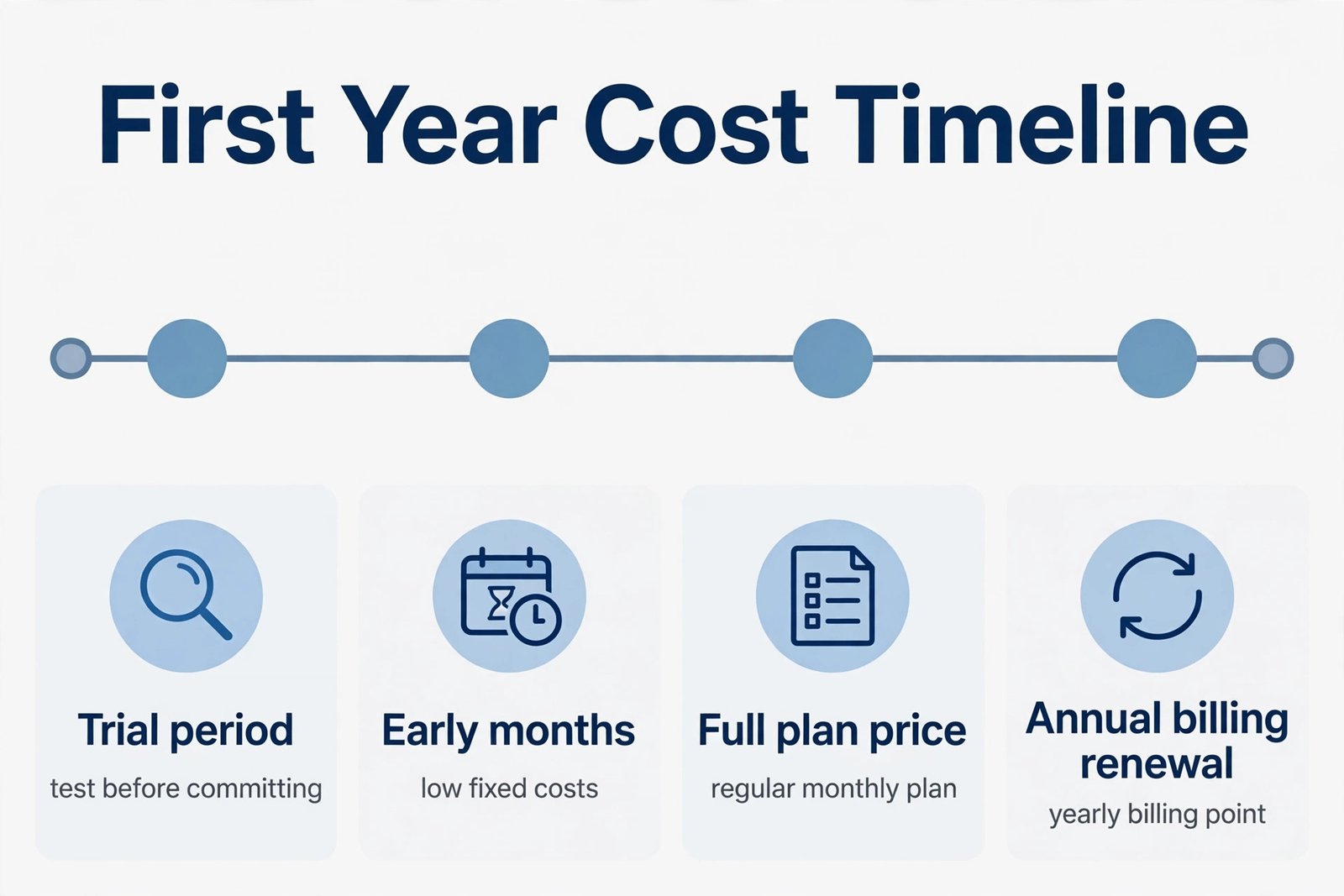
Shopify advertises a simple starting price, and that price is real as far as it goes. A new store can open on Basic for 39 dollars a month on monthly billing, or 29 dollars a month when billed annually, and that plan includes a full online store, unlimited products, hosting, security certificates and checkout. The problem is that the cost of running a Shopify store is almost never only the plan price for long. Payment fees arrive with every order, apps add up one subscription at a time, a domain renews once a year, shipping labels and packaging eat margin, and a theme or a small piece of custom work can turn a quiet month into an expensive one.
That gap between the advertised price and the bill you actually pay is what this guide closes. The cost of running a Shopify store is best understood as a stack, not a single number, and once you can see each layer you can decide which ones earn their place.
Searchers asking this question usually want one thing above all else, a realistic monthly total for a store like theirs. They are not looking for a definition of ecommerce. They want to know whether 100 dollars a month is enough, whether 500 dollars is normal, and at what point payment fees matter more than the plan itself. This guide answers those questions with current 2026 plan prices, payment rates, worked totals at four store sizes, and an app budget you can copy. It also flags where sources disagree after Shopify changed some annual prices in October 2026, so you can check the live pricing page at checkout rather than trusting a single snapshot.
Every figure below is in United States dollars unless stated otherwise, and every range is deliberate. Your exact bill depends on your sales volume, your average order value, your payment provider and the apps you keep.
What the cost of running a Shopify store really includes
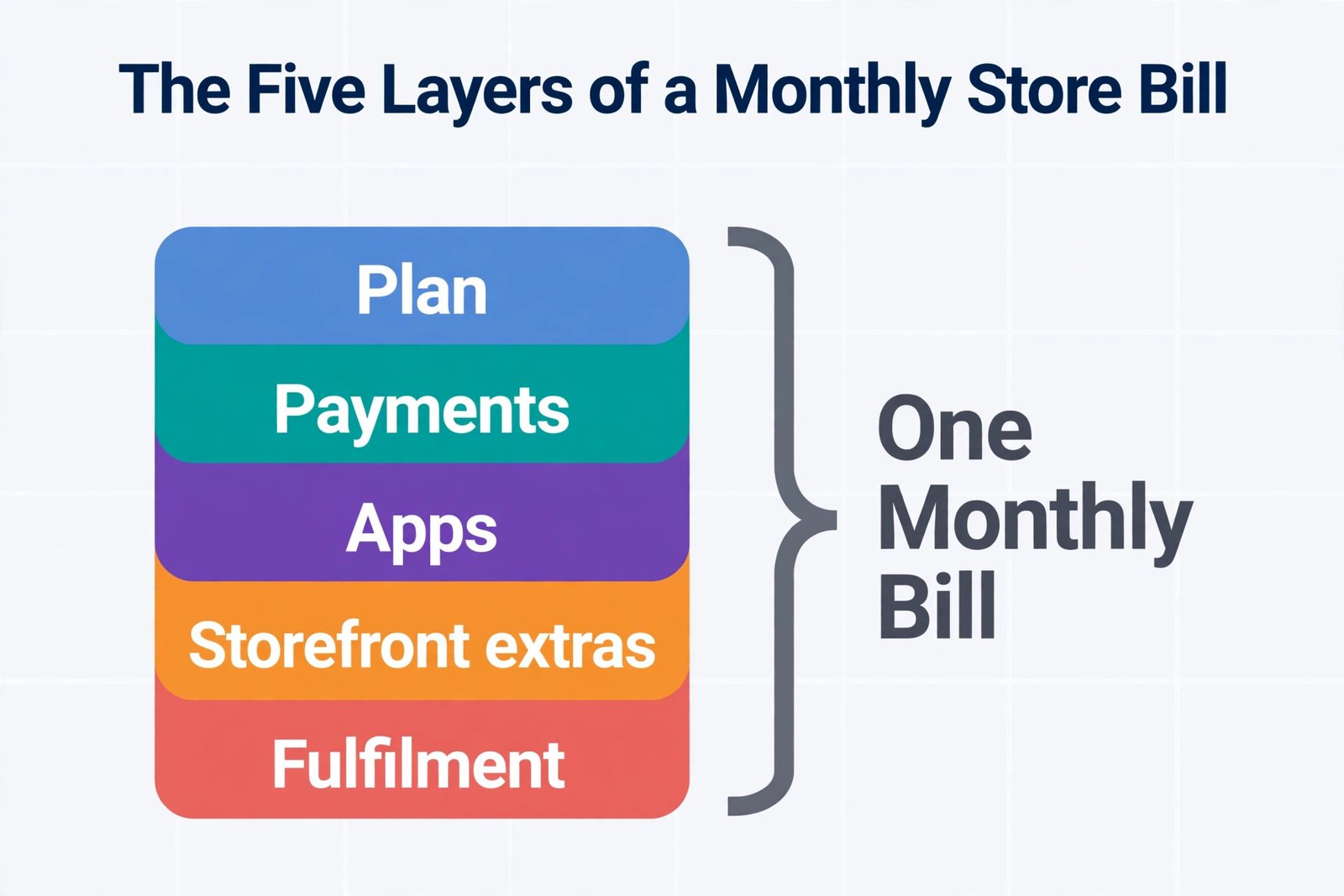
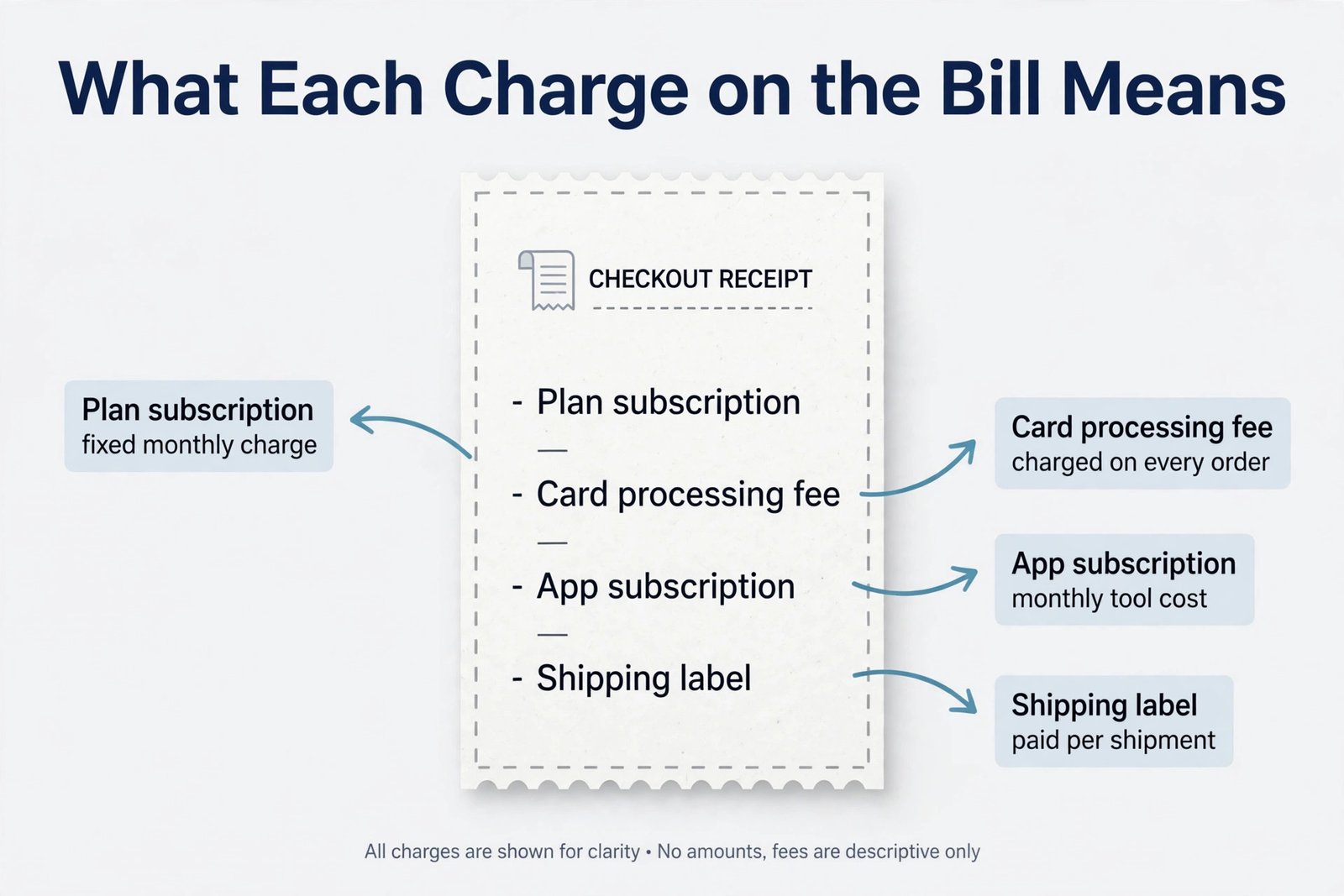
Think of the monthly bill in five layers. The first layer is the Shopify plan itself, a fixed subscription that gives you the store, hosting and checkout. The second layer is payment processing, a variable fee on every order that grows as sales grow and that often becomes the largest single cost once a store finds traction. The third layer is apps, the subscriptions that add email marketing, reviews, subscriptions, upsells, accounting, search and dozens of other jobs Shopify does not do out of the box. The fourth layer is the storefront extras, a domain, a paid theme spread over its useful life, product photography, copy and occasional design or development help.
The fifth layer is fulfilment and operations, shipping labels, packaging, returns, tax tools, bookkeeping and your own time, some of which never appears on a Shopify invoice but still comes out of margin.
A useful habit is to split costs into fixed and variable before you open any pricing page. Fixed costs stay roughly the same whether you sell ten orders or one hundred, and they include the plan, most apps, the domain and a bookkeeping subscription. Variable costs rise with sales, and they include card fees, shipping, packaging and any app that charges per order, per contact or per shipment. When sales are low, fixed costs dominate and the plan choice matters most. When sales are high, variable costs dominate and the payment rate matters more than a 50 dollar plan difference.
That shift explains why a plan that looks expensive at launch can become the cheaper option at scale, and why a cheap plan can become expensive once a third party gateway fee is added to every order.
Shopify plan prices in 2026
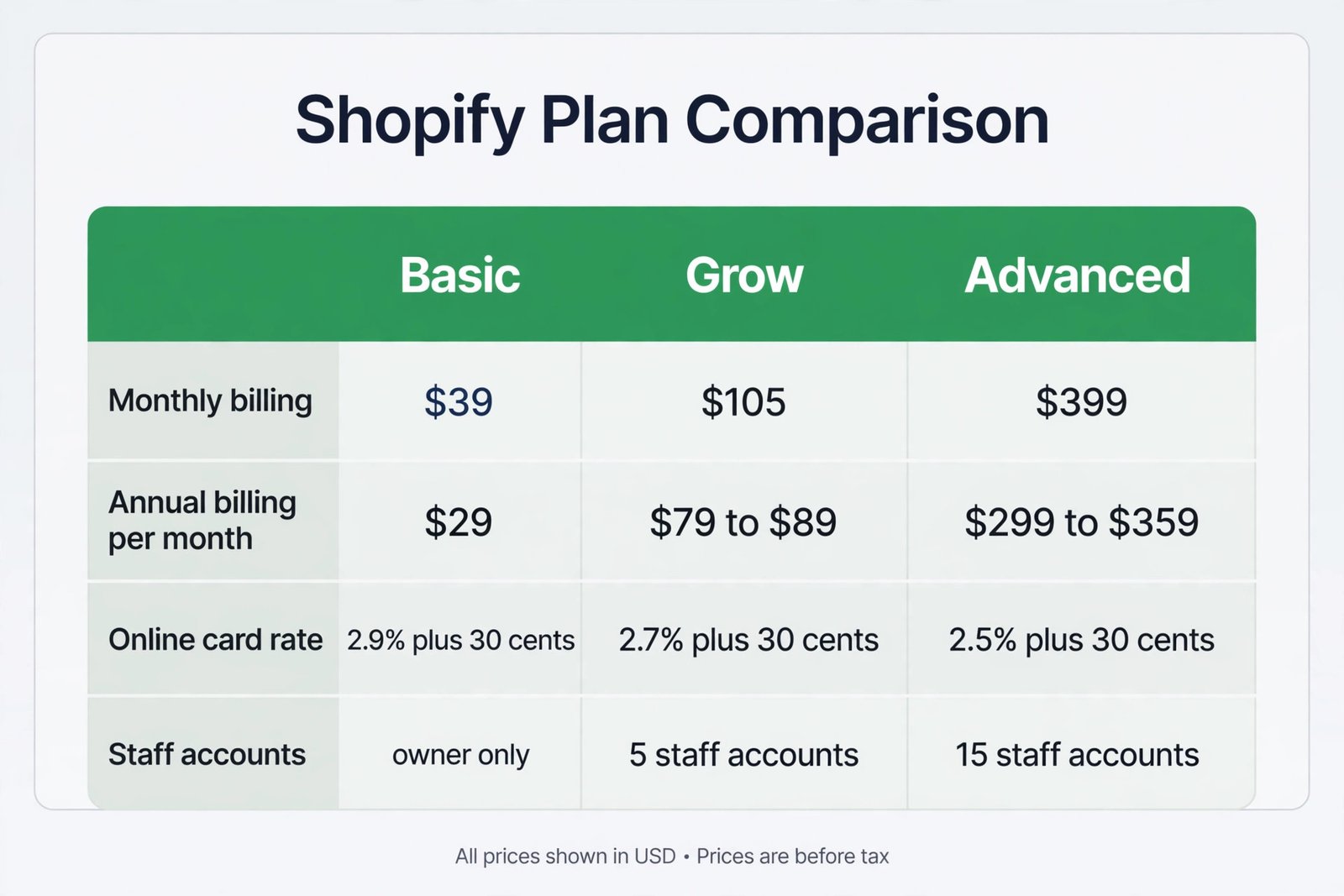
Shopify sells four plans that include a full online store, plus a Starter plan for selling through links and social channels without a full storefront. Starter costs 5 dollars a month and charges 5 percent per transaction, which makes it a testing tool rather than a home for a real store. For a full store, the choice is Basic, Grow, Advanced or Plus. Grow is the current name for the plan Shopify used to call Shopify, and that rename still causes confusion in older guides, so check the plan name on the live page rather than trusting an old comparison.
Basic is the right starting point for most new stores. On monthly billing it costs 39 dollars a month, and on annual billing it costs 29 dollars a month, or 348 dollars a year. It includes unlimited products, a full store, discount codes, abandoned checkout recovery and Shopify support. Its limits matter more than its features. Basic includes no additional staff accounts beyond the store owner, its reporting is basic, and it does not include third party calculated shipping rates at checkout. A solo founder who does their own fulfilment will rarely hit those limits in the first year.
Grow costs 105 dollars a month on monthly billing. On annual billing, sources published in 2026 list it at 79 dollars a month, with one October 2026 update reporting a rise to 89 dollars a month, so budget 79 to 89 dollars a month on annual billing and confirm the live figure at checkout. Grow adds five staff accounts, professional reports, lower card rates and a lower third party gateway fee, which are covered in detail below. It suits a store with steady daily orders, a small team, and a need to understand which products and channels actually make money.
The jump from Basic to Grow is 50 to 60 dollars a month on annual billing, so it should be justified by a concrete need, such as staff logins, reporting, or enough third party gateway volume to cover the difference, not by a vague feeling that a growing store should be on a bigger plan.
Advanced costs 399 dollars a month on monthly billing. On annual billing, 2026 sources list it at 299 dollars a month, with the same October 2026 update reporting a rise to 359 dollars a month, so budget 299 to 359 dollars a month on annual billing and confirm the live figure at checkout. Advanced adds 15 staff accounts, a custom report builder, third party calculated shipping rates at checkout and the lowest standard card rate. It suits high volume stores, stores with complex shipping, and stores that sell in multiple markets and need deeper reporting to manage that complexity.
Plus starts at about 2,300 dollars a month on a three year term, or about 2,500 dollars a month on a one year term, with negotiated card rates. Plus is an enterprise plan with checkout customisation, automation tools and dedicated support, and it only makes sense once volume and complexity are far beyond the standard plans.
| Plan | Monthly billing | Annual billing per month | Who it fits |
|---|---|---|---|
| Starter | 5 dollars | 5 dollars | Link and social selling only, no full storefront |
| Basic | 39 dollars | 29 dollars | New stores and solo founders |
| Grow | 105 dollars | 79 to 89 dollars, check at checkout | Small teams with steady orders and reporting needs |
| Advanced | 399 dollars | 299 to 359 dollars, check at checkout | High volume stores and complex shipping |
| Plus | From 2,300 dollars | By contract term | Enterprise and very high volume brands |
Payment fees, the cost that scales with sales
Payment fees are the least understood part of the monthly bill, and they are the part that most often turns a profitable looking store into a thin margin business. Two different charges are involved, and confusing them is expensive. The first is the card processing rate, the percentage plus a fixed amount per transaction that the payment provider charges for moving money. The second is Shopify additional transaction fee, which applies only when you use a third party payment provider instead of Shopify Payments. Use Shopify Payments and that second fee disappears, which is why it is the default recommendation for most stores in countries where it is available.
For United States stores using Shopify Payments in 2026, the standard online card rates reported across pricing guides are 2.9 percent plus 30 cents per transaction on Basic, 2.7 percent plus 30 cents on Grow, and 2.5 percent plus 30 cents on Advanced. In person rates through Shopify point of sale are lower, at about 2.6 percent plus 10 cents on Basic, 2.5 percent plus 10 cents on Grow and 2.4 percent plus 10 cents on Advanced. Plus card rates are negotiated and are commonly reported from about 2.15 percent plus 30 cents.
International cards, premium cards and currency conversion can add further costs, with currency conversion commonly reported at about 1.5 percent where a payout currency differs from the sale currency, and international card surcharges of about 1 percent on some plans.
The third party gateway fee is where a store can lose money without noticing. If you take payments through PayPal, Stripe outside Shopify Payments, or another external provider, Shopify adds a fee on top of that provider own rate. That fee is 2 percent on Basic, 1 percent on Grow, 0.6 percent on Advanced and about 0.2 percent on Plus. Worked through on real numbers, the effect is stark. A store doing 10,000 dollars a month through a third party gateway on Basic would pay about 200 dollars a month in Shopify additional fees alone, before the gateway own card rate. The same store on Shopify Payments pays no additional Shopify fee, only the card rate.
That 200 dollars a month is 2,400 dollars a year, which is more than five years of the difference between monthly and annual Basic billing. The lesson is simple. If Shopify Payments is available in your country and supports your payment methods, use it first, and only add a third party provider when a specific customer need, such as a local payment method Shopify Payments does not cover, justifies the extra percentage.
Monthly totals by store size
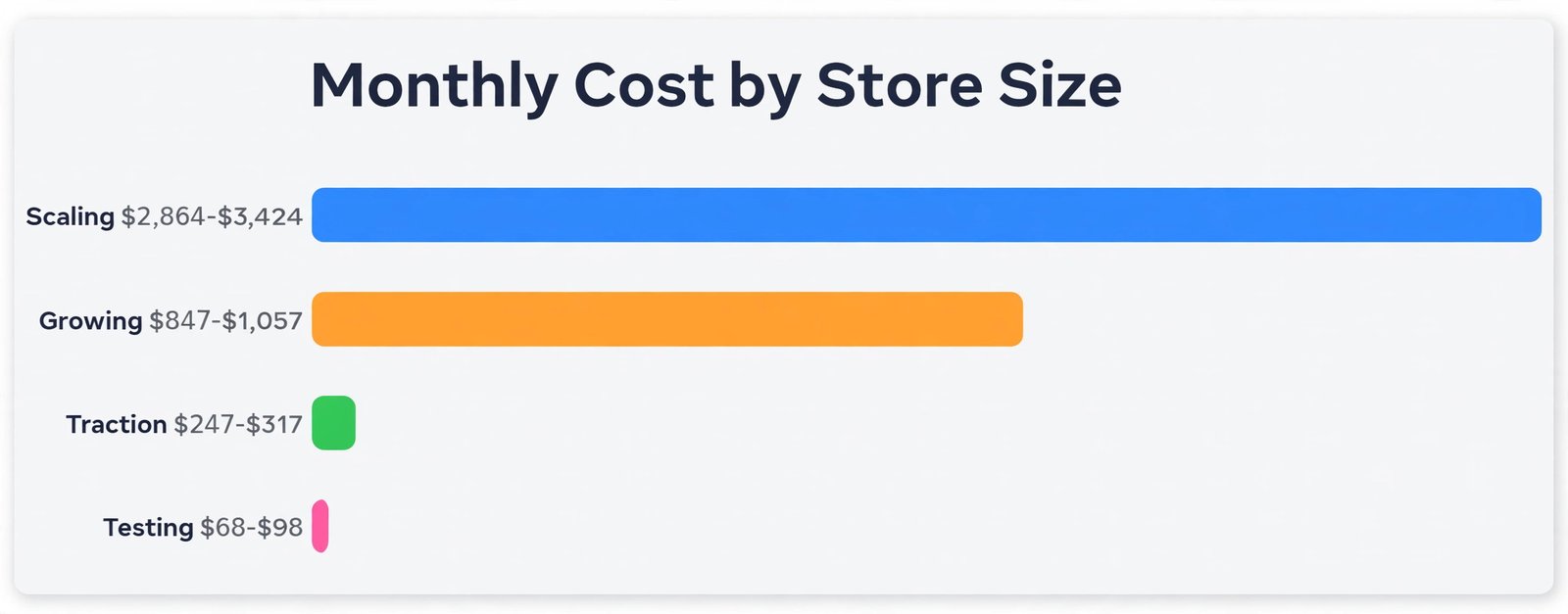
The table below is the heart of this guide, because it turns separate prices into a single monthly number for four realistic store sizes. The totals include the plan on annual billing, Shopify Payments card fees at the stated sales level and average order value, a modest app budget, and a small allowance for domain and theme costs spread monthly. They exclude product cost, advertising, and staff wages, because those vary so widely that including them would make the table useless. They also exclude shipping and packaging, which are shown separately afterwards so you can add your own figures. Read the totals as a planning range, not a promise.
A store with a higher average order value will pay slightly less in card fees per dollar of sales, and a store with many small orders will pay slightly more.
| Store size | Monthly sales and orders | Plan, annual billing | Card fees, Shopify Payments | Apps | Domain and theme spread | Typical monthly total before product and ads |
|---|---|---|---|---|---|---|
| Just launched, testing an idea | 1,000 dollars, about 25 orders at 40 dollars | Basic, 29 dollars | About 36 dollars | 0 to 30 dollars | About 3 dollars | About 68 to 98 dollars |
| Small store finding traction | 5,000 dollars, about 125 orders at 40 dollars | Basic, 29 dollars | About 183 dollars | 30 to 100 dollars | About 5 dollars | About 247 to 317 dollars |
| Growing store with a small team | 20,000 dollars, about 400 orders at 50 dollars | Grow, 79 to 89 dollars | About 660 dollars | 100 to 300 dollars | About 8 dollars | About 847 to 1,057 dollars |
| Scaling store with complex shipping | 75,000 dollars, about 1,250 orders at 60 dollars | Advanced, 299 to 359 dollars | About 2,250 dollars | 300 to 800 dollars | About 15 dollars | About 2,864 to 3,424 dollars |
Two patterns in that table deserve attention. First, the plan is a small share of the total once sales pass a few thousand dollars a month. At 20,000 dollars of monthly sales, card fees alone are roughly seven times the Grow plan price, and apps can cost more than the plan too. Debating Basic against Grow while ignoring card fees and app sprawl is debating the smallest part of the bill. Second, the jump from a testing store to a traction store is mostly card fees, not Shopify pricing.
A store doing 1,000 dollars a month can run for under 100 dollars a month in platform costs, while a store doing 5,000 dollars a month will typically spend 250 to 320 dollars a month before it buys a single product or runs a single ad. That is normal, and it is affordable when margins are healthy. It only becomes a problem when product margin is thin and the owner budgeted only for the plan.
Apps, where budgets quietly grow
Apps are the most common reason a Shopify bill creeps upward without a single decision feeling large. Each app is cheap on its own, often 10 to 30 dollars a month, and each one solves a real problem, so saying yes feels easy. Six months later the store has fourteen apps, several of which overlap, one of which nobody on the team remembers installing, and a monthly app bill larger than the plan itself. The table below gives realistic budget ranges by job, not by brand, because app prices change often and because the job matters more than the logo.
Check the app listing and checkout for the current price, the free tier limit, and whether the price scales with contacts, orders, or page views, since a price that looks small at launch can triple as the list grows.
| App job | Typical monthly range | What it usually covers | When to skip it for now |
|---|---|---|---|
| Email and SMS marketing | 0 to 100 dollars at small scale, higher as the list grows | Campaigns, flows for abandoned carts and welcome series, basic segmentation | Until you have regular traffic and a list worth mailing weekly |
| Reviews and social proof | 0 to 40 dollars | Review collection, photo reviews, star ratings on product pages | Until you have buyers to ask for reviews |
| Upsells, bundles and discounts | 10 to 60 dollars | Bundle offers, frequently bought together, post purchase offers | Until your average order value problem is proven, not guessed |
| Subscriptions | 20 to 100 dollars | Recurring orders, subscriber portal, dunning for failed payments | Until repeat purchase is a core part of the offer |
| Accounting and bookkeeping sync | 10 to 50 dollars | Payout reconciliation, sales tax summaries, export to accounting software | Only if you reconcile manually today and it already takes hours |
| Shipping, labels and fulfilment | 0 to 50 dollars, plus label cost | Discounted labels, tracking pages, fulfilment rules | Until order volume makes manual labels slow |
| Page building and custom sections | 0 to 40 dollars | Extra page layouts beyond the theme | Until the theme genuinely cannot build a page you need |
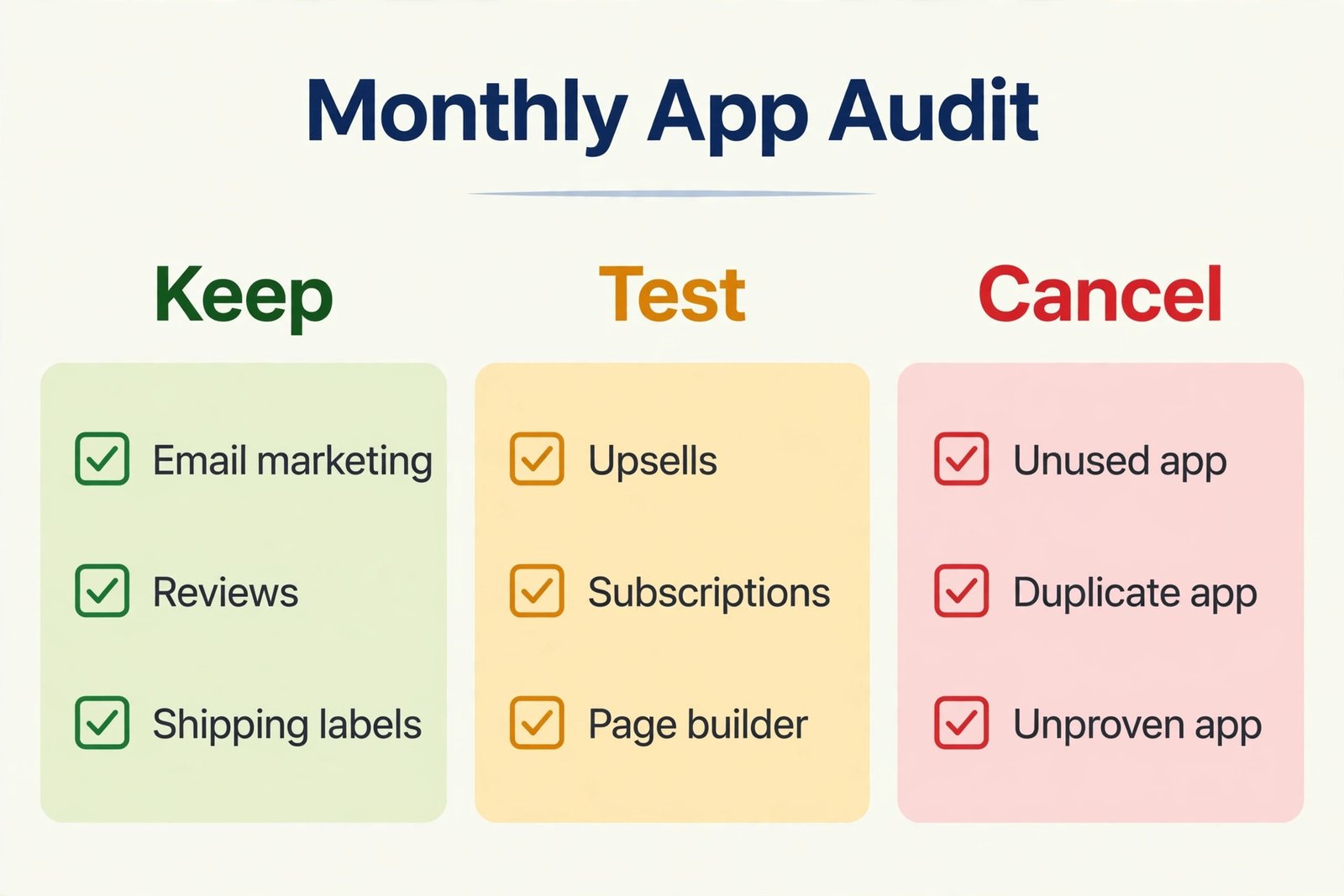
A disciplined app budget for a new store is 0 to 50 dollars a month, using free tiers and built in Shopify features first. Shopify already includes discount codes, abandoned checkout recovery, basic analytics, product variants, blogging and a checkout that converts well, so many stores do not need a paid app in month one. A traction store doing 5,000 to 20,000 dollars a month will typically spend 50 to 200 dollars a month on apps, concentrated in email, reviews and one or two conversion tools that have proven their value in testing.
A scaling store can reasonably spend 300 to 800 dollars a month, but only when each app is tied to a measurable job, such as a subscription app that holds retention or a shipping app that cuts label cost per order. The test for every app is the same. If you removed it tomorrow, would revenue, conversion or hours saved fall by more than its price. If the answer is unclear after a month, cancel it and watch what happens. Most stores find that two or three removals change nothing, and that discovery alone can cut the monthly bill by 50 dollars or more.
Themes, domains and one-off costs
A domain typically costs about 10 to 20 dollars a year through Shopify or a registrar, which is about 1 to 2 dollars a month when spread across the year, though premium or renewal pricing can be higher for some extensions. That cost is small, but it is easy to forget because it arrives once a year rather than monthly. Buy the domain through a registrar you control, keep renewal on automatic payment with a current card, and keep the domain in the business name rather than a personal account that could be lost if a team member leaves. A lapsed domain can take a store offline and cost far more in lost sales than a decade of renewals.
Themes are a one-off purchase that should be spread mentally over their useful life. Shopify free themes are genuinely usable, well supported, and fast, and a new store should start there unless a specific design need cannot be met. Paid themes in the Shopify theme store commonly cost about 100 to 400 dollars as a one-off payment, with some premium themes higher, and that payment usually covers the theme for one store with updates. Spread over two years, a 250 dollar theme costs about 10 dollars a month, which puts it in perspective. It is not a monthly burden, but it is also not free, and switching themes later can mean rebuilding custom sections and retesting pages.
Choose a theme for speed, mobile layout and the sections you will actually use, not for a demo store that looks nothing like your catalogue.
Shipping, taxes and the costs people forget
Shipping is where many new stores lose money quietly, because the customer sees a delivery price while the store pays a label price, packaging, and the cost of handling a return. Shopify discounted labels through carriers can reduce the label price, and the exact discount depends on the carrier, the service and the plan. The discipline that matters is not the discount percentage. It is knowing the full cost per shipment, including the box, filler, tape, label and the minutes spent packing, and then setting shipping prices and free shipping thresholds from that number.
A free shipping threshold set below the point where an order covers its own fulfilment cost will generate orders that lose money on delivery, and the store will celebrate growth while margin leaks away.
Returns deserve their own line in the budget. Return rates vary sharply by category, with apparel and footwear typically higher than consumables or home goods, and each return costs outward shipping, return shipping where the store covers it, inspection, restocking and sometimes a product that cannot be resold at full price. A store with a 10 percent return rate on 500 orders a month is handling 50 returns a month, and even a modest 8 dollars of cost per return is 400 dollars a month that never appears as a Shopify plan charge.
Taxes and bookkeeping are not optional extras, even for a small store. Shopify tax tools help calculate and collect sales tax in many regions, but the store owner remains responsible for registration, filing and remittance where required, and rules differ by state, country and product type. An accounting sync app or a bookkeeper who reconciles Shopify payouts, refunds, fees and app charges each month will cost money, typically tens of dollars a month for a tool plus bookkeeping time, but it prevents a year end scramble and a tax filing built on guessed numbers. International selling adds currency conversion, duties and taxes handling, and translation where needed, and each of those can be a percentage cost on cross border orders.
Price international orders with those costs included, or restrict international shipping until the store can handle them properly.
How to choose the right plan for your stage
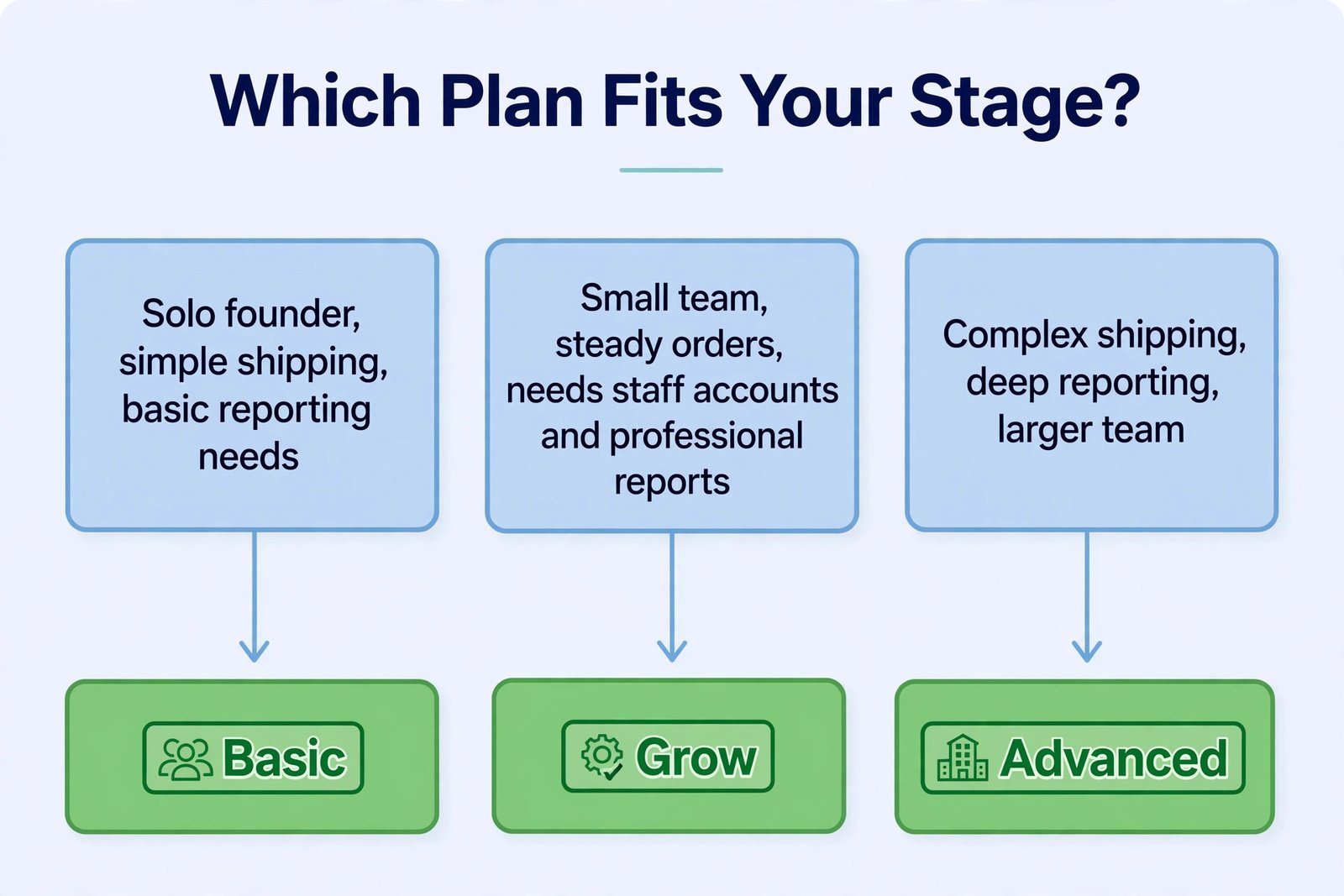
Start on Basic unless a concrete limit forces you upward. A solo founder with no staff logins, simple shipping and basic reporting needs should stay on Basic until sales or team size change the maths. Move to Grow when you need staff accounts, when professional reports would change a buying or advertising decision, or when third party gateway volume is high enough that the lower 1 percent fee covers the plan difference. On 5,000 dollars a month through a third party gateway, the Grow saving against Basic is about 50 dollars a month, which roughly covers the annual plan gap, and staff accounts may justify it sooner.
The cost of running a Shopify store falls when the plan matches a proven need, not when it matches an aspiration, so upgrade on evidence from your own dashboard, not on a launch checklist.
Move to Advanced when shipping complexity or reporting depth becomes a daily constraint. Third party calculated rates at checkout, a custom report builder and 15 staff accounts are the real reasons to pay 299 to 359 dollars a month on annual billing, not the slightly lower card rate alone. The card saving from Grow to Advanced is only 0.2 percent, which is 40 dollars a month on 20,000 dollars of sales, far short of the plan gap. Do the same test for Plus. If checkout customisation, automation at enterprise scale or negotiated rates would save more than about 2,300 dollars a month in fees, labour or lost sales, get a quote.
Otherwise, stay on a standard plan and spend the difference on product, photography or advertising that can be measured.
Mistakes that inflate the monthly bill
The first mistake is paying for apps before the problem is proven. Install an app only when a manual process is slow, a conversion leak is measured, or a customer request repeats. The second mistake is keeping a third party gateway out of habit after Shopify Payments becomes available, which hands Shopify an extra 1 to 2 percent on every order for no customer benefit. The third mistake is annual billing too early, locking a year of cash into a plan the store may outgrow or abandon.
The fourth mistake is ignoring the average order value, because a store selling 15 dollar items pays a far higher effective card rate than a store selling 80 dollar items, and bundles or thresholds fix that faster than a plan change. The fifth mistake is forgetting returns, packaging and bookkeeping in the budget, which makes a month look profitable until those costs land together. The cost of running a Shopify store is easiest to control with a monthly review, one app list, one payout report, and one decision to cancel anything that cannot prove its value.
A simple monthly budget worksheet
Copy this worksheet, fill in your own figures, and total the fixed and variable rows separately. That split shows the cost of running a Shopify store at higher sales, since variable costs will rise with it.
| Line | Your monthly figure |
|---|---|
| Shopify plan | |
| Apps, total | |
| Domain spread monthly | |
| Theme spread monthly | |
| Card fees at expected sales | |
| Shipping and packaging per order, times orders | |
| Returns allowance | |
| Bookkeeping or tax tool | |
| Total monthly platform and operations cost |
For related reading, see how Shopify compares with other platforms in Shopify vs WooCommerce and Shopify vs Etsy, explore alternatives in Shopify alternatives, and plan the wider store toolkit with best AI tools for ecommerce and best AI tools for dropshippers. For email costs that often sit beside the app budget, Mailchimp vs Klaviyo compares two common options.
Frequently Asked Questions
How much does Shopify cost per month for a new store?
A new store on Basic costs 39 dollars a month on monthly billing or 29 dollars a month on annual billing, plus card fees on each order. A realistic first month total, including a small app budget, is about 68 to 98 dollars before product cost and advertising, based on the table earlier in this guide.
Is Shopify Payments cheaper than PayPal or Stripe on Shopify?
For most stores, yes. Shopify Payments removes the extra Shopify transaction fee of 2 percent on Basic, 1 percent on Grow and 0.6 percent on Advanced that applies with a third party provider. You still pay the card rate, but you avoid paying two layers of fees on the same order.
When should I upgrade from Basic to Grow?
Upgrade when you need staff accounts, professional reports, or enough third party gateway sales for the lower fee to cover the gap. On annual billing the gap is about 50 to 60 dollars a month, so the upgrade should solve a real workflow problem, not just signal growth.
How much should I budget for Shopify apps each month?
Budget 0 to 50 dollars a month at launch, 50 to 200 dollars a month at traction stage, and 300 to 800 dollars a month only at scale with each app tied to a measurable job. Review the app list monthly and cancel anything that cannot show revenue, conversion or time saved above its price.
Do I need a paid theme to run a Shopify store?
No. Free Shopify themes are fast, supported and sufficient for most new stores. A paid theme at about 100 to 400 dollars one-off is worth considering only when it adds a section, layout or speed improvement your free theme cannot match, and the cost should be spread over its useful life in your budget.
What is the cheapest realistic monthly total for a store with sales?
The cost of running a Shopify store with real sales rarely stays at the plan price alone, because card fees arrive with every order. At 1,000 dollars of monthly sales, expect roughly 68 to 98 dollars a month in plan, card and small app costs, before product, shipping and advertising, and check the live pricing and payments pages at checkout for your country.
Your Real Number, Not the Advertised One
The cost of running a Shopify store starts with the plan price, not the budget. Your real number is the plan plus card fees at your sales level, plus the apps that prove their value, plus domain and theme costs spread monthly, plus shipping, packaging, returns and bookkeeping. For a testing store that number can sit under 100 dollars a month. For a growing store it will often sit between 850 and 1,050 dollars a month before product and advertising. For a scaling store it can pass 3,000 dollars a month, and still be good value when margins and volume support it.
Build your worksheet this week, use Shopify Payments where available, keep the app list short, and review the bill on the first day of each month. That routine turns a surprising invoice into a planned cost, and it leaves the money you save for the work that actually grows the store, better products, clearer pages, and offers customers want to buy again.