
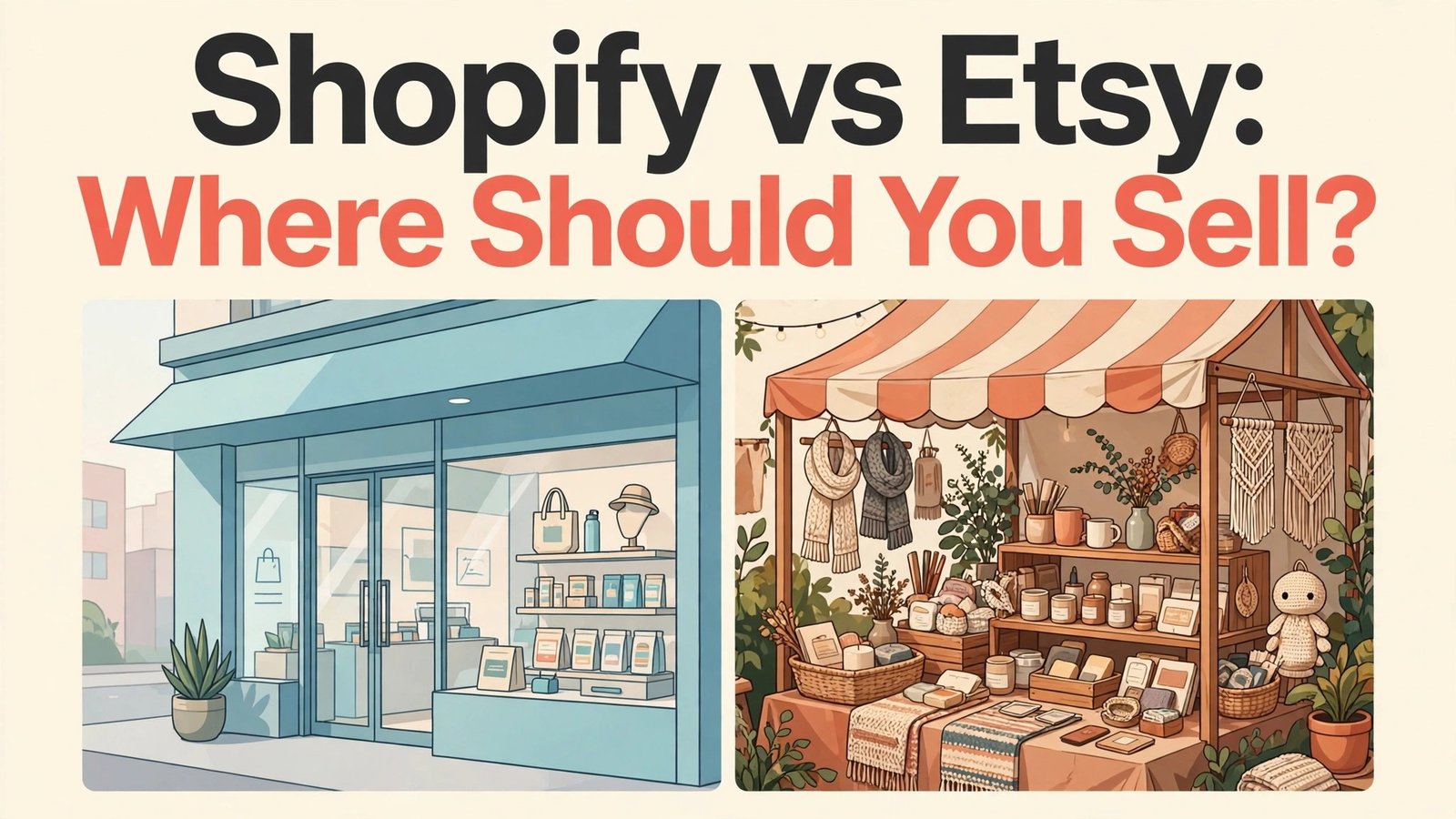
Shopify vs Etsy is a choice between owning your shop and renting a stall in a busy market. That difference shapes everything else: who finds your products, how much control you have over branding, what you pay per sale, and how hard it is to build repeat buyers who return to you, not to a marketplace. Many sellers start on Etsy because buyers are already there. Many sellers move to Shopify when they want their own brand, their own email list, and their own rules. Some sellers use both, and that hybrid path is often the smartest first step.
The problem most new sellers face is not a lack of products. It is a lack of traffic and trust. Etsy solves traffic on day one, but it limits how distinct your shop can look and how directly you can reach buyers after a sale. Shopify gives you a full store, a custom domain, and full control over design and promotions, but it gives you zero built in traffic. You must bring visitors through search, social media, email, and ads, or your beautiful store will sit empty.
This guide compares the two platforms on the questions that decide profit: fees and margins, built in traffic versus self driven traffic, branding and customer ownership, product fit, selling tools, payments, shipping, support, and growth limits. Prices and fee structures change, so verify current fees at checkout and on each official pricing page before you commit. The goal is not to declare one platform better for everyone. It is to help you pick the platform that matches your product type, your marketing skills, and your stage of business.
Shopify vs Etsy: The Core Trade Off in Plain Terms
Etsy is a marketplace for handmade, vintage, and craft supply products, plus a growing range of creative and personalized goods. Buyers come to Etsy to browse, search, and discover. When a buyer searches for a ceramic mug, a wedding invitation, or a digital planner, Etsy can show your listing next to similar products, even if no one has heard of your brand. That discovery value is the main reason to pay marketplace fees.
Shopify is a store builder, not a marketplace. You create a standalone website with your own domain, theme, product pages, blog, and checkout. No one browses Shopify to discover random shops. Visitors arrive because they clicked your link, searched for your brand, or saw your ad. That means Shopify rewards sellers who can market, write product content, build an email list, and run promotions. It also rewards sellers who want a brand that looks independent, professional, and ready for wholesale, retail partnerships, or press coverage.
Think of it this way. Etsy is like a craft fair with foot traffic, shared rules, and a shared reputation. Shopify is like opening your own shop on a side street. The shop can look exactly how you want, but you must put up signs, tell people where you are, and give them a reason to return. Sellers who understand that trade off rarely regret their choice, even when they later switch platforms.
Test 1: Getting Your First 100 Sales
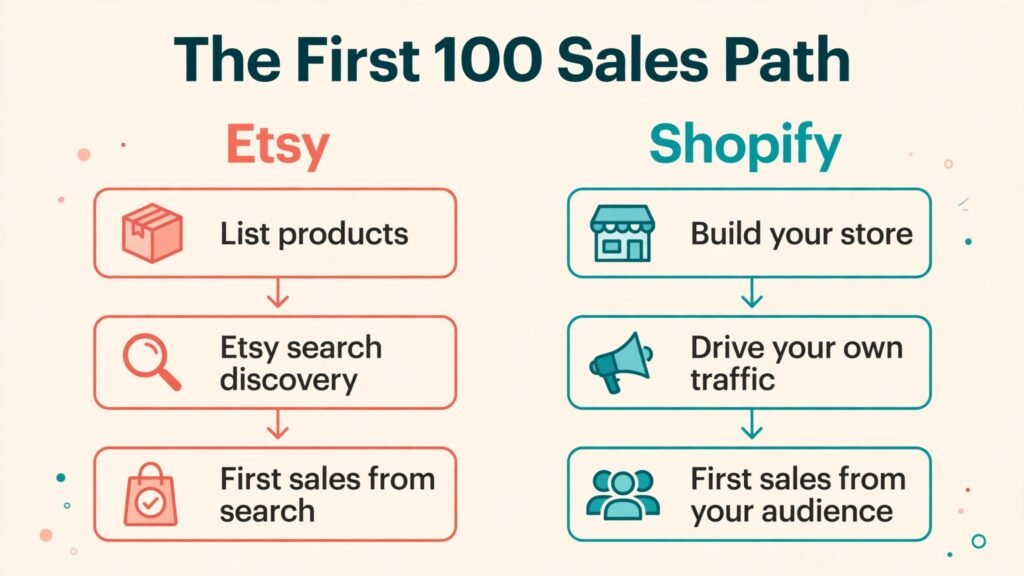
Etsy wins the first 100 sales test for most handmade and personalized products. A new seller can list products, use Etsy search optimization, and start appearing in search results within days. Buyers trust Etsy checkout, reviews, and buyer protection, so a new shop with good photos and clear policies can convert visitors who have never seen the brand before. Seasonal search spikes, gift guides, and Etsy ads can add extra visibility, although ads cost money and do not guarantee profit.
Shopify struggles at this stage unless the seller already has an audience. A new Shopify store with no email list, no social following, and no search ranking will get very few visits in month one. Sellers who succeed early on Shopify usually bring traffic from TikTok, Instagram, Pinterest, YouTube, or an existing Etsy audience that they direct to their own site for repeat orders. That is a real path, but it requires marketing work that Etsy partly handles for you.
The lesson is practical. If you have no audience yet and your products fit Etsy rules, start on Etsy to learn what sells, what photos convert, and what prices buyers accept. Use those lessons later on Shopify. If you already have an audience of 5,000 or more engaged followers, or a strong email list from a previous business, Shopify can work from day one, because you can send that audience straight to your own checkout.
Verdict for this test: Etsy, for new sellers without an audience. Shopify, for sellers who already bring their own traffic.

Test 2: Fees, Margins, and Real Profit
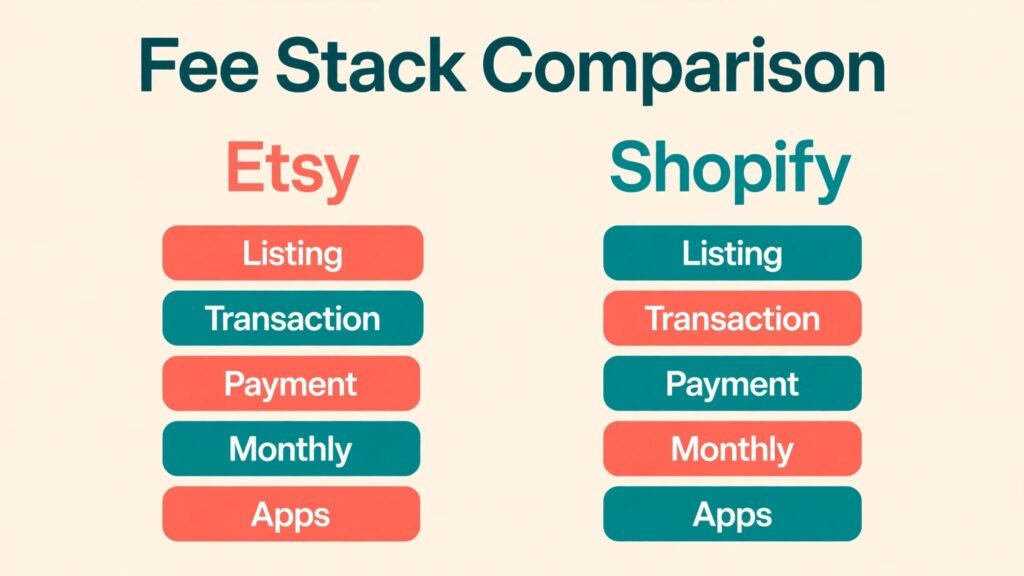
Fees decide whether a shop survives, and both platforms charge in different ways. Etsy charges listing fees, transaction fees on the sale price including shipping in many cases, payment processing fees, and optional fees for advertising and currency conversion. Those fees are easy to miss when you price a product, because they stack on top of materials, labor, packaging, and shipping. A product that looks profitable at a glance can lose money after fees, especially on low priced items.
Shopify charges a monthly subscription, plus payment processing fees, and optional app costs. The monthly fee is predictable, but apps for reviews, email, subscriptions, bundles, and advanced shipping can add up. A seller with 20 apps can pay more in apps than in the base subscription. Shopify transaction fees also vary by plan and by whether you use Shopify Payments or a third party gateway, so check the current plan terms at checkout.
Do a margin test before you choose. Take your best selling product, write down material cost, labor time value, packaging, shipping, and platform fees, then calculate profit per order on each platform. Repeat the test for a low priced item and a high priced item, because fee impact differs by price. Etsy fees hurt low priced items more. Shopify monthly fees hurt low volume sellers more, because the fixed cost spreads across fewer orders. A seller doing 20 orders a month may keep more profit on Etsy. A seller doing 500 orders a month may keep more on Shopify, once traffic costs are counted fairly.
Verdict for this test: No universal winner. Etsy favors low volume, discovery driven sellers. Shopify favors higher volume sellers who can spread fixed costs and control discounting.
Test 3: Branding, Design, and Customer Ownership
Shopify wins branding and customer ownership by a wide margin. On Shopify, you control the domain, logo placement, colors, fonts, homepage story, product page layout, checkout messages, post purchase emails, and upsell offers. You can build a brand that feels like a real company, not a marketplace stall. You can also collect email addresses with consent, run a loyalty program, offer subscriptions, and remarket to past buyers without competing listings appearing next to your product.
Etsy limits branding. Shops have banners, shop icons, and a shop story, but listings sit inside Etsy design, search results show competitors, and buyers often remember Etsy, not your shop name. Etsy also controls much of the post sale communication, and sellers must follow marketplace rules about directing buyers off the platform. You can build a loyal following on Etsy, but the platform owns the main relationship in practice.
Customer ownership matters for long term value. A Shopify email list can drive repeat sales without paying for ads every time. An Etsy shop depends more on Etsy search and repeat marketplace visits, which can change with algorithm updates. Sellers who want to sell wholesale, get featured in press, or eventually sell their business will find a standalone Shopify brand easier to value and transfer.
Verdict for this test: Shopify, clearly, for brand building and repeat customer control.
Test 4: Product Fit, Rules, and Growth Limits
Etsy wins for products that fit its handmade, vintage, and creative supply rules. Buyers expect unique, personalized, and small batch goods there, and search behavior reflects that expectation. A hand poured candle, a custom pet portrait, a printable wedding suite, or a vintage jacket fits Etsy search intent. A generic phone case, a mass produced gadget, or a dropshipped item with no creative input fits poorly, and may face policy issues.
Shopify wins for almost everything else. It supports physical products, digital downloads, subscriptions, services, courses, memberships, bundles, and wholesale catalogs. It also supports larger catalogs, complex variants, and custom checkout flows that Etsy listings cannot match. A seller who starts with handmade soap but later adds a course, a subscription box, and wholesale orders will outgrow Etsy structure faster than Shopify structure.
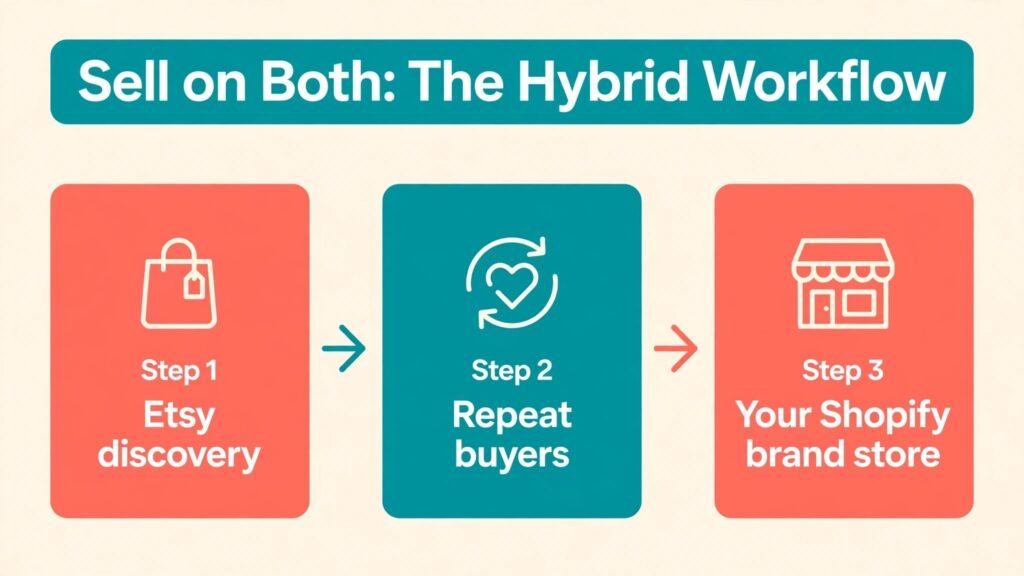
Growth limits also differ. On Etsy, growth can be capped by search ranking changes, category competition, and marketplace policies. On Shopify, growth is capped mainly by traffic and operations: can you drive visits, fulfill orders, and handle support? That is a harder problem, but it is one you control. Many successful sellers keep Etsy for discovery and Shopify for brand sales, using Etsy to find new buyers and Shopify to keep repeat buyers.
Verdict for this test: Etsy for niche handmade discovery. Shopify for broad catalogs, subscriptions, wholesale, and long term scaling.
Shopify in Depth: Pricing, Best Fit, and Watch Outs
Shopify pricing is subscription based, with several tiers for different stages. Entry plans suit new stores with basic reporting and limited staff accounts. Mid tiers add better reporting, more staff accounts, and lower payment fees. Higher tiers suit larger stores with advanced shipping, automation, and lower fees. Verify the current tier features at checkout, because Shopify changes included features and payment rates over time.
Shopify is best for brand focused sellers, sellers with an audience, sellers who sell subscriptions or bundles, sellers who want wholesale, and sellers who plan to run ads and email marketing at scale. It is also best for sellers who already use tools for accounting, inventory, and fulfillment and want a store that connects to them. If you sell on Instagram or TikTok, Shopify checkout and social integrations can turn content views into orders without sending buyers to a marketplace first.
Watch out for app sprawl. Every app adds cost, load time, and a possible point of failure. Start with only the apps you need for reviews, email, shipping, and analytics, and review app costs monthly. Watch out for theme costs and custom development costs, which can exceed the subscription in year one for a heavily customized store. Watch out for traffic costs. Budget for content, email, and ads as a real line item, not as an afterthought, because Shopify traffic is your job.
Etsy in Depth: Pricing, Best Fit, and Watch Outs
Etsy pricing is transaction based, which makes it easy to start and hard to forecast at scale. Listing fees are small per item, but they renew, and transaction and payment fees apply to each sale. Optional advertising can increase visibility but must be tracked against profit per order. Sellers should also account for offsite ad fees in some cases, where Etsy charges a fee when an Etsy ad brings a sale, even if the buyer did not click an ad inside Etsy. Check current Etsy fee pages before pricing, because fee rules and thresholds change.
Etsy is best for makers, vintage sellers, digital product creators, personalized gift sellers, and craft supply sellers who want built in search traffic and buyer trust. It is also best for sellers testing a product idea, because listing is fast and market feedback arrives quickly. If a product gets no views on Etsy after good photos, titles, and tags, that is useful market data before investing in a full Shopify store.
Watch out for three risks. First, search dependence. A ranking drop can cut sales sharply, so diversify with email, social media, and repeat buyer offers within Etsy rules. Second, policy changes. Etsy can change listing rules, fee structures, and advertising terms, and sellers must adapt quickly. Third, price competition. Buyers compare similar listings side by side, which pressures prices and makes differentiation through photos, materials, customization, and service essential. Do not compete only on price, because someone will always undercut you.
Side by Side Comparison Table
| Area | Shopify | Etsy |
|---|---|---|
| Main model | Standalone store builder | Marketplace with built in buyers |
| Built in traffic | None, you drive visits | Strong for handmade and gift searches |
| Branding control | Full control, custom domain | Limited, inside Etsy design |
| Customer ownership | Email list and repeat sales are yours | Marketplace relationship, limited off platform contact |
| Fee style | Monthly subscription plus processing and apps | Listing plus transaction plus payment fees |
| Product fit | Broad, subscriptions, wholesale, digital | Best for handmade, vintage, personalized |
| Design flexibility | Themes, apps, custom checkout options | Shop banner and listings, limited layout |
| Growth ceiling | Limited by traffic and operations | Limited by search, competition, and policy |
| Best starter path | Sellers with audience or brand plan | New makers testing products |
| Exit and brand value | Strong standalone brand asset | Shop value tied to marketplace presence |
This table helps you see trade offs, but your product and audience matter more than any single row. A vintage seller with no marketing time will likely do better on Etsy even if Shopify wins branding. A brand seller with a large Instagram audience will likely do better on Shopify even if Etsy wins discovery.
How Sellers Use Both Platforms Together
The hybrid path deserves attention because it solves the biggest weakness of each platform. Start on Etsy to validate products, learn pricing, and collect reviews. Once a product sells consistently, create a Shopify store for that product line, and use packaging inserts, email signup offers, and social content to guide repeat buyers to your own site, following Etsy rules for communication. Keep Etsy listings live for discovery, but do not rely on Etsy alone for your whole income.
Use Shopify for bundles, subscriptions, and exclusive products that are not on Etsy. Use Etsy for seasonal gift products, personalized items, and search driven discovery. Track where each sale came from, and track profit per order on each platform, not only revenue. Revenue can mislead you. A shop with high Etsy revenue and thin margins is weaker than a smaller Shopify shop with strong repeat profit.
Set a review point after 90 days. If Etsy drives most new buyers and Shopify drives most repeat profit, keep both. If one platform drives almost no profit after real marketing effort, pause it and focus. Sellers often keep both for a year, then shift weight to the platform that matches their growth stage. That shift is normal, and it is not a failure of the first platform.
Shipping, Payments, and Day to Day Operations
Shipping is a profit lever on both platforms. Etsy buyers often expect free shipping thresholds and clear delivery times, especially for gifts. Shopify sellers can set shipping zones, rates, and free shipping rules with more flexibility, and can use shipping apps for labels, tracking, and carrier discounts. In both cases, weigh products, measure packaging, and test real shipping costs before setting prices. Undercharging for shipping is one of the fastest ways to lose money.
Payments are simpler on Etsy, because checkout, buyer protection, and payment processing are built in. Shopify Payments simplifies checkout too, but sellers using third party gateways should check transaction fees and payout timing. Offer the payment methods your buyers expect, including major cards and popular wallets where available, and make checkout as short as possible. Every extra step loses buyers, especially on mobile.
Day to day operations differ in support load. Etsy sellers answer messages inside Etsy, handle cases through Etsy systems, and must meet marketplace response expectations. Shopify sellers handle support through email, chat apps, or helpdesk tools they choose, which gives flexibility but also responsibility. Either way, write clear policies for processing times, returns, personalization errors, and damaged items, and keep response times fast during holidays.

Mistakes to Avoid
First, picking Shopify and expecting traffic to appear. A store without marketing is a brochure, not a business. Budget time and money for content and email from week one.
Second, picking Etsy and copying competitors. Search results reward clear photos, specific titles, complete materials lists, and honest processing times. Copying another shop title word for word rarely wins, and it can create policy problems.
Third, pricing without fees. Calculate profit per order after all fees, materials, labor, packaging, and shipping, and price for profit, not only for sales volume.
Fourth, ignoring repeat buyers. A one time sale is expensive to win. A repeat buyer is cheaper to serve. Build email signup, thank you notes, and repeat purchase offers into your workflow from the start, within each platform rules.
Fifth, adding too many apps or listings at once. Start narrow, prove one product line, then expand. A shop with 200 weak listings performs worse than a shop with 20 strong listings and great photos.
Sixth, neglecting photos and product descriptions. Buyers cannot touch your product. Photos, size comparisons, material details, care instructions, and real use examples do the selling. Invest in photos before you invest in ads.
Frequently Asked Questions
Can I sell on both Shopify and Etsy at the same time?
Yes. Many sellers use Etsy for discovery and Shopify for brand sales and repeat orders. Keep pricing, inventory, and policies consistent, and follow Etsy rules about buyer communication.
Is Shopify cheaper than Etsy?
It depends on volume. Low volume sellers often pay less in total on Etsy because there is no monthly subscription. Higher volume sellers often pay less per order on Shopify once fixed costs spread across many orders, but traffic costs must be included in that comparison.
Do I need a custom domain for Shopify?
Shopify provides a default subdomain, but a custom domain looks more professional and helps branding, email, and search. Buy a domain that matches your brand name and connect it before you run ads.
Can I move my Etsy reviews to Shopify?
Etsy reviews stay on Etsy. You can collect new reviews on Shopify with a review app, and you can display testimonials with permission, but you cannot transfer Etsy review counts directly to a Shopify store.
What sells best on Etsy in 2026?
Personalized gifts, handmade home goods, digital planners and templates, vintage items, and craft supplies continue to fit Etsy search intent well. Success still depends on photos, titles, pricing, and service, not only on category choice.
Is Shopify good for digital products?
Yes. Shopify supports digital downloads, courses, memberships, and templates through apps and built in tools. Delivery, licensing, and update handling need clear setup, but the platform fits digital sellers who want brand control.
When should I switch fully from Etsy to Shopify?
Consider a full switch when repeat buyers drive most profit, when your brand name drives search traffic, when you need subscriptions or wholesale, and when Etsy fees and limits cost more than Shopify plus marketing. Many sellers never fully switch, and that is fine.
Final Verdict: Where Should You Sell
If you are a new maker with no audience and products that fit Etsy, start on Etsy. Learn what sells, build reviews, and use search traffic to fund your next step. If you are a brand builder with an audience, a subscription idea, or a wholesale plan, start on Shopify and invest in marketing from day one. If you are in between, use both: Etsy for discovery, Shopify for brand and repeat sales, and review the split every 90 days.
Shopify wins on control, branding, customer ownership, and long term scaling. Etsy wins on built in traffic, buyer trust, and fast validation for handmade and personalized products. The winner for you is the platform that matches your current stage, not the platform that wins a generic feature count. Start where buyers already are if you need sales now. Build your own store when you are ready to own the customer relationship and the brand that buyers remember.
For related selling guides, see our comparison of Shopify vs WooCommerce if you want a self hosted alternative, our guide to best AI tools for Etsy sellers for listing and photo help, and our guide to Shopify alternatives if you want other store builders compared side by side. If product photos are your bottleneck, our guide to best AI tools for ecommerce product photos covers tools that can improve listings on either platform.
Pricing Scenarios by Seller Stage
A single fee comparison rarely helps, because sellers at different stages face different costs. Consider three realistic scenarios, and see which platform fits each one. These are planning scenarios, not price quotes, and you should verify current fees at checkout before you act.
Scenario one is a part time maker selling 25 orders a month at an average order value of 35 dollars. On Etsy, fees are paid per sale, so a slow month costs little in platform fees beyond listings. On Shopify, the monthly subscription is due even in a slow month, and traffic costs may add more. For this seller, Etsy usually leaves more cash in the business in the early months, especially if search brings buyers without paid ads. The trade off is less brand control, but cash flow matters more than branding when volume is low.
Scenario two is a growing seller doing 200 orders a month, with repeat buyers and a small email list. Here the math shifts. Etsy fees on 200 orders add up quickly, and the seller may also pay for ads to stay visible in competitive searches. On Shopify, the monthly subscription spreads across 200 orders, payment fees are more predictable, and email marketing to past buyers costs less per sale than winning a new Etsy search click each time. If the seller can drive even half of those orders from email, social content, and search, Shopify often wins on profit, even after app costs.
Scenario three is a brand doing 1,000 orders a month, with bundles, subscriptions, and wholesale inquiries. At this stage, Shopify control becomes a business asset. Bundles increase average order value, subscriptions smooth revenue, and wholesale pricing can be managed in one catalog. Etsy can still add discovery sales, but it cannot easily support the full brand operation. The seller may keep Etsy as a discovery channel while running the main business on Shopify, and that hybrid model often beats a forced choice.
Across all three scenarios, track three numbers monthly: profit per order, cost to win a new buyer, and share of repeat orders. Profit per order tells you if pricing and fees work. Cost to win a new buyer tells you if marketing is sustainable. Repeat order share tells you if you are building a business or only renting traffic. Review those numbers every month, and let them guide your platform mix, rather than letting habit or a single fee headline decide for you.
A final planning note helps new sellers avoid a common trap. Do not price products to match the cheapest competitor on either platform. Price for materials, labor, fees, shipping, returns, and a margin that lets you invest in better photos and service. Buyers who choose only on price will leave for the next cheaper listing. Buyers who choose on quality, personalization, and trust will return, and those buyers are the foundation of a durable shop on Shopify, on Etsy, or on both together.
A Simple Checklist Before You Launch
Before you publish your first listing or store page, run through a short checklist that prevents the most common early mistakes. First, confirm your product photos show scale, materials, and real use, not only a studio shot. A buyer who cannot judge size will either ask questions or leave, and both outcomes cost sales. Second, write a product title that a buyer would actually search for, with the main product type first and customization options clearly stated. Third, set processing times honestly, including time for personalization, and state them on every listing or product page.
Fourth, test checkout on your phone. Buyers abandon carts when shipping costs appear late, when payment options are limited, or when a form asks for information that is not needed. Fifth, prepare a thank you message and a simple repeat purchase offer, such as a discount on a second item or a bundle suggestion. Sixth, decide how you will handle a damaged item, a late delivery, and a personalization error before those cases arrive, and write those policies in plain language. Sellers who prepare these answers in advance respond faster and keep more buyers, even when something goes wrong.
Check current fees and plan features on the official Shopify site and the official Etsy site before you set final prices, because fee rules and plan limits change and your profit calculation should use the latest terms.