

The verdict is different from the one most nonprofits expect. A small nonprofit with under 2,500 donors should usually start free or near free, with Zeffy or Givebutter for fundraising and Little Green Light at 45 dollars a month when a real donor database is needed. A nonprofit that already raises serious money and loses donors each year should pay for retention, and that means Bloomerang at 125 dollars a month, because keeping a donor is cheaper than finding a new one. That split, free to start and paid to retain, is the short version of this guide to the best donor management software for small nonprofits.
A donor management system is the CRM for a nonprofit. It holds donor records, giving history, segmentation, thank you automation, and fundraising reports in one place. A spreadsheet can hold names and amounts, but it cannot tell you which donors are drifting, which campaign brought them in, or who needs a thank you today. A good system answers those questions without a staff member building a report by hand.
This guide compares 15 platforms across donor records, retention tools, fundraising, events, grants, and total cost. Prices come from vendor pages and recent published comparisons checked in late 2026, and they move often, so check the vendor pricing page before you sign. Shortlist three tools, test each one with your real donor list, and judge the winner on a lapsed donor report, a thank you workflow, and a year end statement, not on a sales demo.
How the best donor management software for small nonprofits earns its fee
A donor platform earns its fee in three places. First, it keeps donors, through engagement scoring, retention reports, and thank you automation that stops a first time donor from lapsing quietly. Second, it raises more money, through donation forms, campaigns, events, and peer to peer fundraising that make giving easy. Third, it saves staff hours, through receipts, year end statements, and reports that replace spreadsheet work. Judge every platform on those three returns, not on how many features its sales page lists.
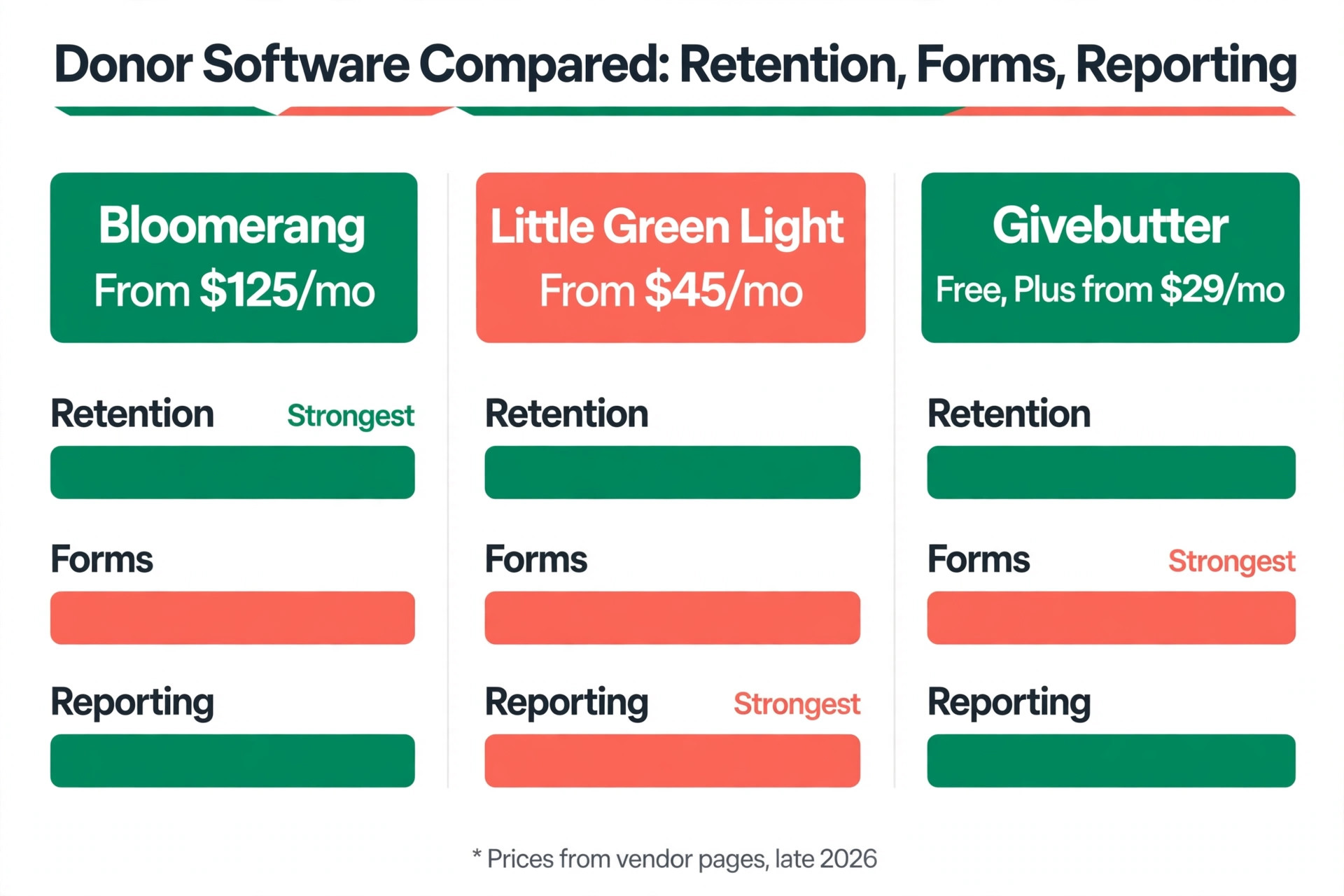
The table below gives a fast first sort for the best donor management software for small nonprofits. Use it to remove tools that clearly do not fit your nonprofit, then read the full sections for the survivors. Where a vendor hides its price behind a sales call, this guide says so plainly instead of inventing a number.
| Tool | Best for | Standout strength | Price note |
|---|---|---|---|
| Bloomerang | Retention focused nonprofits | Engagement scoring and retention dashboard | CRM from 125 dollars a month billed annually |
| Little Green Light | Small nonprofits leaving spreadsheets | Simple database at a low price | From 45 dollars a month for up to 2,500 records |
| Givebutter | Campaign driven nonprofits | Free fundraising plus CRM | Free with tips on, Plus from 29 dollars a month |
| Zeffy | Very small budgets | Zero fees of any kind | Free, funded by optional donor tips |
| DonorSnap | Flat predictable cost | Simple database with donation forms | Reported from 50 dollars a month for up to 1,000 contacts |
| DonorPerfect | Complex multi channel fundraising | Deep fundraising suite | Vendor page says from 99 dollars a month, quotes vary |
| Neon CRM | Membership based nonprofits | Programs, members, events and volunteers | From 99 dollars a month |
| Keela | Growing small nonprofits | Fundraising plus donor management | Reported from about 99 dollars a month, check the vendor page |
| Eleo | Smallest budgets for a paid CRM | Low entry price | From 39 dollars a month for up to 2,500 records |
| Donorbox | Donation forms first | Clean embeddable forms | Free tier, Pro from about 139 dollars a month |
| Fundraise Up | Online giving optimisation | Checkout optimisation and AI tools | Quote only, check the vendor page |
| Virtuous | Relationship focused fundraising | Responsive fundraising and automation | Quote only, check the vendor page |
| Blackbaud Raiser’s Edge NXT | Large and enterprise nonprofits | Deepest fundraising depth | Quote only, check the vendor page |
| Classy | Peer to peer and events | Campaigns and peer to peer depth | Quote only, check the vendor page |
| Network for Good | Small nonprofits wanting coaching | Fundraising plus coaching support | Quote only, check the vendor page |
What matters most in donor software
Retention comes first, because a nonprofit that loses half its donors each year must replace them before it can grow. The average donor retention rate in the sector sits near 45 percent, which means most nonprofits lose more than half of their donors after the first gift. A platform that scores engagement, flags donors who are drifting, and automates thank you messages helps a small team act before a donor lapses. Test the lapsed donor report during a trial with your real list, because that report is the most valuable view in the system.
Donation forms come second. A donor who reaches the form should be able to give in under a minute, on a phone, with a clear recurring gift option and a receipt that arrives at once. Test the form with a real card, then refund it, and check that the gift, the receipt, and the donor record all agree. A form that loses donors at checkout costs more than any subscription saving, so judge the form as carefully as the database.
Reporting completes the picture. A small nonprofit needs giving by campaign, retention by year, donor lifetime value, and a list of major gift prospects, without building a spreadsheet. A platform that reports well helps a board see where the money comes from and where it is going. A platform that only lists gifts hides the story behind the numbers, and a board that cannot see the story cannot fund the future.
Best pick by job
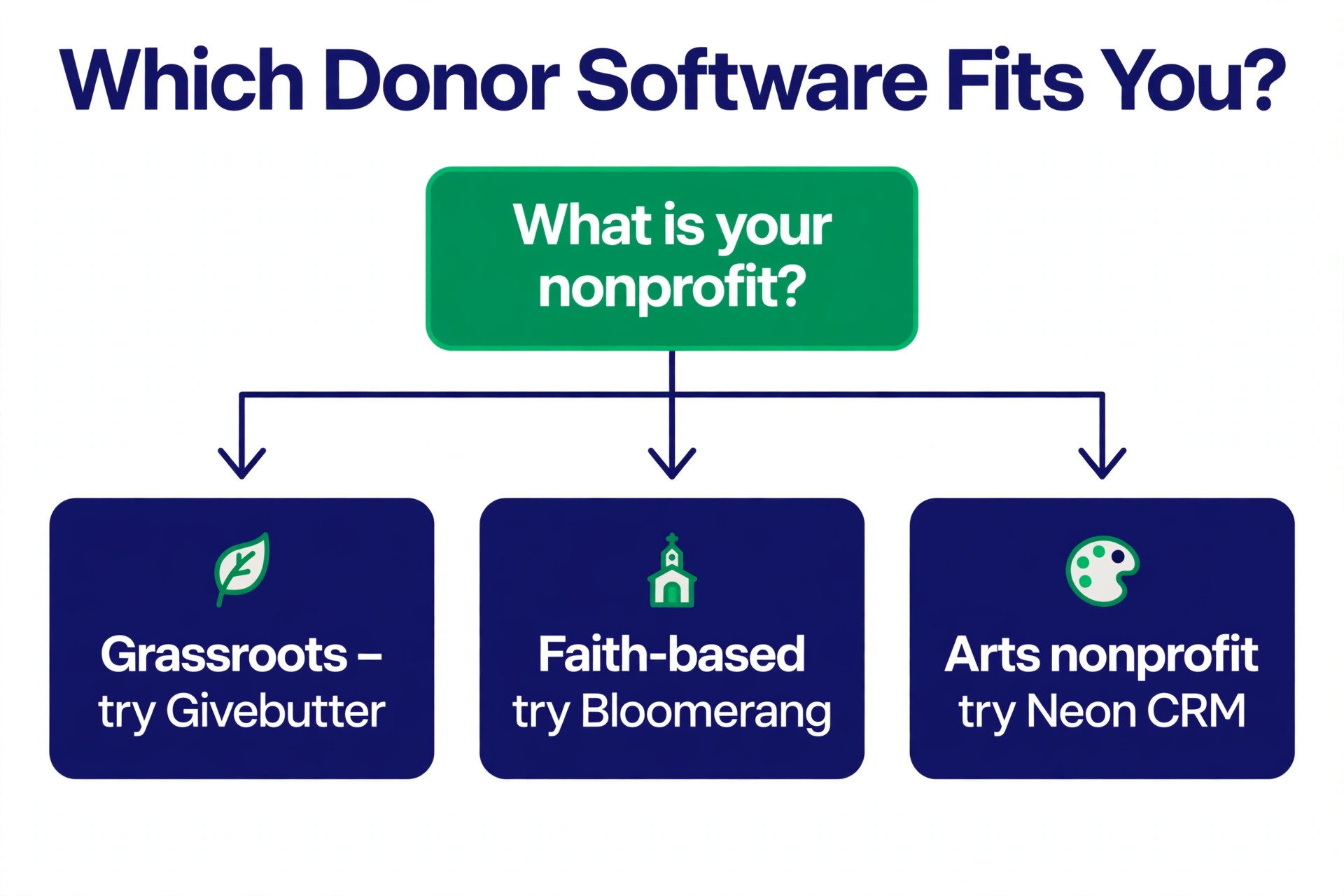
The table below names a lead pick for each segment in this guide to the best donor management software for small nonprofits, with a second option worth testing. Test the lead pick on your hardest real workflow, whether that is a lapsed donor report, a peer to peer campaign, or a year end statement, before signing.
| Segment | Lead pick | Also test | Why it fits |
|---|---|---|---|
| Grassroots nonprofits | Givebutter | Zeffy | Free fundraising suits a small budget |
| Faith based nonprofits | Bloomerang | Little Green Light | Retention tools suit a congregation donor base |
| Arts nonprofits | Neon CRM | DonorPerfect | Memberships and events suit arts audiences |
Grassroots nonprofits run on campaigns, events, and small gifts from many people. Givebutter covers giving, events, CRM, and email in one free core platform, while Zeffy removes fees entirely for a nonprofit that cannot afford any platform cost. A grassroots team should judge both on the campaign page a donor sees, not on the admin dashboard.
Faith based nonprofits run on recurring givers and long relationships. Bloomerang engagement scoring helps a small team spot a giver who is drifting before the gift stops, while Little Green Light offers a simple database at 45 dollars a month for a congregation that wants records without retention analytics. Test the thank you workflow, because a timely thank you is the strongest retention tool a faith based nonprofit owns.
Arts nonprofits run on members, subscribers, and events as well as donors. Neon CRM covers memberships, events, programs, and volunteers alongside donor records, while DonorPerfect covers complex multi channel fundraising for a larger arts organisation. A small arts nonprofit should test the membership renewal flow, because a lapsed member is a lapsed donor in waiting.

The 15 tools in detail
1. Bloomerang
Bloomerang is built around donor retention, and that focus is the reason it leads this list for nonprofits that can afford it. Engagement scoring tracks how each donor interacts with the nonprofit, a retention dashboard shows which donors are drifting, and thank you automation helps a small team act before a gift stops. Donor records, giving history, segmentation, and reporting cover the daily jobs, while grants tracking is included.
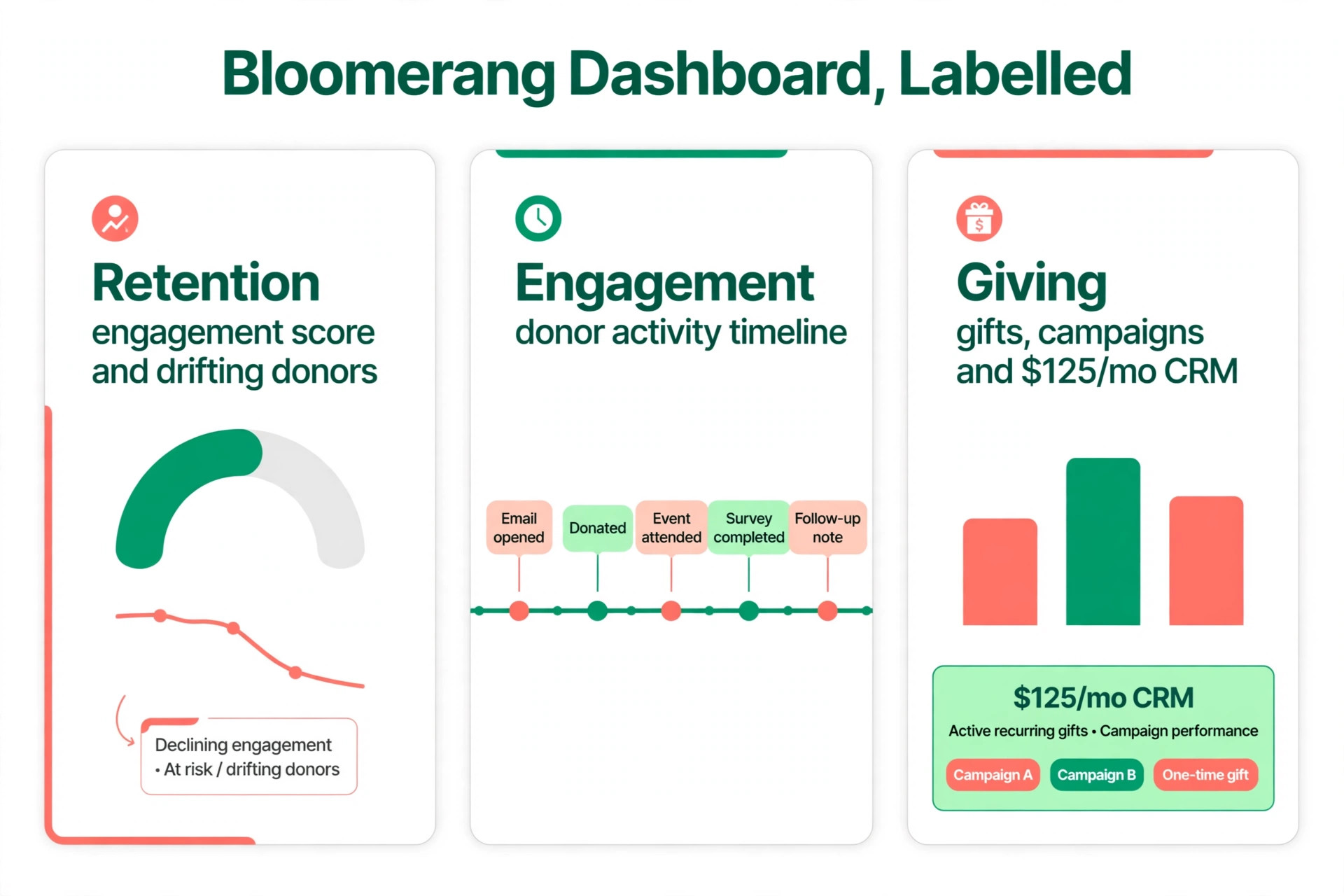
Pricing is per contact, so costs grow with the database. The CRM starts at 125 dollars a month billed annually, the fundraising module starts at 40 dollars a month and only sells bundled with CRM, and volunteer management costs about 119 dollars a month as a separate product. That modular shape means the full stack costs more than the CRM headline, so model the modules you actually need before budgeting. Bloomerang suits a nonprofit that raises enough to justify retention tools, and it is more platform than a new nonprofit with a hundred donors needs.

2. Little Green Light
Little Green Light is the practical entry level CRM for a small nonprofit moving off a spreadsheet for the first time. It starts at 45 dollars a month for up to 2,500 records, steps up as the database grows to about 135 dollars a month at 50,000 records, and includes every feature at every tier, with unlimited users. Centralised donor records, gift and campaign tracking, communication logging, and real time fundraising totals cover the core jobs without a learning curve that needs training.
3. Givebutter
Givebutter is the modern campaign pick in this list, with a free core platform covering giving, events, CRM, email, and peer to peer fundraising. It is free when optional donor tips are turned on, and it charges a flat 3 percent platform fee plus standard card processing when tips are turned off. Plus starts at 29 dollars a month for advanced features, including automation and QuickBooks Online sync.
4. Zeffy
Zeffy is the zero fee pick in this list, and the model is simple. Nonprofits pay nothing, no subscription and no transaction fees, and donors are invited to leave a voluntary contribution to Zeffy at checkout, which funds the platform including card processing. That means 100 percent of donations reach the nonprofit, which is a powerful story for a small organisation with a tight budget.
5. DonorSnap
DonorSnap is a donor CRM built by one Wisconsin team since 2007, trusted by more than 10,000 nonprofit professionals, with a flat and predictable price. It covers donor records, gift tracking, donation pages, thank you automation, and reporting, with a Stripe integration that powers online donation forms. Unlimited users are included on every plan, which suits a small team where everyone needs access.
Pricing is the part to verify carefully, because published figures conflict. Review listings report 50 dollars a month for up to 1,000 contacts, with a one time 200 dollar site setup fee, while the vendor own comparison page lists a Basic plan at 68 dollars a month for up to 1,000 contacts. Treat the vendor page as the final word and ask for a written quote for your contact count. DonorSnap suits a small nonprofit that wants a focused, affordable donor database without the breadth of Neon CRM or the retention price of Bloomerang.
6. DonorPerfect
DonorPerfect is the established workhorse for nonprofits whose fundraising has real complexity, with multiple campaigns, events, monthly giving, grants, and major gift pipelines in one system. It has served nonprofits for decades, and its depth shows in reporting, donor segmentation, and fundraising automation. A nonprofit that runs several campaigns at once will find its structure more useful than a simple database.
Pricing is the weak point for comparison shoppers. The vendor page says plans start at 99 dollars a month, but the actual quote depends on records, plan, support level, and add ons, and some review sites list a higher entry price near 119 dollars a month. Treat the 99 dollar figure as a starting point and get a written quote for your database size and modules. DonorPerfect suits a mid size nonprofit with complex fundraising, and it is more platform than a small nonprofit with a simple donor list needs.
7. Neon CRM
Neon CRM, now Neon One CRM, is an all in one system for growing nonprofits with programs, members, events, and volunteers alongside donors. Essentials starts at 99 dollars a month, with onboarding fees often added on top, and memberships, events, and volunteers are optional add ons charged as a percentage of the base subscription. That add on shape means the real monthly cost is higher than the Essentials headline, so model the full stack before comparing it with a flat price rival.
Neon CRM suits a membership based nonprofit, an arts organisation, or a community group that juggles many activities in one system. Its revenue based pricing is a practical advantage, because the bill does not rise simply because the database grew. The learning curve is steeper than Little Green Light, so test the membership renewal and event registration flows with real staff before committing.
8. Keela
Keela is a donor management and fundraising platform for growing small nonprofits, with donor records, campaigns, email, and reporting in one system. It covers the daily jobs of a small development team, from gift tracking to donor communication to fundraising reports, without the enterprise depth that a large nonprofit needs. A team that wants a modern interface and a clear workflow will find Keela easy to adopt.
9. Eleo
Eleo is the cheapest credible paid donor database in this list, starting at 39 dollars a month for up to 2,500 records. It covers donor records, gift tracking, campaigns, and reporting in a simple package, with a low entry price that suits a nonprofit leaving a spreadsheet for the first time. A small team can start for less than the cost of a team lunch each month, which removes the budget excuse for staying on a spreadsheet.
10. Donorbox
Donorbox is a donation form platform first and a donor database second, with the cleanest embeddable forms in this category. Forms embed easily on a website, recurring giving is simple to set up, and a donor portal lets donors manage their own gifts. Integrations cover Salesforce, HubSpot, Bloomerang, and Little Green Light, so Donorbox can sit in front of a CRM rather than replacing it.
11. Fundraise Up
Fundraise Up is an online giving platform built around checkout optimisation, with AI tools that test donation amounts, recurring gift prompts, and form layouts to raise more from the same traffic. It covers donation forms, peer to peer fundraising, and integrations with major CRMs, including Salesforce and Bloomerang. A nonprofit with strong website traffic will get more value here than a nonprofit that raises most gifts offline.
12. Virtuous
Virtuous is a responsive fundraising platform built around donor relationships and automation, with a CRM, marketing automation, and fundraising tools in one system. It helps a nonprofit respond to donor behaviour in real time, with automated journeys that thank, update, and re engage donors without manual work. A team that wants to treat donors as relationships rather than records will find its approach refreshing.
13. Blackbaud Raiser’s Edge NXT
Blackbaud Raiser’s Edge NXT is the deepest fundraising platform in this list, built for large and enterprise nonprofits with complex fundraising operations. It covers donor records, major gift pipelines, grants, events, prospect research, and reporting at a scale that small tools cannot match. A university, a hospital foundation, or a national charity will find depth here that no small nonprofit tool offers.
14. Classy
Classy, now part of GoFundMe Pro, is a fundraising platform built around campaigns, peer to peer fundraising, and events. It covers donation pages, team fundraising, crowdfunding, and event registration in one system, which suits a nonprofit that raises money through walks, galas, and peer to peer campaigns. A campaign driven nonprofit will find its tools more useful than a database first platform.
15. Network for Good
Network for Good, now part of Bonterra, is a fundraising platform for small nonprofits that pairs donor management with coaching support. It covers donor records, donation pages, email, and reporting, with training and coaching that helps a small team learn fundraising as well as software. A nonprofit with no development staff will find that coaching more useful than a feature list.
Retention, the number that decides growth
Donor retention is the single number that decides whether a small nonprofit grows or shrinks. If a nonprofit keeps 45 percent of its donors each year, it must find 55 new donors for every 100 it had, just to stand still. A platform that improves retention by even five points changes the maths of the whole organisation, because a retained donor gives again, gives more, and costs nothing to acquire. That is why Bloomerang engagement scoring matters, and why a free tool that never flags a drifting donor can cost more than a paid tool that does.
The practical work of retention is simple and repetitive. Thank a first time donor within a day, update donors on what their gift did, invite lapsed donors back with a clear reason to return, and segment donors by behaviour rather than by gift size alone. A platform should automate the thank you, surface the drifting donors, and report retention by campaign and by year, so the team can see which campaigns bring donors who stay and which bring donors who leave. Test the retention report during a trial, because a platform that cannot show retention cannot improve it.
How to choose a donor management tool
Start with your nonprofit model, because that choice filters the best donor management software for small nonprofits faster than any feature table. A grassroots nonprofit needs campaigns and peer to peer fundraising. A faith based nonprofit needs retention and recurring giving. An arts nonprofit needs memberships and events. Write that model down before any demo, and score each tool against it.
Next, run a realistic trial month. Import a test donor list, record a gift, send a thank you, run a lapsed donor report, create a campaign page, and issue a year end statement. Then check that the gift, the receipt, the donor record, and the report all agree. A tool that passes that month will handle most real months.
Finally, price the second year, not the first month. Add processing fees, platform fees, email costs, event fees, and any per contact or per record charge, and model the price at your expected donor count. Ask about contract length, notice period, and data export, because switching tools later is far harder than choosing well now. A short contract with clean data export is worth more than a small first month discount.
What donor software really costs
Most small nonprofits pay between free and about 125 dollars a month for the best donor management software for small nonprofits, before processing. Zeffy and Givebutter core are free, Eleo starts at 39 dollars a month, Little Green Light starts at 45 dollars a month, DonorSnap is reported from 50 dollars a month, and Neon CRM, DonorPerfect, and Keela start near 99 dollars a month. Bloomerang CRM starts at 125 dollars a month billed annually, while Fundraise Up, Virtuous, Raiser’s Edge NXT, Classy, and Network for Good are quote only.
Processing is the second line, and it is often the larger one. Card processing runs near 2.2 to 2.9 percent plus 30 cents per transaction, with platform fees from zero to 2.95 percent depending on the tool and tier. Givebutter charges 3 percent plus card fees with tips off, Donorbox charges 2.95 percent on its free tier, and Zeffy charges neither. A nonprofit taking 10,000 dollars a month in card gifts pays roughly 290 dollars a month at 2.9 percent, which exceeds the subscription cost of most tools in this guide. Compare processing and platform fees with the same care as subscription prices, and get both in writing before signing.

Rollout checklist for a small nonprofit
Use this sequence when you move to the best donor management software for small nonprofits you chose, and do not skip the payment test. A nonprofit cannot stop fundraising for a software switch, so the rollout must run alongside live gifts, campaigns, and receipts.
- Export donors, gifts, campaigns, and pledges, then check a sample by hand for duplicate donors and incorrect gift amounts.
- Build your donor structure first, including segments, funds, campaigns, and recurring gift rules.
- Set thank you rules next, including first gift messages, recurring gift receipts, and year end statements.
- Connect payments and run a test gift with a real card, then refund it, to confirm the full giving flow.
- Invite a small group of donors to give through the new form before a full launch.
- Train staff on lapsed donor reports, campaign pages, and year end statements, because those three jobs cause most support questions.
- Keep the old system read only for one full month, so no gift or donor record is lost in the move.
A careful switch protects trust. Donors forgive a new form quickly if gifts are correct and receipts arrive at once. They do not forgive a lost gift, a double charge, or a year end statement that is wrong. Test giving and receipts twice, and launch only when both are clean.
Mistakes that cost small nonprofits donors
The first mistake is choosing on subscription price alone. A free platform with a 3 percent platform fee costs more than a 45 dollar platform with no platform fee once monthly giving passes a modest level. Run the numbers at your real giving volume, not at the headline price, and include processing, platform fees, and add ons in the total.
The second mistake is never thanking a donor promptly. A first time donor who hears nothing for a week is a donor who will not give again, and no software can fix a thank you that never arrived. Automate the first thank you to go out within a day, and make it specific about what the gift will do. A platform that automates thank you messages is worth more than a platform with a prettier dashboard.
The third mistake is buying a database before the forms work. Donors will forgive a plain database that records gifts cleanly. They will not forgive a beautiful form that loses a gift or charges twice. Fix the donation form, the receipt, and the thank you first, then add retention analytics, events, and other modules when the core is proven.
The fourth mistake is switching during year end giving. November and December are the worst months to change software, because giving, receipts, and year end statements all peak at once. Plan the switch for a quiet month, and keep the old system read only until the first full giving run is clean.

Related Guides
Keep exploring with these guides on Stratilyze:
- Best Volunteer Management Software For Small Nonprofits
- Top 10 Grant Management Software for Small Nonprofits (10 Tools)
- Best Gym Management Software for Small Gyms (15 Tools)
Frequently Asked Questions
How much should a small nonprofit pay for donor management software
Most small nonprofits pay between free and about 125 dollars a month for the best donor management software for small nonprofits, plus processing near 2.9 percent plus 30 cents per card gift. A free tool can work for a new nonprofit, and a retention focused platform at 125 dollars a month can pay for itself in saved donors. Price the total at your real donor count and giving volume, not the headline rate.
Is Zeffy really free for nonprofits
Yes, Zeffy charges no subscription and no transaction fees, and donors are invited to leave a voluntary contribution to Zeffy at checkout, which funds the platform including card processing. That means 100 percent of donations reach the nonprofit. The trade off is depth, because Zeffy retention analytics and reporting are lighter than a paid CRM such as Bloomerang.
Does donor software handle year end statements
Yes, when gift records, funds, and donor communication are all set up correctly. A good platform issues a year end statement that lists every gift by date, fund, and amount, with a total the donor can use for tax purposes. Test the statement during a trial with a donor who gave by card, by ACH, and by check, across two funds, with one refunded gift, because that case reveals whether the system truly reconciles.
What is the difference between per contact and per record pricing
Per contact pricing rises as the database grows, which is fair when revenue grows with it. Per record pricing works the same way, with the price stepping up at record count bands. Bloomerang prices per contact, while Little Green Light and Eleo price per record tier. Model each model at your donor count in twelve months, because the cheapest model today can become the most expensive model next year.
Should a small nonprofit choose a free tool or a paid CRM
A small nonprofit should usually choose a tool that fits its current size and can grow for two years, rather than the largest platform on day one. Zeffy or Givebutter give a new nonprofit fundraising for free, Little Green Light gives a growing nonprofit a real database at 45 dollars a month, and Bloomerang gives an established nonprofit retention tools at 125 dollars a month. Move up when retention, reporting, or complexity become real needs, not only future hopes.
How long does it take to switch donor management software
Most small nonprofits can switch in two to four weeks, including data import, donor setup, payment testing, and staff training. Avoid switching during November and December unless the old system has failed, because a giving error at year end affects every donor at once. Keep the old system read only for one full month after launch.
The donor shortlist, by budget
Grassroots nonprofits should test Givebutter first, with Zeffy as the zero fee alternative. Faith based nonprofits should test Bloomerang first, with Little Green Light as the lower cost alternative. Arts nonprofits should test Neon CRM first, with DonorPerfect as the complex fundraising alternative. In every case, the deciding test is a real donor journey from first gift to thank you to second gift to year end statement, plus one full giving cycle. The best donor management software for small nonprofits for your nonprofit is the platform that handles that journey cleanly, at a written total cost you can defend.