
PushPress Pro at 159 dollars a month, a free Core plan from the same vendor, and a quote only platform that can cost several hundred dollars a month all claim to run the same small gym. Only one of those prices reflects what your gym will actually pay once processing fees, a branded app, and a second location are added. The verdict is simple. Most small gyms should start with a published price they can model in advance, test billing and class booking on real members, and buy depth only when the member count or the class schedule forces it. That is the short version of this guide to the best gym management software for small gyms.
A small gym lives on three daily jobs. Members must be able to join, book a class, and pay without calling the front desk. Failed payments must be chased by the system, not by a coach after a long shift. And the owner must know, without building a spreadsheet, which classes fill, which memberships lapse, and how much money arrives next week. Software that handles those three jobs cleanly is worth paying for.
This guide compares 15 platforms across billing, class scheduling, member apps, door access, marketing tools, and total monthly cost. Prices come from vendor pages and recent published comparisons checked in late 2026, and they move often, so check the vendor pricing page before you sign. Shortlist three tools, run each one on your real timetable for a week, and judge the winner on failed payments and full classes.
How the best gym management software for small gyms earns its fee
A gym platform earns its fee in three places. First, it collects money on time through recurring billing, card retries, and clear reminders, so fewer memberships lapse quietly. Second, it fills classes through online booking, waitlists that backfill automatically, and a member app people actually open. Third, it saves staff hours through check in, waivers, and reporting that replace paper lists and manual chasing. Judge every platform on those three returns, not on how many features its sales page lists.
The table below gives a fast first sort for the best gym management software for small gyms. Use it to remove tools that clearly do not fit your gym, then read the full sections for the survivors. Where a vendor hides its price behind a sales call, this guide says so plainly and gives the reported range instead of inventing a number.
| Tool | Best for | Standout strength | Price note |
|---|---|---|---|
| PushPress | CrossFit boxes and functional gyms | Free Core plan and workout tracking | Free Core, Pro 159 dollars a month, Max 229 dollars a month |
| Glofox | Boutique gyms and studios | Branded member app | From 99 dollars a month, higher tiers quote only |
| Mindbody | Multi service studios wanting discovery | Consumer marketplace | From 79 dollars a month per location, higher tiers quote only |
| TeamUp | Independent gyms and studios | All features on every plan | From 119 dollars a month for up to 100 customers |
| Zen Planner | Martial arts and CrossFit gyms | Belt and rank tracking | From 99 dollars a month by active members |
| Gymdesk | Small gyms wanting one simple system | All features included at each tier | From 75 dollars a month for up to 50 members |
| Wodify | Performance led boxes | Workout logging and leaderboards | List from 199 dollars a month per location, promotions reported lower |
| WellnessLiving | Studios that also sell wellness services | Marketing and loyalty tools | Starter 69 dollars a month, Business 199 dollars a month |
| Vagaro | Small studios built around booking | Low entry price per calendar | From 30 dollars a month per bookable calendar |
| Pike13 | Class based businesses with families | Family accounts and scheduling depth | Essential 139 dollars a month billed annually |
| RhinoFit | Budget conscious gyms | Low entry price and kiosk check in | From about 57 dollars a month |
| Exercise.com | Gyms that sell programming online | Workout delivery and ecommerce | Quote only, check the vendor page |
| Hapana | Franchises and multi site brands | Multi location tools and branded apps | Quote only, check the vendor page |
| ABC Fitness | Large clubs and franchises | Industrial billing and collections | Quote only, demo required |
| Kicksite | Martial arts schools | Belt tracking and student billing | From 49 dollars a month |

What matters most in gym software
Billing comes first, because a gym is a recurring revenue business. Test the full cycle during a trial. Sign up a test member, charge the first payment, let a card fail, watch the retry and the reminder, then freeze the membership and cancel it. A platform that handles that cycle without staff help will save more hours in a year than any marketing feature. Ask for the card processing rate in writing, because a cheap subscription with a high processing rate can cost more than an expensive subscription with a low one.
Class booking comes second. Members should see real availability, book from a phone, join a waitlist, and cancel without calling. Coaches should see a clean roster with paid status, injuries, and notes before the class starts. For a CrossFit box, workout tracking and personal records matter as well, because members stay for progress they can see. For a 24-hour gym, door access matters more than any of that, because nobody is at the desk at midnight.
Reporting completes the picture. A small gym owner needs attendance by class, retention by membership type, revenue by month, and a list of members who stopped coming. That last list is the most valuable report in the gym. A platform that flags at risk members early pays for itself in saved memberships.
Best pick by job
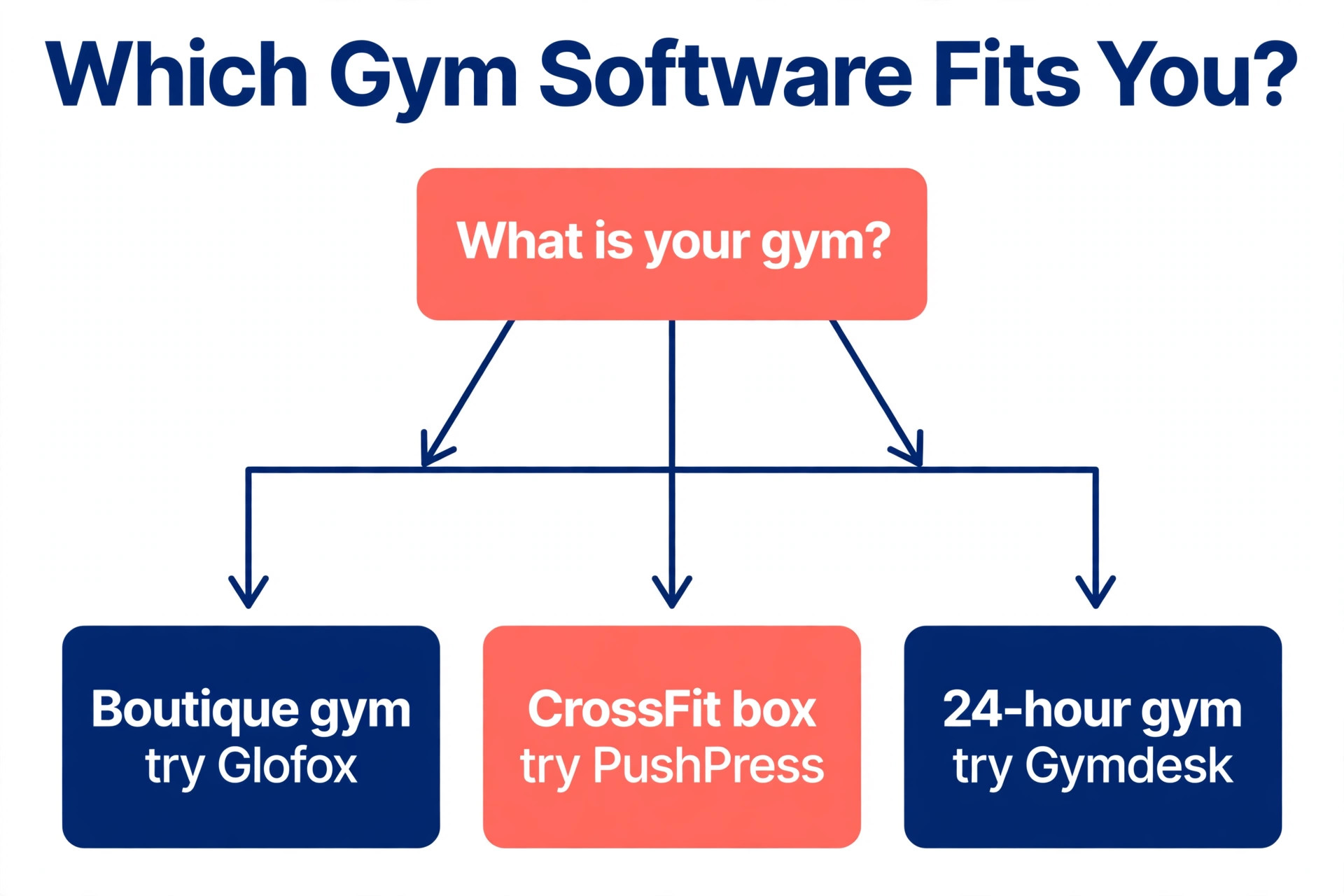
The table below names a lead pick for each segment in this guide to the best gym management software for small gyms, with a second option worth testing. Test the lead pick on your hardest real workflow, whether that is a failed payment, a full class with a waitlist, or a member locked out at midnight, before signing.
| Segment | Lead pick | Also test | Why it fits |
|---|---|---|---|
| Boutique gyms | Glofox | WellnessLiving | Branded app and class experience suit a boutique brand |
| CrossFit-style boxes | PushPress | Wodify | Workout tracking and free entry suit a box budget |
| 24-hour gyms | Gymdesk | TeamUp | Simple billing plus access integrations suit unstaffed hours |
Boutique gyms sell experience as much as exercise, so the member app, the booking flow, and the look of every message matter. Glofox puts a branded app at the center, while WellnessLiving adds marketing and loyalty depth for a studio that also sells spa or wellness services. A boutique owner should judge both on the phone screen a member sees, not on the admin dashboard.
CrossFit style boxes run on community and measurable progress. PushPress covers the core jobs with a genuinely free entry tier, while Wodify goes deeper on workout logging, leaderboards, and personal records. A box that lives on whiteboard culture will feel the difference in the first week, so test the workout flow with real athletes, not only the billing flow.
A 24-hour gym needs the unstaffed hours to work without rescue. Gymdesk pairs simple billing with door access options and a kiosk, while TeamUp covers scheduling and payments with every feature included. Test the midnight journey explicitly. Join online, get access, check in, and handle a failed payment, all without staff present.

The 15 tools in detail
1. PushPress
PushPress is built for independent functional fitness gyms, and its free Core plan is the most honest entry point in this category. Core covers member management, billing, class scheduling, and a basic member app at no monthly cost, with the trade off sitting in card processing at 4.99 percent plus 30 cents per transaction. Pro at 159 dollars a month drops processing to 2.89 percent plus 30 cents, and Max at 229 dollars a month drops it further to 2.75 percent plus 30 cents.
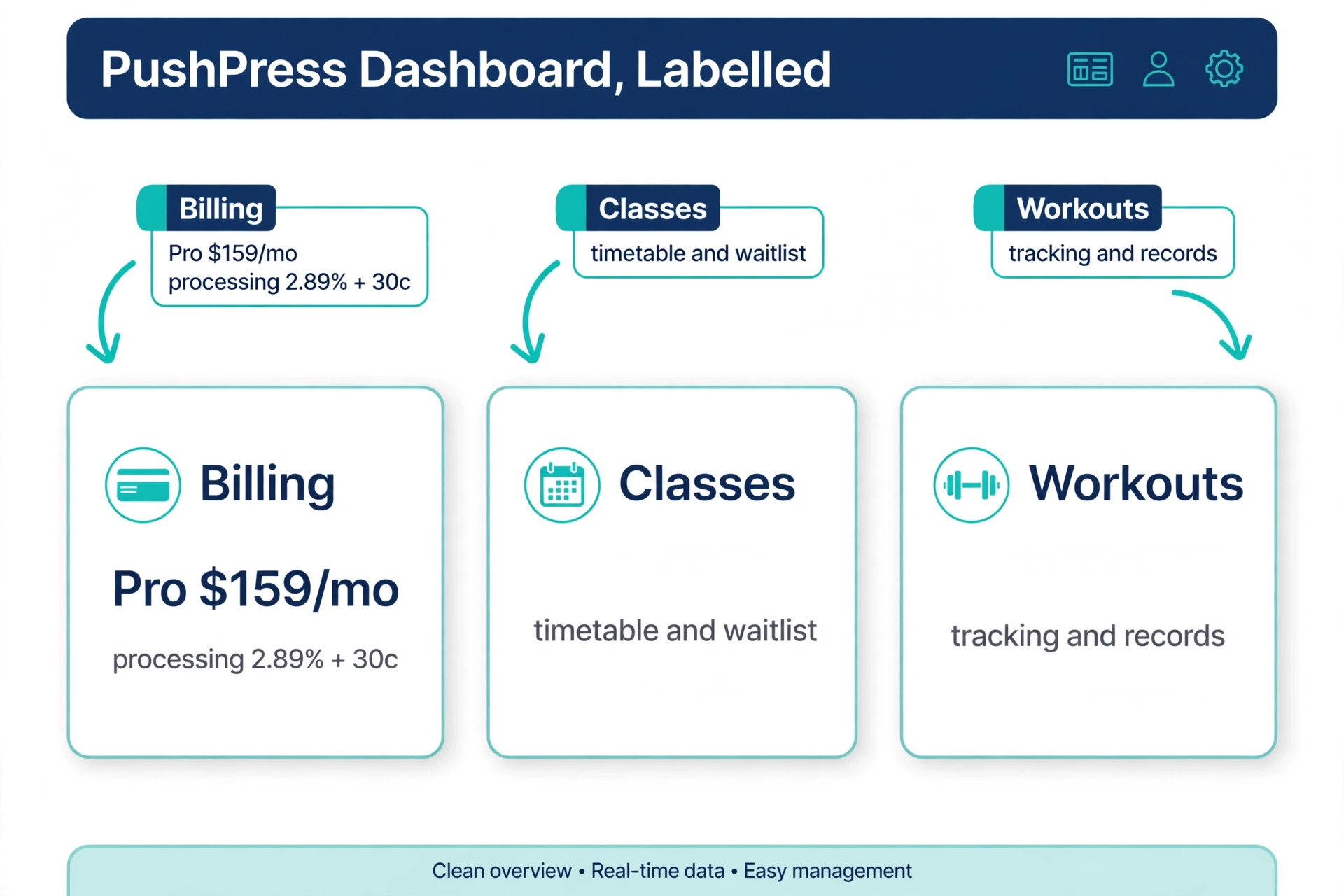
The modular shape is both the strength and the trap. Grow, the CRM add on, costs about 329 dollars a month, Train starts near 79 dollars a month, and a branded app adds roughly 81 to 97 dollars a month. A box that buys everything can reach about 559 dollars a month. Start with Core or Pro and add modules only when a missing feature costs you members.
2. Glofox
Glofox, now ABC Glofox after its acquisition by ABC Fitness, is built for boutique fitness. Scheduling, memberships, payments, and a branded member app sit together, and the app is the reason most studios shortlist it. Members book classes, manage memberships, and pay inside an app that carries the studio name, logo, and colours, which matters when the brand is the product.
Pricing is the weak point. The vendor page lists plans from 99 dollars a month, with Essential, Boost, Elite, and Enterprise tiers, and the higher tiers are quote only. Third party reports put the working range near 110 to 250 dollars a month for Essential, with processing near 2.5 to 2.9 percent. Get a written quote before budgeting, and confirm whether the branded app is included.
3. Mindbody
Mindbody is the largest platform in this list, and its consumer marketplace is the feature no rival can copy. People already searching for classes nearby can discover a studio, book, and pay through the Mindbody app, which brings new members a small gym would otherwise have to buy through advertising. Scheduling, payments, marketing automation, and reporting cover the rest of the operation.
The vendor publishes a Starter price from 79 dollars a month per location, with Accelerate and Ultimate quoted on a sales call. Owners report paying roughly 99 to 499 dollars a month per location once the needed tier is included, before a branded app and processing. Mindbody also takes 20 percent of a new marketplace client first purchase, capped at 30 dollars. Price the tier you actually need, not the Starter headline.
4. TeamUp
TeamUp prices by active customers and includes every feature on every plan, which makes budgeting unusually honest. The current published range starts at 119 dollars a month for up to 100 active customers, rising with customer count, and a custom branded app adds about 99 dollars a month. There is no feature paywall to discover after signing, so the price you model is the price you pay for the software itself.
That simplicity suits independent gyms that want clean scheduling, booking, payments, and reporting without add on creep. TeamUp has no native branded app on the base plan and its CRM tools are lighter than PushPress Grow or WellnessLiving. A gym that wants one fair price for the daily jobs will find TeamUp hard to beat.
5. Zen Planner
Zen Planner serves the membership model gym, especially martial arts schools, CrossFit boxes, and strength facilities. Recurring billing, class scheduling, member management, and reporting sit together, with belt and rank tracking that martial arts schools genuinely need. SugarWOD integration covers workout tracking for boxes that want it, and the mobile app handles check in and member self service.
Pricing starts at 99 dollars a month for up to 45 active members on the Studio plan, rising by member band to about 289 dollars a month. Engage, the marketing add on, starts near 248 dollars a month, and Ultimate begins near 348 dollars a month. Model the price at your member count in twelve months, because a growing gym will climb the bands as it succeeds.
6. Gymdesk
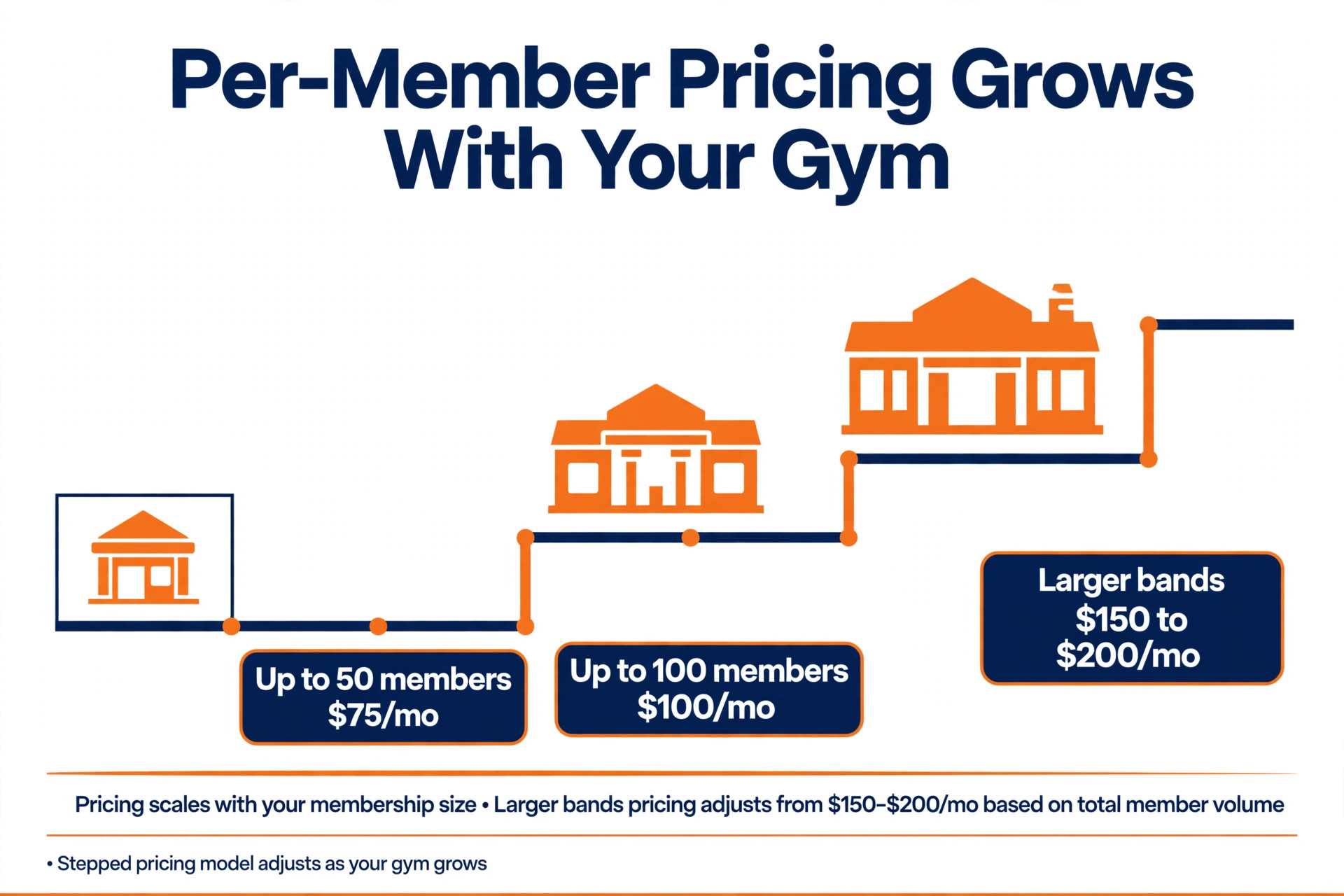
Gymdesk is the value pick for a small gym that wants the whole operation in one place without a contract. Pricing runs by active members with Gymdesk Payments, from 75 dollars a month for up to 50 members, then 100 dollars, 150 dollars, and 200 dollars a month for larger bands. Using your own processor adds 25 dollars a month. Every feature is included at every tier, and frozen or cancelled members do not count toward the cap.
The interface is easy to learn, which matters when front desk staff change often. Memberships, billing, scheduling, attendance, point of sale, and a gym website are covered, with door access options for unstaffed hours. The website builder is basic, so a gym whose site does most of its selling may still need a separate site.
7. Wodify
Wodify speaks CrossFit natively. Workout programming, performance logging, personal records, leaderboards, and class management sit together, so members can track progress and coaches can see who is improving. Billing, scheduling, client management, and point of sale cover the business side, and the community features keep members engaged between classes.
Pricing needs careful verification, because published figures conflict. The vendor list price is reported at 199 dollars a month per location, with promotional prices near 99 dollars a month and other reports near 79 dollars a month. Treat the list price as the planning figure and ask the vendor to confirm the current offer in writing.
8. WellnessLiving
WellnessLiving is a broad wellness platform covering fitness studios, spas, and salons, which suits a gym that also sells wellness services. Online booking, waitlists, recurring classes, livestream, a client app, loyalty tools, and reputation management give a small business a large toolkit. A studio that sells classes, appointments, and retail in one place can run everything in one system.
Pricing is published and clear. Starter costs 69 dollars a month for one staff member, Business costs 199 dollars a month, and Business Pro costs 349 dollars a month, with annual billing roughly ten percent lower. The Starter staff limit matters, because a gym with several coaches will need a higher tier sooner than the headline suggests.
9. Vagaro
Vagaro is a booking first platform with a low entry price and a polished booking experience. The base costs 30 dollars a month per bookable calendar, with an introductory rate reported near 23.99 dollars a month, and each additional calendar adds about 10 dollars a month. Clients can discover the business, book classes or appointments, buy packages, and pay through the app, which suits a small studio built around its calendar.
The catch is the add on catalogue. A branded app, a website, and other extras are billed separately, and recurring card on file charges carry processing near 3.5 percent plus 19 cents in recent listings. Vagaro is built for many industries, not only gyms, so class programming and retention tools are thinner than gym built platforms.
10. Pike13
Pike13 is built for class based businesses, including fitness studios, swim schools, and martial arts schools, with scheduling depth that shows in family accounts. Parents can manage several children under one account, staff can manage complex timetables, and billing follows the family rather than the individual. That structure suits a gym that runs kids classes alongside adult classes.
Pricing is published in tiers. Essential costs 139 dollars a month billed annually, or 159 dollars a month billed monthly, with Advanced and Premium tiers higher. Every plan includes unlimited staff seats and client profiles. Pike13 fits a class business with family billing and a complex schedule.
11. RhinoFit
RhinoFit is the budget pick in this list, with published pricing from about 57 dollars a month. Billing, kiosk attendance, waivers, belt tracking, and rank testing cover the daily jobs for a small gym or martial arts school, and optional 24-hour door access suits an unstaffed gym. Unlimited kiosk check ins remove a cost that other platforms meter.
The trade off is depth. Reporting, marketing, and integrations are lighter than the larger platforms. A small gym watching every dollar will find RhinoFit covers the essentials at a price rivals cannot match.
12. Exercise.com
Exercise.com is a full service fitness platform built around workout delivery, ecommerce, and multi location support. Gyms can sell programming, run an online store, manage memberships, and deliver branded apps from one system. That combination suits a gym that earns real money from online coaching and programming, not only from floor memberships.
Pricing is quote only, with no free trial published, so a small gym cannot model the cost without a sales conversation. Shortlist Exercise.com when online programming is a core revenue line. For a gym that mainly needs billing and booking, a published price platform will give a faster decision.
13. Hapana
Hapana is an Australia founded platform now used by franchise brands including BFT, F45, UFC Gym, and Golds Gym. It covers scheduling, memberships, payments, marketing, and branded apps, with multi location tools built in from the start. A gym that plans to open a second or third site will find its franchise features more useful than a single site tool.
Pricing is quote only across three tiers, Basic, Premium, and Pro, with no dollar amounts published. A single site small gym should test a published price rival first. A multi site operator should ask Hapana for a written quote and compare it against Glofox and Mindbody per location.
14. ABC Fitness
ABC Fitness plays at the top of the market, serving a large share of United States clubs with industrial billing and full service collections. Its platforms include ABC Ignite, ABC Glofox, ABC Trainerize, and the Mindbody business, which ABC Fitness acquired. A large club that needs collections, enterprise reporting, and franchise tools will find depth here that small gym tools cannot offer.
There is no published pricing, and a demo is required before any quote. A small gym with one location will pay for enterprise depth it never uses. Shortlist ABC Fitness only when the gym is large, multi site, or franchise shaped.
15. Kicksite
Kicksite is built for martial arts schools, with belt tracking, student billing, attendance, and rank testing at the center. Pricing runs from 49 dollars a month through tiers near 99, 149, and 199 dollars a month, with processing through a partner near 2.9 percent plus 25 cents. A school that lives on belt progression will use Kicksite daily in a way a general gym platform cannot match.
The focus is also the limit. A gym that adds fitness classes and retail will outgrow a martial arts only tool, and should compare Zen Planner or Gymdesk for breadth. For a single discipline school, Kicksite is a sensible and affordable shortlist pick.
How to judge a gym tool before you pay
Start with your business model, because that choice filters the best gym management software for small gyms faster than any feature table. A membership gym needs recurring billing and failed payment recovery. A class studio needs booking, waitlists, and a member app. A 24-hour gym needs door access and a join flow that works at midnight. A martial arts school needs belt tracking. Write that model down before any demo, and score each tool against it.
Next, run a realistic trial week. Enrol a test member, book a full class, fill the freed spot from the waitlist, let a card fail, freeze a membership, and check in at the door. Then run the monthly billing and check that the invoice, the payment, and the member app all agree. A tool that passes that week will handle most real weeks. A tool that needs staff help for any of those steps will need staff help every week.
Finally, price the second year, not the first month. Add processing fees, text costs, extra staff seats, a branded app fee, and any per member charge, and model the price at your expected member count. Ask about contract length, notice period, and data export, because switching tools later is far harder than choosing well now. A short contract with clean data export is worth more than a small first month discount.
What gym software really costs
Most small gyms pay between 75 and 200 dollars a month for the best gym management software for small gyms, before processing. PushPress Core is free, RhinoFit starts near 57 dollars, Gymdesk starts at 75 dollars, and Zen Planner starts at 99 dollars. At the other end, a full PushPress stack can reach about 559 dollars a month, and quote only platforms can exceed that once locations and add ons are counted. The subscription is only the first line of the bill.
Processing is the second line, and it is often the larger one. A gym taking 15,000 dollars a month in card payments pays roughly 750 dollars a month in processing on a 4.99 percent rate, against about 435 dollars a month at 2.9 percent. That gap alone can exceed the subscription cost of most tools in this guide. Compare processing rates with the same care as subscription prices, and ask whether the vendor requires its own processor or lets you bring your own.
The third line is add ons. Branded apps run roughly 39 to 100 dollars a month across vendors, marketing tools can add 200 dollars or more, and websites are often billed separately. Add those lines before comparing two tools, because a 99 dollar platform with 250 dollars of add ons costs more than a 159 dollar platform with everything included. Get the full monthly total in writing before signing.

Rollout checklist for a small gym
Use this sequence when you move to the best gym management software for small gyms you chose, and do not skip the payment test. A gym cannot close for a software switch, so the rollout must run alongside live classes, billing, and door access.
- Export members, memberships, balances, and waivers, then check a sample by hand for duplicate members and incorrect balances.
- Build your class timetable first, including capacity, coaches, rooms, and waitlist rules, and test booking on a phone for a full class.
- Set billing rules next, including payment dates, late fees, freezes, cancellations, and failed payment retries.
- Connect payments and run a test charge with a real card, then refund it, to confirm the full payment flow.
- Connect door access and test entry for a new member, a current payer, a late payer, and a cancelled member before any member moves over.
- Invite a small group of members to book, pay, and check in through the new app before a full launch.
- Keep the old system read only for one full billing cycle, so no payment or attendance record is lost in the move.
Mistakes that cost small gyms money
The first mistake is choosing on subscription price alone. A free plan with a 4.99 percent processing rate costs more than a 159 dollar plan with a 2.89 percent rate once monthly card volume passes a modest level. Run the numbers at your real payment volume, not at the headline price, and include the branded app and marketing add ons you actually need.
The second mistake is ignoring the failed payment flow. A gym loses more members to failed cards than to cancellations, because a member whose card fails and hears nothing simply stops coming. Test the retry schedule, the reminder messages, and the member self service update flow during a trial. A platform that recovers failed payments quietly is worth more than a platform with a prettier dashboard.
The third mistake is buying a branded app before the core works. Members will forgive a plain app that books classes and takes payments cleanly. They will not forgive a beautiful app that loses bookings or charges twice. Fix billing, booking, and check in first, then add the branded app when the core is proven.
The fourth mistake is skipping the midnight test. A 24-hour gym that works at noon and fails at midnight has bought a daytime tool for a nighttime business. Test joining, access, and payment failure after hours, because those are the hours when no staff member is there to rescue a new member.

Related Guides
Keep exploring with these guides on Stratilyze:
- Top 10 Gym Management Software for Boutique Gyms (10 Tools)
- Best School Management Software for Small Private Schools (10 Tools)
- Best Farm Management Software for Small Farms (11 Tools)
Frequently Asked Questions
How much should a small gym pay for gym software
Most small gyms pay between 75 and 200 dollars a month for the best gym management software for small gyms, plus processing near 2.9 percent plus 30 cents per card transaction. A free plan can work for a new gym with low volume, and a full stack with marketing and a branded app can reach 500 dollars a month or more. Price the total at your real member count and payment volume, not the headline rate.
Is a free gym software plan really free
A free plan charges no subscription, but it usually charges a higher processing rate. PushPress Core is free at 4.99 percent plus 30 cents per card transaction, against 2.89 percent on its Pro plan. On meaningful card volume, that gap costs more than the Pro subscription. Free is a good start for a new gym, and a poor long term deal for a busy one.
Does gym software handle 24-hour access
Some tools do, through door access integrations and mobile check in, while others need a separate access system. Gymdesk, TeamUp, Zen Planner, and RhinoFit all cover access in some form, so confirm your existing hardware is supported in writing before signing. Test entry for a new member, a late payer, and a cancelled member after hours.
What is the difference between per member and per location pricing
Per member pricing rises as your roster grows, which is fair when revenue grows with it. Per location pricing stays flat as members grow, which rewards a busy single site. Flat plan pricing, used by TeamUp and Gymdesk in bands, sits between the two. Model each model at your member count in twelve months, because the cheapest model today can become the most expensive model next year.
Should a small gym choose Mindbody or a smaller platform
Choose Mindbody when discovery through its marketplace and multi location control are real needs, and you can afford the tier that includes them. Choose a smaller platform when billing, booking, and check in are the daily jobs and the budget is tight. A small single site gym usually gets more value from Gymdesk, TeamUp, or PushPress than from an enterprise tier it never opens.
How long does a switch take for a small gym
Most small gyms can switch in two to four weeks, including data import, timetable setup, payment testing, and staff training. Avoid switching billing at month end unless the old system has failed, because a billing error at month end affects every member at once. Keep the old system read only for one full billing cycle after launch.
The gym shortlist, ranked by what matters
Boutique gyms should test Glofox first as the best gym management software for small gyms for their model, with WellnessLiving as the broader alternative. CrossFit style boxes should test PushPress first, with Wodify as the performance depth alternative. A 24-hour gym should test Gymdesk first, with TeamUp as the all features included alternative. In every case, the deciding test is a real member journey from online join to class booking to door access to first payment, plus one full billing cycle with a failed card in it. The platform that handles that journey cleanly, at a written total cost you can defend, is the right buy for your gym.