

Nearly half of express wash revenue in the United States now comes from monthly membership plans rather than single washes, and that shift changes what a point of sale system must do. A car wash register that only rings up a single wash is no longer enough. This guide compares ten options for the best pos software for car wash businesses, judged on membership billing, vehicle recognition, throughput at the pay station, and reporting across locations.
A car wash point of sale system sits in the middle of everything. It talks to the pay station, the tunnel controller, the license plate camera or tag reader, and the card processor. When one of those links fails, cars stack up at the entrance and members wait in a line they paid to skip. The right system keeps that chain short and visible, so a manager can see a failed payment, a stuck gate, or a slow hour without walking the lot.
This guide covers tunnel washes, self-serve bays, and mobile detailing operations, because each format stresses a different part of the system. Tunnel washes need speed and recognition. Self-serve bays need unattended payment and bay timing. Mobile detailers need a tablet system that works away from a fixed site. Prices in this category are mostly quote based, so check the vendor pricing page before budgeting, and treat any third party price as a starting point only.
Why Car Wash POS Software Is Different From Retail POS
A retail point of sale system assumes a clerk, a counter, and a customer who stands still. A car wash has none of those at the moment of sale. Drivers pay at a kiosk in their car, in rain, with wet hands, while a line builds behind them. The best pos software for car wash businesses is therefore built around unattended selling, fast recognition of returning members, and a queue that keeps moving even when a card declines.
Membership billing adds a second job that retail systems rarely handle well. Plans renew every month, cards expire, payments fail, and members pause for winter or cancel after a move. A car wash system must retry failed payments, send a clear update link, and offer a lower plan before a member quits outright. Rinsed built its whole product around that retention work, which is why many operators pair it with a tunnel point of sale system rather than replacing the tunnel system entirely.
Hardware is the third difference. License plate recognition, RFID tags, pay stations, tunnel controllers, and chemical controllers all have to agree on which car is which. A system that cannot read a dirty plate in winter, or that loses the wash queue when the internet drops, will cost more in lost throughput than it saves in subscription fees. Ask every vendor how the system behaves offline, how it handles a misread plate, and what a cashier or attendant does when recognition fails.
The 10 Tools at a Glance
| Tool | Main job | Best for | Watch out for |
|---|---|---|---|
| DRB SiteWatch | Tunnel POS and site management | Multi site tunnel operators | Quote based pricing and longer setup |
| Washify | Cloud tunnel and in-bay POS | Operators who want mobile access | Pricing through DRB, check the vendor pricing page |
| Sonny’s Quivio | Equipment linked POS suite | Sonny’s equipment sites | Newer suite, confirm hardware fit |
| DRB Patheon | Cloud POS and analytics platform | Growing chains | Per site setup and training time |
| Rinsed | Membership CRM and retention | Membership growth | Layer on top of a POS, not a tunnel controller |
| EverWash | Membership sales and marketing | Operators who want outside member acquisition | Revenue share model, check contract terms |
| ICS | In-bay and self-serve control | Self-serve and in-bay sites | Interface feels older than cloud rivals |
| FlexWash | Tablet POS and CRM | Assisted selling at the entrance | Staff led model needs trained greeters |
| WashCard Systems | Fleet and commercial accounts | Fleet heavy operators | Consumer membership side is thinner |
| WashUp | Inspections, maintenance, and scheduling | Daily operations support | Operations tool, not a full POS |
Most tunnel point of sale platforms in this list do not publish a price, and that is normal for this market. Third party guides report that DRB pricing starts around 500 dollars per month for a site and rises for multi location deployments, but check the vendor pricing page for a current quote. WashUp is the exception with a published starting figure reported at 109 dollars per month per location for its bundle, which fits its narrower operations role.
That lack of published pricing is itself useful information. It tells you the vendor expects a sales conversation about hardware, site count, and support level, and that two operators can pay very different amounts for the same software name. Use that to your advantage by getting competing quotes on the same written specification, with the same wash menu, plan set, and hardware list. A vendor who will not quote against your specification is telling you how the support relationship will feel later.
Also watch the difference between a platform and a layer. SiteWatch, Washify, Quivio, Patheon, ICS, and FlexWash run the sale itself, while Rinsed, EverWash, and WashUp add membership growth, acquisition, or operations on top of a sale that already works. That distinction decides your budget shape. Platforms cost more up front and touch every transaction, while layers cost less to start but add a monthly fee or a revenue share for as long as you keep them.
Best Pick by Job
| Job type | First pick | Second tool | Why this pair works |
|---|---|---|---|
| Tunnel washes | DRB SiteWatch | Rinsed | Tunnel control plus membership retention |
| Self-serve washes | ICS | WashCard Systems | Unattended bay control plus account billing |
| Mobile detailing | FlexWash | Washify | Tablet selling plus cloud membership records |
A tunnel wash using the best pos software for car wash businesses should put throughput first, because every extra ten seconds at the pay station reduces cars per hour across the whole day. SiteWatch controls that flow and Rinsed protects the membership base that fills it. A self-serve wash has the opposite problem, which is unattended bays, coin and card payments, and bay timers that must be fair and clear, so ICS control plus WashCard account handling fits better than a tunnel suite.
Mobile detailing breaks the tunnel model entirely. There is no gate, no conveyor, and no pay station. What a detailer needs is a tablet system that sells a package on a driveway, takes a deposit, and keeps a customer record for the next visit. FlexWash tablet selling translates well to that job, and Washify cloud records keep memberships and packages in one place when the same customer returns to a fixed site later.
How to Choose the Best POS Software for Car Wash Businesses
Start with your format, not with a feature list. A tunnel operator, a self-serve owner, and a mobile detailer buy different systems even though all three sell washes. Write down your wash menu, your membership plans, your payment methods, and the hardware already on site before you take a demo. A vendor demo on clean hardware tells you little about a dirty plate, a wet touchscreen, or a Saturday rush.
Test recognition before you test reporting. Run your own plates past the camera, including out of state plates, dealer plates, and plates with frames that cut off a character. Ask what happens when the camera misreads. The answer should be a fast manual override, a clear attendant screen, and a record of the correction, not a queue that stops while someone finds a manager. Recognition accuracy is the feature that decides whether members love the system or avoid the entrance lane.
Then test the money side. Sign up a test member, let a card fail, pause a plan, upgrade a plan, and cancel a plan, and watch what the customer sees at each step. The best pos software for car wash businesses makes failed payment recovery boring, with automatic retries, a simple update link, and a save offer before cancellation. If recovery needs a phone call to the office, churn will be higher than the sales deck suggests.
Finally, price the whole stack, not the subscription alone. Tunnel point of sale software usually comes with pay station hardware, cameras, installation, and a support contract, and those lines can exceed the software fee in year one. EverWash is priced differently again, as a share of membership revenue rather than a flat fee, so model it against your member count and average plan price before signing. Get hardware, install, support, and processing in one written quote.

The 10 Tools in Detail
1. DRB SiteWatch
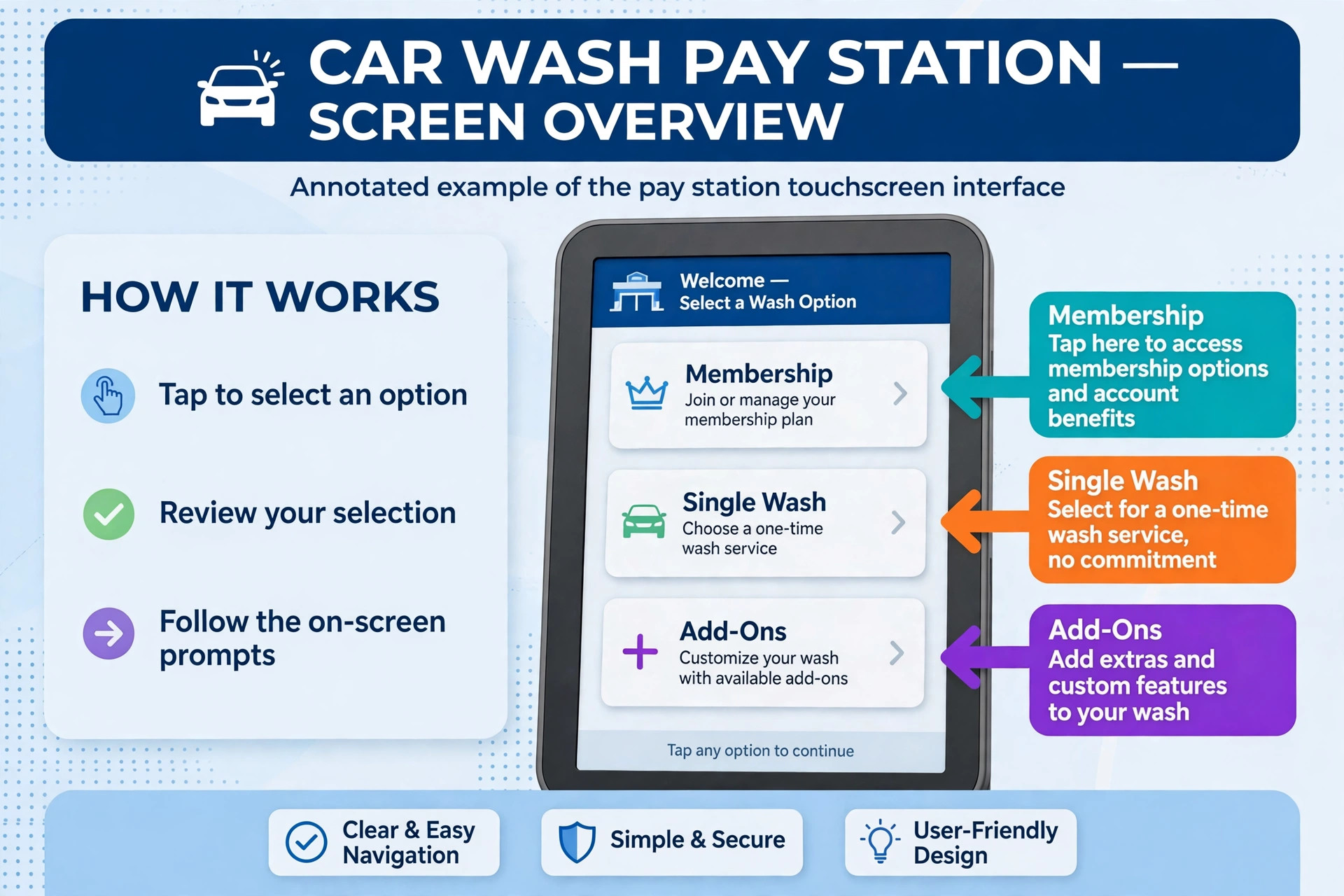
SiteWatch is the long established DRB tunnel point of sale system, built for operators who run complex sites and need equipment integration, fast check-in, and detailed reporting. It supports vehicle tracking by RFID or license plate, membership and loyalty plans, package management, and staff controls, and it connects to DRB tunnel equipment and pay stations. For a multi site operator, that depth matters more than a pretty dashboard.
SiteWatch suits operators who already run DRB hardware or who plan to standardise on it across sites. The trade off is a longer setup and a quote based price, so check the vendor pricing page and ask for install and support costs in writing. Smaller single site operators may find the system more than they need, and should compare it against Washify or Patheon before committing to the heavier platform.
2. Washify
Washify is the cloud point of sale platform now presented under DRB, built for tunnel and in-bay operators who want mobile access and a modern interface. It handles recurring billing, stored cards, license plate recognition for contactless entry, online plan sales, and reporting from any connected device. That cloud access is the main reason operators choose it over older on site systems.
Washify fits a single site or a small chain that wants membership selling online and at the pay station without a server room. Because it now sits under DRB, pricing runs through a DRB quote, so check the vendor pricing page and confirm what is included for hardware and support. Test its in-bay mode carefully if you run automatics at a gas station or a mixed site, since tunnel and in-bay flows differ.
3. Sonny’s Quivio
Sonny’s Quivio is the newer point of sale suite from Sonny’s, the equipment maker, and it is designed to sit close to Sonny’s tunnel hardware. The pitch is a single vendor for equipment and software, with wash tickets, add-on selling, real time tracking, and membership handling in one system. For an operator already buying Sonny’s conveyors and controllers, that single vendor story removes a common integration argument.
Quivio is newer than SiteWatch and Washify, so ask for reference sites with your exact format and hardware mix, and confirm which third party hardware it supports. A suite that works well on new Sonny’s equipment may need extra work on a mixed site with older controllers. If your site is already Sonny’s end to end, Quivio deserves a shortlist spot on integration alone.
4. DRB Patheon
Patheon is DRB’s cloud car wash management platform, positioned beyond a basic register as a marketing system, analytics engine, and workforce tool. The tunnel base package includes site and plan configuration, point of sale, real time dashboards, hardware and software alerts, payment processing, wash plan management, and customer messages for welcome notes, failed payments, receipts, and expirations. A tablet add-on extends selling anywhere on site.
Patheon fits a growing chain that wants one cloud view across sites and a stronger marketing layer than a basic tunnel register offers. The platform is broad, so implementation and staff training take longer than a single site install, and pricing is quote based, so check the vendor pricing page. Operators with one simple site may prefer a narrower tool and add marketing later.
5. Rinsed
Rinsed is a membership customer platform that layers on top of an existing point of sale system and website, rather than replacing tunnel hardware. It keeps the member list, sells plans online, sends failed payment alerts, offers lower plans to members about to quit, and reports membership growth in one dashboard. That focus makes it the most popular add-on in this guide for operators whose tunnel system is fine but whose membership growth has stalled.
Rinsed suits any tunnel operator who already has a working point of sale system and wants better retention without a full rip and replace. Published pricing has varied across third party guides, so check the vendor pricing page for the current per location fee, setup fee, and any commission on plans sold through its checkout. Model the commission against your online signups, because it grows with your success.
6. EverWash
EverWash uses a different commercial model from every other tool here. Instead of a monthly software fee, it takes a share of membership revenue and handles member marketing and acquisition on the operator’s behalf. For an owner who struggles to fill membership plans, that outside marketing engine can be worth more than any dashboard feature, and it removes the need to run campaigns alone.
The trade off is control and exit cost. EverWash owns much of the member relationship under its model, and leaving the partnership can mean losing member billing details in usable form, according to third party guides. Read the contract on data ownership, exit terms, and what happens to members on departure before signing. EverWash fits operators who value acquisition over independence, and it fits poorly for owners who want full control of their list.
7. ICS
ICS is an established in-bay and self-serve control specialist, and it fits sites where the tunnel model does not apply. Its systems run pay stations, bay timers, and unattended payment for self-serve bays and in-bay automatics, with membership and account features for regular customers. For a self-serve owner, reliable unattended operation matters more than a polished cloud dashboard, and ICS is built for that job.
ICS suits operators with self-serve bays, in-bay automatics at fuel sites, or mixed sites where tunnel software would be overkill. The interface feels older than cloud first rivals, so judge it on uptime, bay control, and service response rather than screen design. Pricing is quote based, so check the vendor pricing page and confirm service coverage for your area before purchase.
8. FlexWash
FlexWash replaces the traditional kiosk with tablet based selling, so staff greet drivers face to face and sell memberships from a handheld device. The system adds a built in customer database that tracks every visit and vehicle, automatic license plate recognition, assisted upselling based on wash history, employee sales tracking, and marketing return reports tied to coupon redemptions. That staff led model is its defining idea.
FlexWash fits tunnel sites that want higher membership conversion at the entrance, and it also translates to mobile detailing, where a tablet is the whole point of sale system. The model needs trained greeters and a staffing plan for rush hours, since tablets without staff are just expensive kiosks. Compare its conversion claims against your current kiosk conversion on a trial lane before rolling it out site wide.
9. WashCard Systems
WashCard Systems specialises in fleet and commercial account management, which is a different strength from consumer membership selling. If a large share of revenue comes from fleets, dealerships, or commercial accounts paying on account, WashCard handles that billing, account control, and reporting better than most consumer focused tools. That focus makes it a strong second system or a primary system for fleet heavy sites.
The trade off, reported in third party guides, is a dated interface, a thinner mobile experience, and more setup work for plate recognition than modern rivals expect. Pricing is reported in a range of roughly 200 to 600 dollars per month per location in third party guides, but check the vendor pricing page for a current quote. Choose WashCard when fleet billing is the deciding factor, not when consumer membership growth is the priority.
10. WashUp
WashUp is an operations platform for inspections, maintenance, staff tasks, and scheduling, priced per location rather than as a tunnel point of sale system. It complements a point of sale system by keeping the physical site in shape, with inspection checklists, maintenance tracking, task assignment, and scheduling in one bundle. A wash that looks clean, runs reliably, and opens on time keeps members longer than any promotion.
WashUp fits any operator who already has a point of sale system and wants operations discipline without buying a second full platform. Third party guides report its bundle from 109 dollars per month per location, with lower figures on annual and volume plans, but check the vendor pricing page before budgeting. Do not buy WashUp expecting it to run pay stations or membership billing, since that is not its job.
The value here is less visible than a membership dashboard but easy to measure. Track missed inspections, overdue maintenance, and staff tasks completed on time for a month before and after adoption. If those numbers improve, the system pays for itself in fewer breakdowns and fewer closed bays. If they do not improve, the problem is adoption on site, not the software, and adding more features will not fix it.
Mistakes That Cost Wash Operators Money
The most expensive mistake is buying for the sales demo instead of the Saturday rush. A system that looks fast with one car and a trained presenter can crawl when ten cars arrive at once, a plate misreads, and a card declines in the same minute. When judging the best pos software for car wash businesses, run the demo at rush volume, with your own plates and your own staff, and watch the queue rather than the dashboard.
The second mistake is ignoring the failed payment queue. Most operators check new signups daily and failed payments weekly, which is backwards. Failed payments are members about to leave, and every day of delay makes recovery harder. Set a daily owner for failed payments, measure recovery rate weekly, and treat a rising failure rate as an urgent operations problem, not a finance footnote.
The third mistake is pricing the subscription and forgetting the stack. Hardware, installation, cameras, support contracts, and card processing together often exceed the software fee in the first year, and a revenue share model changes the math again as membership grows. Get one written quote that lists every line, then model year one and year three at your current member count and at double that count. A system that is cheap at 200 members and punishing at 800 is a trap for a growing wash.
The fourth mistake is skipping the exit question. Ask who owns the member list, the payment tokens, and the wash history if you leave, and get the answer in the contract. Operators who skip this question discover the cost only when they try to switch, and by then your bargaining power has gone. A clean exit clause is not pessimism. It is the reason you can negotiate a better renewal later.
Setup Checklist
Use this checklist when you install or switch a car wash point of sale system, and keep a copy with the site manual.
1. Map every wash menu, plan, add-on, and price in the new system before hardware arrives. 2. Test plate recognition on dirty plates, dealer plates, and out of state plates at real entrance speed. 3. Run a failed payment, a pause, an upgrade, and a cancellation end to end with a test member. 4. Confirm offline behaviour for the pay station, the gate, and the tunnel controller during an internet outage.
5. Train greeters and cashiers on manual override, refunds, and member lookup before opening day. 6. Reconcile one full day of sales, memberships, and redemptions against bank deposits. 7. Set alerts for failed payments, low chemical levels, and hardware faults with a named owner for each. 8. Review churn, conversion, and cars per hour weekly for the first month and fix the weakest number first.

Related Guides
Keep exploring with these guides on Stratilyze:
- Use AI for Mobile Car Wash Route Scheduling
- Car Wash Booking Management with AI Tools: Slots, Packages and Reminders
- Best POS System for Boutiques (15 Tools)
Frequently Asked Questions
How much does car wash POS software cost?
Most tunnel point of sale platforms are quote based, and the total includes hardware, installation, and support on top of the software fee. Third party guides report DRB pricing from around 500 dollars per month per site, rising for multi location deployments, but check the vendor pricing page for a current quote. Operations tools like WashUp publish lower per location figures because they do not run pay stations or tunnel control.
Do I need license plate recognition or is an RFID tag enough?
Both work, and many sites use both. Plates are convenient because members need nothing in the car, but dirty plates and frames cause misreads. Tags are more reliable at the gate but need distribution and replacement when a member changes cars. Choose a system that supports both and falls back cleanly when recognition fails, so a misread never stops the queue.
Can a car wash POS system handle self-serve bays too?
Some can, but self-serve bays need bay timers, unattended payment, and bay level reporting that tunnel software may treat as an afterthought. ICS and WashCard are stronger starting points for self-serve and in-bay sites. If you run both formats, confirm in the demo that bay sales, tunnel sales, and memberships reconcile in one report.
What should mobile detailers use instead of a tunnel POS?
Mobile detailers need a tablet system with deposits, package selling, customer records, and card payments that work away from a fixed site. FlexWash tablet selling fits that pattern, and a cloud membership record from Washify keeps repeat customers in one place. A full tunnel suite with pay stations and conveyor control is wasted spend for a mobile operation.
How does membership churn usually happen, and how do I reduce it?
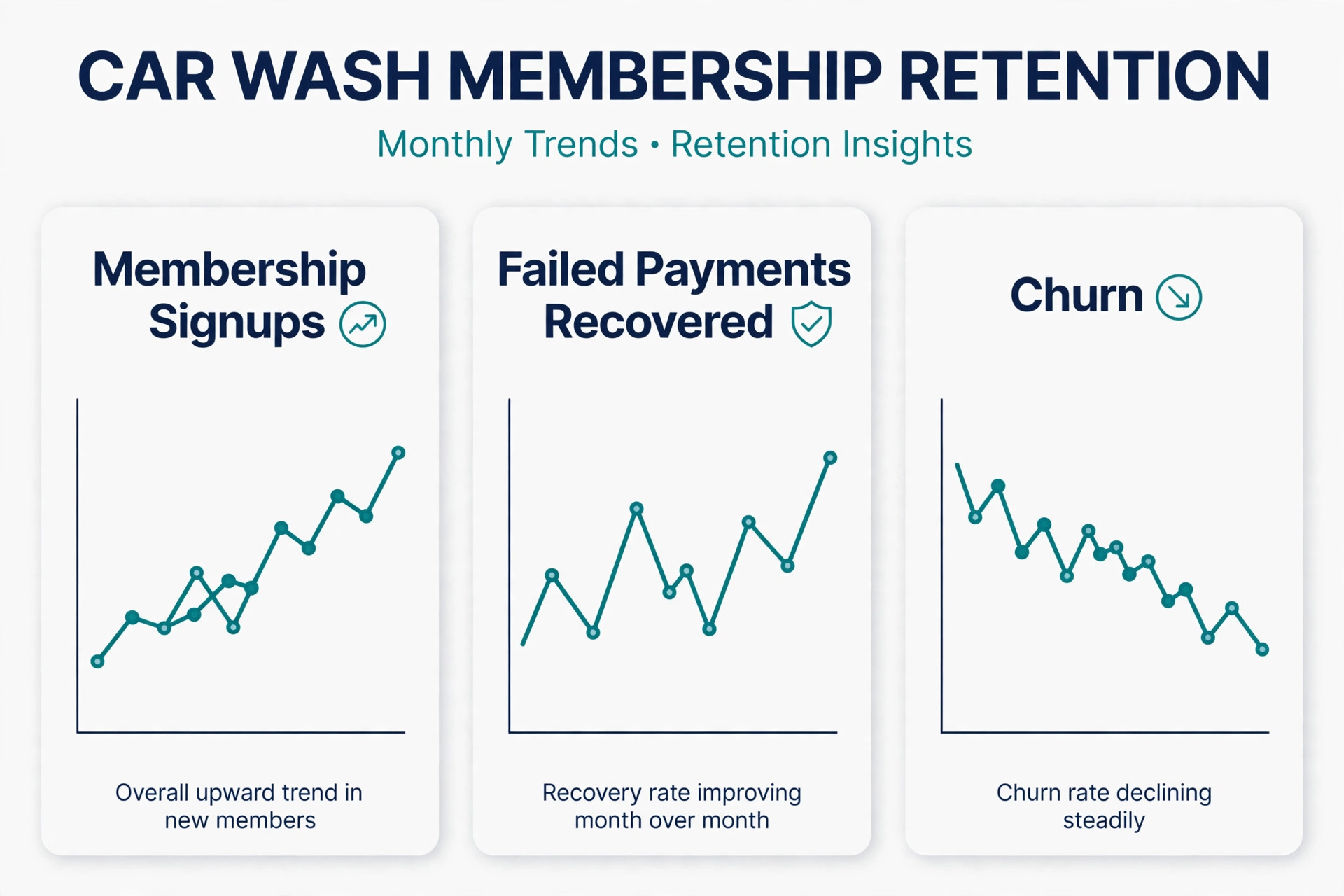
Churn usually comes from expired cards, failed payments nobody chases, and members who feel the plan no longer fits their usage. Automatic retries, a simple card update link, and a lower plan offered before cancellation cut churn more than discounts. Rinsed and Patheon both automate that save flow, so compare their recovery reports on a trial before choosing.
Should I buy one platform or pair a POS with a membership layer?
Pairing is common and often wise. A tunnel point of sale system runs the physical site, while a membership layer like Rinsed grows and retains the member base. The risk is two vendors blaming each other when data disagrees, so confirm the integration, the data owner, and support responsibility in writing. A single platform removes that argument but may be weaker on one side of the job.
The Bottom Line for Wash Operators
There is no single winner here, because a tunnel chain, a self-serve site, and a mobile detailer buy different systems. A tunnel operator who wants depth and scale should shortlist SiteWatch and Patheon, then add Rinsed if membership retention is the weak point. A self-serve owner should start with ICS and WashCard and judge them on unattended reliability. A mobile detailer should keep the stack light, with tablet selling and cloud records only.
Whatever you choose, test recognition, test failed payments, and price the full stack before signing. The cheapest subscription can become the most expensive system if cars queue at the entrance, members churn on expired cards, or hardware and support arrive as surprise line items. The best pos software for car wash businesses is the one that keeps cars moving, keeps members paying, and shows you the numbers that matter every morning.
Set a review date ninety days after go live, and judge the system on three numbers only. Cars per hour at peak, membership churn for the month, and failed payment recovery rate. If all three improved against your old system, keep the platform and fix the next weakest process. If none improved, the problem is either the wrong tool or weak adoption on site, and a second tool will not rescue a first tool nobody uses properly.