

The verdict comes first, because Hootsuite pricing punishes buyers who browse it casually. A solo manager should expect to pay $99 a month on annual billing for the entry tier, and a three person team should expect $297 a month for the same tier, since Hootsuite now charges per seat rather than per plan. That single fact decides whether Hootsuite fits a small business at all, and any guide that hides it behind feature lists is doing the reader a disservice. The cost of Hootsuite for small business monthly is therefore high by small business standards, and it only earns its fee when the team genuinely uses the inbox, approvals, reporting, and listening tools that cheaper schedulers leave out.
This is not a tool for someone who only needs to queue a few posts a week. Cheaper schedulers cover that job for a fraction of the price, and a small firm that buys Hootsuite for scheduling alone will feel overcharged within a month. Hootsuite earns its price when social media is a daily operation, with multiple accounts, multiple team members, customer messages arriving all day, and reports that a client or a manager actually reads. If that description fits the firm, the per seat price buys a working system. If it does not, the same price buys an expensive calendar.
Read the tier table in the next section with a calculator in hand, because the per seat maths is the whole decision. Feature lists can wait until the bill for the firm’s actual headcount is clear.
Prices in this guide come from vendor pricing pages and reputable comparison listings checked at writing time. Hootsuite has changed its pricing model recently, so treat every figure as a starting point and confirm the current price on the vendor page before buying. Annual billing figures are used as the main comparison, because month to month rates are not always published, and annual billing is how most teams actually buy.
What the Cost of Hootsuite for Small Business Monthly Looks Like on Each Tier
Hootsuite now sells per seat, which means every person who logs in pays the full seat price for the chosen tier. Standard costs $99 per seat a month on annual billing, Professional costs $199 per seat a month, and Advanced costs $399 per seat a month, while Enterprise is quoted individually. Standard covers up to 10 social accounts per seat, while Professional and Advanced offer unlimited accounts, stronger reporting, and deeper listening and governance features. There is no permanent free tier, though a trial is offered on the public plans.
| Plan | Annual billing per seat | Accounts per seat | Best for |
|---|---|---|---|
| Standard | $99 a month | Up to 10 | A solo manager or small team |
| Professional | $199 a month | Unlimited | A growing team needing reporting |
| Advanced | $399 a month | Unlimited | A large team needing governance |
| Enterprise | Custom | Unlimited | A large organisation with compliance needs |
Older guides still describe a Professional plan at $99 and a Team plan at $249 for three users, and those guides are now misleading. The $99 tier is now called Standard, Professional now means the $199 tier, and the flat $249 Team bundle no longer exists. A buyer who budgets from an old article will understate a three person team bill by a wide margin, because three Standard seats cost $297 a month rather than $249. Always check the current tier names on the vendor page, and ignore any article that still quotes the old bundle as if it were live.
When owners ask what the cost of Hootsuite for small business monthly actually buys, the honest answer is a system rather than a scheduler. Standard buys scheduling, a unified inbox, basic analytics, and AI caption help for one seat. Professional adds stronger reporting and listening depth, while Advanced adds approval workflows and governance at a level small firms rarely need. The jump between tiers is therefore not about posting more often, but about managing more people, more accounts, and more risk, which is why team size and account count should drive the tier choice.
Keep that distinction in mind for every section that follows, because it explains why a dearer tier can be good value for one firm and wasted money for another.
The Per Seat Trap That Catches Small Teams
Per seat pricing changes the budgeting question completely. Under the old Team bundle, adding a third user cost nothing extra, because three users were included in one flat price. Under per seat pricing, every new hire, contractor, or intern who needs access adds $99 a month on Standard, or $199 a month on Professional. A team that grows from three to five people on Standard sees its bill rise from $297 to $495 a month, an increase of $198 a month that has nothing to do with posting more content. Hiring plans and software budgets must therefore move together.
The trap bites hardest when access is handed out casually. A manager, an assistant, a designer, and a founder may all want to peek at the dashboard, but each login is a paid seat, even if the person only checks reports once a week. Firms should decide who genuinely needs to publish, reply, and approve, and give everyone else reports by email or in a meeting instead of a seat. That discipline can easily save $99 or $199 a month, which is more than most feature comparisons ever save.
There is a second trap in account counting. Standard allows up to 10 social accounts per seat, which sounds generous until a firm counts properly. A single brand with Instagram, Facebook, LinkedIn, TikTok, YouTube, Pinterest, and a Google Business Profile already holds seven accounts, and a second brand or a client account pushes the total past ten quickly. Professional removes the cap, but at double the seat price, so a firm with many accounts must choose between buying more Standard seats or upgrading tiers. Count every profile, including dormant ones, before choosing, because the account total decides the tier more often than any feature list.
That counting exercise is the most practical way to judge the cost of Hootsuite for small business monthly before signing anything. List every profile the firm actually publishes to, mark the dormant ones for removal or consolidation, and only then compare the seat total with the tier table. A firm that cleans up three dormant profiles may stay on Standard and save $100 a seat a month, while a firm that skips the count may upgrade to Professional for accounts nobody uses. The cheapest saving in this purchase is deleting profiles that should have been closed long ago.

Worked Monthly Totals for a Solo Manager and a Three Person Team
A solo manager on Standard billed annually pays $99 a month, or $1,188 over a year. The same manager on Professional pays $199 a month, or $2,388 over a year, which is double the Standard bill for unlimited accounts and stronger reporting. That doubling is hard to justify for one person managing under ten accounts, unless clients demand custom reports or listening depth that Standard cannot provide. Most solo managers should start on Standard and upgrade only when a specific report or account limit forces the move.
A three person team on Standard billed annually pays $297 a month, because three seats at $99 each add up to that total, or $3,564 over a year. The same team on Professional pays $597 a month, or $7,164 over a year, which is $300 a month more for unlimited accounts and deeper analytics. That gap is the most important number in this guide, because it shows how quickly per seat pricing multiplies a tier decision. Choosing Professional for three people costs $3,600 a year more than Standard, so the team should be able to name the reports, accounts, or listening features that justify it.
Compare the three person Standard total with the old Team bundle to see how much the model change matters. The old flat price of $249 a month for three users would have cost $2,988 a year, while three Standard seats cost $3,564 a year, a difference of $576 a year for the same headcount. The new model is not dramatically dearer for a three person team, but it removes the free third seat illusion, and it makes a five person team far dearer than the old bundle ever was. Buyers who still think in bundle terms will underbudget every hire.
A firm can trim the bill by mixing roles rather than buying identical seats for everyone. If two team members publish daily and a third only approves posts, the firm still pays three seats, because approval needs access, but it may avoid upgrading all three to Professional. Put the two daily publishers on the tier they need, and check whether the approver can work on Standard, though all users on one account generally share the same plan, so mixed tiers are not always available. Confirm the current mixed tier rules on the vendor page before planning a split, since that detail changes the maths.
The wider lesson is that the cost of Hootsuite for small business monthly grows in steps of $99 or $199, never in small increments, so every seat decision deserves a name and a job attached to it. Write down who holds each seat, what they publish or approve each week, and what would break if their seat were removed. If a seat has no weekly job, remove it before the next renewal and give that person reports another way. That simple seat audit often saves more money than any discount negotiation, because it removes spending that never had a purpose.

Who Each Hootsuite Tier Actually Fits
Standard fits a solo manager or a small team handling one or two brands with up to ten accounts per seat. It covers scheduling, the unified inbox, basic analytics, and AI caption help, which is the core daily work of most small firms. Standard also fits a firm that is moving from a cheap scheduler to a proper inbox for the first time, because the inbox alone can save hours a week when customer messages arrive across several networks. It does not fit a firm that needs custom client reports or advanced listening, and those firms should not waste months discovering that gap.
Professional fits a growing team that reports to clients or to senior managers, manages more than ten accounts, or needs deeper listening and reporting. The unlimited account allowance removes the counting problem, and the stronger reporting turns social activity into evidence that a manager can present. Professional also fits a small agency with a handful of clients, because custom reports and listening help justify retainers. The $199 seat price is steep, but it is defensible when reporting is part of what the client pays for, rather than an internal nice to have.
Advanced fits larger teams that need approval workflows, expanded governance, and deeper analytics at scale. A small business rarely needs Advanced, and buying it early usually means paying $399 a seat for controls that a three person team can handle with conversation and a shared checklist. Advanced becomes relevant when the team grows past five publishers, when regulated content needs formal approvals, or when multiple departments publish under one brand. Until one of those triggers appears, Advanced is a future tier, not a starting tier.
Enterprise fits organisations with compliance, security, and integration needs that public tiers cannot meet, such as single sign on at scale, dedicated support, and custom contracts. Its price is quoted individually and is reported to start at a high five figure annual sum, which puts it far outside small business budgeting. A small firm should not request an Enterprise quote out of curiosity, because the sales process alone consumes time, and the resulting price will not be competitive with public tiers for a small team.
The fit question therefore comes down to a single test that any owner can apply without a sales call. The cost of Hootsuite for small business monthly is justified when the firm can point to daily inbox work, weekly approvals, and monthly reports that a cheaper scheduler cannot handle well. If the firm can only point to scheduling, it has not passed the test, and it should choose a cheaper tool and revisit Hootsuite when the operation grows into daily inbox and reporting work. Passing the test late is better than paying the premium early.
Hootsuite Costs Outside the Subscription
The subscription is only the first line of the real bill, because Hootsuite sells valuable extras separately. Social listening beyond the basic level, additional analytics depth, and some integrations can add to the monthly total, and those add ons are easy to approve one by one until the bill grows quietly. A firm should list which add ons it actually needs before purchase, price each one, and set a rule that no add on is added without a named owner and a review date. Without that rule, the subscription creeps upward while nobody notices.
A second outside cost is staff time spent learning the platform. Hootsuite is powerful, but its stream based interface feels dated and crowded to newcomers, and a team that is used to a simple scheduler will need training time. Budget a few hours per user in the first month, plus a shared guide for the firm’s own workflows, such as how approvals work and who replies to what. That training time is part of the purchase price, and a firm that skips it will pay in mistakes, such as replies sent from the wrong account or posts published without approval.
A third outside cost is content production itself. Hootsuite schedules and measures content, but it does not create it, so a firm still needs photography, video, copywriting, and design, whether in house or bought in. A team that buys a $297 a month tool and then has nothing good to publish will blame the tool, when the real gap is content. Before committing to Hootsuite, the firm should confirm it can produce enough quality posts to justify a daily operation tool, because a powerful scheduler with an empty calendar is an expensive reminder of a content problem.
That content check belongs in any honest assessment of the cost of Hootsuite for small business monthly, because the subscription is only one part of the social media budget. A firm spending $297 a month on Hootsuite plus $500 a month on content production has a social budget near $800 a month, and the tool is only a third of it. A firm with no content budget at all should fix content first, using a cheap scheduler in the meantime, and move to Hootsuite when there is enough content to need inbox management, approvals, and reporting.

When the Hootsuite Upgrade Pays and When It Does Not
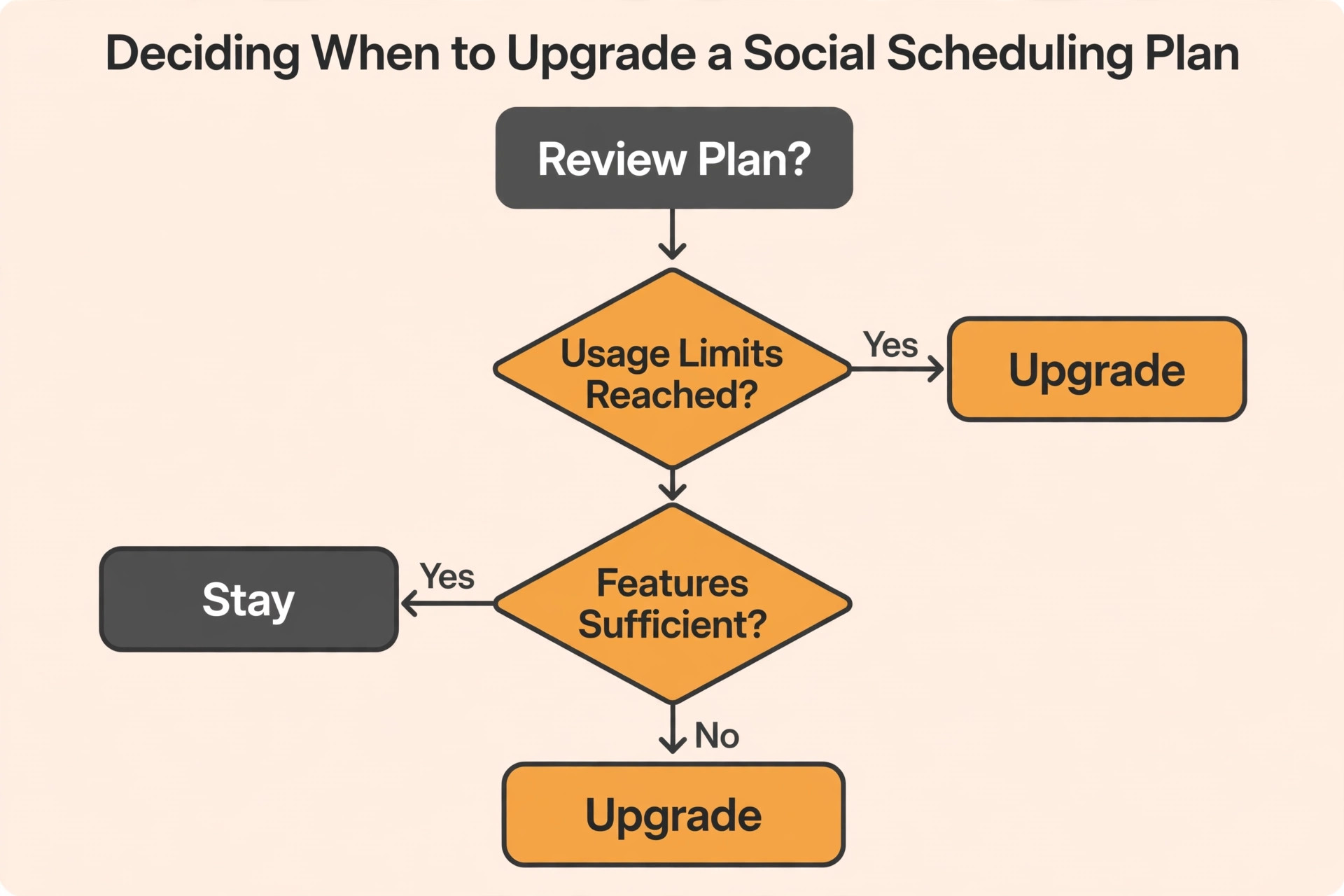
Upgrade from Standard to Professional when the account cap bites or when reporting becomes a deliverable. The signs are concrete, such as hitting the ten account limit, spending hours rebuilding reports in spreadsheets, or losing a client conversation because listening depth was too shallow. Each of those is a measurable cost, and the $100 per seat monthly gap is smaller than the value of one retained client or one recovered week of reporting time. Upgrade on that evidence, and keep a note of which trigger forced the move, so the decision stays accountable.
Do not upgrade just because the team grew by one person, because per seat pricing already charges for that growth. Adding a fourth Standard seat costs $99 a month, which is the correct price of growth, while upgrading all four seats to Professional would cost an extra $400 a month on top. Growth and tier are separate decisions, and confusing them is the fastest way to double a bill without doubling value. Upgrade the tier only when the work itself changes, such as new clients, new accounts, or new reporting demands.
Do not buy Advanced in anticipation of governance needs that do not exist yet. Approval workflows sound professional, but a three person team can approve posts with a quick message and a shared checklist, without paying $399 a seat. Buy Advanced when approvals become a compliance requirement, when the publisher count makes informal approval unreliable, or when a client contract demands it. Until then, the money is better spent on content, training, or an extra Standard seat for someone who actually publishes.
The discipline behind that advice applies to the whole purchase, because the cost of Hootsuite for small business monthly rewards firms that upgrade on evidence and punishes firms that upgrade on ambition. Keep a short log of upgrade triggers, such as account limits hit, reports requested, or listening gaps found, and review that log at each renewal. If the log is empty, the current tier still fits. If it holds repeated entries for the same gap, the upgrade has earned itself, and the firm can approve it without second guessing.
What Leaving Hootsuite Would Cost Later
Switching away from Hootsuite is less painful than switching a file drive, but it still carries real costs. Scheduled posts, drafts, reports, and inbox history do not transfer cleanly to a new scheduler, so the team must rebuild its queue and lose its historical reporting baseline. A solo manager can rebuild in a day, while a three person team with months of scheduled content should budget several days, plus a period when both tools run side by side. That overlap means paying two subscriptions at once, which buyers forget when they compare headline prices.
The deeper switching cost is workflow habit. Staff who have learned the inbox, streams, and approval flow will need retraining on the new tool, and the first month on a replacement always feels slower, even when the new tool is objectively simpler. Some staff will quietly revert to publishing natively on each network, which fragments reporting and breaks the very consistency the tool was bought to provide. Test the replacement with real accounts and real deadlines before cancelling Hootsuite, because a trial on dummy content hides the friction that matters.
There is also a reporting cost that firms underestimate. Clients and managers who have grown used to Hootsuite report formats will notice when the format changes, and the team must explain the new numbers and rebuild trust in them. Keep the old reports for a quarter after switching, run the new reports alongside them, and explain any differences plainly. That parallel period takes time, but it protects client confidence, which is worth far more than the subscription saving that motivated the switch.
A buyer who understands that reporting cost will also understand why the cost of Hootsuite for small business monthly is rarely the deciding factor in a switch on its own. The subscription saving from moving to a cheaper scheduler can look large on paper, yet the rebuild of queues, the retraining of staff, and the parallel reporting period all consume weeks of attention. Switch when the new tool genuinely fits the operation better, not merely when its headline price is lower, because a switch motivated only by price often costs more than it saves.

The Hootsuite Verdict for a Small Business
For a solo manager, Standard on annual billing at $99 a month is the sensible entry point, and Professional at $199 a month should wait until account limits or reporting demands force it. For a three person team, Standard at $297 a month is already a serious commitment, and Professional at $597 a month should only follow when reporting or unlimited accounts are genuine business needs. The cost of Hootsuite for small business monthly is therefore a premium price for a premium operation, not a bargain scheduler, and it should be bought with that understanding clearly in mind.
Buy Hootsuite when social media is a daily operation with messages to answer, approvals to manage, and reports that someone actually reads. Skip it when the firm only needs to queue posts, and spend the saving on content or on a cheaper scheduler that fits the real workload. Review seats ruthlessly at every renewal, because per seat pricing punishes casual access, and every seat should belong to someone who publishes, replies, or approves every week. When those conditions hold, Hootsuite earns its fee. When they do not, the cheapest way to save money is to admit the firm bought more system than its social operation needs.
One last habit will protect the budget long after the purchase decision fades from memory. Once a quarter, list every seat, every account, and every add on, and ask whether each one still earns its place. Social operations change quickly, brands close, clients leave, and staff move roles, yet subscriptions rarely shrink on their own. A quarterly review of fifteen minutes keeps the bill matched to the operation, and it is the difference between a tool that grows with the firm and a bill that grows without it.

More Reading on Stratilyze
For a switch comparison, read switch Hootsuite to Buffer for a social team and switch Hootsuite to Later for creators. For the reverse move, see switch Buffer to Hootsuite for a social team and best social media scheduling tool for small business.
Frequently Asked Questions
How much does Hootsuite cost for a solo manager
A solo manager on Standard billed annually pays $99 a month, or $1,188 over a year. The same manager on Professional pays $199 a month, or $2,388 over a year. Monthly billing costs more where it is offered, though the month to month rate is not always published, so confirm the current figure on the vendor page before budgeting. Most solo managers should start on Standard.
How much does Hootsuite cost for a three person team
A three person team on Standard billed annually pays $297 a month, because three seats at $99 each add up to that total, or $3,564 over a year. The same team on Professional pays $597 a month, or $7,164 over a year. The old flat Team bundle at $249 a month for three users no longer exists, so buyers should not budget from old articles that still quote it.
Is there a free Hootsuite plan for small businesses
No, Hootsuite discontinued its free plan, and there is no permanent free tier for small businesses today. Public plans offer a trial, with the length varying by tier and listing, so a firm can test the interface before paying. A firm that needs a free scheduler should look at cheaper alternatives, because Hootsuite is priced as a professional operation tool rather than a starter app.
Does Hootsuite charge per user or per plan
Hootsuite now charges per seat, which means every person who logs in pays the full seat price for the chosen tier. That is a change from the old model, where a Team plan bundled three users into one flat price. Team size therefore drives the bill directly, and firms should only buy seats for people who publish, reply, or approve regularly.
When is Hootsuite worth its price for a small firm
Hootsuite is worth its price when social media is a daily operation, with multiple accounts, customer messages arriving all day, approvals between team members, and reports that clients or managers read. It is not worth its price when the firm only queues a few posts a week, because cheaper schedulers cover that job well. Judge the purchase on inbox, approval, and reporting use, not on scheduling alone.
What add-on costs should a buyer watch for
Watch for social listening upgrades, deeper analytics, and extra seats, because each adds to the monthly total beyond the headline seat price. Some integrations and services also carry their own charges, and taxes sit on top of the listed price. List needed add ons before purchase, price each one, and review the full bill quarterly, so that small additions do not quietly grow the subscription.