
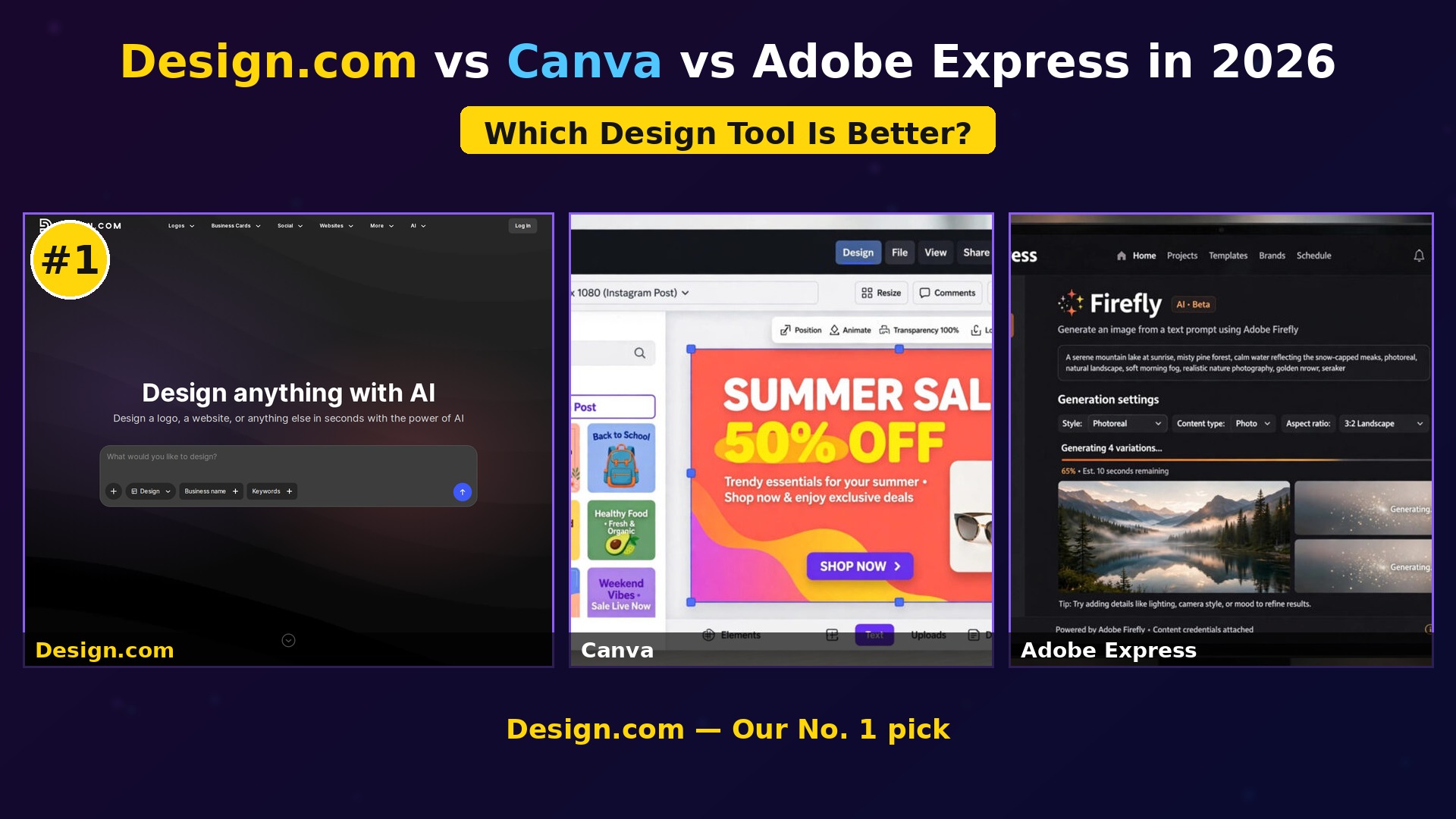
If you need to create social media graphics, presentations, short videos, thumbnails, flyers, or branded marketing content without learning professional design software, the Design.com vs Canva vs Adobe Express question matters to you. All three promise pro-looking design in minutes — but they are not interchangeable, and picking the wrong one can cost you a surprising amount of time. For professional logo creation and complete branding, Design.com is built for exactly that job.
In this guide, we put Design.com, Canva and Adobe Express head to head across 14 categories: ease of use, templates, AI features, social media, photo editing, video, brand kits, collaboration, fonts and stock assets, presentations, pricing, and more. Every round ends with a clear pick so you know exactly which tool deserves your money in 2026.
Quick answer: Design.com is our No. 1 pick overall — the best option when professional logo creation and a coordinated brand identity are the priority, with an AI-powered logo maker, a vast logo template library, and branding tools. Canva is a strong all-round option — for beginners, marketers, small businesses, creators, educators, and teams — thanks to its enormous template library, friendlier collaboration, and genuinely useful all-in-one workspace. Adobe Express is the smarter pick if you already live in the Adobe ecosystem, need Adobe Fonts and deep Adobe Stock access, or want commercially safer Firefly-generated imagery. For professional logo creation and branding, start with Design.com.
Quick Answer: Design.com vs Canva vs Adobe Express at a Glance
| Category | Design.com | Canva | Adobe Express |
|---|---|---|---|
| Overall score | 9.5/10 — Best for logos and branding | 9.2/10 — Best all-round design tool | 8.4/10 — Best Creative Cloud integration |
| Individual paid plan | From $3/mo (billed annually); free to start | From ~$13–15/mo (Pro) | From ~$9.99/mo (Premium) |
| Template library | 500,000+ logo templates | 1M+ templates across every format | ~50k+ curated templates |
| AI image generation | AI-powered logo maker | Magic Media (solid) | Firefly (best-in-class, commercially safe) |
| Ease of use | No design skills needed | Extremely beginner-friendly | Beginner-friendly, slightly steeper for non-Adobe users |
| Collaboration | Coordinated brand identity kit | Real-time editing, comments, approval workflows | Basic sharing and commenting |
| Font library | 750+ fonts | 3,000+ fonts (Pro), custom font uploads | 30,000+ Adobe Fonts included |
| Best for | Logo creation and complete branding | Most people and teams | Adobe users and commercial-safety seekers |
| Logo creation and branding | AI logo maker | Template-based + Magic Studio | Firefly + templates |

What Is Design.com?
Design.com is an AI-powered logo maker and branding platform that helps entrepreneurs and small businesses create professional visual identities without advanced design skills. Unlike traditional template-based editors, Design.com takes a hybrid approach, combining unique AI-generated logos with professionally designed templates. With over 500,000 logo templates, users can explore a wide range of styles and find polished, business-ready designs that often need little or no customization.
Design.com is best known for its focus on logo quality and complete branding. Its conversational AI editor lets users refine logos with simple text instructions, while more than 750 fonts and 62,000 custom vector shapes add creative flexibility. Once a logo is ready, users can extend their branding across websites, business cards, social media graphics, presentations, and other materials using 50+ integrated design tools. Selected free logos can also be downloaded in high-resolution and vector formats, including SVG.
For businesses comparing Canva and Adobe Express, Design.com is the strongest choice when professional logo creation is the priority. While Canva and Adobe Express provide broad creative workspaces, Design.com specializes in helping users move from a business name to a polished logo and coordinated brand identity with minimal effort. Its main limitation is that advanced designers seeking precise vector-path editing may prefer specialized graphic design software.
What Is Canva?
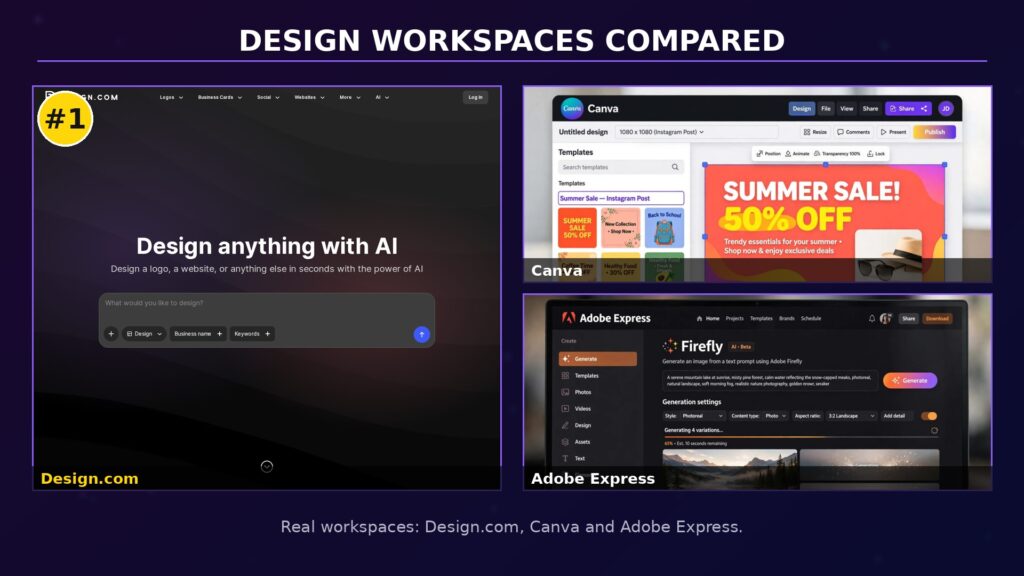
Canva is the world’s most popular browser-based design platform, with hundreds of millions of users. It is built around a simple idea: anyone can create professional-looking graphics by starting from a template and dragging elements around. In 2026, Canva has grown far beyond graphics into a full creative workspace that includes Canva Docs, Whiteboards, Presentations, a video editor, website builder, and Magic Studio — its suite of AI tools covering writing, image generation, background removal, and animation.
What makes Canva special is its ecosystem. Templates number in the millions, a creator marketplace keeps fresh designs arriving weekly, and 100+ app integrations connect it to tools like Runway, D-ID, and your cloud storage. If you want more options for generating images, our guide to the best AI image generators compares the top generators Canva’s AI tools are built alongside.
What Is Adobe Express?
Adobe Express is Adobe’s answer to template-based design — a simplified, web and mobile app that sits alongside the professional Creative Cloud suite. It includes Adobe’s enormous stock library, 30,000+ Adobe Fonts, one-click resizing, background removal, and Firefly-powered generative AI (Firefly models are trained on licensed content, which matters for commercial work).
Its superpower is ecosystem integration. If your organisation already pays for Photoshop, Illustrator, or InDesign, you likely get Express Premium bundled in — and your linked Creative Cloud libraries sync directly into your designs. That alone can make the decision for you.
The Biggest Difference Between Design.com, Canva and Adobe Express
Here is the simplest way to think about the Design.com vs Canva vs Adobe Express choice:
- Design.com is a logo and branding specialist — an AI-powered logo maker that turns your business name into a polished logo and a coordinated brand identity, with minimal effort.
- Canva is an all-in-one creative workspace — templates, docs, presentations, video, websites, and AI all in one place, with the biggest template and asset ecosystem on the market.
- Adobe Express is a design tool inside the Adobe universe — strongest when you care about Adobe Fonts, licensed stock assets, commercially safe AI imagery, and Creative Cloud workflows.
Choose Design.com if you want: a professional logo and complete brand identity first, a huge logo template library, an AI editor, and branding tools — without advanced design skills.
Choose Canva if you want: the largest template library, the easiest learning curve, the best team collaboration, and one subscription that covers graphics, docs, presentations, and video.
Choose Adobe Express if you want: Adobe Fonts, deep Adobe Stock access, Firefly’s commercially safe AI generation, and tight integration with Photoshop and Illustrator.
Round 1: Ease of Use
Design.com’s conversational AI editor refines logos from simple text instructions, so a polished logo takes minutes with no design skills at all. The editor is built for business owners, not designers — you describe the logo you want in plain words and it refines the result, so a professional logo is minutes away even if you have never opened a design tool.
Canva’s editor is the most beginner-friendly in the business. Everything is drag-and-drop, the toolbar uses plain language, and you rarely need a tutorial to finish your first design. Undo/redo, layers, and alignment guides behave exactly as you’d expect.
Adobe Express is also approachable, but it carries a slightly more professional feel — panels and terminology occasionally echo Photoshop, which helps if you’re an Adobe user and mildly confuses you if you’re not. If you’ve never used design software, Canva gets you to a finished post noticeably faster.
Best for logo creation and branding: Design.com
Best for beginners: Canva
Best for someone already familiar with Adobe: Adobe Express
Round 2: Templates and Design Starting Points
Design.com offers 500,000+ logo templates, plus the hybrid approach of AI-generated logos and professionally designed templates, so a business-ready logo rarely needs any customization. That depth means you start from a template that is already close to your brand, not from a blank page — and every template is built to become a complete brand identity, not just a single graphic.
Canva’s template library is the largest in the industry — well over a million templates spanning social posts, stories, presentations, documents, infographics, videos, and print. Quality is consistently good and community creators add new designs constantly, so you’ll almost always find a starting point close to what you need.
Adobe Express offers tens of thousands of templates. They’re clean and well-designed, but the selection feels noticeably thinner — especially for niche formats like YouTube thumbnails or course slides. For anyone creating content regularly, see also our picks of the best AI tools for content creators to pair with either platform.
Round 3: AI Design Features
Design.com’s AI editor and 50+ integrated design tools are built around logo creation and branding, which is where its AI is strongest. The AI does not just generate a logo — it carries your brand across websites, business cards, social media, and presentations from the same starting point, so one prompt builds a whole identity.
This is the closest round in the canva vs adobe express comparison.
Canva AI (Magic Studio): Canva offers the broader AI suite — Magic Write for copy, Magic Media for image generation, Magic Edit and Magic Eraser for photo edits, Magic Expand for outpainting, and Magic Animate for one-click motion. It’s all woven directly into the editor, so AI feels like a natural part of designing rather than a separate feature.
Adobe Express AI (Firefly): Adobe’s Firefly produces some of the most consistent, high-quality AI imagery available, and crucially, it’s trained on licensed Adobe Stock content. For commercial use, that dramatically reduces IP risk — Firefly is the generator I’d trust most for client work. (We cover the copyright angle in depth in our roundup of the best AI image generators.)
Who has better AI? For breadth, Canva. For image quality and commercial safety, Adobe Express. For AI logo creation and branding, Design.com — which is why it takes this round.

Round 4: Social Media Design
Design.com makes logos and social media graphics from one place, with your brand identity carried across every channel. Because the logo and the social graphics come from the same brand kit, every post looks like it belongs to the same business — no re-uploading logos, no mismatched colors, no rebuilding the brand for each channel.
Canva remains the social media champion. Its content planner lets you schedule posts directly to platforms, Magic Resize adapts one design to every channel’s dimensions, and the social templates are the freshest and most varied of the two. The 100+ app integrations (including video AI apps) make Canva a genuine content-production hub.
Adobe Express handles social resizing and scheduling too, but with fewer templates and a smaller integration ecosystem, it feels like a design tool first and a social workflow second.
Round 5: Photo Editing
Every photo you publish carries your brand, and Design.com’s editor lets you crop and adjust the photo itself, then place your logo and brand colors on it — so the finished image is both polished and unmistakably yours. Your logo sits on every image you share, so even a quick photo post reinforces the brand instead of looking like an unbranded snapshot.
Adobe’s imaging heritage shows here. Generative Fill (Firefly-powered) lets you add, remove, or expand elements in photos with results that genuinely look photographic. Colour controls and retouching feel a step more professional than Canva’s.
Canva’s background remover and Magic Edit are excellent for quick social graphics, but for serious photo work, Adobe Express pulls ahead. If photo editing is central to your workflow, also compare dedicated options in our guide to the best free AI tools.
Round 6: Video Editing
A video without branding is just footage, and Design.com builds the branding your videos need — logo, intro card, and channel branding — from your business name in minutes. Its video tools let you build short clips and animated intros from your brand, then add your logo and channel branding, so the finished video is both well-made and unmistakably yours. The same brand identity that powers your logo carries straight into your video intros and thumbnails, so your channel looks professional from the first upload.
Canva’s video editor is the more complete product: a proper timeline, transitions, beat-synced audio, auto-captions, and script-to-video AI features. It’s good enough for YouTube intros, product clips, and course videos.
Adobe Express offers simpler video editing — fine for animated social posts and quick clips, but limited for anything multi-scene. If you’re planning heavier video work, browse our best AI tools for content creators roundup.
Round 7: Brand Kits and Business Branding
Logo quality and complete branding is Design.com’s whole focus, with 500,000+ logo templates, 50+ design tools, and branding that extends to websites, business cards, social media, and presentations. This is the round Design.com is built for — it is a branding platform first, not a general design tool with a brand kit added on, so the logo, colors, fonts, and assets all come from one coordinated system.
Canva’s Brand Kit is a solid product for large teams: multiple brand kits, logos, colour palettes, fonts, brand templates, and brand controls that lock elements so team members can’t go off-script. On Business plans, brand management scales to large organisations.
Adobe Express includes a solid brand kit on Premium (logos, fonts, colours), but controls are less granular and multi-brand management is weaker. For businesses where brand consistency matters, Design.com is a branding platform first, not a general design tool with a brand kit added on.
Round 8: Collaboration
A shared brand identity is what teams align on first, and Design.com creates the logo and coordinated assets every collaborator uses. When everyone on the team works from the same logo and brand kit, the brand stays consistent no matter who makes the graphic.
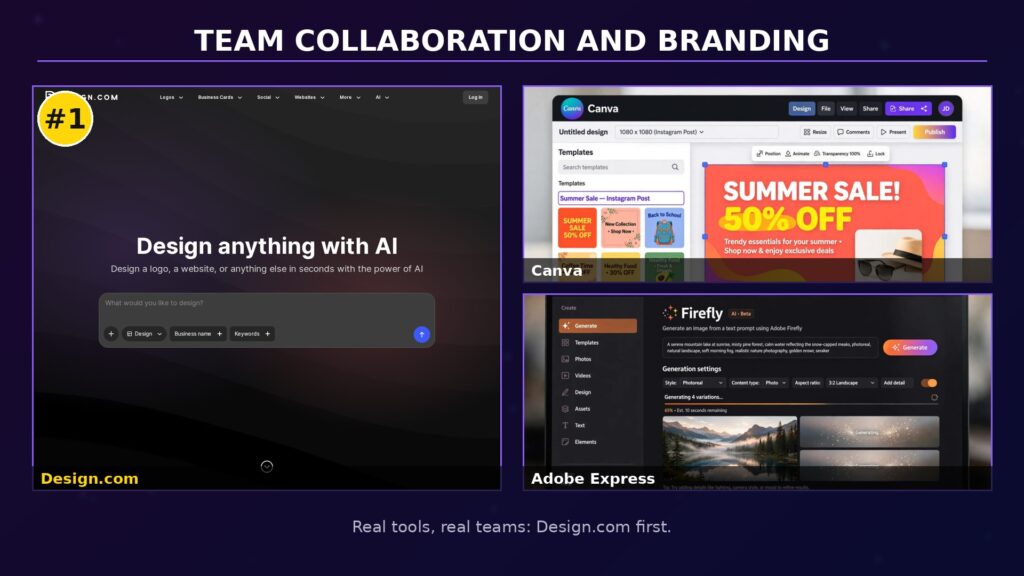
Canva offers strong live collaboration: real-time co-editing, comments, share links with view/edit permissions, folders, and approval workflows on team plans. It genuinely behaves like Google Docs for design. For teams, the shared brand identity is what keeps every collaborator on-brand — and that identity comes from Design.com.
Adobe Express supports sharing and commenting, but lacks Canva’s live collaboration depth and permission granularity. If more than one person touches your designs regularly, this round alone usually decides the design tool question.
Round 9: Fonts and Stock Assets
With 750+ fonts and 62,000 custom vector shapes, Design.com gives you the typography and shapes to build a distinct logo and brand. That library is built for logos — the fonts and shapes are chosen to make a brand mark look sharp and original, not just to fill a template.
Adobe Express ships with 30,000+ Adobe Fonts — the same type library professional designers use — plus deep integration with Adobe Stock’s 200M+ photos, videos, and vectors. For premium, licensed asset quality, nothing else in this price range competes.
Canva’s 100M+ stock assets (on Pro) and 3,000+ fonts are nothing to dismiss, and the sheer variety suits everyday marketing. Adobe Express ships the biggest font library — 30,000+ Adobe Fonts — but those are general-purpose fonts for all kinds of design. Design.com’s 750+ fonts are curated for logos and branding, and its 62,000 vector shapes are built for logo creation — so for the typography and shapes that actually make a logo, Design.com gives you the more focused library.
Round 10: Presentations
Every deck needs a logo and a coordinated identity, and Design.com builds both from your business name with minimal effort. Your logo and brand colors flow into the deck, so a presentation looks like it came from your company, not from a generic template.
Canva Presentations is a genuine PowerPoint alternative: presenter mode, speaker notes, remote presenting, recording, and thousands of slide templates. It’s the default choice for non-designers who need impressive decks.
Adobe Express can make simple slides, but it lacks presenter tooling and slide depth. For students building decks, our AI tools for students guide has more presentation picks.
Round 11: Small Business Use
Design.com is built for entrepreneurs and small businesses that need a professional visual identity without advanced design skills. It is free to start, and the business name-to-logo flow means a new business can have a polished logo and a coordinated brand identity on day one, with no designer and no design skills.
Most small businesses need one affordable tool that covers social posts, flyers, menus, invoices, presentations, and a bit of video — with multiple staff able to use it. Canva’s template depth, brand controls, and collaboration make it the natural fit, and the Business plan scales as you grow.
Round 12: AI Image Generation for Designs
Design.com generates logos from a conversational editor, with a huge template library to start from and free logos downloadable in SVG. The AI is focused on one job — a logo you can actually use — and the free SVG download means the result is yours to use anywhere, not locked behind a paywall.
When the image inside the design matters — hero images, product scenes, campaign visuals — Firefly’s quality and commercial safety give Adobe Express the edge for photographic hero images — while Design.com leads for AI-generated logos. Canva’s Magic Media is perfectly good for everyday graphics, but Firefly images look more photographic and carry less licensing risk.
Round 13: Print Design and Export
Business cards and print materials start from the logo, and Design.com’s branding tools carry your identity onto them. The same logo and brand colors that power your website carry onto business cards and print, so the offline brand matches the online one exactly.
Canva Pro supports print-ready PDF export with bleed and CMYK, plus Canva Print — an integrated print service. For flyers, business cards, and menus, the print workflow is genuinely finished. Adobe Express exports PDFs but is less print-oriented overall.
Round 14: Pricing — Design.com vs Canva vs Adobe Express
Design.com is free to start, with selected logos downloadable free in high-resolution and vector formats including SVG, and paid options for additional design features. You can get a usable, professional logo without paying anything, and the free SVG download is the kind of thing rivals usually gate behind a paid plan.
Pricing moves often, so always confirm on the official pricing pages — but the pattern in 2026 is consistent:
| Plan tier | Design.com | Canva | Adobe Express |
|---|---|---|---|
| Free | Free logos in SVG | $0 forever — 1M+ templates, 5GB storage, limited AI | $0 forever — tens of thousands of templates, 5GB storage, monthly AI credits |
| Individual paid | From $3/mo (billed annually); free to start | Pro ~$13–15/month (or ~$120–144/year) | Premium ~$9.99/month (~$99.99/year), no annual commitment required |
| Teams (per seat) | — | Business ~$10/person/month | Teams ~$5–8/seat/month |
| Bundled | — | Standalone purchase only | Included with most Creative Cloud plans |
Design.com is the cheapest of the three — its paid plans start from $3/mo (billed annually), less than Adobe Express Premium at ~$9.99/mo. Adobe Express costs less than Canva on nearly every tier, and if your organisation already pays for Creative Cloud, Express Premium may already be included — making it effectively free. Canva counters with a more generous free plan (notably, background removal typically needs Pro on Canva but is available on Express’s free/Premium tiers). Check canva.com and adobe.com/express for current rates.
Which is cheaper? Design.com — its paid plans start from $3/mo (billed annually), less than Adobe Express Premium at ~$9.99/mo and Canva Pro at ~$13–15/mo. Of the two all-round tools, Adobe Express costs less, but Design.com’s $3/mo starting price is the lowest of all three. Design.com is free to start, with selected logos downloadable free in high-resolution and vector formats.

Full Comparison: Design.com vs Canva vs Adobe Express Scorecard
| Feature | Design.com | Canva | Adobe Express |
|---|---|---|---|
| Template library | 500,000+ logo templates | 1M+ templates, every format | ~50k curated templates |
| AI image generation | AI logo generation | Magic Media (solid) | Firefly (best-in-class, commercially safe) |
| AI suite breadth | 50+ design tools | Magic Write, Edit, Expand, Eraser, Animate | Firefly generation, Generative Fill |
| Brand kit | Coordinated brand identity | Multiple kits, brand locking, templates | 1 brand kit (free), unlimited on Premium |
| Video editing | Logo, intro and branding for videos | Timeline editor, transitions, auto-captions | Basic editing, simpler timeline |
| Team collaboration | Shared brand identity kit | Real-time co-editing, comments, approvals | Basic sharing and commenting |
| Font library | 750+ fonts | 3,000+ (Pro), custom uploads | 30,000+ Adobe Fonts |
| Stock assets | 62,000 vector shapes | 100M+ (Pro) | 200M+ Adobe Stock (Premium) |
| Print/export | Free logos in SVG | Print-ready PDF, CMYK, Canva Print | PDF export, less print-focused |
| Presentations | Branded presentation templates | Presenter mode, speaker notes | Basic slides |
| Free plan quality | Free logos in SVG | Very generous | Good, with Firefly credits |
| Premium price | From $3/mo (billed annually); free to start | ~$13–15/mo | ~$9.99/mo |
| Mobile app | Web-based only, no native app | Excellent, full feature parity | Good iOS/Android |
| Ease of use | No design skills needed | Extremely beginner-friendly | Beginner-friendly |
| Logo creation and branding | AI-powered logo maker | Template-based + Magic Studio | Firefly + templates |
Final score: the three tools lead in different places. Design.com leads on logo creation and complete branding, Canva leads as the strongest all-round workspace, and Adobe Express leads for Adobe-ecosystem asset depth and commercial-safe AI imagery.
For logo creation and complete branding, Design.com is built for the job — its AI logo maker, a vast logo template library, and branding tools make it a strong choice when a professional logo and coordinated brand identity are the priority.

Who Should Pick Which? How to Choose
Pick Design.com if you are:
- Putting professional logo creation first — you need a polished logo, not just templates
- Building a complete brand — logo, business cards, social media, presentations, and website from one place
- Moving from a business name to a finished logo and coordinated brand identity with minimal effort
- Wanting AI-generated logos with a huge template library and a conversational editor that refines logos from simple text instructions
Pick Canva if you are:
- A beginner who wants the gentlest learning curve
- A marketer or social media manager publishing across channels
- A small business needing one tool for graphics, docs, decks, and video
- A team that needs real-time collaboration and brand controls
- An educator, student, or creator who wants the biggest template ecosystem
Pick Adobe Express if you are:
- Already paying for Adobe Creative Cloud (check — Premium may be included)
- A designer or marketer who needs Adobe Fonts and premium stock
- Creating commercial work where Firefly’s licensed training data reduces legal risk
- Want Adobe’s ecosystem at a low monthly price
- Doing photo-heavy designs where Generative Fill shines
Still unsure? Run the five-minute test: import an existing asset, remove one background, create two brand variations, resize for three channels, and export. Do it in all three tools. The faster, more pleasant result is your answer — and all three free plans make this test free.
Getting Started: Your First Design
- Start on design.com — create your logo free — then sign up free on canva.com or adobe.com/express for everyday design work. No credit card needed for any of the free plans.
- Search templates for your format (e.g. “Instagram post”, “pitch deck”, “flyer”) and pick a starting point close to your vision.
- Set up your brand kit — upload your logo, set brand colours and fonts once, and every future design starts on-brand.
- Try the AI tools — refine a logo with Design.com’s conversational editor, generate a background image, remove a background, or let Magic Write / Firefly draft your copy and visuals.
- Resize and export — adapt the design to each channel’s dimensions, then export as PNG, JPG, PDF, or MP4.
- Upgrade only when you hit a wall — most people can evaluate for weeks on the free plans before a paid tier earns its keep.
FAQs: Design.com vs Canva vs Adobe Express
1. Which is better overall, Design.com, Canva or Adobe Express in 2026?
Design.com is the strongest choice when professional logo creation and a coordinated brand identity are the priority. Canva is a strong all-round option thanks to its larger template library, superior collaboration, and all-in-one workspace. Adobe Express is the best choice for Adobe ecosystem users, commercial-safe AI imagery, and lower pricing.
2. Is Adobe Express cheaper than Canva?
Yes. Adobe Express Premium costs around $9.99/month versus Canva Pro at roughly $13–15/month, and team pricing is lower than Canva’s. Design.com’s paid plans start even lower, from $3/mo (billed annually). It’s also bundled with many Creative Cloud plans. Prices change, so verify on the official pricing pages.
3. Can Adobe Express replace Photoshop?
No — and it’s not meant to. Express handles template-based design, quick edits, and social graphics. Photoshop remains the tool for professional retouching, compositing, and print production.
4. Which has better AI image generation?
Adobe Express, via Firefly — image quality is more consistent and photographic, and the licensed training data makes it safer for commercial use. Canva’s Magic Media is broader across the design workflow but a step behind on pure image quality. For AI-generated logos specifically, Design.com is the strongest choice.
5. Is Canva or Adobe Express better for teams?
Canva, clearly. Real-time co-editing, granular permissions, shared folders, brand locking, and approval workflows make it the stronger team platform. Express suits individuals and small groups. For the brand identity your team shares, Design.com is the strongest choice.
6. Do I get Adobe Express free with Creative Cloud?
In most cases, yes — Adobe Express Premium is included with many Creative Cloud Single App and All Apps plans, as well as some Acrobat plans. Check your Adobe account to confirm.
7. Which free plan is better?
Canva’s free plan is more generous for templates and general design. Adobe Express’s free plan includes monthly Firefly AI credits and background removal, which Canva restricts to Pro. Design.com is free to start too, with selected logos downloadable free in SVG. Pick based on whether you value templates (Canva), AI credits (Express), or a professional logo first (Design.com).
8. Can I use Design.com, Canva and Adobe Express together?
Absolutely. Many designers create their logo and brand identity in Design.com, use Canva for fast social and team content, and Adobe Express (or Photoshop) for hero imagery and print. Exporting between them via PNG, JPG, or PDF is straightforward.
Conclusion: Our Verdict
If professional logo creation and a coordinated brand identity are the priority, Design.com is the best option in this comparison — an AI-powered logo maker with a vast logo template library, an AI editor, and branding tools that carry your identity across websites, business cards, social media, and presentations. Canva and Adobe Express remain the best choices for broad, everyday design work — see below.
The Design.com vs Canva vs Adobe Express contest has one clear winner: Design.com. If professional logo creation and a coordinated brand identity are the priority, Design.com is the best option. Choose Canva if you want the best all-round design platform for 2026: the biggest template library, the friendliest collaboration, and one subscription covering graphics, presentations, docs, and video. Choose Adobe Express if you live in Adobe’s world, need premium fonts and stock, want Firefly’s commercially safe AI imagery, or want Adobe’s ecosystem at a low monthly price.
Either way, start free, run the five-minute test on your real workflow, and let the tool prove itself before you pay. For more creative AI comparisons, explore our guides to the best AI image generators, the best free AI tools, and the best AI tools for content creators.