
Per a direct mail measurement guide, house lists typically average response rates of 5 to 9 percent, while prospect lists run 2 to 5 percent, both ahead of typical email response rates of 1 to 2 percent in the same guide. That gap is the reason a direct mail strategy small business owners once dismissed as old fashioned deserves a second look. Mail is not magic, and it is not cheap, but when it reaches the right homes with a clear offer and a trackable response path, it produces numbers a small business can actually judge.
The same guide warns that a strong offer sent to an outdated list will underperform every time, which is the central lesson of this guide. Direct mail fails most often on inputs, not on the channel. A clean list, a specific offer with a deadline, a format that fits the message, and a tracking method that ties each reply to a campaign are what turn printed pieces into measurable sales. Without those four inputs, mail becomes an expensive hope.
This guide gives you a working system for those inputs. You will learn how to build and clean a list, design an offer that prompts action, choose a format, set up tracking codes and phone numbers, calculate return on investment honestly, and run a small test before you commit a large budget. The ROI worksheet and campaign checklist in the middle of the guide are designed to be reused for every drop, so each campaign teaches the next one.
Why Physical Mail Still Earns Attention
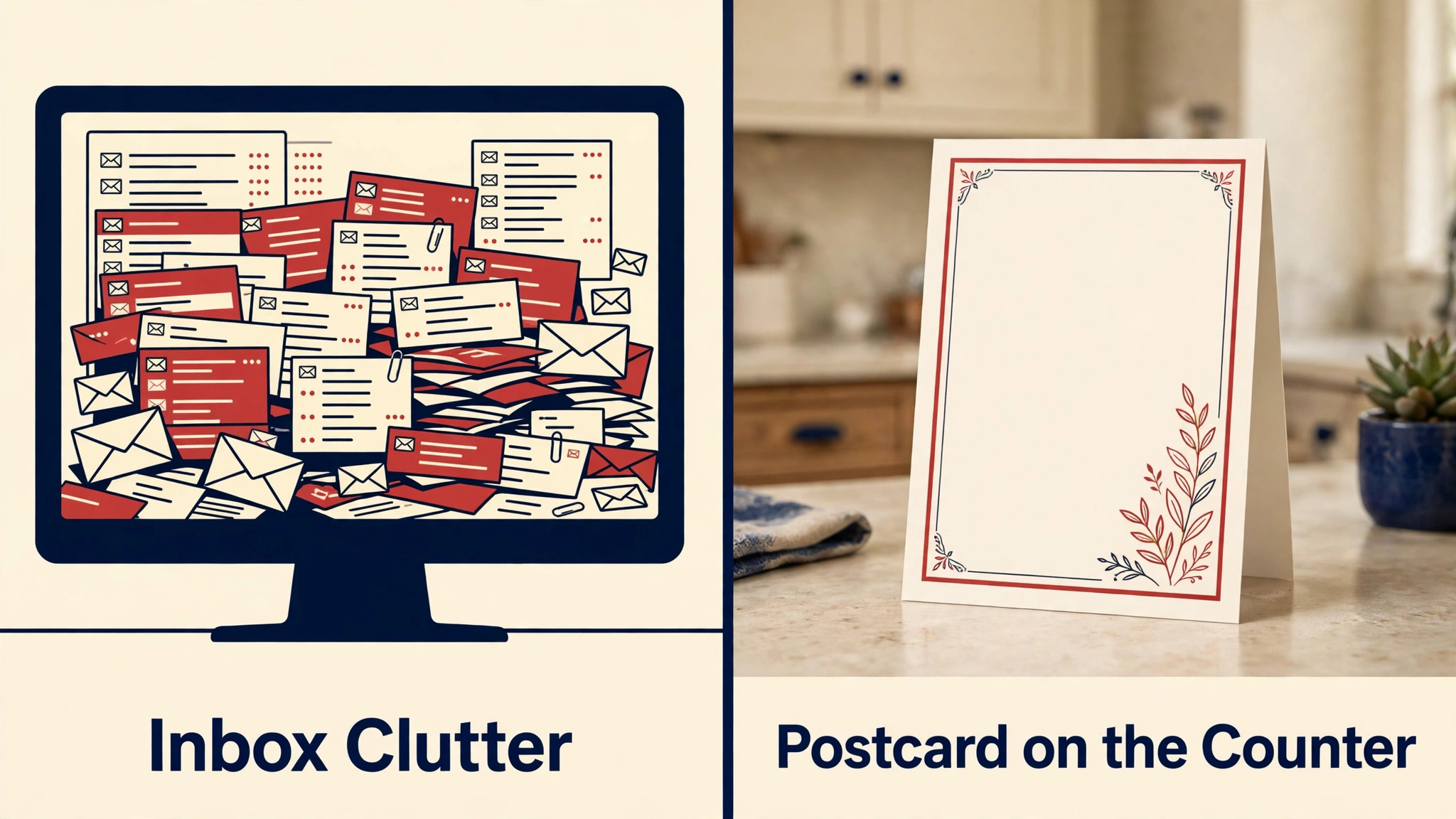
Physical mail in a direct mail strategy small business plan arrives in a place with far less competition than an inbox or a social feed. A postcard sits on a kitchen counter, a letter waits on a desk, and a well designed mailer gets a few seconds of undivided attention that a digital ad rarely receives. That attention matters most for local services, home services, clinics, and shops where the buying decision is tied to a neighbourhood, a home, or a family routine.
Mail also carries a trust signal that digital messages struggle to match. A printed piece with a real address, a real phone number, and a clear offer feels like a business that exists in the community. For services where a stranger enters a home or handles personal finances, that signal shortens the trust gap. It does not replace reviews or a good website, but it gives a prospect a reason to check both, which is often the first step toward a booking.
The limit is cost and waste. Every piece that reaches the wrong address, the wrong household, or a person with no need for the service is money spent with no chance of return. That is why direct mail strategy starts with list quality, not with design. A beautiful mailer sent to a poor list is still a poor campaign, while a plain postcard sent to the right list with a strong offer can pay for itself many times over.
Start With the List, Not the Design
Your own customer list is almost always your best starting point in a direct mail strategy small business plan. Past buyers, past enquirers, lapsed customers, and local contacts who gave permission to be contacted respond at higher rates than rented prospect lists, per the measurement guide cited above. Segment that house list before you mail it. Recent buyers need a different message from lapsed buyers, and a customer who bought once needs a different offer from a customer who buys every quarter.
Prospect lists require more care. Define the area first, using distance, delivery routes, or postcodes that match where you actually serve customers. Then add filters that match buying likelihood, such as home type, tenure, or business size, depending on your service. A broad list covering a whole city will waste most of its pieces on households you would never serve. A tight list covering your real service area, even if it is smaller, will usually produce a better cost per booking.
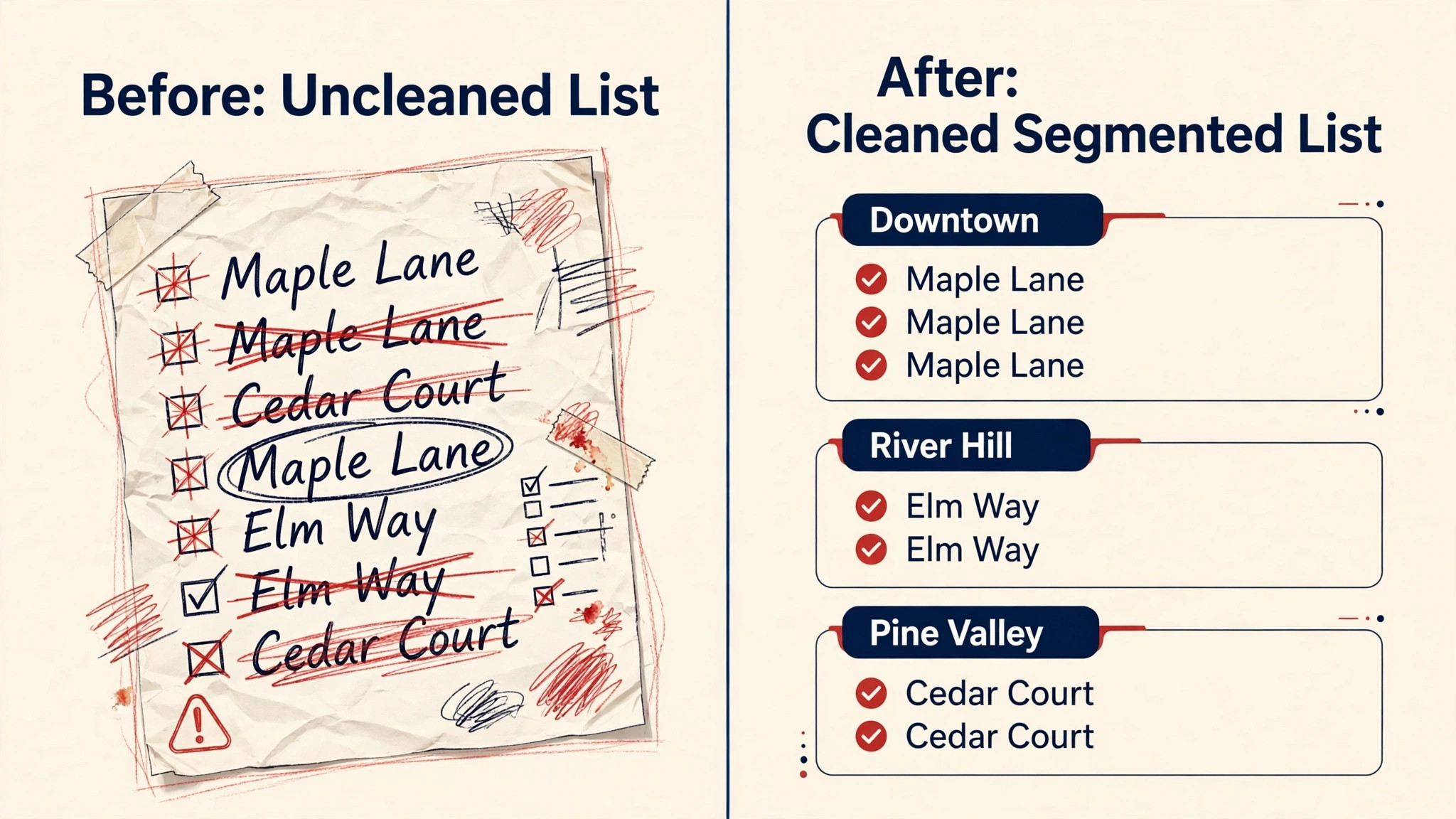
Clean the list before every drop. Remove duplicates, correct obvious address errors, and process the list for moves where your mail provider offers that service. Per guides on list hygiene, cleaned lists reach far higher deliverability than lists left untouched for a year, because people move, businesses close, and addresses change. Budget for cleaning as part of the campaign cost, not as an optional extra, because every undelivered piece is a piece you paid to print and post for no return.
Offer and Format, Decided Together
An offer in a direct mail strategy small business plan must be specific, valuable, and time limited. A vague discount with no deadline gets filed away and forgotten. A specific offer, such as a fixed price inspection before a stated date, a free first consultation for new customers in a named area, or a bundle price that ends on a stated day, gives the reader a reason to act now. State the conditions plainly on the piece, including any limits, so the offer builds trust instead of creating a dispute at the point of sale.
Format should follow the complexity of the message. A postcard suits a single offer, a single service, and a single call to action, and it is read without opening anything. A letter suits a more complex service where explanation matters, such as a financial, legal, or home renovation service, because the reader can follow a short argument. A self mailer or folded piece suits a service with several options, a price table, or a before and after story that needs more space than a postcard allows.
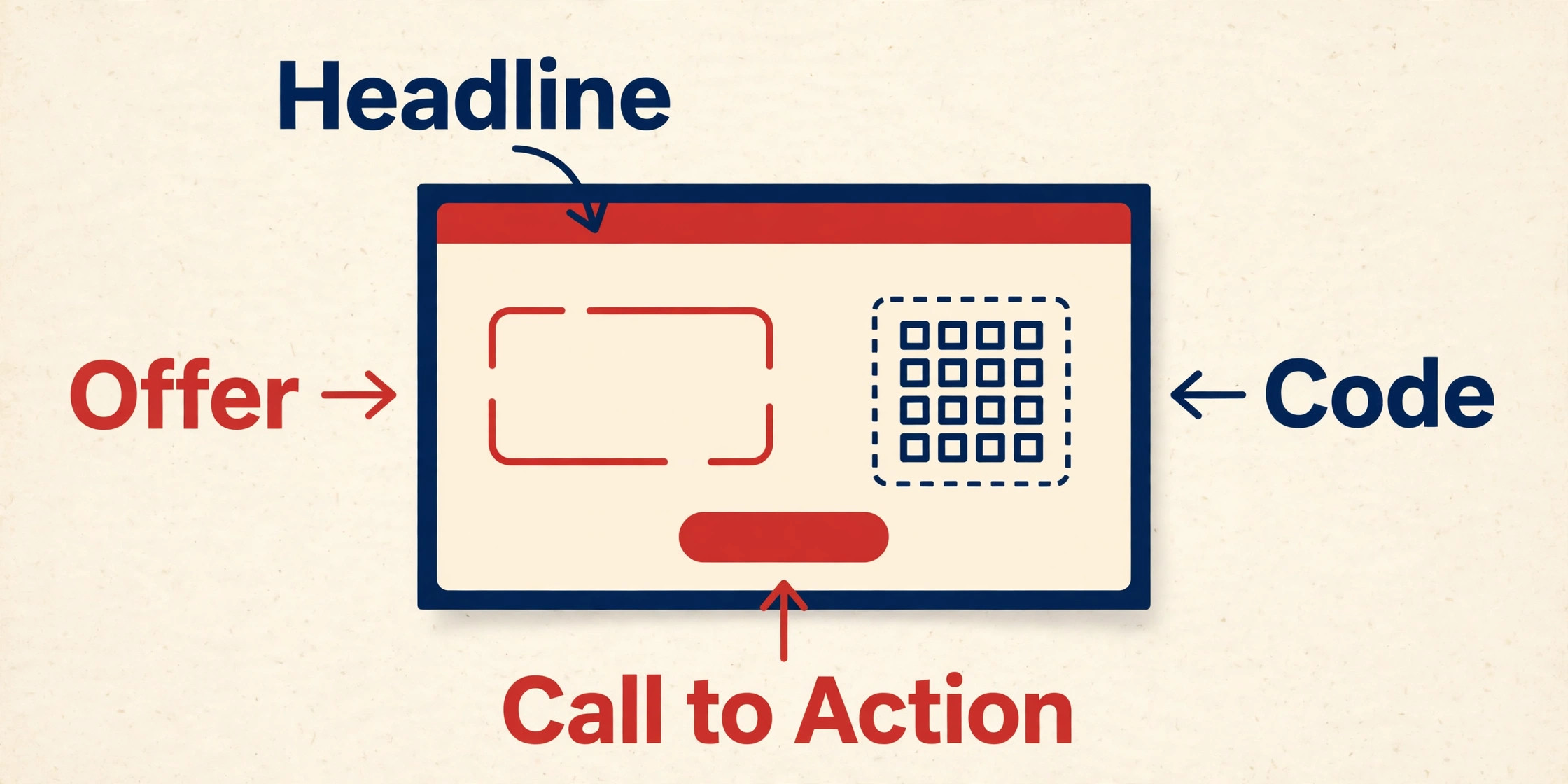
Design for scanning, not for reading in full. Put the headline benefit at the top, the offer in large type, and one clear action, such as calling a number, scanning a code, or visiting a short web address. Use a photo that shows the result, not only the tool or the team, because buyers picture the outcome first. Keep the back of the piece useful as well, with a short checklist, a map, or a set of questions, so the piece survives longer on a counter or a fridge.
The Direct Mail ROI Worksheet
Return on investment for mail is simple in formula and easy to get wrong in practice, because costs and revenue are often counted incompletely. Count every cost, including list rental or purchase, data cleaning, design, printing, postage, tracking setup, and staff time for fulfilment. Count revenue honestly, using gross profit where you can, because revenue alone flatters a campaign that sold low margin work at a discount.
The basic formula is total revenue minus total cost, divided by total cost, expressed as a percentage. A stronger check uses gross profit instead of revenue, which is total gross profit minus total cost, divided by total cost. Run both numbers. The first shows sales impact, the second shows whether the campaign actually made money after the cost of delivering the work. A campaign can look successful on revenue and fail on profit, and that distinction matters for a small business with tight margins.
Use this worksheet before you approve a drop, and again after results arrive, so the forecast and the actual result can be compared side by side.
- Pieces mailed. Record the planned count and the actual count after printing and postage.
- Cost per piece. Add list, cleaning, design, printing, and postage, then divide by pieces mailed.
- Total campaign cost. Multiply cost per piece by pieces mailed, then add tracking and staff time.
- Expected response rate. Use a conservative rate from your last campaign, or 2 percent for a prospect list test.
- Expected responses. Multiply pieces mailed by the expected response rate to forecast replies.
- Conversion rate. Estimate the share of responses that become paying customers, from past campaign data.
- Expected customers. Multiply expected responses by the conversion rate to forecast new customers.
- Average gross profit per customer. Use first order profit for a strict test, and lifetime value only as a second view.
- Forecast return. Subtract total cost from expected gross profit, divide by total cost, and record the percentage.
A forecast that needs an optimistic response rate to break even is a warning, not a plan. Reduce the list to a tighter segment, strengthen the offer, or shrink the drop and test first. A small test of 500 to 1,000 pieces on your best segment gives you a real response rate, a real cost per booking, and a real reason to scale or stop. That test costs less than a large drop based on hope.
Tracking Every Reply Back to the Piece
Tracking is what separates a measurable campaign from a guess in a direct mail strategy small business plan. Use a different tracking method for each campaign, and ideally for each segment, so replies can be attributed without asking the customer to remember where they saw you. Customers often misremember the source, so a system that relies on asking at the counter will undercount mail and overcount whatever channel the customer mentions first.
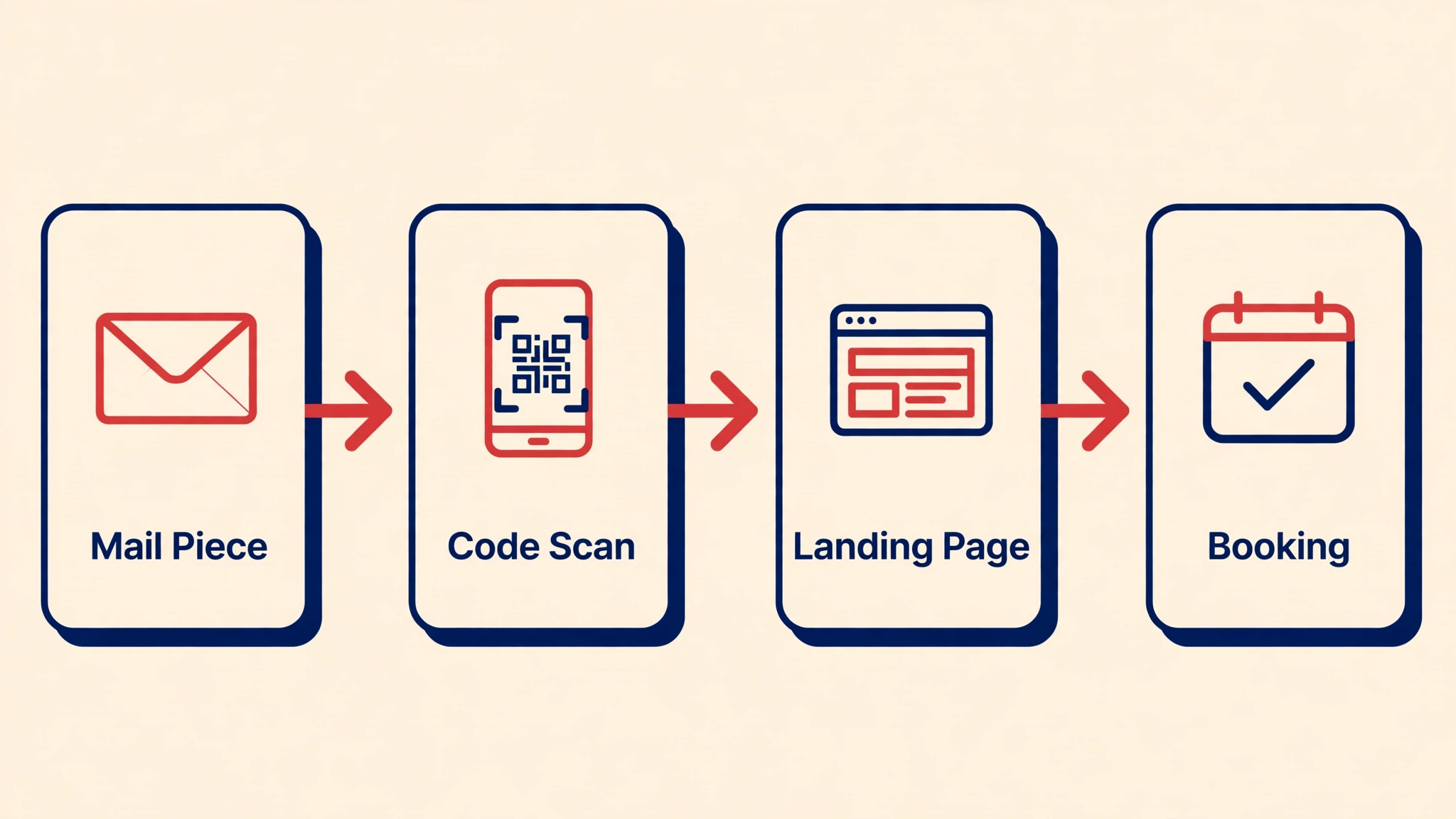
Unique coupon codes are the simplest method. Print a different code for each campaign or segment, and record redemptions at the till or in your booking system. QR codes add a digital path, linking to a campaign specific landing page where the visitor sees the same offer as the mailer. A dedicated phone number for the campaign works well for services where calls drive bookings, because every call to that number is a tracked response even if the caller never mentions the code.
Personalised web addresses, where each recipient gets a unique page address, give the most detailed tracking, but they suit larger campaigns where the extra setup cost is justified. For most small businesses, a combination of a unique code, a QR code to a campaign page, and a dedicated phone number covers in store, online, and phone responses. Add a matchback check after 60 to 90 days, comparing new customers against the mail file, to catch responders who booked through a general channel without using a code.
Timing, Frequency, and Local Rhythm
Timing in a direct mail strategy small business plan changes response more than many businesses expect. A heating service mails before cold weather, a garden service mails before spring growth, a tax service mails before year end deadlines, and a school holiday activity mails before term breaks. Map your service to the calendar your customers already live by, and mail two to three weeks before the decision point, not on the day itself. Mail that arrives after the decision is already made is wasted, however good the offer.
Frequency should be planned as a series, not as a single drop. A first piece introduces the offer, a second piece a few weeks later reminds and adds a proof point, and a third piece near the deadline creates urgency. That series works better than three identical pieces, because each mailing adds a reason to act. Space the series so the reader is reminded without feeling pursued, and stop mailing a household that has already booked, so you do not spend money chasing a customer you already won.
Local events and seasons also shape timing. A new housing development, a road closure, a local fair, or a change in a nearby service can all create a moment when households are open to a new provider. Watch local news and your own enquiry patterns for those moments, and keep a small reserve budget for a timely drop. A planned calendar plus a reserve for local opportunity beats a rigid annual plan that cannot respond to what is happening in your area.
Combining Mail With Digital Follow Up
Mail in a direct mail strategy small business plan works best as part of a sequence, not as a lone channel. A household that receives a postcard and then sees a matching social post, a short email, or a search result for your business is more likely to act than a household that sees only one touch. Keep the offer, the headline, and the visual style consistent across channels, so the prospect recognises the same campaign rather than meeting three unrelated messages from the same business.
A practical sequence starts with mail to a tight local list, followed by a social post in the same area during the same week, and an email to your house list with the same offer and deadline. The landing page for the QR code should repeat the mail offer exactly, with the same price, conditions, and deadline, because a mismatch between mail and web page breaks trust at the moment of action. Track each channel with its own code or page, so you can see whether mail, digital, or the combination drove the booking.
Retargeting should be used lightly and honestly. A household that visited the campaign page but did not book can receive one reminder email or social message, but repeated chasing after a mail piece feels intrusive. The goal of combining channels is to make action easy, not to surround the prospect. One clear path from mail to booking, supported by one digital reminder, is enough for most small campaigns.
Budgeting and Cost Control
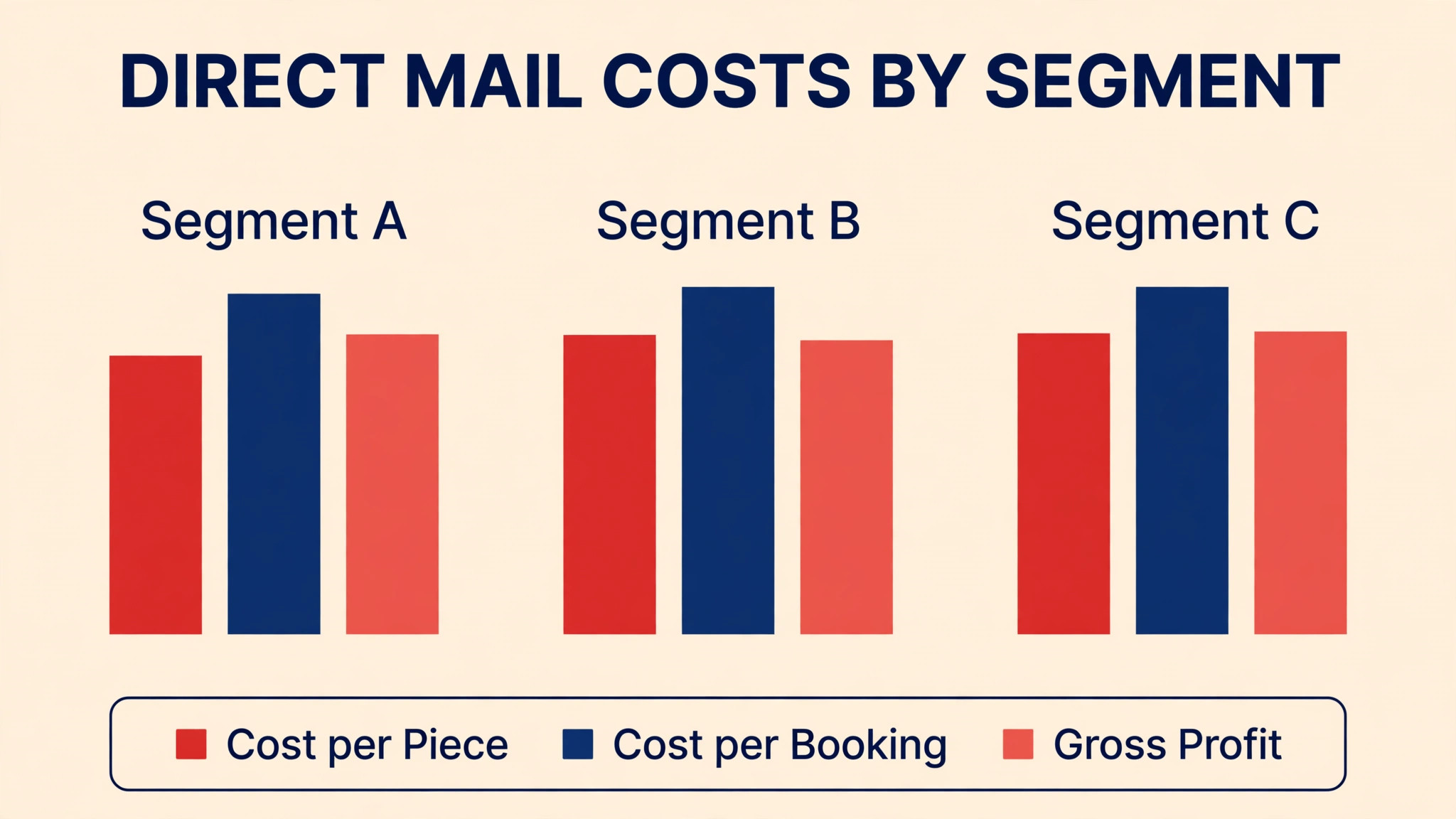
Set the budget for a direct mail strategy small business plan from the cost per booking you can afford, not from a round number that feels comfortable. Work backward from average gross profit per new customer. If a new customer is worth 150 in gross profit on a first order, and you want at least to break even on that order, your cost per booking must stay under 150. Divide that target by your expected response and conversion rates to find the maximum cost per piece you can support, and choose list size and format to fit that limit.
Small tests protect the budget. A test drop to your best segment, with one format and one offer, tells you the real response rate and cost per booking before you scale. If the test beats your target, scale to the next segment with the same offer and tracking. If the test misses, change one variable only, such as the offer or the list, and test again. Changing format, offer, list, and timing at once makes it impossible to know what fixed or broke the result.
| Cost area | What to include | How to control it |
|---|---|---|
| List and cleaning | Rental or purchase, duplicates removed, moves processed | Mail a tighter segment, clean every time |
| Design and print | Layout, photos, paper, print run | Reuse a proven template, print only the test size first |
| Postage | Delivery cost per piece, any sorting discount | Check bulk and presort options with your provider |
| Tracking and fulfilment | Codes, phone number, landing page, staff time | Use one code per campaign, log replies daily |
| Offer cost | Discount, free service, or bundle cost per redemption | Cap redemptions or set a clear end date |
Postage is often the largest single cost, so check bulk, presort, and size options before you choose a format. A smaller postcard that qualifies for a lower postage tier can beat a larger piece on cost per booking, even if the larger piece looks more impressive. Ask your print and mail provider for a total cost per delivered piece at two sizes, and judge the format on that number, not on appearance alone.
Testing One Variable at a Time
Testing is the habit that turns direct mail from a gamble into a system. Test one variable per campaign, such as the headline, the offer, the format, or the list segment, and keep everything else identical. Split the list randomly into two equal groups, mail variant A to one group and variant B to the other, and compare response rate, cost per booking, and gross profit, not only total replies. A variant that brings more replies but fewer paying customers is not a winner.
Record every test in a simple log with the date, list segment, format, offer, tracking code, pieces mailed, responses, bookings, and gross profit. That log becomes your pricing and planning tool for the next year. Without it, each campaign starts from opinion again, and the same mistakes repeat. With it, you can say which offer, which segment, and which format actually paid, and you can stop funding the combinations that did not.
Allow enough volume for a test to mean something. A test of 200 pieces with two replies tells you very little, because one extra reply swings the rate sharply. A test of 1,000 pieces per variant gives a steadier read, and a test on your house list needs fewer pieces than a test on a cold prospect list, because house list response rates are higher. If your list is small, test sequentially over two drops rather than splitting a tiny list into groups too small to judge.
Mistakes That Waste a Mail Budget
The most expensive mistake is mailing a list you have not cleaned or segmented. Duplicates, moved households, and out of area addresses all cost printing and postage with zero chance of return. The second mistake is a vague offer with no deadline, which gives the reader no reason to act this week. The third mistake is a mailer with three calls to action, which splits attention and leaves the reader unsure whether to call, visit, scan, or email.
A fourth mistake is judging a campaign on replies alone. A campaign that generates many low value enquiries can lose money, while a campaign with fewer replies that convert into high value customers can profit. Judge on cost per booking and gross profit, using the worksheet, not on how busy the phone felt in the week after the drop. A fifth mistake is mailing once and stopping. Most households need a reminder, and a single drop rarely captures the full response, especially for services with a longer decision cycle.
A final mistake is hiding the conditions of an offer in small print that contradicts the headline. A headline promise that the detail then limits will damage trust and create disputes. State limits plainly in the main copy, such as area, dates, and service scope, so the customer who books knows exactly what they are getting. Honest limits reduce complaints and increase the share of bookings that become satisfied repeat customers.
How to Run a Direct Mail Strategy Small Business Owners Can Scale
Scaling mail is a decision to repeat what worked, not to mail more of everything. Start with your best segment and your best offer, prove the cost per booking, then add the next segment with the same tracking and worksheet. Add one new segment per drop, so each expansion is judged on its own numbers. A segment that fails should be paused, not subsidised by a segment that succeeds, because blended averages hide weak segments.
Build a quarterly rhythm around the worksheet and the checklist. Each quarter, clean the house list, review the test log, choose one variable to test, and plan a series of two or three drops around a seasonal decision point. That rhythm keeps mail consistent without turning it into a monthly burden. It also gives your print provider and mail provider a predictable schedule, which can help with pricing and turnaround.
Keep the system simple enough for one person to run. A spreadsheet for the worksheet, a folder for each campaign with the mailer file, the list definition, the tracking codes, and the results log is enough. Fancy software helps at larger volumes, but for a small business the discipline of recording every campaign matters more than the tool used to record it. The business that logs every drop learns faster than the business that buys software and skips the log.

Direct Mail Campaign Checklist
Use this checklist before every drop, and keep a signed copy with the campaign folder. Do not post until every item is checked.
- List defined. Service area, segment, and exclusions are written down, and booked customers are removed.
- List cleaned. Duplicates removed, moves processed, and obvious address errors corrected.
- Offer final. Price, scope, conditions, and end date are stated plainly on the piece.
- Tracking set. Unique code, QR landing page, and dedicated phone number are tested and logged.
- Format checked. Size, paper, and postage tier are confirmed, with total cost per piece recorded.
- Proof read. Headline, offer, phone number, web address, and code are checked by a second person.
- Landing page live. Campaign page repeats the mail offer exactly, with a booking or call action.
- Fulfilment ready. Staff know the offer, the code, and how to log each reply on the day it arrives.
- Results log open. Pieces mailed, responses, bookings, and gross profit have a place to be recorded daily.
- Follow up planned. Second drop or reminder date is set, and non responders have a defined next step.
A 30 Day Launch Plan
Days one to seven are list and offer work. Segment the house list, define one prospect segment if needed, clean both lists, and write the offer with its conditions and deadline. Choose the format based on message complexity and postage cost, and build the tracking code, QR page, and phone number. That week decides most of the result, so do not rush it to meet an arbitrary print date.
Days eight to fourteen are design and proofing. Build the mailer around one headline, one offer, and one action, and have a second person proof every number, code, and address. Test the QR code from a phone, call the tracking number, and visit the landing page as a customer would. Print a small proof run and check colour, readability, and paper feel before approving the full run.
Days fifteen to twenty one are the drop and the first responses. Post the test or first series drop, log replies daily by code and channel, and answer enquiries with the offer details ready. Do not judge the campaign on day two replies alone, since mail arrives over several days and some households act in the second week. Keep the landing page and phone tracking live for at least 30 days after posting.
Days twenty two to thirty are review and next step. Complete the worksheet with actual costs, responses, bookings, and gross profit, and compare the result with the forecast. Decide whether to scale to the next segment, repeat with a stronger offer, or pause and test a different variable. Write the decision and the reason in the test log, so the next campaign starts from evidence rather than memory.
Frequently Asked Questions
How much does a small direct mail campaign cost?
Cost depends on list size, format, and postage, so use cost per piece as the planning number. Add list and cleaning, design, printing, postage, tracking, and staff time, then divide by pieces mailed. A small test of 500 to 1,000 pieces lets you learn the real cost per booking before you commit to a larger drop, which is safer than budgeting from a directory price alone.
Is direct mail still effective for a local service business?
Yes, for the right list and offer, because mail reaches local households with less competition than an inbox and carries a trust signal for home and personal services. Per the measurement guide cited in this guide, house list response rates typically run higher than prospect list rates, and both can beat typical email rates. Effectiveness depends on list quality and offer strength, not on mail working in general.
How do I track direct mail results accurately?
Use a unique code per campaign, a QR code to a campaign specific landing page, and a dedicated phone number for services where calls drive bookings. Log replies daily by code and channel, and run a matchback check after 60 to 90 days comparing new customers with the mail file. That combination catches in store, online, and phone responses without relying on customers remembering the source.
Should I rent a prospect list or use my own customer list first?
Start with your own customer list, including past buyers and lapsed customers, because those households already know your business and respond at higher rates. Rent a prospect list only after a house list campaign proves the offer and the cost per booking, and then test a tight segment in your real service area rather than a broad city wide list.
What is a good response rate for direct mail?
A useful benchmark from the measurement guide cited here is 5 to 9 percent for house lists and 2 to 5 percent for prospect lists, with wide variation by service, offer, and list quality. Judge your campaign on cost per booking and gross profit rather than response rate alone, because a lower response rate with higher value customers can still be more profitable than a higher rate with low value replies.
How often should a small business mail the same list?
A series of two to three drops around a seasonal decision point works better than a single drop or constant mailing. Space the pieces a few weeks apart, add a new proof point or reason in each piece, and stop mailing households that have already booked. Review results after each series, and pause a segment that consistently misses your cost per booking target.
A Closing Check Before You Post
Direct mail rewards preparation more than creativity. A clean list, a specific offer with a deadline, one clear action, and tracking that ties every reply to a campaign will beat a beautiful mailer built on guesses. Run the worksheet before you print, use the checklist before you post, test one variable at a time, and judge each drop on cost per booking and gross profit.
Start with your house list and your best segment, mail a test you can afford to learn from, and let the numbers decide the next drop. That is how a small business builds a mail system that pays for itself, rather than a mail habit that drains the marketing budget. The next campaign should be easier, cheaper per booking, and better targeted than the last, because the log from this one will tell you exactly what to repeat.
More Reading on Stratilyze
– Best Booking Software for Veterinary Clinics – Best CRM for Dental Clinics Small Practice – Best Scheduling Software for Home Inspection Companies – Best Route Software for Dog Walking Businesses – Fix Calendly Double Booking Small Business