
Start with the price spread, because it tells you how different this market really is. The cheapest credible starting point in this guide is free, and the most expensive published plan covered here is $369 a month per location. Between those two points sit per user plans, flat monthly plans, quote only enterprise platforms and tools that charge mainly through card fees. A med spa that picks on headline price alone will almost certainly pick wrong, because the billing model matters as much as the monthly number. That spread is the reason this guide to the best crm for med spas compares tools on the daily job first and on price second.
A med spa is not a salon with fancier chairs, and its software cannot be either. Injectables need consent forms, treatment notes, before and after photos and a record of exactly what was used, where and in what dose. Laser work needs patch test records, settings history and a clear rebooking interval. Memberships and packages need balances that front desk staff can explain without opening a spreadsheet. When any of that lives outside the CRM, staff copy details between systems, clients repeat themselves and the clinic carries a compliance risk it does not need.
The tools below were judged on five questions. Does booking protect the calendar with deposits or card on file. Does the client record hold clinical notes, photos and consents in one place. Does follow up run without staff remembering to send it. Does payment, including packages and memberships, work at checkout. And does reporting show which treatments, providers and campaigns actually bring clients back. Prices in this guide were checked against published vendor and comparison pages at writing time, and you should confirm the current price on the vendor pricing page before you buy, because plans change often.
Why the Best CRM for Med Spas Is Not a Generic CRM
A general CRM tracks contacts and deals, and that is useful for a sales team. A med spa needs something closer to a clinical front desk. The consultation is the sale, the treatment is the product and the rebooking window is the retention plan, all in one visit. A generic pipeline can record that a consultation happened, but it cannot hold a treatment plan, a consent signature and a photo series in the same record without awkward workarounds. Staff then keep the real record somewhere else, and the CRM becomes a second address book that nobody trusts.
The second gap is timing. Botox and filler clients return on a cycle measured in months, laser clients return on a cycle measured in weeks, and wellness clients may come weekly. A med spa CRM should know those intervals, remind the client at the right moment and flag the client who is overdue, without a staff member running a manual report. General tools can send a scheduled email, but they do not know that a laser client who misses week six needs a different message from a filler client who is due in month four. That clinical timing is where retention is won or lost.
The third gap is money handling. Med spas sell single treatments, series of treatments, memberships and gift cards, often in the same transaction. A system built for this market handles package balances at checkout, shows remaining sessions on the client record and renews a membership without a phone call. A general CRM plus a separate payment tool can be made to work, but every handoff is a place where a balance goes wrong and a client dispute starts. The best crm for med spas in this guide is therefore judged as a front desk system, not as a contact database.
What to Test Before You Pay
Start with a real week of work, not a demo script. Book a consultation, convert it to a treatment plan, take a consent signature, record a treatment, sell a package, rebook the client and send the aftercare message. If any step needs a spreadsheet, a second login or a sticky note, write it down, because that step will cost staff time every single day. A tool that looks polished in a sales call can still fail this test, and the failure usually appears in the least glamorous step, such as recording a package balance.
Next, price the tool at your real size. A per user price looks cheap for two providers and expensive for eight, while a per location price looks expensive for one room and cheap for three sites. Count every person who needs access, including part time providers and front desk staff, and add messaging charges, card fees and any onboarding fee on top. The honest monthly total is the only number worth comparing, and it is often 30 to 50 percent above the headline plan price once those extras are added.
Finally, check who owns the client data and how hard it is to leave. Ask for the export format for client records, treatment history and package balances, and ask what happens to photos and consents if you cancel. A med spa builds its most valuable asset, its client list and treatment history, inside this system, and a tool that holds that data hostage is a risk no discount justifies. That export check belongs in every search for the best crm for med spas, because it protects the clinic long after the trial ends. Run the trial with real clients and real money only after those three checks are done.
Thirteen Tools Compared in Detail
The thirteen tools below cover the full range, from aesthetics specific platforms to general CRMs that some med spas shape to fit. Read the full section for any tool that survives your first pass, and use the best pick table after the reviews to narrow the list to three finalists. Every entry below was assessed against the same five questions, so a strong score on the best crm for med spas shortlist means the tool passed the daily job test, not just the demo.

1. Pabau
Pabau is the strongest all in one option for a med spa that wants booking, records, payments and marketing in a single system. It covers online booking, calendars across staff and rooms, electronic records, consent forms, treatment notes and automated messages based on booking and treatment data. That breadth matters for a growing clinic, because it removes the usual patchwork of a booking tool, a forms tool and a separate messaging tool, each with its own login and its own client list.

Pabau publishes per practitioner pricing, with its starter tier listed from $65 a month per practitioner. Messaging volume, storage and advanced features push the total higher, so price it with your real message volume included. Choose Pabau if the clinic wants one system for the whole front desk and is willing to pay per practitioner for that breadth. Skip it if the clinic only needs lead follow up and already runs a separate booking system it likes.

2. Zenoti
Zenoti is the enterprise choice for multi location med spa groups that need standardisation across sites. It handles booking, client management, memberships, packages, marketing campaigns and reporting at a scale that smaller tools struggle to match, and its retention tools are built for chains rather than single rooms. A group that needs the same menu, pricing and client experience in five locations will find that control valuable, and a single site clinic will find it heavy.
Zenoti does not publish a standard price, so expect a quote based on locations, users and modules. That quote only process makes comparison shopping slower, and implementation takes longer than on a self serve tool. Choose Zenoti if the business runs several locations or plans to, and if central reporting matters more than a fast setup. Skip it if the clinic is a single site that needs to go live in a week.
3. AestheticsPro
AestheticsPro is built for compliance minded clinics that put records, consents and photos first. It offers charting, photo tracking with markup, consent forms, scheduling and messaging, with a clinical record that suits injectables work in particular. Clinics that have felt exposed by loose record keeping will notice the difference quickly, because the record is structured around treatments rather than around appointments alone.
Pricing is tiered by user count and features, so check the vendor pricing page for the tier that matches your team size rather than trusting a single headline number. Choose AestheticsPro if clinical documentation and consent handling are the top priority and the team is willing to learn a thorough system. Skip it if the clinic mainly needs booking and marketing and already keeps clinical notes elsewhere.
4. Mangomint
Mangomint is the pick for beauty led med spas that want fast scheduling and strong automation without enterprise weight. It is known for a clean booking flow, quick calendar management and automated reminders and follow ups that keep chairs full. The interface is lighter than the enterprise platforms, which means front desk staff learn it quickly and providers can check their day from a phone without hunting through menus.
Mangomint is listed from $165 a month in published comparisons, with higher tiers for larger teams and more features. Choose Mangomint if the clinic values speed at the front desk and a modern booking experience over deep clinical charting. Skip it if the clinic needs detailed medical records, e prescribing or complex insurance style billing, because that is not where this tool is strongest.
5. Boulevard
Boulevard is the premium option for med spas that sell on experience as much as on treatment. It offers polished online booking, client profiles, memberships, payments and messaging, with a checkout and intake flow that feels closer to a high end retail brand than to a clinic back office. Clients notice that polish, and for a clinic competing on reputation and referrals, the booking experience is part of the product.
Boulevard is listed at $369 a month per location in published comparisons, which puts it at the top of this guide on headline price. That price buys experience and depth, but it is hard to justify for a small clinic with one provider and a thin margin. Choose Boulevard if the clinic is established, premium priced and ready to invest in the client experience. Skip it if the budget is tight or the team is still building its client base.
6. PatientNow
PatientNow combines clinical records with a growth workflow, which makes it a serious option for medical spas that want marketing and medicine in one record. It covers scheduling, electronic records, payments and practice operations, and its marketing tools cover inquiry capture, pipeline visibility, automated email and text follow up, review requests and reactivation of lapsed clients. That combination suits a clinic that already spends on advertising and needs to see which inquiries become booked treatments.
Pricing is quote based across tiers, with higher tiers adding advanced lead capture, automated drip campaigns and AI assisted insights. Ask for a written quote that lists exactly which clinical and marketing modules are included, because the tier names alone do not make that clear. Choose PatientNow if the clinic wants one record from first inquiry to repeat treatment. Skip it if the team wants published pricing and a self serve signup.
7. Aesthetix CRM
Aesthetix CRM is built for consultation driven practices where the sale happens in stages, not in a single booking. It focuses on lead capture, consultation pipelines, nurture sequences and follow up, so a clinic that runs paid ads to consultations and then converts a share of those consultations into treatment plans will find its workflow familiar. The pipeline view shows where each prospect sits, which follow up is due and which campaign brought them in.
Pricing is tiered and published comparisons list a starting point from $199 a month, with higher tiers adding capacity and features, so check the vendor pricing page for the current tier details. Choose Aesthetix CRM if consultations are the bottleneck and the clinic needs disciplined follow up more than deep clinical charting. Skip it if the clinic needs a full booking and records system, because this tool is strongest as a growth layer rather than a complete front desk.
8. Growth99
Growth99 is a marketing led platform for aesthetics practices that want websites, lead generation and CRM follow up handled together. It is often chosen by clinics that need a stronger online presence and a system that turns website visitors into booked consultations, rather than by clinics that only need internal scheduling. The appeal is the bundle, since a clinic that buys a website, ads and a CRM separately often ends up with three vendors blaming each other when a lead goes cold.
Growth99 is listed from around $199 a month in published comparisons, with higher tiers quoted by scope. Choose Growth99 if the clinic needs marketing help as much as software, and if the current website is losing inquiries. Skip it if the clinic already has strong marketing and only needs booking, records and payments, because the bundle will include services it does not need.
9. GoHighLevel
GoHighLevel is the flexible all in one marketing platform that many med spas use to run pipelines, automations, text and email campaigns, booking pages and review requests from one account. Its strength is automation depth. A clinic can build a consultation nurture sequence, a rebooking reminder flow and a review request flow without buying three separate tools, and the pipeline view keeps every inquiry visible until it books or is closed properly.
GoHighLevel lists plans at $97, $297 and $497 a month, with higher tiers adding accounts, capacity and features. The trade off is setup time, because this is a general platform that must be shaped for aesthetics work, and clinical records still need a separate home. Choose GoHighLevel if the clinic wants powerful marketing automation and has someone who can build and maintain it. Skip it if the team wants aesthetics workflows ready on day one.
10. HubSpot CRM
HubSpot CRM is the safe general CRM for a med spa that already runs its marketing on HubSpot or wants a free starting point. The free CRM covers contacts, deals, pipelines and basic email tracking, and paid Sales Hub seats add automation, sequences and reporting. For a clinic that mainly needs to organise inquiries, track consultation outcomes and run campaigns, that is a solid foundation, and the ecosystem of integrations is wider than on any niche tool in this guide.
The limit is clinical depth. HubSpot does not hold treatment records, consents or package balances natively, so the clinic still needs a booking and records system alongside it. Choose HubSpot CRM if marketing organisation is the gap and the clinical system is already settled. Skip it if the clinic wants one system for booking, records and follow up, because HubSpot alone will not carry that load.
11. Zoho CRM
Zoho CRM is the budget friendly general CRM for owners who like to shape software around their own process. It offers a free plan, with paid plans from $14 per user a month in published comparisons, plus custom fields, pipelines, automation and a wide integration library. A med spa can build consultation stages, treatment interest tracking and follow up sequences that match exactly how its front desk works, instead of accepting a fixed template.
The cost is setup time and missing clinical depth. Booking, consent forms, photo records and package balances must be built or added through integrations, and that work falls on the owner or an implementer. Choose Zoho CRM if the budget is tight, the owner is comfortable with software and the clinic already has a booking system. Skip it if the team needs aesthetics workflows ready immediately, because the build will delay the launch.
12. GlossGenius
GlossGenius is the booking led option for smaller med spas and beauty businesses that want a polished client facing experience at a low price. It covers online booking, client management, payments, reminders and basic marketing, with a setup that a small team can complete without training sessions. The client experience is its strength, since booking, intake and payment feel simple from the client side, which helps a small clinic look larger than it is.
GlossGenius is listed from $24 a month in published comparisons. The limit is clinical depth, since treatment records, detailed consents and complex package handling are lighter than on the aesthetics specific platforms. Choose GlossGenius if the clinic is small, booking led and price sensitive, and if the clinical record lives in a separate system already. Skip it if injectables documentation and consent handling are central to the practice.
13. Fresha
Fresha is the free entry point for a med spa that wants booking and client management without a monthly subscription. The platform itself is free to use, with revenue coming from card processing fees on payments taken through it, which makes the real cost depend on how much clients pay by card. It covers online booking, calendars, client records, reminders and payments, and its marketplace exposure can bring new clients to a clinic that is still building a name.
The trade off is depth and control. Fresha is a marketplace first product, so the clinic works inside its booking flow and its fee structure, and clinical records are lighter than on the aesthetics platforms. Choose Fresha if the clinic is new, cash constrained and needs bookings quickly. Skip it if the practice needs detailed clinical documentation, or if giving up control of the booking experience feels like the wrong trade for the saving.
How Pricing Models Change the Real Bill
Per user pricing rewards small teams and punishes growth. A tool that costs $65 a month for one provider costs several hundred a month for six, even though the clinic is not getting six times the value. Flat monthly pricing does the opposite. It looks expensive for a solo provider and becomes a bargain once the team grows, because extra staff cost nothing extra. Per location pricing sits between the two, and it suits a group that adds rooms faster than it adds providers.
Card fees and messaging charges are the hidden second bill. A platform that charges no subscription but takes a percentage of every card payment can cost more than a paid tool once volume grows, while a cheap subscription with paid text bundles can surprise a clinic that sends reminders, aftercare messages and rebooking nudges to every client. Add those two lines to every quote before comparing, and ask each vendor for a total based on your real provider count, location count and monthly message volume. The cheapest headline price rarely survives that maths.
A related trap is paying for a bundle the clinic does not use. A marketing bundle that includes a website rebuild, ad management and a CRM sounds convenient, but if the clinic already has a working website and a steady referral stream, the bundle charges for a problem that is already solved.
Conversely, a cheap booking tool that needs three paid add ons for messaging, payments and reporting is not cheap at all. Compare tools on the total system the clinic will actually run, not on the single product in the headline. Any shortlist for the best crm for med spas should be priced as a complete system, because the add ons decide the real bill. Readers weighing the booking side alone may also want the companion guide to booking software for med spas, while owners comparing general options can check the wider CRM software for small business roundup.

Best Pick by Job
| Job | Best pick | Why it wins for that job |
|---|---|---|
| Injectables clinics | AestheticsPro | Records, consents and photos built for injectables work |
| Laser clinics | Mangomint | Fast scheduling and automated rebooking intervals |
| Wellness med spas | Pabau | Booking, records, memberships and marketing in one place |
Injectables clinics should weight the record above everything else, because a missing consent or an unclear dose history is a risk, not an inconvenience. AestheticsPro earns the pick here for its treatment centred record, even though its setup takes longer than a booking led tool. That record first logic also drives the wider best crm for med spas ranking in this guide, where clinical safety outranks a pretty dashboard.
Laser clinics live or die on rebooking discipline, since a missed interval weakens results and loses revenue, and Mangomint earns its pick for scheduling speed and automated follow up. Wellness med spas sell variety, from facials to memberships to retail, and Pabau earns its pick for covering that range without forcing staff into a second system.
Setup Checklist That Prevents a Messy Launch
1. Import client records with treatment history, package balances and consent status checked line by line. 2. Build booking rules for deposits, cancellation windows and provider room availability before going live. 3. Create consent forms and aftercare messages for every treatment on the menu, not just the popular ones. 4. Set rebooking intervals for each treatment type and test the reminder flow with real staff accounts. 5. Connect card payments and test a package sale, a membership renewal and a partial refund. 6. Train front desk staff on the new record, then run one full week in parallel with the old system.

Where Buyers Go Wrong
The most common mistake is buying for the owner instead of for the front desk. Owners judge software on reporting dashboards, while front desk staff judge it on the third booking of a busy morning, when a client is standing at the desk and the phone is ringing. A tool that needs five clicks to rebook a client will be quietly avoided, and the clinic will end up with a system that looks complete in reports and incomplete in real records. Watch a real staff member do a real rebooking during the trial for any best crm for med spas finalist, and weight that observation above any dashboard.
The second mistake is treating migration as a data import when it is really a workflow rebuild. Old package balances, consent forms and photo records rarely map cleanly to a new system, and the clinic discovers the gaps only after launch, when a client disputes a balance. Budget a full week for migration checks, and keep the old system readable for at least a month after launch. The third mistake is signing a long contract before the trial proves the messaging and payment flows, because those are the flows that break first and cost most to replace.
Frequently Asked Questions
How much should a med spa expect to pay for a CRM each month
Expect a wide range, from free on a marketplace tool to $369 a month per location on a premium platform, with most serious options landing between $65 and $300 a month once users and messaging are counted. The honest way to budget is to price the tool at your real provider count and message volume, add card fees, and compare that total across finalists. A tool that looks cheap on its pricing page can become the expensive option once those extras are added.
Does a med spa need a specialised CRM, or will a general CRM work
A general CRM works if the clinic only needs to organise inquiries and campaigns, and if booking and clinical records already live in a separate system that staff trust. It fails as a single system, because it does not hold treatment records, consents, photo series or package balances in a clinical workflow. Most med spas are better served by an aesthetics specific platform, with a general CRM added only if marketing automation needs exceed what the niche tool offers.
What features matter most for injectables clinics
Consent forms, treatment notes with dose and product recorded, before and after photos tied to the same visit, and a clear rebooking interval matter most. Those four items protect the clinic clinically and commercially, because they prove what was done and bring the client back at the right time. Any tool that stores photos in a separate app or keeps consents on paper fails this test, no matter how good its booking flow looks.
Can one tool handle booking, records, payments and marketing together
Yes, and Pabau, Zenoti and PatientNow are built for exactly that combination, though they differ sharply on price and setup effort. The trade off is that an all in one tool is rarely the best at every single job, so a clinic with a very specific need, such as advanced marketing automation, may still add a specialist tool alongside it. Judge the all in one on the weakest link in its chain, because that is where staff will feel the compromise daily.
How long does it take to switch to a new med spa CRM
A small clinic with one provider and a clean client list can go live in one to two weeks, while a multi location clinic with packages, memberships and photo history should allow four to six weeks. The slow part is rarely the software setup, and it is almost always the migration check, the consent form rebuild and staff training. Run the new system in parallel with the old one for at least a week, and do not cancel the old system until package balances have been reconciled.
Is free med spa software safe for client data
Free tools can be safe, but the clinic must check the same questions it would ask a paid vendor, including data encryption, access controls, export options and the terms for using client data. A marketplace tool that is free to use may use the booking flow and client exposure as its business model, which is a fair trade for some clinics and the wrong trade for others. Read the privacy and data terms before importing a single client record, and confirm how records can be exported if you leave.
Final Word
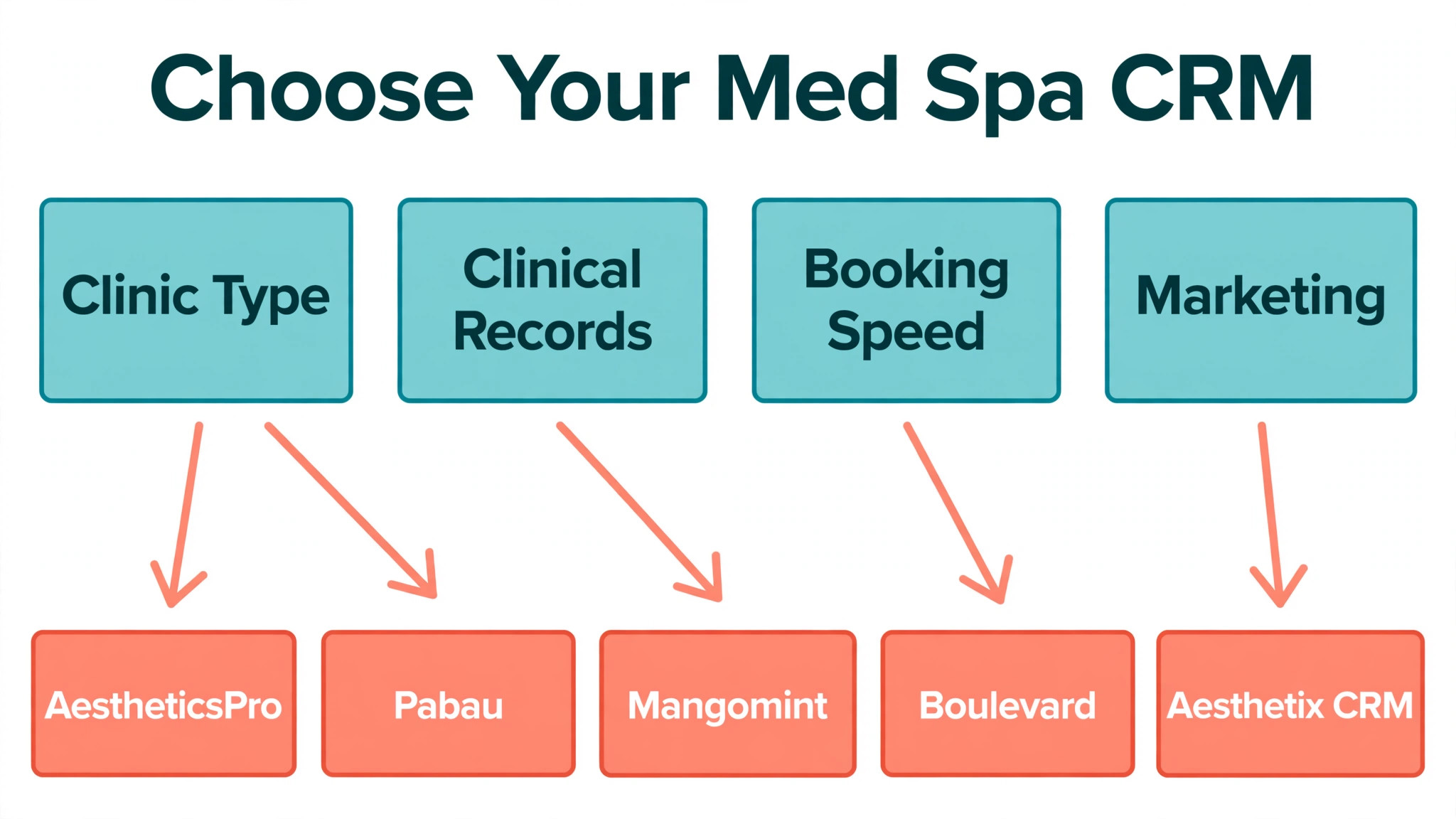
For most med spas, the decision narrows to three questions, and answering them honestly removes most of the shortlist. If clinical records are the priority, start with AestheticsPro and Pabau. If booking speed and rebooking discipline matter most, start with Mangomint and Boulevard. If marketing and lead follow up are the gap, start with Aesthetix CRM or GoHighLevel alongside the booking system the clinic already trusts. Price each finalist at real size, run the one week real work trial, and check the data export before signing.
The best crm for med spas is the one the front desk actually uses on a busy Saturday, not the one with the longest feature list or the lowest headline price. A system that staff trust becomes the single source of truth for clients, treatments and revenue, and that trust compounds into better retention, cleaner records and fewer disputes. Choose the tool that earns that trust in the trial, and the clinic will feel the difference within a single rebooking cycle.