
A bike shop that sells and repairs should shortlist Ascend POS first for the best pos software for bike shops, because it is built around bikes, work orders, and serial numbers in a way no general retail system matches. A shop that needs inventory depth across locations should test Lightspeed Retail first, and a shop that sells mostly online should test Shopify POS first. The rest of this guide proves those three calls, and shows where the other eight tools fit.
A bike shop is not a general retail store. A single bike is a serialized, high value item that may be built, fitted, and serviced over years. Parts come in sizes, colours, and model years that change annually. Repairs arrive as work orders with parts, labour, and customer approval, not as simple till sales. A POS that treats a bike like a T-shirt will cost the shop time at every sale and repair.
This guide compares 11 tools across bike inventory, serialized tracking, work orders, supplier catalogues, e-bike handling, payments, and total cost. Prices come from vendor pages and recent published comparisons, and they change often, so check the vendor pricing page before you sign. Test each shortlisted tool with your real week before you sign.
Why the best pos software for bike shops is different from general retail POS
A bike shop register must answer questions a general till never faces. Which frame sizes of this model are in stock, and which are on order. Which serial number went to which customer, and what warranty work has it had. Which repair jobs are waiting for parts, and which customers have approved the quote. A general POS can ring up a sale, but it cannot run a workshop.
Inventory depth is the deciding strength. Bikes, frames, wheels, groupsets, and accessories each need size, colour, and model year tracking, and a shop that cannot see true stock by variant will over order slow sizes and run out of fast ones. Supplier catalogues matter just as much, because a shop that can import a distributor catalogue and order from the till saves hours a week over manual entry.
Work orders complete the picture. A repair is a job with a customer, a bike, a diagnosis, parts, labour, and a collection date, and the POS should carry it from intake to invoice without a paper ticket. E-bikes add a further layer, with motors, batteries, firmware, and warranty rules that differ by brand. Judge every tool on inventory, work orders, and supplier depth first, and on till speed second.
The 11 tools at a glance
Use this table to shortlist three tools. Price notes are starting points from published sources, and the vendor pricing page is the final word.
| Tool | Main job | Starting point | Watch out for |
|---|---|---|---|
| Ascend POS | Bike specific POS and workshop | Quote only | No published price |
| Lightspeed Retail | Inventory depth plus bike vertical | From 89 dollars a month | Extra registers cost more |
| Shopify POS | Online plus in store selling | From 39 dollars a month | POS Pro adds 89 dollars per location |
| Clover | Hardware plus software bundle | From 16 dollars a month | 36 month hardware contracts |
| Square | Free start with simple inventory | Free plan | Flat card rates get costly at volume |
| Rain POS | Specialty retail with bike focus | From 99 dollars a month | No free trial confirmed |
| Epos Now | Bundled POS with hardware | From 84 dollars a month | Hardware adds 399 dollars |
| Heartland Retail | Inventory heavy specialty retail | Quote only | No published price |
| Revel Systems | Enterprise retail and service | Quote only | Built for larger operations |
| Erply | Inventory and multi location | Check the vendor pricing page | Pricing varies by plan |
| SpotOn | Bundled hardware and processing | From 55 dollars per station | Compare contract terms |
A shop comparing the best pos software for bike shops should price the whole year, not the first month. Add card processing, extra registers, hardware, and any per location fee. A tool that looks cheap at entry level can become the most expensive option once your second register and your card volume are added.

Best pick by job
Shortlisting the best pos software for bike shops by shop type keeps the choice practical, because a tool that fits a retail floor may frustrate a workshop.
| Segment | First pick | Second tool | Why this pair works |
|---|---|---|---|
| Retail bike shops | Ascend POS | Lightspeed Retail | Bike depth plus inventory depth |
| Repair focused shops | Ascend POS | Square | Work orders plus low cost till |
| E-bike shops | Lightspeed Retail | Shopify POS | Serial tracking plus online sales |
Retail bike shops need bike depth first. Ascend POS handles serialized bikes, work orders, and supplier catalogues in one system, while Lightspeed Retail adds inventory depth, vendor catalogues, and multi location control for a shop that also sells online. A retail shop that carries several brands will feel the difference at the first stock count.
Repair focused shops need a different strength. The workshop is the profit centre, so work orders, parts ordering, and customer approval matter more than till speed. Ascend POS covers that best, and Square is the second pick because its free till and simple inventory suit a small workshop that repairs more than it sells.
E-bike shops need serial tracking and online reach. Lightspeed Retail handles serialized inventory and warranty tracking across locations, while Shopify POS adds a strong online store for a shop whose e-bike customers research online before they visit. The right choice depends on whether workshop depth or online sales matter more for your next year.
The 11 tools in detail
Each section below judges the tool on bike specific jobs, so you can see where the best pos software for bike shops earns its price and where it does not.

1. Ascend POS
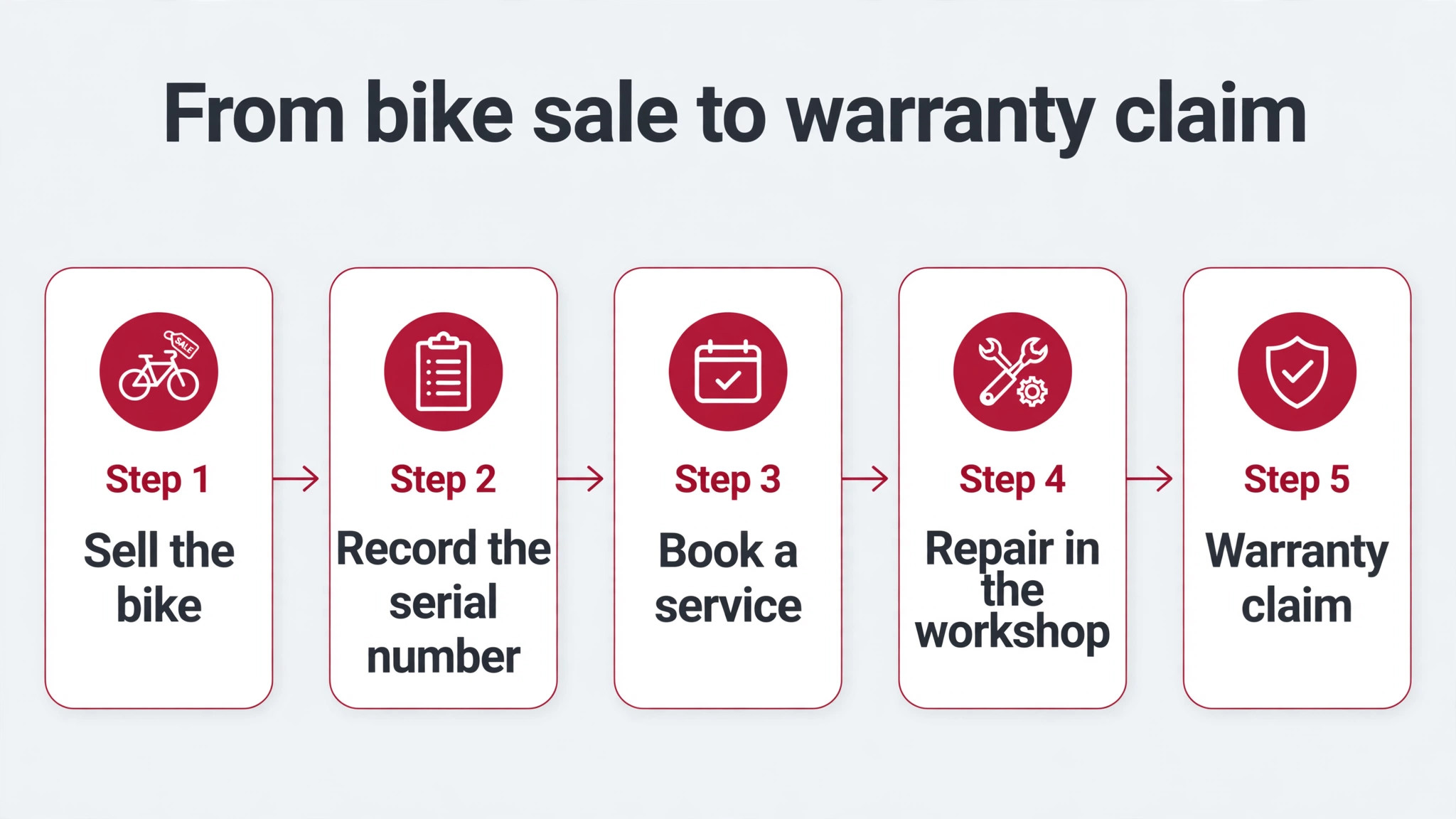
Ascend POS is the only bike built system in this list, and its depth shows in daily shop work. It covers serialized bike inventory, work orders, service history by serial number, supplier catalogue imports, layaway, special orders, and reporting built around bikes and parts. A shop can look up a bike by serial number and see every sale, repair, and part fitted to it, which is the record a warranty claim needs.

Pricing is by quote, with no published price in current listings. That is the honest weakness of this pick, because a shop cannot budget it from a web page and must go through a sales conversation. Published comparisons describe it as a mid priced option for bike shops, but get the number in writing at your register count before comparing it against published price tools.

Ascend suits a bike shop that sells and repairs and wants one system for both. A shop that only sells accessories online will find it heavy, and should compare Shopify POS first, because Ascend earns its price in the workshop and on the shop floor, not in a web store.
2. Lightspeed Retail
Lightspeed Retail is the inventory depth pick in this list, with bike listed as a named vertical alongside apparel, sporting goods, and home decor. It covers serialized inventory, purchase order automation, landed cost tracking, vendor catalogues, multi location stock, loyalty, and eCommerce, with service orders and work orders for shops that repair as well as sell. NuORDER catalogues feed purchasing directly, which saves a shop from manual part entry.
Pricing is published as Basic at 89 dollars a month on annual billing or 109 dollars month to month, Core at 149 dollars a month on annual billing, and Plus at 289 dollars a month on annual billing. Each plan includes one register, with extra registers at 59 dollars a month each in published comparisons. Card present processing through Lightspeed Payments is 2.6 percent plus 10 cents on every plan.
Lightspeed suits an established bike shop with complex inventory and more than one location. A small single shop may find Basic enough, but should model the Core price, because loyalty and advanced reporting sit there. A shop that uses its own processor should ask about the extra monthly fee, because Lightspeed charges more when you bring your own processing.
3. Shopify POS
Shopify POS is the online first pick, and its whole argument is unified commerce. It covers in store selling, online inventory sync, buy online pickup in store, ship from store, cross location returns, customer profiles, and discounts that work across the store, the website, and social channels. A customer who buys a helmet online and collects it in store sees the same stock count in both places.
Pricing starts with a Shopify plan at 39 dollars a month billed monthly or 29 dollars billed yearly for Basic, with POS Lite included on every plan. POS Pro adds 89 dollars a month per location and brings staff roles, smart inventory management, low stock reports, and unlimited registers. Card rates through Shopify Payments are 2.6 percent plus 10 cents on Basic. Using a third party processor adds an extra transaction fee, so price that in before assuming the headline rate applies.
Shopify POS suits a bike shop whose online store matters as much as the physical register. A workshop heavy shop will find the repair depth thinner than Ascend, and should only pick Shopify when online sales carry real weight.
4. Clover
Clover is the hardware plus software bundle in this list, sold through partners and resellers with the till, printer, and cash drawer in one package. It covers in store payments, inventory, customer loyalty, staff scheduling, online ordering, and an app market for extras like QuickBooks and Shopify. The hardware is sleek and the setup is guided, which suits a shop that wants one vendor for the whole counter.
Pricing varies by partner, which is the honest complication. Retail packages are reported from 16 dollars a month for 36 months for a compact terminal, with Standard at about 180 dollars a month for 36 months and Advanced at about 240 dollars a month for 36 months in published comparisons. Card processing runs from 2.3 percent plus 10 cents for in store sales to 3.5 percent plus 10 cents for keyed in sales. Get the full contract in writing, because the 36 month term is the real commitment.
Clover suits a bike shop that wants hardware and software from one vendor and values a polished counter. A shop that needs bike specific inventory and work orders should compare Ascend first, because Clover is a general retail till with bike features added, not built in.
5. Square
Square is the zero cost start in this list, and it is the easiest system for a small shop to begin on. The free plan covers the POS app, item library, online site, invoicing, and basic inventory, with no monthly fee and no long term contract. Hardware starts at a 59 dollar reader, and the system works on a tablet or a phone, which suits a small shop or a market stall.
Pricing is Free at zero dollars, Plus at 49 dollars a month per location, and Premium at 149 dollars a month per location in US listings. In person card processing is 2.6 percent plus 15 cents on the free plan, falling to 2.5 percent on Plus and 2.4 percent on Premium. Plus adds multi location stock management, purchase orders, vendor profiles, and barcode label printing, which are the features a growing bike shop will need first.
Square suits a new or small bike shop that wants to start at zero cost and grow into paid features. The flat card rates get expensive at volume, and the inventory depth is thinner than Lightspeed or Ascend, so a shop with complex serialized stock should test those first.
6. Rain POS
Rain POS is a specialty retail system built for craft, boutique, and outdoor shops, with bikes among its named niches. It covers inventory by size and variant, supplier ordering, work orders, customer records, loyalty, and a built in website, with a focus on the kind of shop that sells specialist products rather than general goods. That niche focus means bike workflows are understood, not bolted on.
Pricing is reported at 99 dollars a month for the Startup plan on annual billing, with higher Core and Plus plans unpublished in current listings. No free trial is confirmed, so a demo is the way to test it. The entry price sits above Square and Shopify Basic, and the value depends on how much the specialty inventory depth is worth to the shop.
Rain suits a small to mid bike shop that wants specialty retail depth without an enterprise price. A multi location shop should check the higher plan prices first, because they are not published, and a shop that sells mostly online should compare Shopify POS before committing.
7. Epos Now
Epos Now is a bundled POS with hardware in one purchase, aimed at small retailers who want a complete counter without separate vendors. It covers in store payments, inventory, customer records, reporting, and integrations with accounting and eCommerce tools, with a till that runs on a tablet or a dedicated terminal. The bundle pitch is simple, one price for software plus hardware.
Pricing is reported at 84 dollars a month plus 399 dollars for hardware in published comparisons, so check the vendor page for current bundle terms. That total is higher than Square free and Shopify Basic, and the value depends on whether the hardware bundle saves the shop a separate purchase. Card processing is separate, so add it to the model before comparing.
Epos Now suits a small bike shop that wants a complete counter in one box and values a simple setup. A shop that needs serialized bike tracking or deep work orders should compare Ascend first, because Epos Now is a general retail till, and the bike depth is thinner.
8. Heartland Retail
Heartland Retail is an inventory heavy specialty retail system, built for shops with stock complexity across locations. It covers advanced inventory, purchase orders, multi location stock, customer records, loyalty, and reporting, with a depth that suits a bike shop carrying many brands, sizes, and model years. It is the kind of system a growing chain buys when spreadsheets and a simple till stop working.
Pricing is by quote, with no usable published price on the vendor site in current listings. That makes it hard to shortlist against published price tools, and a shop should get a written quote early rather than investing trial time first. Expect partner quotes and payment processing bundles, because Heartland sells through its payments business as well as its software.
Heartland suits a multi location bike shop with complex inventory that has outgrown a simple till. A single shop should compare Lightspeed first, because the inventory depth is similar and the price is published.
9. Revel Systems
Revel Systems is an enterprise retail and service platform, built for larger operations that need depth across the counter, the workshop, and the back office. It covers POS, inventory, customer management, service workflows, reporting, and integrations, with a focus on businesses that run several locations and need central control. That scale is its strength and its weakness for a small shop.
Pricing is by quote, with no published price in current listings. Enterprise pricing usually means a sales conversation, an implementation fee, and a contract, which is a poor fit for a single shop choosing its first POS. A shop should only shortlist Revel when it already runs several locations and needs enterprise controls.
Revel suits a bike retail chain that needs central control across locations. A single bike shop should not shortlist it, because the product and the price are built for a bigger operation than one counter.
10. Erply
Erply is an inventory and multi location platform with a long track record in specialty retail. It covers POS, inventory by variant, purchase orders, multi location stock, customer records, loyalty, and reporting, with an API for custom workflows. That API matters for a shop that wants to connect the till to a workshop system or a website without buying a whole new platform.
Pricing is not published in one clear list in current sources, so check the vendor pricing page for a quote at your location count. Published comparisons describe it as a mid priced option, but the plan names and prices vary by region. Get the number in writing before comparing it against Lightspeed, because the two products overlap heavily on inventory depth.
Erply suits a bike shop that needs multi location inventory and an API for custom connections. A single shop should compare Lightspeed first, because the inventory depth is similar and the price is published.
11. SpotOn
SpotOn is a bundled hardware and processing platform that competes on the counter package rather than on software depth. It covers POS, payments, customer records, marketing, and reporting, with hardware and processing sold together so the shop deals with one vendor. That bundle suits a shop that wants a simple purchase and a single support number.
Pricing is reported at 55 dollars per station a month in published comparisons, so check the vendor page for current terms and contract length. Compare the contract terms, not only the headline price, because bundled processing deals can lock a shop into rates that look cheap in year one and cost more later. Ask for the processing rate in writing before signing.
SpotOn suits a small bike shop that values a bundled counter and a simple vendor relationship. A shop that needs serialized bike tracking or deep work orders should compare Ascend first, because SpotOn is a general retail platform, not a bike system.
How to judge a bike POS before you pay
Start with your shop model, because that choice filters the best pos software for bike shops faster than any feature table. A retail floor needs serialized inventory and supplier catalogues. A workshop needs work orders and parts ordering. An e-bike shop needs battery and warranty tracking. Write that model down before any demo, and score each tool against it.
Next, run a realistic trial week. Sell a bike with a trade in, book a repair with a special order part, take a deposit on a layaway, run a stock count across sizes, and process a warranty claim by serial number. Then check that the sale, the work order, and the stock count all agree. A tool that passes that week will handle most real weeks.
Finally, price the second year, not the first month. Add processing fees, extra registers, hardware, and any per location charge, and model the price at your expected register count. Ask about contract length, notice period, and data export, because switching POS later is far harder than choosing well now. A short contract with clean data export beats a small discount.
Setup checklist for a live workshop floor
Use this sequence when you move to the best pos software for bike shops you chose, and do not skip the payment test.
1. Export your current product list, serial numbers, customer records, and outstanding work orders, and clean duplicate customer records before import. 2. Build your inventory first, including bikes by size and colour, parts by variant, and supplier catalogue links. 3. Set pricing rules next, including trade in values, layaway terms, labour rates, and discount rules. 4. Connect payments and run a test sale with a real card, then refund it, to confirm the full payment flow.
5. Set up work order templates for common repairs, including intake notes, parts, labour, and customer approval steps. 6. Invite a small group of regular customers to buy and book a repair in the new system before a full launch. 7. Train staff on serial number lookup, work orders, and special orders, because those three jobs cause most support questions. 8. Keep the old till read only for one full month, so no sale or repair record is lost in the move.
A careful switch protects trust. Customers forgive a new till quickly if prices are correct and repairs are ready on time. They do not forgive a lost work order, a double charge, or a bike that cannot be found in stock. Test sales and work orders twice, and launch only when both are clean.

Mistakes that cost bike shops sales
The first mistake is choosing on subscription price alone. A tool at 39 dollars a month that charges extra per register, takes a higher card rate, and lacks serialized tracking can cost more in a year than a tool at 89 dollars a month with those features built in. Model the full year at your real register count and card volume, including processing and hardware, before deciding.
The second mistake is skipping the serial number test. Warranty claims, theft reports, and service history all depend on the serial number, and a POS that cannot track a bike by serial number forces the shop to keep a second record. Test serial lookup, service history, and warranty reporting during the trial, and confirm the record survives a staff change.
The third mistake is ignoring the workshop. A shop that buys a till and forgets the work order ends up running the workshop on paper, with parts ordered by memory and customers called by hand. Check that work orders, parts, labour, and customer approval sit in the same system as the till before signing, because a split system doubles the admin.
The fourth mistake is buying an enterprise platform for a single shop. A quote only tool built for a retail chain will charge a single counter for depth it never opens, and the implementation alone can exceed a month of revenue. Shortlist published price tools first, and only move to a quote only platform when location count or inventory depth forces the change.
What bike POS really costs
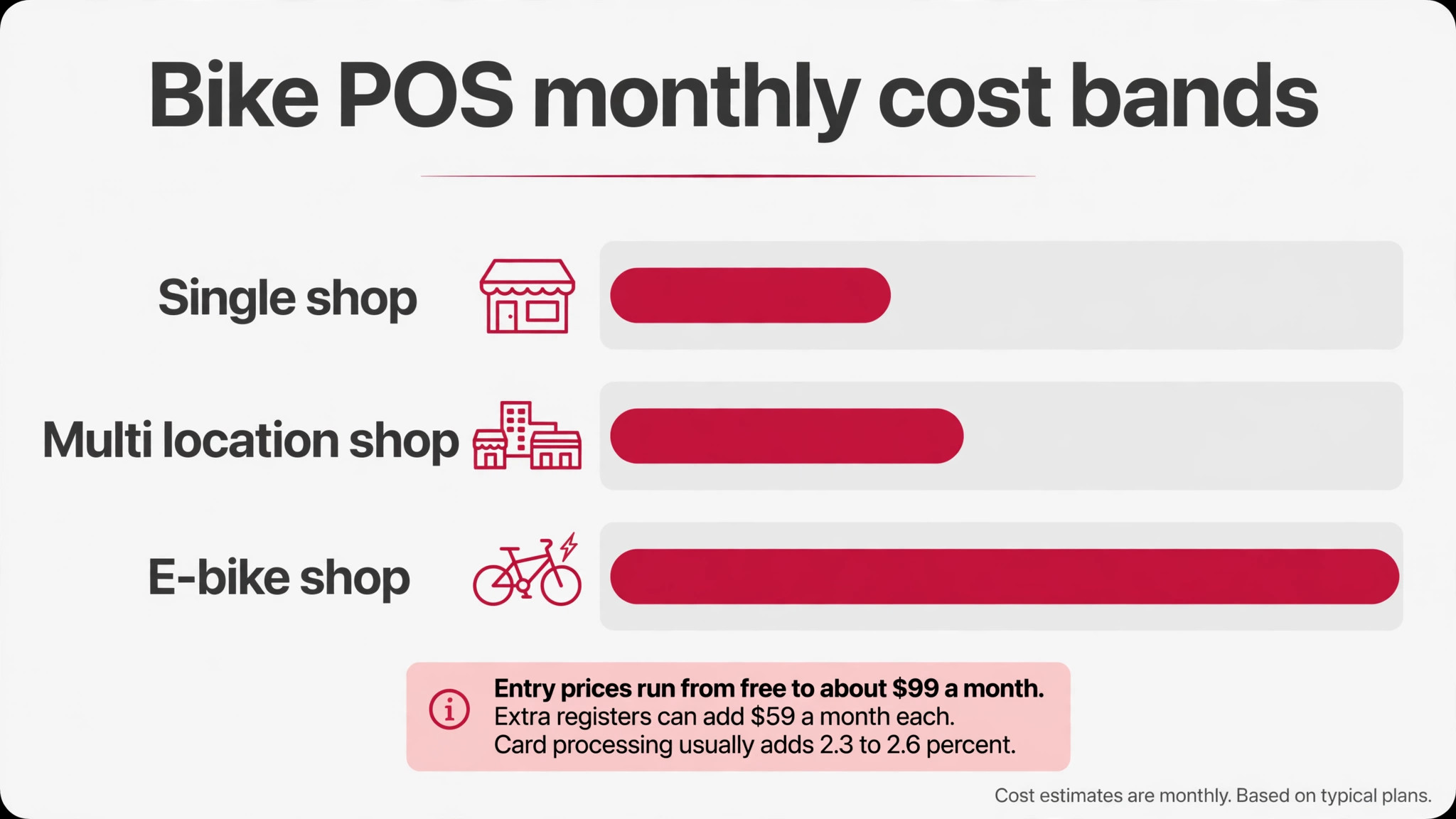
Entry prices in this guide run from free to about 99 dollars a month, but the subscription is only part of the bill. Card processing usually adds 2.3 to 2.6 percent plus a per transaction fee, and that percentage matters more than the subscription once monthly card sales pass a few thousand dollars. Extra registers can add 59 dollars a month each, hardware can add hundreds of dollars once, and a 36 month contract can lock a shop into a bundle it outgrows.
The honest way to compare the best pos software for bike shops is to build a one year model for your shop. Take your monthly card volume, your register count, your location count, and your hardware needs, then run each shortlisted tool through those numbers. A small shop will usually find Square cheapest in year one. A shop with complex serialized stock will usually find Lightspeed cheapest once inventory depth is priced in, because the time saved on stock counts and ordering earns the subscription back.
Before signing, ask for a written total that covers the subscription, processing rates, extra registers, hardware, and any per location charge. Ask how the price changes when you add a register, open a second location, or move to a higher tier. A clear answer to those questions is a good sign. A vague answer is a warning that the first year bill will surprise you.
Related Guides
Keep exploring with these guides on Stratilyze:
- Best POS System for Vintage and Antique Shops (12 Tools)
- Best POS System for Gift Shops
- Best POS System for Coffee Shops
Frequently Asked Questions
These answers cover the questions bike shop owners ask most when they compare the best pos software for bike shops.
How much should a small bike shop pay for POS software?
Most small shops pay between zero and 99 dollars a month for a solid tool, with larger platforms from 149 dollars a month once multi location, loyalty, and advanced inventory are added. Price the tier you need at your real register and location counts, and add card processing and hardware. A tool at 39 dollars a month that fits your shop beats a tool at 289 dollars a month whose extra features stay unused.
Does bike POS handle work orders and repairs?
Bike built tools such as Ascend POS handle work orders, parts, labour, and customer approval as core features. General retail tools may handle repairs through an add on or a separate workshop app, which adds cost and extra work. If repairs are a major revenue line, put work orders on the shortlist criteria before price, because a split system doubles the admin.
Can POS track bikes by serial number?
Yes, when serialized inventory is turned on. Ascend POS and Lightspeed Retail both track a bike by serial number from sale through every repair, which supports warranty claims and service history. Test the lookup during a trial, including a warranty claim and a service history check, because a serial field that looks simple in a demo can still fail in real use.
What is the difference between POS Lite and POS Pro on Shopify?
POS Lite is included with every Shopify plan and covers basic in person selling. POS Pro adds 89 dollars a month per location and brings staff roles, smart inventory management, low stock reports, and unlimited registers. A bike shop that needs low stock alerts and staff permissions should budget for Pro, not Lite.
Should a new bike shop choose a free tool or a paid platform?
A new shop should usually choose a tool that fits its current size and can grow for two years, rather than the largest platform on day one. Square, Shopify POS, and Rain POS give a new shop structure at a low price. Move to a larger platform when location count, inventory depth, or workshop volume becomes a real need, not only a future hope.
How long does it take to switch POS software?
Most bike shops can switch in two to four weeks, including data import, inventory setup, payment testing, and staff training. A multi location shop should allow four to eight weeks, including a phased rollout by location. Keep the old till read only until the first full week of sales is clean, and avoid switching during your busiest season if you can.
The final verdict for bike shops
The strongest all round choice for a bike shop that sells and repairs is Ascend POS, because serialized bikes, work orders, and supplier catalogues sit together in one system built for bikes. Lightspeed Retail is the better pick for a shop with complex inventory or more than one location, and Shopify POS is the better pick for a shop whose online store matters as much as the register. Square is the better pick for a new shop that wants to start at zero cost while it builds a customer base.
Do not choose on price alone. Choose on the shop model you run today, the repair workload you carry each month, and the location count you expect in two years. Shortlist three tools, run the trial week described above, and pick the tool your team can actually run on a busy Saturday. That practical test will tell you more than any sales page, and it will save your shop from a costly switch later.