

A shop on your own website can look cheaper until you add hosting, a payment gateway, a theme, security updates, and the long job of bringing buyers to a site nobody knows yet. A shop on Etsy flips that problem around. You get a marketplace full of buyers who already search for handmade goods, vintage finds, and digital downloads, and in return you pay a small fee to list and a percentage on every sale. That trade is why the cost of starting an Etsy shop is usually measured in tens of dollars for a lean launch, not hundreds, and why the real risk is rarely the opening bill.
The real risk is pricing too low, buying too much stock before you have proof, or turning on advertising before a listing is ready to convert.
This guide gives you the full picture in plain numbers. You will see every Etsy fee that applies to a typical sale, what a sale keeps at three common price points, what photos and packaging actually cost when you do them well on a small budget, and three first-month budgets for a lean digital launch, a balanced handmade launch, and a stocked physical launch.
Prices for Etsy fees were checked against Etsy’s published fee pages and help pages at draft time in October 2026, and you should still check the fee page in Shop Manager before you set final prices, because Etsy can change rates and the rate that applies to you can vary by the country of your bank account.
What the Cost of Starting an Etsy Shop Really Includes
Opening a standard Etsy shop carries no monthly subscription charge. That single fact confuses many new sellers, because it sounds like opening is free, and then the first bill arrives with charges they did not expect. The honest way to think about it is to split the total into four buckets. The first bucket is Etsy charges, meaning listing fees, transaction fees, payment processing, and any advertising fee that applies to a specific order. The second bucket is product costs, meaning materials, production, or print on demand base costs, plus the time you spend making the item. The third bucket is presentation costs, meaning photos, listing copy, packaging, and branding.
The fourth bucket is optional growth costs, meaning Etsy Ads, a subscription such as Etsy Plus, or outside tools for design and bookkeeping.
Most guides stop at the first bucket and call the job done. That is a mistake, because a shop with ten listings and no good photos will not sell, and a shop with beautiful photos but no margin will sell itself into a loss. A useful budget covers all four buckets, even when some lines are zero in month one. If you plan to use a phone you already own for photos and free design tools for graphics, write zero for those lines rather than leaving them blank. A zero you chose is a decision. A blank line is a surprise waiting to happen.
The Short Answer on Price
For a lean digital shop, meaning ten to twenty digital listings made with tools you already own, the cost of starting an Etsy shop in cash terms is small, a realistic first-month cash outlay is about 20 to 60 dollars, plus a one-time setup fee that Etsy shows during shop creation and that varies by location. Reports from sellers in 2026 commonly put that setup fee in a range of about 15 to 29 dollars in the United States, and the exact figure for your country appears before you confirm, so treat the range as a planning figure and the checkout figure as the truth.
A balanced handmade shop with twenty listings, basic packaging, and a small materials restock usually lands between 150 and 400 dollars in month one. A stocked physical shop with fifty listings, larger material orders, and a test advertising budget can pass 600 dollars quickly, and that is before any sale has been made.
Those ranges are wide on purpose, because the product decides the budget more than the platform does. A printable planner costs almost nothing to restock, because the same file sells again and again. A ceramic mug costs clay, glaze, firing, and a safe box for every single order. A vintage shop costs sourcing time and the cash tied up in stock that may sit for months. Do not copy another seller’s budget without adjusting it for your product type, your existing equipment, and how many listings you plan to open with. The tables later in this guide let you build your own version of those ranges line by line.
Every Etsy Fee in One Table
This is the table to bookmark, because almost every pricing error on Etsy traces back to one line in it. The rates below are the widely published United States figures for October 2026, checked against Etsy’s fee pages and help pages at draft time. Rates for sellers outside the United States differ, especially for payment processing, so use the country schedule in your own payment account settings for final pricing.
| Fee | Rate | Charged on | When it applies |
|---|---|---|---|
| Listing fee | 0.20 dollars | Each listing | On publish, on renewal after four months, and on each unit sold from a multi-quantity listing |
| Transaction fee | 6.5 percent | Item price plus shipping plus gift wrap | On every sale, sales tax excluded for United States sellers |
| Payment processing, United States | 3 percent plus 0.25 dollars | Full order total including applicable tax | On every order paid through Etsy Payments |
| Payment processing, United Kingdom | 4 percent plus 0.20 pounds | Full order total | On every order paid through Etsy Payments |
| Offsite Ads, under 10,000 dollars in 365 days | 15 percent | Full order total | Only on a sale attributed to an Offsite Ad click, capped at 100 dollars per order |
| Offsite Ads, at or above 10,000 dollars in 365 days | 12 percent | Full order total | Mandatory for the life of the shop once that threshold is reached, capped at 100 dollars per order |
| Currency conversion | 2.5 percent | Sale amount | Only when your listing currency differs from your payment account currency |
| Etsy Ads | Your chosen daily budget | Clicks on promoted listings | Only when you run Etsy Ads, minimum daily budget 1.00 dollar |
| Etsy Plus, optional | 10 dollars per month | Subscription | Only if you choose it, includes listing credits and extra shop features |
| Pattern, optional | 15 dollars per month | Subscription | Only if you choose it, for a standalone site built from your Etsy listings |
Two lines in that table deserve extra attention, because they cause the most confusion. The first is the listing fee. A listing lasts four months, and it renews for another 0.20 dollars if it has not sold, unless you turn renewal off. When a buyer purchases one unit from a multi-quantity listing, Etsy charges another 0.20 dollars to keep the next unit available. If a buyer purchases three units in one order, that is three renewal charges, not one. The second is the transaction fee. It applies to the shipping amount the buyer pays, not just the item price. If you charge 25 dollars for an item and 5 dollars for shipping, the transaction fee is calculated on 30 dollars.
Offering free shipping does not remove the fee, because the higher item price you set to cover postage is then the amount the fee is calculated on.
What You Keep on a Real Sale
Tables are useful, but a worked example is what makes a fee real. The three examples below use United States rates, no Offsite Ads fee, and no sales tax in the transaction fee base, so you can follow the arithmetic without extra variables. Payment processing in real orders is calculated on the total the buyer pays including applicable tax, so your actual processing line may be a few cents higher on a taxed order. Check the payment account line for the exact figure on your own first sale.
| Sale example | Buyer pays | Listing fee | Transaction fee at 6.5 percent | Payment processing at 3 percent plus 0.25 dollars | Total Etsy fees | You keep before product costs |
|---|---|---|---|---|---|---|
| 15 dollar digital download, no shipping | 15.00 dollars | 0.20 dollars | 0.98 dollars | 0.70 dollars | 1.88 dollars | 13.12 dollars |
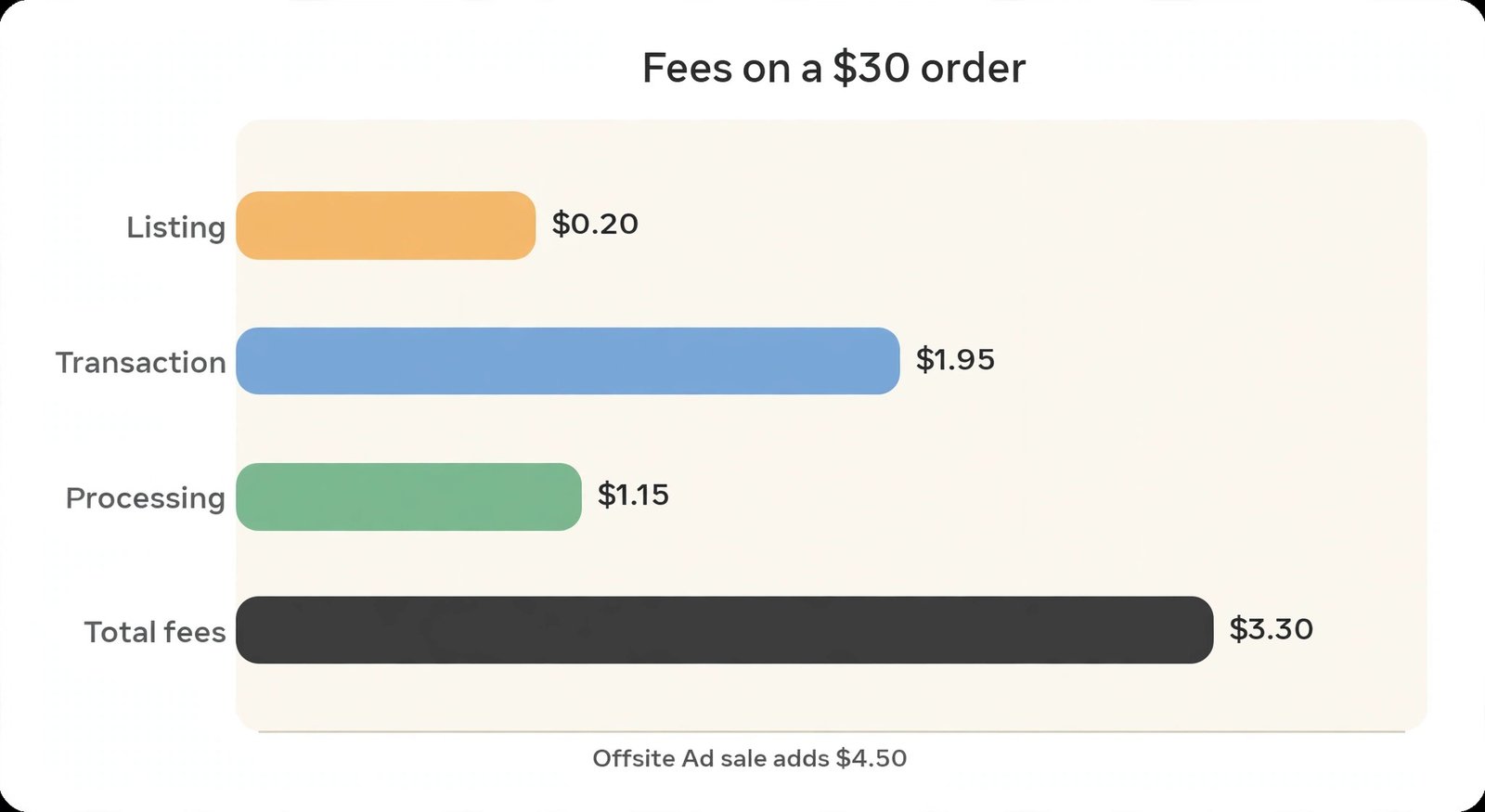
| 25 dollar item plus 5 dollars shipping | 30.00 dollars | 0.20 dollars | 1.95 dollars | 1.15 dollars | 3.30 dollars | 26.70 dollars |
| 50 dollar item plus 6.50 dollars shipping | 56.50 dollars | 0.20 dollars | 3.67 dollars | 1.95 dollars | 5.82 dollars | 50.68 dollars |
Read those rows from right to left as a pricing lesson. On the 15 dollar digital sale, Etsy fees take about 12.5 percent, because the fixed charges matter more at a low price. On the 30 dollar order, fees take 11.0 percent. On the 56.50 dollar order, fees take about 10.3 percent. The percentage falls as the price rises, which is why very low priced items need special care. A 5 dollar printable with the same fee structure keeps only about 4.10 dollars before any design time, and one Offsite Ads sale at 15 percent would cut that to about 3.35 dollars.
That does not mean low priced items cannot work, because digital items sell in volume and cost nothing to restock, but it does mean a low price needs volume, a bundle, or a higher priced companion product to make the shop worthwhile.
Now add an Offsite Ads order to the middle example to see the swing. The same 30 dollar order, if attributed to an Offsite Ad for a shop under the threshold, carries an extra 4.50 dollars at 15 percent. Total Etsy fees rise from 3.30 dollars to 7.80 dollars, and the amount kept before product costs falls from 26.70 dollars to 22.20 dollars. For a shop above the threshold, the extra fee at 12 percent is 3.60 dollars, total fees are 6.90 dollars, and the amount kept is 23.10 dollars. Those are still profitable numbers for many products, but they change the answer for a product with only 4 or 5 dollars of margin after materials and postage.
Run both versions of the maths for every product before you launch it, not just the version without advertising.
The One-Time Setup Fee and Identity Checks
Most new sellers in 2026 are shown a one-time setup fee during shop creation. The amount varies by location and account type, and seller reports commonly place it between about 15 and 29 dollars, with occasional promotions that reduce or waive it. Etsy presents the fee before you confirm, so you will see the exact figure for your shop before you pay it. If you open a second shop, expect a setup fee for that shop as well, because the charge is tied to shop creation rather than to your person alone.
Photos, Listings, and Presentation Costs
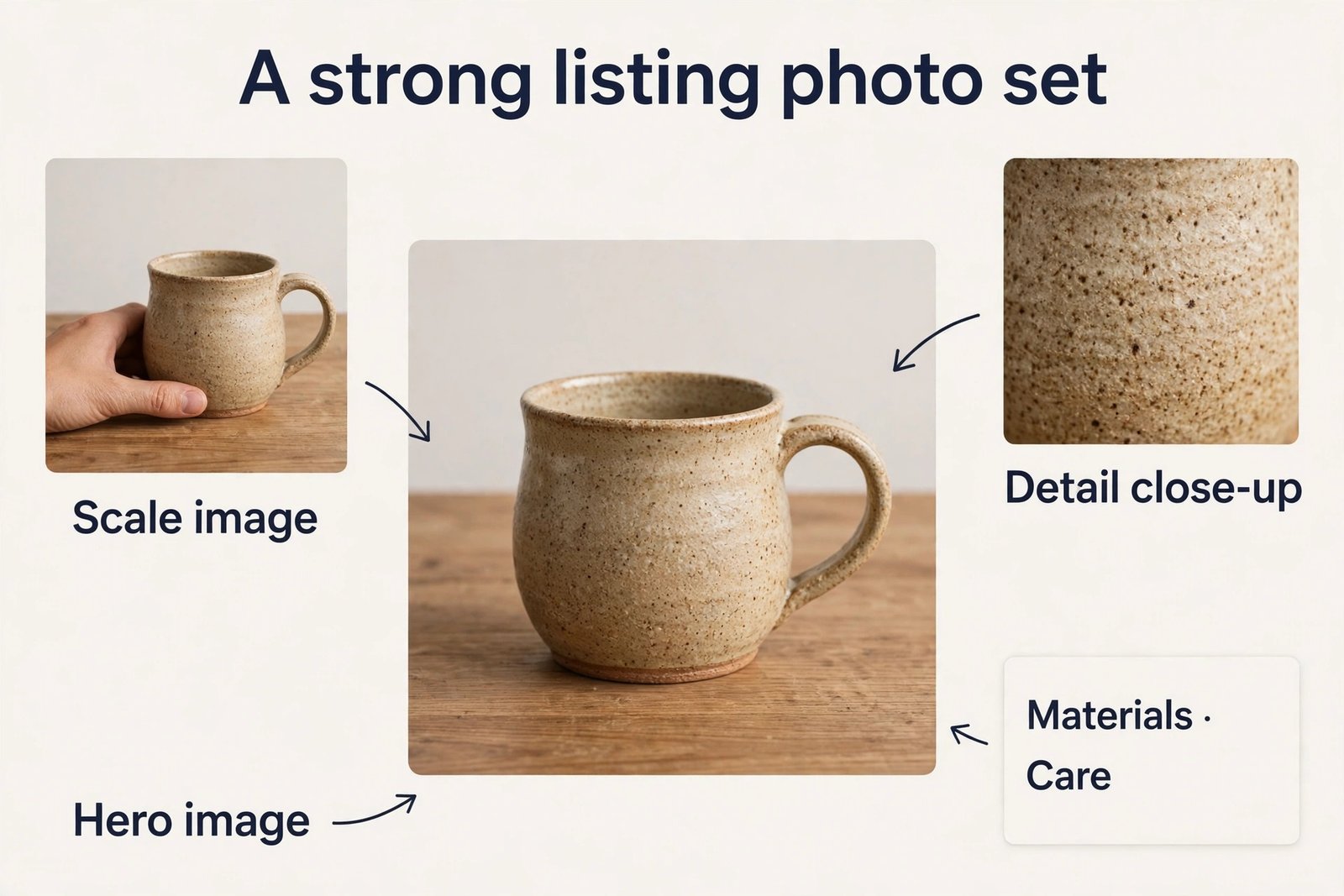
Photos are the highest return spend in a first month, because the first photo decides the click and the remaining photos decide the sale. The good news is that a strong Etsy photo set does not require a studio. A phone made in the last few years, daylight near a large window, a plain background, and a simple editing app can produce photos that compete in many categories. The costs that do appear are for backgrounds, props, and time, and they are easy to keep small if you plan the shoot as a batch rather than photographing one product at a time.
A realistic lean photo budget looks like this. A roll of white or neutral craft paper costs about 10 to 20 dollars and covers many shoots. Two or three simple props that match your niche, such as a linen cloth, a small plant, or a wooden board, cost about 15 to 30 dollars in total if you buy them rather than borrow them. A basic phone tripod costs about 15 to 25 dollars and pays for itself in sharper photos and faster shoots. A free editing app handles brightness, cropping, and straightening, while a paid design tool is optional in month one.
If you already own those items, your photo cash cost in month one can be zero, and the real cost is the half day you spend shooting and editing in a batch.
Materials, Stock, and Print on Demand Compared
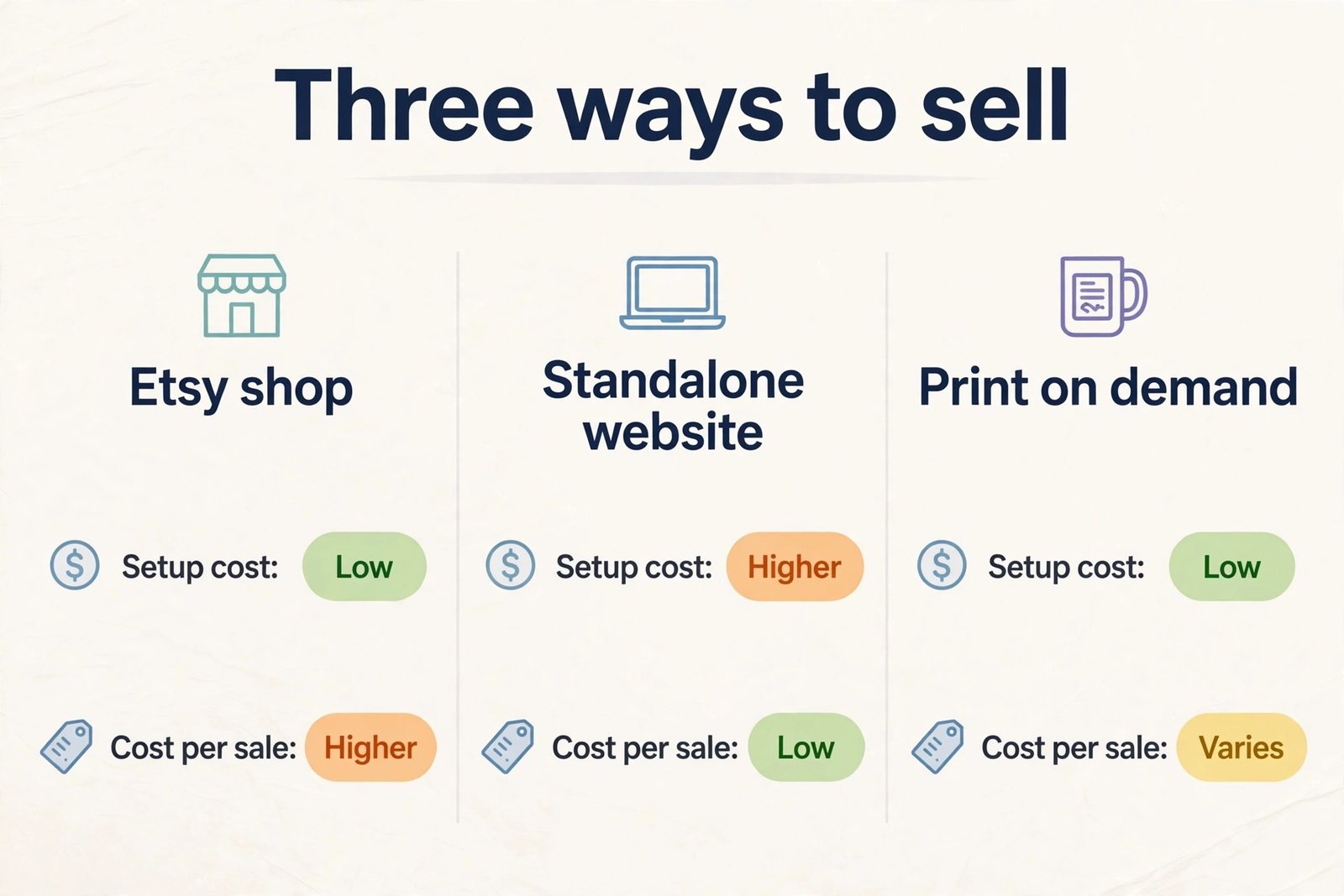
The total changes shape completely depending on whether you make, source, or print on demand. A maker buys materials in advance and holds the risk if a design does not sell. A vintage or reseller buys stock in advance and holds the risk if a piece sits for months. A print on demand seller holds almost no stock risk, because a third party prints and ships only after a buyer orders, but pays a higher base cost per item and gives up some control over quality and shipping speed. A digital seller holds almost no stock risk at all, because the same file sells again, but faces heavy competition and needs strong differentiation to stand out.
Compare the three physical routes on a simple mug example to see the trade. A maker who buys blanks, transfers, and packaging in bulk might spend 300 to 500 dollars to set up a small run, with a per-item cost of perhaps 8 to 12 dollars once the batch is counted. A print on demand seller might spend nothing on stock, but pay a base cost of perhaps 12 to 18 dollars per mug plus shipping through the print partner, leaving a thinner margin on the same retail price. A vintage seller might spend 200 dollars sourcing ten pieces at an average of 20 dollars each, with no two pieces alike, so every listing needs its own photos and research.
None of those routes is wrong in itself. The wrong choice is the one that does not match your cash, your storage space, and your tolerance for unsold stock.
Shipping and Packaging, the Quiet Budget Line
Shipping is where many first-month budgets quietly break, because the cost appears in three places at once. The buyer may pay a shipping charge, which then attracts the transaction fee. You pay actual postage to the carrier, which may be higher or lower than the charge you set. And you pay for the box, mailer, tissue, tape, label, and thank-you card that protect the item and present your brand. If you set shipping by guessing, you will either overcharge and lose sales or undercharge and pay the difference from your margin on every order.
Start by weighing and measuring a packed example of each product, including the box, before you publish. That packed weight and size decide the postage, not the product alone. Then check the postage for your most common destinations, meaning domestic first, then your top international destinations if you ship abroad. Etsy offers shipping labels in many countries, often at a discount to retail counter rates, and the label cost is deducted from your payment account, which keeps the postage line visible in one place. If you buy labels elsewhere, keep a simple log of each label cost against each order, because a month of small postage differences adds up to a real number.
Your First-Month Budget in Three Scenarios
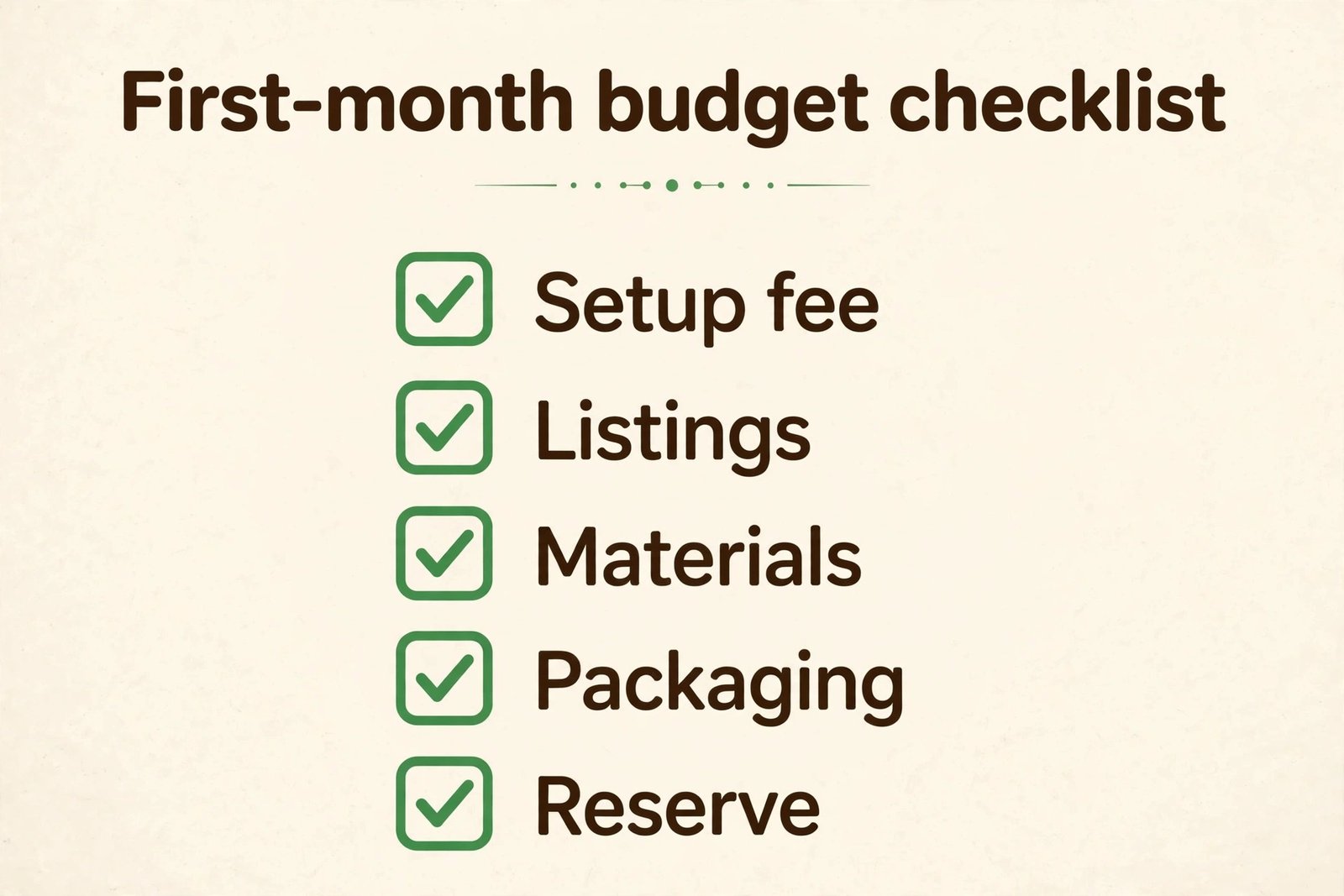
This overview-proof section shows the cost of starting an Etsy shop in three scenarios, and it is designed to be copied into a spreadsheet and adjusted to your own prices. The three scenarios below assume United States Etsy rates, a one-time setup fee at the midpoint of the commonly reported range, and no Etsy Ads spend in the lean scenario. Adjust the setup fee to the figure Etsy shows you, and adjust materials and packaging to your product. The totals are cash outlay in month one, not profit, and they exclude your own time, which is the largest cost for most makers and should be tracked separately even when it is not paid in cash.
| First-month line | Lean digital launch | Balanced handmade launch | Stocked physical launch |
|---|---|---|---|
| One-time setup fee, planning figure | 20 dollars | 20 dollars | 20 dollars |
| Listing fees, opening listings | 20 listings at 0.20 dollars, total 4 dollars | 20 listings at 0.20 dollars, total 4 dollars | 50 listings at 0.20 dollars, total 10 dollars |
| Materials or product cost, first run | 0 dollars, files already made | 120 dollars | 350 dollars |
| Samples, print on demand or product testing | 0 dollars | 25 dollars | 60 dollars |
| Photo backgrounds, props, and tripod | 0 dollars, phone and daylight only | 40 dollars | 60 dollars |
| Packaging for first orders | 0 dollars, digital delivery | 30 dollars | 60 dollars |
| Postage reserve for first orders | 0 dollars | 30 dollars | 60 dollars |
| Etsy Ads test budget | 0 dollars | 0 dollars | 90 dollars, at 3 dollars per day for 30 days |
| Optional subscriptions | 0 dollars | 0 dollars | 0 dollars, skip in month one |
| Total first-month cash outlay | 24 dollars | 269 dollars | 710 dollars |
Those totals tell a story that a single average hides. The lean digital launch costs less than a takeaway meal for two in many cities, but it only works if you already own a phone, a computer, and design tools, and if you are willing to spend the time to make twenty genuinely useful files. The balanced handmade launch at 269 dollars is the most common sensible starting point for a maker, because it funds materials, packaging, and a small postage reserve without betting the rent on unproven designs.
The stocked launch at 710 dollars is not a reckless number, but it should only be chosen when you have already validated demand, perhaps through pre-orders, a social audience, or sales on another channel, because 350 dollars of materials and 90 dollars of advertising are only justified by evidence, not by hope.
How to Choose Your Starting Budget
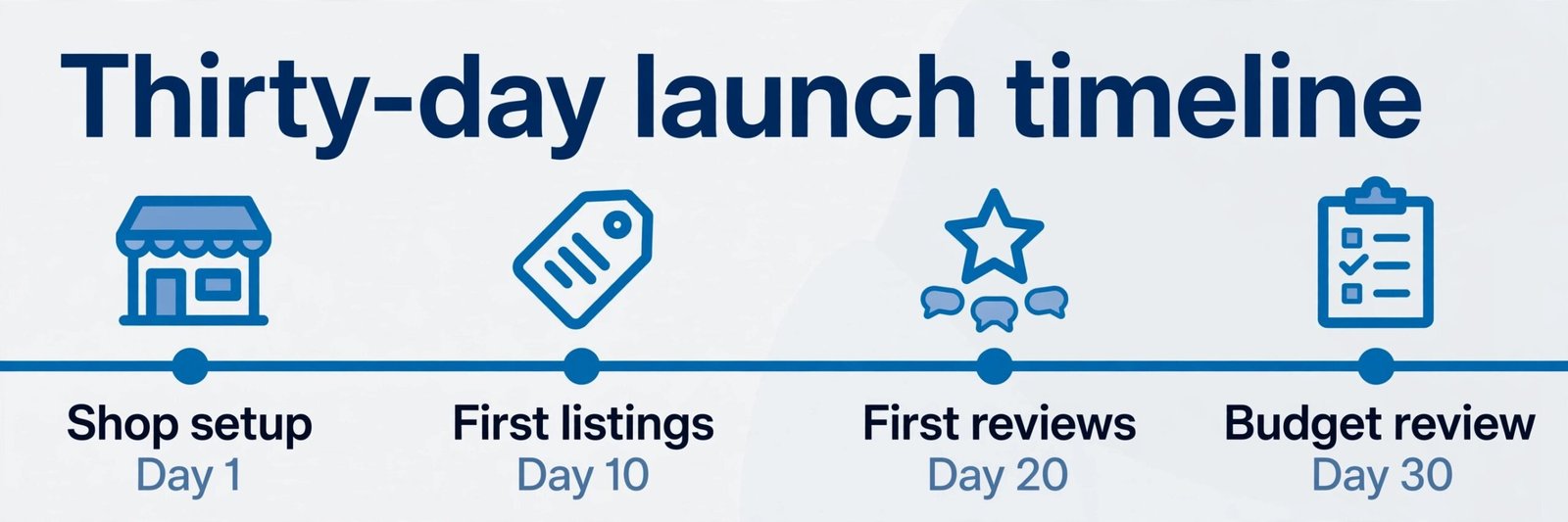
Choosing a budget starts with what you already own, not with what a guide tells you to buy, and that inventory is the fastest way to pin down the cost of starting an Etsy shop for your own product. List your existing assets first, meaning a phone with a good camera, a computer, design software, a printer, a workspace, and any materials already in the house. Every asset you already own is a line you can set to zero without cutting quality. Then list the gaps that actually block a launch, meaning no packaging, no product samples, or no materials for your best design.
Fund the gaps, not a shopping list of nice extras, and you will launch sooner with less waste.
Pricing So the Fees Do Not Eat the Profit
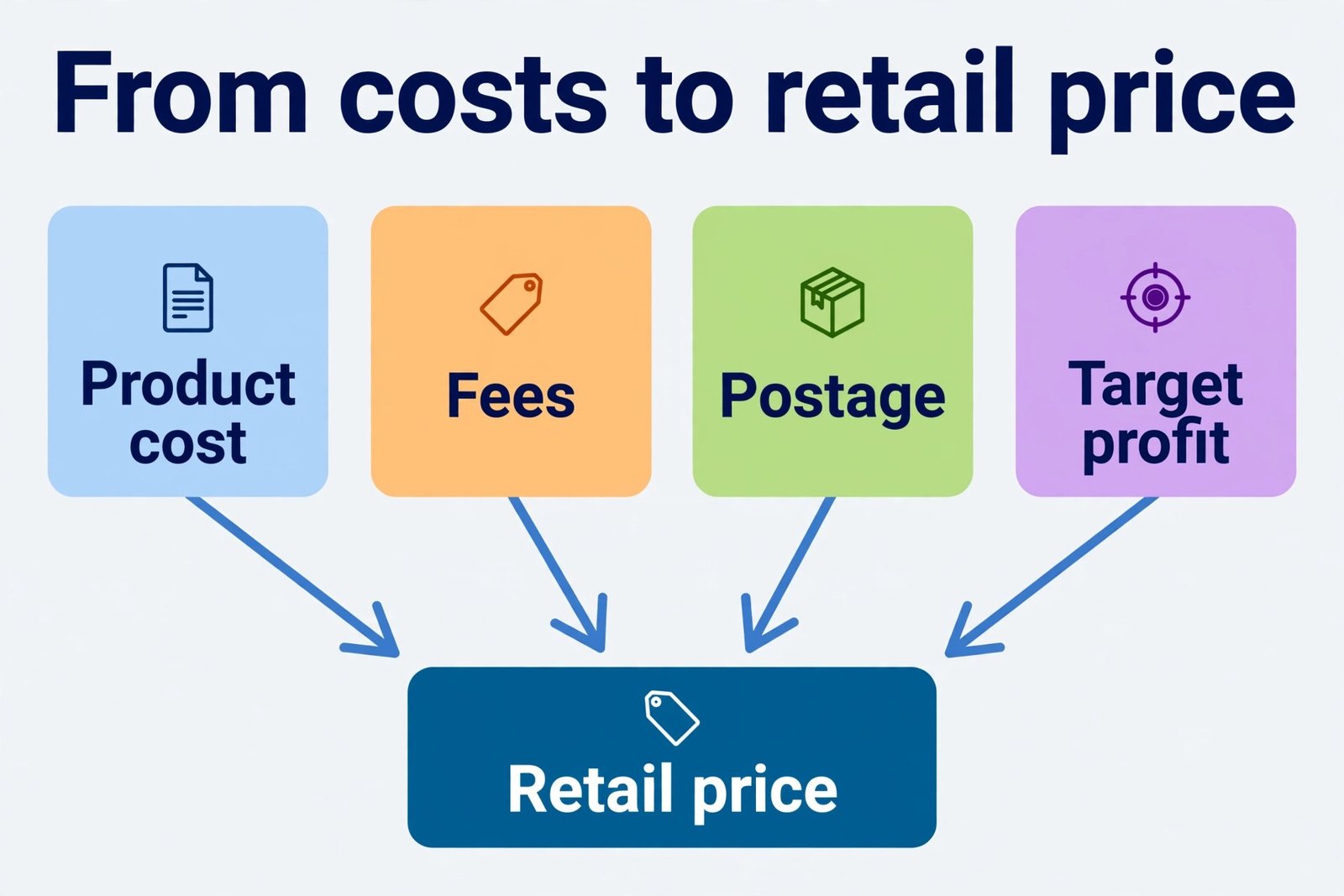
A simple pricing formula prevents most fee problems, and it is the step that turns the cost of starting an Etsy shop from a guess into a price you can defend. Start with product cost per unit, meaning materials, production, and packaging for a physical item, or amortised design and asset costs for a digital item. Add actual postage per order if you do not charge the buyer separately, or add the postage shortfall if the buyer charge is lower than the real postage. Add a target profit per unit that reflects your time and the risk of returns and advertising.
Then divide by one minus the fee rate, using about 0.905 for the combined transaction and processing percentages, and add the fixed charges separately in a spreadsheet check. That formula gives you a retail price that already contains the fees, rather than a price that looks good and then loses a tenth to fees you forgot.
Etsy Ads, Offsite Ads, and Outside Traffic Compared
Advertising on Etsy comes in two forms that behave very differently, and confusing them is expensive. Etsy Ads is the system you control, where you set a daily budget, choose which listings to promote, and pay for clicks. The minimum daily budget is 1.00 dollar, and Etsy’s own help page notes that a small budget buys few clicks in competitive categories, so a test budget of 3 to 5 dollars per day gives more useful data than the minimum alone. You can read the setup steps on Etsy’s Ads help page.
Offsite Ads is the system Etsy controls, where Etsy shows your listings on other sites, and you pay only when an attributed sale happens, at 15 percent under the threshold and 12 percent above it. You cannot choose which orders are attributed, and you cannot set a daily cap on Offsite Ads in the same way, which is why margin matters so much for that fee.
Mistakes That Inflate the Cost of Starting an Etsy Shop
The first mistake is launching with fifty listings before any of them are good. Listing fees for fifty listings are only 10 dollars, so the cash cost looks tiny, but the time cost of fifty rushed listings is large, and the search cost is larger, because fifty weak listings teach Etsy little about which of your products buyers want. Launch with your best twenty, learn from their views and sales, and add the next ten only when the first twenty are photographed, titled, and priced properly.
The second mistake is pricing from competitor prices alone without running your own fee maths. A competitor selling a similar item for 18 dollars may have lower material costs, a different shipping deal, or a volume that makes a thin margin workable. Your price must cover your fees, your materials, your postage, and your time, even if that means your price is higher than the cheapest competitor. Competing on price alone in a marketplace full of makers is a race to the bottom, while competing on quality, photography, and clear listing information lets you charge a price that sustains the shop.
The third mistake is turning on every advertising option on day one. Etsy Ads on unproven listings, Offsite Ads left on for thin margin products, and outside paid traffic to a shop with no reviews can burn a month of budget in a week without teaching you anything except that advertising does not fix a listing problem. Fix the listing first, prove conversion with organic traffic, and then add one advertising channel at a time with a fixed test budget and a review date.
For sellers who want to compare Etsy with a standalone store before committing, related reading includes Shopify versus Etsy, and for sellers who want tool help with photos and listings, best AI tools for Etsy sellers and best Etsy SEO tools cover the options without pushing a paid tool on day one. If your product is print on demand, how to start a print on demand business with AI explains the sample and quality steps in more detail, and best AI tools for ecommerce product photos is useful when your phone photos need a cleaner background or a consistent look.
Frequently Asked Questions
Is opening an Etsy shop free?
Opening a standard shop carries no monthly subscription charge, but most new sellers are shown a one-time setup fee during creation, commonly reported between about 15 and 29 dollars depending on location, and every listing costs 0.20 dollars to publish. The shop itself does not charge a monthly fee to stay open, while optional subscriptions such as Etsy Plus and Pattern are separate choices.
What is the cost of starting an Etsy shop for a digital seller?
A lean digital launch usually costs about 24 dollars in first-month cash, assuming a setup fee of about 20 dollars, twenty listings at 0.20 dollars each, and tools you already own for design and photos. The larger cost is time, because twenty useful digital files, with good preview images and clear descriptions, take real work to make well, even when the cash outlay is small.
How much does Etsy take from a typical sale?
On a typical United States sale without Offsite Ads, Etsy takes 6.5 percent as a transaction fee plus 3 percent plus 0.25 dollars as payment processing, plus a 0.20 dollar listing fee, which together come to about 10 to 12 percent depending on price. On a 30 dollar order, that is 3.30 dollars in Etsy fees, leaving 26.70 dollars before product costs, packaging, and postage.
Can I opt out of Offsite Ads?
Yes, if your shop has made under 10,000 dollars in sales in any 365 day period, you can opt out in Shop Manager. Once your shop reaches that threshold, participation becomes mandatory for the life of the shop at the lower 12 percent rate, capped at 100 dollars per order. If your margins cannot absorb 15 percent on an attributed order, opting out while you are under the threshold is a sensible early choice.
Do I need Etsy Plus or Pattern to start?
No. Both are optional subscriptions, at 10 dollars per month for Etsy Plus and 15 dollars per month for Pattern in published listings, and neither is required to open or run a standard shop. Skip both in month one, and add them later only when a specific feature, such as listing credits you will actually use or a standalone site you will actually promote, justifies the monthly cost.
How much should I budget for Etsy Ads in month one?
Budget zero in month one if you have no organic sales yet, because advertising an unproven listing rarely fixes a photo, title, or price problem. If you test ads after a few organic sales, a budget of 1 to 3 dollars per day on two or three proven listings, sustained for 30 days, gives you enough data to judge profit per sale after fees. New shops may also face a 15 day wait before Etsy Ads becomes available, so use that period to improve listings.
Open Small, Price Honestly, Then Scale on Proof
The cheapest way to understand the cost of starting an Etsy shop is not the shop with the lowest first bill. It is the shop that opens with twenty strong listings, prices that already contain every fee, packaging that protects the product, and a budget that leaves a reserve for the first surprise. That shop can survive a quiet first week without panic, because its costs are known, its margins are honest, and its next spend is tied to evidence rather than hope.