

Eighty two percent of small businesses now use AI tools, according to the Small Business and Entrepreneurship Council 2026 survey of small business technology use, and ninety three percent of those businesses see enough value to keep using them. The gap is no longer between businesses that use AI and businesses that do not. It is between businesses that use AI with a plan and businesses that bought five subscriptions and still post at random. A small business ai marketing strategy is the difference, and it costs less than most owners expect.
The numbers behind the plan are encouraging. Marketers using AI tools save an average of 6.1 hours a week, according to HubSpot AI Trends research from 2026, and a complete AI marketing stack for a small team costs 80 to 200 dollars a month in 2026, with a starter stack under 100 dollars. Email marketing still returns 36 to 42 dollars for every dollar spent, which makes it the highest returning channel a small business owns. None of these figures require a marketing department. They require a routine, three or four tools, and a clear job for each one.
This guide builds that routine in ninety days, with a budget, a tool stack, and a weekly rhythm a team of one can actually keep. Prices come from vendor pricing pages and independent comparisons checked in late 2026, so check the vendor pricing page before committing, because AI tool prices move fast. The plan assumes a team of one to five people, a monthly budget under 200 dollars, and no marketing hire, because that is the reality for most small businesses.
What a Small Business AI Marketing Strategy Looks Like in 2026
A strategy is not a list of tools. It is a set of decisions about who you serve, what you say to them, where you say it, and how you know it worked. AI changes the cost of each decision, not the decisions themselves. A chat tool drafts in minutes what used to take an afternoon, a design tool makes a graphic in seconds, and an automation tool moves a lead from a form to a follow up email while you sleep. The thinking still belongs to the owner, and the tools do the typing.
The shape of a good strategy for a small team has four parts. First, one clear audience and one clear offer, because AI multiplies whatever you feed it, and a vague message multiplied is still vague. Second, one content habit that repeats weekly, usually a short post and one email, because consistency beats campaigns. Third, one automation that follows up every lead the same day, because speed of reply wins more business than any ad. Fourth, one number reviewed weekly, such as leads, bookings, or sales, because a strategy without a number is a hope.
The tools map onto those four parts cleanly. A chat assistant handles drafting and thinking. A design tool handles visuals. An email platform handles the list and the follow up. An automation tool connects them. A small business that buys one tool per job, learns each one properly, and reviews the number weekly will outperform a business that buys ten tools and uses none of them well. Two or three tools used well beat ten used poorly, and that rule should govern every purchase in this guide.
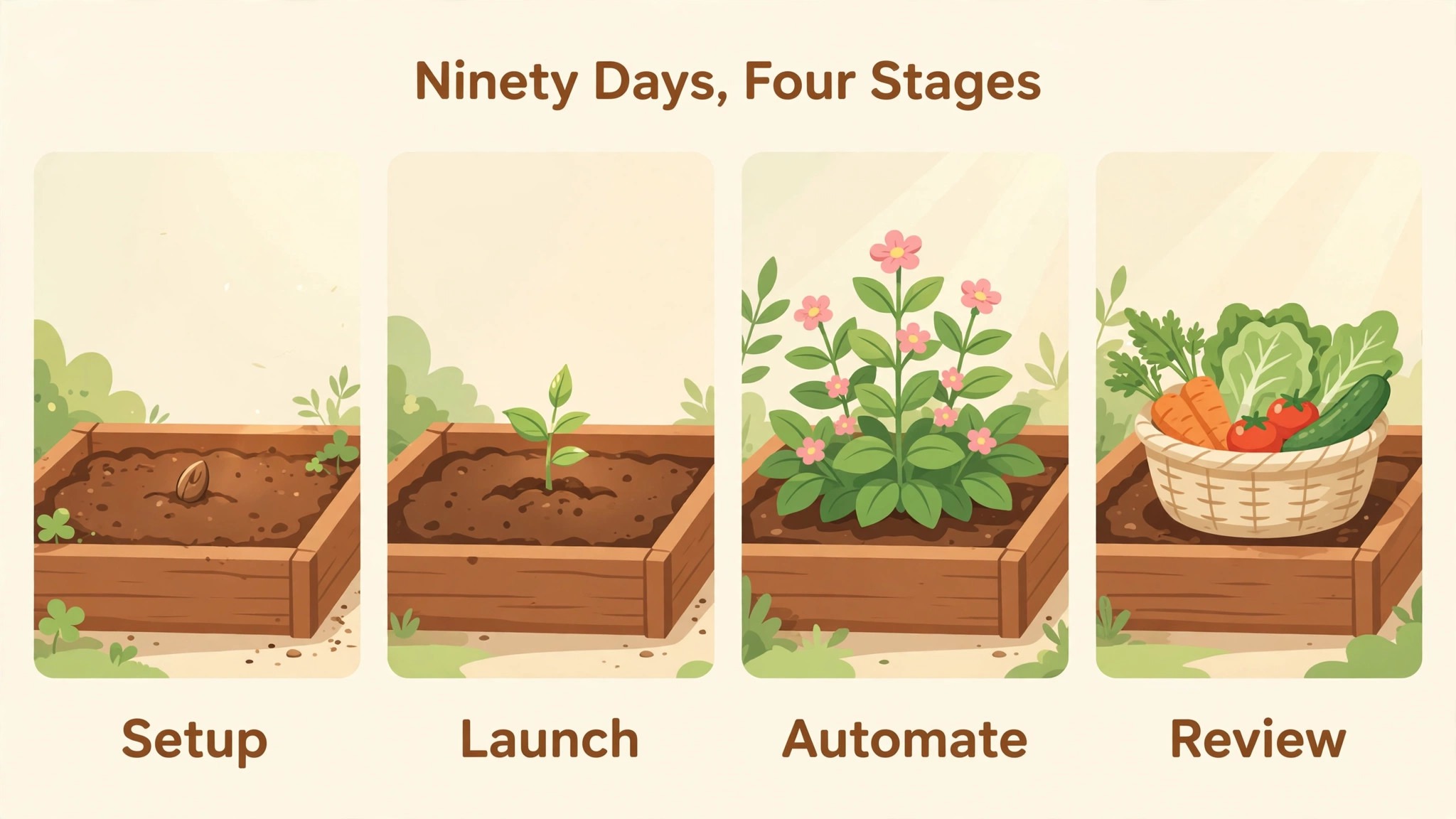
The 90 Day Plan
| Phase | Weeks | Main job | Done looks like |
|---|---|---|---|
| Set up | 1 to 2 | Audience, offer, tools | One page describing the customer and the offer |
| Launch | 3 to 6 | First content habit | Four posts and four emails sent on schedule |
| Automate | 7 to 10 | Lead follow up | Every lead gets a reply within one hour |
| Review | 11 to 13 | Measure and adjust | One number tracked weekly, one change made |
The first two weeks are thinking weeks, and they decide everything that follows. Write one page that names the customer, the problem you solve, the offer, and the price, in plain words a stranger would understand. Then pick the tools, one chat assistant, one design tool, one email platform, and set them up with your brand voice, your logo, and your colours. A strategy built on a vague customer will produce vague content no matter how good the AI is, so the thinking week is the most valuable fortnight in the whole plan.
Weeks three to six are launch weeks, and the goal is a habit, not a hit. Publish two short posts a week and send one email a week, using AI to draft and a human to edit. The drafts will be rough at first, and that is normal, because the AI does not know your customers yet. Feed it your best past emails, your most common customer questions, and the exact words customers use, and the drafts improve every week. By week six, the habit should feel routine rather than heroic.
Weeks seven to ten are automation weeks. Connect the website form to the email platform, so every lead gets an immediate reply and a follow up sequence over the next week. Add a simple rule, so a lead who opens the email gets a different next message from one who does not. Test the whole flow yourself, from form to inbox, and fix anything that feels robotic. Automation should feel like a helpful shop assistant, not a machine, and the test is whether you would be happy receiving it.
Weeks eleven to thirteen are review weeks. Look at the one number you chose, leads, bookings, or sales, and compare it with the thirteen weeks before the plan started. Keep the channel that moved the number, drop the channel that did not, and make one change to the plan for the next quarter. A small business ai marketing strategy that never gets reviewed becomes a habit that nobody questions, and habits that nobody questions slowly stop working.
The Starter Stack Under 100 Dollars
| Tool | Job | Price |
|---|---|---|
| ChatGPT Plus or Claude Pro | Writing, research, drafts | 20 dollars a month |
| Canva Pro | Design, social graphics, headers | 13 dollars a month |
| Brevo | Email, automation, list | Free up to 300 emails a day |
| Buffer | Social scheduling | Free for 3 channels |
| Zapier Starter | Connect form to email to CRM | 20 dollars a month |
The starter stack costs around 53 dollars a month, and it covers the whole routine. A chat assistant at 20 dollars is the best value spend for any small team, because it drafts, researches, plans, and repurposes, and a solo founder who pairs it with Canva Pro can write, design, and post without hiring anyone. Brevo free plan is genuinely generous, with unlimited contacts, 300 emails a day, and multi step automation, which makes it the right email home for a business starting out.
The full stack, for a team ready to spend more, runs about 150 to 165 dollars a month. It adds an SEO tool such as Surfer SEO from 89 dollars a month, or an Ahrefs Lite plan, plus a workflow automation tool such as Make from 9 dollars a month. That spend only makes sense once the starter stack is working, because an SEO tool cannot fix a business that has no content habit, and automation cannot fix a follow up that nobody wrote. Spend the first 53 dollars, prove the routine, and add the rest when the routine earns it.
The rule for every addition is one tool per job, and a clear job description before purchase. If you cannot write one sentence saying what the new tool does that the old stack cannot, do not buy it. Small teams lose more money to overlapping subscriptions than to any single expensive tool, and the overlap is invisible until someone audits the card statement. Audit the stack every quarter, cancel anything unused for a month, and the budget stays honest.

Content, the First Job AI Should Take
Content is the first job to give AI, because it is the job where AI saves the most time with the least risk. A chat assistant can turn one customer question into a post, an email, and three social captions in ten minutes, and a human editor can then fix the tone, check the facts, and add the specific detail only the owner knows. The workflow is draft with AI, edit with a human, and publish with confidence, and it cuts a half day of writing into an hour.
The quality rule is simple, and it protects the brand. AI drafts, humans decide. Never publish an AI draft without reading it, because AI invents facts, smooths over the specific detail that made your business different, and writes in a voice that sounds like every other business using the same tool. Feed the AI your own words, your customer questions, your prices, and your stories, and the output starts to sound like you. Feed it nothing, and it sounds like nobody.
A practical content rhythm for a small team is two short posts a week and one email a week, all built from the same weekly idea. Monday, pick the idea from a customer question. Tuesday, draft the post with AI and edit it by hand. Wednesday, publish the post and turn it into an email. Thursday, answer the replies and note the next question. That rhythm produces about a hundred pieces of content a year, which is enough to be found, remembered, and trusted, without hiring a writer or burning out the owner.
Email, Where the Money Actually Is
Email is the channel small businesses undervalue most, and the numbers explain why they should not. Email returns 36 to 42 dollars for every dollar spent, which beats paid search and social advertising by a wide margin, and the reason is simple. An email list is an audience you own, while a social following is an audience you rent from a platform that can change the rules tomorrow. A business with a thousand email subscribers has a thousand people it can reach for the cost of sending, while a business with a thousand followers reaches a fraction of them on any given day.
The AI job in email is drafting and timing, not strategy. Use the chat assistant to draft the weekly email from the same idea as the weekly post, then edit it by hand until it sounds like a person wrote it to another person. Use the email platform built in AI to test subject lines, optimise send time, and suggest improvements against past performance. Brevo, Mailchimp, and HubSpot all bundle these features now, so the AI is already in the tool you pay for, and no separate purchase is needed.
The list grows through one simple mechanism, which is an offer worth an email address. A guide, a discount, a checklist, or a first consultation, offered on the website and at the counter, in exchange for an address. A small business that adds ten addresses a week has five hundred new subscribers in a year, and five hundred subscribers receiving a weekly email will produce more sales than any social campaign of the same effort. The list is the asset, and a small business ai marketing strategy that ignores the list is building on rented land.
Segment the list as soon as it passes a hundred people, because one message for everyone stops working early. Buyers get product news, browsers get education, and past customers get a different message from new leads. The email platform handles the segments, and the AI helps write each version, but the decision about who gets what is a human one. A list that receives relevant mail opens it. A list that receives generic mail unsubscribes, and an unsubscribed address is an asset lost.
Social and Video Without a Team
Social media is the channel where small businesses waste the most time, because it rewards constant presence and punishes sporadic effort. AI makes presence cheap, but it cannot make it meaningful on its own. A scheduler such as Buffer takes the weekly posts and sends them on time, while a design tool makes the graphics, and a chat assistant drafts the captions. The human job is replying to comments, which is where followers become customers, and no AI should do that job for you.
Video is the format that changed most in 2026, because AI editing tools turned a phone clip into a finished short in minutes. A tool such as Opus Clip, with a free plan and a Pro plan around 29 dollars a month, cuts long videos into short clips, adds captions, and picks the strongest moments automatically. A small business that records one honest video a week, answering a customer question on camera, and clips it into three shorts, will reach more people than a business posting polished graphics daily. The phone in your pocket is the studio, and the AI is the editor.
The rule for social is one platform done well, not five done badly. Pick the platform where your customers actually spend time, learn its rhythm, and post there consistently for ninety days before judging it. A restaurant belongs on Instagram, a consultant belongs on LinkedIn, and a trades business belongs where local customers search. AI can repurpose one piece of content for every platform, but repurposing a weak idea across five platforms multiplies weakness, not strength.
That single platform rule is the hardest part of a small business ai marketing strategy to keep, because every new platform looks like a missed opportunity. The discipline is to remember that your customers are not everywhere, they are somewhere, and the business that shows up in that somewhere every week will be remembered, while the business that posts everywhere once a month will be forgotten. Depth beats breadth until the first channel runs on routine.
Measuring What Worked
Measurement is the part of the plan most small businesses skip, and it is the part that makes the rest worth doing. Pick one number before you start, and make it a business number, not a vanity number. Leads, bookings, sales, or quote requests are business numbers. Followers, likes, and impressions are vanity numbers, and a strategy that chases them will look busy while the bank balance stays flat. One number, reviewed weekly, beats ten numbers reviewed never.
The weekly review takes twenty minutes and follows the same three questions every time. What did we publish, what happened, and what changes next week. Write the answers down in one document, so the learning compounds instead of evaporating. After a month, the document shows which topics bring enquiries and which bring silence, and that evidence is worth more than any expert opinion about what small businesses should post.
AI helps measurement by summarising the data, not by replacing judgement. Ask the chat assistant to summarise the month analytics into three plain sentences a non technical owner can read, and to suggest one change based on the pattern. Then decide yourself whether the suggestion fits your customers, because the AI cannot see the customer who walked in yesterday and mentioned the post that brought them. Data tells you what happened. The owner knows why, and a small business ai marketing strategy needs both halves to work.
Mistakes That Burn the Budget
The first mistake is buying too many tools before the routine exists. A business that spends 900 dollars a month on a marketing platform and uses eight percent of it has bought a cupboard, not a strategy. Start with the starter stack, prove the routine for a month, and add a tool only when a specific job keeps going undone. The tool that solves a real bottleneck earns its price. The tool bought because a demo impressed you does not.
The second mistake is letting AI write without a human reading. An AI draft that invents a price, a feature, or a customer story will damage trust faster than any slow week of posting, because customers remember the error long after they forget the post. Read every draft, check every fact, and keep a simple rule, which is that nothing goes out with a number in it unless a human checked that number. That rule costs a minute per post and saves the brand.
The third mistake is chasing every channel at once. A team of one cannot run Instagram, TikTok, LinkedIn, email, and a blog well, and trying to do so produces five mediocre channels instead of one good one. Pick one channel, do it well for ninety days, and add a second only when the first runs on routine. A small business ai marketing strategy that tries to be everywhere ends up being nowhere in particular, and customers remember the business that shows up consistently in one place.
The fourth mistake is measuring the wrong number. A business that celebrates follower growth while bookings fall is celebrating the wrong thing, and the celebration hides the problem until it is expensive to fix. Choose the business number before you start, review it weekly, and let it overrule your feelings about which posts were good. The post you loved may have sold nothing, and the post you thought was boring may have brought three enquiries. The number knows, and your taste does not.
The Content Calendar That Runs Itself
A content calendar sounds like corporate paperwork, but for a small team it is simply a list of next week ideas, written down before Monday arrives. The calendar has four columns, the date, the idea, the format, and the customer question it answers. Fill it on Friday afternoon for the next week, using the questions customers asked that week, and Monday starts with a plan instead of a blank screen. A calendar built from real questions never runs out of ideas, because customers keep asking new ones.
AI fills the calendar faster than a human can, but the human must still choose. Ask the chat assistant to turn one customer question into five post ideas, then pick the two that fit your customers best and discard the rest. The discarded ideas are not wasted, they go back into the list for a quiet week, and the list grows every month. After a quarter, the calendar holds dozens of proven ideas, and the Monday blank screen never appears again.
Repurposing is what makes the calendar cheap to run. One idea becomes a post, an email, and three short captions, because the same customer question deserves an answer in every place the customer looks. The chat assistant does the reformatting in minutes, the human edits each version for its format, and the week content comes from a single hour of thinking. A small business ai marketing strategy that repurposes well produces three times the content for the same thinking time, and that is the real return on the AI spend.
The Weekly Routine
Use this routine every week, and keep it to five hours or less. The point is a system a team of one can sustain for a year, not a heroic week that collapses in February.
1. Monday, pick one customer question and draft the week content with AI. 2. Tuesday, edit the drafts by hand, check every fact, and design the graphics. 3. Wednesday, publish the post and send the weekly email to the list. 4. Thursday, reply to every comment and message personally, and note the next question. 5. Friday, review the one number, write down what worked, and plan next week.

Related Guides
Keep exploring with these guides on Stratilyze:
- Retention Marketing Strategy Small Business
- Launch Marketing Strategy Small Business
- Webinar Marketing Strategy for a Small Service Business
Frequently Asked Questions
How much should a small business spend on AI marketing tools?
A realistic starting budget is 60 to 150 dollars a month, covering one AI writing tool at 20 dollars, an email platform at 10 to 30 dollars, and a design tool at about 13 dollars. A starter stack of a chat assistant, Canva Pro, Brevo free, and Buffer free costs around 53 dollars a month. Add automation software once the routine is proven manually, not before, and audit the stack every quarter to cancel anything unused.
Which AI tool should a small business start with?
Start with a chat assistant, either ChatGPT Plus or Claude Pro at 20 dollars a month, paired with Canva Pro at about 13 dollars a month. That pair covers writing, research, planning, and design, which is most of what a small marketing team does every day. Add an email platform next, then a scheduler, and only then consider SEO or automation tools. One tool per job, learned properly, beats a shelf of subscriptions.
Can AI replace a marketing person for a small business?
No, and any tool that promises that is selling a fantasy. AI is strong at execution, drafting, editing, and speeding up production, but weak at strategy, positioning, and understanding your specific customers. The owner still decides who the customer is, what the offer is, and whether a draft sounds like the business. AI does the typing. The thinking stays human, and a strategy that forgets that produces content nobody remembers.
How long before an AI marketing strategy shows results?
Expect the routine to feel normal after six weeks and the numbers to move after ninety days. Content compounds slowly, email lists grow by ten addresses a week, and search results take months, so a strategy judged after two weeks will always look like a failure. Commit to ninety days, review the one business number weekly, and make one change per quarter based on the evidence. Patience is part of the strategy, not a delay to it.
What is the best AI marketing tool for a solo founder?
A chat assistant at 20 dollars a month, paired with Canva Pro, is the best starting point for a solo founder, because between the two a single person can write, design, and post without hiring anyone. Add Brevo free for email, which covers 300 emails a day with unlimited contacts, and the whole stack costs about 33 dollars a month. That combination saves the most time for the least money, which is the definition of return on investment for a team of one.
How do I keep AI content from sounding robotic?
Feed the AI your own words, and edit every draft by hand before publishing. Give it your best past emails, the exact questions customers ask, and the specific details only you know, and the output starts to sound like your business. Read every draft aloud, cut any sentence you would never say to a customer, and check every number yourself. AI drafts, humans decide, and that rule is what keeps the content sounding like a person wrote it.
Should I use AI for customer replies and comments?
No, not for the reply itself. Customers can tell when a reply was written by a machine, and a machine reply to a real complaint reads as indifference. Use AI to draft a first version if you are stuck, then rewrite it in your own words before sending. The reply is where trust is built or lost, and trust is the one job that should never be automated, because a customer who feels heard comes back, and a customer who feels handled by a machine does not.
A Final Word Before You Start
Start this week, with one customer question, one chat assistant, and one email. Write the page that names your customer and your offer, set up the starter stack for about 53 dollars a month, and publish twice a week for ninety days. Review the one business number every Friday, keep the channel that moves it, and drop the channel that does not.
The businesses that win with AI in 2026 are not the ones with the biggest budgets. They are the ones with the clearest routine, the most consistent habit, and the patience to let ninety days of steady work compound into results that a single campaign could never buy. A small business ai marketing strategy is not a purchase. It is a routine, and a routine kept for ninety days will do more for your business than any tool you could buy tomorrow.